Social Media Marketing


Creating Cross-Platform
     Engagement


      Kathryn McMann Consultancy
      @KathrynMcMann
      www.kathrynmcmann.com
What Social Media can do for your business

• Build communities across multiple platforms (on and offline) turning loyal
  customers into fans and brand advocates
• Reach across Global Markets
• Enable personable customer support and invaluable market research and feedback
• Cost-effective skills-based recruitment
• Provide consumer insight and user demographics
• Generate awareness as well as advertising and promotion
• Establish your authority in your area of expertise - thought leadership
• Crisis Management
How do you get ‘their’ attention?

•   Provide valuable content
•   Regularly and actively engage with multiple niche communities
•   Ensure the technology is in place and works (share buttons, links, RSS feeds)
•   Optimizing media – SMO (Social Media Optimization) Your popularity increases
    search ranking results across all community driven sites. (hashtags, SEO, keywords
    and back links)
Ways a brand can engage and interact with their audience:

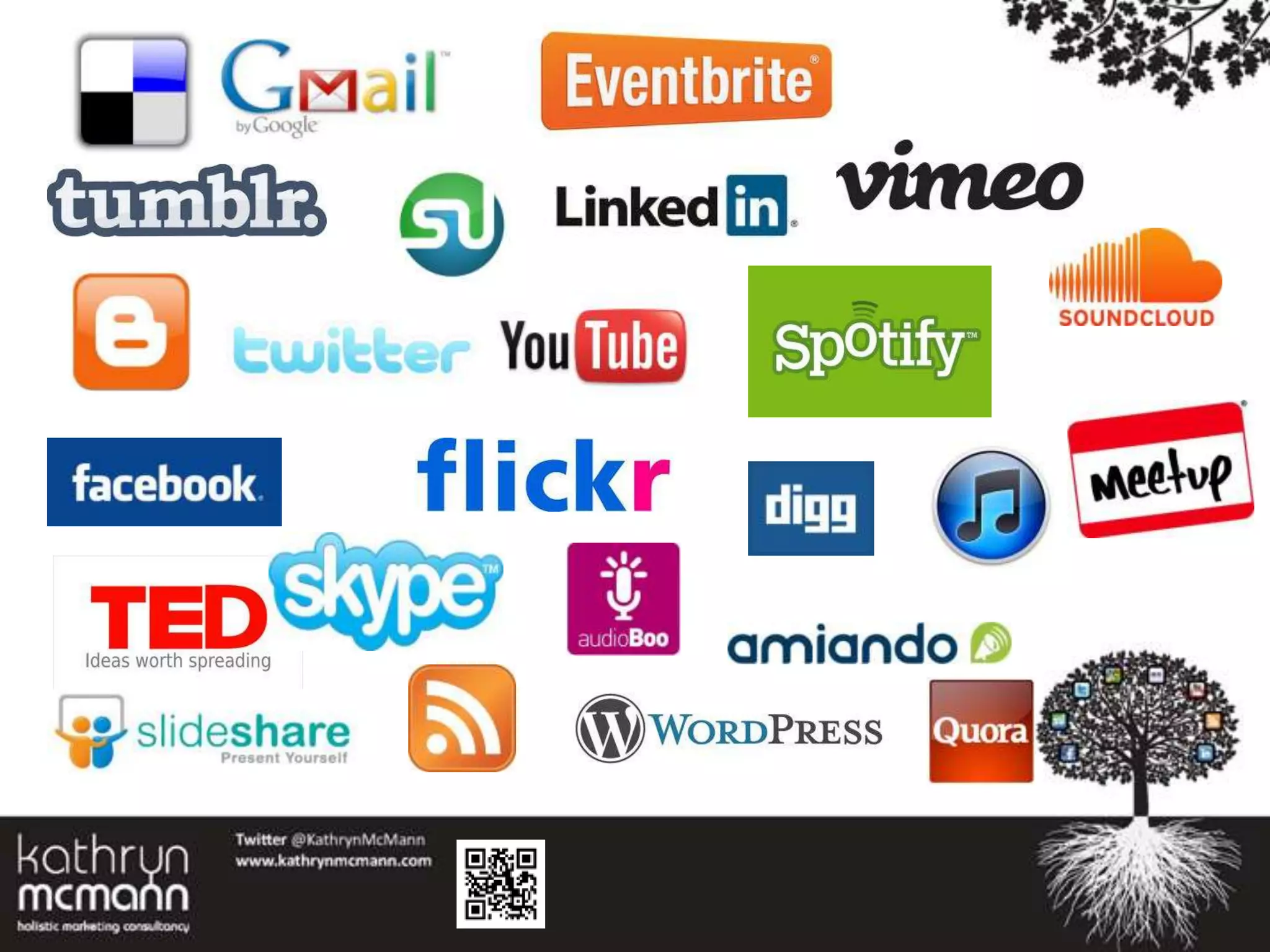
•   Social Networks (Facebook,          •   Social bookmarking (Delicious, Digg)
    LinkedIn)                           •   News Aggregation (Facebook,
•   Niche topic forums (knitting)       •   Wikis
                                        •   Geo mapping (Foursquare, Gowalla)
•   Micro-blogging (twitter)
                                        •   Audio sharing (Soundcloud, Spotify)
•   Blogs and RSS feeds (Wordpress,     •   Social Gaming (Farmville, World of Warcraft)
    Blogger)                            •   Search Engine Recommendations (Google+,
•   Brand specific forums (Porsche)         SEO)
•   Photo sharing (Flickr, Pinterest)   •   Ebooks and whitepapers (Scribd, Issuu)
•   Video sharing (Youtube, Vimeo,
    Ustream)
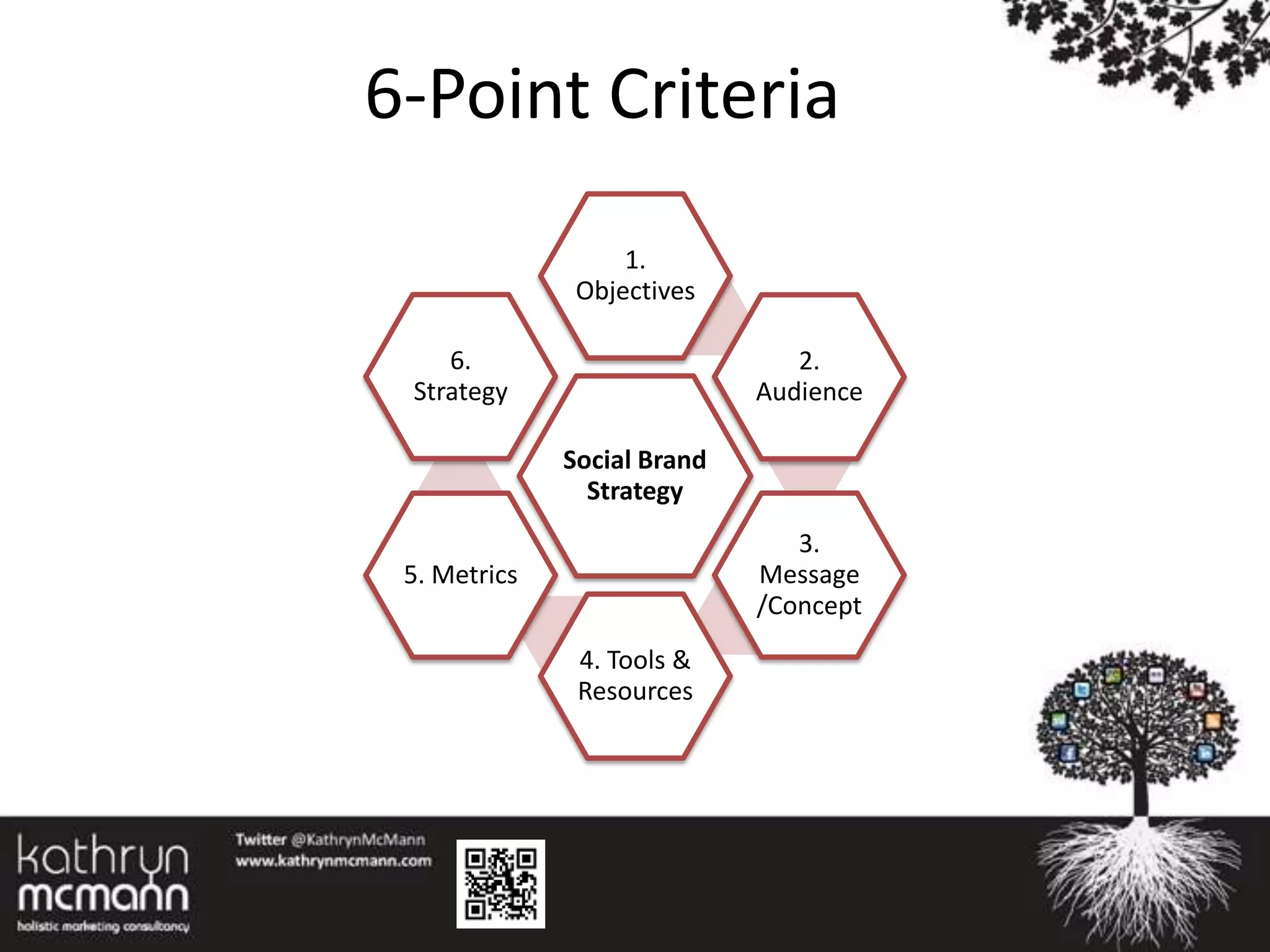
6-Point Criteria
                   1.
               Objectives

    6.                          2.
 Strategy                    Audience

              Social Brand
                Strategy
                                3.
 5. Metrics                  Message
                             /Concept
               4. Tools &
               Resources
1. Objectives
Start by asking
• Who you are
• why your creating a social business strategy
• And what you want to offer.
Rooted in core brand principles
- Define – your brand identity - brand voice (tonality) – brand personality
- Create brand social Guidelines – what you can and can’t do.
2. Audience
Who are you aiming at?
Who is your audience?
Segment demographics Profiling –keep refining them until you are happy.

Consider Key Industry Influencers: The top 100
3. Concept / Message
Message – brand -> media ->platform -> unique approach

•   Consider your content to be used across a range of platforms
•   Tailor your message for the medium
•   A good concept travels across all different media, threading them together
    seamless

Content Curation
• It is about where it is as much as what it is. SMO = SEO + popularity +
   community driven site
• Consider keywords, hashtags, repetition, backlinks, SEO, analytics into the mix
• Consider whether you would be interested in your content?
   Does it inform? Intrigue? Inspire? Engage ?
4. Tools and Resources
Tools = Online applications and social networks of kinds, physical events, word
of mouth, traditional PR and marketing activity.
• Use and get to know your tools capabilities

Resources = People, time, offline equipment, collective knowledge base
• Understand your limits as well as capabilities

Work within your boundaries. If you over-extend your resources at the
beginning you will let down your community, your network and the trust you
had spent time building up . Be realistic.
5. Metrics
Start by asking what you want to achieve
Know your tools
Where do they offer value? influence and reach?
1 - Divide your tracking into Mentions and sentiment – then
2 - Resonance, sharing (includes retweets), and intent.

Create regular measurement benchmarks to ensure your strategy is working
and if its not you are able to adapt it immediately.

Measure your progress:
Twitter Search https://twitter.com/#!/search-home
Follower Wonk http://followerwonk.com/
Twitter Count http://twittercounter.com/
Board Tracker http://www.boardtracker.com/
Klout & Peer Index
6. Strategy
Putting it all together
• Build the metrics and benchmarks into the strategy
• Communicate the strategy all the stakeholders and team members.
• Create Static Guidelines to be able to adapt and act in real-time.
• It takes time to create content . Factor this in.
Content & Curation:
• Be constructive, informative, supportive, educational, personal and creative
• Create content for many mediums (video, audio, whitepapers, and more), to
   be embedded within community driven platforms (with high SEO ranking.)
• Consumers are interested in content, not keywords. Reuse keywords for all
   your content to climb to the top of your specialist subject
• Ensure all technology connects (links, buttons , widgets)
Remember
DO:
- Start with who, why and what you want to contribute.
- Be an active listener and offer valuable content, don’t project.
- Be realistic and assess your resources and tools before starting anything
- Include SMO into your strategy to support your efforts and increase your
  search ranking
- Research , plan and communicate to your entire team. It affects them all.

DON’T
- Add to the noise – be constructive, informative, supportive, educational,
  personal
- Don’t - Ignore your audience whatever you do! They’ve invested their
  time in you by signing up to your page, or helping retweet your content.
  Invest in them back.
Any questions?
Next Steps
Create your own strategy
Set up your accounts
Download the apps and start engaging with your audience


Manage the apps (as well as measure)

Tweetdeck http://www.tweetdeck.com/
Hootsuite http://hootsuite.com
Now lets give it a go.
Kathryn McMann
Kathryn McMann Consultancy
Holistic and Social Media Consultancy
Tel: 0330 111 0630
www.KathrynMcMann.com
Twitter: @KathrynMcMann
Scribd: Kathryn McMann

Creating Cross Platform Engagement

  • 1.
    Social Media Marketing CreatingCross-Platform Engagement Kathryn McMann Consultancy @KathrynMcMann www.kathrynmcmann.com
  • 2.
    What Social Mediacan do for your business • Build communities across multiple platforms (on and offline) turning loyal customers into fans and brand advocates • Reach across Global Markets • Enable personable customer support and invaluable market research and feedback • Cost-effective skills-based recruitment • Provide consumer insight and user demographics • Generate awareness as well as advertising and promotion • Establish your authority in your area of expertise - thought leadership • Crisis Management
  • 4.
    How do youget ‘their’ attention? • Provide valuable content • Regularly and actively engage with multiple niche communities • Ensure the technology is in place and works (share buttons, links, RSS feeds) • Optimizing media – SMO (Social Media Optimization) Your popularity increases search ranking results across all community driven sites. (hashtags, SEO, keywords and back links)
  • 5.
    Ways a brandcan engage and interact with their audience: • Social Networks (Facebook, • Social bookmarking (Delicious, Digg) LinkedIn) • News Aggregation (Facebook, • Niche topic forums (knitting) • Wikis • Geo mapping (Foursquare, Gowalla) • Micro-blogging (twitter) • Audio sharing (Soundcloud, Spotify) • Blogs and RSS feeds (Wordpress, • Social Gaming (Farmville, World of Warcraft) Blogger) • Search Engine Recommendations (Google+, • Brand specific forums (Porsche) SEO) • Photo sharing (Flickr, Pinterest) • Ebooks and whitepapers (Scribd, Issuu) • Video sharing (Youtube, Vimeo, Ustream)
  • 6.
    6-Point Criteria 1. Objectives 6. 2. Strategy Audience Social Brand Strategy 3. 5. Metrics Message /Concept 4. Tools & Resources
  • 7.
    1. Objectives Start byasking • Who you are • why your creating a social business strategy • And what you want to offer. Rooted in core brand principles - Define – your brand identity - brand voice (tonality) – brand personality - Create brand social Guidelines – what you can and can’t do.
  • 8.
    2. Audience Who areyou aiming at? Who is your audience? Segment demographics Profiling –keep refining them until you are happy. Consider Key Industry Influencers: The top 100
  • 9.
    3. Concept /Message Message – brand -> media ->platform -> unique approach • Consider your content to be used across a range of platforms • Tailor your message for the medium • A good concept travels across all different media, threading them together seamless Content Curation • It is about where it is as much as what it is. SMO = SEO + popularity + community driven site • Consider keywords, hashtags, repetition, backlinks, SEO, analytics into the mix • Consider whether you would be interested in your content? Does it inform? Intrigue? Inspire? Engage ?
  • 10.
    4. Tools andResources Tools = Online applications and social networks of kinds, physical events, word of mouth, traditional PR and marketing activity. • Use and get to know your tools capabilities Resources = People, time, offline equipment, collective knowledge base • Understand your limits as well as capabilities Work within your boundaries. If you over-extend your resources at the beginning you will let down your community, your network and the trust you had spent time building up . Be realistic.
  • 11.
    5. Metrics Start byasking what you want to achieve Know your tools Where do they offer value? influence and reach? 1 - Divide your tracking into Mentions and sentiment – then 2 - Resonance, sharing (includes retweets), and intent. Create regular measurement benchmarks to ensure your strategy is working and if its not you are able to adapt it immediately. Measure your progress: Twitter Search https://twitter.com/#!/search-home Follower Wonk http://followerwonk.com/ Twitter Count http://twittercounter.com/ Board Tracker http://www.boardtracker.com/ Klout & Peer Index
  • 12.
    6. Strategy Putting itall together • Build the metrics and benchmarks into the strategy • Communicate the strategy all the stakeholders and team members. • Create Static Guidelines to be able to adapt and act in real-time. • It takes time to create content . Factor this in. Content & Curation: • Be constructive, informative, supportive, educational, personal and creative • Create content for many mediums (video, audio, whitepapers, and more), to be embedded within community driven platforms (with high SEO ranking.) • Consumers are interested in content, not keywords. Reuse keywords for all your content to climb to the top of your specialist subject • Ensure all technology connects (links, buttons , widgets)
  • 13.
    Remember DO: - Start withwho, why and what you want to contribute. - Be an active listener and offer valuable content, don’t project. - Be realistic and assess your resources and tools before starting anything - Include SMO into your strategy to support your efforts and increase your search ranking - Research , plan and communicate to your entire team. It affects them all. DON’T - Add to the noise – be constructive, informative, supportive, educational, personal - Don’t - Ignore your audience whatever you do! They’ve invested their time in you by signing up to your page, or helping retweet your content. Invest in them back.
  • 14.
  • 15.
    Next Steps Create yourown strategy Set up your accounts Download the apps and start engaging with your audience Manage the apps (as well as measure) Tweetdeck http://www.tweetdeck.com/ Hootsuite http://hootsuite.com
  • 16.
    Now lets giveit a go.
  • 17.
    Kathryn McMann Kathryn McMannConsultancy Holistic and Social Media Consultancy Tel: 0330 111 0630 www.KathrynMcMann.com Twitter: @KathrynMcMann Scribd: Kathryn McMann

Editor's Notes

  • #4 Already lots of noise, add value. Think Niche community interests within larger communities.