Media Objectives, Strategies and Planning
Major Factors
in Creating and
Building
a Media Plan
Media Questions
Two basic processes:
1. Planning media strategy,
including the specific types of
consumers/audiences the
messages will be directed to.
2. Selecting and Buying media vehicles.
• Media planning is both an art and a
science. An essential part of the
advertising business.
Media Questions
• Where should we advertise?
• Which media vehicles?
• When during the year?
• Should we concentrate our advertising?
• How often should it run?
• What opportunities are there to
integrate our media planning with other
Promotion or Communication tools?
Media Objectives, Strategies and Planning
• Planners direct the messages to the
right people at the right time in the right
environments.
• TV: Networks, syndication, local,
cable, satellite.
• National, Regional and Local issues
• Non traditional: In flights, parking meters,
blimps, shopping carts, milk cartons, litter
cans, taxis, sponsorships.
Media Objectives, Strategies and Planning
• Increasing media choices and options
• Audience fragmentation
• Costs and rate hikes
• Multimedia, and interactive
• Diverse audiences
• And more
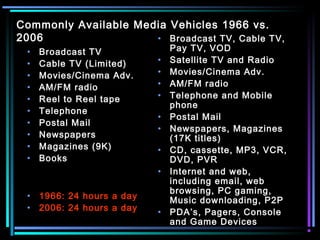
Commonly Available Media Vehicles 1966 vs.
2006
• Broadcast TV
• Cable TV (Limited)
• Movies/Cinema Adv.
• AM/FM radio
• Reel to Reel tape
• Telephone
• Postal Mail
• Newspapers
• Magazines (9K)
• Books
• 1966: 24 hours a day
• 2006: 24 hours a day
• Broadcast TV, Cable TV,
Pay TV, VOD
• Satellite TV and Radio
• Movies/Cinema Adv.
• AM/FM radio
• Telephone and Mobile
phone
• Postal Mail
• Newspapers, Magazines
(17K titles)
• CD, cassette, MP3, VCR,
DVD, PVR
• Internet and web,
including email, web
browsing, PC gaming,
Music downloading, P2P
• PDA’s, Pagers, Console
and Game Devices
Media Objectives, Strategies and Planning
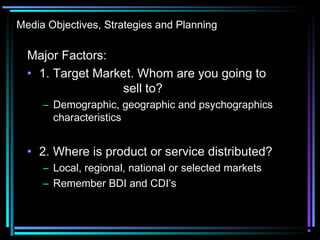
Major Factors:
• 1. Target Market. Whom are you going to
sell to?
– Demographic, geographic and psychographics
characteristics
• 2. Where is product or service distributed?
– Local, regional, national or selected markets
– Remember BDI and CDI’s
Media Objectives, Strategies and Planning
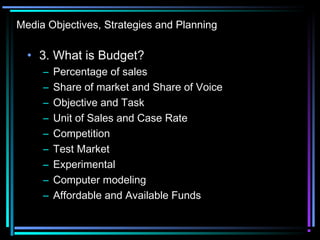
• 3. What is Budget?
– Percentage of sales
– Share of market and Share of Voice
– Objective and Task
– Unit of Sales and Case Rate
– Competition
– Test Market
– Experimental
– Computer modeling
– Affordable and Available Funds
Media Objectives, Strategies and Planning
• 4. What is Competition Doing?
– Budgets
– Which Media?
– Which Schedules?
– And more
Media Objectives, Strategies and Planning
• 5. Nature of Message?
– Electronic/Broadcast
– Print
– Color/B&W
– Demonstration
– Simple Statements
Media Objectives, Strategies and Planning
• 6. Reach
vs.
Frequency
vs.
Continuity
(Continuous Schedule)
Media Objectives, Strategies and Planning
Reach (Cume)
• The number of different or unduplicated
households or persons that are exposed to a
television program or commercial at least
once during the average week for a reported
time period. During the course of the
schedule illustrated, seven different
households were exposed to the spot at least
once. Since each home represents 10 % of
the universe, this makes the reach or cume
70%.
Media Objectives, Strategies and Planning
Frequency
• Average number of times a household
or a person viewed a given television
program, station or commercial during a
specific time period.
Media Objectives, Strategies and Planning
Continuity/Continuous Schedule
• Advertising runs steadily and varies
little. Compare with:
• Flighting and Pulsing with scheduling
Media Objectives, Strategies and Planning
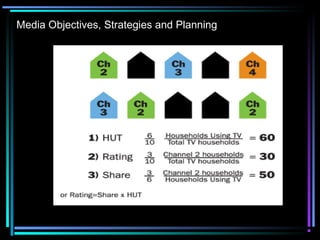
• Rating (RTG or %):
• The estimate of the size of a television
audience relative to the total universe,
expressed as a percentage. The
estimated percent of all TV households
or persons tuned to a specific station. In
the example, three of the 10 homes in
the universe are tuned to channel 2.
That translates to a 30 rating.
Media Objectives, Strategies and Planning
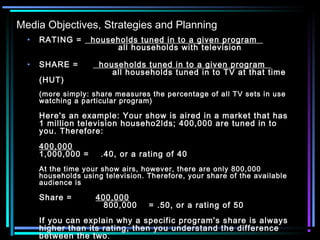
• RATING =   households tuned in to a given program  
                           all households with television
• SHARE =       households tuned in to a given program  
                         all households tuned in to TV at that time
(HUT)
(more simply: share measures the percentage of all TV sets in use
watching a particular program)
Here's an example: Your show is aired in a market that has
1 million television househo2lds; 400,000 are tuned in to
you. Therefore:
400,000
1,000,000 =    .40, or a rating of 40
At the time your show airs, however, there are only 800,000
households using television. Therefore, your share of the available
audience is
Share =        400,000
                      800,000    = .50, or a rating of 50
If you can explain why a specific program's share is always
higher than its rating, then you understand the difference
between the two.
Media Objectives, Strategies and Planning
• 7. Media Mix
– Combination of different media, and
size of ads
– Which Media?
– Which Schedules?
– And more
Media Objectives, Strategies and Planning
• 8. Seasonality and Length of Schedule?
– Hot tea vs. Cold tea?
– Snow blowers, toothpaste, coffee.
– Morning Drive and Evening Drive
– Flighting
– Pulsing
Media Objectives, Strategies and Planning
• 9. Tie-ins with Merchandising
and Sales Force?
– Coupons, Contests, Trade Deals, Sales Calls,
Displays, Budgets.
– Which Media?
– Events
• Super Bowl
• Academy Awards
• Sports
– Which Schedules?
– And more
Media Objectives, Strategies and Planning
Where?
56.9% of media exposure took
place in the home, but 21.1% took
place at work, 8.3% in the car and
13.7% in other locations.
Media Objectives, Strategies and Planning
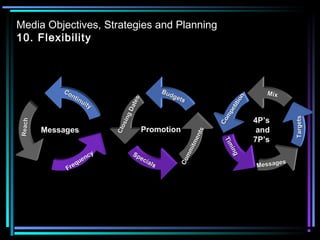
10. Flexibility
PromotionPromotion
Budgets
Budgets
ClosingDates
ClosingDates
Specials
Specials
Commitments
Commitments
4P’s4P’s
andand
7P’s7P’s
Com
petition
Com
petition
MixMix
TargetsTargets
Messages
Messages
Timing
Timing
MessagesMessages
Continuity
Continuity
ReachReach
Frequency
Frequency
Media Objectives, Strategies and Planning
• 11. Cost Efficiencies
– Which Media?
– Which Schedules?
– Which Vehicles?
Media Objectives, Strategies and Planning
• Advertising is an investment in future
sales.
• It’s greatest powers are in short-
term promotions and its cumulative
long-range effects.
• And more

Creating a media plan

  • 1.
    Media Objectives, Strategiesand Planning Major Factors in Creating and Building a Media Plan
  • 2.
    Media Questions Two basicprocesses: 1. Planning media strategy, including the specific types of consumers/audiences the messages will be directed to. 2. Selecting and Buying media vehicles. • Media planning is both an art and a science. An essential part of the advertising business.
  • 3.
    Media Questions • Whereshould we advertise? • Which media vehicles? • When during the year? • Should we concentrate our advertising? • How often should it run? • What opportunities are there to integrate our media planning with other Promotion or Communication tools?
  • 4.
    Media Objectives, Strategiesand Planning • Planners direct the messages to the right people at the right time in the right environments. • TV: Networks, syndication, local, cable, satellite. • National, Regional and Local issues • Non traditional: In flights, parking meters, blimps, shopping carts, milk cartons, litter cans, taxis, sponsorships.
  • 5.
    Media Objectives, Strategiesand Planning • Increasing media choices and options • Audience fragmentation • Costs and rate hikes • Multimedia, and interactive • Diverse audiences • And more
  • 6.
    Commonly Available MediaVehicles 1966 vs. 2006 • Broadcast TV • Cable TV (Limited) • Movies/Cinema Adv. • AM/FM radio • Reel to Reel tape • Telephone • Postal Mail • Newspapers • Magazines (9K) • Books • 1966: 24 hours a day • 2006: 24 hours a day • Broadcast TV, Cable TV, Pay TV, VOD • Satellite TV and Radio • Movies/Cinema Adv. • AM/FM radio • Telephone and Mobile phone • Postal Mail • Newspapers, Magazines (17K titles) • CD, cassette, MP3, VCR, DVD, PVR • Internet and web, including email, web browsing, PC gaming, Music downloading, P2P • PDA’s, Pagers, Console and Game Devices
  • 7.
    Media Objectives, Strategiesand Planning Major Factors: • 1. Target Market. Whom are you going to sell to? – Demographic, geographic and psychographics characteristics • 2. Where is product or service distributed? – Local, regional, national or selected markets – Remember BDI and CDI’s
  • 8.
    Media Objectives, Strategiesand Planning • 3. What is Budget? – Percentage of sales – Share of market and Share of Voice – Objective and Task – Unit of Sales and Case Rate – Competition – Test Market – Experimental – Computer modeling – Affordable and Available Funds
  • 9.
    Media Objectives, Strategiesand Planning • 4. What is Competition Doing? – Budgets – Which Media? – Which Schedules? – And more
  • 10.
    Media Objectives, Strategiesand Planning • 5. Nature of Message? – Electronic/Broadcast – Print – Color/B&W – Demonstration – Simple Statements
  • 11.
    Media Objectives, Strategiesand Planning • 6. Reach vs. Frequency vs. Continuity (Continuous Schedule)
  • 12.
  • 13.
    Media Objectives, Strategiesand Planning Reach (Cume) • The number of different or unduplicated households or persons that are exposed to a television program or commercial at least once during the average week for a reported time period. During the course of the schedule illustrated, seven different households were exposed to the spot at least once. Since each home represents 10 % of the universe, this makes the reach or cume 70%.
  • 14.
    Media Objectives, Strategiesand Planning Frequency • Average number of times a household or a person viewed a given television program, station or commercial during a specific time period.
  • 15.
    Media Objectives, Strategiesand Planning Continuity/Continuous Schedule • Advertising runs steadily and varies little. Compare with: • Flighting and Pulsing with scheduling
  • 16.
    Media Objectives, Strategiesand Planning • Rating (RTG or %): • The estimate of the size of a television audience relative to the total universe, expressed as a percentage. The estimated percent of all TV households or persons tuned to a specific station. In the example, three of the 10 homes in the universe are tuned to channel 2. That translates to a 30 rating.
  • 17.
    Media Objectives, Strategiesand Planning • RATING =   households tuned in to a given program                              all households with television • SHARE =       households tuned in to a given program                            all households tuned in to TV at that time (HUT) (more simply: share measures the percentage of all TV sets in use watching a particular program) Here's an example: Your show is aired in a market that has 1 million television househo2lds; 400,000 are tuned in to you. Therefore: 400,000 1,000,000 =    .40, or a rating of 40 At the time your show airs, however, there are only 800,000 households using television. Therefore, your share of the available audience is Share =        400,000                       800,000    = .50, or a rating of 50 If you can explain why a specific program's share is always higher than its rating, then you understand the difference between the two.
  • 18.
    Media Objectives, Strategiesand Planning • 7. Media Mix – Combination of different media, and size of ads – Which Media? – Which Schedules? – And more
  • 19.
    Media Objectives, Strategiesand Planning • 8. Seasonality and Length of Schedule? – Hot tea vs. Cold tea? – Snow blowers, toothpaste, coffee. – Morning Drive and Evening Drive – Flighting – Pulsing
  • 20.
    Media Objectives, Strategiesand Planning • 9. Tie-ins with Merchandising and Sales Force? – Coupons, Contests, Trade Deals, Sales Calls, Displays, Budgets. – Which Media? – Events • Super Bowl • Academy Awards • Sports – Which Schedules? – And more
  • 21.
    Media Objectives, Strategiesand Planning Where? 56.9% of media exposure took place in the home, but 21.1% took place at work, 8.3% in the car and 13.7% in other locations.
  • 22.
    Media Objectives, Strategiesand Planning 10. Flexibility PromotionPromotion Budgets Budgets ClosingDates ClosingDates Specials Specials Commitments Commitments 4P’s4P’s andand 7P’s7P’s Com petition Com petition MixMix TargetsTargets Messages Messages Timing Timing MessagesMessages Continuity Continuity ReachReach Frequency Frequency
  • 23.
    Media Objectives, Strategiesand Planning • 11. Cost Efficiencies – Which Media? – Which Schedules? – Which Vehicles?
  • 24.
    Media Objectives, Strategiesand Planning • Advertising is an investment in future sales. • It’s greatest powers are in short- term promotions and its cumulative long-range effects. • And more