
Creating a Culture of
Engagement
Communication
Proud to Help Others
Achieve their Goals
What employee engagement
is not …
Employee engagement does not mean
employee happiness.
Employee engagement does not mean
employee satisfaction.
Employee engagement is the emotional commitment
the employee has to the organization and its goals.
Engagement Challenges
Survey Questions (Scale of 1 – 10)
1. My organization has strong employee
engagement.
2. My organization is very skilled at
communicating with employees.
3. My organization has a clear
communication strategy.
“87% of organizations cite culture and engagement as one
of their top challenges.”
Global Human Capital Trends, 2015
AGENDA
Agenda
1. How companies communicate
2. Understand the 4 Steps of
Leadership Communication
3. Practice crafting your message
Today’s Take-Aways
1. One action step
2. One supporting statistic
3. One new business contact
(Corporate Leadership Council)
Engaged Employees are:
• 57% more likely to
work harder
• 80% more likely to
perform better
• 87% more likely to
stay longer with the company
WHAT DRIVES EMPLOYEE ENGAGEMENT?
COMMUNICATION | LEADERSHIP | COMMUNITY ENGAGMENT
How Companies Communicate
The three most used channels are:
1. Intranet (93%)
2. E-mail (90%)
3. Leadership communications (84%)
Siemens
“A business with 100 employees spends an average downtime of 17 hours a
week clarifying communication.”
(Internal Communication & Technology Survey 2014)
How Companies Communicate
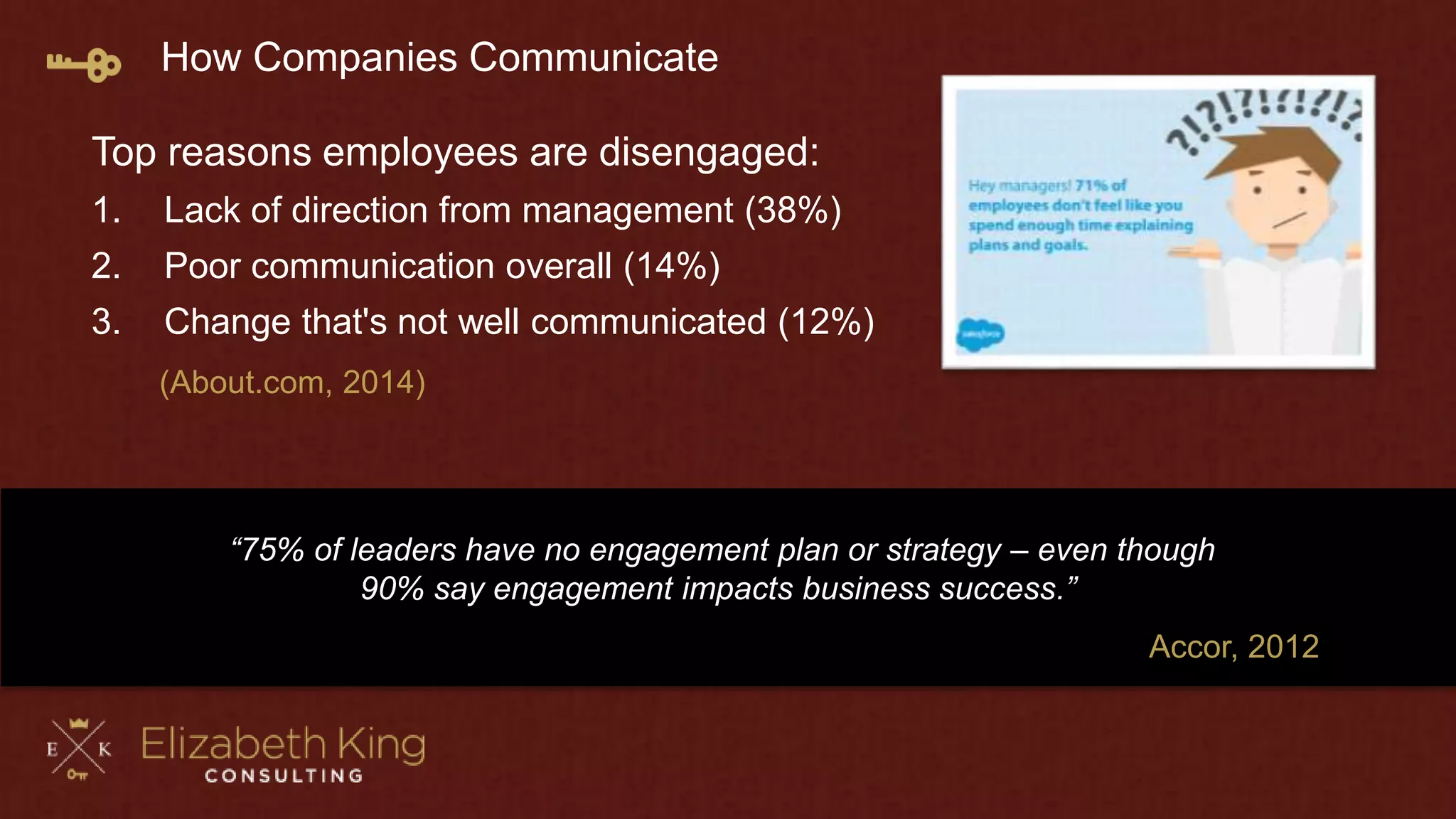
Top reasons employees are disengaged:
1. Lack of direction from management (38%)
2. Poor communication overall (14%)
3. Change that's not well communicated (12%)
“75% of leaders have no engagement plan or strategy – even though
90% say engagement impacts business success.”
Accor, 2012
(About.com, 2014)
How Companies Communicate
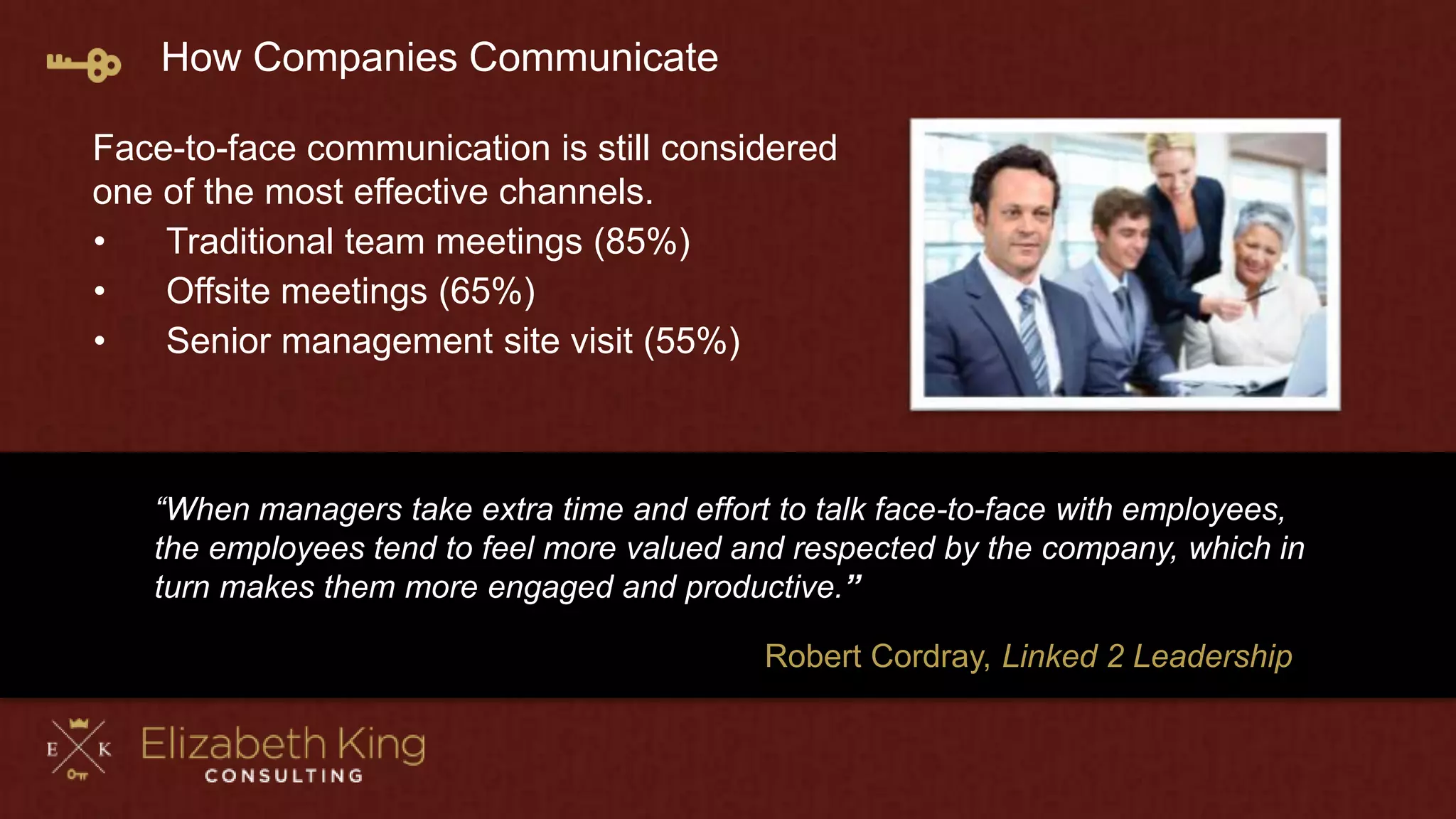
Face-to-face communication is still considered
one of the most effective channels.
• Traditional team meetings (85%)
• Offsite meetings (65%)
• Senior management site visit (55%)
“When managers take extra time and effort to talk face-to-face with employees,
the employees tend to feel more valued and respected by the company, which in
turn makes them more engaged and productive.”
Robert Cordray, Linked 2 Leadership
Impact of Leaders on Employee Engagement
EMPLOYEE PERSPECTIVE
• 98% of employees will fail to be
engaged when managers give little or
no feedback.
• 69% of employees say they would
work harder if they felt their efforts
were better recognized.
“When employees understand their role in business,
91% will work towards that success,
but the number plummets to 23% if they don’t.”
(Business2Community.com)
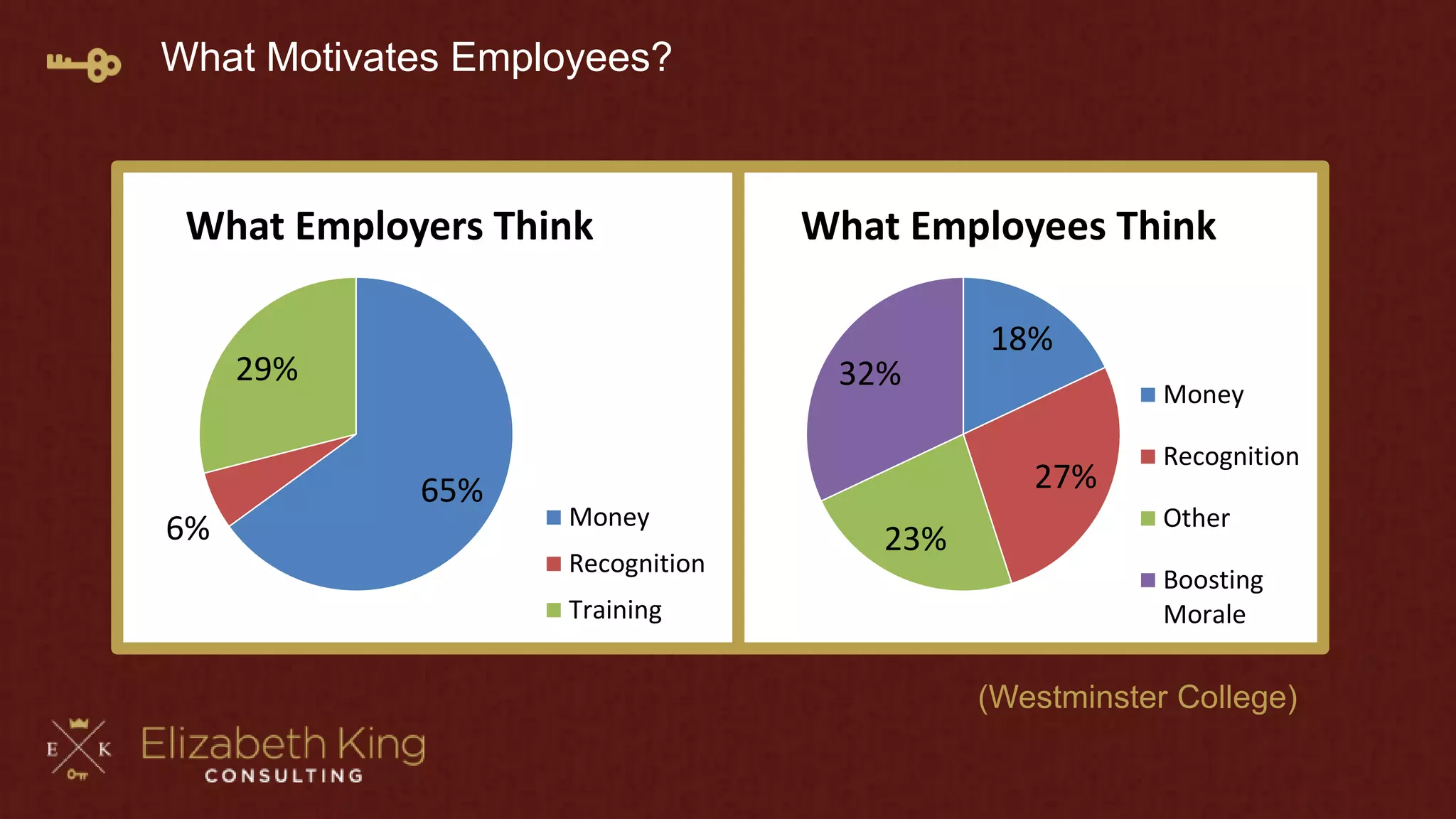
What Motivates Employees?
65%
6%
29%
What Employers Think
Money
Recognition
Training
18%
27%
23%
32%
What Employees Think
Money
Recognition
Other
Boosting
Morale
(Westminster College)
What Motivates Employees?
• Recognition
• Praise and appreciation
• Sense of influence
• Opportunities for growth
(Harvard Business Review)
43% of highly engaged employees received feedback at least once a week,
compared to only 18% of employees with low engagement.
Business2Community.com
What Motivates Employees?
How to Increase Engagement:
• Give employees the opportunity to give feedback
• Make employees feel informed about organization
• Demonstrate management’s commitment to the
organization.
“33% of employees say lack of open, honest communication
has the most negative impact on employee morale.”
HerdWisdom.com
EFFECTIVE LEADERSHIP
COMMUNICATION
Crafting Your Message
4 Steps to Leadership Communication
1. Say it – VERBAL
2. Write it – WRITTEN
3. Picture it – IMAGE
4. Model it – EXAMPLE
Melcrum, 2012
“61% of employees need to hear information
3-5 times to believe.”
Crafting Your Message
Know Your Audience
1. Who is your audience?
2. Why are you communicating with this
audience?
Crafting Your Message
Determine Key Messages
1. What are your key messages?
• Determine top 1-3 points you want
to convey to your audience.
“Your key messages must meet two criteria:
be concise and interesting.”
Lindsey McCaffrey
Crafting Your Message
Call to Action
1. What do you want the audience to do
after reading the message?
2. Clearly define how to take action.
“Before you send your letter or memo, make sure it is crystal clear
what you want the recipient to do.”
David Ogilvy
Crafting Your Message
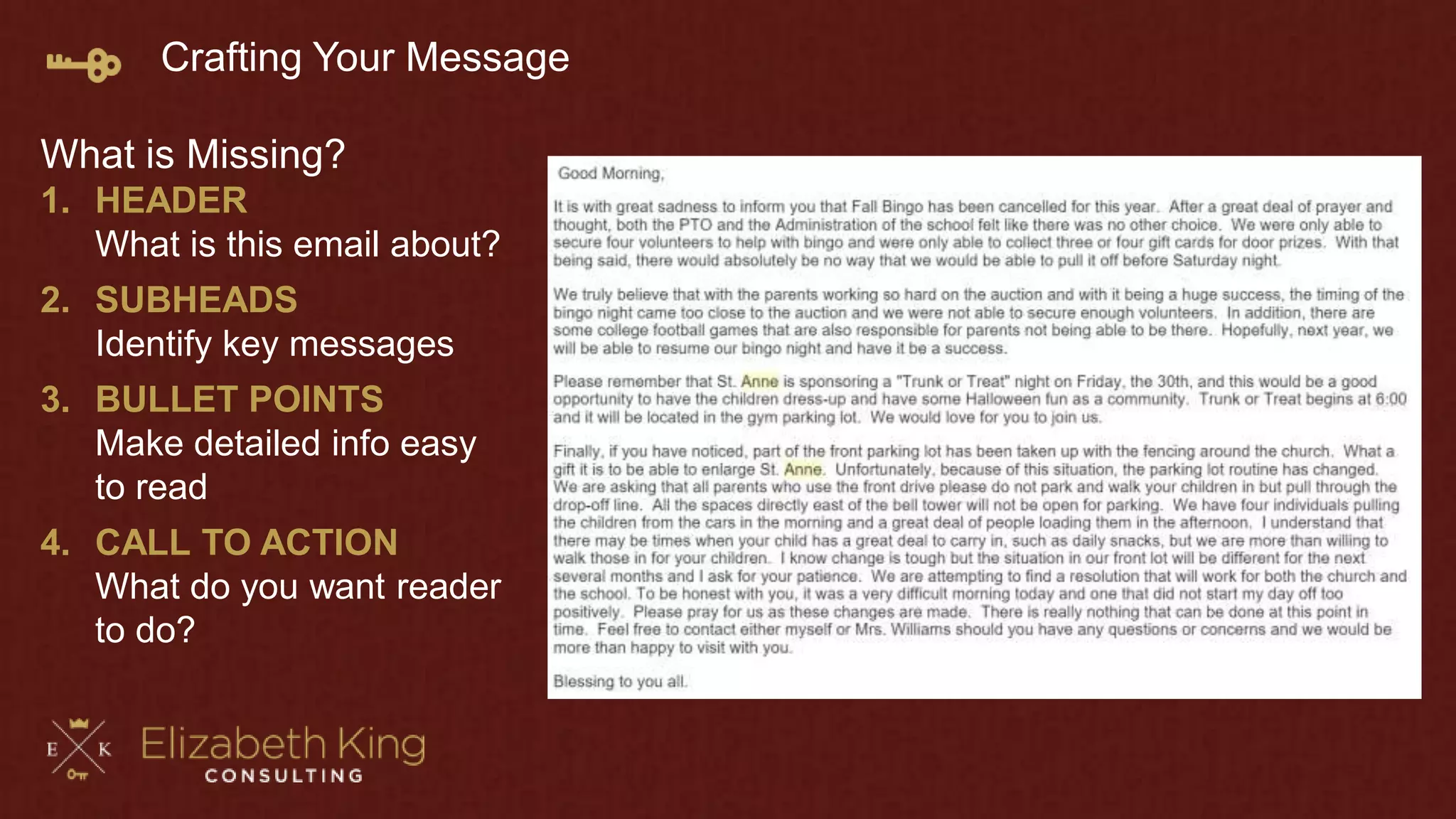
What is Missing?
1. HEADER
What is this email about?
2. SUBHEADS
Identify key messages
3. BULLET POINTS
Make detailed info easy
to read
4. CALL TO ACTION
What do you want reader
to do?
Crafting Your Message
What has been added?
1. HEADER
What is this email about?
2. SUBHEADS
Identify key messages
3. BULLET POINTS
Make detailed info easy
to read
4. CALL TO ACTION
What do you want reader
to do?
Crafting Your Message
Worksheet: Crafting a leadership communication
Crafting a Leadership Communication
“Speak in such a way that others love to listen to you.
Listen in such a way that others love to speak to you.” - Anonymous
TAKE ACTION
What is your action step going
to be?
1. Complete survey. Leave it on the table.
2. Take your notes with you.
3. Schedule a time to do your action step –
Put it on the calendar!
4. Network – Tell someone about your
action step.
“Knowledge without application is meaningless.”
Thomas Edison
Thank you for
coming!
1-918-853-6771
www.ElizabethKingConsulting.com

Creating a Culture of Engagement_Communication

  • 1.
    Creating a Cultureof Engagement Communication
  • 2.
    Proud to HelpOthers Achieve their Goals
  • 3.
    What employee engagement isnot … Employee engagement does not mean employee happiness. Employee engagement does not mean employee satisfaction. Employee engagement is the emotional commitment the employee has to the organization and its goals.
  • 4.
    Engagement Challenges Survey Questions(Scale of 1 – 10) 1. My organization has strong employee engagement. 2. My organization is very skilled at communicating with employees. 3. My organization has a clear communication strategy. “87% of organizations cite culture and engagement as one of their top challenges.” Global Human Capital Trends, 2015
  • 5.
  • 6.
    Agenda 1. How companiescommunicate 2. Understand the 4 Steps of Leadership Communication 3. Practice crafting your message Today’s Take-Aways 1. One action step 2. One supporting statistic 3. One new business contact (Corporate Leadership Council) Engaged Employees are: • 57% more likely to work harder • 80% more likely to perform better • 87% more likely to stay longer with the company
  • 7.
    WHAT DRIVES EMPLOYEEENGAGEMENT? COMMUNICATION | LEADERSHIP | COMMUNITY ENGAGMENT
  • 8.
    How Companies Communicate Thethree most used channels are: 1. Intranet (93%) 2. E-mail (90%) 3. Leadership communications (84%) Siemens “A business with 100 employees spends an average downtime of 17 hours a week clarifying communication.” (Internal Communication & Technology Survey 2014)
  • 9.
    How Companies Communicate Topreasons employees are disengaged: 1. Lack of direction from management (38%) 2. Poor communication overall (14%) 3. Change that's not well communicated (12%) “75% of leaders have no engagement plan or strategy – even though 90% say engagement impacts business success.” Accor, 2012 (About.com, 2014)
  • 10.
    How Companies Communicate Face-to-facecommunication is still considered one of the most effective channels. • Traditional team meetings (85%) • Offsite meetings (65%) • Senior management site visit (55%) “When managers take extra time and effort to talk face-to-face with employees, the employees tend to feel more valued and respected by the company, which in turn makes them more engaged and productive.” Robert Cordray, Linked 2 Leadership
  • 11.
    Impact of Leaderson Employee Engagement EMPLOYEE PERSPECTIVE • 98% of employees will fail to be engaged when managers give little or no feedback. • 69% of employees say they would work harder if they felt their efforts were better recognized. “When employees understand their role in business, 91% will work towards that success, but the number plummets to 23% if they don’t.” (Business2Community.com)
  • 12.
    What Motivates Employees? 65% 6% 29% WhatEmployers Think Money Recognition Training 18% 27% 23% 32% What Employees Think Money Recognition Other Boosting Morale (Westminster College)
  • 13.
    What Motivates Employees? •Recognition • Praise and appreciation • Sense of influence • Opportunities for growth (Harvard Business Review) 43% of highly engaged employees received feedback at least once a week, compared to only 18% of employees with low engagement. Business2Community.com
  • 14.
    What Motivates Employees? Howto Increase Engagement: • Give employees the opportunity to give feedback • Make employees feel informed about organization • Demonstrate management’s commitment to the organization. “33% of employees say lack of open, honest communication has the most negative impact on employee morale.” HerdWisdom.com
  • 15.
  • 16.
    Crafting Your Message 4Steps to Leadership Communication 1. Say it – VERBAL 2. Write it – WRITTEN 3. Picture it – IMAGE 4. Model it – EXAMPLE Melcrum, 2012 “61% of employees need to hear information 3-5 times to believe.”
  • 17.
    Crafting Your Message KnowYour Audience 1. Who is your audience? 2. Why are you communicating with this audience?
  • 18.
    Crafting Your Message DetermineKey Messages 1. What are your key messages? • Determine top 1-3 points you want to convey to your audience. “Your key messages must meet two criteria: be concise and interesting.” Lindsey McCaffrey
  • 19.
    Crafting Your Message Callto Action 1. What do you want the audience to do after reading the message? 2. Clearly define how to take action. “Before you send your letter or memo, make sure it is crystal clear what you want the recipient to do.” David Ogilvy
  • 20.
    Crafting Your Message Whatis Missing? 1. HEADER What is this email about? 2. SUBHEADS Identify key messages 3. BULLET POINTS Make detailed info easy to read 4. CALL TO ACTION What do you want reader to do?
  • 21.
    Crafting Your Message Whathas been added? 1. HEADER What is this email about? 2. SUBHEADS Identify key messages 3. BULLET POINTS Make detailed info easy to read 4. CALL TO ACTION What do you want reader to do?
  • 22.
    Crafting Your Message Worksheet:Crafting a leadership communication Crafting a Leadership Communication “Speak in such a way that others love to listen to you. Listen in such a way that others love to speak to you.” - Anonymous
  • 23.
  • 24.
    What is youraction step going to be? 1. Complete survey. Leave it on the table. 2. Take your notes with you. 3. Schedule a time to do your action step – Put it on the calendar! 4. Network – Tell someone about your action step. “Knowledge without application is meaningless.” Thomas Edison
  • 25.

Editor's Notes

  • #4 “26% of employees are Actively Disengaged, 45% of employees are Disengaged” (Dale Carnegie Training)
  • #9 “The average person receives 120-150 e-mails per day. It's very likely that a person will misplace, delete or not even see a specific email, and therefore could miss a crucial piece of information.” Phil Simon, Message Not Received
  • #10 71% of employees feel managers do not spend enough time explaining goals and plans. (People Driven Performance)
  • #11 81% of companies use large scale events as part of their internal communication mix. (Gatehouse, State of the Sector 2015)
  • #12 Organizations that increased practices related to engagement by just 10% increased profits by an average of $2,400 per employee per year. (The Work Foundation)
  • #14 30x more likely to make workers actively engaged at work when managers focus on employee’s strengths. Business2Community.com
  • #15 52% fail to take any action as a result of survey feedback, and 27% of managers don’t bother to review survey results at all. (OfficeVibe.com)
  • #17 “Speak in such a way that others love to listen to you. Listen in such a way that others love to speak to you.” Anonymous