Futenma Log:
Base Relocation Negotiations 2009-2010
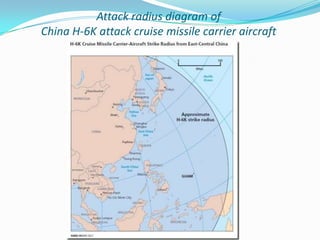
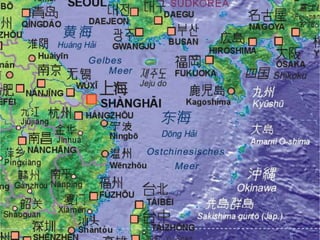
Attack radius diagram of
China H-6K attack cruise missile carrier aircraft
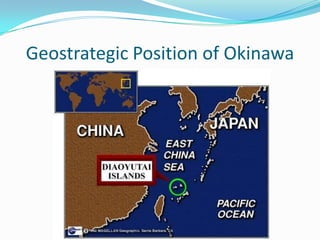
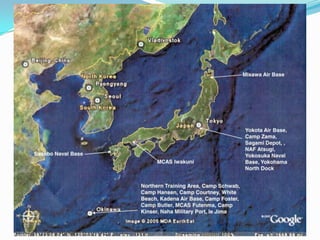
Geostrategic Position of Okinawa
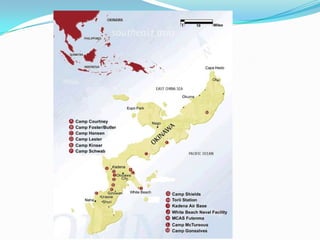
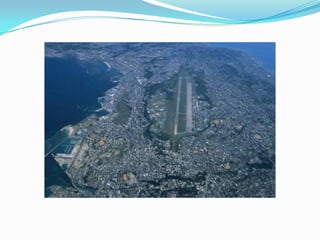
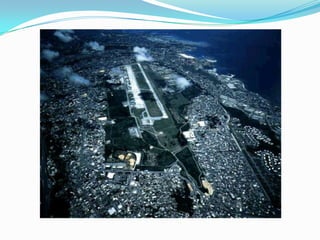
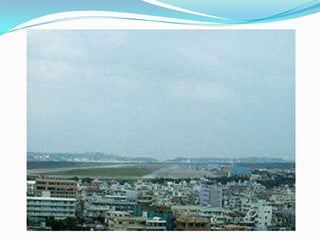
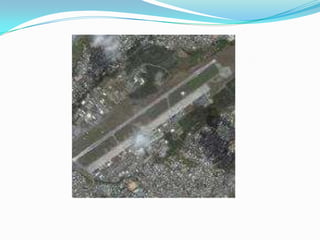
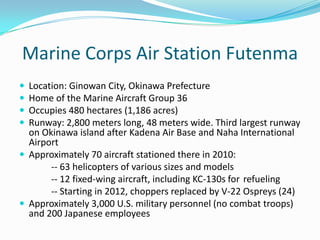
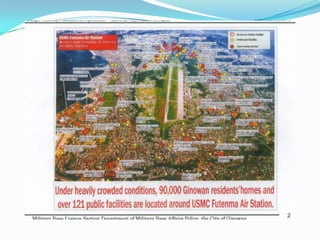
Marine Corps Air Station Futenma
 Location: Ginowan City, Okinawa Prefecture
 Home of the Marine Aircraft Group 36
 Occupies 480 hectares (1,186 acres)
 Runway: 2,800 meters long, 48 meters wide. Third largest runway
  on Okinawa island after Kadena Air Base and Naha International
  Airport
 Approximately 70 aircraft stationed there in 2010:
       -- 63 helicopters of various sizes and models
       -- 12 fixed-wing aircraft, including KC-130s for refueling
       -- Starting in 2012, choppers replaced by V-22 Ospreys (24)
 Approximately 3,000 U.S. military personnel (no combat troops)
  and 200 Japanese employees
MAG-36 Combat Support at Futenma
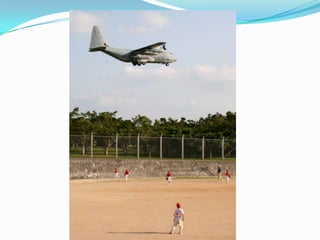
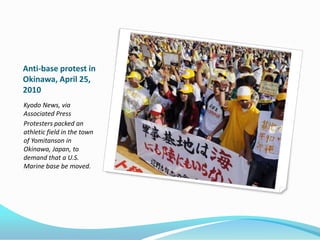
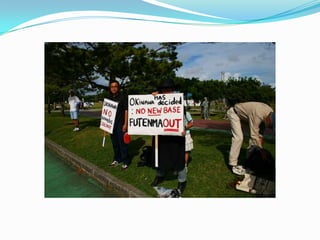
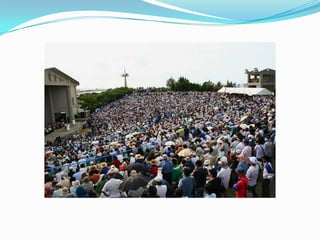
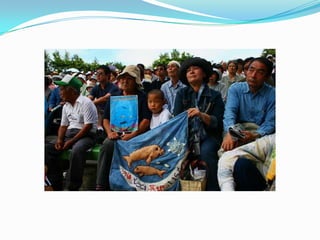
Anti-base protest in
Okinawa, April 25,
2010
Kyodo News, via
Associated Press
Protesters packed an
athletic field in the town
of Yomitanson in
Okinawa, Japan, to
demand that a U.S.
Marine base be moved.
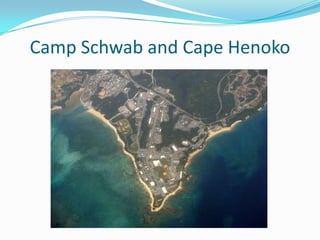
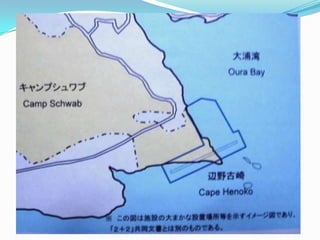
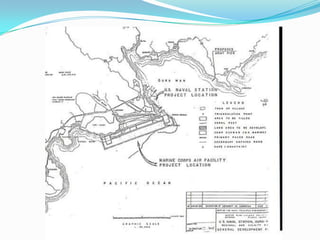
Camp Schwab and Cape Henoko
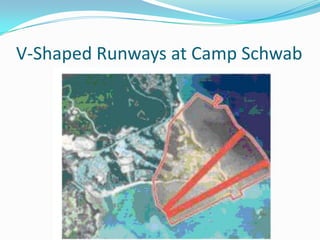
V-Shaped Runways at Camp Schwab
Okinawa says NO to FRF relocation
 Okinawans rejected the plan to construct a new U.S.
  base in a referendum held in December 1997 in Nago
  City.
 In every opinion poll on this issue since then, 70-80
  percent of the respondents have expressed
  opposition to the new U.S. base construction plan.
 In July 2008, the Okinawa Prefectural Assembly also
  expressed its opposition to the base in a resolution.
Futenma cannot be relocated to Henoko
Yoshio Shimoji                  August 15, 2011

   Defense Minister Toshimi Kitazawa and Defense Secretary Leon Panetta reaffirmed "that Tokyo and
   Washington will move forward with the plan to relocate the controversial Futenma base within Okinawa."
   Futenma was constructed toward the end of WW II with an aim of attacking mainland Japan by B-29's in
   order to end the war quickly. But the war ended before that plan was actually carried out. Futenma should
   have been returned at that point; instead, it has continued to be in the firm grip of the U.S. military all
   these years to this day.
   Evidently, the U.S. military seized the land in clear violation of Article 46 of the Hague Convention, which
   states: "Family honour and rights, the lives of persons, and private property, as well as religious convictions
   and practice, must be respected. Private property cannot be confiscated."
   The illegality of Futenma would not disappear even if it were to be moved to Henoko or anywhere else in
   Okinawa just like dirty money would not become clean how many times it might undergo laundering.
   Both Kitazawa and Panetta must realize this and search for an alternative solution, that is, to move it
   outside of Okinawa, most preferably, to the U.S. mainland

   ( Yoshio Shimoji, born in Miyako Island, Okinawa, M.S. (Georgetown University), taught English and linguistics at the University of the Ryukyus from
   1966 until his retirement in 2003.)
Opinion on Okinawa Bases
   Okinawa referendum (September 1996): 90% want consolidation and reduction
    of U.S. bases in Okinawa (i.e., no relocation of Futenma inside Okinawa)

   Asahi opinion survey (May 12, 1997) of the nation and Okinawa: 72% of all
    Japanese as well as Okinawans wanted a phased reduction of U.S. bases in
    Okinawa, 59% of Okinawans and 38% of all Japanese wanted Okinawa bases
    relocated elsewhere in Japan. 57% of Okinawans and 76% of all Japanese
    wanted the security treaty with the U.S. maintained

   Yomiuri poll (June 23, 2006): 50% of all Japanese positive about U.S.-Japan
    agreement to realign U.S. forces in Japan, 38% were negative. On relocating
    Futenma to another location in Okinawa and redeploying 8,000 Marines from
    Okinawa to Guam, survey found 52% denying such would alleviate Okinawa’s
    base-hosting burden, with only 36% positive. Results show Okinawans were not
    the only Japanese with negative views about realignment results.

   Okinawa Times/Asahi poll (June 2009): 68% of Okinawans oppose relocating
    Futenma within the prefecture, against only 18% in favor. Opposed said
    relocating to Henoko would not reduce the overall burden of the U.S. bases in
    Okinawa and destroy marine environment.
More Opinion on Okinawa Bases
Asahi poll released May 14, 2020
 70% of Okinawa’s residents opposed PM
  Hatoyama’s decision to move Futenma helicopter
  function to another site in the prefecture, with
  training on Tokunoshima in Kagoshima Prefecture

 43% of Okinawa’s residents wanted all bases to be
 removed from the prefecture
Anatomy of Dependency
Base economy: Sources of Income
1. Host nation support budget includes salaries for 9,000
   Japanese employed at U.S. bases (50b yen-$645m)
2. Many more Japanese jobs and incomes indirectly linked
   to U.S. bases such as contractors and vendors
3. Rents: Most base land privately owned but leased to
   the Japanese government (totaling $1 billion in 2009)
4. Complex system of subsidies from the central
   government to communities hosting U.S. bases
      Since 1997, Nago City (hosts Camp Schwab) has
   received $145 million for ACCEPTING FRF to Henoko
As of March 2011
Okinawa Consolidation, Reduction, Realignment

 All bases south of Camp Foster and certain areas of Camp
  Foster to be returned to Japan
 USMC forces consolidate to remaining bases
 8,000 Marines leave Okinawa (plus dependents)
 Relocated to Guam by 2014 (GOJ pays $6.09 b; U.S.
  $4.189 b)
 10,000 MAGTF capability remains in Okinawa
 Tangible progress with FRF is precondition for relocation
Futenma Relocation Plan
 Relocation of Marine Aerial Refueler Transport Squadron
  152 (VMGR-152) – KC-130J fixed-wing aircraft – to MCAS
  Iwakuni
 MAG-36 (helicopter unit) relocates to Futenma
  Replacement Facility (FRF) at Henoko Saki
 FRF are V-shaped dual runways, 1,600m in length with
  100m overruns
 Long runway operations provided by access to Japanese
  airfields
The SACO Final Report
                on Futenma Air Station
   At the Security Consultative Committee (SCC) held on December 2, 1996, Minister Ikeda,
    Minister Kyuma, Secretary Perry, and Ambassador Mondale reaffirmed their commitment
    to the Special Action Committee on Okinawa (SACO) Interim Report of April 15, 1996 and
    the Status Report of September 19, 1996. Based on the SACO Interim Report, both
    Governments have been working to determine a suitable option for the return of Futenma
    Air Station and the relocation of its assets to other facilities and areas in Okinawa, while
    maintaining the airfield's critical military functions and capabilities. The Status Report
    called for the Special Working Group on Futenma to examine three specific alternatives: 1)
    incorporate the heliport into Kadena Air Base; 2) construct a heliport at Camp Schwab;
    and 3) develop and construct a sea-based facility (SBF).

   On December 2, 1996, the SCC approved the SACO recommendation to pursue the SBF
    option. Compared to the other two options, the SBF is judged to be the best option in
    terms of enhanced safety and quality of life for the Okinawan people while maintaining
    operational capabilities of U.S. forces. In addition, the SBF can function as a fixed facility
    during its use as a military base and can also be removed when no longer necessary.

   Return Futenma Air Station within the next five to seven years, after adequate
    replacement facilities are completed and operational.
State of Progress in SACO Report
Returned:
   Aha Training Area (total)
   Sobe Communication Site (total)
   Yomitan Auxiliary Airfield (total)
   Senaha Communication Station (most)
In Process:
   Northern Training Area (more than half)
   Gimbaru Training Area (total)
   Naha Port
   Camp Kuwae
No Progress:
   MCAS Futenma
Main actors in negotiations, 1996-7
Japanese side                         American side
 Prime Minister Hashimoto             President Clinton
 Chief Cabinet Secretary              Ambassador to Japan Mondale
    Kajiyama
                                       Pentagon
   JDA Director General Usui, then
                                          Dep. Assist. Sect. Campbell
    Kyuma
                                          FIG (Futenma Implementation
   Vice Defense Minister Moriya
                                           Group) U.S.-Japan working gp.
   LDP Policy Res. Council Chair
                                          USFJ
    Yamasaki
   Hashimoto advisor Yukio            Dep. Assist. Sec. State Hubbard
    Okamoto                            American Embassy, Tokyo
   Okinawa Governor Ota
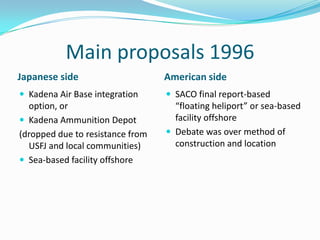
Main proposals 1996
Japanese side                     American side
 Kadena Air Base integration      SACO final report-based
  option, or                        “floating heliport” or sea-based
 Kadena Ammunition Depot           facility offshore
(dropped due to resistance from    Debate was over method of
  USFJ and local communities)       construction and location
 Sea-based facility offshore
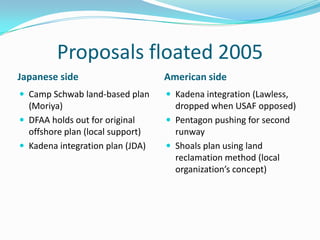
Proposals floated 2005
Japanese side                     American side
 Camp Schwab land-based plan      Kadena integration (Lawless,
  (Moriya)                          dropped when USAF opposed)
 DFAA holds out for original      Pentagon pushing for second
  offshore plan (local support)     runway
 Kadena integration plan (JDA)    Shoals plan using land
                                    reclamation method (local
                                    organization’s concept)
Competing proposals in 2005
    On the table at this time for both governments to consider
    were four proposals for the Futenma replacement facility:
   The original Henoko-offing plan, based on the 1996 SACO
    agreement, which was scheduled for joint military-civilian use
    (Runway 2,500 meters long, 730 meters long);
   A scaled-down Henoko plan, also known as the shoals plan or
    the reef plan, that would only be a military heliport (Length
    1,500 meters, width 500 meters);
   Camp Schwab land-based plan (Runway within the base 1,300
    – 1,500 meters long);
   Kadena integration plan, under which a heliport for the
    Marines would be built inside that Air Force base.
SCC agreement October 29, 2005
 Both sides will locate the FRF in an "L"-shaped
 configuration that combines the shoreline areas of Camp
 Schwab and adjacent water areas of Oura Bay. The
 runway portion of the facility will cross Henoko-saki,
 extending from Oura Bay into the water areas along the
 south shore of Camp Schwab. The lower section of the
 facility, oriented in a northeast-southwest direction will
 include a runway and overruns, with a total length of
 1800 meters exclusive of seawalls.
United States-Japan Roadmap for Realignment Implementation
                        May 1, 2006


Futenma Replacement Facility (FRF):
 The United States and Japan will locate the FRF in a configuration
  that combines the Henoko-saki and adjacent water areas of Oura
  and Henoko Bays, including two runways aligned in a "V"-shape,
  each runway having a length of 1,600 meters plus two 100-meter
  overruns. The length of each runway portion of the facility is 1,800
  meters, exclusive of seawalls. This facility ensures agreed
  operational capabilities while addressing issues of safety, noise,
  and environmental impacts.
 In order to locate the FRF, inclusive of agreed support facilities, in
  the Camp Schwab area, necessary adjustments will be made, such
  as reconfiguration of Camp Schwab facilities and adjacent water
  surface areas.
 Construction of the FRF is targeted for completion by 2014.
U.S.-Japanese Roadmap for
              Force Realignment
 Issued on May 1, 2006, the Roadmap is a comprehensive, interconnected
  package of force posture changes on Okinawa and the Japanese main islands.
  The major provisions for Okinawa are:
 --Redeployment of U.S. Marine Corps air units from Futenma Air Station to a
  replacement facility to be constructed in the less populated area adjacent to
  Camp Schwab;
 --Reduction of U.S. force levels on Okinawa by relocating 8,000 Marines and
  9,000 dependents to Guam;
 --Japan's provision of $6 billion of the estimated $10 billion cost to relocate to
  Guam;
 -- Consolidation of remaining U.S. Marine units in less heavily populated areas
  in northern Okinawa; and
 --Return of several U.S. bases south of Kadena Air Base to Okinawa control.
 The Okinawa realignment initiatives are interconnected. The relocation of
  8,000 Marines to Guam, consolidation of Marine forces, and land returns south
  of Kadena depend on "tangible progress toward completion of the Futenma
  Replacement Facility (FRF) and Japan's financial contributions to fund
  development of required facilities and infrastructure on Guam."
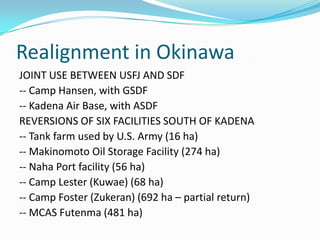
Realignment in Okinawa
JOINT USE BETWEEN USFJ AND SDF
-- Camp Hansen, with GSDF
-- Kadena Air Base, with ASDF
REVERSIONS OF SIX FACILITIES SOUTH OF KADENA
-- Tank farm used by U.S. Army (16 ha)
-- Makinomoto Oil Storage Facility (274 ha)
-- Naha Port facility (56 ha)
-- Camp Lester (Kuwae) (68 ha)
-- Camp Foster (Zukeran) (692 ha – partial return)
-- MCAS Futenma (481 ha)
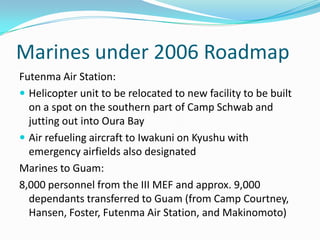
Marines under 2006 Roadmap
Futenma Air Station:
 Helicopter unit to be relocated to new facility to be built
  on a spot on the southern part of Camp Schwab and
  jutting out into Oura Bay
 Air refueling aircraft to Iwakuni on Kyushu with
  emergency airfields also designated
Marines to Guam:
8,000 personnel from the III MEF and approx. 9,000
  dependants transferred to Guam (from Camp Courtney,
  Hansen, Foster, Futenma Air Station, and Makinomoto)
Official draft plan for relocating the Futenma Air Station
.

     The Hatoyama government:
     Proposes modifying the existing Japan-U.S. plan to relocate
     the Futenma Air Station to reclaimed land on the coast in
     Nago, Okinawa, to transfer it instead to a pile-supported
     facility to be built some 500 meters southwest from the
     coastline with only one 1,800-meter runway.
    Proposes transferring some of the training of Futenma's
     helicopter unit to Tokunoshima Island, Kagoshima Prefecture.
    Promotes transferring some of the training held by U.S.
     forces in Okinawa to Self-Defense Forces bases elsewhere in
     Japan.
    Calls for the return of part of ''Area Hotel Hotel,'' a water
     area east of Okinawa Island used for drills, and of the
     bombing and shooting ranges on Kumejima and Tori islands,
     located west of the main Okinawa island (5/9/2010).
Excerpt of Japan-U.S. joint statement
   on Futenma relocation accord (5/27/10)
 The Ministers confirmed their commitment to implement steadily the realignment
  initiatives described in the May 1, 2006, SCC Document, “United States-Japan
  Roadmap for Realignment Implementation," as supplemented by this SCC Statement.
 The Ministers reaffirmed that, as provided for in the Guam Agreement of February 17,
  2009, the relocation of approximately 8,000 III Marine Expeditionary Force (MEF)
  personnel and their approximately 9,000 dependents from Okinawa to Guam is
  dependent on tangible progress toward the completion of the replacement facility. The
  relocation to Guam will realize the consolidation and return of most of the facilities
  south of Kadena.
 Bearing this in mind, the two sides intend to verify and validate that this Futenma
  relocation plan appropriately considers factors such as safety, operational
  requirements, noise impact, environmental concerns, and effects on the local
  community.
 Both sides confirmed the intention to locate the replacement facility at the Camp
  Schwab Henoko-saki area and adjacent waters, with the runway portion(s) of the
  facility to be 1,800 meters long, inclusive of overruns, exclusive of seawalls.
 In order to achieve the earliest possible return of MCAS Futenma, the Ministers
  decided that a study by experts regarding the replacement facility's location,
  configuration and construction method would be completed promptly (in any event no
  later than the end of August and that the verification and validation would be
  completed by the time of the next SCC.
Futenma “negotiations” 2009-10
Japanese side                      American side
 PM Hatoyama                       (President Obama)
                                    (Secretary Clinton)
 Foreign Minister Okada
                                    Assistant Secretary of State
 Defense Minister Kitazawa            Campbell
 Chief Cabinet Secretary Hirano      (Defense Secretary Gates)
 (MOFA and MOD officials)            Assistant Secretary of Defense
                                       Gregson
 Advisor: Yukio Okamoto
                                      Ambassador to Japan Roos
                                      Japan Desk
                                      U.S. Embassy Staff
                                      Naha Consul General
Hatoyama: Marines No Deterrence
 In a May 4, 2010 meeting with Gov. Hirokazu Nakaima of Okinawa
  Prefecture, then Prime Minister Hatoyama said that he had no alternative
  but to give up the idea of moving the Futenma air station out of Okinawa
  Prefecture. Asked why the facility had to remain in Okinawa, he said that as
  he "studied the issue more and more," he came to realize that various U.S.
  armed forces units, including marines, combine to maintain a deterrent.
 In a 2011 interview, Hatoyama said that when it became clear that he had
  to accept the Henoko plan, he had to find a "post factum justification."
  Although he did not believe that U.S. Marines in Okinawa per se directly
  deter war, he thought the word deterrent in a wide sense could be used as
  such a justification. Using the Buddhist concept of "hoben" — a way in
  which Buddha leads people to understand his teachings depending on the
  degree of their ability to understand — he said that if someone insists that
  his justification was hoben, he had to admit that it was hoben. In everyday
  language, hoben is usually taken to mean an expedient excuse.
Okamoto rebuts Hatoyama
 Commentator Yukio Okamoto, who served as a foreign policy advisor in the
  Hatoyama administration, criticized previous Prime Minister Yukio Hatoyama in
  presenting his views as a speaker recommended by the Liberal Democratic Party at
  a public hearing of the House of Representatives' Budget Committee yesterday. All
  the more because Okamoto grappled with the issue of relocating the U.S. Marine
  Corps' Futenma Air Station for many years, he seems to have been unable to hide
  his chagrin over the setback to the settlement of the issue on account of
  Hatoyama's irresponsible statements.

 In the hearing, Okamoto said: "I explained to then Prime Minister Hatoyama the
  concept of deterrence and made efforts to have him understand it." He then made
  this candid remark: "The plan to relocate (the Futenma Air Station) to the Henoko
  district (in Nago City, Okinawa Prefecture) was viable at that time, but since
  (Hatoyama) insisted on moving the base out of the prefecture, it became
  impossible to implement the plan. The responsibility [for the ongoing stagnation]
  rests largely with the previous prime minister."
Negotiations, 1995-96, 2006-7:
           Main conclusions
 Leadership essential in both cases, particularly at final stage to
    break impasse
   Intense efforts by negotiators, matched by persuasive efforts
    of intermediaries sent to Okinawa
   Difficult negotiations: at times extremely contentious, divisive
    and sometimes on verge of collapse
   For sake of alliance, pulled back from brink before talks
    completely collapsed
   Agreements were Pyrrhic victories for implementation of each
    remained elusive
   Decision-making process in first and second agreements:
    marked similarities but some dissimilarities : i.e., role of LDP
    was negative factor in first, positive factor in second case
Main conclusions (continued)
 Agreements ambiguous about exact location and
  modality of FRF, led to lengthy conflict over both during
  implementation stage
 Opinion in Okinawa basically a constant and not a
  variable
 Okinawa governors proved to be a main obstacle to
  agreement and then to implementation
Futenma negotiations, 2009-10
         Conclusions reached
 Alliance was “damaged” by the Hatoyama administration’s
    mishandling of the Futenma issue
   U.S. never wavered from its basic demand to honor 2006
    Roadmap Agreement; Faulted for lacking flexibility
   Japan misread the U.S., which abides by fundamental principle
    that government-to-government agreement must be honored
   Washington-Tokyo trust relationship never established
   Hatoyama government did not understand and thus ignored
    Okinawan sensitivities; Proposals never vetted with locals
   Okinawa lost all confidence in Tokyo; felt betrayed by
    Hatoyama (5/2010); remains opposed in principle to
    compromise solution, proactive efforts of Kan government
    notwithstanding
Conclusions continued:
 Hatoyama government treated Futenma issue as a search for
    parking lots for Futenma aircraft
   Issue of Japan’s national security never seems to have come
    up
   Ignored issue of maintaining military capabilities of U.S. forces
    on Okinawa
    Politics given priority over alliance or national security
   Decision-making process was politically motivated and
    incoherent
   Kan government reconfirmed bilateral agreement, but has
    delayed final conclusions on modality for political reasons
   U.S. remained disengaged from Dec. 2009 to May 2010,
    although maintained a veto power over silly proposals
Implementation Barrier
 Implementation always needed a consensus to hold
  among the three parties: USG, GOJ, and Okinawa
 Now as in the past agreements, local opposition has
  made plans impossible to implement. An impasse exists.
 Consensus on the U.S. side to support plan is unraveling,
  starting with the Senate and views in Pentagon.
 GOJ not carrying out intense nemawashi or informal
  spadework to convince locals to accept compromise
 Roadmap agreement is a package in which Futenma is
  inseparable part of an intricate realignment scheme
Consensus Unraveling
Senators Levin, McCain and
            Webb Propose:
 Placing the realignment of the basing of U.S. military forces in South
  Korea on hold pending further review, and reevaluate any proposal
  to increase the number of family members accompanying military
  personnel.
 Revising the Marine Corps force realignment implementation plan
  for Guam to consist of a presence with a permanently-assigned
  headquarters element bolstered by deployed, rotating combat units,
  and consideration of off-island training sites
 Examining the feasibility of moving Marine Corps assets at MCAS
  Futenma, Okinawa, to Kadena Air Base, Okinawa, rather than
  building an expensive replacement facility at Camp Schwab – while
  dispersing a part of Air Force assets now at Kadena to Andersen Air
  Base in Guam and/or other locations in Japan.
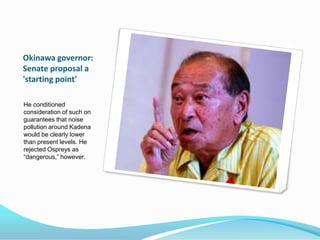
Okinawa governor:
Senate proposal a
'starting point'

He conditioned
consideration of such on
guarantees that noise
pollution around Kadena
would be clearly lower
than present levels. He
rejected Ospreys as
“dangerous,” however.
Senators’ Proposal Rejected
 Kadena option rejected as not feasible due to local
  opposition
 Kadena Mayor Hiroshi Toyama: "Both the town and the
  residents are dead set against the plan. There is no other
  way than to relocate (Futenma) outside Japan."
 More than 20,000 residents who live near the Kadena
  base had just filed a lawsuit demanding suspension of
  flights early in the morning and at night and
  compensation for damage.
 Kadena vetted and rejected by USG/GOJ several times in
  past
Alliance Critics
 Some reject conventional view that U.S.-Japan alliance is
  key to peace and stability in East Asia
 Deny that the concept of deterrence has anything to do
  with the presence of a forward-deployed Marine wing
 Deny that the Marine forces along with other U.S. forces
  in Japan satisfy U.S. national strategy by visibly
  demonstrating the U.S. commitment to regional security
 Deny these forces deter aggression, provide a crisis-
  response capability should deterrence fail, and avoid the
  risk of interpreting some withdrawals as a sign of a
  lessening of the U.S. commitment.
Proposed Removal of Marines to U.S.
 Critics say Guam and Henoko relocations are too
  expensive, so bring Marine combat capability
  back to California; they could always fly back in
  case of a contingency, keeping places and ships
  ready in Japan to receive them
 But opponents of that idea argue that virtual
  presence (similar to DPJ proposal in 1996) is
  actual absence; they could not readily respond.
  How can rotary wing components return?

PPT 11.22.2011 Cracks in the Alliance

  • 1.
    Futenma Log: Base RelocationNegotiations 2009-2010
  • 3.
    Attack radius diagramof China H-6K attack cruise missile carrier aircraft
  • 4.
  • 12.
    Marine Corps AirStation Futenma  Location: Ginowan City, Okinawa Prefecture  Home of the Marine Aircraft Group 36  Occupies 480 hectares (1,186 acres)  Runway: 2,800 meters long, 48 meters wide. Third largest runway on Okinawa island after Kadena Air Base and Naha International Airport  Approximately 70 aircraft stationed there in 2010: -- 63 helicopters of various sizes and models -- 12 fixed-wing aircraft, including KC-130s for refueling -- Starting in 2012, choppers replaced by V-22 Ospreys (24)  Approximately 3,000 U.S. military personnel (no combat troops) and 200 Japanese employees
  • 13.
  • 17.
    Anti-base protest in Okinawa,April 25, 2010 Kyodo News, via Associated Press Protesters packed an athletic field in the town of Yomitanson in Okinawa, Japan, to demand that a U.S. Marine base be moved.
  • 18.
    Camp Schwab andCape Henoko
  • 20.
  • 22.
    Okinawa says NOto FRF relocation  Okinawans rejected the plan to construct a new U.S. base in a referendum held in December 1997 in Nago City.  In every opinion poll on this issue since then, 70-80 percent of the respondents have expressed opposition to the new U.S. base construction plan.  In July 2008, the Okinawa Prefectural Assembly also expressed its opposition to the base in a resolution.
  • 23.
    Futenma cannot berelocated to Henoko Yoshio Shimoji August 15, 2011 Defense Minister Toshimi Kitazawa and Defense Secretary Leon Panetta reaffirmed "that Tokyo and Washington will move forward with the plan to relocate the controversial Futenma base within Okinawa." Futenma was constructed toward the end of WW II with an aim of attacking mainland Japan by B-29's in order to end the war quickly. But the war ended before that plan was actually carried out. Futenma should have been returned at that point; instead, it has continued to be in the firm grip of the U.S. military all these years to this day. Evidently, the U.S. military seized the land in clear violation of Article 46 of the Hague Convention, which states: "Family honour and rights, the lives of persons, and private property, as well as religious convictions and practice, must be respected. Private property cannot be confiscated." The illegality of Futenma would not disappear even if it were to be moved to Henoko or anywhere else in Okinawa just like dirty money would not become clean how many times it might undergo laundering. Both Kitazawa and Panetta must realize this and search for an alternative solution, that is, to move it outside of Okinawa, most preferably, to the U.S. mainland ( Yoshio Shimoji, born in Miyako Island, Okinawa, M.S. (Georgetown University), taught English and linguistics at the University of the Ryukyus from 1966 until his retirement in 2003.)
  • 24.
    Opinion on OkinawaBases  Okinawa referendum (September 1996): 90% want consolidation and reduction of U.S. bases in Okinawa (i.e., no relocation of Futenma inside Okinawa)  Asahi opinion survey (May 12, 1997) of the nation and Okinawa: 72% of all Japanese as well as Okinawans wanted a phased reduction of U.S. bases in Okinawa, 59% of Okinawans and 38% of all Japanese wanted Okinawa bases relocated elsewhere in Japan. 57% of Okinawans and 76% of all Japanese wanted the security treaty with the U.S. maintained  Yomiuri poll (June 23, 2006): 50% of all Japanese positive about U.S.-Japan agreement to realign U.S. forces in Japan, 38% were negative. On relocating Futenma to another location in Okinawa and redeploying 8,000 Marines from Okinawa to Guam, survey found 52% denying such would alleviate Okinawa’s base-hosting burden, with only 36% positive. Results show Okinawans were not the only Japanese with negative views about realignment results.  Okinawa Times/Asahi poll (June 2009): 68% of Okinawans oppose relocating Futenma within the prefecture, against only 18% in favor. Opposed said relocating to Henoko would not reduce the overall burden of the U.S. bases in Okinawa and destroy marine environment.
  • 25.
    More Opinion onOkinawa Bases Asahi poll released May 14, 2020  70% of Okinawa’s residents opposed PM Hatoyama’s decision to move Futenma helicopter function to another site in the prefecture, with training on Tokunoshima in Kagoshima Prefecture  43% of Okinawa’s residents wanted all bases to be removed from the prefecture
  • 26.
  • 27.
    Base economy: Sourcesof Income 1. Host nation support budget includes salaries for 9,000 Japanese employed at U.S. bases (50b yen-$645m) 2. Many more Japanese jobs and incomes indirectly linked to U.S. bases such as contractors and vendors 3. Rents: Most base land privately owned but leased to the Japanese government (totaling $1 billion in 2009) 4. Complex system of subsidies from the central government to communities hosting U.S. bases Since 1997, Nago City (hosts Camp Schwab) has received $145 million for ACCEPTING FRF to Henoko
  • 28.
  • 29.
    Okinawa Consolidation, Reduction,Realignment  All bases south of Camp Foster and certain areas of Camp Foster to be returned to Japan  USMC forces consolidate to remaining bases  8,000 Marines leave Okinawa (plus dependents)  Relocated to Guam by 2014 (GOJ pays $6.09 b; U.S. $4.189 b)  10,000 MAGTF capability remains in Okinawa  Tangible progress with FRF is precondition for relocation
  • 30.
    Futenma Relocation Plan Relocation of Marine Aerial Refueler Transport Squadron 152 (VMGR-152) – KC-130J fixed-wing aircraft – to MCAS Iwakuni  MAG-36 (helicopter unit) relocates to Futenma Replacement Facility (FRF) at Henoko Saki  FRF are V-shaped dual runways, 1,600m in length with 100m overruns  Long runway operations provided by access to Japanese airfields
  • 31.
    The SACO FinalReport on Futenma Air Station  At the Security Consultative Committee (SCC) held on December 2, 1996, Minister Ikeda, Minister Kyuma, Secretary Perry, and Ambassador Mondale reaffirmed their commitment to the Special Action Committee on Okinawa (SACO) Interim Report of April 15, 1996 and the Status Report of September 19, 1996. Based on the SACO Interim Report, both Governments have been working to determine a suitable option for the return of Futenma Air Station and the relocation of its assets to other facilities and areas in Okinawa, while maintaining the airfield's critical military functions and capabilities. The Status Report called for the Special Working Group on Futenma to examine three specific alternatives: 1) incorporate the heliport into Kadena Air Base; 2) construct a heliport at Camp Schwab; and 3) develop and construct a sea-based facility (SBF).  On December 2, 1996, the SCC approved the SACO recommendation to pursue the SBF option. Compared to the other two options, the SBF is judged to be the best option in terms of enhanced safety and quality of life for the Okinawan people while maintaining operational capabilities of U.S. forces. In addition, the SBF can function as a fixed facility during its use as a military base and can also be removed when no longer necessary.  Return Futenma Air Station within the next five to seven years, after adequate replacement facilities are completed and operational.
  • 32.
    State of Progressin SACO Report Returned: Aha Training Area (total) Sobe Communication Site (total) Yomitan Auxiliary Airfield (total) Senaha Communication Station (most) In Process: Northern Training Area (more than half) Gimbaru Training Area (total) Naha Port Camp Kuwae No Progress: MCAS Futenma
  • 33.
    Main actors innegotiations, 1996-7 Japanese side American side  Prime Minister Hashimoto  President Clinton  Chief Cabinet Secretary  Ambassador to Japan Mondale Kajiyama  Pentagon  JDA Director General Usui, then  Dep. Assist. Sect. Campbell Kyuma  FIG (Futenma Implementation  Vice Defense Minister Moriya Group) U.S.-Japan working gp.  LDP Policy Res. Council Chair  USFJ Yamasaki  Hashimoto advisor Yukio  Dep. Assist. Sec. State Hubbard Okamoto  American Embassy, Tokyo  Okinawa Governor Ota
  • 34.
    Main proposals 1996 Japaneseside American side  Kadena Air Base integration  SACO final report-based option, or “floating heliport” or sea-based  Kadena Ammunition Depot facility offshore (dropped due to resistance from  Debate was over method of USFJ and local communities) construction and location  Sea-based facility offshore
  • 35.
    Proposals floated 2005 Japaneseside American side  Camp Schwab land-based plan  Kadena integration (Lawless, (Moriya) dropped when USAF opposed)  DFAA holds out for original  Pentagon pushing for second offshore plan (local support) runway  Kadena integration plan (JDA)  Shoals plan using land reclamation method (local organization’s concept)
  • 36.
    Competing proposals in2005 On the table at this time for both governments to consider were four proposals for the Futenma replacement facility:  The original Henoko-offing plan, based on the 1996 SACO agreement, which was scheduled for joint military-civilian use (Runway 2,500 meters long, 730 meters long);  A scaled-down Henoko plan, also known as the shoals plan or the reef plan, that would only be a military heliport (Length 1,500 meters, width 500 meters);  Camp Schwab land-based plan (Runway within the base 1,300 – 1,500 meters long);  Kadena integration plan, under which a heliport for the Marines would be built inside that Air Force base.
  • 37.
    SCC agreement October29, 2005 Both sides will locate the FRF in an "L"-shaped configuration that combines the shoreline areas of Camp Schwab and adjacent water areas of Oura Bay. The runway portion of the facility will cross Henoko-saki, extending from Oura Bay into the water areas along the south shore of Camp Schwab. The lower section of the facility, oriented in a northeast-southwest direction will include a runway and overruns, with a total length of 1800 meters exclusive of seawalls.
  • 38.
    United States-Japan Roadmapfor Realignment Implementation May 1, 2006 Futenma Replacement Facility (FRF):  The United States and Japan will locate the FRF in a configuration that combines the Henoko-saki and adjacent water areas of Oura and Henoko Bays, including two runways aligned in a "V"-shape, each runway having a length of 1,600 meters plus two 100-meter overruns. The length of each runway portion of the facility is 1,800 meters, exclusive of seawalls. This facility ensures agreed operational capabilities while addressing issues of safety, noise, and environmental impacts.  In order to locate the FRF, inclusive of agreed support facilities, in the Camp Schwab area, necessary adjustments will be made, such as reconfiguration of Camp Schwab facilities and adjacent water surface areas.  Construction of the FRF is targeted for completion by 2014.
  • 39.
    U.S.-Japanese Roadmap for Force Realignment  Issued on May 1, 2006, the Roadmap is a comprehensive, interconnected package of force posture changes on Okinawa and the Japanese main islands. The major provisions for Okinawa are:  --Redeployment of U.S. Marine Corps air units from Futenma Air Station to a replacement facility to be constructed in the less populated area adjacent to Camp Schwab;  --Reduction of U.S. force levels on Okinawa by relocating 8,000 Marines and 9,000 dependents to Guam;  --Japan's provision of $6 billion of the estimated $10 billion cost to relocate to Guam;  -- Consolidation of remaining U.S. Marine units in less heavily populated areas in northern Okinawa; and  --Return of several U.S. bases south of Kadena Air Base to Okinawa control.  The Okinawa realignment initiatives are interconnected. The relocation of 8,000 Marines to Guam, consolidation of Marine forces, and land returns south of Kadena depend on "tangible progress toward completion of the Futenma Replacement Facility (FRF) and Japan's financial contributions to fund development of required facilities and infrastructure on Guam."
  • 40.
    Realignment in Okinawa JOINTUSE BETWEEN USFJ AND SDF -- Camp Hansen, with GSDF -- Kadena Air Base, with ASDF REVERSIONS OF SIX FACILITIES SOUTH OF KADENA -- Tank farm used by U.S. Army (16 ha) -- Makinomoto Oil Storage Facility (274 ha) -- Naha Port facility (56 ha) -- Camp Lester (Kuwae) (68 ha) -- Camp Foster (Zukeran) (692 ha – partial return) -- MCAS Futenma (481 ha)
  • 41.
    Marines under 2006Roadmap Futenma Air Station:  Helicopter unit to be relocated to new facility to be built on a spot on the southern part of Camp Schwab and jutting out into Oura Bay  Air refueling aircraft to Iwakuni on Kyushu with emergency airfields also designated Marines to Guam: 8,000 personnel from the III MEF and approx. 9,000 dependants transferred to Guam (from Camp Courtney, Hansen, Foster, Futenma Air Station, and Makinomoto)
  • 42.
    Official draft planfor relocating the Futenma Air Station . The Hatoyama government:  Proposes modifying the existing Japan-U.S. plan to relocate the Futenma Air Station to reclaimed land on the coast in Nago, Okinawa, to transfer it instead to a pile-supported facility to be built some 500 meters southwest from the coastline with only one 1,800-meter runway.  Proposes transferring some of the training of Futenma's helicopter unit to Tokunoshima Island, Kagoshima Prefecture.  Promotes transferring some of the training held by U.S. forces in Okinawa to Self-Defense Forces bases elsewhere in Japan.  Calls for the return of part of ''Area Hotel Hotel,'' a water area east of Okinawa Island used for drills, and of the bombing and shooting ranges on Kumejima and Tori islands, located west of the main Okinawa island (5/9/2010).
  • 43.
    Excerpt of Japan-U.S.joint statement on Futenma relocation accord (5/27/10)  The Ministers confirmed their commitment to implement steadily the realignment initiatives described in the May 1, 2006, SCC Document, “United States-Japan Roadmap for Realignment Implementation," as supplemented by this SCC Statement.  The Ministers reaffirmed that, as provided for in the Guam Agreement of February 17, 2009, the relocation of approximately 8,000 III Marine Expeditionary Force (MEF) personnel and their approximately 9,000 dependents from Okinawa to Guam is dependent on tangible progress toward the completion of the replacement facility. The relocation to Guam will realize the consolidation and return of most of the facilities south of Kadena.  Bearing this in mind, the two sides intend to verify and validate that this Futenma relocation plan appropriately considers factors such as safety, operational requirements, noise impact, environmental concerns, and effects on the local community.  Both sides confirmed the intention to locate the replacement facility at the Camp Schwab Henoko-saki area and adjacent waters, with the runway portion(s) of the facility to be 1,800 meters long, inclusive of overruns, exclusive of seawalls.  In order to achieve the earliest possible return of MCAS Futenma, the Ministers decided that a study by experts regarding the replacement facility's location, configuration and construction method would be completed promptly (in any event no later than the end of August and that the verification and validation would be completed by the time of the next SCC.
  • 45.
    Futenma “negotiations” 2009-10 Japaneseside American side  PM Hatoyama  (President Obama)  (Secretary Clinton)  Foreign Minister Okada  Assistant Secretary of State  Defense Minister Kitazawa Campbell  Chief Cabinet Secretary Hirano  (Defense Secretary Gates)  (MOFA and MOD officials)  Assistant Secretary of Defense Gregson  Advisor: Yukio Okamoto  Ambassador to Japan Roos  Japan Desk  U.S. Embassy Staff  Naha Consul General
  • 54.
    Hatoyama: Marines NoDeterrence  In a May 4, 2010 meeting with Gov. Hirokazu Nakaima of Okinawa Prefecture, then Prime Minister Hatoyama said that he had no alternative but to give up the idea of moving the Futenma air station out of Okinawa Prefecture. Asked why the facility had to remain in Okinawa, he said that as he "studied the issue more and more," he came to realize that various U.S. armed forces units, including marines, combine to maintain a deterrent.  In a 2011 interview, Hatoyama said that when it became clear that he had to accept the Henoko plan, he had to find a "post factum justification." Although he did not believe that U.S. Marines in Okinawa per se directly deter war, he thought the word deterrent in a wide sense could be used as such a justification. Using the Buddhist concept of "hoben" — a way in which Buddha leads people to understand his teachings depending on the degree of their ability to understand — he said that if someone insists that his justification was hoben, he had to admit that it was hoben. In everyday language, hoben is usually taken to mean an expedient excuse.
  • 55.
    Okamoto rebuts Hatoyama Commentator Yukio Okamoto, who served as a foreign policy advisor in the Hatoyama administration, criticized previous Prime Minister Yukio Hatoyama in presenting his views as a speaker recommended by the Liberal Democratic Party at a public hearing of the House of Representatives' Budget Committee yesterday. All the more because Okamoto grappled with the issue of relocating the U.S. Marine Corps' Futenma Air Station for many years, he seems to have been unable to hide his chagrin over the setback to the settlement of the issue on account of Hatoyama's irresponsible statements.  In the hearing, Okamoto said: "I explained to then Prime Minister Hatoyama the concept of deterrence and made efforts to have him understand it." He then made this candid remark: "The plan to relocate (the Futenma Air Station) to the Henoko district (in Nago City, Okinawa Prefecture) was viable at that time, but since (Hatoyama) insisted on moving the base out of the prefecture, it became impossible to implement the plan. The responsibility [for the ongoing stagnation] rests largely with the previous prime minister."
  • 56.
    Negotiations, 1995-96, 2006-7: Main conclusions  Leadership essential in both cases, particularly at final stage to break impasse  Intense efforts by negotiators, matched by persuasive efforts of intermediaries sent to Okinawa  Difficult negotiations: at times extremely contentious, divisive and sometimes on verge of collapse  For sake of alliance, pulled back from brink before talks completely collapsed  Agreements were Pyrrhic victories for implementation of each remained elusive  Decision-making process in first and second agreements: marked similarities but some dissimilarities : i.e., role of LDP was negative factor in first, positive factor in second case
  • 57.
    Main conclusions (continued) Agreements ambiguous about exact location and modality of FRF, led to lengthy conflict over both during implementation stage  Opinion in Okinawa basically a constant and not a variable  Okinawa governors proved to be a main obstacle to agreement and then to implementation
  • 58.
    Futenma negotiations, 2009-10 Conclusions reached  Alliance was “damaged” by the Hatoyama administration’s mishandling of the Futenma issue  U.S. never wavered from its basic demand to honor 2006 Roadmap Agreement; Faulted for lacking flexibility  Japan misread the U.S., which abides by fundamental principle that government-to-government agreement must be honored  Washington-Tokyo trust relationship never established  Hatoyama government did not understand and thus ignored Okinawan sensitivities; Proposals never vetted with locals  Okinawa lost all confidence in Tokyo; felt betrayed by Hatoyama (5/2010); remains opposed in principle to compromise solution, proactive efforts of Kan government notwithstanding
  • 59.
    Conclusions continued:  Hatoyamagovernment treated Futenma issue as a search for parking lots for Futenma aircraft  Issue of Japan’s national security never seems to have come up  Ignored issue of maintaining military capabilities of U.S. forces on Okinawa  Politics given priority over alliance or national security  Decision-making process was politically motivated and incoherent  Kan government reconfirmed bilateral agreement, but has delayed final conclusions on modality for political reasons  U.S. remained disengaged from Dec. 2009 to May 2010, although maintained a veto power over silly proposals
  • 60.
    Implementation Barrier  Implementationalways needed a consensus to hold among the three parties: USG, GOJ, and Okinawa  Now as in the past agreements, local opposition has made plans impossible to implement. An impasse exists.  Consensus on the U.S. side to support plan is unraveling, starting with the Senate and views in Pentagon.  GOJ not carrying out intense nemawashi or informal spadework to convince locals to accept compromise  Roadmap agreement is a package in which Futenma is inseparable part of an intricate realignment scheme
  • 61.
  • 62.
    Senators Levin, McCainand Webb Propose:  Placing the realignment of the basing of U.S. military forces in South Korea on hold pending further review, and reevaluate any proposal to increase the number of family members accompanying military personnel.  Revising the Marine Corps force realignment implementation plan for Guam to consist of a presence with a permanently-assigned headquarters element bolstered by deployed, rotating combat units, and consideration of off-island training sites  Examining the feasibility of moving Marine Corps assets at MCAS Futenma, Okinawa, to Kadena Air Base, Okinawa, rather than building an expensive replacement facility at Camp Schwab – while dispersing a part of Air Force assets now at Kadena to Andersen Air Base in Guam and/or other locations in Japan.
  • 63.
    Okinawa governor: Senate proposala 'starting point' He conditioned consideration of such on guarantees that noise pollution around Kadena would be clearly lower than present levels. He rejected Ospreys as “dangerous,” however.
  • 64.
    Senators’ Proposal Rejected Kadena option rejected as not feasible due to local opposition  Kadena Mayor Hiroshi Toyama: "Both the town and the residents are dead set against the plan. There is no other way than to relocate (Futenma) outside Japan."  More than 20,000 residents who live near the Kadena base had just filed a lawsuit demanding suspension of flights early in the morning and at night and compensation for damage.  Kadena vetted and rejected by USG/GOJ several times in past
  • 65.
    Alliance Critics  Somereject conventional view that U.S.-Japan alliance is key to peace and stability in East Asia  Deny that the concept of deterrence has anything to do with the presence of a forward-deployed Marine wing  Deny that the Marine forces along with other U.S. forces in Japan satisfy U.S. national strategy by visibly demonstrating the U.S. commitment to regional security  Deny these forces deter aggression, provide a crisis- response capability should deterrence fail, and avoid the risk of interpreting some withdrawals as a sign of a lessening of the U.S. commitment.
  • 66.
    Proposed Removal ofMarines to U.S.  Critics say Guam and Henoko relocations are too expensive, so bring Marine combat capability back to California; they could always fly back in case of a contingency, keeping places and ships ready in Japan to receive them  But opponents of that idea argue that virtual presence (similar to DPJ proposal in 1996) is actual absence; they could not readily respond. How can rotary wing components return?