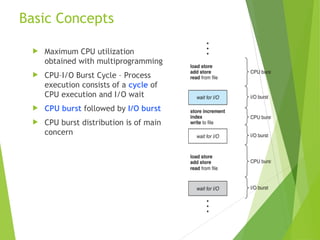
Basic Concepts
MaximumCPU utilization
obtained with multiprogramming
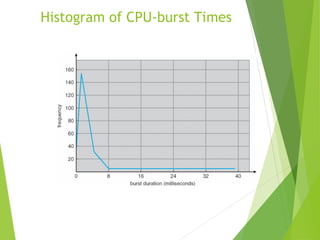
CPU–I/O Burst Cycle – Process
execution consists of a cycle of
CPU execution and I/O wait
CPU burst followed by I/O burst
CPU burst distribution is of main
concern
CPU Scheduler
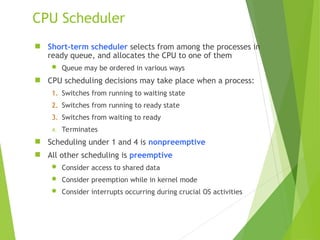
Short-termscheduler selects from among the processes in
ready queue, and allocates the CPU to one of them
Queue may be ordered in various ways
CPU scheduling decisions may take place when a process:
1. Switches from running to waiting state
2. Switches from running to ready state
3. Switches from waiting to ready
4. Terminates
Scheduling under 1 and 4 is nonpreemptive
All other scheduling is preemptive
Consider access to shared data
Consider preemption while in kernel mode
Consider interrupts occurring during crucial OS activities
5.
Dispatcher
Dispatcher modulegives control of the CPU to the process
selected by the short-term scheduler; this involves:
switching context
switching to user mode
jumping to the proper location in the user program to restart
that program
Dispatch latency – time it takes for the dispatcher to stop
one process and start another running
6.
Scheduling Criteria
CPUutilization – keep the CPU as busy as possible
Throughput – # of processes that complete their execution per
time unit
Turnaround time – amount of time to execute a particular
process
Waiting time – amount of time a process has been waiting in
the ready queue
Response time – amount of time it takes from when a request
was submitted until the first response is produced, not output
(for time-sharing environment)
7.
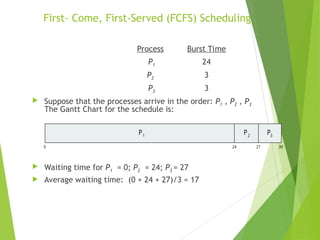
First- Come, First-Served(FCFS) Scheduling
Process Burst Time
P1 24
P2 3
P3 3
Suppose that the processes arrive in the order: P1 , P2 , P3
The Gantt Chart for the schedule is:
Waiting time for P1 = 0; P2 = 24; P3 = 27
Average waiting time: (0 + 24 + 27)/3 = 17
P P P
1 2 3
0 24 30
27
8.
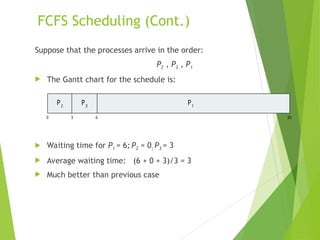
FCFS Scheduling (Cont.)
Supposethat the processes arrive in the order:
P2 , P3 , P1
The Gantt chart for the schedule is:
Waiting time for P1 = 6; P2 = 0; P3 = 3
Average waiting time: (6 + 0 + 3)/3 = 3
Much better than previous case
P1
0 3 6 30
P2
P3
9.
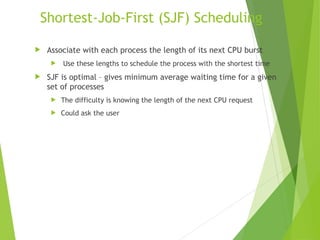
Shortest-Job-First (SJF) Scheduling
Associate with each process the length of its next CPU burst
Use these lengths to schedule the process with the shortest time
SJF is optimal – gives minimum average waiting time for a given
set of processes
The difficulty is knowing the length of the next CPU request
Could ask the user
10.
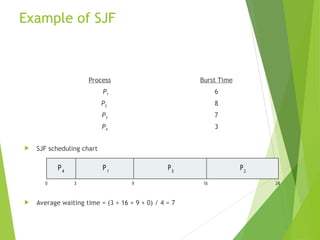
Example of SJF
ProcessArrival Time Burst Time
P1 0.0 6
P2 2.0 8
P3 4.0 7
P4 5.0 3
SJF scheduling chart
Average waiting time = (3 + 16 + 9 + 0) / 4 = 7
P3
0 3 24
P4
P1
16
9
P2
11.
Example of Shortest-remaining-time-first
Now we add the concepts of varying arrival times and preemption to the
analysis
ProcessAarri Arrival TimeTBurst Time
P1 0 8
P2 1 4
P3 2 9
P4 3 5
Preemptive SJF Gantt Chart
Average waiting time = [(10-1)+(1-1)+(17-2)+5-3)]/4 = 26/4 = 6.5 msec
P4
0 1 26
P1
P2
10
P3
P1
5 17
12.
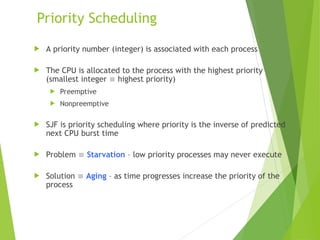
Priority Scheduling
Apriority number (integer) is associated with each process
The CPU is allocated to the process with the highest priority
(smallest integer highest priority)
Preemptive
Nonpreemptive
SJF is priority scheduling where priority is the inverse of predicted
next CPU burst time
Problem Starvation – low priority processes may never execute
Solution Aging – as time progresses increase the priority of the
process
13.
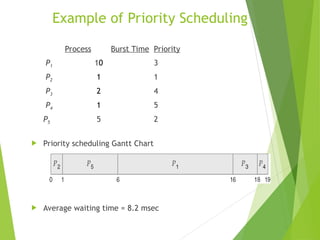
Example of PriorityScheduling
ProcessAarri Burst TimeTPriority
P1 10 3
P2 1 1
P3 2 4
P4 1 5
P5 5 2
Priority scheduling Gantt Chart
Average waiting time = 8.2 msec
14.
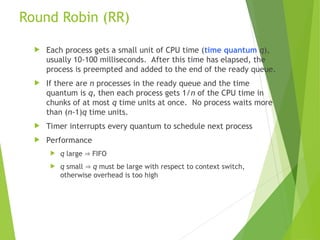
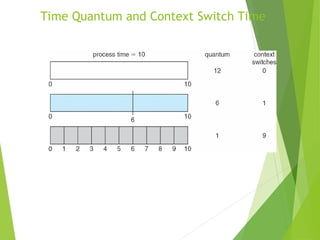
Round Robin (RR)
Each process gets a small unit of CPU time (time quantum q),
usually 10-100 milliseconds. After this time has elapsed, the
process is preempted and added to the end of the ready queue.
If there are n processes in the ready queue and the time
quantum is q, then each process gets 1/n of the CPU time in
chunks of at most q time units at once. No process waits more
than (n-1)q time units.
Timer interrupts every quantum to schedule next process
Performance
q large FIFO
q small q must be large with respect to context switch,
otherwise overhead is too high
15.
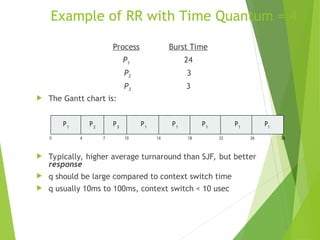
Example of RRwith Time Quantum = 4
Process Burst Time
P1 24
P2 3
P3 3
The Gantt chart is:
Typically, higher average turnaround than SJF, but better
response
q should be large compared to context switch time
q usually 10ms to 100ms, context switch < 10 usec
P P P
1 1 1
0 18 30
26
14
4 7 10 22
P2
P3
P1
P1
P1
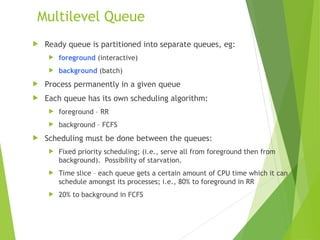
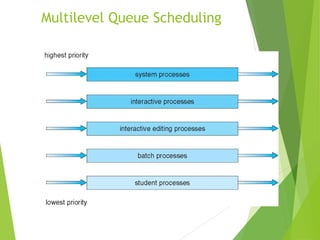
Multilevel Queue
Readyqueue is partitioned into separate queues, eg:
foreground (interactive)
background (batch)
Process permanently in a given queue
Each queue has its own scheduling algorithm:
foreground – RR
background – FCFS
Scheduling must be done between the queues:
Fixed priority scheduling; (i.e., serve all from foreground then from
background). Possibility of starvation.
Time slice – each queue gets a certain amount of CPU time which it can
schedule amongst its processes; i.e., 80% to foreground in RR
20% to background in FCFS
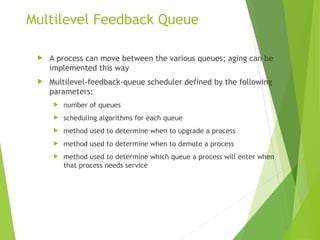
Multilevel Feedback Queue
A process can move between the various queues; aging can be
implemented this way
Multilevel-feedback-queue scheduler defined by the following
parameters:
number of queues
scheduling algorithms for each queue
method used to determine when to upgrade a process
method used to determine when to demote a process
method used to determine which queue a process will enter when
that process needs service
20.
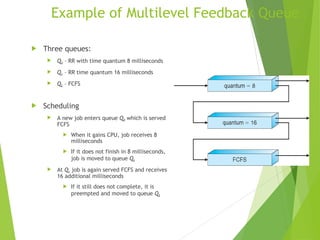
Example of MultilevelFeedback Queue
Three queues:
Q0 – RR with time quantum 8 milliseconds
Q1 – RR time quantum 16 milliseconds
Q2 – FCFS
Scheduling
A new job enters queue Q0 which is served
FCFS
When it gains CPU, job receives 8
milliseconds
If it does not finish in 8 milliseconds,
job is moved to queue Q1
At Q1 job is again served FCFS and receives
16 additional milliseconds
If it still does not complete, it is
preempted and moved to queue Q2
![Example of Shortest-remaining-time-first
Now we add the concepts of varying arrival times and preemption to the
analysis
ProcessAarri Arrival TimeTBurst Time
P1 0 8
P2 1 4
P3 2 9
P4 3 5
Preemptive SJF Gantt Chart
Average waiting time = [(10-1)+(1-1)+(17-2)+5-3)]/4 = 26/4 = 6.5 msec
P4
0 1 26
P1
P2
10
P3
P1
5 17](https://image.slidesharecdn.com/cpuscheduling-260202103224-8d7cd65d/85/CPU-SCHEDULING-IN-THE-OPERATING-SYSTEM-ppt-11-320.jpg)