Crafting an Equitable Carbon Pollution Tax for Vermont:
An Analysis of the Impacts of Bill H.412 on
Vermont’s Low-Income Community
Josh Brosnan, Paul Lagasse, Sawyer Olson,
Sydney Sanders and Virginia Wiltshire-Gordon
ES 401
Middlebury College
Fall 2015
1
Table of Contents:
Executive Summary 2
Background 4
Focus of Our Project 5
Methods: 6
Case Study Comparisons 6
Lessons Learned from Expert Interviews 16
Survey 21
Focus Groups 22
Results: 23
Survey Results 23
Focus Group Results 28
Discussion 30
Recommendations 35
Acknowledgements 36
Work Cited 37
Appendices 42
2
Executive Summary:
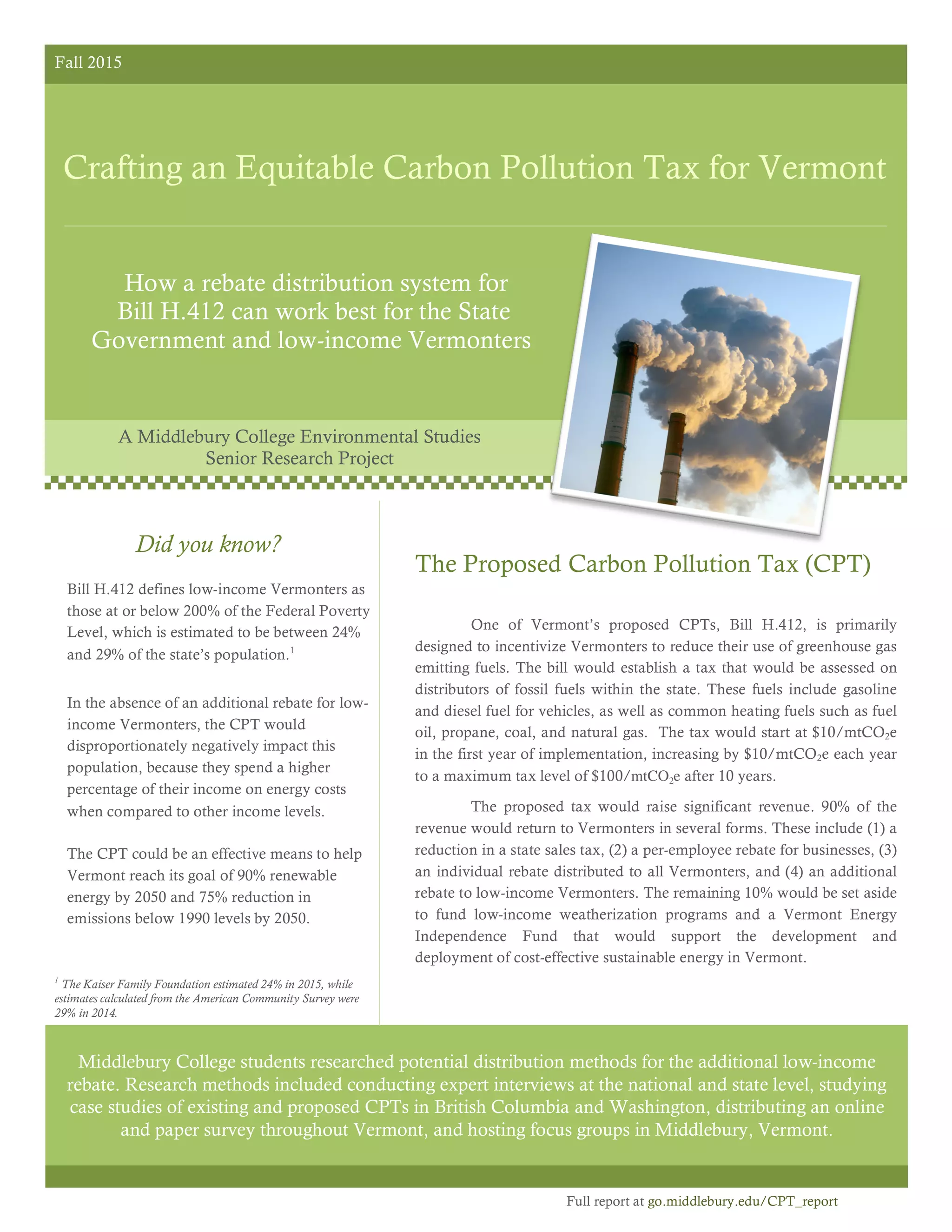
Vermont’s proposed carbon pollution tax, Bill H.412, is designed to incentivize
Vermonters to reduce their use of greenhouse gas emitting fuel. The bill would establish a tax
that would be assessed on distributors of fossil fuels within the state. These fuels include
gasoline and diesel fuel for vehicles, as well as common heating fuels such as fuel oil, propane,
coal, and natural gas. The tax would start at $10/mtCO2e in the first year of implementation,
increasing by $10/mtCO2e each year to a maximum tax level of $100/mtCO2e after 10 years.
90% of the revenue raised by the tax would return to Vermonters in several forms. The other
10% of the revenue raised would help fund low-income weatherization programs and a Vermont
Energy Independence Fund that would support the development and deployment of cost-
effective sustainable energy projects across the state.
Many taxes, including the proposed carbon pollution tax, can be regressive and
negatively impact low-income individuals, who spend a higher percentage of their income on
taxes compared to other income levels. Therefore, Bill H.412 should provide additional
considerations for low-income Vermonters to prevent unnecessary harm on this population. As
the bill is currently written, it does provide an additional rebate, but it does not specify how it
will distribute the rebate. Addressing this area of concern in a thoughtful manner is necessary to
ensure that Vermont’s carbon pollution tax is as equitable as possible. Recognizing this, we
worked to determine the best rebate distribution system for both low-income Vermonters and the
state of Vermont.
Our research methods included conducting expert interviews, examining case studies of
existing and proposed carbon pollution taxes, distributing an online and paper survey throughout
Vermont, and hosting focus groups in Middlebury, Vermont. Low-income Vermonters are
defined in the proposed carbon pollution tax as those with an “income that is 200 percent or less
of [the] federal poverty level”.1
It is estimated that these individuals account for about 29% of the
state’s population.2,3
In speaking with the members of Community Action Agencies and other
low-income advocates, we determined that 200% of the federal poverty level is widely used in
Vermont, and therefore likely makes sense as a threshold in the bill. However, the low-income
advocates with whom we talked expressed concern that individuals slightly above the low-
income threshold will not receive any additional rebate, which could create a benefit cliff. A
benefit cliff refers to a problem that occurs when a benefit is cut off entirely at a set income
threshold. From our research, we found that other existing and proposed carbon pollution taxes
address this issue. We believe that British Columbia’s approach, where the additional rebate for
low-income individuals is reduced by 2% of net family income over the income threshold, is the
most effective method to address benefit cliffs because it allows for a simple but gradual ramp-
1
Deen et al. An Act Relating to Establishing a Carbon Pollution Tax, 1
2
U. S. Census Bureau. “American FactFinder - Results.”
3
Another estimate puts the percentage of Vermonters living at or below 200% of the federal poverty level at 24% of the state’s
total population. See "State Health Facts: Distribution of Total Population by Federal Poverty Level." Kff.org
3
down of the rebate for individuals over the income threshold.4,5
To ensure that Bill H.412 is as
equitable as possible, legislators must consider the efficacy of different rebate distribution
methods. Through our survey we found that 41% of low-income respondents preferred to receive
a rebate through an income tax. While British Columbia distributes the rebates associated with
its carbon tax through the income tax system, it is crucial for Vermont legislators to recognize
that following in the footsteps of other carbon pollution taxes, and distributing rebates solely
through the income tax system would leave out a significant percentage of Vermonters.
According to the Vermont Department of taxes, 8% of Vermont residents live in households that
do not file taxes.6
This percentage is primarily made up of low-income individuals who are not
required to file taxes. 27% of survey respondents expressed interest in receiving a rebate through
an Electronic Benefit Transfer (EBT) card, a way in which many low-income individuals already
receive benefits, such as food assistance. Focus groups conducted with low-income individuals
in Middlebury, Vermont made it clear that while many low-income individuals recognize the
importance of environmental issues, and expressed a desire to curb their fossil fuel usage, their
economic status makes it especially difficult for them to adapt to the burden that would come
with a carbon pollution tax. Despite this, many low-income Vermonters expressed support for
Bill H.412. Both our survey and focus group results suggested that the rebate associated with
Vermont’s proposed carbon pollution tax should be delivered as a cash equivalent, giving low-
income residents the ability to choose how to spend their rebate; this could be accomplished both
through the income tax system and an EBT card distribution method.
Given our research, we recommend a two-pronged rebate distribution system employing
both income tax rebates and EBT cards with cash withdrawal accounts. We suggest that residents
with existing EBT cards should automatically receive their rebate through a cash account linked
to their card. All other low-income residents should receive the rebates associated with the
carbon pollution tax through an income tax credit. However, beyond this default distribution
structure, we suggest that low-income Vermonters should have a choice to opt into either rebate
distribution system. After much research, we firmly believe that a two-pronged distribution
system is most equitable for the largest number of Vermonters. While we believe our findings to
be an important starting point, continued research must be conducted to address the issue of
benefit cliffs, and to determine the feasibility of implementation of our two-prong rebate
distribution system.
4
Income Taxation Branch, Revenue Division, and Ministry of Finance. “Low Income Climate Action Tax Credit.”
5
British Columbia’s carbon tax went into effect on July 1st
, 2008.
6
Facebook message with Rebecca Sameroff, a statistician for the Vermont Department of Taxes on November 18th, 2015
4
Background:
For more than a decade, Vermont has been setting goals for reducing greenhouse gas
emissions, increasing the utilization of renewable energy, and increasing efficiency through
weatherization and other programs. In terms of greenhouse gas emissions, the target is to reduce
emissions to 50% below 1990 levels by 2028 and 75% below by 2050.7
For renewable energy,
the Public Service Department’s Comprehensive Energy Plan calls for meeting 90% of the
state’s energy needs with renewables by 2050.8
An additional stated goal is to increase the
weatherization of 25% of the state’s housing stock (about 80,000 units) by 2020.9
In 2014, a report prepared for the Vermont Department of Public Service noted that
Vermont now requires strong and effective policies to achieve the stated goals, and the report
suggested a number of policy options that the state could consider in order to help it meet its
energy goals.10
The first among those options was putting a price on carbon, through a tax or a
cap and trade system. In 2015 there were two bills, H.412 and H.395, introduced into the
Vermont legislature that would put a tax on carbon pollution from fossil fuels sold and
distributed in the state. The two bills are structurally similar and differ mainly in how fast they
reach the final tax rate and how the revenue from the tax is allocated, with H.395 reaching the
final tax rate more quickly and with H.412 returning a higher percentage of the revenue directly
to Vermonters. Of these two bills, H.412 emerged as the favorite of Energy Independent
Vermont (EIV), a coalition of diverse stakeholders including environmental organizations, low-
income advocacy groups, business associations, and academics. According one of H.412’s
cosponsors, Rep. Mary Sullivan, the bill’s goal is not just to bring in revenue but to change
behavior and cause Vermonters to use less fossil fuels.11
The bill would impose a tax on the sale of fossil fuels in the state in order to reflect
external costs of greenhouse gas emissions in the price of these fuels, which will reduce fossil
fuel use.12
The tax starts at $10 per metric ton of carbon dioxide emissions equivalent
($10/mtCO2e) emitted by fuel sold in the state by distributors, increasing by $10/mtCO2e each
year and reaching a final price of $100/mtCO2e after ten years.13
7
Public Service Department. “Total Energy Study.”
8
Public Service Department. “State Renewable Energy Goals.”
9
“Vermont Statutes Online,Title 10,Chapter 23, § 581: Building Efficiency Goals”
10
Regulatory Assistance Project. “Policy Options for Achieving Vermont’s Renewable Energy Carbon Targets.”
11
VTDigger. “State Carbon Tax Would Raise Gas Prices by as Much as 88 Cents a Gallon.”
12
Deen et al. An Act Relating to Establishing a Carbon Pollution Tax, 1
13
Ibid, 4.
5
The annual revenue from this tax would be used in the following ways:
• Offsetting administrative costs of the tax, up to $300,000
• 90% used for tax credits and rebates, including:
o Specific dollar amounts put toward reducing the state sales tax down from 6% to
5%
o 40% of the remaining revenue in this section put towards a per-employee rebate
for employers
o The remaining 60% in this section put towards an individual rebate for taxpayers.
§ Three quarters of this amount divided up and returned to all Vermonters as
a tax credit
§ One quarter of this amount set aside as an extra low-income rebate to be
divided up and allocated to Vermonters with income at or below 200% of
the federal poverty level
• 10% put into funds for home weatherization assistance and a Vermont Energy
Independence Fund for the development of clean energy resources14
Focus of Our Project:
Many taxes have the potential to be regressive, and therefore disproportionately
negatively impact low-income individuals.15
Low-income Vermonters are defined in the
proposed carbon pollution tax as those with an “income that is 200 percent or less of [the] federal
poverty level”.16
It is estimated that these individuals account for about 29% of the state’s
population.17,18
Various stakeholders of the EIV coalition have raised concerns about the impacts
of the tax on this specific population. This is because low-income people spend a higher
percentage of their income on energy costs when compared to other income levels, and will be
burdened by the additional tax.19
An analysis done by the Vermont Law School found that in
2012, the poorest income decile in Vermont had an average of only 72% of their income
remaining after spending on energy, compared to over 90% of income remaining for people in
the top half of incomes.20
The EIV coalition and others are concerned that a carbon pollution tax would
disproportionately negatively impact low-income people, a population with the least disposable
income to invest in efficiency and the least flexibility to reduce their consumption. Some low-
14
Ibid.
15
"Who Pays? 5th Edition | The Institute on Taxation and Economic Policy (ITEP)."
16
Deen et al. An Act Relating to Establishing a Carbon Pollution Tax, 1
17
U. S. Census Bureau. “American FactFinder - Results.”
18
Another estimate puts the percentage of Vermonters living at or below 200% of the federal poverty level at 24% of the state’s
total population. See "State Health Facts: Distribution of Total Population by Federal Poverty Level." Kff.org
19
“Millions of Low-Income Households Burdened by Fuel Insecurity.” PBS NewsHour.
20
Teller-Elsberg et al. “Energy Costs and Burdens in Vermont: Burdensome for Whom?”, 15.
6
income advocates, including Jan Demers of Champlain Valley Office of Economic Opportunity
(CVOEO), believe that low-income Vermonters should be exempt from the proposed tax in order
to protect them from these negative effects. However, assuming that low-income Vermonters
would not be excluded from the tax, rebates delivered to this population should be distributed in
a way that protects this group from the potential unintended negative impacts, and gives them the
opportunity to choose how they spend the rebate.
Currently, the bill under consideration states that the “Commissioner [of Taxes], in
consultation with the Secretary of Human Services, shall determine the manner in which this
rebate is delivered to eligible taxpayers, and shall consider delivering this rebate through existing
programs that provide resources to low-income Vermonters such as 3SquaresVT or Home
Heating Fuel Assistance.” Additionally, the bill says that “eligible taxpayers shall receive this
rebate on a monthly basis.”
Because the bill does not describe a specific method or program for distributing the
rebate to low-income people, we have tried to determine the most effective, efficient, and
equitable rebate distribution system that the state of Vermont could implement. The ideal
distribution method would accomplish those goals without making it logistically unfeasible and
too costly for the Vermont government. We aimed to determine the method that would reach the
most low-income Vermonters while also allowing them to spend the rebate without any
restrictions.
Methods:
Case Comparisons
Vermont’s proposed carbon pollution tax does not exist in isolation. Other nations and
states have proposed and existing carbon pollution taxes. Recognizing this, Vermont can learn
from the successes and shortcomings of other attempts to tax carbon pollution. We researched a
variety of carbon pollution taxes throughout North America and Europe. Specifically, we were
interested in learning how the design of these other taxes address low-income residents. We
looked most deeply into the proposed and implemented taxes in British Columbia, Washington
and Massachusetts. Other states and countries that have proposed or implemented taxes include
Oregon, New York, Rhode Island, Denmark, Finland, Ireland, Norway, Sweden, the
Netherlands, Australia, and Chile.
7
British Columbia
On July 1, 2008, British Columbia implemented a carbon tax.21,22
Seven years later, the
success of British Columbia’s carbon tax makes it an important example for Vermont legislators
to consider in their design of Vermont’s carbon pollution tax.
British Columbia’s carbon tax started at $10/mtCO2e and increased by $5/mtCO2e every
year until 2012. Since then, the tax has stayed constant at $30/mtCO2e.23,24
It is revenue-neutral,
meaning that every dollar raised by the tax is returned to individuals and businesses through tax
reductions; none of the revenue from the carbon tax is used to fund government spending. Since
the implementation of the tax, the first two individual income tax brackets have been reduced by
five percent.25
Yet, tax reductions alone are not enough to make British Columbia’s carbon tax
equitable.
Had no additional measures been taken, British Columbia’s carbon tax would have
adversely impacted lower income residents who spend a higher percentage of their funds on
energy and transportation than their wealthier counterparts. In recognition of this, legislators in
British Columbia instituted the Low-Income Climate Action Credit. This credit is paid quarterly
along with the Federal Goods and Services Tax Credit, a harmonized sales tax credit. Individuals
can apply for the tax credit when they file their income tax return.26
This is significant, because it
means that individuals who do not file income taxes are not be able to receive the rebates
associated with British Columbia’s carbon tax. Information provided by the British Columbia
Ministry of Finance, Tax Policy Branch, stated that the number of individuals in British
Columbia who live in households where no one filed federal and provincial income tax (in
Canada they are filed together) and therefore would not be able to receive the rebates associated
with the tax fluctuates between 6% and 10% of the total population. The BC Ministry of Finance,
Tax Policy Branch, emphasized that it is impossible to reach the entire population and that using
the tax system to deliver a benefit creates an incentive for people to file their taxes.27
The Low-
Income Climate Action Tax Credit is a non-table payment, meaning that an individual does not
need to include it as income when they file their tax return. Only one person can apply for the
credit on behalf of a family. Anyone who is nineteen years or older, has a spouse or common-law
partner, or is a parent who resides with a child can apply for the tax credit as long as they reside
in British Columbia.28
The amount an individual receives from the tax credit depends on the size of their family
and their adjusted net family income. The maximum annual payment for the tax credit in 2015
was $115.50 for an individual, $115.50 for their spouse, and $34.50 per child or $115.50 for the
21
British Columbia refers to its carbon pollution tax as a “carbon tax”. In the “Case Studies” section of our paper we refer to the
various carbon pollution taxes as they are locally known.
22
Province of British Columbia. “Carbon Tax: Overview of the Revenue-Neutral Carbon Tax.”
23
ibid.
24
All monetary values under the sub-heading “British Columbia” are given in Canadian Dollars.
25
ibid.
26
Income Taxation Branch, Revenue Division, and Ministry of Finance. “Low Income Climate Action Tax Credit.”
27
Email with Daphna Mills on November 10th, 2015.
28
Income Taxation Branch, Revenue Division, and Ministry of Finance. “Low Income Climate Action Tax Credit.”
8
first child in a single parent family. In 2015, the net income threshold to receive the credit was
$32,445 for single people, and $37,852 for married individuals or single parents. The credit is
reduced by 2% of net family income over the income threshold.29
This minimizes any possibility
for the creation of a benefit cliff, a problem that occurs when a benefit is cut off entirely at a set
income threshold. With that in mind, there is disagreement among low-income advocates in
Vermont over whether the rebates from the proposed carbon pollution taxes would be large
enough to create significant benefit cliffs.
Unlike the United States, Canada does not have an official federal poverty line. Because
of this, the income threshold for British Columbia’s carbon tax was created specifically for this
piece of legislation. According to the BC Ministry of Finance, Tax Policy Branch, the thresholds
were determined to best assist low-income households with the economic burden associated with
the carbon tax while also ensuring the revenue neutrality of the bill.30
British Columbia also has an additional rebate for rurally located individuals. This
additional rebate came about as a result of protests, and responds to the fact that most remote and
rural communities are unfairly burdened by the carbon tax because of the long-distances they are
required to travel for work and daily necessities, and higher home heating requirements than
people in cities.31
The Northern and Rural Homeowner Benefit provides up to $200 for
homeowners in the areas of the province outside of major metropolitan centers. Specifically, this
refers to anywhere outside of the Capital Regional District, the Greater Vancouver Regional
District, and the Fraser Valley Regional District.32
Individuals can receive both the Northern and
Rural Homeowner Benefit and the Low Income Climate Action Tax Credit; the two rebates are
not mutually exclusive. In contrast to British Columbia, the rural nature of Vermont would make
the adoption of an additional rebate for rurally located individuals redundant; instead legislators
would be better served by addressing the concerns of rurally located Vermonters in the initial
rebate that is associated with its carbon pollution tax.
In British Columbia, farmers are exempt from the carbon tax.33
Revenue from the
agricultural sector in British Columbia accounts for over eleven billion dollars, and represents
just under five percent of British Columbia’s GDP in 2013.34
This stands in contrast to
Vermont’s proposed carbon pollution tax, which emphasizes the inclusion of all Vermonters in
the tax as necessary for preserving the spirit of the bill. Significantly, Vermont’s agricultural
sector accounts for less than 2% of the state’s GDP.35
29
ibid.
30
Email with Daphna Mills on November 8th, 2015.
31
Beck et al., A Rural Myth? The Perceived Unfairness of Carbon Taxes in Rural Communities
32
Income Taxation Branch, Revenue Division, and Ministry of Finance. “Low Income Climate Action Tax Credit.”
33
Province of British Columbia. “Certificate of Famer Exemption.”
34
Ministry of Agriculture. “Agriculture Business and Economy.”
35
Jeffords, “Economic Impact of Agriculture in Vermont.”
9
What Can Vermont Learn from British Columbia’s Carbon Tax?
• Revenue neutrality: This may lower costs for administrators and dispel any
concerns over increasing government spending that may exist amongst
politicians and Vermont residents.
• Problems with distribution through the tax system: Many low-income folks do
not file taxes. While it is simpler and likely cheaper for administrators to
distribute the rebates through tax refunds, doing so leaves out a significant
percentage of low-income individuals; the very people that the additional
rebates are supposed to aid.
• Gradual ramp down of additional rebate: Unlike British Columbia’s carbon
tax, in the case of Vermont’s proposed carbon pollution tax, individuals just
above the low-income threshold would not receive any additional rebates. A
gradual ramp down of the additional rebate, possibly mirroring British
Columbia’s Low-Income Climate Action Tax Credit, could diminish Bill
H.412’s chance of creating a benefit cliff.
• Lower maximum tax rate: Vermont’s proposed carbon pollution tax is much
more ambitious than British Columbia’s. British Columbia’s tax plateaus at
$30/mtCO2e, while Vermont’s stabilizes at $100/mtCO2e. Yet, British
Columbia’s tax has been successful in curbing individual behavior.36
Lowering the maximum taxation rate could ease Bill H.412’s journey through
legislation without compromising the goals of the carbon pollution tax.
• Frequency of rebate distribution matters: For low-income individuals, the
frequency with which they receive their additional rebate is crucial, especially
as the rebate increases in monetary value. As it is currently written, Bill H.412
would distribute the rebates monthly. Going forward, legislators should
continue to emphasize the importance of having the rebates associated with
Vermont’s carbon pollution tax be distributed frequently.
• Exemption of agriculture: There has been some resistance to Vermont’s
proposed carbon pollution tax from its agricultural sector. While it stands in
contrast to the spirit of the bill, and Vermont has a significantly smaller
agricultural sector than British Columbia, special considerations for
Vermont’s agricultural sector could help curtail some of that sector’s qualms
with Bill H.412.
36
Province of British Columbia. “Carbon Tax: Overview of the Revenue-Neutral Carbon Tax.”
10
Washington
Washington state’s proposed a carbon tax, referendum I-732, needed at least 250,000
signatures to make ballot in November 2016. According to Yoram Bauman, an economist
working on the tax for Carbon Washington,referendum I-732 appears to have obtained enough
signatures to qualify for the ballot.37,38
I-732 draws heavily on British Columbia’s carbon tax. If implemented, the tax would
begin at $15/mtCO2e, and increase to $25/mtCO2e after two years. After this point, the tax would
increase by 3.5% percent per year until it would plateau at $100/mtCO2e; it would take forty
years to reach this number in 2016 dollars.39
Like British Columbia, Washington state’s proposed
carbon tax is designed to be revenue-neutral. Currently, people in Washington state with the
lowest income pay the greatest percentage of their income in taxes. I-732 would attempt to make
Washington’s tax code more progressive by reducing sales tax from 6.5% to 5.5%.40
There would also be a rebate for low-income Washingtonians associated with the carbon
tax. The revenue raised from I-732 would go to the Working Families Rebate, which was created
in 2008, but never funded. The Working Families Rebate is a bump up of the Federal Earned
Income Tax Credit (EITC), and comes in the form of a sales tax exemption.41
Through a refund
of a portion of state sales tax, the Working Families Rebate aims provide up to $1,500 a year to
the 400,000 households in Washington that qualify for the EITC. The Working Families Rebate
would phase in at a 15% increase of the EITC in its first year, and in its second year and onward,
it would be a 25% bump up of the EITC.42
The EITC was established in recognition of the reality that federal payroll taxes cost low-
income families a substantially higher share of their income when compared to middle or upper
class families. Also, larger families face higher living expenses than smaller families, and this is
taken into account in the design of the EITC. The maximum federal benefit for families with two
children in tax year 2015 was $5,548; for families with three or more children, the max was
$6,242. For families with one child the maximum is $3,359. Workers without a qualifying child
can also receive an EITC, but at a much lower amount. The maximum credit for individuals or
couples without children was $503 in 2015.43
For families with very low earnings, the dollar
amount of the EITC increases as earnings rise. For example, families with two children receive a
credit equal to 40 cents for each dollar earned up to $12,900, for a maximum benefit of $5,160.
Families continue to be eligible for maximum credit until personal income reaches $16,840 (or
$21,970 for married-couple families), after which the amount they receive goes down until it
reaches zero when family income surpasses the eligibility level.44
For single-parent families with
37
Email with Yoram Bauman on November 8th, 2015.
38
“Carbon tax seems to have enough signatures to make ballot.” Greenwire.
39
“Our Proposal.” Carbon Washington.
40
ibid.
41
ibid.
42
ibid.
43
“2015 EITC Income Limits, Maximum Credit Amounts and Tax Law Updates.” IRS.
44
ibid.
11
two children, eligibility for the EITC ends when income exceeds $41,341. Families with one
child remain eligible until their income exceeds $36,372. Finally, for married couples, eligibility
for the credit ends when income exceeds $46,471.45
Working families with incomes below the
federal poverty line receive the largest benefits. However, because the EITC phases out
gradually as income rises, many families with incomes well above the poverty line still benefit to
some degree. Therefore, by distributing rebates through the EITC, I-732 avoids the possibility of
creating a benefit cliff. But, because I-732 distributes its rebates through the tax system,
Washingtonians who do not file taxes would not be able to claim the rebates to which they are
entitled. In both of these senses, I-732 is similar to British Columbia’s carbon tax.
Paralleling British Columbia’s carbon tax, I-732 plans to provide farmers with special
treatment. The referendum calls for a forty-year phase in for farm diesel and fuel used in public
transportation systems.46
The total amount of farm diesel and fuel used in public transportation
systems is about 100 million gallons, and amounts to just 2% of statewide carbon dioxide
emissions.47
The exemption of farm diesel from I-732 is not surprising because of the size
Washington state’s agriculture sector. Washington has a $49 billion food and agriculture
industry, which employs approximately 160,000 people and comprises 13% of the state’s GDP;
farm diesel is also already exempt from the state’s existing fuel tax.48
It is worthwhile to
recognize that Washington state’s agricultural sector is significantly larger than Vermont’s
agricultural sector.
What Can Vermont Learn from Washington’s Proposed Carbon Tax?
● Revenue neutrality: Like British Columbia, this could lower costs for
administrators and dispel any concerns over increasing government spending that may
exist amongst politicians and residents.
● Problem with distribution through the tax system: Many low-income folks do not
file taxes. While it is simpler and likely cheaper for administrators to distribute the
rebates through the tax system, doing so leaves out a significant percentage of low-
income individuals; the very people that the additional rebates are supposed to aid.
● Gradual ramp down of additional rebate: Because it is a bump up of the EITC,
Washington’s additional rebate for low-income individuals will gradually ramp up and
ramp down. Following Washington’s lead, and making the rebate a bump up of the
EITC, Vermont legislators could diminish Bill H.412’s chance of creating a benefit
cliff.
● Timeframe to reach maximum tax rate: Like Vermont’s proposed carbon
pollution taxes plateau at $100/mtCO2e, but Washington’s does so over forty years
while Vermont reaches its maximum rate in just ten years. Increasing the timeframe to
45
ibid.
46
“Our Proposal.” Carbon Washington.
47
ibid.
48
Washington State Department of Agriculture, “Agriculture: A Cornerstone of Washington’s Economy.”
12
reach its maximum taxation rate could ease Bill H.412’s journey through legislation
without compromising the ultimate goals of the carbon pollution tax.
● Exemption of agriculture: While Washington state has a significantly larger
agricultural sector than Vermont does, there has been some resistance to Vermont’s
proposed carbon pollution tax from its agricultural sector. Following Washington’s
example and exempting farm diesel could help curtail the agricultural sector’s qualms
with Bill H.412.
Massachusetts
In April of 2015, State Senator Mike Barrett proposed Massachusetts’ carbon dioxide
emissions fee, Bill S.1747. Testimony from Barrett was heard by the state’s general assembly on
October 27th
, 2015.49
If enacted into law, the fee would begin at $10/mtCO2e in its first year.
Charges would increase by $5/mtCO2e per year until the rate reached $40/mtCO2e.50
The bill would be rhetorically classified as a fee and not a tax because all the revenue it
raised would flow into a transparent fund, which was created specifically for the bill and
remained separate from the state’s government’s general treasury. This fund would be referred to
as the Carbon Dioxide Emissions Charges Rebate Fund. Because none of the proceeds from the
fee would go to the government, Bill S1747 would be revenue-neutral.51
As currently designed, every resident in Massachusetts, with the exception of “rurally
located” individuals, would receive an equal rebate from the bill.52
Residents of rural
municipalities would receive an additional Motor Vehicle Fuel Rebate, the amount of which
would also be annually determined by the Commissioner. The bill defines a “rural municipality”
as one where residents drive, on average, 130% or more per year of the statewide average per
household.53
According to one estimate, when the carbon charge rate reaches $40/mtCO2e, the
annual rebate associated with the bill would be $225.54
That being said, the Commissioner of
Energy Resources would set the amount of the individual rebate that is distributed to residents.55
Bill S1747 is unique amongst proposed the carbon pollution taxes we examined in that it
contains no special considerations for low-income individuals. In fact, the bill only mentions
low-income residents once, noting that “special attention” would be made to locate the names
and addresses of low-income residents, so that rebates can be delivered to them.56
According to
the bill, on average, people and employers would receive rebate payments that would fully offset
the higher cost of gas and oil, with low and moderate-income households coming out ahead
because they use less energy than wealthier households. Further differentiating itself from the
49
Barrett, An Act Combating Climate Change
50
ibid.
51
ibid.
52
ibid.
53
ibid.
54
Schoenberg, “Environmentalists Push Carbon Fee in Massachusetts.”
55
Barrett, An Act Combating Climate Change
56
ibid.
13
other carbon pollution taxes that we examined, Bill S1747 does not exempt farmers from its
carbon charges; no one is exempt from the fee.57
In this sense, it is similar to Vermont’s proposed
carbon pollution tax.
What Can Vermont Learn From Massachusetts’ Carbon Dioxide Emissions Fee?
● Revenue neutrality: As we have previously mentioned, this may lower costs for
administrators and dispel any concerns over increasing government spending that may
exist amongst politicians and residents.
● Changing the tax to a fee: Due to the stigmatization of taxes, rhetorically, Bill
H.412 may be meet with less resistance if it were a classified as a “fee”. Following
Massachusetts’ lead, Vermont could do this by creating a transparent fund for the
revenue raised from Bill H.412, which would remain separate from the state
government’s general treasury.
● Lower maximum tax rate: Vermont’s proposed carbon pollution tax is much more
ambitious than Massachusetts’ carbon dioxide emissions fee. Massachusetts’ fee
plateau’s at $40/mtCO2e, while Vermont’s tax stabilizes at $100/mtCO2e. As discussed
earlier, lowering the maximum taxation rate could ease Bill H.412’s journey through
legislation.
● No exemptions: Like Massachusetts’ carbon dioxide emissions fee, no one is
exempt from Vermont’s proposed carbon pollution tax because it goes against the
spirit of the bill, which is to curb individual fossil fuel use across the board. While this
concept may be met with some resistance, emphasizing that other states are following
this framework may provide Bill H.412 with increased legitimacy.
57
ibid.
14
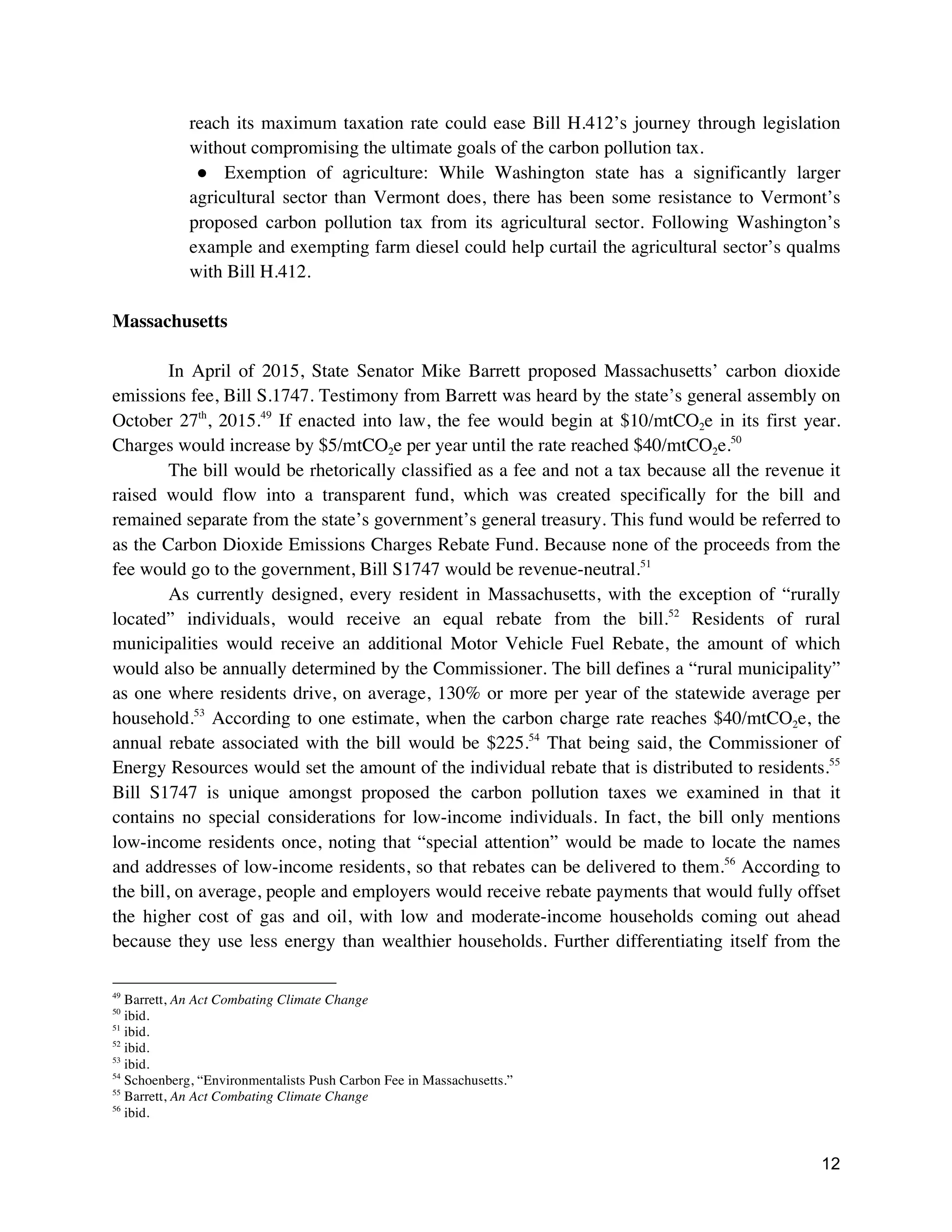
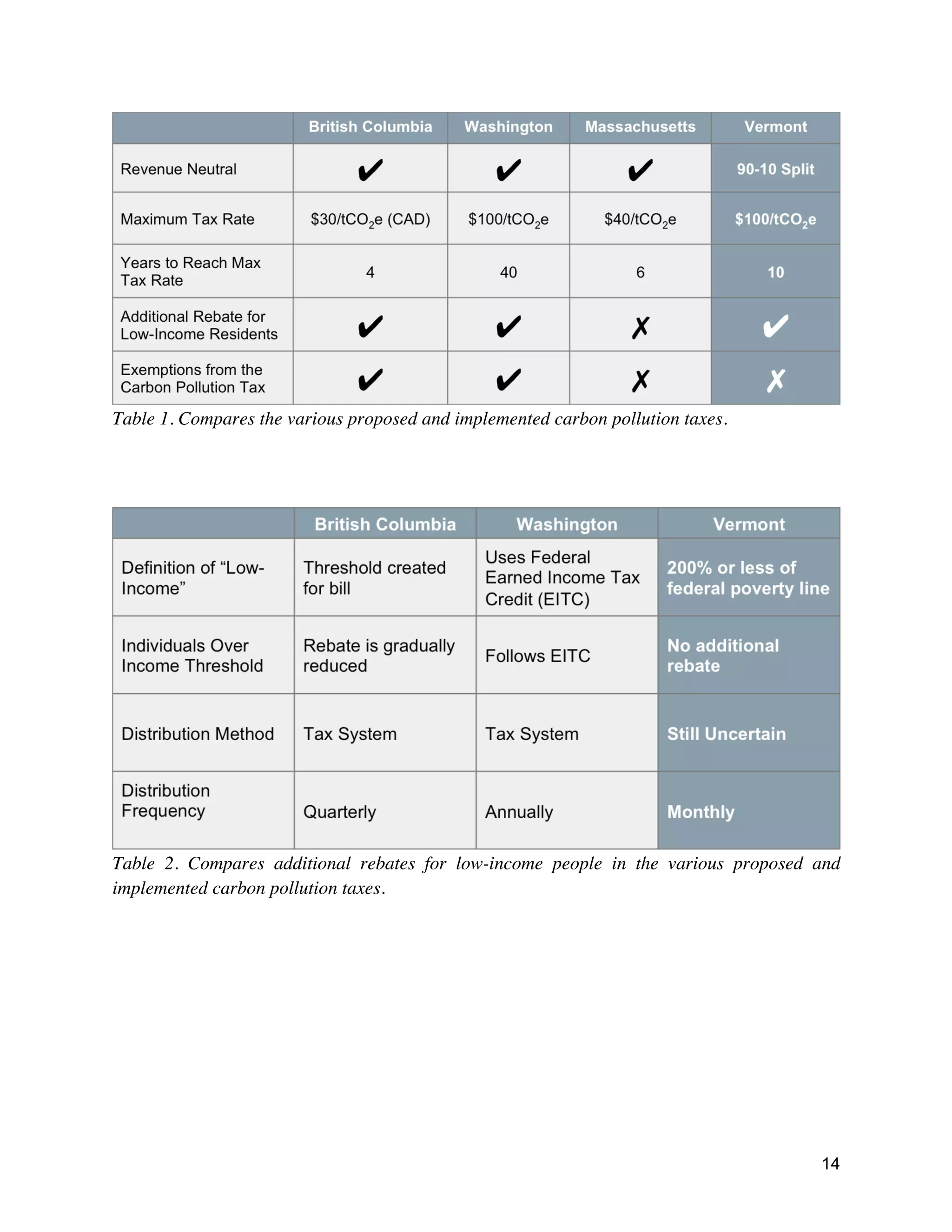
Table 1. Compares the various proposed and implemented carbon pollution taxes.
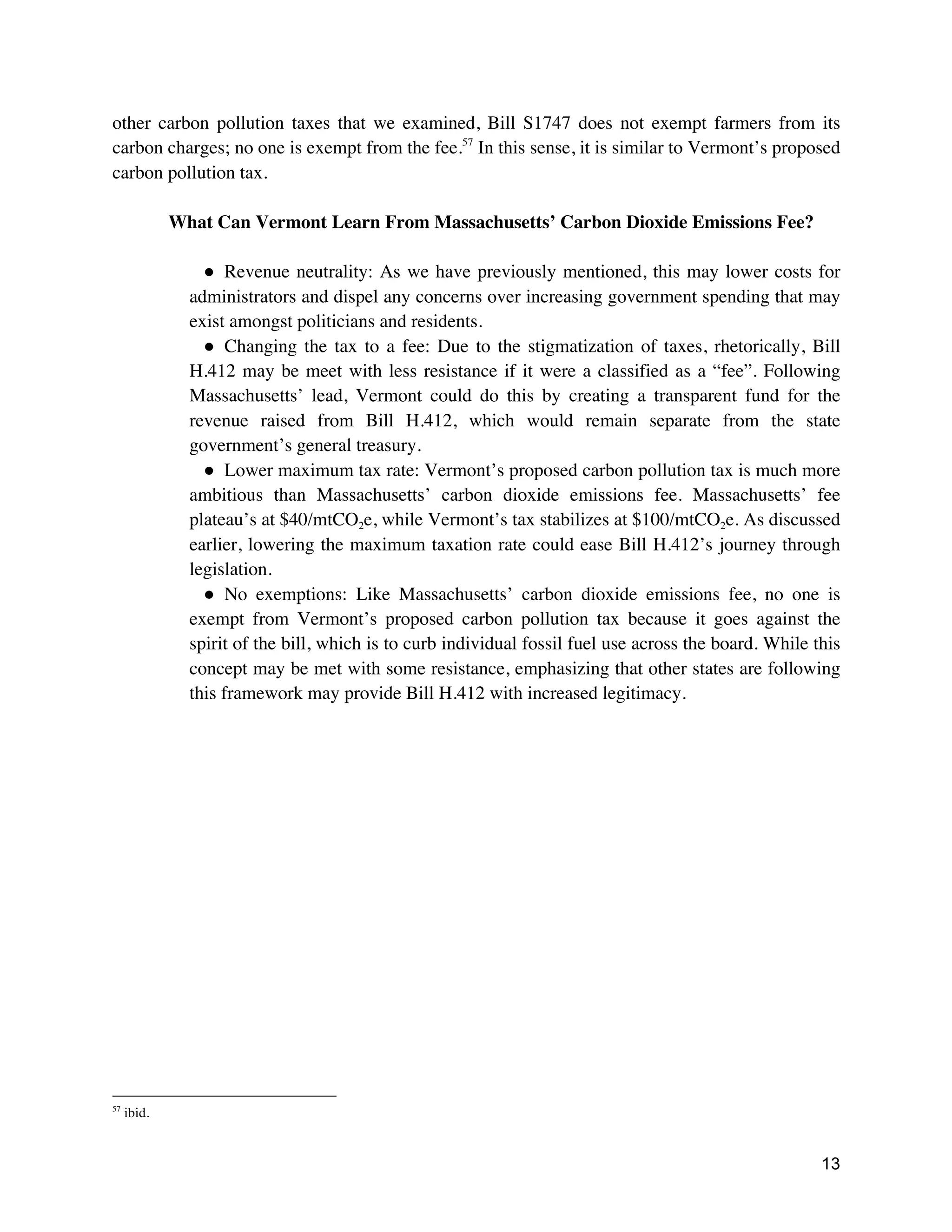
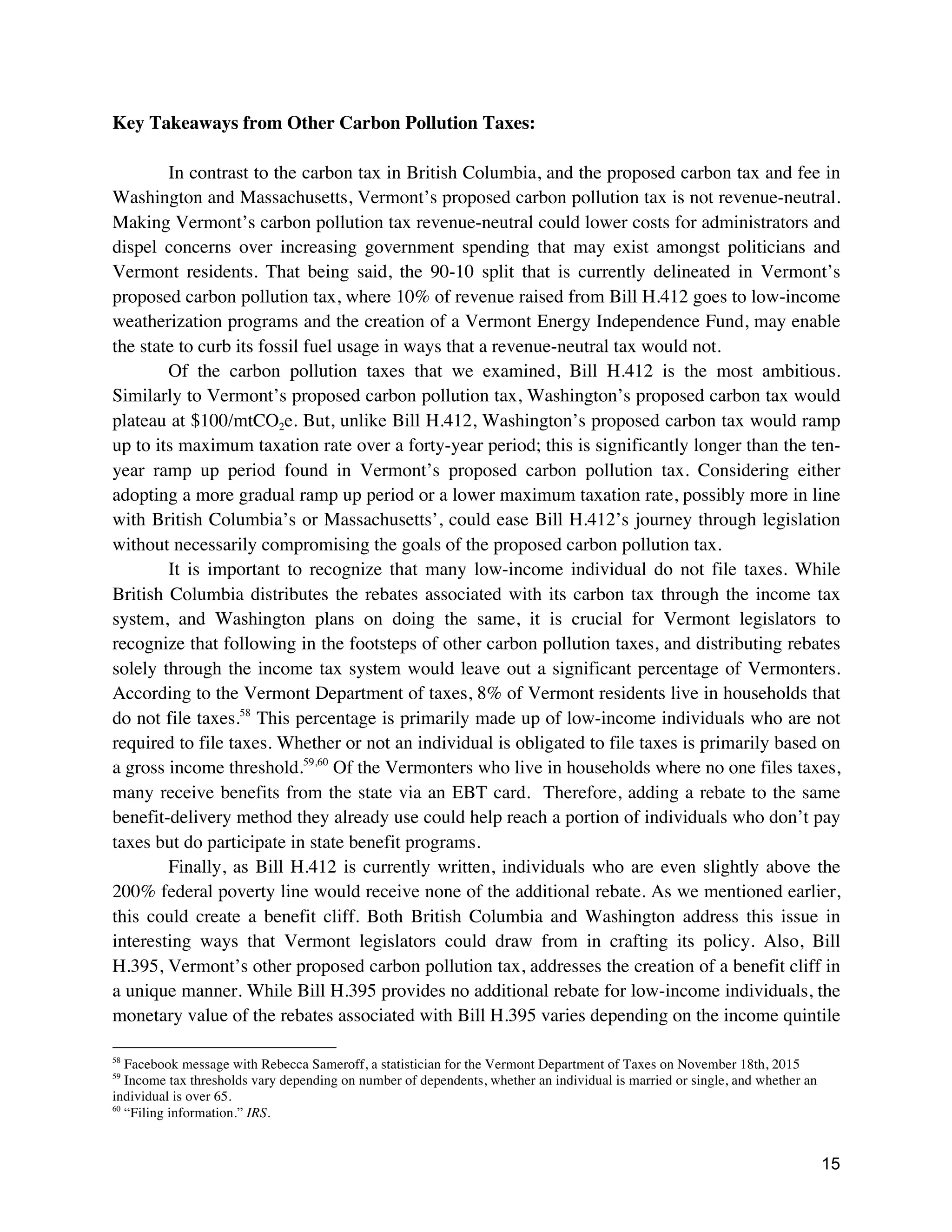
Table 2. Compares additional rebates for low-income people in the various proposed and
implemented carbon pollution taxes.
15
Key Takeaways from Other Carbon Pollution Taxes:
In contrast to the carbon tax in British Columbia, and the proposed carbon tax and fee in
Washington and Massachusetts, Vermont’s proposed carbon pollution tax is not revenue-neutral.
Making Vermont’s carbon pollution tax revenue-neutral could lower costs for administrators and
dispel concerns over increasing government spending that may exist amongst politicians and
Vermont residents. That being said, the 90-10 split that is currently delineated in Vermont’s
proposed carbon pollution tax, where 10% of revenue raised from Bill H.412 goes to low-income
weatherization programs and the creation of a Vermont Energy Independence Fund, may enable
the state to curb its fossil fuel usage in ways that a revenue-neutral tax would not.
Of the carbon pollution taxes that we examined, Bill H.412 is the most ambitious.
Similarly to Vermont’s proposed carbon pollution tax, Washington’s proposed carbon tax would
plateau at $100/mtCO2e. But, unlike Bill H.412, Washington’s proposed carbon tax would ramp
up to its maximum taxation rate over a forty-year period; this is significantly longer than the ten-
year ramp up period found in Vermont’s proposed carbon pollution tax. Considering either
adopting a more gradual ramp up period or a lower maximum taxation rate, possibly more in line
with British Columbia’s or Massachusetts’, could ease Bill H.412’s journey through legislation
without necessarily compromising the goals of the proposed carbon pollution tax.
It is important to recognize that many low-income individual do not file taxes. While
British Columbia distributes the rebates associated with its carbon tax through the income tax
system, and Washington plans on doing the same, it is crucial for Vermont legislators to
recognize that following in the footsteps of other carbon pollution taxes, and distributing rebates
solely through the income tax system would leave out a significant percentage of Vermonters.
According to the Vermont Department of taxes, 8% of Vermont residents live in households that
do not file taxes.58
This percentage is primarily made up of low-income individuals who are not
required to file taxes. Whether or not an individual is obligated to file taxes is primarily based on
a gross income threshold.59,60
Of the Vermonters who live in households where no one files taxes,
many receive benefits from the state via an EBT card. Therefore, adding a rebate to the same
benefit-delivery method they already use could help reach a portion of individuals who don’t pay
taxes but do participate in state benefit programs.
Finally, as Bill H.412 is currently written, individuals who are even slightly above the
200% federal poverty line would receive none of the additional rebate. As we mentioned earlier,
this could create a benefit cliff. Both British Columbia and Washington address this issue in
interesting ways that Vermont legislators could draw from in crafting its policy. Also, Bill
H.395, Vermont’s other proposed carbon pollution tax, addresses the creation of a benefit cliff in
a unique manner. While Bill H.395 provides no additional rebate for low-income individuals, the
monetary value of the rebates associated with Bill H.395 varies depending on the income quintile
58
Facebook message with Rebecca Sameroff, a statistician for the Vermont Department of Taxes on November 18th, 2015
59
Income tax thresholds vary depending on number of dependents, whether an individual is married or single, and whether an
individual is over 65.
60
“Filing information.” IRS.
16
that an individual belongs to.61
Of the money that goes back to individuals through personal
income tax credits, none will go to the top income quintile, 40% will be distributed equally
amongst the 2nd
and 3rd
highest income quintiles, and 60% will be distributed equally amongst
the two lowest income quintiles.62
Clearly, crafting an equitable carbon pollution tax is no easy undertaking. It is therefore
paramount to the success of Bill H.412 that Vermont legislators examine other existing and
proposed carbon pollution taxes and see what Vermont can learn from them.
Lessons Learned from Expert Interviews:
Jan Demers, Executive Director, Champlain Valley of Economic Opportunity (CVOEO)
Steve Geller, Executive Director, Southeastern Vermont Community Action (SEVCA)
We had the opportunity to speak with Jan Demers, the Executive Director of CVOEO,
which serves Addison, Chittenden, Franklin, and Grand Isle counties as well as Steve Geller, the
Executive Director of SEVCA, which serves Windham and Windsor counties. CVOEO works to
address the “fundamental issues of economic, social, and racial justice and works with people to
achieve economic independence”63
. Their services include weatherization, income tax
assistance, fuel assistance, domestic violence and sexual assault assistance, housing assistance,
food shelves, warmth assistance and a program called Community Action. SEVCA functions
similarly to CVOEO, in that its mission is to lessen the hardships of poverty through programs
that foster self-sufficiency. Specifically, SEVCA offers a number of business development and
workforce preparation services, family services, home care and weatherization services, and also
manages multiple thrift stores in both Windham and Windsor county. Demers (CVOEO) was
reluctant to sign on in support of the carbon pollution tax in Vermont because of the possible
unintended negative outcomes for the low-income population that her organization serves.
Demers currently would rather have low-income people, at or under the 200% poverty level, be
exempt from the bill. She explained that low-income Vermonters spend a larger percentage of
their income on gas, heating, and other energy sources than other Vermonters, and therefore will
be impacted greater by the tax. Additionally, she believes that two other barriers low-income
Vermonters face if they did have to participate in the tax would be not knowing that they
qualified for a rebate, and not having access to the rebate if they do not file for taxes.
Geller (SEVCA) discussed similar concerns, noting the potential for a benefit cliff caused
by this tax. He felt very strongly that a more complex mechanism to determine who would and
would not qualify for the additional low-income rebate must be implemented into the proposed
carbon pollution tax. Geller believed that a sliding income scale could be used, so that
61
Pearson et al. An Act Relating to Establishing a Carbon Pollution Tax.
62
ibid.
63
Champlain Valley Office of Economic Opportunity. “Mission.”
17
individuals who earn slightly above 200% of the federal poverty line would receive an additional
rebate that is slightly smaller. This system could also be used to protect those who make very
little annually, as the additional low-income rebate could be increased for individuals at or below
100% of the federal poverty line.
Despite her views, Demers was open to discussing rebate distribution systems with us.
Demers mentioned the importance of understanding a benefit cliff and how this should be
considered in any rebate distribution system, to avoid negative consequences for low-income
people that move slightly above the 200% poverty level. Demers described the large stigma
associated with the use of Electronic Benefit Transfer (EBT) cards. Individuals that receive
government benefits can authorize a transfer of these benefits from a Federal account to a card.
This card looks like and function like a debit card, and can be used at participating grocery stores
for example, or ATMs, through an unrestricted cash withdrawal account.64
Geller disagreed with
Demers about the stigma associated with EBT cards: he believed that, because they “look like
Mastercards”, they’re a large improvement from food stamps. Additionally, they would be
effective in reducing the potential negative impacts of receiving a rebate just once a year. Geller
explained that, as the tax increases, low income earners will have less ability to deal with fuel
price increases, and would need to receive the tax rebate more frequently to cope with these price
increases.
Demers does believe that an unrestricted cash benefit through an EBT card could work
well, as it could empower low-income Vermonters to independently decide how they spend their
rebate. She also pointed out the importance of creating a new account because adding the rebate
to an existing account might put the amount of money over the total allowed, causing the
cardholder to lose out on any benefit above the limit.
Chad Stone, Chief Economist, Center for Budget and Policy Priorities
The Congressional Budget Office Microeconomic Studies Division
In addition to our conversations with Vermont-based low-income advocates, we
researched carbon pollution tax rebate options and approaches that have been analyzed at the
federal level and were able to speak to two of the authors of these reports. Chad Stone is the
chief economist for the Center for Budget and Policy Priorities (CBPP), a nonpartisan research
and policy institute focused on poverty reduction and fiscal responsibility. We also talked to an
advisor in the Congressional Budget Office’s Microeconomic Studies Division. Both reports
provided multiple approaches that are capable of reaching different segments of the rebate-
eligible community. The CBPP report, entitled “The Design and Implementation of Policies to
Protect Low-Income Households under a Carbon Tax,” introduced a three-pronged approach for
distributing rebates that they estimated would reach 95% of households in the bottom income
quintile. Working low-income households would be rebated through a refundable income tax
credit similar to the EITC. Recipients of federal money from programs such as social security
64
“General Electronic Benefit Transfer Information”.
18
and veterans benefits would receive their rebate as an increase to those benefits, an idea which is
not directly applicable at the state level. Very low-income families would receive benefits
through state human services agencies using the EBT card system already in place for several
benefit programs including SNAP.65
The analysis for the CBO, “Offsetting a Carbon Tax’s Costs
on Low-Income Households,” did not propose a specific rebate system but instead outlined some
of the policy options and provided criteria for analyzing the different choices. The report
emphasized the trade-offs that are inevitable in any rebate system between equity, administrative
costs, and preserving incentives to pursue efficiency.66
Both the CBO and the CBPP reports
emphasized that a carbon pollution tax should do no harm, meaning it should not make the poor
poorer or push more people into poverty.
65
Stone, “The Design and Implementation of Policies to Protect Low-Income Households under a Carbon Tax.”
66
Dinan, “Offsetting a Carbon Tax’s Costs on Low-Income Households.”
19
From our research and expert interviews, we compiled a list of different rebate distribution
options to consider:
Potential Rebate
Method:
Description: Distribution method: Average
percentage of
Vermonters who
participate (as of
2014):
Electronic
Benefit Transfer
(EBT) Card
“allows a recipient to authorize
transfer of their government
benefits from a Federal account
to a retailer account to pay for
products received”; can have a
cash withdrawal account67
The United States
Department of
Agriculture, under
Food and Nutrition
Service, distributes
EBT cards through
Vermont’s Department
of Children and
Families68
At least 14.3% of
Vermonters
participate, as this is
the percentage of
Vermonters that
receive SNAP
benefits.
Additionally, some
receive crisis fuel
benefits through
EBT cards69
3SquaresVT/Sup
plemental
Nutrition
Assistance
Program (SNAP)
“offers nutrition assistance to
millions of eligible, low-
income individuals and
families and provides
economic benefits to
communities”70
The United States
Department of
Agriculture, under
Food and Nutrition
Services, distributes
SNAP benefits
through Vermont’s
Department of
Children and
Families71
14.3% of
Vermonters
participate72
LiHEAP (Fuel
Assistance)
helps low-income people pay
for their home heating bills73
A national program
distributed by
Vermont’s Department
of Children and
Families74
9.97% of Vermont
households
participate75 76
67
“General Electronic Benefit Transfer Information”, USDA
68
Ibid.
69
Ibid.
70
“Supplemental Nutrition Assistance Program (SNAP)”.
71
Ibid.
72
U. S. Census Bureau. “American FactFinder - Results.”
73
“Fuel Assistance”.
74
Ibid.
75
"Campaign for Home Energy Assistance: Vermont Facts." Liheap.org
76
U. S. Census Bureau. “American FactFinder - Results.”
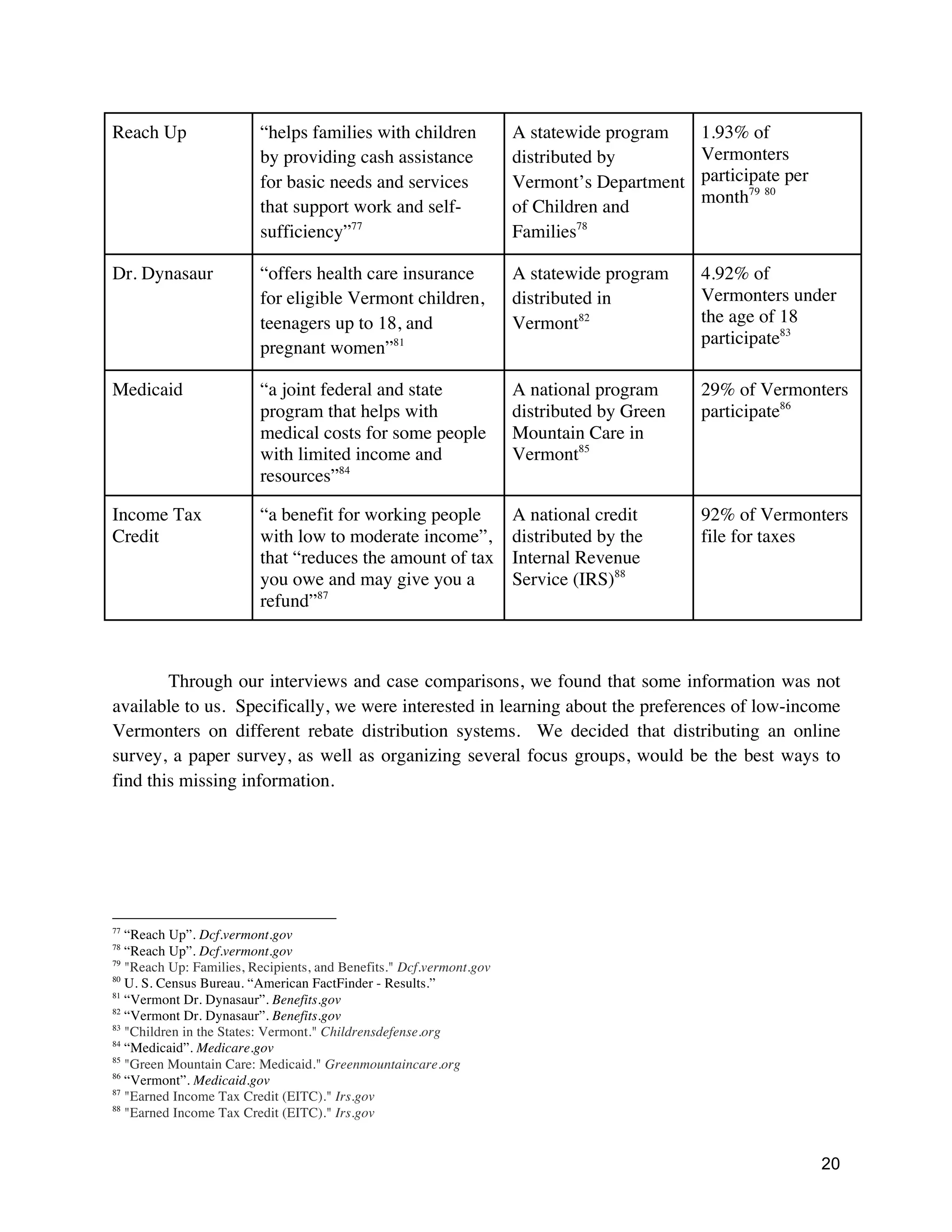
20
Reach Up “helps families with children
by providing cash assistance
for basic needs and services
that support work and self-
sufficiency”77
A statewide program
distributed by
Vermont’s Department
of Children and
Families78
1.93% of
Vermonters
participate per
month79 80
Dr. Dynasaur “offers health care insurance
for eligible Vermont children,
teenagers up to 18, and
pregnant women”81
A statewide program
distributed in
Vermont82
4.92% of
Vermonters under
the age of 18
participate83
Medicaid “a joint federal and state
program that helps with
medical costs for some people
with limited income and
resources”84
A national program
distributed by Green
Mountain Care in
Vermont85
29% of Vermonters
participate86
Income Tax
Credit
“a benefit for working people
with low to moderate income”,
that “reduces the amount of tax
you owe and may give you a
refund”87
A national credit
distributed by the
Internal Revenue
Service (IRS)88
92% of Vermonters
file for taxes
Through our interviews and case comparisons, we found that some information was not
available to us. Specifically, we were interested in learning about the preferences of low-income
Vermonters on different rebate distribution systems. We decided that distributing an online
survey, a paper survey, as well as organizing several focus groups, would be the best ways to
find this missing information.
77
“Reach Up”. Dcf.vermont.gov
78
“Reach Up”. Dcf.vermont.gov
79
"Reach Up: Families, Recipients, and Benefits." Dcf.vermont.gov
80
U. S. Census Bureau. “American FactFinder - Results.”
81
“Vermont Dr. Dynasaur”. Benefits.gov
82
“Vermont Dr. Dynasaur”. Benefits.gov
83
"Children in the States: Vermont." Childrensdefense.org
84
“Medicaid”. Medicare.gov
85
"Green Mountain Care: Medicaid." Greenmountaincare.org
86
“Vermont”. Medicaid.gov
87
"Earned Income Tax Credit (EITC)." Irs.gov
88
"Earned Income Tax Credit (EITC)." Irs.gov
21
Survey
A survey method was chosen because of its ability to collect a large amount of
information from many individuals across the state without becoming a large burden to the
participants. It also allowed the research team to gain insight into the lifestyles and living
situations of Vermonters from different parts of the state and collect potentially sensitive
information in an anonymous format. This is something we couldn’t do with focus groups, and
literature reviews wouldn’t provide the information we required.
Our survey was designed using the online survey building website Qualtrics, which was
selected because of its powerful data output capabilities and its flexible question structures. One
of the major challenges that we encountered early on while building the survey was that most of
our participants would know little, if anything, about the proposed carbon pollution tax. Our
survey had to be educational without being cumbersome or biasing our results. While it would be
best to have participants read the bill itself, this is an unrealistic expectation from both a time and
effort standpoint, so we had to create an abridged description of the proposed legislation that
captured the essence of the bill without becoming too technical or lengthy. We achieved this in
two ways: first, we looked to the Energy Independent Vermont’s one-page description of the bill,
which provided us with a summary of the bill, and second, we broke up informational sections of
the survey with a series of questions. This allowed the survey to flow from one topic to the next
in an organic fashion, rather than having two to three informational pages at the beginning,
followed by all of the questions.
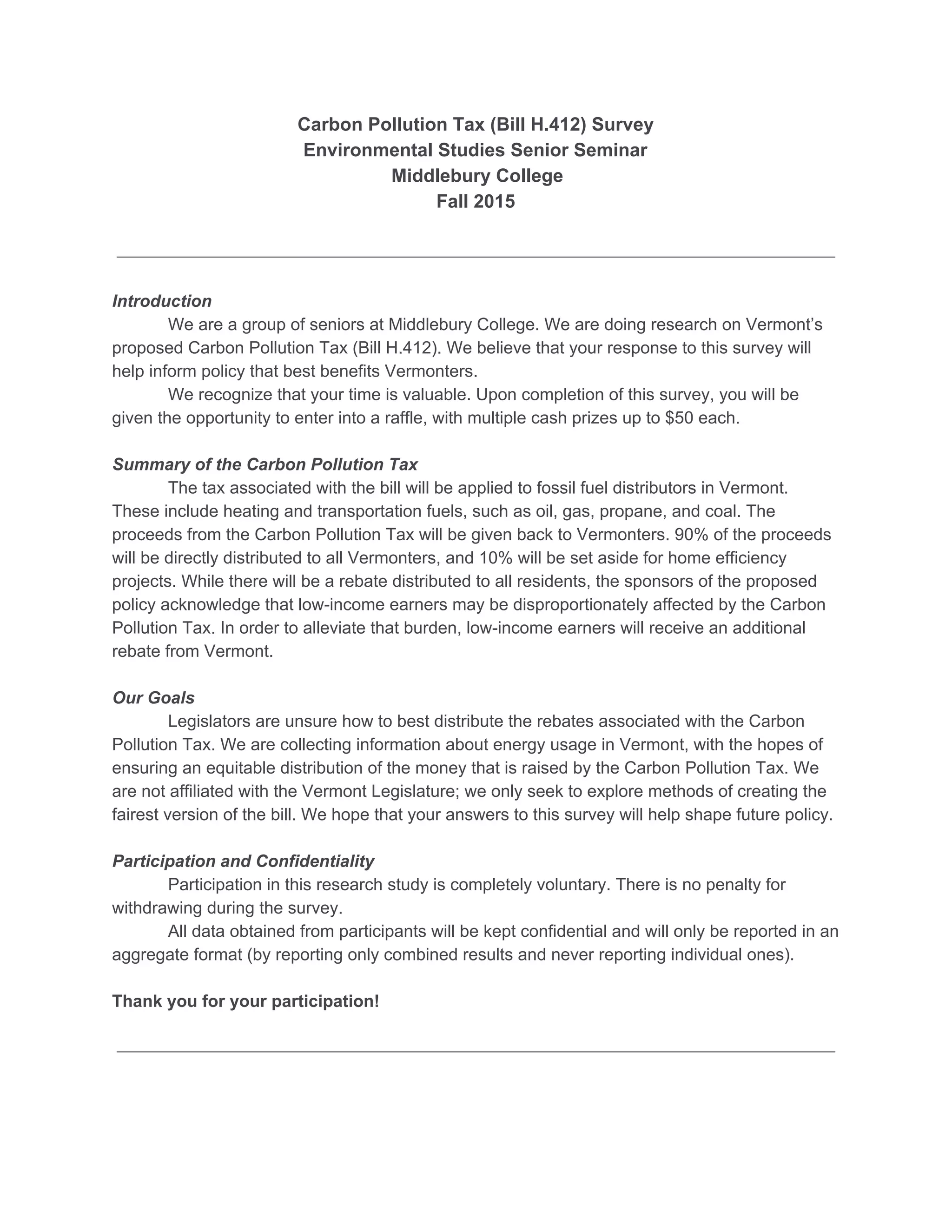
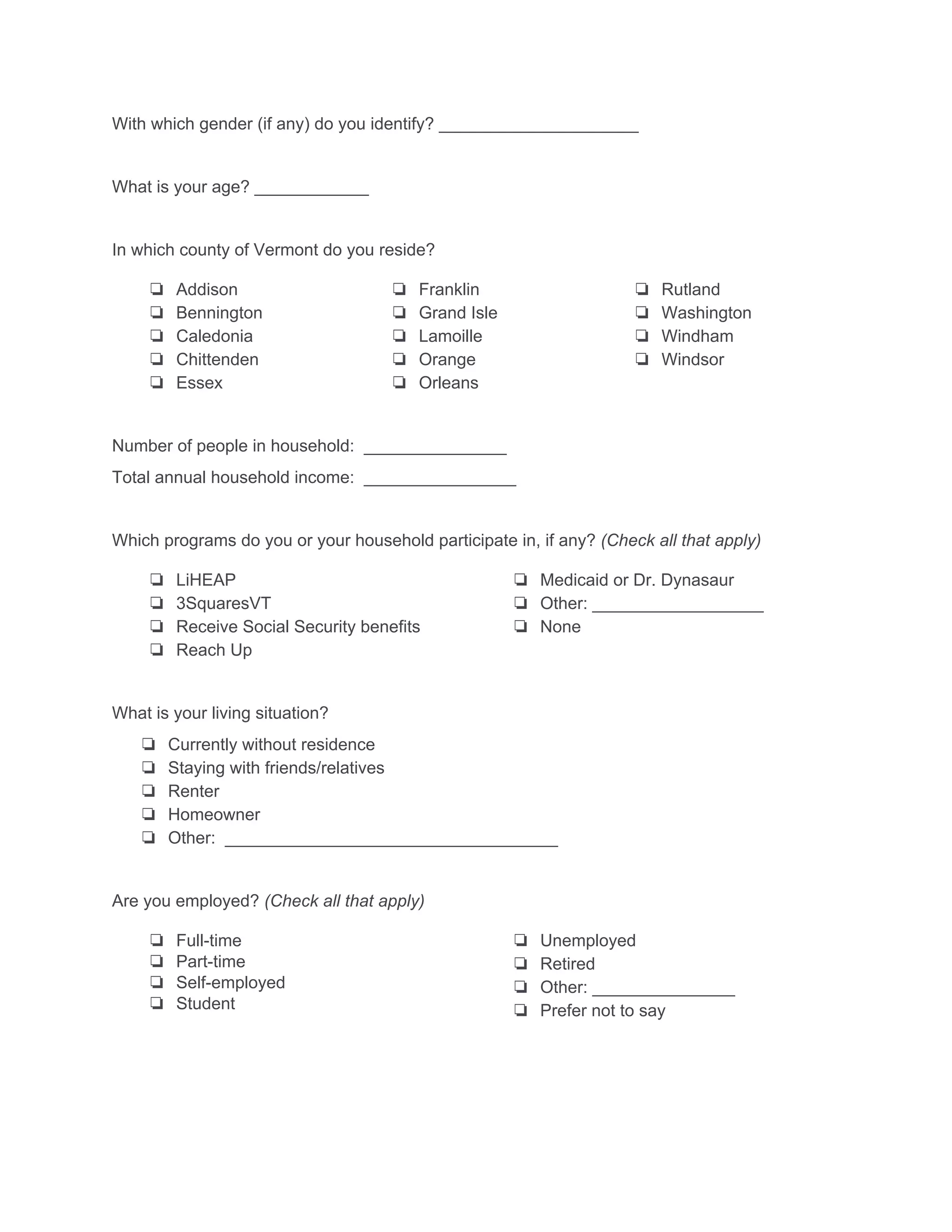
Questions included in the survey were either multiple choice, short answer, forced-
response drill down, or preference ranking (Appendix C) The majority of the questions were
multiple choice with participants selecting from a predetermined list (e.g. “In which county of
Vermont do you reside?”). In order to maintain response accuracy and feasibility of the survey,
we included some “exit choices” for questions, like a “no preference” option or an “other”
option, although we did try to limit the number of exit choices where possible to gain the most
information from the survey. Short answer questions often followed multiple choice questions
and were intended to allow participants to elaborate on their multiple choice responses. This was
an effective method to get more insight into the reasoning behind participants’ choices, and most
participants took advantage of this additional response space to explain . Questions were written
in plain, conversational English so that they were accessible to all participants, and were piloted
extensively to avoid any potential ambiguity.
The forced-response questions were a series of questions with answers in the form of
drop down menus. The answers to several early questions determined which questions were
shown in the remainder of the survey. We used approach in order to select who qualified as low-
income based on their household income and size. If a participant was determined to be low-
income, then a specific series of question appeared, focusing primarily on their preferred rebate
method and frequency. It was important to extract only low-income residents for the rebate-
focused questions, as the survey ultimately targeted this demographic. Responses from non low-
income respondents were collected on several question, but were not the target of the survey.
22
We utilized two major distribution methods for this survey. We created both a paper
version and an online version of the survey. The online version of survey was distributed using
Front Porch Forum, a community-based blog where local residents may post advertisements,
inquiries, and information about events. The survey was posted in the Middlebury, Vergennes,
Newfane/Townshend, Guilford, Burlington, and Rutland blogs, reaching also into the towns that
neighbor those towns, in order to reach a variety of communities in the state. This allowed us to
look for patterns in rebate preference based on geography. We also believed that it was important
to distribute a paper version of the survey in order to avoid gain responses from Vermonters who
may not have access to a computer. The paper version of the survey was distributed at the
Charter House, which provides basic food and housing for those in need in Middlebury. One of
the programs they offer includes providing free lunches for anyone in the community Monday
through Thursday.89
Limitations with the paper survey included a lower level of confidentiality,
because many of the surveys were distributed by hand, and an inability to select out participants
by income level. The second issue was addressed by intentionally distributing the survey at a
location that attracts predominantly low-income residents of the Middlebury area.
Focus Groups
While our survey was constructed to collect answers to specific questions about the needs
and preferences of low-income Vermonters, we also decided that focus groups with low-income
earners would provide us with an opportunity to hear perspectives and creative ideas about
potential rebate systems for the carbon pollution tax. We worked closely with Doug Sinclair,
President and Housing Programs Director of the Charter House in Middlebury, to organize our
focus groups at this location. Our primary goal of the first visit to the Charter House was to
distribute the paper version of the survey. During our second session at the Charter House, we
hosted our focus groups with low-income individuals. Because the Charter House hosts free
lunches Monday through Thursday, with additional funding from Middlebury College, we were
able to host a Friday afternoon pizza lunch, utilizing the Charter House as a meeting space. In
total, 26 adults participated in our focus groups. We separated into two smaller groups, in order
to hear more in depth responses. Each group had one male-identifying and one female-
identifying student leader to help make individuals feel more comfortable. With help from our
community partner and professors, we developed a focus group guide focusing primarily on
encouraging our participants to talk to us about their thoughts and concerns about the proposed
carbon pollution tax. We started with personal introductions and then a brief description of the
proposed carbon pollution tax. Our goal was to solicit new ideas for rebate distribution systems
and how those systems would likely work. Additionally, we asked questions about what would
likely change in our participants lives if the carbon pollution tax was in place, as well as how
individuals would prefer to spend their rebate, if the tax were in place.
89
For more information on the Charter House, please see their website: http://www.charterhousecoalition.org.
23
Results:
Survey Results
After receiving responses from 333 Vermont residents throughout the state, we had a
much clearer understanding of what many respondents preferred for a rebate method, as well as
how they viewed the carbon pollution tax as proposed. Results from the survey were both
enlightening and surprising at times. Of the 333 total completed surveys (both paper and online),
91 of those completed surveys were submitted by low-income participants. These responses were
especially important, as they focused on our target demographic.
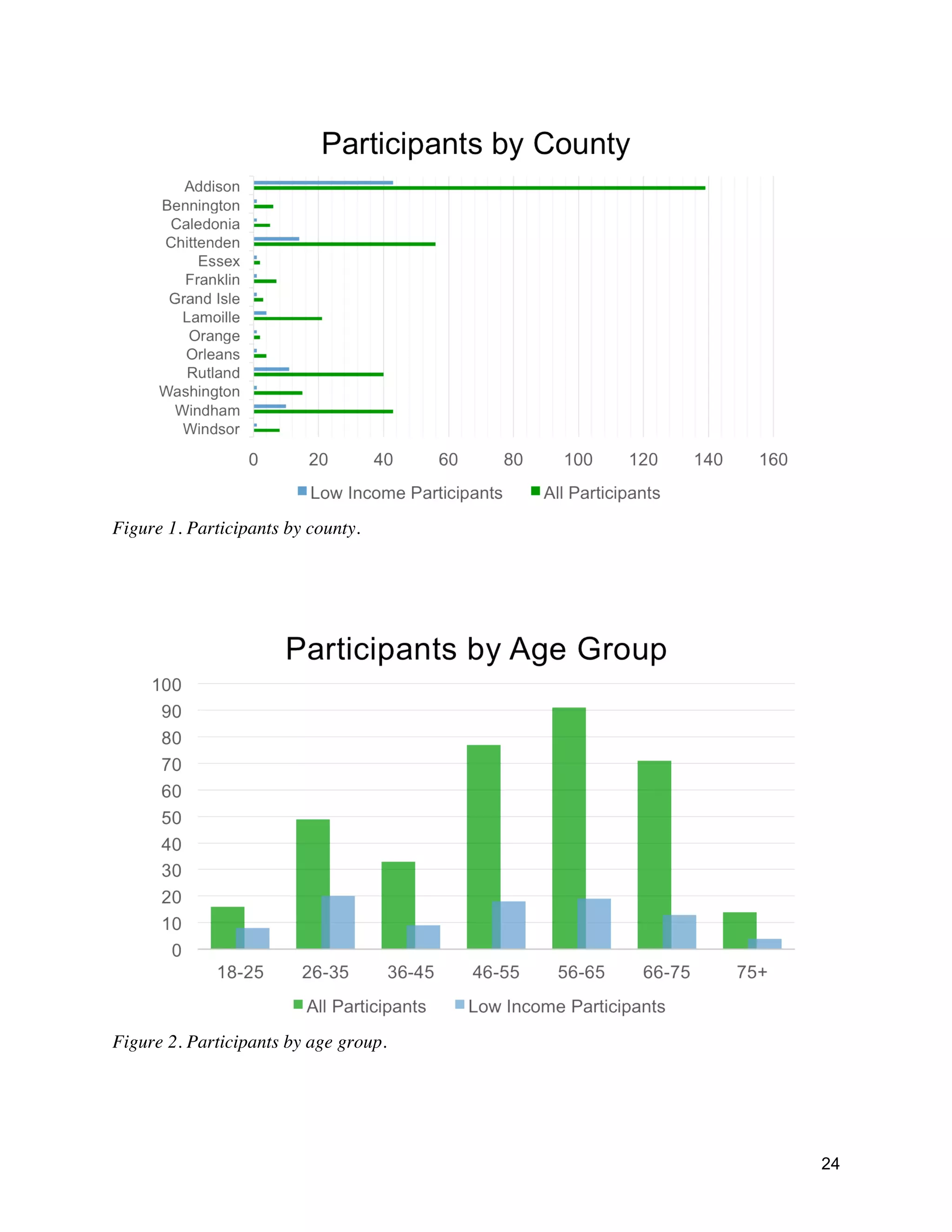
All 14 counties of the state were represented in the study. Addison County had the largest
number of respondents (139), including the largest number of low-income respondents (43)
(Figure 1). Addison County also had one of the largest percentages of total respondents that
qualified as low-income (31%). This is largely due to the fact that Middlebury College is located
in Addison County and people might have been more open to answering a survey from college
students located in their county. Additionally, paper surveys were distributed solely at
Middlebury’s Charter House, so all of these respondents are included in the Addison County
respondent group. Other counties that had high numbers of low-income respondents include
Essex, Orange, Grande Isle, and Rutland, although apart from Addison County, Rutland was the
only county with a large percentage of low-income respondents and a high number of total
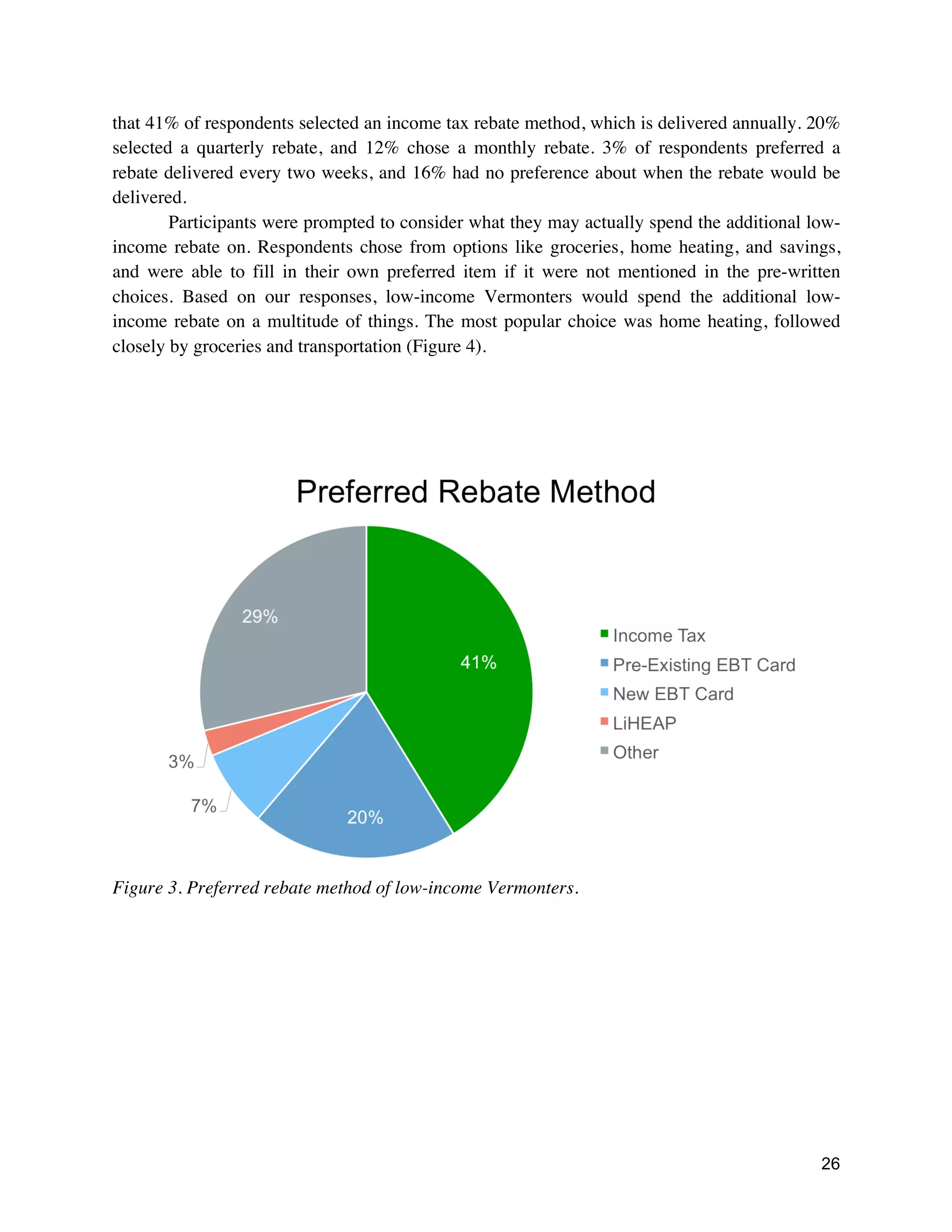
respondents. Respondents by age group (broken down into deciles between 18 and 75) appeared
to have an approximately normal distribution, with 56-65 being the largest age group represented
(Figure 2). This did not hold true for low-income respondents, though. The largest number of
low-income participants fell into the 26-35 age category.
38% of participants stated that they, on average, spend between $1000 and $2000 on
heating each year. This finding holds true for just low-income participants, indicating that a tax
without additional financial protection for low-income individuals has the potential to be
regressive. The three most common home heating methods among all participants were fuel
oil/kerosene, wood, and propane/natural gas. This was also found among low-income earners.
41% of low-income Vermonters used fuel oil or kerosene to heat their homes, 23% use wood,
and 21% use propane or other natural gas (not including utility gas from neighborhood pipelines)
(Table 3).
Respondents were asked to rank the likelihood that they would use different forms of
transportation, including walking, biking, driving, carpooling, taking the bus, and taking the
train. Low-income respondents ranked using the bus as their first, second or third choice (rank 1,
2 or 3) more often than non low-income respondents while non low-income respondents ranked
bus as their 5th, 6th or 7th choice (rank 5, 6 or 7) the same or more often than low-income
respondents.
24
Figure 1. Participants by county.
Figure 2. Participants by age group.
25
Fuel Type All Participants
Non-Low-Income
Participants
Low-Income
Participants
Fuel oil, kerosene, other
liquid fuels
172 50% 132 55% 35 41%
Wood 93 27% 70 29% 20 23%
Propane, Butane or other
liquefied petroleum gas
83 24% 64 26% 18 21%
Electricity 40 12% 22 9% 15 17%
Utility gas from
underground pipes
serving neighborhood
36 11% 22 9% 13 15%
Other 19 6% 12 5% 7 8%
Solar energy 10 3% 8 3% 2 2%
No fuel used 3 1% 1 0% 2 2%
Coal or coke 3 1% 2 1% 1 1%
Table 3. Fuel Type Used by Income Level
The most important result from the survey was the preferred rebate method of low-
income individuals. Due to the design of the survey, this question was only shown to Vermonters
considered low-income by bill H.412. Respondents were given the choice between an income tax
rebate, a new EBT card, an addition to a pre-existing EBT card, an addition to an individual’s
LiHEAP balance, or Other, which allowed respondents to specify another program that would
work best for them. Some respondents selected Other and, rather than suggesting a specific
program or rebate method, indicated that they did not support a carbon pollution tax. As these
respondents did not actually answer the question, they were filtered out during the analysis of
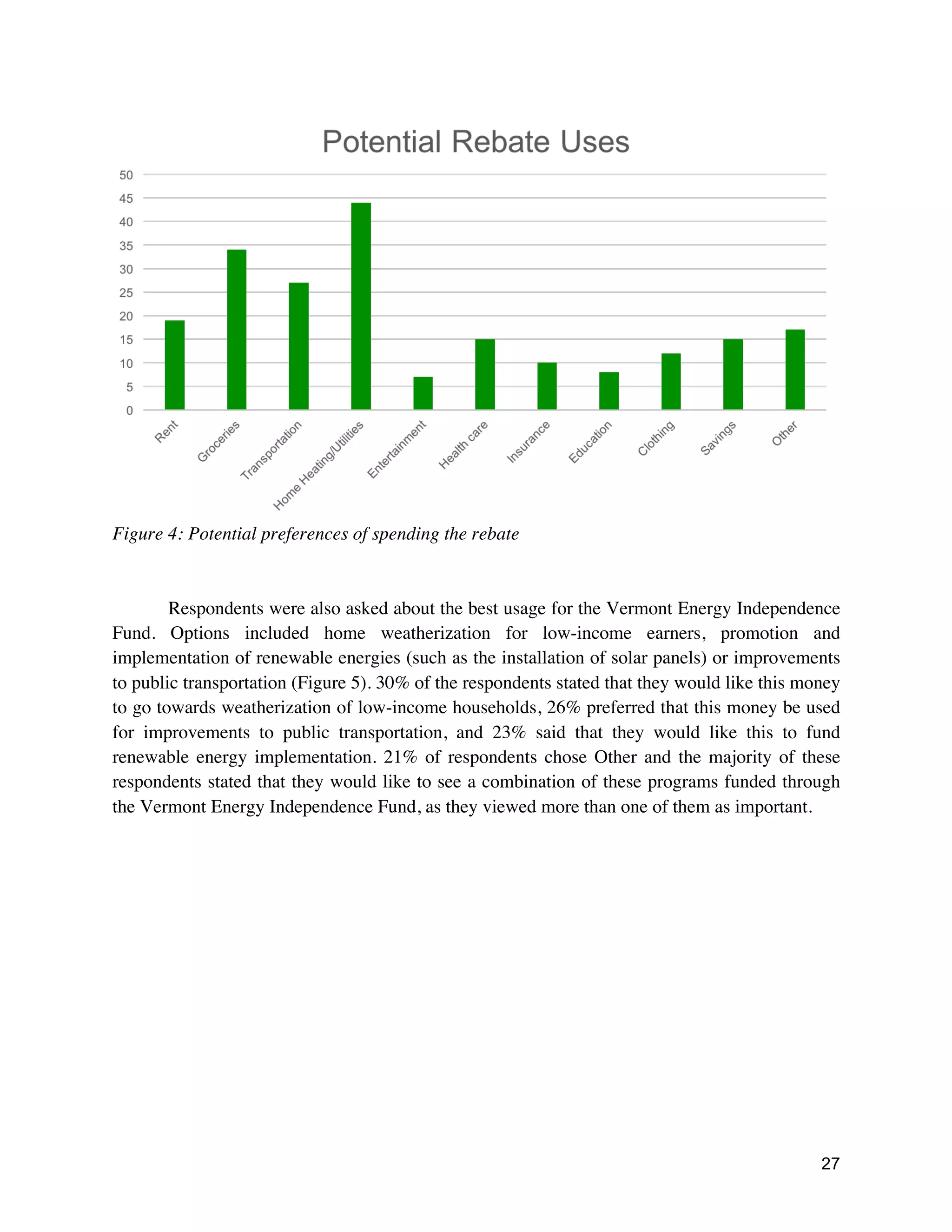
this question. After removing these responses, 41% of these residents indicated that their
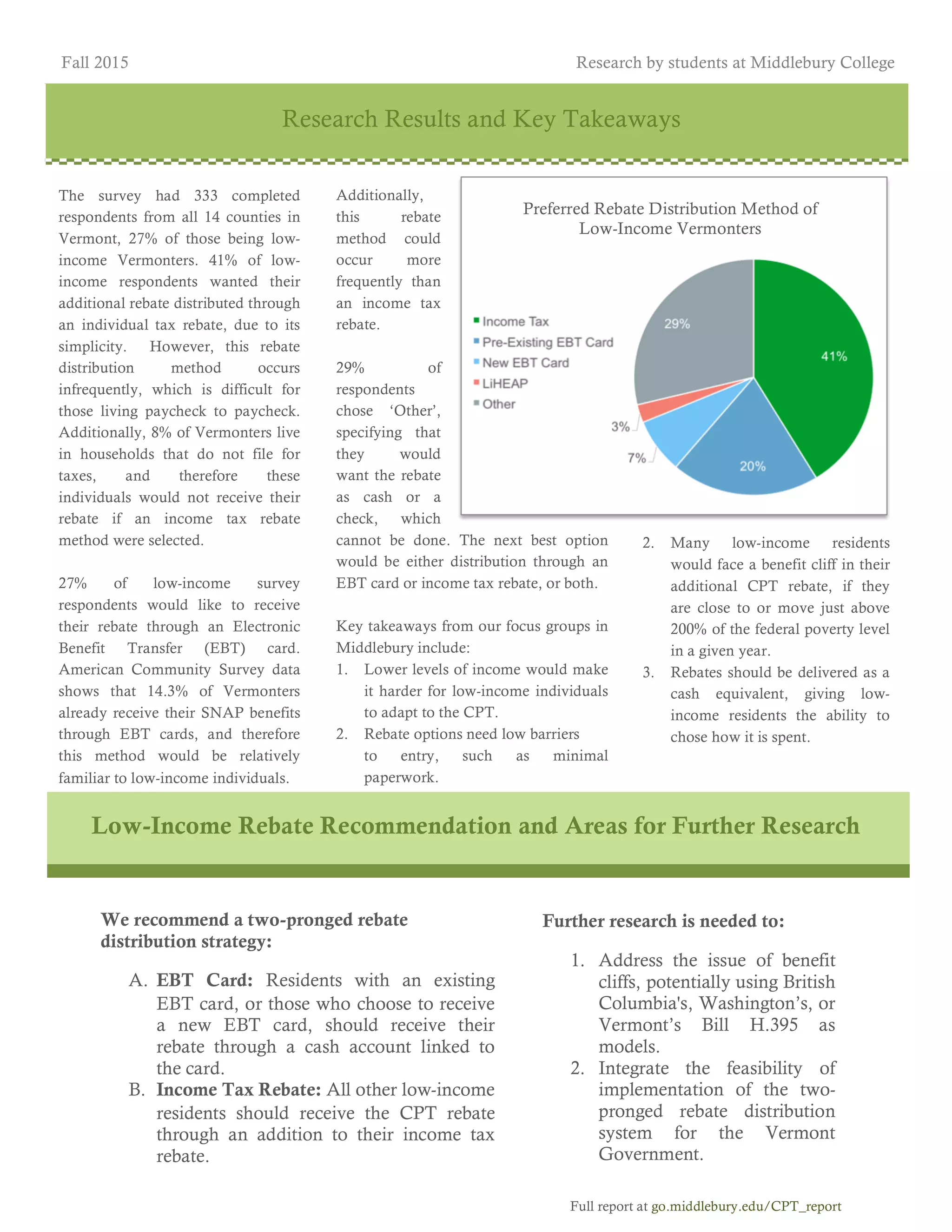
preferred rebate method would be through an income tax rebate (Figure 3). 27% of respondents
indicated that a rebate through an account linked to an EBT card would work best (this is a
combination of the new and pre-existing EBT card options). 3% of respondents indicated that
they would like to receive a rebate as an addition to their LiHEAP balance. 29% indicated an
Other response, and the majority of these respondents said that a rebate as cash or a check would
be best.
After this question, respondents were asked to explain why this method would work best
for them. One respondent, who selected an EBT card method, stated that this method “makes the
most sense [and is a] better way to handle [the] distribution of money”. Another participant who
also preferred an EBT card method said that they “Probably won't have the cash flow ... to wait
for an income tax rebate”. Participants who preferred an income tax method stated that it would
be “simple”, “easy” and “transparent”. When asked about preferred rebate frequency, 49% of
participants indicated that an annual rebate would work best. This may be influenced by the fact
26
that 41% of respondents selected an income tax rebate method, which is delivered annually. 20%
selected a quarterly rebate, and 12% chose a monthly rebate. 3% of respondents preferred a
rebate delivered every two weeks, and 16% had no preference about when the rebate would be
delivered.
Participants were prompted to consider what they may actually spend the additional low-
income rebate on. Respondents chose from options like groceries, home heating, and savings,
and were able to fill in their own preferred item if it were not mentioned in the pre-written
choices. Based on our responses, low-income Vermonters would spend the additional low-
income rebate on a multitude of things. The most popular choice was home heating, followed
closely by groceries and transportation (Figure 4).
Figure 3. Preferred rebate method of low-income Vermonters.
27
Figure 4: Potential preferences of spending the rebate
Respondents were also asked about the best usage for the Vermont Energy Independence
Fund. Options included home weatherization for low-income earners, promotion and
implementation of renewable energies (such as the installation of solar panels) or improvements
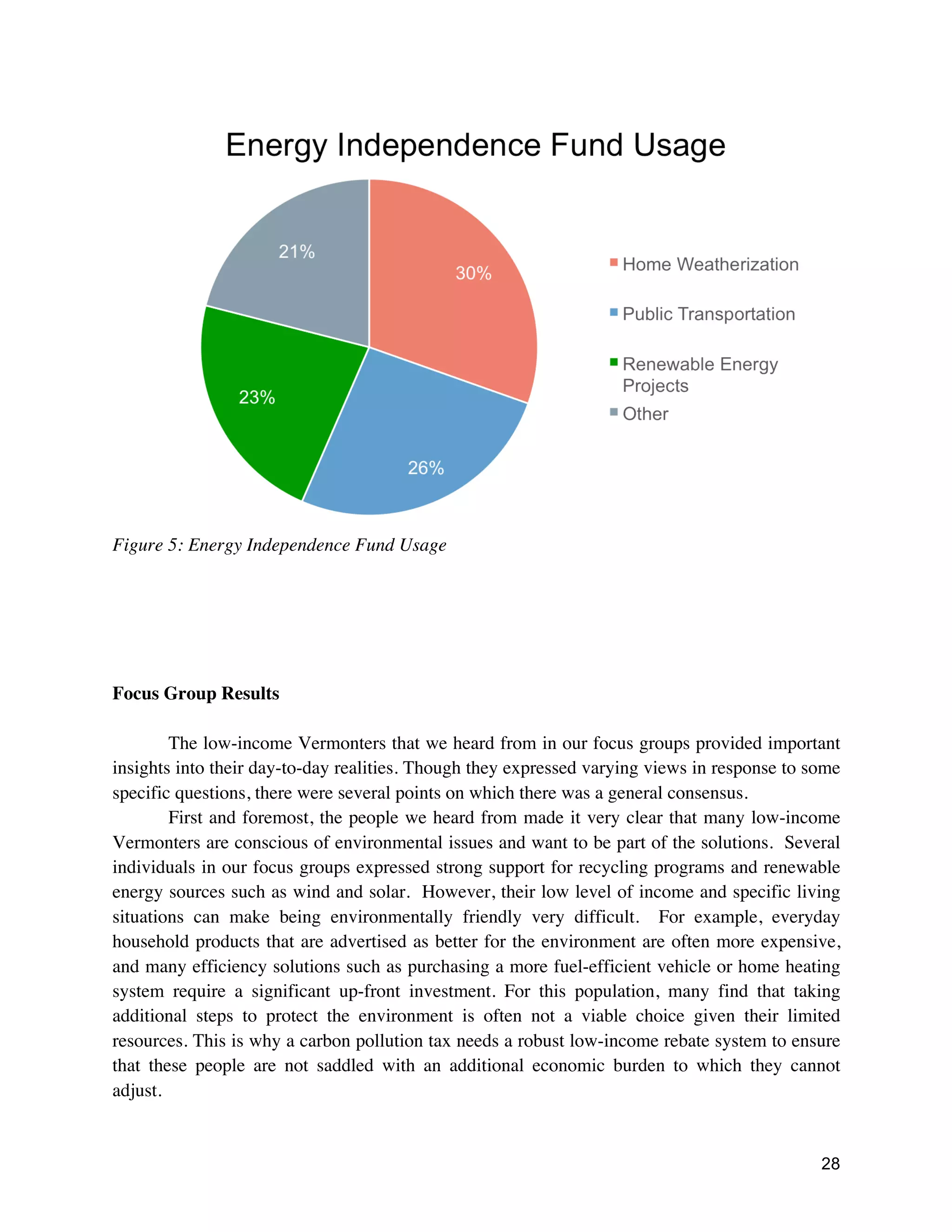
to public transportation (Figure 5). 30% of the respondents stated that they would like this money
to go towards weatherization of low-income households, 26% preferred that this money be used
for improvements to public transportation, and 23% said that they would like this to fund
renewable energy implementation. 21% of respondents chose Other and the majority of these
respondents stated that they would like to see a combination of these programs funded through
the Vermont Energy Independence Fund, as they viewed more than one of them as important.
28
Figure 5: Energy Independence Fund Usage
Focus Group Results
The low-income Vermonters that we heard from in our focus groups provided important
insights into their day-to-day realities. Though they expressed varying views in response to some
specific questions, there were several points on which there was a general consensus.
First and foremost, the people we heard from made it very clear that many low-income
Vermonters are conscious of environmental issues and want to be part of the solutions. Several
individuals in our focus groups expressed strong support for recycling programs and renewable
energy sources such as wind and solar. However, their low level of income and specific living
situations can make being environmentally friendly very difficult. For example, everyday
household products that are advertised as better for the environment are often more expensive,
and many efficiency solutions such as purchasing a more fuel-efficient vehicle or home heating
system require a significant up-front investment. For this population, many find that taking
additional steps to protect the environment is often not a viable choice given their limited
resources. This is why a carbon pollution tax needs a robust low-income rebate system to ensure
that these people are not saddled with an additional economic burden to which they cannot
adjust.
29
In terms of the preferred rebate delivery method, different individuals expressed different
preferences. There were multiple supporters of both the income tax rebate and the EBT card
delivery mechanisms. One participant put forward the idea of distributing rebates through Social
Security or through community groups and charity organizations. Several participants said that
either they themselves use an EBT card or that they know people who do, and that an EBT card
rebate in a flexible cash account would be a good way for them to receive money from the state.
Others expressed that an income tax rebate would work well for them. One thing that many
participants agreed upon was that the rebate system should be easily accessible to low-income
Vermonters. This means it should not require a lot of new paperwork and documentation, and
people should not have to take a lot of time to search out how to apply for the rebate. One
individual mentioned that this would be especially important if the rebate is not very large, such
as in the early years of the tax, because many people would not bother to ‘jump through a bunch
of hoops’ to receive the relatively small compensation to which they are entitled.
Other topics that were discussed during the focus groups included the value of receiving
the rebate as a cash equivalent, the frequency of rebate distribution, and the issue of benefit
cliffs. Participants wanted to receive the rebate in a form that would allow them to decide for
themselves what to spend it on. For some, this pointed towards an income tax rebate while
others voiced support for an EBT card unrestricted account, separate from the benefits they may
receive through assistance programs. The frequency of distribution question received a variety
of responses. Some would prefer a single rebate annually, while others wanted it in smaller,
more-frequent disbursement such as monthly or every other week. Still others indicated that
their preference could be affected by the size of the rebate, because if it were small they would
want it in one lump sum annually but if it were larger it might be more useful to receive it more
often. The topic of benefit cliffs also came up, and one participant noted that they knew people
who had been faced with a difficult situation when they made a bit more money and lost benefits
from some assistance programs that they relied upon.
Focus group members were also asked how they would like to see the money in the
Vermont Energy Independence Fund spent. Ideas from the low-income Vermonters included
investments to make public transportation cheaper and more accessible, funding to help people
invest in renewable energy and efficiency projects such as heat pumps, and weatherization.
There was significant support for the idea of weatherizing buildings, but some individuals were
skeptical of the ability of the state government to follow through, or were concerned about the
fact that renters have a more difficult time accessing weatherization programs than homeowners
because they have to go through their landlords. The issue with renters is that they may not be
able to invest in improvements to a residence they do not own, and that landlords may not have
the incentive to improve a residence they do not live in. Additionally, one focus group
participant suggested that landlords may be wary of weatherization because it might require
inspectors to come into buildings which may not be up to code.
30
Discussion:
Definition of Low Income and Benefit Cliffs
In speaking with the members of Community Action agencies and other low-income
advocates, we determined that 200% of the federal poverty level is widely used in Vermont, and
therefore likely makes sense as a threshold in the bill. However, our focus groups and expert
interviews provided us with insight into the potential benefit cliff associated with the carbon
pollution tax if the additional rebate for low-income individuals does not decline slowly as
income rises about this level. In our focus groups, several individuals mentioned their concern
for losing benefits if their income increases above this threshold. Vermont’s Bill H.412 could
benefit from considering the ways in which other proposed and existing carbon pollution taxes
address benefit cliffs, and reduce unnecessary harm on low-income individuals. To address
benefit cliffs, Bill H.395 gives the bottom two income quintiles of Vermont an increased benefit
compared to the top three income quintiles. This increases the percent of Vermonters receiving
the greatest rebate from 29% in Bill H.412 to 40%, which could help to reduce a benefit cliff.90
As described earlier, Washington’s low-income rebate gradually increases and then decreases as
it follow the EITC, while British Columbia’s rebate gradually decreases for every dollar made
over the income threshold, either of which could be an option for Vermont. We believe that
British Columbia’s approach is the most effective method to address benefit cliffs because it is a
simple but gradual ramp-down for individuals over the threshold and can stand on its own
independent of EITC requirements.
Preferred Rebate Systems and Frequency
Overall, our survey and focus groups gave us insight into the preferred rebate systems of
low-income individuals. Based on our survey, 41% of low-income Vermonters preferred an
income tax rebate, while 27% preferred an EBT card (which included either using one they
already had or adding a new one).
A conservative group that opposes Vermont’s proposed carbon pollution tax posted our
survey on their social media page. Subsequently many of the group’s members filled out our
survey and likely impacted the results of the aforementioned question.91
Responses were skewed
toward an ‘other’ option that did not represent a preference for a different rebate method but
rather was an opposition to the tax in general. In calculating the percentages for the different
rebate systems, we removed all “Other” responses that did not mention a preferred rebate
method. We did this in order to give a more accurate representation of rebate system
preferences. Most of the “Other” responses we received that remained in our results (totaling
29%) preferred the rebate to be distributed through cash or a check. However, the experts we
talked to emphasize the importance of using existing systems or programs to distribute the
rebate, rather than creating new bureaucracies. The options most similar to a cash or check
90
Pearson et al. H.395: An Act Relating to Establishing a Carbon Pollution Tax
91
See “Result Bias due to Survey Methods” on page 34.
31
option are an income tax rebate or a rebate on an EBT card in an unrestricted cash account. In
our focus groups, participants also preferred EBT cards and income tax rebates. Most of those
who did not already have an EBT card favored an income tax rebate because they were already
familiar with this method. More than 14% of Vermonters currently use EBT cards to receive
their 3SquaresVT benefits. The qualifications for 3SquaresVT are different from the low-income
qualification in H.412. To qualify for 3SquaresVT, an individual must have an income at or
below 185% of the federal poverty level.92
If we assume that all 3SquaresVT users are low-
income as defined by H.412, then 48.2% of low-income Vermonters likely already hold EBT
cards, and could be easier to reach through this rebate distribution system .
In our survey we asked respondents what they would be likely to spend this hypothetical
rebate on, and the responses showed a wide variety of preferences (Figure 4). Home heating and
groceries were the most frequently selected choices. This points to preferences for a rebate
system that allows low-income Vermonters to determine for themselves how the money is spent.
Both an income tax rebate and an EBT card with an unrestricted cash account provide this
option. However, some survey respondents and focus group participants wanted more of the
revenue of the tax to go to the Energy Independence Fund to help them adapt to the carbon
pollution tax. Low-income Vermonters in the focus groups expressed strong interest in becoming
more environmentally friendly but cited high costs as a barrier. They felt that increasing the
funding to the Energy Independence Fund would directly improve their ability to be more
environmentally conscious. Additionally, one of our survey results shows that low-income
Vermonters ride buses more than other income levels showing that this population would be the
greatest beneficiaries of improved public transportation systems.
In considering a rebate system that would work for low-income Vermonters, however,
the preferred method of an income tax rebate has two main downsides. First, the timing of
distribution is likely to be limited to once a year, and second, about 8% of Vermonters do not file
taxes and would not be reached by a rebate delivered in this form.93
Using EBT cards for
distribution might be more logistically difficult, as cash accounts linked to EBT cards have
monetary limits. Given these restrictions, it may be necessary to develop a new, unrestricted cash
accounts that can be linked to all EBT cards, which would not have spending guidelines or value
limits. There also is still stigma attached to using an EBT card according to some of our low-
income advocates, which may discourage people from receiving the rebate using this method.
This stigma is lessened by the fact that EBT cards now look and function in a similar manner to
most debit cards, so it is hard to tell whether or not an EBT card is being used at a register.
Our survey results and focus groups both confirmed that a plurality of low-income
respondents were in favor of receiving the rebate annually (49%). From the focus groups, we
learned that this would be especially true if the additional rebate would be small. However, 20%
of low-income survey respondents preferred receiving the rebate four times a year and 12%
preferred monthly. This sentiment, of a higher rebate frequency, was echoed in both our focus
92
3SquaresVT, dcf.vermont.gov
93
Facebook message with Rebecca Sameroff, a statistician for the Vermont Department of Taxes on November 18th, 2015
32
groups and survey results. These survey respondents saw a benefit of receiving the rebate more
frequently, so they would have access to it during the times of the year when they needed it the
most.
Administrative Costs
In our expert interviews and case studies, we briefly explored administrative costs
associated with different rebate methods. An income tax rebate would likely not cost the state
much because there would be no additional forms or mailings that would require an
administrative presence. Government staff would need to learn the mechanisms behind the new
rebate system, but beyond that, prior examples show that new income tax rebates have relatively
low administrative costs94
. Implementing an EBT card method would be more labor-intensive at
the outset of the program, as all new cash accounts would need to be created and linked to EBT
cards. However, after this initial set up, there would not be a significant amount of additional
staff time required, as rebate transfers theoretically would occur at a set frequency.
Vermonters Excluded under Specific Rebate Systems
As mentioned above, approximately 8% of Vermonters would not be able to receive an
income tax rebate because they do not live in households that file taxes.95
The exact
demographics of this population are unknown. It is also unknown how many of these
Vermonters might participate in other programs for which they use an EBT card. A national
study found that these individuals who exist outside of the state’s reach are primarily women
who are single parents.96
While this study was not conducted for Vermont specifically, it may
help provide an insight into the types of individuals who do not file income taxes or receive
assistance benefits. However, it would be important to reach these individuals using methods
other than an income tax rebate. Special outreach to this group would be necessary. One method
of outreach that could be beneficial to single parents could occur through schools, and perhaps
specifically to students who are a part of the free or reduced lunch program in Vermont. From
the focus groups, we also heard that an unknown percentage of Vermonters who do not file taxes
receive Social Security benefits, which is supported by the fact that the income level requiring
Vermonters to pay taxes is higher for those over 65.97
A potential method to reach out to this
population could be by including information in all Vermonters’ Social Security mailings about
how to join the EBT card rebate system.
94
Stone, Chad. “The Design and Implementation of Policies to Protect Low-Income
Households under a Carbon Tax.”
95
Facebook message with Rebecca Sameroff, a statistician for the Vermont Department of Taxes on November 18th, 2015
96
Zedlewski et al., “Families Coping without Earnings or Government Cash Assistance.”
97
“Filing Information.” IRS.gov
33
Result Bias due to Survey Methods
Our results answered many of our questions posed at the beginning of our project,
answered questions we did not know were important, and raised new ones. Our results were also
biased in particular ways based on our collection methods. Addison County is over represented
in the survey partially because it was the only county in which we distributed a paper version of
the survey. It is also possible that more residents in this county were familiar with Middlebury
College and therefore were more interested in participating. Some of our results were also
impacted by the discourse around the proposed carbon pollution tax in Vermont, which is
currently very contentious. In general, politically conservative groups in the state do not support
the proposed carbon pollution tax. A conservative group found our online survey, misinterpreted
it as a petition for the carbon pollution tax, and asked members of their group to fill out the
survey and mark “strongly oppose” to questions about opinions of the tax. One of these groups
was a Facebook page titled “Vermonters Against Peter Shumlin” which posted our survey asking
members to fill out the survey in this way.98
We noticed the increase in responses to our survey
because of this post, and the questions asking for opinions about the tax were skewed toward
“strongly opposed” after the post. However, most of these respondents were not low-income, and
our survey design included filter questions to determine if the respondent was low-income.
Therefore, questions targeting low-income individuals specifically received minimal traffic from
the circulation by this conservative group. However, there were a few cases in which results
were skewed, which we addressed on a case-by-case basis below.
The table below (Table 3) shows our survey results compared to the American
Community Survey data for Vermont.99
The rate of participation in assistance programs by low-
income individuals in our survey was not representative of the rate of participation by the general
population in Vermont. Overall in our survey, we found an under representation of Vermonters
who participate in assistance programs. This may be a result of our sample method, which was
largely through Front Porch Forum, which may be frequented by demographics that do match
Vermont’s general low-income population. Since our sample size was small, we also do not have
enough evidence to say that these are non-random results. The percentage of respondents who
qualified as low-income was a survey demographic that was most similar to American
Community Survey; 29% of Vermonters qualify as low-income, while 27% of our survey
respondents also qualified as low-income.100
98
Mullin, Valerie. “Vermonters against Peter Shumlin.”
99
U. S. Census Bureau. “American FactFinder - Results.”
100
ibid.
34
Vermonters that Participate in:
American Community Survey
Statistics:
Survey Results:
LiHeap 9.97% 1%
3SquaresVT 14.3% 7%
Reach Up 1.93% 0%
Medicaid and Dr. Dynasaur 29% and 4.92% 17% in total
Table 4. Percentage of Vermonters that participate in specific assistance programs.
Household or Individual?
Our research also looked into the question of whether rebates should be distributed to
individuals or households. Our survey results showed that distribution at the household level was
marginally preferred, with 39% of low-income respondents choosing this option. However, 31%
preferred individual distribution and 30% had no preference. Because filing taxes can be done as
a household or as an individual, an income tax rebate method could provide potential flexibility
to individual preferences. Additionally, EBT cards are administered at the household level. None
of the focus group participants or experts we spoke to expressed any concern about children not
receiving the rebate, especially considering that the federal poverty level takes into account
household size, so families with children would qualify for the additional rebate at higher income
levels.
Visibility of Rebate
Finally, we considered whether certain rebate methods would change the visibility of the
rebate, and in doing so, create a more positive response to the carbon pollution tax. Rebate
methods that deliver money back as a stand-alone sum rather than being lumped in with other
benefits may foster support for a carbon pollution tax, as Vermonters will have a heightened
awareness of the exact amount given back to them.
Uses for the Vermont Energy Independence Fund
The main objective of the carbon pollution tax is to reduce carbon emissions by changing
Vermonters’ behavior. For low-income folks this is especially difficult and therefore the use of
the 10% of revenue set aside for weatherization programs and the Vermont Energy Independence
Fund is very important. From our survey, we found that home weatherization was most
important to low-income individuals (30%) but that public transportation (26%) and renewable
energy projects (23%) were important as well (Figure 3). We found that a much higher
percentage of low-income Vermonters walk and take the bus than other income levels. Low-
income individuals were also about twice as likely as higher income levels to be renters (31% of
low-income, 16% overall), and concerns specific to renters were brought up in our focus groups
35
as well. Participants were also concerned that some landlords do not have enough incentive to
participate in weatherization programs. One particular concern we heard was that some landlords
do not want to participate in weatherization programs because an inspection would reveal that
their property is not up to code. To address these renter issues it is important for the programs to
have strong incentives for landlords. Additionally, many focus group participants expressed that
they would like to be financially supported in joining things like solar cooperatives.
Recommendations:
To ensure that the low-income rebates associated with Bill H.412 reach the largest
number of Vermonters possible, we recommend that the proposed carbon pollution tax employs
a combination of rebate distribution methods. Specifically, we suggest that Vermont should
deliver revenue from the carbon pollution tax to low-income individuals as income tax rebates
and an unrestricted cash account accessible through EBT cards. As the Vermont Department of
Taxes indicated, the 8% of Vermonters who do not file taxes would not receive the rebates that
are associated with Bill H.412 if they were distributed exclusively through the income tax
system. Concern for those who do not file taxes was clearly voiced by numerous Vermonters in
our survey and focus groups. Thus, we believe that individuals who already have EBT cards
should automatically receive the additional rebates from Bill H.412 on their EBT cards. These
individuals should also be given the option to opt out and receive their rebates through the
income tax system if they so desire. Individuals who do not have an EBT card would
automatically receive the rebate through the income tax system. They could however opt into
receiving the rebate through a new EBT card.
We recognize that this combination of rebate distribution methods would not reach every
low-income Vermonter; specifically, individuals who do not file taxes and do not have an EBT
card would not be able receive the rebates associated with Vermont’s proposed carbon pollution
tax. As we previously discussed, these individuals are especially difficult for the state to reach.
The state must continue to pursue any and all avenues to reach these Vermonters, and provide
them with the benefits that they are entitled to, and it is our firm recommendation that they do so.
Moving forward, Vermont legislators must address the possibility that Bill H.412, as currently
written, could create or exacerbate a benefit cliff. By looking at existing and proposed carbon
pollution taxes, Vermont policymakers can determine a remedy to this problem. Additionally, it
is crucial for Vermont legislators to recognize and address the frequency that individuals receive
their rebates, which is especially important for those who live paycheck-to-paycheck. Finally,
while we recognize that distributing rebates through EBT cards and the income tax system may
be more complicated for the state, we firmly believe that this policy design is necessary to ensure
that Bill H.412 is as equitable as possible, and its rebates reach as many low-income residents as
possible.
36
Acknowledgements:
Our group would particularly like to thank: Middlebury College Professors Chris Klyza
and Mez Baker-Medard; Diane Munroe, Middlebury College Coordinator for Community Based
Environmental Studies; Amy Shollenberger of Action Circles; Doug Sinclair and everyone at the
Middlebury Charter House; Jan Demers, Executive Director of CVOEO; Steve Geller, Executive
Director of SEVCA; Karen Lafayette of the Vermont Low Income Advocacy Council; the
Vermont Department of Taxes; the British Columbia Ministry of Finance; the hundreds of
Vermonters that participated in our survey or focus groups. We could not have done it without
you!
37
Work Cited:
“2015 EITC Income Limits, Maximum Credit Amounts and Tax Law Updates.” IRS.gov. 2015.
Web. Accessed 20 Oct. 2015. https://www.irs.gov/Credits-&-
Deductions/Individuals/Earned-Income-Tax-Credit/EITC-Income-Limits-Maximum-
Credit-Amounts
3SquaresVT. dcf.vermont.gov. Accessed December 13th, 2015.
http://dcf.vermont.gov/benefits/3SquaresVT
Barrett, Michael J. An Act Combating Climate Change, 2015.
https://malegislature.gov/Bills/189/Senate/S1747
Beck, Marisa, Nicholas Rivers, and Hidemichi Yonezawa. “A Rural Myth? The Perceived
Unfairness of Carbon Taxes in Rural Communities.” Accessed December 5, 2015.
http://papers.ssrn.com/sol3/papers.cfm?abstract_id=2603565
"Campaign for Home Energy Assistance: Vermont Facts." Liheap.org. 2014. Accessed
December 13, 2015. http://liheap.org/cms/assets/uploads/2014/05/Vermont-2015.pdf
“Carbon Tax: Overview of the Revenue-Neutral Carbon Tax.” Province of British Columbia.
N.p., n.d. Web. 20 Oct. 2015. http://www.fin.gov.bc.ca/tbs/tp/climate/carbon_tax.htm
“Carbon Tax Seems to Have Enough Signatures to Make Ballot.” 2015. Greenwire. Accessed
December 14. http://www.eenews.net/stories/1060028898
“Certificate of Exemption Farmer.” Accessed December 5, 2015.
http://www.sbr.gov.bc.ca/documents_library/forms/0458fill.pdf.
Champlain Valley Office of Economic Opportunity. “Mission.” Cvoeo.org, n.d.
https://www.cvoeo.org/index.cfm?fuseaction=menus&menu_id=15&pId=2.
"Children in the States: Vermont." Childrensdefence.org. 2015. Accessed December 13, 2015.
http://www.childrensdefense.org/library/data/state-data-repository/cits/2015/2015-
vermont-children-in-the-states.pdf
Deen, David L., Mary Sullivan, John L. Bartholomen, and Steven Berry. H.412: An Act Relating
to Establishing a Carbon Pollution Tax, 2015.
38
http://legislature.vermont.gov/assets/Documents/2016/Docs/BILLS/H-0412/H-
0412%20As%20Introduced.pdf
Dinan, Terry. “Offsetting a Carbon Tax’s Costs on Low-Income Households.” Nov. 2012. Web.
20 Oct. 2015. https://www.cbo.gov/sites/default/files/cbofiles/attachments/11-
13LowIncomeOptions.pdf
"Earned Income Tax Credit (EITC)." Irs.gov. 2015. Accessed December 13, 2015.
https://www.irs.gov/Credits-&-Deductions/Individuals/Earned-Income-Tax-Credit
Teller-Elsberg, Jonathan, Benjamin Sovacool, Taylor Smith, and Emily Laine. “Energy Costs
and Burdens in Vermont: Burdensome for Whom?” Vermont Law School Institute for
Energy and the Environment, December 2014. http://www-
assets.vermontlaw.edu/Assets/iee/VLS%20IEE%20Energy%20Burden%20Report.pdf.
Energy Independent Vermont. “Carbon Pollution Tax Bill Overview.” Web. 20 Oct. 2015.
http://www.energyindependentvt.org/wp-content/uploads/2015/03/2015-03-Pollution-
Tax-Bill-Overview.pdf.
“Filing Information.” IRS.gov, 2014. Accessed December 11, 2015.
https://www.irs.gov/publications/p17/ch01.html.
“Fuel Assistance”. Dcf.vermont.gov. Accessed December 5, 2015.
http://dcf.vermont.gov/benefits/fuel-assistance.
“General Electronic Benefit Transfer Information”. USDA. Accessed December 5, 2015.
http://www.fns.usda.gov/ebt/general-electronic-benefit-transfer-ebt-information.
"Green Mountain Care: Medicaid." GreenMountainCare.org. 2015. Accessed December 13,
2015. http://www.greenmountaincare.org/vermont-health-insurance-plans/medicaid
Jeffords, James. “Economic Impact of Agriculture in Vermont.” University of Vermont, 2010.
Accessed October 20, 2015.
https://www.uvm.edu/~vlrs/Agriculture/agric%20econ%20impact.pdf.
39
“Low Income Climate Action Tax Credit.” Province of British Columbia. N.p., n.d. Web.
Accessed October 20, 2015. http://www2.gov.bc.ca/gov/content/taxes/income-
taxes/personal/credits/climate-action.
“Medicaid”. Medicare.gov. Accessed December 5, 2015. https://www.medicare.gov/your-
medicare-costs/help-paying-costs/medicaid/medicaid.html
“Millions of Low-Income Households Burdened by Fuel Insecurity.” PBS NewsHour. Accessed
November 12, 2015. http://www.pbs.org/newshour/bb/millions-low-income-households-
burdened-fuel-insecurity/.
Ministry of Agriculture. “Agriculture Business and Economy.” Province of British Columbia.
Accessed December 5, 2015. http://www2.gov.bc.ca/gov/content/industry/agriculture-
seafood/agriculture-business-and-economy.
Mullin, Valerie. “Vermonters against Peter Shumlin.”Facebook, November 14, 2015.
https://www.facebook.com/groups/56246528951/.
“Our Proposal.” Carbon Washington. N.p., n.d. Web. 20 Oct. 2015. http://carbonwa.org/policy/
Pearson, Chris, Mollie Burke, Curt McCormack, and James McCullough. H.395: An Act
Relating to Establishing a Carbon Pollution Tax, 2015.
http://legislature.vermont.gov/assets/Documents/2016/Docs/BILLS/H-0395/H-
0395%20As%20Introduced.pdf.
Public Service Department. “State Renewable Energy Goals.” Accessed November 11, 2015.
http://publicservice.vermont.gov/topics/renewable_energy/state_goals.
Public Service Department. “Total Energy Study.” Accessed November 11, 2015.
http://publicservice.vermont.gov/publications/total_energy_study.
“Reach Up.” Dcf.vermont.gov. Accessed December 5, 2015.
http://dcf.vermont.gov/benefits/reachup
"Reach Up: Families, Recipients, and Benefits." Department of Children and Families. 2015.
Accessed December 13, 2015.
http://dcf.vermont.gov/sites/dcf/files/ESD/Docs/RUCounty.pdf
Regulatory Assistance Project. “Policy Options for Achieving Vermont’s Renewable
40
Energy Carbon Targets: Prepared for the Vermont Department of Public Service June 2013,” n.d.
http://publicservice.vermont.gov/sites/psd/files/Pubs_Plans_Reports/TES/A.%20RAP_Po
licy%20Options%20for%20Achieving%20Vermont%20Renewable%20Energy%20and%
20Carbon%20Targets.pdf
Schoenberg, Shira. “Environmentalists Push Carbon Fee in Massachusetts.” Masslive.com.
Masslive.com, October 27, 2015.
http://www.masslive.com/politics/index.ssf/2015/10/environmentalists_push_carbon.html
“State Carbon Tax Would Raise Gas Prices by as Much as 88 Cents a Gallon.” VTDigger.org
Accessed November 12, 2015. http://vtdigger.org/2015/10/25/state-carbon-tax-would-
raise-gas-prices-by-as-much-as-88-cents-a-gallon/
"State Health Facts: Distribution of Total Population by Federal Poverty Level." The Henry J.
Kaiser Family Foundation, 2015. Accessed December 15th,
2015. http://kff.org/other/state-indicator/distribution-by-fpl/
Stone, Chad. “The Design and Implementation of Policies to Protect Low-Income Households
under a Carbon Tax.” Center on Budget and Policy Priorities. N.p., 21 Sept. 2015. Web.
20 Oct. 2015. http://www.cbpp.org/research/climate-change/the-design-and-
implementation-of-policies-to-protect-low-income-households
“Supplemental Nutrition ASsistance Program (SNAP)”. Accessed December 5, 2015.
http://www.fns.usda.gov/snap/supplemental-nutrition-assistance-program-snap
U. S. Census Bureau. “American FactFinder - Results.” Accessed November 12, 2015.
http://factfinder.census.gov/faces/tableservices/jsf/pages/productview.xhtml?pid=ACS_1
4_1YR_S1701&prodType=table.
“Vermont”. Medicaid.gov. Accessed December 5, 2015. http://www.medicaid.gov/medicaid-
chip-program-information/by-state/vermont.html
“Vermont Dr. Dynasaur”. Benefits.gov. Accessed December 5, 2015.
http://www.benefits.gov/benefits/benefit-details/1614
“Vermont Statutes Online,Title 10,Chapter 23, § 581: Building Efficiency Goals,” Accessed
November 12, 2015. http://legislature.vermont.gov/statutes/section/10/023/00581.
Washington State Department of Agriculture. “Agriculture: A Cornerstone of Washington’s
Economy.” 2015. http://agr.wa.gov/aginwa/.
41
"Who Pays? 5th Edition | The Institute on Taxation and Economic Policy (ITEP)." The Institute
on Taxation and Economic Policy (ITEP). 2015. Accessed December 13, 2015.
http://www.itep.org/whopays/full_report.php
Zedlewski, Sheila, Sandi Nelson, Kathryn Edin, Heather Koball, Pomper Kate, and Tracy
Roberts. “Families Coping without Earnings or Government Cash Assistance.” Urban
Institute, February 1, 2003. http://www.urban.org/research/publication/families-coping-
without-earnings-or-government-cash-assistance
42
Appendices:
Appendix A: Paper Survey
Appendix B: Selected Survey Responses from Low-Income Individuals
Appendix C: Communications Document for Community Partners and Legislators
Carbon Pollution Tax (Bill H.412) Survey 
Environmental Studies Senior Seminar 
 Middlebury College 
Fall 2015 
Introduction 
We are a group of seniors at Middlebury College. We are doing research on Vermont’s 
proposed Carbon Pollution Tax (Bill H.412). We believe that your response to this survey will 
help inform policy that best benefits Vermonters.   
We recognize that your time is valuable. Upon completion of this survey, you will be 
given the opportunity to enter into a raffle, with multiple cash prizes up to $50 each.  
Summary of the Carbon Pollution Tax 
The tax associated with the bill will be applied to fossil fuel distributors in Vermont. 
These include heating and transportation fuels, such as oil, gas, propane, and coal. The 
proceeds from the Carbon Pollution Tax will be given back to Vermonters. 90% of the proceeds 
will be directly distributed to all Vermonters, and 10% will be set aside for home efficiency 
projects. While there will be a rebate distributed to all residents, the sponsors of the proposed 
policy acknowledge that low­income earners may be disproportionately affected by the Carbon 
Pollution Tax. In order to alleviate that burden, low­income earners will receive an additional 
rebate from Vermont.  
Our Goals 
Legislators are unsure how to best distribute the rebates associated with the Carbon 
Pollution Tax. We are collecting information about energy usage in Vermont, with the hopes of 
ensuring an equitable distribution of the money that is raised by the Carbon Pollution Tax. We 
are not affiliated with the Vermont Legislature; we only seek to explore methods of creating the 
fairest version of the bill. We hope that your answers to this survey will help shape future policy. 
Participation and Confidentiality 
Participation in this research study is completely voluntary. There is no penalty for 
withdrawing during the survey. 
All data obtained from participants will be kept confidential and will only be reported in an 
aggregate format (by reporting only combined results and never reporting individual ones). 
Thank you for your participation! 
With which gender (if any) do you identify? _____________________ 
 
What is your age? ____________ 
 
In which county of Vermont do you reside? 
❏ Addison 
❏ Bennington 
❏ Caledonia 
❏ Chittenden 
❏ Essex 
❏ Franklin 
❏ Grand Isle 
❏ Lamoille 
❏ Orange 
❏ Orleans 
❏ Rutland 
❏ Washington 
❏ Windham 
❏ Windsor 
 
Number of people in household:  _______________ 
Total annual household income:  ________________ 
 
Which programs do you or your household participate in, if any? ​(Check all that apply) 
❏ LiHEAP 
❏ 3SquaresVT 
❏ Receive Social Security benefits 
❏ Reach Up 
❏ Medicaid or Dr. Dynasaur 
❏ Other: __________________ 
❏ None 
 
What is your living situation? 
❏ Currently without residence 
❏ Staying with friends/relatives 
❏ Renter 
❏ Homeowner 
❏ Other:  ___________________________________ 
 
Are you employed? ​(Check all that apply) 
❏ Full­time 
❏ Part­time 
❏ Self­employed 
❏ Student 
❏ Unemployed 
❏ Retired 
❏ Other: _______________ 
❏ Prefer not to say 
 
 
Are you a veteran of the U.S. Armed Forces? 
❏ Yes  ❏ No 
Approximately how much does your household spend on heating a year? 
❏ $0 ­ 500 
❏ $500 ­ 1,000 
❏ $1,000 ­ 2,000 
❏ $2,000 ­ 3,000 
❏ $3,000 ­ 4,000 
 
What is your household's primary mode(s) of heating in the winter? ​(Check all that apply) 
❏ Utility gas from underground pipes serving neighborhood 
❏ Propane, Butane or other liquefied petroleum gas 
❏ Electricity 
❏ Fuel oil, kerosene, other liquid fuels 
❏ Coal or coke 
❏ Wood 
❏ Solar energy 
❏ No fuel used 
❏ Other:  ___________________________ 
 
On an average week, approximately how many miles do you personally drive? 
❏ 0­50 
❏ 50­100 
❏ 100­200 
❏ 200­300 
❏ 300­400 
❏ 400­500 
❏ 500­600 
❏ 600+ 
 
On an average week, approximately how many miles does your entire household drive 
(including the miles you personally drive)? 
❏ 0­100 
❏ 100­200 
❏ 200­400 
❏ 400­600 
❏ 600­800 
❏ 800+ 


What types of transportation are you most likely to use during an average week? (Please rank, 
1 = Most Likely, 7 = Least Likely) 
     _____        Car (single occupant) 
     _____        Car (multiple people/carpool) 
     _____        Bus 
     _____        Train 
     _____        Bicycle 
     _____        Walk 
     _____        Other:  ___________________________ 
 
Have you or your household participated in a home weatherization program? 
❏ Yes  ❏ No 
If you answered “yes”, please explain what changes you made to your home in a few 
sentences. 


As explained at the beginning of the survey, the Vermont State Legislature is 
considering a new Carbon Pollution Tax. The tax will be applied to fossil fuel distributors in 
Vermont. These include heating and transportation fuels, such as oil, gas, propane, and coal. 
The proceeds from the Carbon Pollution Tax will be given back to Vermonters. 90% of the 
proceeds will be directly distributed to all Vermonters, and 10% will be set aside for home 
efficiency projects. While there will be a rebate distributed to all residents, Vermont 
acknowledges that low­income earners may be disproportionately affected by the Carbon 
Pollution Tax. In order to alleviate that burden, low­income earners will receive an additional 
rebate from Vermont. 
 
After reading the above description, how supportive might you be of this Carbon Pollution Tax? 
(circle one) 
 
Strongly Support Support Oppose Strongly Oppose Unsure 
 
Since the proposed Carbon Pollution Tax gradually increases over 10 years, the rebate 
will also increase over that same time period. Estimates of the rebate per adult start around 
$100 per year and increase to $700 per year over the ten­year period. 
If you received this rebate in the next year, what would you be likely to spend it on? ​(Check all 
that apply) 
❏ Rent
❏ Groceries
❏ Transportation
❏ Home heating and utilities
❏ Entertainment
❏ Health care
❏ Insurance
❏ Education
❏ Clothing
❏ Savings
❏ Other: ______________________
How would you personally prefer to receive a rebate from the Carbon Pollution Tax? 
❏ Through an income tax rebate
❏ Through an existing electronic benefit transfer (EBT) card in an account with unrestricted
use
❏ Through a new electronic benefit transfer (EBT) card with rebate in an account with
unrestricted use
❏ Through an addition to your LiHEAP balance ​(if applicable)
❏ Other
In a few sentences, please explain why this is your preferred rebate option. If you selected 
"Other", please explain what your preferred method would be and why you chose it.  
Assuming the total amount of your household rebate would be the same, how would you prefer 
to receive the rebate? 
❏ Distributed to your household
❏ Distributed to individual adults
❏ No preference
How frequently would you prefer to receive the rebate? 
❏ Annually
❏ Four times a year
❏ Monthly
❏ Every two weeks
❏ No preference
❏ I don’t know
10% of the revenue generated by the Carbon Pollution Tax will go into an Energy 
Efficiency Fund, which may assist Vermonters in switching to renewable energy sources, fund 
public transportation, or weatherize old or inefficient households. Proposals for the use of this 
money are currently being developed.  
Where would you like to see this money go? ​(Check all that apply) 
❏ Home weatherization
❏ Public transportation
❏ Financing programs for individual or community renewable energy projects
❏ Other:
____________________________________________________ 
____________________________________________________ 
____________________________________________________ 
In a few sentences, please explain why you chose these proposal(s) for the Energy Efficiency 
Fund: 
49
Appendix B: Selected Survey Responses from Low-Income Individuals
Pro-income tax rebate distribution system:
Seems to be the easiest and most cost efficient.
[Addison County]
Because I do taxes every year and it would be easy to add this rebate to my tax return.
[Windham County]
It seems the most simple, both for myself and the government
[Chittenden County]
Would be more likely to get it into savings (vs spending it without intention).
[Rutland County]
If I get it mailed home, I know I get it.
[Addison County]
An income tax rebate gives the most flexibility and ease of use
[Rutland County]
Don't participate in LiHEAP or EBT
[Addison County]
It would not require me to do anything in addition to filing my tax return. (I'd prefer the carbon
tax not happen in the first place, since the rebate will simply be a bit less than whatever the oil
company increases its rates by.)
[Addison County]
This seems like the most cost effective way for the government to give it back. I don't think
mailing out hundreds of thousands of plastic cards (in which the production process involves c02
generation) would be a good method for giving a carbon rebate.
-Low-income resident from Addison County
Income tax rebate money gets set aside for us for needed upgrades/purchases and sometimes
vacation. It'd be nice to have extra there.
[Addison County]
Anything I can do to offset high taxes ...
[Lamoille County]
50
Pro-EBT card:
That would benefit my family the most
[Addison County]
Then you're allowed to spend the rebate on what you choose
[Addison County]
Makes the most sense AND easier AND better way to handle distribution of money
[Rutland County]
Electronic is easier
[Chittenden County]
Probably won't have the cash flow to allow me to wait for an income tax rebate.
[Chittenden County]
It ensures that the money doesn't disappear into taxes if I make a little more money in a
particular year and might be sooner than a tax refund or at a different time of the year when I am
desperate
[Chittenden County]
Because I got an EBT card, so it's easy to get the cash
[Rutland County]
The EBT card would be easier due to already having one and so do so many other Vermonters.
[Addison County]
I already have a EBT card would be most convenient
[Addison County]
It would be most helpful to be able to use the rebate freely.
[Chittenden County]
So that we can determine how we need to use the rebate. We might use it towards our fuel bill,
however, we might need it for rent or groceries or transportation costs more at the time it is
distributed. Or we may want to distribute it among the above categories as we see fit.
[Addison County]
51
Vermont Energy Independence Fund:
They're all equally important to combating climate change!
[Addison County]
All of those issues are important and given the disparity in the income levels, lower-income
people often need assistance in all those areas.
[Addison County]
I think it should benefit communities as a whole, and not just people that know what they need to
say to get the government to give them solar panels. It definitely should NOT go to funding
privately held solar "farms" (which is a very ironic name for them- solar plant would make more
sense). I'm skeptical that this tax would actually benefit individuals, and not just raise the price
of oil and heating while giving solar panels to well connected people.
[Addison County]
People living in poverty can't get ahead. Everyone deserves to be warm in these cold months.
[Addison County]
Help low income vermonters get off grid solar panels.
[Addison County]
There is a need for weatherization of old homes particularly for low-income housing. & public
transportation in Vermont does leave much to be desired
[Addison County]
Public transportation is the only option that ought to fall under the umbrella of state services. It
is not for the state to dictate how or to what extent individuals use renewable energy. Annual
rebates would minimize transactions and thus hopefully minimize the costs of running the
program. My household's energy bill is paid by the landlord, not the tenants, so the rebate should
not be distributed to the individual tenants.
[Addison County]
Getting homes for people without one. Have been homeless before and it is a huge problem in
this state. NO JOKE.
[Addison County]
Home weatherization will help people save money over time. Having a good public
transportation system will help people get to work, appts., ect.
[Addison County]
Low or no interest loans to people/companies to properly insulate basements/homes and to install
insulated windows. people may not have the start-up money to insulate homes, install new
windows but these are money-saving measures that will be realized over the years to come and
will increase energy savings [Chittenden County]
52
Public transportation on a large scale is unrealistic given the low population density in Vermont,
so I chose the other two methods which are at least feasible.
[Rutland County]
Public transportation IS badly needed and helps cut down pollution as well as cuts down ON
vehicle numbers. being used. Weather programs for / homes help cut down ON fuel usages and
increasingly make homes worth more. AND if communities bond together for energy efficiency
efforts that helps many people.
[Rutland County]
If the goal is to reduce carbon emissions, then I believe the biggest win in Rutland city would be
Home Weatherization. Rutland City has many rental properties (so people are not invested in
putting money into the building) which also happen to be very old (the curtains in our apartment
literally blow when the wind blow outside!). If these buildings could be properly weatherized, I
believe there would be a huge reduction in overall energy usage (for heating and cooling in
particular). Public transportation would be a distant second. If there was an efficient bus route to
places I needed to go (ie it didn't take me an hour longer than using my car), I would take it. I
believe that the more efficient the bus the more people that will use it and the more people that
use it instead of a car the less carbon emissions. A side benefit would be that it would help give
families without a car (which are usually also the low income families) a leg up (ie broaden the
type of jobs they could take).
[Rutland County]
Renewable energy projects are essential for developing a more sustainable lifestyle.
[Windham County]
Home weatherization and public transportation are two areas that would create immediate
improvement to the quality of life for many people in my town and Windham County.
[Windham County]
Old homes are energy hogs in Vermont. They seem to be a far greater pollution problem than
automobiles. Many people, like our family, don't have the money and/or time to properly
weatherize our homes. I'd love to weatherize our home, but haven't been able to make it happen
due to these reasons.
[Windham County]
To make this really effective, redistribute only 10% of the cash directly - the 90% should go to
energy efficiency improvements.
[Addison County]
53
Pro Carbon Pollution Tax:
We need more free market solutions (in conjunction with environmental regulation) to attack
climate change from all sides.
[Addison County]
It is good to give back to consumers and also take care of our environment.
[Addison County]
Bring awareness to consumers about the real costs of fossil fuels and their extraction.
[Addison County]
I feel it is vital to the future of our children and our planet to finally put a price on carbon
pollution.
[Chittenden County]
I support it because companies should be discouraged from polluting and these resources belong
to all the people.
[Addison County]
We need more help
[Addison County]
I think it's a good idea because it creates incentives for EVERYONE to reduce reliance on fossil
fuels. Also it sounds like it will piss off conservatives and hopefully they'll move away.
[Addison County]
I think it is a good idea and I like getting money back.
[Chittenden County]
It's got to happen, and it passes at least some of the money to Vermonters to help offset cost and
is income sensitive
[Chittenden County]
I support it because it makes people think about their consumption and impact on the
environment. If working to be as energy efficient and minimize their impact on the earth is not
enough to motivate people to think about their consumption, maybe this tax will.
[Chittenden County]
It makes sense and has potential for being administered fairly.
[Windham County]
54
Against Carbon Pollution Tax:
Yet another layer of bureaucracy for the low income families to have to navigate. It costs them
money they don't have for a situation they can't fix. Anytime you take a dollar out of the working
poor's pocket, they are having to do without something.
[Chittenden County]
It is counter productive to tax necessities and will impact the poor the most. Vermont does NOT
need new taxes, what we need is a government which will make better use of the taxes we
already pay and eliminate the waste.
[Chittenden County]
I think this is a foolish idea, to tax people on the necessities of life in the northeast ! Most of us
are already using the minimum about of fuel possible. My personal landscaping pretty much
offsets my carbon footprint. We should be taxing the developers of wind and solar sites to offset
their negative environmental impacts.
[Chittenden County]
I would like the tax to disappear. We have no need for it.
[Rutland County]
Strongly oppose any further tax of ANY kind imposed on working people in Vermont. We are
being taxed right out of this state now & most can't afford to live here.
[Rutland County]
strongly opposed. It will instantly become a bureaucratic nightmare and impose economic
hardship on those struggling to heat themselves in the winter and transport themselves year
round, while doing nothing to affect global warming.
[Orleans County]
heating products are expensive enough. a whole dollar per gallon increase would make fuels
unaffordable for many. and if the cost of fuels rose significantly, no one could afford to heat their
homes
[Franklin County]
I do not support the tax. This is Vermont not some damn social experiment. This liberal bs has
been destroying a great state for years now.
[Grand Isle County]
I'd like to look you in the eye and tell you how wrong and evil you really are!
[Rutland County]
We can't afford the heat house now you’re going to drive people out of state
[Lamoille County]
Fall 2015
Crafting an Equitable Carbon Pollution Tax for Vermont
How a rebate distribution system for
Bill H.412 can work best for the State
Government and low-income Vermonters
The Proposed Carbon Pollution Tax (CPT)
One of Vermont’s proposed CPTs, Bill H.412, is primarily
designed to incentivize Vermonters to reduce their use of greenhouse gas
emitting fuels. The bill would establish a tax that would be assessed on
distributors of fossil fuels within the state. These fuels include gasoline
and diesel fuel for vehicles, as well as common heating fuels such as fuel
oil, propane, coal, and natural gas. The tax would start at $10/mtCO2e
in the first year of implementation, increasing by $10/mtCO2e each year
to a maximum tax level of $100/mtCO2e after 10 years.
The proposed tax would raise significant revenue. 90% of the
revenue would return to Vermonters in several forms. These include (1) a
reduction in a state sales tax, (2) a per-employee rebate for businesses, (3)
an individual rebate distributed to all Vermonters, and (4) an additional
rebate to low-income Vermonters. The remaining 10% would be set aside
to fund low-income weatherization programs and a Vermont Energy
Independence Fund that would support the development and
deployment of cost-effective sustainable energy in Vermont.
Middlebury College students researched potential distribution methods for the additional low-income
rebate. Research methods included conducting expert interviews at the national and state level, studying
case studies of existing and proposed CPTs in British Columbia and Washington, distributing an online
and paper survey throughout Vermont, and hosting focus groups in Middlebury, Vermont.
Did you know?
Bill H.412 defines low-income Vermonters as
those at or below 200% of the Federal Poverty
Level, which is estimated to be between 24%
and 29% of the state’s population.1
In the absence of an additional rebate for low-
income Vermonters, the CPT would
disproportionately negatively impact this
population, because they spend a higher
percentage of their income on energy costs
when compared to other income levels.
The CPT could be an effective means to help
Vermont reach its goal of 90% renewable
energy by 2050 and 75% reduction in
emissions below 1990 levels by 2050.
A Middlebury College Environmental Studies
Senior Research Project
1
The Kaiser Family Foundation estimated 24% in 2015, while
estimates calculated from the American Community Survey were
29% in 2014.
Full report at go.middlebury.edu/CPT_report
lorem ipsum dolor issue, date
2
The survey had 333 completed
respondents from all 14 counties in
Vermont, 27% of those being low-
income Vermonters. 41% of low-
income respondents wanted their
additional rebate distributed through
an individual tax rebate, due to its
simplicity. However, this rebate
distribution method occurs
infrequently, which is difficult for
those living paycheck to paycheck.
Additionally, 8% of Vermonters live
in households that do not file for
taxes, and therefore these
individuals would not receive their
rebate if an income tax rebate
method were selected.
27% of low-income survey
respondents would like to receive
their rebate through an Electronic
Benefit Transfer (EBT) card.
American Community Survey data
shows that 14.3% of Vermonters
already receive their SNAP benefits
through EBT cards, and therefore
this method would be relatively
familiar to low-income individuals.
Additionally,
this rebate
method could
occur more
frequently than
an income tax
rebate.
29% of
respondents
chose ‘Other’,
specifying that
they would
want the rebate
as cash or a
check, which
cannot be done. The next best option
would be either distribution through an
EBT card or income tax rebate, or both.
Key takeaways from our focus groups in
Middlebury include:
1. Lower levels of income would make
it harder for low-income individuals
to adapt to the CPT.
2. Rebate options need low barriers
to entry, such as minimal
paperwork.
Research Results and Key Takeaways
2. Many low-income residents
would face a benefit cliff in their
additional CPT rebate, if they
are close to or move just above
200% of the federal poverty level
in a given year.
3. Rebates should be delivered as a
cash equivalent, giving low-
income residents the ability to
chose how it is spent.
Low-Income Rebate Recommendation and Areas for Further Research
Fall 2015 Research by students at Middlebury College
We recommend a two-pronged rebate
distribution strategy:
A. EBT Card: Residents with an existing
EBT card, or those who choose to receive
a new EBT card, should receive their
rebate through a cash account linked to
the card.
B. Income Tax Rebate: All other low-income
residents should receive the CPT rebate
through an addition to their income tax
rebate.
Further research is needed to:
1. Address the issue of benefit
cliffs, potentially using British
Columbia's, Washington’s, or
Vermont’s Bill H.395 as
models.
2. Integrate the feasibility of
implementation of the two-
pronged rebate distribution
system for the Vermont
Government.
Preferred Rebate Distribution Method of
Low-Income Vermonters
Full report at go.middlebury.edu/CPT_report

CPT_LI_Rebate_Report_Fall15 (1)

  • 1.
    Crafting an EquitableCarbon Pollution Tax for Vermont: An Analysis of the Impacts of Bill H.412 on Vermont’s Low-Income Community Josh Brosnan, Paul Lagasse, Sawyer Olson, Sydney Sanders and Virginia Wiltshire-Gordon ES 401 Middlebury College Fall 2015
  • 2.
    1 Table of Contents: ExecutiveSummary 2 Background 4 Focus of Our Project 5 Methods: 6 Case Study Comparisons 6 Lessons Learned from Expert Interviews 16 Survey 21 Focus Groups 22 Results: 23 Survey Results 23 Focus Group Results 28 Discussion 30 Recommendations 35 Acknowledgements 36 Work Cited 37 Appendices 42
  • 3.
    2 Executive Summary: Vermont’s proposedcarbon pollution tax, Bill H.412, is designed to incentivize Vermonters to reduce their use of greenhouse gas emitting fuel. The bill would establish a tax that would be assessed on distributors of fossil fuels within the state. These fuels include gasoline and diesel fuel for vehicles, as well as common heating fuels such as fuel oil, propane, coal, and natural gas. The tax would start at $10/mtCO2e in the first year of implementation, increasing by $10/mtCO2e each year to a maximum tax level of $100/mtCO2e after 10 years. 90% of the revenue raised by the tax would return to Vermonters in several forms. The other 10% of the revenue raised would help fund low-income weatherization programs and a Vermont Energy Independence Fund that would support the development and deployment of cost- effective sustainable energy projects across the state. Many taxes, including the proposed carbon pollution tax, can be regressive and negatively impact low-income individuals, who spend a higher percentage of their income on taxes compared to other income levels. Therefore, Bill H.412 should provide additional considerations for low-income Vermonters to prevent unnecessary harm on this population. As the bill is currently written, it does provide an additional rebate, but it does not specify how it will distribute the rebate. Addressing this area of concern in a thoughtful manner is necessary to ensure that Vermont’s carbon pollution tax is as equitable as possible. Recognizing this, we worked to determine the best rebate distribution system for both low-income Vermonters and the state of Vermont. Our research methods included conducting expert interviews, examining case studies of existing and proposed carbon pollution taxes, distributing an online and paper survey throughout Vermont, and hosting focus groups in Middlebury, Vermont. Low-income Vermonters are defined in the proposed carbon pollution tax as those with an “income that is 200 percent or less of [the] federal poverty level”.1 It is estimated that these individuals account for about 29% of the state’s population.2,3 In speaking with the members of Community Action Agencies and other low-income advocates, we determined that 200% of the federal poverty level is widely used in Vermont, and therefore likely makes sense as a threshold in the bill. However, the low-income advocates with whom we talked expressed concern that individuals slightly above the low- income threshold will not receive any additional rebate, which could create a benefit cliff. A benefit cliff refers to a problem that occurs when a benefit is cut off entirely at a set income threshold. From our research, we found that other existing and proposed carbon pollution taxes address this issue. We believe that British Columbia’s approach, where the additional rebate for low-income individuals is reduced by 2% of net family income over the income threshold, is the most effective method to address benefit cliffs because it allows for a simple but gradual ramp- 1 Deen et al. An Act Relating to Establishing a Carbon Pollution Tax, 1 2 U. S. Census Bureau. “American FactFinder - Results.” 3 Another estimate puts the percentage of Vermonters living at or below 200% of the federal poverty level at 24% of the state’s total population. See "State Health Facts: Distribution of Total Population by Federal Poverty Level." Kff.org
  • 4.
    3 down of therebate for individuals over the income threshold.4,5 To ensure that Bill H.412 is as equitable as possible, legislators must consider the efficacy of different rebate distribution methods. Through our survey we found that 41% of low-income respondents preferred to receive a rebate through an income tax. While British Columbia distributes the rebates associated with its carbon tax through the income tax system, it is crucial for Vermont legislators to recognize that following in the footsteps of other carbon pollution taxes, and distributing rebates solely through the income tax system would leave out a significant percentage of Vermonters. According to the Vermont Department of taxes, 8% of Vermont residents live in households that do not file taxes.6 This percentage is primarily made up of low-income individuals who are not required to file taxes. 27% of survey respondents expressed interest in receiving a rebate through an Electronic Benefit Transfer (EBT) card, a way in which many low-income individuals already receive benefits, such as food assistance. Focus groups conducted with low-income individuals in Middlebury, Vermont made it clear that while many low-income individuals recognize the importance of environmental issues, and expressed a desire to curb their fossil fuel usage, their economic status makes it especially difficult for them to adapt to the burden that would come with a carbon pollution tax. Despite this, many low-income Vermonters expressed support for Bill H.412. Both our survey and focus group results suggested that the rebate associated with Vermont’s proposed carbon pollution tax should be delivered as a cash equivalent, giving low- income residents the ability to choose how to spend their rebate; this could be accomplished both through the income tax system and an EBT card distribution method. Given our research, we recommend a two-pronged rebate distribution system employing both income tax rebates and EBT cards with cash withdrawal accounts. We suggest that residents with existing EBT cards should automatically receive their rebate through a cash account linked to their card. All other low-income residents should receive the rebates associated with the carbon pollution tax through an income tax credit. However, beyond this default distribution structure, we suggest that low-income Vermonters should have a choice to opt into either rebate distribution system. After much research, we firmly believe that a two-pronged distribution system is most equitable for the largest number of Vermonters. While we believe our findings to be an important starting point, continued research must be conducted to address the issue of benefit cliffs, and to determine the feasibility of implementation of our two-prong rebate distribution system. 4 Income Taxation Branch, Revenue Division, and Ministry of Finance. “Low Income Climate Action Tax Credit.” 5 British Columbia’s carbon tax went into effect on July 1st , 2008. 6 Facebook message with Rebecca Sameroff, a statistician for the Vermont Department of Taxes on November 18th, 2015
  • 5.
    4 Background: For more thana decade, Vermont has been setting goals for reducing greenhouse gas emissions, increasing the utilization of renewable energy, and increasing efficiency through weatherization and other programs. In terms of greenhouse gas emissions, the target is to reduce emissions to 50% below 1990 levels by 2028 and 75% below by 2050.7 For renewable energy, the Public Service Department’s Comprehensive Energy Plan calls for meeting 90% of the state’s energy needs with renewables by 2050.8 An additional stated goal is to increase the weatherization of 25% of the state’s housing stock (about 80,000 units) by 2020.9 In 2014, a report prepared for the Vermont Department of Public Service noted that Vermont now requires strong and effective policies to achieve the stated goals, and the report suggested a number of policy options that the state could consider in order to help it meet its energy goals.10 The first among those options was putting a price on carbon, through a tax or a cap and trade system. In 2015 there were two bills, H.412 and H.395, introduced into the Vermont legislature that would put a tax on carbon pollution from fossil fuels sold and distributed in the state. The two bills are structurally similar and differ mainly in how fast they reach the final tax rate and how the revenue from the tax is allocated, with H.395 reaching the final tax rate more quickly and with H.412 returning a higher percentage of the revenue directly to Vermonters. Of these two bills, H.412 emerged as the favorite of Energy Independent Vermont (EIV), a coalition of diverse stakeholders including environmental organizations, low- income advocacy groups, business associations, and academics. According one of H.412’s cosponsors, Rep. Mary Sullivan, the bill’s goal is not just to bring in revenue but to change behavior and cause Vermonters to use less fossil fuels.11 The bill would impose a tax on the sale of fossil fuels in the state in order to reflect external costs of greenhouse gas emissions in the price of these fuels, which will reduce fossil fuel use.12 The tax starts at $10 per metric ton of carbon dioxide emissions equivalent ($10/mtCO2e) emitted by fuel sold in the state by distributors, increasing by $10/mtCO2e each year and reaching a final price of $100/mtCO2e after ten years.13 7 Public Service Department. “Total Energy Study.” 8 Public Service Department. “State Renewable Energy Goals.” 9 “Vermont Statutes Online,Title 10,Chapter 23, § 581: Building Efficiency Goals” 10 Regulatory Assistance Project. “Policy Options for Achieving Vermont’s Renewable Energy Carbon Targets.” 11 VTDigger. “State Carbon Tax Would Raise Gas Prices by as Much as 88 Cents a Gallon.” 12 Deen et al. An Act Relating to Establishing a Carbon Pollution Tax, 1 13 Ibid, 4.
  • 6.
    5 The annual revenuefrom this tax would be used in the following ways: • Offsetting administrative costs of the tax, up to $300,000 • 90% used for tax credits and rebates, including: o Specific dollar amounts put toward reducing the state sales tax down from 6% to 5% o 40% of the remaining revenue in this section put towards a per-employee rebate for employers o The remaining 60% in this section put towards an individual rebate for taxpayers. § Three quarters of this amount divided up and returned to all Vermonters as a tax credit § One quarter of this amount set aside as an extra low-income rebate to be divided up and allocated to Vermonters with income at or below 200% of the federal poverty level • 10% put into funds for home weatherization assistance and a Vermont Energy Independence Fund for the development of clean energy resources14 Focus of Our Project: Many taxes have the potential to be regressive, and therefore disproportionately negatively impact low-income individuals.15 Low-income Vermonters are defined in the proposed carbon pollution tax as those with an “income that is 200 percent or less of [the] federal poverty level”.16 It is estimated that these individuals account for about 29% of the state’s population.17,18 Various stakeholders of the EIV coalition have raised concerns about the impacts of the tax on this specific population. This is because low-income people spend a higher percentage of their income on energy costs when compared to other income levels, and will be burdened by the additional tax.19 An analysis done by the Vermont Law School found that in 2012, the poorest income decile in Vermont had an average of only 72% of their income remaining after spending on energy, compared to over 90% of income remaining for people in the top half of incomes.20 The EIV coalition and others are concerned that a carbon pollution tax would disproportionately negatively impact low-income people, a population with the least disposable income to invest in efficiency and the least flexibility to reduce their consumption. Some low- 14 Ibid. 15 "Who Pays? 5th Edition | The Institute on Taxation and Economic Policy (ITEP)." 16 Deen et al. An Act Relating to Establishing a Carbon Pollution Tax, 1 17 U. S. Census Bureau. “American FactFinder - Results.” 18 Another estimate puts the percentage of Vermonters living at or below 200% of the federal poverty level at 24% of the state’s total population. See "State Health Facts: Distribution of Total Population by Federal Poverty Level." Kff.org 19 “Millions of Low-Income Households Burdened by Fuel Insecurity.” PBS NewsHour. 20 Teller-Elsberg et al. “Energy Costs and Burdens in Vermont: Burdensome for Whom?”, 15.
  • 7.
    6 income advocates, includingJan Demers of Champlain Valley Office of Economic Opportunity (CVOEO), believe that low-income Vermonters should be exempt from the proposed tax in order to protect them from these negative effects. However, assuming that low-income Vermonters would not be excluded from the tax, rebates delivered to this population should be distributed in a way that protects this group from the potential unintended negative impacts, and gives them the opportunity to choose how they spend the rebate. Currently, the bill under consideration states that the “Commissioner [of Taxes], in consultation with the Secretary of Human Services, shall determine the manner in which this rebate is delivered to eligible taxpayers, and shall consider delivering this rebate through existing programs that provide resources to low-income Vermonters such as 3SquaresVT or Home Heating Fuel Assistance.” Additionally, the bill says that “eligible taxpayers shall receive this rebate on a monthly basis.” Because the bill does not describe a specific method or program for distributing the rebate to low-income people, we have tried to determine the most effective, efficient, and equitable rebate distribution system that the state of Vermont could implement. The ideal distribution method would accomplish those goals without making it logistically unfeasible and too costly for the Vermont government. We aimed to determine the method that would reach the most low-income Vermonters while also allowing them to spend the rebate without any restrictions. Methods: Case Comparisons Vermont’s proposed carbon pollution tax does not exist in isolation. Other nations and states have proposed and existing carbon pollution taxes. Recognizing this, Vermont can learn from the successes and shortcomings of other attempts to tax carbon pollution. We researched a variety of carbon pollution taxes throughout North America and Europe. Specifically, we were interested in learning how the design of these other taxes address low-income residents. We looked most deeply into the proposed and implemented taxes in British Columbia, Washington and Massachusetts. Other states and countries that have proposed or implemented taxes include Oregon, New York, Rhode Island, Denmark, Finland, Ireland, Norway, Sweden, the Netherlands, Australia, and Chile.
  • 8.
    7 British Columbia On July1, 2008, British Columbia implemented a carbon tax.21,22 Seven years later, the success of British Columbia’s carbon tax makes it an important example for Vermont legislators to consider in their design of Vermont’s carbon pollution tax. British Columbia’s carbon tax started at $10/mtCO2e and increased by $5/mtCO2e every year until 2012. Since then, the tax has stayed constant at $30/mtCO2e.23,24 It is revenue-neutral, meaning that every dollar raised by the tax is returned to individuals and businesses through tax reductions; none of the revenue from the carbon tax is used to fund government spending. Since the implementation of the tax, the first two individual income tax brackets have been reduced by five percent.25 Yet, tax reductions alone are not enough to make British Columbia’s carbon tax equitable. Had no additional measures been taken, British Columbia’s carbon tax would have adversely impacted lower income residents who spend a higher percentage of their funds on energy and transportation than their wealthier counterparts. In recognition of this, legislators in British Columbia instituted the Low-Income Climate Action Credit. This credit is paid quarterly along with the Federal Goods and Services Tax Credit, a harmonized sales tax credit. Individuals can apply for the tax credit when they file their income tax return.26 This is significant, because it means that individuals who do not file income taxes are not be able to receive the rebates associated with British Columbia’s carbon tax. Information provided by the British Columbia Ministry of Finance, Tax Policy Branch, stated that the number of individuals in British Columbia who live in households where no one filed federal and provincial income tax (in Canada they are filed together) and therefore would not be able to receive the rebates associated with the tax fluctuates between 6% and 10% of the total population. The BC Ministry of Finance, Tax Policy Branch, emphasized that it is impossible to reach the entire population and that using the tax system to deliver a benefit creates an incentive for people to file their taxes.27 The Low- Income Climate Action Tax Credit is a non-table payment, meaning that an individual does not need to include it as income when they file their tax return. Only one person can apply for the credit on behalf of a family. Anyone who is nineteen years or older, has a spouse or common-law partner, or is a parent who resides with a child can apply for the tax credit as long as they reside in British Columbia.28 The amount an individual receives from the tax credit depends on the size of their family and their adjusted net family income. The maximum annual payment for the tax credit in 2015 was $115.50 for an individual, $115.50 for their spouse, and $34.50 per child or $115.50 for the 21 British Columbia refers to its carbon pollution tax as a “carbon tax”. In the “Case Studies” section of our paper we refer to the various carbon pollution taxes as they are locally known. 22 Province of British Columbia. “Carbon Tax: Overview of the Revenue-Neutral Carbon Tax.” 23 ibid. 24 All monetary values under the sub-heading “British Columbia” are given in Canadian Dollars. 25 ibid. 26 Income Taxation Branch, Revenue Division, and Ministry of Finance. “Low Income Climate Action Tax Credit.” 27 Email with Daphna Mills on November 10th, 2015. 28 Income Taxation Branch, Revenue Division, and Ministry of Finance. “Low Income Climate Action Tax Credit.”
  • 9.
    8 first child ina single parent family. In 2015, the net income threshold to receive the credit was $32,445 for single people, and $37,852 for married individuals or single parents. The credit is reduced by 2% of net family income over the income threshold.29 This minimizes any possibility for the creation of a benefit cliff, a problem that occurs when a benefit is cut off entirely at a set income threshold. With that in mind, there is disagreement among low-income advocates in Vermont over whether the rebates from the proposed carbon pollution taxes would be large enough to create significant benefit cliffs. Unlike the United States, Canada does not have an official federal poverty line. Because of this, the income threshold for British Columbia’s carbon tax was created specifically for this piece of legislation. According to the BC Ministry of Finance, Tax Policy Branch, the thresholds were determined to best assist low-income households with the economic burden associated with the carbon tax while also ensuring the revenue neutrality of the bill.30 British Columbia also has an additional rebate for rurally located individuals. This additional rebate came about as a result of protests, and responds to the fact that most remote and rural communities are unfairly burdened by the carbon tax because of the long-distances they are required to travel for work and daily necessities, and higher home heating requirements than people in cities.31 The Northern and Rural Homeowner Benefit provides up to $200 for homeowners in the areas of the province outside of major metropolitan centers. Specifically, this refers to anywhere outside of the Capital Regional District, the Greater Vancouver Regional District, and the Fraser Valley Regional District.32 Individuals can receive both the Northern and Rural Homeowner Benefit and the Low Income Climate Action Tax Credit; the two rebates are not mutually exclusive. In contrast to British Columbia, the rural nature of Vermont would make the adoption of an additional rebate for rurally located individuals redundant; instead legislators would be better served by addressing the concerns of rurally located Vermonters in the initial rebate that is associated with its carbon pollution tax. In British Columbia, farmers are exempt from the carbon tax.33 Revenue from the agricultural sector in British Columbia accounts for over eleven billion dollars, and represents just under five percent of British Columbia’s GDP in 2013.34 This stands in contrast to Vermont’s proposed carbon pollution tax, which emphasizes the inclusion of all Vermonters in the tax as necessary for preserving the spirit of the bill. Significantly, Vermont’s agricultural sector accounts for less than 2% of the state’s GDP.35 29 ibid. 30 Email with Daphna Mills on November 8th, 2015. 31 Beck et al., A Rural Myth? The Perceived Unfairness of Carbon Taxes in Rural Communities 32 Income Taxation Branch, Revenue Division, and Ministry of Finance. “Low Income Climate Action Tax Credit.” 33 Province of British Columbia. “Certificate of Famer Exemption.” 34 Ministry of Agriculture. “Agriculture Business and Economy.” 35 Jeffords, “Economic Impact of Agriculture in Vermont.”
  • 10.
    9 What Can VermontLearn from British Columbia’s Carbon Tax? • Revenue neutrality: This may lower costs for administrators and dispel any concerns over increasing government spending that may exist amongst politicians and Vermont residents. • Problems with distribution through the tax system: Many low-income folks do not file taxes. While it is simpler and likely cheaper for administrators to distribute the rebates through tax refunds, doing so leaves out a significant percentage of low-income individuals; the very people that the additional rebates are supposed to aid. • Gradual ramp down of additional rebate: Unlike British Columbia’s carbon tax, in the case of Vermont’s proposed carbon pollution tax, individuals just above the low-income threshold would not receive any additional rebates. A gradual ramp down of the additional rebate, possibly mirroring British Columbia’s Low-Income Climate Action Tax Credit, could diminish Bill H.412’s chance of creating a benefit cliff. • Lower maximum tax rate: Vermont’s proposed carbon pollution tax is much more ambitious than British Columbia’s. British Columbia’s tax plateaus at $30/mtCO2e, while Vermont’s stabilizes at $100/mtCO2e. Yet, British Columbia’s tax has been successful in curbing individual behavior.36 Lowering the maximum taxation rate could ease Bill H.412’s journey through legislation without compromising the goals of the carbon pollution tax. • Frequency of rebate distribution matters: For low-income individuals, the frequency with which they receive their additional rebate is crucial, especially as the rebate increases in monetary value. As it is currently written, Bill H.412 would distribute the rebates monthly. Going forward, legislators should continue to emphasize the importance of having the rebates associated with Vermont’s carbon pollution tax be distributed frequently. • Exemption of agriculture: There has been some resistance to Vermont’s proposed carbon pollution tax from its agricultural sector. While it stands in contrast to the spirit of the bill, and Vermont has a significantly smaller agricultural sector than British Columbia, special considerations for Vermont’s agricultural sector could help curtail some of that sector’s qualms with Bill H.412. 36 Province of British Columbia. “Carbon Tax: Overview of the Revenue-Neutral Carbon Tax.”
  • 11.
    10 Washington Washington state’s proposeda carbon tax, referendum I-732, needed at least 250,000 signatures to make ballot in November 2016. According to Yoram Bauman, an economist working on the tax for Carbon Washington,referendum I-732 appears to have obtained enough signatures to qualify for the ballot.37,38 I-732 draws heavily on British Columbia’s carbon tax. If implemented, the tax would begin at $15/mtCO2e, and increase to $25/mtCO2e after two years. After this point, the tax would increase by 3.5% percent per year until it would plateau at $100/mtCO2e; it would take forty years to reach this number in 2016 dollars.39 Like British Columbia, Washington state’s proposed carbon tax is designed to be revenue-neutral. Currently, people in Washington state with the lowest income pay the greatest percentage of their income in taxes. I-732 would attempt to make Washington’s tax code more progressive by reducing sales tax from 6.5% to 5.5%.40 There would also be a rebate for low-income Washingtonians associated with the carbon tax. The revenue raised from I-732 would go to the Working Families Rebate, which was created in 2008, but never funded. The Working Families Rebate is a bump up of the Federal Earned Income Tax Credit (EITC), and comes in the form of a sales tax exemption.41 Through a refund of a portion of state sales tax, the Working Families Rebate aims provide up to $1,500 a year to the 400,000 households in Washington that qualify for the EITC. The Working Families Rebate would phase in at a 15% increase of the EITC in its first year, and in its second year and onward, it would be a 25% bump up of the EITC.42 The EITC was established in recognition of the reality that federal payroll taxes cost low- income families a substantially higher share of their income when compared to middle or upper class families. Also, larger families face higher living expenses than smaller families, and this is taken into account in the design of the EITC. The maximum federal benefit for families with two children in tax year 2015 was $5,548; for families with three or more children, the max was $6,242. For families with one child the maximum is $3,359. Workers without a qualifying child can also receive an EITC, but at a much lower amount. The maximum credit for individuals or couples without children was $503 in 2015.43 For families with very low earnings, the dollar amount of the EITC increases as earnings rise. For example, families with two children receive a credit equal to 40 cents for each dollar earned up to $12,900, for a maximum benefit of $5,160. Families continue to be eligible for maximum credit until personal income reaches $16,840 (or $21,970 for married-couple families), after which the amount they receive goes down until it reaches zero when family income surpasses the eligibility level.44 For single-parent families with 37 Email with Yoram Bauman on November 8th, 2015. 38 “Carbon tax seems to have enough signatures to make ballot.” Greenwire. 39 “Our Proposal.” Carbon Washington. 40 ibid. 41 ibid. 42 ibid. 43 “2015 EITC Income Limits, Maximum Credit Amounts and Tax Law Updates.” IRS. 44 ibid.
  • 12.
    11 two children, eligibilityfor the EITC ends when income exceeds $41,341. Families with one child remain eligible until their income exceeds $36,372. Finally, for married couples, eligibility for the credit ends when income exceeds $46,471.45 Working families with incomes below the federal poverty line receive the largest benefits. However, because the EITC phases out gradually as income rises, many families with incomes well above the poverty line still benefit to some degree. Therefore, by distributing rebates through the EITC, I-732 avoids the possibility of creating a benefit cliff. But, because I-732 distributes its rebates through the tax system, Washingtonians who do not file taxes would not be able to claim the rebates to which they are entitled. In both of these senses, I-732 is similar to British Columbia’s carbon tax. Paralleling British Columbia’s carbon tax, I-732 plans to provide farmers with special treatment. The referendum calls for a forty-year phase in for farm diesel and fuel used in public transportation systems.46 The total amount of farm diesel and fuel used in public transportation systems is about 100 million gallons, and amounts to just 2% of statewide carbon dioxide emissions.47 The exemption of farm diesel from I-732 is not surprising because of the size Washington state’s agriculture sector. Washington has a $49 billion food and agriculture industry, which employs approximately 160,000 people and comprises 13% of the state’s GDP; farm diesel is also already exempt from the state’s existing fuel tax.48 It is worthwhile to recognize that Washington state’s agricultural sector is significantly larger than Vermont’s agricultural sector. What Can Vermont Learn from Washington’s Proposed Carbon Tax? ● Revenue neutrality: Like British Columbia, this could lower costs for administrators and dispel any concerns over increasing government spending that may exist amongst politicians and residents. ● Problem with distribution through the tax system: Many low-income folks do not file taxes. While it is simpler and likely cheaper for administrators to distribute the rebates through the tax system, doing so leaves out a significant percentage of low- income individuals; the very people that the additional rebates are supposed to aid. ● Gradual ramp down of additional rebate: Because it is a bump up of the EITC, Washington’s additional rebate for low-income individuals will gradually ramp up and ramp down. Following Washington’s lead, and making the rebate a bump up of the EITC, Vermont legislators could diminish Bill H.412’s chance of creating a benefit cliff. ● Timeframe to reach maximum tax rate: Like Vermont’s proposed carbon pollution taxes plateau at $100/mtCO2e, but Washington’s does so over forty years while Vermont reaches its maximum rate in just ten years. Increasing the timeframe to 45 ibid. 46 “Our Proposal.” Carbon Washington. 47 ibid. 48 Washington State Department of Agriculture, “Agriculture: A Cornerstone of Washington’s Economy.”
  • 13.
    12 reach its maximumtaxation rate could ease Bill H.412’s journey through legislation without compromising the ultimate goals of the carbon pollution tax. ● Exemption of agriculture: While Washington state has a significantly larger agricultural sector than Vermont does, there has been some resistance to Vermont’s proposed carbon pollution tax from its agricultural sector. Following Washington’s example and exempting farm diesel could help curtail the agricultural sector’s qualms with Bill H.412. Massachusetts In April of 2015, State Senator Mike Barrett proposed Massachusetts’ carbon dioxide emissions fee, Bill S.1747. Testimony from Barrett was heard by the state’s general assembly on October 27th , 2015.49 If enacted into law, the fee would begin at $10/mtCO2e in its first year. Charges would increase by $5/mtCO2e per year until the rate reached $40/mtCO2e.50 The bill would be rhetorically classified as a fee and not a tax because all the revenue it raised would flow into a transparent fund, which was created specifically for the bill and remained separate from the state’s government’s general treasury. This fund would be referred to as the Carbon Dioxide Emissions Charges Rebate Fund. Because none of the proceeds from the fee would go to the government, Bill S1747 would be revenue-neutral.51 As currently designed, every resident in Massachusetts, with the exception of “rurally located” individuals, would receive an equal rebate from the bill.52 Residents of rural municipalities would receive an additional Motor Vehicle Fuel Rebate, the amount of which would also be annually determined by the Commissioner. The bill defines a “rural municipality” as one where residents drive, on average, 130% or more per year of the statewide average per household.53 According to one estimate, when the carbon charge rate reaches $40/mtCO2e, the annual rebate associated with the bill would be $225.54 That being said, the Commissioner of Energy Resources would set the amount of the individual rebate that is distributed to residents.55 Bill S1747 is unique amongst proposed the carbon pollution taxes we examined in that it contains no special considerations for low-income individuals. In fact, the bill only mentions low-income residents once, noting that “special attention” would be made to locate the names and addresses of low-income residents, so that rebates can be delivered to them.56 According to the bill, on average, people and employers would receive rebate payments that would fully offset the higher cost of gas and oil, with low and moderate-income households coming out ahead because they use less energy than wealthier households. Further differentiating itself from the 49 Barrett, An Act Combating Climate Change 50 ibid. 51 ibid. 52 ibid. 53 ibid. 54 Schoenberg, “Environmentalists Push Carbon Fee in Massachusetts.” 55 Barrett, An Act Combating Climate Change 56 ibid.
  • 14.
    13 other carbon pollutiontaxes that we examined, Bill S1747 does not exempt farmers from its carbon charges; no one is exempt from the fee.57 In this sense, it is similar to Vermont’s proposed carbon pollution tax. What Can Vermont Learn From Massachusetts’ Carbon Dioxide Emissions Fee? ● Revenue neutrality: As we have previously mentioned, this may lower costs for administrators and dispel any concerns over increasing government spending that may exist amongst politicians and residents. ● Changing the tax to a fee: Due to the stigmatization of taxes, rhetorically, Bill H.412 may be meet with less resistance if it were a classified as a “fee”. Following Massachusetts’ lead, Vermont could do this by creating a transparent fund for the revenue raised from Bill H.412, which would remain separate from the state government’s general treasury. ● Lower maximum tax rate: Vermont’s proposed carbon pollution tax is much more ambitious than Massachusetts’ carbon dioxide emissions fee. Massachusetts’ fee plateau’s at $40/mtCO2e, while Vermont’s tax stabilizes at $100/mtCO2e. As discussed earlier, lowering the maximum taxation rate could ease Bill H.412’s journey through legislation. ● No exemptions: Like Massachusetts’ carbon dioxide emissions fee, no one is exempt from Vermont’s proposed carbon pollution tax because it goes against the spirit of the bill, which is to curb individual fossil fuel use across the board. While this concept may be met with some resistance, emphasizing that other states are following this framework may provide Bill H.412 with increased legitimacy. 57 ibid.
  • 15.
    14 Table 1. Comparesthe various proposed and implemented carbon pollution taxes. Table 2. Compares additional rebates for low-income people in the various proposed and implemented carbon pollution taxes.
  • 16.
    15 Key Takeaways fromOther Carbon Pollution Taxes: In contrast to the carbon tax in British Columbia, and the proposed carbon tax and fee in Washington and Massachusetts, Vermont’s proposed carbon pollution tax is not revenue-neutral. Making Vermont’s carbon pollution tax revenue-neutral could lower costs for administrators and dispel concerns over increasing government spending that may exist amongst politicians and Vermont residents. That being said, the 90-10 split that is currently delineated in Vermont’s proposed carbon pollution tax, where 10% of revenue raised from Bill H.412 goes to low-income weatherization programs and the creation of a Vermont Energy Independence Fund, may enable the state to curb its fossil fuel usage in ways that a revenue-neutral tax would not. Of the carbon pollution taxes that we examined, Bill H.412 is the most ambitious. Similarly to Vermont’s proposed carbon pollution tax, Washington’s proposed carbon tax would plateau at $100/mtCO2e. But, unlike Bill H.412, Washington’s proposed carbon tax would ramp up to its maximum taxation rate over a forty-year period; this is significantly longer than the ten- year ramp up period found in Vermont’s proposed carbon pollution tax. Considering either adopting a more gradual ramp up period or a lower maximum taxation rate, possibly more in line with British Columbia’s or Massachusetts’, could ease Bill H.412’s journey through legislation without necessarily compromising the goals of the proposed carbon pollution tax. It is important to recognize that many low-income individual do not file taxes. While British Columbia distributes the rebates associated with its carbon tax through the income tax system, and Washington plans on doing the same, it is crucial for Vermont legislators to recognize that following in the footsteps of other carbon pollution taxes, and distributing rebates solely through the income tax system would leave out a significant percentage of Vermonters. According to the Vermont Department of taxes, 8% of Vermont residents live in households that do not file taxes.58 This percentage is primarily made up of low-income individuals who are not required to file taxes. Whether or not an individual is obligated to file taxes is primarily based on a gross income threshold.59,60 Of the Vermonters who live in households where no one files taxes, many receive benefits from the state via an EBT card. Therefore, adding a rebate to the same benefit-delivery method they already use could help reach a portion of individuals who don’t pay taxes but do participate in state benefit programs. Finally, as Bill H.412 is currently written, individuals who are even slightly above the 200% federal poverty line would receive none of the additional rebate. As we mentioned earlier, this could create a benefit cliff. Both British Columbia and Washington address this issue in interesting ways that Vermont legislators could draw from in crafting its policy. Also, Bill H.395, Vermont’s other proposed carbon pollution tax, addresses the creation of a benefit cliff in a unique manner. While Bill H.395 provides no additional rebate for low-income individuals, the monetary value of the rebates associated with Bill H.395 varies depending on the income quintile 58 Facebook message with Rebecca Sameroff, a statistician for the Vermont Department of Taxes on November 18th, 2015 59 Income tax thresholds vary depending on number of dependents, whether an individual is married or single, and whether an individual is over 65. 60 “Filing information.” IRS.
  • 17.
    16 that an individualbelongs to.61 Of the money that goes back to individuals through personal income tax credits, none will go to the top income quintile, 40% will be distributed equally amongst the 2nd and 3rd highest income quintiles, and 60% will be distributed equally amongst the two lowest income quintiles.62 Clearly, crafting an equitable carbon pollution tax is no easy undertaking. It is therefore paramount to the success of Bill H.412 that Vermont legislators examine other existing and proposed carbon pollution taxes and see what Vermont can learn from them. Lessons Learned from Expert Interviews: Jan Demers, Executive Director, Champlain Valley of Economic Opportunity (CVOEO) Steve Geller, Executive Director, Southeastern Vermont Community Action (SEVCA) We had the opportunity to speak with Jan Demers, the Executive Director of CVOEO, which serves Addison, Chittenden, Franklin, and Grand Isle counties as well as Steve Geller, the Executive Director of SEVCA, which serves Windham and Windsor counties. CVOEO works to address the “fundamental issues of economic, social, and racial justice and works with people to achieve economic independence”63 . Their services include weatherization, income tax assistance, fuel assistance, domestic violence and sexual assault assistance, housing assistance, food shelves, warmth assistance and a program called Community Action. SEVCA functions similarly to CVOEO, in that its mission is to lessen the hardships of poverty through programs that foster self-sufficiency. Specifically, SEVCA offers a number of business development and workforce preparation services, family services, home care and weatherization services, and also manages multiple thrift stores in both Windham and Windsor county. Demers (CVOEO) was reluctant to sign on in support of the carbon pollution tax in Vermont because of the possible unintended negative outcomes for the low-income population that her organization serves. Demers currently would rather have low-income people, at or under the 200% poverty level, be exempt from the bill. She explained that low-income Vermonters spend a larger percentage of their income on gas, heating, and other energy sources than other Vermonters, and therefore will be impacted greater by the tax. Additionally, she believes that two other barriers low-income Vermonters face if they did have to participate in the tax would be not knowing that they qualified for a rebate, and not having access to the rebate if they do not file for taxes. Geller (SEVCA) discussed similar concerns, noting the potential for a benefit cliff caused by this tax. He felt very strongly that a more complex mechanism to determine who would and would not qualify for the additional low-income rebate must be implemented into the proposed carbon pollution tax. Geller believed that a sliding income scale could be used, so that 61 Pearson et al. An Act Relating to Establishing a Carbon Pollution Tax. 62 ibid. 63 Champlain Valley Office of Economic Opportunity. “Mission.”
  • 18.
    17 individuals who earnslightly above 200% of the federal poverty line would receive an additional rebate that is slightly smaller. This system could also be used to protect those who make very little annually, as the additional low-income rebate could be increased for individuals at or below 100% of the federal poverty line. Despite her views, Demers was open to discussing rebate distribution systems with us. Demers mentioned the importance of understanding a benefit cliff and how this should be considered in any rebate distribution system, to avoid negative consequences for low-income people that move slightly above the 200% poverty level. Demers described the large stigma associated with the use of Electronic Benefit Transfer (EBT) cards. Individuals that receive government benefits can authorize a transfer of these benefits from a Federal account to a card. This card looks like and function like a debit card, and can be used at participating grocery stores for example, or ATMs, through an unrestricted cash withdrawal account.64 Geller disagreed with Demers about the stigma associated with EBT cards: he believed that, because they “look like Mastercards”, they’re a large improvement from food stamps. Additionally, they would be effective in reducing the potential negative impacts of receiving a rebate just once a year. Geller explained that, as the tax increases, low income earners will have less ability to deal with fuel price increases, and would need to receive the tax rebate more frequently to cope with these price increases. Demers does believe that an unrestricted cash benefit through an EBT card could work well, as it could empower low-income Vermonters to independently decide how they spend their rebate. She also pointed out the importance of creating a new account because adding the rebate to an existing account might put the amount of money over the total allowed, causing the cardholder to lose out on any benefit above the limit. Chad Stone, Chief Economist, Center for Budget and Policy Priorities The Congressional Budget Office Microeconomic Studies Division In addition to our conversations with Vermont-based low-income advocates, we researched carbon pollution tax rebate options and approaches that have been analyzed at the federal level and were able to speak to two of the authors of these reports. Chad Stone is the chief economist for the Center for Budget and Policy Priorities (CBPP), a nonpartisan research and policy institute focused on poverty reduction and fiscal responsibility. We also talked to an advisor in the Congressional Budget Office’s Microeconomic Studies Division. Both reports provided multiple approaches that are capable of reaching different segments of the rebate- eligible community. The CBPP report, entitled “The Design and Implementation of Policies to Protect Low-Income Households under a Carbon Tax,” introduced a three-pronged approach for distributing rebates that they estimated would reach 95% of households in the bottom income quintile. Working low-income households would be rebated through a refundable income tax credit similar to the EITC. Recipients of federal money from programs such as social security 64 “General Electronic Benefit Transfer Information”.
  • 19.
    18 and veterans benefitswould receive their rebate as an increase to those benefits, an idea which is not directly applicable at the state level. Very low-income families would receive benefits through state human services agencies using the EBT card system already in place for several benefit programs including SNAP.65 The analysis for the CBO, “Offsetting a Carbon Tax’s Costs on Low-Income Households,” did not propose a specific rebate system but instead outlined some of the policy options and provided criteria for analyzing the different choices. The report emphasized the trade-offs that are inevitable in any rebate system between equity, administrative costs, and preserving incentives to pursue efficiency.66 Both the CBO and the CBPP reports emphasized that a carbon pollution tax should do no harm, meaning it should not make the poor poorer or push more people into poverty. 65 Stone, “The Design and Implementation of Policies to Protect Low-Income Households under a Carbon Tax.” 66 Dinan, “Offsetting a Carbon Tax’s Costs on Low-Income Households.”
  • 20.
    19 From our researchand expert interviews, we compiled a list of different rebate distribution options to consider: Potential Rebate Method: Description: Distribution method: Average percentage of Vermonters who participate (as of 2014): Electronic Benefit Transfer (EBT) Card “allows a recipient to authorize transfer of their government benefits from a Federal account to a retailer account to pay for products received”; can have a cash withdrawal account67 The United States Department of Agriculture, under Food and Nutrition Service, distributes EBT cards through Vermont’s Department of Children and Families68 At least 14.3% of Vermonters participate, as this is the percentage of Vermonters that receive SNAP benefits. Additionally, some receive crisis fuel benefits through EBT cards69 3SquaresVT/Sup plemental Nutrition Assistance Program (SNAP) “offers nutrition assistance to millions of eligible, low- income individuals and families and provides economic benefits to communities”70 The United States Department of Agriculture, under Food and Nutrition Services, distributes SNAP benefits through Vermont’s Department of Children and Families71 14.3% of Vermonters participate72 LiHEAP (Fuel Assistance) helps low-income people pay for their home heating bills73 A national program distributed by Vermont’s Department of Children and Families74 9.97% of Vermont households participate75 76 67 “General Electronic Benefit Transfer Information”, USDA 68 Ibid. 69 Ibid. 70 “Supplemental Nutrition Assistance Program (SNAP)”. 71 Ibid. 72 U. S. Census Bureau. “American FactFinder - Results.” 73 “Fuel Assistance”. 74 Ibid. 75 "Campaign for Home Energy Assistance: Vermont Facts." Liheap.org 76 U. S. Census Bureau. “American FactFinder - Results.”
  • 21.
    20 Reach Up “helpsfamilies with children by providing cash assistance for basic needs and services that support work and self- sufficiency”77 A statewide program distributed by Vermont’s Department of Children and Families78 1.93% of Vermonters participate per month79 80 Dr. Dynasaur “offers health care insurance for eligible Vermont children, teenagers up to 18, and pregnant women”81 A statewide program distributed in Vermont82 4.92% of Vermonters under the age of 18 participate83 Medicaid “a joint federal and state program that helps with medical costs for some people with limited income and resources”84 A national program distributed by Green Mountain Care in Vermont85 29% of Vermonters participate86 Income Tax Credit “a benefit for working people with low to moderate income”, that “reduces the amount of tax you owe and may give you a refund”87 A national credit distributed by the Internal Revenue Service (IRS)88 92% of Vermonters file for taxes Through our interviews and case comparisons, we found that some information was not available to us. Specifically, we were interested in learning about the preferences of low-income Vermonters on different rebate distribution systems. We decided that distributing an online survey, a paper survey, as well as organizing several focus groups, would be the best ways to find this missing information. 77 “Reach Up”. Dcf.vermont.gov 78 “Reach Up”. Dcf.vermont.gov 79 "Reach Up: Families, Recipients, and Benefits." Dcf.vermont.gov 80 U. S. Census Bureau. “American FactFinder - Results.” 81 “Vermont Dr. Dynasaur”. Benefits.gov 82 “Vermont Dr. Dynasaur”. Benefits.gov 83 "Children in the States: Vermont." Childrensdefense.org 84 “Medicaid”. Medicare.gov 85 "Green Mountain Care: Medicaid." Greenmountaincare.org 86 “Vermont”. Medicaid.gov 87 "Earned Income Tax Credit (EITC)." Irs.gov 88 "Earned Income Tax Credit (EITC)." Irs.gov
  • 22.
    21 Survey A survey methodwas chosen because of its ability to collect a large amount of information from many individuals across the state without becoming a large burden to the participants. It also allowed the research team to gain insight into the lifestyles and living situations of Vermonters from different parts of the state and collect potentially sensitive information in an anonymous format. This is something we couldn’t do with focus groups, and literature reviews wouldn’t provide the information we required. Our survey was designed using the online survey building website Qualtrics, which was selected because of its powerful data output capabilities and its flexible question structures. One of the major challenges that we encountered early on while building the survey was that most of our participants would know little, if anything, about the proposed carbon pollution tax. Our survey had to be educational without being cumbersome or biasing our results. While it would be best to have participants read the bill itself, this is an unrealistic expectation from both a time and effort standpoint, so we had to create an abridged description of the proposed legislation that captured the essence of the bill without becoming too technical or lengthy. We achieved this in two ways: first, we looked to the Energy Independent Vermont’s one-page description of the bill, which provided us with a summary of the bill, and second, we broke up informational sections of the survey with a series of questions. This allowed the survey to flow from one topic to the next in an organic fashion, rather than having two to three informational pages at the beginning, followed by all of the questions. Questions included in the survey were either multiple choice, short answer, forced- response drill down, or preference ranking (Appendix C) The majority of the questions were multiple choice with participants selecting from a predetermined list (e.g. “In which county of Vermont do you reside?”). In order to maintain response accuracy and feasibility of the survey, we included some “exit choices” for questions, like a “no preference” option or an “other” option, although we did try to limit the number of exit choices where possible to gain the most information from the survey. Short answer questions often followed multiple choice questions and were intended to allow participants to elaborate on their multiple choice responses. This was an effective method to get more insight into the reasoning behind participants’ choices, and most participants took advantage of this additional response space to explain . Questions were written in plain, conversational English so that they were accessible to all participants, and were piloted extensively to avoid any potential ambiguity. The forced-response questions were a series of questions with answers in the form of drop down menus. The answers to several early questions determined which questions were shown in the remainder of the survey. We used approach in order to select who qualified as low- income based on their household income and size. If a participant was determined to be low- income, then a specific series of question appeared, focusing primarily on their preferred rebate method and frequency. It was important to extract only low-income residents for the rebate- focused questions, as the survey ultimately targeted this demographic. Responses from non low- income respondents were collected on several question, but were not the target of the survey.
  • 23.
    22 We utilized twomajor distribution methods for this survey. We created both a paper version and an online version of the survey. The online version of survey was distributed using Front Porch Forum, a community-based blog where local residents may post advertisements, inquiries, and information about events. The survey was posted in the Middlebury, Vergennes, Newfane/Townshend, Guilford, Burlington, and Rutland blogs, reaching also into the towns that neighbor those towns, in order to reach a variety of communities in the state. This allowed us to look for patterns in rebate preference based on geography. We also believed that it was important to distribute a paper version of the survey in order to avoid gain responses from Vermonters who may not have access to a computer. The paper version of the survey was distributed at the Charter House, which provides basic food and housing for those in need in Middlebury. One of the programs they offer includes providing free lunches for anyone in the community Monday through Thursday.89 Limitations with the paper survey included a lower level of confidentiality, because many of the surveys were distributed by hand, and an inability to select out participants by income level. The second issue was addressed by intentionally distributing the survey at a location that attracts predominantly low-income residents of the Middlebury area. Focus Groups While our survey was constructed to collect answers to specific questions about the needs and preferences of low-income Vermonters, we also decided that focus groups with low-income earners would provide us with an opportunity to hear perspectives and creative ideas about potential rebate systems for the carbon pollution tax. We worked closely with Doug Sinclair, President and Housing Programs Director of the Charter House in Middlebury, to organize our focus groups at this location. Our primary goal of the first visit to the Charter House was to distribute the paper version of the survey. During our second session at the Charter House, we hosted our focus groups with low-income individuals. Because the Charter House hosts free lunches Monday through Thursday, with additional funding from Middlebury College, we were able to host a Friday afternoon pizza lunch, utilizing the Charter House as a meeting space. In total, 26 adults participated in our focus groups. We separated into two smaller groups, in order to hear more in depth responses. Each group had one male-identifying and one female- identifying student leader to help make individuals feel more comfortable. With help from our community partner and professors, we developed a focus group guide focusing primarily on encouraging our participants to talk to us about their thoughts and concerns about the proposed carbon pollution tax. We started with personal introductions and then a brief description of the proposed carbon pollution tax. Our goal was to solicit new ideas for rebate distribution systems and how those systems would likely work. Additionally, we asked questions about what would likely change in our participants lives if the carbon pollution tax was in place, as well as how individuals would prefer to spend their rebate, if the tax were in place. 89 For more information on the Charter House, please see their website: http://www.charterhousecoalition.org.
  • 24.
    23 Results: Survey Results After receivingresponses from 333 Vermont residents throughout the state, we had a much clearer understanding of what many respondents preferred for a rebate method, as well as how they viewed the carbon pollution tax as proposed. Results from the survey were both enlightening and surprising at times. Of the 333 total completed surveys (both paper and online), 91 of those completed surveys were submitted by low-income participants. These responses were especially important, as they focused on our target demographic. All 14 counties of the state were represented in the study. Addison County had the largest number of respondents (139), including the largest number of low-income respondents (43) (Figure 1). Addison County also had one of the largest percentages of total respondents that qualified as low-income (31%). This is largely due to the fact that Middlebury College is located in Addison County and people might have been more open to answering a survey from college students located in their county. Additionally, paper surveys were distributed solely at Middlebury’s Charter House, so all of these respondents are included in the Addison County respondent group. Other counties that had high numbers of low-income respondents include Essex, Orange, Grande Isle, and Rutland, although apart from Addison County, Rutland was the only county with a large percentage of low-income respondents and a high number of total respondents. Respondents by age group (broken down into deciles between 18 and 75) appeared to have an approximately normal distribution, with 56-65 being the largest age group represented (Figure 2). This did not hold true for low-income respondents, though. The largest number of low-income participants fell into the 26-35 age category. 38% of participants stated that they, on average, spend between $1000 and $2000 on heating each year. This finding holds true for just low-income participants, indicating that a tax without additional financial protection for low-income individuals has the potential to be regressive. The three most common home heating methods among all participants were fuel oil/kerosene, wood, and propane/natural gas. This was also found among low-income earners. 41% of low-income Vermonters used fuel oil or kerosene to heat their homes, 23% use wood, and 21% use propane or other natural gas (not including utility gas from neighborhood pipelines) (Table 3). Respondents were asked to rank the likelihood that they would use different forms of transportation, including walking, biking, driving, carpooling, taking the bus, and taking the train. Low-income respondents ranked using the bus as their first, second or third choice (rank 1, 2 or 3) more often than non low-income respondents while non low-income respondents ranked bus as their 5th, 6th or 7th choice (rank 5, 6 or 7) the same or more often than low-income respondents.
  • 25.
    24 Figure 1. Participantsby county. Figure 2. Participants by age group.
  • 26.
    25 Fuel Type AllParticipants Non-Low-Income Participants Low-Income Participants Fuel oil, kerosene, other liquid fuels 172 50% 132 55% 35 41% Wood 93 27% 70 29% 20 23% Propane, Butane or other liquefied petroleum gas 83 24% 64 26% 18 21% Electricity 40 12% 22 9% 15 17% Utility gas from underground pipes serving neighborhood 36 11% 22 9% 13 15% Other 19 6% 12 5% 7 8% Solar energy 10 3% 8 3% 2 2% No fuel used 3 1% 1 0% 2 2% Coal or coke 3 1% 2 1% 1 1% Table 3. Fuel Type Used by Income Level The most important result from the survey was the preferred rebate method of low- income individuals. Due to the design of the survey, this question was only shown to Vermonters considered low-income by bill H.412. Respondents were given the choice between an income tax rebate, a new EBT card, an addition to a pre-existing EBT card, an addition to an individual’s LiHEAP balance, or Other, which allowed respondents to specify another program that would work best for them. Some respondents selected Other and, rather than suggesting a specific program or rebate method, indicated that they did not support a carbon pollution tax. As these respondents did not actually answer the question, they were filtered out during the analysis of this question. After removing these responses, 41% of these residents indicated that their preferred rebate method would be through an income tax rebate (Figure 3). 27% of respondents indicated that a rebate through an account linked to an EBT card would work best (this is a combination of the new and pre-existing EBT card options). 3% of respondents indicated that they would like to receive a rebate as an addition to their LiHEAP balance. 29% indicated an Other response, and the majority of these respondents said that a rebate as cash or a check would be best. After this question, respondents were asked to explain why this method would work best for them. One respondent, who selected an EBT card method, stated that this method “makes the most sense [and is a] better way to handle [the] distribution of money”. Another participant who also preferred an EBT card method said that they “Probably won't have the cash flow ... to wait for an income tax rebate”. Participants who preferred an income tax method stated that it would be “simple”, “easy” and “transparent”. When asked about preferred rebate frequency, 49% of participants indicated that an annual rebate would work best. This may be influenced by the fact
  • 27.
    26 that 41% ofrespondents selected an income tax rebate method, which is delivered annually. 20% selected a quarterly rebate, and 12% chose a monthly rebate. 3% of respondents preferred a rebate delivered every two weeks, and 16% had no preference about when the rebate would be delivered. Participants were prompted to consider what they may actually spend the additional low- income rebate on. Respondents chose from options like groceries, home heating, and savings, and were able to fill in their own preferred item if it were not mentioned in the pre-written choices. Based on our responses, low-income Vermonters would spend the additional low- income rebate on a multitude of things. The most popular choice was home heating, followed closely by groceries and transportation (Figure 4). Figure 3. Preferred rebate method of low-income Vermonters.
  • 28.
    27 Figure 4: Potentialpreferences of spending the rebate Respondents were also asked about the best usage for the Vermont Energy Independence Fund. Options included home weatherization for low-income earners, promotion and implementation of renewable energies (such as the installation of solar panels) or improvements to public transportation (Figure 5). 30% of the respondents stated that they would like this money to go towards weatherization of low-income households, 26% preferred that this money be used for improvements to public transportation, and 23% said that they would like this to fund renewable energy implementation. 21% of respondents chose Other and the majority of these respondents stated that they would like to see a combination of these programs funded through the Vermont Energy Independence Fund, as they viewed more than one of them as important.
  • 29.
    28 Figure 5: EnergyIndependence Fund Usage Focus Group Results The low-income Vermonters that we heard from in our focus groups provided important insights into their day-to-day realities. Though they expressed varying views in response to some specific questions, there were several points on which there was a general consensus. First and foremost, the people we heard from made it very clear that many low-income Vermonters are conscious of environmental issues and want to be part of the solutions. Several individuals in our focus groups expressed strong support for recycling programs and renewable energy sources such as wind and solar. However, their low level of income and specific living situations can make being environmentally friendly very difficult. For example, everyday household products that are advertised as better for the environment are often more expensive, and many efficiency solutions such as purchasing a more fuel-efficient vehicle or home heating system require a significant up-front investment. For this population, many find that taking additional steps to protect the environment is often not a viable choice given their limited resources. This is why a carbon pollution tax needs a robust low-income rebate system to ensure that these people are not saddled with an additional economic burden to which they cannot adjust.
  • 30.
    29 In terms ofthe preferred rebate delivery method, different individuals expressed different preferences. There were multiple supporters of both the income tax rebate and the EBT card delivery mechanisms. One participant put forward the idea of distributing rebates through Social Security or through community groups and charity organizations. Several participants said that either they themselves use an EBT card or that they know people who do, and that an EBT card rebate in a flexible cash account would be a good way for them to receive money from the state. Others expressed that an income tax rebate would work well for them. One thing that many participants agreed upon was that the rebate system should be easily accessible to low-income Vermonters. This means it should not require a lot of new paperwork and documentation, and people should not have to take a lot of time to search out how to apply for the rebate. One individual mentioned that this would be especially important if the rebate is not very large, such as in the early years of the tax, because many people would not bother to ‘jump through a bunch of hoops’ to receive the relatively small compensation to which they are entitled. Other topics that were discussed during the focus groups included the value of receiving the rebate as a cash equivalent, the frequency of rebate distribution, and the issue of benefit cliffs. Participants wanted to receive the rebate in a form that would allow them to decide for themselves what to spend it on. For some, this pointed towards an income tax rebate while others voiced support for an EBT card unrestricted account, separate from the benefits they may receive through assistance programs. The frequency of distribution question received a variety of responses. Some would prefer a single rebate annually, while others wanted it in smaller, more-frequent disbursement such as monthly or every other week. Still others indicated that their preference could be affected by the size of the rebate, because if it were small they would want it in one lump sum annually but if it were larger it might be more useful to receive it more often. The topic of benefit cliffs also came up, and one participant noted that they knew people who had been faced with a difficult situation when they made a bit more money and lost benefits from some assistance programs that they relied upon. Focus group members were also asked how they would like to see the money in the Vermont Energy Independence Fund spent. Ideas from the low-income Vermonters included investments to make public transportation cheaper and more accessible, funding to help people invest in renewable energy and efficiency projects such as heat pumps, and weatherization. There was significant support for the idea of weatherizing buildings, but some individuals were skeptical of the ability of the state government to follow through, or were concerned about the fact that renters have a more difficult time accessing weatherization programs than homeowners because they have to go through their landlords. The issue with renters is that they may not be able to invest in improvements to a residence they do not own, and that landlords may not have the incentive to improve a residence they do not live in. Additionally, one focus group participant suggested that landlords may be wary of weatherization because it might require inspectors to come into buildings which may not be up to code.
  • 31.
    30 Discussion: Definition of LowIncome and Benefit Cliffs In speaking with the members of Community Action agencies and other low-income advocates, we determined that 200% of the federal poverty level is widely used in Vermont, and therefore likely makes sense as a threshold in the bill. However, our focus groups and expert interviews provided us with insight into the potential benefit cliff associated with the carbon pollution tax if the additional rebate for low-income individuals does not decline slowly as income rises about this level. In our focus groups, several individuals mentioned their concern for losing benefits if their income increases above this threshold. Vermont’s Bill H.412 could benefit from considering the ways in which other proposed and existing carbon pollution taxes address benefit cliffs, and reduce unnecessary harm on low-income individuals. To address benefit cliffs, Bill H.395 gives the bottom two income quintiles of Vermont an increased benefit compared to the top three income quintiles. This increases the percent of Vermonters receiving the greatest rebate from 29% in Bill H.412 to 40%, which could help to reduce a benefit cliff.90 As described earlier, Washington’s low-income rebate gradually increases and then decreases as it follow the EITC, while British Columbia’s rebate gradually decreases for every dollar made over the income threshold, either of which could be an option for Vermont. We believe that British Columbia’s approach is the most effective method to address benefit cliffs because it is a simple but gradual ramp-down for individuals over the threshold and can stand on its own independent of EITC requirements. Preferred Rebate Systems and Frequency Overall, our survey and focus groups gave us insight into the preferred rebate systems of low-income individuals. Based on our survey, 41% of low-income Vermonters preferred an income tax rebate, while 27% preferred an EBT card (which included either using one they already had or adding a new one). A conservative group that opposes Vermont’s proposed carbon pollution tax posted our survey on their social media page. Subsequently many of the group’s members filled out our survey and likely impacted the results of the aforementioned question.91 Responses were skewed toward an ‘other’ option that did not represent a preference for a different rebate method but rather was an opposition to the tax in general. In calculating the percentages for the different rebate systems, we removed all “Other” responses that did not mention a preferred rebate method. We did this in order to give a more accurate representation of rebate system preferences. Most of the “Other” responses we received that remained in our results (totaling 29%) preferred the rebate to be distributed through cash or a check. However, the experts we talked to emphasize the importance of using existing systems or programs to distribute the rebate, rather than creating new bureaucracies. The options most similar to a cash or check 90 Pearson et al. H.395: An Act Relating to Establishing a Carbon Pollution Tax 91 See “Result Bias due to Survey Methods” on page 34.
  • 32.
    31 option are anincome tax rebate or a rebate on an EBT card in an unrestricted cash account. In our focus groups, participants also preferred EBT cards and income tax rebates. Most of those who did not already have an EBT card favored an income tax rebate because they were already familiar with this method. More than 14% of Vermonters currently use EBT cards to receive their 3SquaresVT benefits. The qualifications for 3SquaresVT are different from the low-income qualification in H.412. To qualify for 3SquaresVT, an individual must have an income at or below 185% of the federal poverty level.92 If we assume that all 3SquaresVT users are low- income as defined by H.412, then 48.2% of low-income Vermonters likely already hold EBT cards, and could be easier to reach through this rebate distribution system . In our survey we asked respondents what they would be likely to spend this hypothetical rebate on, and the responses showed a wide variety of preferences (Figure 4). Home heating and groceries were the most frequently selected choices. This points to preferences for a rebate system that allows low-income Vermonters to determine for themselves how the money is spent. Both an income tax rebate and an EBT card with an unrestricted cash account provide this option. However, some survey respondents and focus group participants wanted more of the revenue of the tax to go to the Energy Independence Fund to help them adapt to the carbon pollution tax. Low-income Vermonters in the focus groups expressed strong interest in becoming more environmentally friendly but cited high costs as a barrier. They felt that increasing the funding to the Energy Independence Fund would directly improve their ability to be more environmentally conscious. Additionally, one of our survey results shows that low-income Vermonters ride buses more than other income levels showing that this population would be the greatest beneficiaries of improved public transportation systems. In considering a rebate system that would work for low-income Vermonters, however, the preferred method of an income tax rebate has two main downsides. First, the timing of distribution is likely to be limited to once a year, and second, about 8% of Vermonters do not file taxes and would not be reached by a rebate delivered in this form.93 Using EBT cards for distribution might be more logistically difficult, as cash accounts linked to EBT cards have monetary limits. Given these restrictions, it may be necessary to develop a new, unrestricted cash accounts that can be linked to all EBT cards, which would not have spending guidelines or value limits. There also is still stigma attached to using an EBT card according to some of our low- income advocates, which may discourage people from receiving the rebate using this method. This stigma is lessened by the fact that EBT cards now look and function in a similar manner to most debit cards, so it is hard to tell whether or not an EBT card is being used at a register. Our survey results and focus groups both confirmed that a plurality of low-income respondents were in favor of receiving the rebate annually (49%). From the focus groups, we learned that this would be especially true if the additional rebate would be small. However, 20% of low-income survey respondents preferred receiving the rebate four times a year and 12% preferred monthly. This sentiment, of a higher rebate frequency, was echoed in both our focus 92 3SquaresVT, dcf.vermont.gov 93 Facebook message with Rebecca Sameroff, a statistician for the Vermont Department of Taxes on November 18th, 2015
  • 33.
    32 groups and surveyresults. These survey respondents saw a benefit of receiving the rebate more frequently, so they would have access to it during the times of the year when they needed it the most. Administrative Costs In our expert interviews and case studies, we briefly explored administrative costs associated with different rebate methods. An income tax rebate would likely not cost the state much because there would be no additional forms or mailings that would require an administrative presence. Government staff would need to learn the mechanisms behind the new rebate system, but beyond that, prior examples show that new income tax rebates have relatively low administrative costs94 . Implementing an EBT card method would be more labor-intensive at the outset of the program, as all new cash accounts would need to be created and linked to EBT cards. However, after this initial set up, there would not be a significant amount of additional staff time required, as rebate transfers theoretically would occur at a set frequency. Vermonters Excluded under Specific Rebate Systems As mentioned above, approximately 8% of Vermonters would not be able to receive an income tax rebate because they do not live in households that file taxes.95 The exact demographics of this population are unknown. It is also unknown how many of these Vermonters might participate in other programs for which they use an EBT card. A national study found that these individuals who exist outside of the state’s reach are primarily women who are single parents.96 While this study was not conducted for Vermont specifically, it may help provide an insight into the types of individuals who do not file income taxes or receive assistance benefits. However, it would be important to reach these individuals using methods other than an income tax rebate. Special outreach to this group would be necessary. One method of outreach that could be beneficial to single parents could occur through schools, and perhaps specifically to students who are a part of the free or reduced lunch program in Vermont. From the focus groups, we also heard that an unknown percentage of Vermonters who do not file taxes receive Social Security benefits, which is supported by the fact that the income level requiring Vermonters to pay taxes is higher for those over 65.97 A potential method to reach out to this population could be by including information in all Vermonters’ Social Security mailings about how to join the EBT card rebate system. 94 Stone, Chad. “The Design and Implementation of Policies to Protect Low-Income Households under a Carbon Tax.” 95 Facebook message with Rebecca Sameroff, a statistician for the Vermont Department of Taxes on November 18th, 2015 96 Zedlewski et al., “Families Coping without Earnings or Government Cash Assistance.” 97 “Filing Information.” IRS.gov
  • 34.
    33 Result Bias dueto Survey Methods Our results answered many of our questions posed at the beginning of our project, answered questions we did not know were important, and raised new ones. Our results were also biased in particular ways based on our collection methods. Addison County is over represented in the survey partially because it was the only county in which we distributed a paper version of the survey. It is also possible that more residents in this county were familiar with Middlebury College and therefore were more interested in participating. Some of our results were also impacted by the discourse around the proposed carbon pollution tax in Vermont, which is currently very contentious. In general, politically conservative groups in the state do not support the proposed carbon pollution tax. A conservative group found our online survey, misinterpreted it as a petition for the carbon pollution tax, and asked members of their group to fill out the survey and mark “strongly oppose” to questions about opinions of the tax. One of these groups was a Facebook page titled “Vermonters Against Peter Shumlin” which posted our survey asking members to fill out the survey in this way.98 We noticed the increase in responses to our survey because of this post, and the questions asking for opinions about the tax were skewed toward “strongly opposed” after the post. However, most of these respondents were not low-income, and our survey design included filter questions to determine if the respondent was low-income. Therefore, questions targeting low-income individuals specifically received minimal traffic from the circulation by this conservative group. However, there were a few cases in which results were skewed, which we addressed on a case-by-case basis below. The table below (Table 3) shows our survey results compared to the American Community Survey data for Vermont.99 The rate of participation in assistance programs by low- income individuals in our survey was not representative of the rate of participation by the general population in Vermont. Overall in our survey, we found an under representation of Vermonters who participate in assistance programs. This may be a result of our sample method, which was largely through Front Porch Forum, which may be frequented by demographics that do match Vermont’s general low-income population. Since our sample size was small, we also do not have enough evidence to say that these are non-random results. The percentage of respondents who qualified as low-income was a survey demographic that was most similar to American Community Survey; 29% of Vermonters qualify as low-income, while 27% of our survey respondents also qualified as low-income.100 98 Mullin, Valerie. “Vermonters against Peter Shumlin.” 99 U. S. Census Bureau. “American FactFinder - Results.” 100 ibid.
  • 35.
    34 Vermonters that Participatein: American Community Survey Statistics: Survey Results: LiHeap 9.97% 1% 3SquaresVT 14.3% 7% Reach Up 1.93% 0% Medicaid and Dr. Dynasaur 29% and 4.92% 17% in total Table 4. Percentage of Vermonters that participate in specific assistance programs. Household or Individual? Our research also looked into the question of whether rebates should be distributed to individuals or households. Our survey results showed that distribution at the household level was marginally preferred, with 39% of low-income respondents choosing this option. However, 31% preferred individual distribution and 30% had no preference. Because filing taxes can be done as a household or as an individual, an income tax rebate method could provide potential flexibility to individual preferences. Additionally, EBT cards are administered at the household level. None of the focus group participants or experts we spoke to expressed any concern about children not receiving the rebate, especially considering that the federal poverty level takes into account household size, so families with children would qualify for the additional rebate at higher income levels. Visibility of Rebate Finally, we considered whether certain rebate methods would change the visibility of the rebate, and in doing so, create a more positive response to the carbon pollution tax. Rebate methods that deliver money back as a stand-alone sum rather than being lumped in with other benefits may foster support for a carbon pollution tax, as Vermonters will have a heightened awareness of the exact amount given back to them. Uses for the Vermont Energy Independence Fund The main objective of the carbon pollution tax is to reduce carbon emissions by changing Vermonters’ behavior. For low-income folks this is especially difficult and therefore the use of the 10% of revenue set aside for weatherization programs and the Vermont Energy Independence Fund is very important. From our survey, we found that home weatherization was most important to low-income individuals (30%) but that public transportation (26%) and renewable energy projects (23%) were important as well (Figure 3). We found that a much higher percentage of low-income Vermonters walk and take the bus than other income levels. Low- income individuals were also about twice as likely as higher income levels to be renters (31% of low-income, 16% overall), and concerns specific to renters were brought up in our focus groups
  • 36.
    35 as well. Participantswere also concerned that some landlords do not have enough incentive to participate in weatherization programs. One particular concern we heard was that some landlords do not want to participate in weatherization programs because an inspection would reveal that their property is not up to code. To address these renter issues it is important for the programs to have strong incentives for landlords. Additionally, many focus group participants expressed that they would like to be financially supported in joining things like solar cooperatives. Recommendations: To ensure that the low-income rebates associated with Bill H.412 reach the largest number of Vermonters possible, we recommend that the proposed carbon pollution tax employs a combination of rebate distribution methods. Specifically, we suggest that Vermont should deliver revenue from the carbon pollution tax to low-income individuals as income tax rebates and an unrestricted cash account accessible through EBT cards. As the Vermont Department of Taxes indicated, the 8% of Vermonters who do not file taxes would not receive the rebates that are associated with Bill H.412 if they were distributed exclusively through the income tax system. Concern for those who do not file taxes was clearly voiced by numerous Vermonters in our survey and focus groups. Thus, we believe that individuals who already have EBT cards should automatically receive the additional rebates from Bill H.412 on their EBT cards. These individuals should also be given the option to opt out and receive their rebates through the income tax system if they so desire. Individuals who do not have an EBT card would automatically receive the rebate through the income tax system. They could however opt into receiving the rebate through a new EBT card. We recognize that this combination of rebate distribution methods would not reach every low-income Vermonter; specifically, individuals who do not file taxes and do not have an EBT card would not be able receive the rebates associated with Vermont’s proposed carbon pollution tax. As we previously discussed, these individuals are especially difficult for the state to reach. The state must continue to pursue any and all avenues to reach these Vermonters, and provide them with the benefits that they are entitled to, and it is our firm recommendation that they do so. Moving forward, Vermont legislators must address the possibility that Bill H.412, as currently written, could create or exacerbate a benefit cliff. By looking at existing and proposed carbon pollution taxes, Vermont policymakers can determine a remedy to this problem. Additionally, it is crucial for Vermont legislators to recognize and address the frequency that individuals receive their rebates, which is especially important for those who live paycheck-to-paycheck. Finally, while we recognize that distributing rebates through EBT cards and the income tax system may be more complicated for the state, we firmly believe that this policy design is necessary to ensure that Bill H.412 is as equitable as possible, and its rebates reach as many low-income residents as possible.
  • 37.
    36 Acknowledgements: Our group wouldparticularly like to thank: Middlebury College Professors Chris Klyza and Mez Baker-Medard; Diane Munroe, Middlebury College Coordinator for Community Based Environmental Studies; Amy Shollenberger of Action Circles; Doug Sinclair and everyone at the Middlebury Charter House; Jan Demers, Executive Director of CVOEO; Steve Geller, Executive Director of SEVCA; Karen Lafayette of the Vermont Low Income Advocacy Council; the Vermont Department of Taxes; the British Columbia Ministry of Finance; the hundreds of Vermonters that participated in our survey or focus groups. We could not have done it without you!
  • 38.
    37 Work Cited: “2015 EITCIncome Limits, Maximum Credit Amounts and Tax Law Updates.” IRS.gov. 2015. Web. Accessed 20 Oct. 2015. https://www.irs.gov/Credits-&- Deductions/Individuals/Earned-Income-Tax-Credit/EITC-Income-Limits-Maximum- Credit-Amounts 3SquaresVT. dcf.vermont.gov. Accessed December 13th, 2015. http://dcf.vermont.gov/benefits/3SquaresVT Barrett, Michael J. An Act Combating Climate Change, 2015. https://malegislature.gov/Bills/189/Senate/S1747 Beck, Marisa, Nicholas Rivers, and Hidemichi Yonezawa. “A Rural Myth? The Perceived Unfairness of Carbon Taxes in Rural Communities.” Accessed December 5, 2015. http://papers.ssrn.com/sol3/papers.cfm?abstract_id=2603565 "Campaign for Home Energy Assistance: Vermont Facts." Liheap.org. 2014. Accessed December 13, 2015. http://liheap.org/cms/assets/uploads/2014/05/Vermont-2015.pdf “Carbon Tax: Overview of the Revenue-Neutral Carbon Tax.” Province of British Columbia. N.p., n.d. Web. 20 Oct. 2015. http://www.fin.gov.bc.ca/tbs/tp/climate/carbon_tax.htm “Carbon Tax Seems to Have Enough Signatures to Make Ballot.” 2015. Greenwire. Accessed December 14. http://www.eenews.net/stories/1060028898 “Certificate of Exemption Farmer.” Accessed December 5, 2015. http://www.sbr.gov.bc.ca/documents_library/forms/0458fill.pdf. Champlain Valley Office of Economic Opportunity. “Mission.” Cvoeo.org, n.d. https://www.cvoeo.org/index.cfm?fuseaction=menus&menu_id=15&pId=2. "Children in the States: Vermont." Childrensdefence.org. 2015. Accessed December 13, 2015. http://www.childrensdefense.org/library/data/state-data-repository/cits/2015/2015- vermont-children-in-the-states.pdf Deen, David L., Mary Sullivan, John L. Bartholomen, and Steven Berry. H.412: An Act Relating to Establishing a Carbon Pollution Tax, 2015.
  • 39.
    38 http://legislature.vermont.gov/assets/Documents/2016/Docs/BILLS/H-0412/H- 0412%20As%20Introduced.pdf Dinan, Terry. “Offsettinga Carbon Tax’s Costs on Low-Income Households.” Nov. 2012. Web. 20 Oct. 2015. https://www.cbo.gov/sites/default/files/cbofiles/attachments/11- 13LowIncomeOptions.pdf "Earned Income Tax Credit (EITC)." Irs.gov. 2015. Accessed December 13, 2015. https://www.irs.gov/Credits-&-Deductions/Individuals/Earned-Income-Tax-Credit Teller-Elsberg, Jonathan, Benjamin Sovacool, Taylor Smith, and Emily Laine. “Energy Costs and Burdens in Vermont: Burdensome for Whom?” Vermont Law School Institute for Energy and the Environment, December 2014. http://www- assets.vermontlaw.edu/Assets/iee/VLS%20IEE%20Energy%20Burden%20Report.pdf. Energy Independent Vermont. “Carbon Pollution Tax Bill Overview.” Web. 20 Oct. 2015. http://www.energyindependentvt.org/wp-content/uploads/2015/03/2015-03-Pollution- Tax-Bill-Overview.pdf. “Filing Information.” IRS.gov, 2014. Accessed December 11, 2015. https://www.irs.gov/publications/p17/ch01.html. “Fuel Assistance”. Dcf.vermont.gov. Accessed December 5, 2015. http://dcf.vermont.gov/benefits/fuel-assistance. “General Electronic Benefit Transfer Information”. USDA. Accessed December 5, 2015. http://www.fns.usda.gov/ebt/general-electronic-benefit-transfer-ebt-information. "Green Mountain Care: Medicaid." GreenMountainCare.org. 2015. Accessed December 13, 2015. http://www.greenmountaincare.org/vermont-health-insurance-plans/medicaid Jeffords, James. “Economic Impact of Agriculture in Vermont.” University of Vermont, 2010. Accessed October 20, 2015. https://www.uvm.edu/~vlrs/Agriculture/agric%20econ%20impact.pdf.
  • 40.
    39 “Low Income ClimateAction Tax Credit.” Province of British Columbia. N.p., n.d. Web. Accessed October 20, 2015. http://www2.gov.bc.ca/gov/content/taxes/income- taxes/personal/credits/climate-action. “Medicaid”. Medicare.gov. Accessed December 5, 2015. https://www.medicare.gov/your- medicare-costs/help-paying-costs/medicaid/medicaid.html “Millions of Low-Income Households Burdened by Fuel Insecurity.” PBS NewsHour. Accessed November 12, 2015. http://www.pbs.org/newshour/bb/millions-low-income-households- burdened-fuel-insecurity/. Ministry of Agriculture. “Agriculture Business and Economy.” Province of British Columbia. Accessed December 5, 2015. http://www2.gov.bc.ca/gov/content/industry/agriculture- seafood/agriculture-business-and-economy. Mullin, Valerie. “Vermonters against Peter Shumlin.”Facebook, November 14, 2015. https://www.facebook.com/groups/56246528951/. “Our Proposal.” Carbon Washington. N.p., n.d. Web. 20 Oct. 2015. http://carbonwa.org/policy/ Pearson, Chris, Mollie Burke, Curt McCormack, and James McCullough. H.395: An Act Relating to Establishing a Carbon Pollution Tax, 2015. http://legislature.vermont.gov/assets/Documents/2016/Docs/BILLS/H-0395/H- 0395%20As%20Introduced.pdf. Public Service Department. “State Renewable Energy Goals.” Accessed November 11, 2015. http://publicservice.vermont.gov/topics/renewable_energy/state_goals. Public Service Department. “Total Energy Study.” Accessed November 11, 2015. http://publicservice.vermont.gov/publications/total_energy_study. “Reach Up.” Dcf.vermont.gov. Accessed December 5, 2015. http://dcf.vermont.gov/benefits/reachup "Reach Up: Families, Recipients, and Benefits." Department of Children and Families. 2015. Accessed December 13, 2015. http://dcf.vermont.gov/sites/dcf/files/ESD/Docs/RUCounty.pdf Regulatory Assistance Project. “Policy Options for Achieving Vermont’s Renewable
  • 41.
    40 Energy Carbon Targets:Prepared for the Vermont Department of Public Service June 2013,” n.d. http://publicservice.vermont.gov/sites/psd/files/Pubs_Plans_Reports/TES/A.%20RAP_Po licy%20Options%20for%20Achieving%20Vermont%20Renewable%20Energy%20and% 20Carbon%20Targets.pdf Schoenberg, Shira. “Environmentalists Push Carbon Fee in Massachusetts.” Masslive.com. Masslive.com, October 27, 2015. http://www.masslive.com/politics/index.ssf/2015/10/environmentalists_push_carbon.html “State Carbon Tax Would Raise Gas Prices by as Much as 88 Cents a Gallon.” VTDigger.org Accessed November 12, 2015. http://vtdigger.org/2015/10/25/state-carbon-tax-would- raise-gas-prices-by-as-much-as-88-cents-a-gallon/ "State Health Facts: Distribution of Total Population by Federal Poverty Level." The Henry J. Kaiser Family Foundation, 2015. Accessed December 15th, 2015. http://kff.org/other/state-indicator/distribution-by-fpl/ Stone, Chad. “The Design and Implementation of Policies to Protect Low-Income Households under a Carbon Tax.” Center on Budget and Policy Priorities. N.p., 21 Sept. 2015. Web. 20 Oct. 2015. http://www.cbpp.org/research/climate-change/the-design-and- implementation-of-policies-to-protect-low-income-households “Supplemental Nutrition ASsistance Program (SNAP)”. Accessed December 5, 2015. http://www.fns.usda.gov/snap/supplemental-nutrition-assistance-program-snap U. S. Census Bureau. “American FactFinder - Results.” Accessed November 12, 2015. http://factfinder.census.gov/faces/tableservices/jsf/pages/productview.xhtml?pid=ACS_1 4_1YR_S1701&prodType=table. “Vermont”. Medicaid.gov. Accessed December 5, 2015. http://www.medicaid.gov/medicaid- chip-program-information/by-state/vermont.html “Vermont Dr. Dynasaur”. Benefits.gov. Accessed December 5, 2015. http://www.benefits.gov/benefits/benefit-details/1614 “Vermont Statutes Online,Title 10,Chapter 23, § 581: Building Efficiency Goals,” Accessed November 12, 2015. http://legislature.vermont.gov/statutes/section/10/023/00581. Washington State Department of Agriculture. “Agriculture: A Cornerstone of Washington’s Economy.” 2015. http://agr.wa.gov/aginwa/.
  • 42.
    41 "Who Pays? 5thEdition | The Institute on Taxation and Economic Policy (ITEP)." The Institute on Taxation and Economic Policy (ITEP). 2015. Accessed December 13, 2015. http://www.itep.org/whopays/full_report.php Zedlewski, Sheila, Sandi Nelson, Kathryn Edin, Heather Koball, Pomper Kate, and Tracy Roberts. “Families Coping without Earnings or Government Cash Assistance.” Urban Institute, February 1, 2003. http://www.urban.org/research/publication/families-coping- without-earnings-or-government-cash-assistance
  • 43.
    42 Appendices: Appendix A: PaperSurvey Appendix B: Selected Survey Responses from Low-Income Individuals Appendix C: Communications Document for Community Partners and Legislators
  • 44.
    Carbon Pollution Tax (Bill H.412) Survey  Environmental Studies Senior Seminar   Middlebury College  Fall 2015  Introduction  We are a group of seniors at Middlebury College. We are doing research on Vermont’s  proposed Carbon Pollution Tax (Bill H.412). We believe that your response to this survey will  help inform policy that best benefits Vermonters.    We recognize that your time is valuable. Upon completion of this survey, you will be  given the opportunity to enter into a raffle, with multiple cash prizes up to $50 each.   Summary of the Carbon Pollution Tax  The tax associated with the bill will be applied to fossil fuel distributors in Vermont.  These include heating and transportation fuels, such as oil, gas, propane, and coal. The  proceeds from the Carbon Pollution Tax will be given back to Vermonters. 90% of the proceeds  will be directly distributed to all Vermonters, and 10% will be set aside for home efficiency  projects. While there will be a rebate distributed to all residents, the sponsors of the proposed  policy acknowledge that low­income earners may be disproportionately affected by the Carbon  Pollution Tax. In order to alleviate that burden, low­income earners will receive an additional  rebate from Vermont.   Our Goals  Legislators are unsure how to best distribute the rebates associated with the Carbon  Pollution Tax. We are collecting information about energy usage in Vermont, with the hopes of  ensuring an equitable distribution of the money that is raised by the Carbon Pollution Tax. We  are not affiliated with the Vermont Legislature; we only seek to explore methods of creating the  fairest version of the bill. We hope that your answers to this survey will help shape future policy.  Participation and Confidentiality  Participation in this research study is completely voluntary. There is no penalty for  withdrawing during the survey.  All data obtained from participants will be kept confidential and will only be reported in an  aggregate format (by reporting only combined results and never reporting individual ones).  Thank you for your participation! 
  • 45.
    With which gender (if any) do you identify? _____________________    What is your age? ____________    In which county of Vermont do you reside?  ❏ Addison  ❏ Bennington  ❏Caledonia  ❏ Chittenden  ❏ Essex  ❏ Franklin  ❏ Grand Isle  ❏ Lamoille  ❏ Orange  ❏ Orleans  ❏ Rutland  ❏ Washington  ❏ Windham  ❏ Windsor    Number of people in household:  _______________  Total annual household income:  ________________    Which programs do you or your household participate in, if any? ​(Check all that apply)  ❏ LiHEAP  ❏ 3SquaresVT  ❏ Receive Social Security benefits  ❏ Reach Up  ❏ Medicaid or Dr. Dynasaur  ❏ Other: __________________  ❏ None    What is your living situation?  ❏ Currently without residence  ❏ Staying with friends/relatives  ❏ Renter  ❏ Homeowner  ❏ Other:  ___________________________________    Are you employed? ​(Check all that apply)  ❏ Full­time  ❏ Part­time  ❏ Self­employed  ❏ Student  ❏ Unemployed  ❏ Retired  ❏ Other: _______________  ❏ Prefer not to say     
  • 46.
    Are you a veteran of the U.S. Armed Forces?  ❏ Yes  ❏No  Approximately how much does your household spend on heating a year?  ❏ $0 ­ 500  ❏ $500 ­ 1,000  ❏ $1,000 ­ 2,000  ❏ $2,000 ­ 3,000  ❏ $3,000 ­ 4,000    What is your household's primary mode(s) of heating in the winter? ​(Check all that apply)  ❏ Utility gas from underground pipes serving neighborhood  ❏ Propane, Butane or other liquefied petroleum gas  ❏ Electricity  ❏ Fuel oil, kerosene, other liquid fuels  ❏ Coal or coke  ❏ Wood  ❏ Solar energy  ❏ No fuel used  ❏ Other:  ___________________________    On an average week, approximately how many miles do you personally drive?  ❏ 0­50  ❏ 50­100  ❏ 100­200  ❏ 200­300  ❏ 300­400  ❏ 400­500  ❏ 500­600  ❏ 600+    On an average week, approximately how many miles does your entire household drive  (including the miles you personally drive)?  ❏ 0­100  ❏ 100­200  ❏ 200­400  ❏ 400­600  ❏ 600­800  ❏ 800+         
  • 47.
    What types of transportation are you most likely to use during an average week? (Please rank,  1 = Most Likely, 7 = Least Likely)       _____        Car (single occupant)       _____        Car (multiple people/carpool)       _____        Bus       _____        Train       _____        Bicycle       _____        Walk       _____        Other:  ___________________________    Have you or your household participated in a home weatherization program?  ❏ Yes  ❏No  If you answered “yes”, please explain what changes you made to your home in a few  sentences.              As explained at the beginning of the survey, the Vermont State Legislature is  considering a new Carbon Pollution Tax. The tax will be applied to fossil fuel distributors in  Vermont. These include heating and transportation fuels, such as oil, gas, propane, and coal.  The proceeds from the Carbon Pollution Tax will be given back to Vermonters. 90% of the  proceeds will be directly distributed to all Vermonters, and 10% will be set aside for home  efficiency projects. While there will be a rebate distributed to all residents, Vermont  acknowledges that low­income earners may be disproportionately affected by the Carbon  Pollution Tax. In order to alleviate that burden, low­income earners will receive an additional  rebate from Vermont.    After reading the above description, how supportive might you be of this Carbon Pollution Tax?  (circle one)    Strongly Support Support Oppose Strongly Oppose Unsure   
  • 48.
    Since the proposed Carbon Pollution Tax gradually increases over 10 years, the rebate  will also increase over that same time period. Estimates of the rebate per adult start around  $100 per year and increase to $700 per year over the ten­year period.  If you received this rebate in the next year, what would you be likely to spend it on? ​(Check all  that apply)  ❏ Rent ❏ Groceries ❏Transportation ❏ Home heating and utilities ❏ Entertainment ❏ Health care ❏ Insurance ❏ Education ❏ Clothing ❏ Savings ❏ Other: ______________________ How would you personally prefer to receive a rebate from the Carbon Pollution Tax?  ❏ Through an income tax rebate ❏ Through an existing electronic benefit transfer (EBT) card in an account with unrestricted use ❏ Through a new electronic benefit transfer (EBT) card with rebate in an account with unrestricted use ❏ Through an addition to your LiHEAP balance ​(if applicable) ❏ Other In a few sentences, please explain why this is your preferred rebate option. If you selected  "Other", please explain what your preferred method would be and why you chose it.   Assuming the total amount of your household rebate would be the same, how would you prefer  to receive the rebate?  ❏ Distributed to your household ❏ Distributed to individual adults ❏ No preference
  • 49.
    How frequently would you prefer to receive the rebate?  ❏ Annually ❏ Four times a year ❏Monthly ❏ Every two weeks ❏ No preference ❏ I don’t know 10% of the revenue generated by the Carbon Pollution Tax will go into an Energy  Efficiency Fund, which may assist Vermonters in switching to renewable energy sources, fund  public transportation, or weatherize old or inefficient households. Proposals for the use of this  money are currently being developed.   Where would you like to see this money go? ​(Check all that apply)  ❏ Home weatherization ❏ Public transportation ❏ Financing programs for individual or community renewable energy projects ❏ Other: ____________________________________________________  ____________________________________________________  ____________________________________________________  In a few sentences, please explain why you chose these proposal(s) for the Energy Efficiency  Fund: 
  • 50.
    49 Appendix B: SelectedSurvey Responses from Low-Income Individuals Pro-income tax rebate distribution system: Seems to be the easiest and most cost efficient. [Addison County] Because I do taxes every year and it would be easy to add this rebate to my tax return. [Windham County] It seems the most simple, both for myself and the government [Chittenden County] Would be more likely to get it into savings (vs spending it without intention). [Rutland County] If I get it mailed home, I know I get it. [Addison County] An income tax rebate gives the most flexibility and ease of use [Rutland County] Don't participate in LiHEAP or EBT [Addison County] It would not require me to do anything in addition to filing my tax return. (I'd prefer the carbon tax not happen in the first place, since the rebate will simply be a bit less than whatever the oil company increases its rates by.) [Addison County] This seems like the most cost effective way for the government to give it back. I don't think mailing out hundreds of thousands of plastic cards (in which the production process involves c02 generation) would be a good method for giving a carbon rebate. -Low-income resident from Addison County Income tax rebate money gets set aside for us for needed upgrades/purchases and sometimes vacation. It'd be nice to have extra there. [Addison County] Anything I can do to offset high taxes ... [Lamoille County]
  • 51.
    50 Pro-EBT card: That wouldbenefit my family the most [Addison County] Then you're allowed to spend the rebate on what you choose [Addison County] Makes the most sense AND easier AND better way to handle distribution of money [Rutland County] Electronic is easier [Chittenden County] Probably won't have the cash flow to allow me to wait for an income tax rebate. [Chittenden County] It ensures that the money doesn't disappear into taxes if I make a little more money in a particular year and might be sooner than a tax refund or at a different time of the year when I am desperate [Chittenden County] Because I got an EBT card, so it's easy to get the cash [Rutland County] The EBT card would be easier due to already having one and so do so many other Vermonters. [Addison County] I already have a EBT card would be most convenient [Addison County] It would be most helpful to be able to use the rebate freely. [Chittenden County] So that we can determine how we need to use the rebate. We might use it towards our fuel bill, however, we might need it for rent or groceries or transportation costs more at the time it is distributed. Or we may want to distribute it among the above categories as we see fit. [Addison County]
  • 52.
    51 Vermont Energy IndependenceFund: They're all equally important to combating climate change! [Addison County] All of those issues are important and given the disparity in the income levels, lower-income people often need assistance in all those areas. [Addison County] I think it should benefit communities as a whole, and not just people that know what they need to say to get the government to give them solar panels. It definitely should NOT go to funding privately held solar "farms" (which is a very ironic name for them- solar plant would make more sense). I'm skeptical that this tax would actually benefit individuals, and not just raise the price of oil and heating while giving solar panels to well connected people. [Addison County] People living in poverty can't get ahead. Everyone deserves to be warm in these cold months. [Addison County] Help low income vermonters get off grid solar panels. [Addison County] There is a need for weatherization of old homes particularly for low-income housing. & public transportation in Vermont does leave much to be desired [Addison County] Public transportation is the only option that ought to fall under the umbrella of state services. It is not for the state to dictate how or to what extent individuals use renewable energy. Annual rebates would minimize transactions and thus hopefully minimize the costs of running the program. My household's energy bill is paid by the landlord, not the tenants, so the rebate should not be distributed to the individual tenants. [Addison County] Getting homes for people without one. Have been homeless before and it is a huge problem in this state. NO JOKE. [Addison County] Home weatherization will help people save money over time. Having a good public transportation system will help people get to work, appts., ect. [Addison County] Low or no interest loans to people/companies to properly insulate basements/homes and to install insulated windows. people may not have the start-up money to insulate homes, install new windows but these are money-saving measures that will be realized over the years to come and will increase energy savings [Chittenden County]
  • 53.
    52 Public transportation ona large scale is unrealistic given the low population density in Vermont, so I chose the other two methods which are at least feasible. [Rutland County] Public transportation IS badly needed and helps cut down pollution as well as cuts down ON vehicle numbers. being used. Weather programs for / homes help cut down ON fuel usages and increasingly make homes worth more. AND if communities bond together for energy efficiency efforts that helps many people. [Rutland County] If the goal is to reduce carbon emissions, then I believe the biggest win in Rutland city would be Home Weatherization. Rutland City has many rental properties (so people are not invested in putting money into the building) which also happen to be very old (the curtains in our apartment literally blow when the wind blow outside!). If these buildings could be properly weatherized, I believe there would be a huge reduction in overall energy usage (for heating and cooling in particular). Public transportation would be a distant second. If there was an efficient bus route to places I needed to go (ie it didn't take me an hour longer than using my car), I would take it. I believe that the more efficient the bus the more people that will use it and the more people that use it instead of a car the less carbon emissions. A side benefit would be that it would help give families without a car (which are usually also the low income families) a leg up (ie broaden the type of jobs they could take). [Rutland County] Renewable energy projects are essential for developing a more sustainable lifestyle. [Windham County] Home weatherization and public transportation are two areas that would create immediate improvement to the quality of life for many people in my town and Windham County. [Windham County] Old homes are energy hogs in Vermont. They seem to be a far greater pollution problem than automobiles. Many people, like our family, don't have the money and/or time to properly weatherize our homes. I'd love to weatherize our home, but haven't been able to make it happen due to these reasons. [Windham County] To make this really effective, redistribute only 10% of the cash directly - the 90% should go to energy efficiency improvements. [Addison County]
  • 54.
    53 Pro Carbon PollutionTax: We need more free market solutions (in conjunction with environmental regulation) to attack climate change from all sides. [Addison County] It is good to give back to consumers and also take care of our environment. [Addison County] Bring awareness to consumers about the real costs of fossil fuels and their extraction. [Addison County] I feel it is vital to the future of our children and our planet to finally put a price on carbon pollution. [Chittenden County] I support it because companies should be discouraged from polluting and these resources belong to all the people. [Addison County] We need more help [Addison County] I think it's a good idea because it creates incentives for EVERYONE to reduce reliance on fossil fuels. Also it sounds like it will piss off conservatives and hopefully they'll move away. [Addison County] I think it is a good idea and I like getting money back. [Chittenden County] It's got to happen, and it passes at least some of the money to Vermonters to help offset cost and is income sensitive [Chittenden County] I support it because it makes people think about their consumption and impact on the environment. If working to be as energy efficient and minimize their impact on the earth is not enough to motivate people to think about their consumption, maybe this tax will. [Chittenden County] It makes sense and has potential for being administered fairly. [Windham County]
  • 55.
    54 Against Carbon PollutionTax: Yet another layer of bureaucracy for the low income families to have to navigate. It costs them money they don't have for a situation they can't fix. Anytime you take a dollar out of the working poor's pocket, they are having to do without something. [Chittenden County] It is counter productive to tax necessities and will impact the poor the most. Vermont does NOT need new taxes, what we need is a government which will make better use of the taxes we already pay and eliminate the waste. [Chittenden County] I think this is a foolish idea, to tax people on the necessities of life in the northeast ! Most of us are already using the minimum about of fuel possible. My personal landscaping pretty much offsets my carbon footprint. We should be taxing the developers of wind and solar sites to offset their negative environmental impacts. [Chittenden County] I would like the tax to disappear. We have no need for it. [Rutland County] Strongly oppose any further tax of ANY kind imposed on working people in Vermont. We are being taxed right out of this state now & most can't afford to live here. [Rutland County] strongly opposed. It will instantly become a bureaucratic nightmare and impose economic hardship on those struggling to heat themselves in the winter and transport themselves year round, while doing nothing to affect global warming. [Orleans County] heating products are expensive enough. a whole dollar per gallon increase would make fuels unaffordable for many. and if the cost of fuels rose significantly, no one could afford to heat their homes [Franklin County] I do not support the tax. This is Vermont not some damn social experiment. This liberal bs has been destroying a great state for years now. [Grand Isle County] I'd like to look you in the eye and tell you how wrong and evil you really are! [Rutland County] We can't afford the heat house now you’re going to drive people out of state [Lamoille County]
  • 56.
    Fall 2015 Crafting anEquitable Carbon Pollution Tax for Vermont How a rebate distribution system for Bill H.412 can work best for the State Government and low-income Vermonters The Proposed Carbon Pollution Tax (CPT) One of Vermont’s proposed CPTs, Bill H.412, is primarily designed to incentivize Vermonters to reduce their use of greenhouse gas emitting fuels. The bill would establish a tax that would be assessed on distributors of fossil fuels within the state. These fuels include gasoline and diesel fuel for vehicles, as well as common heating fuels such as fuel oil, propane, coal, and natural gas. The tax would start at $10/mtCO2e in the first year of implementation, increasing by $10/mtCO2e each year to a maximum tax level of $100/mtCO2e after 10 years. The proposed tax would raise significant revenue. 90% of the revenue would return to Vermonters in several forms. These include (1) a reduction in a state sales tax, (2) a per-employee rebate for businesses, (3) an individual rebate distributed to all Vermonters, and (4) an additional rebate to low-income Vermonters. The remaining 10% would be set aside to fund low-income weatherization programs and a Vermont Energy Independence Fund that would support the development and deployment of cost-effective sustainable energy in Vermont. Middlebury College students researched potential distribution methods for the additional low-income rebate. Research methods included conducting expert interviews at the national and state level, studying case studies of existing and proposed CPTs in British Columbia and Washington, distributing an online and paper survey throughout Vermont, and hosting focus groups in Middlebury, Vermont. Did you know? Bill H.412 defines low-income Vermonters as those at or below 200% of the Federal Poverty Level, which is estimated to be between 24% and 29% of the state’s population.1 In the absence of an additional rebate for low- income Vermonters, the CPT would disproportionately negatively impact this population, because they spend a higher percentage of their income on energy costs when compared to other income levels. The CPT could be an effective means to help Vermont reach its goal of 90% renewable energy by 2050 and 75% reduction in emissions below 1990 levels by 2050. A Middlebury College Environmental Studies Senior Research Project 1 The Kaiser Family Foundation estimated 24% in 2015, while estimates calculated from the American Community Survey were 29% in 2014. Full report at go.middlebury.edu/CPT_report
  • 57.
    lorem ipsum dolorissue, date 2 The survey had 333 completed respondents from all 14 counties in Vermont, 27% of those being low- income Vermonters. 41% of low- income respondents wanted their additional rebate distributed through an individual tax rebate, due to its simplicity. However, this rebate distribution method occurs infrequently, which is difficult for those living paycheck to paycheck. Additionally, 8% of Vermonters live in households that do not file for taxes, and therefore these individuals would not receive their rebate if an income tax rebate method were selected. 27% of low-income survey respondents would like to receive their rebate through an Electronic Benefit Transfer (EBT) card. American Community Survey data shows that 14.3% of Vermonters already receive their SNAP benefits through EBT cards, and therefore this method would be relatively familiar to low-income individuals. Additionally, this rebate method could occur more frequently than an income tax rebate. 29% of respondents chose ‘Other’, specifying that they would want the rebate as cash or a check, which cannot be done. The next best option would be either distribution through an EBT card or income tax rebate, or both. Key takeaways from our focus groups in Middlebury include: 1. Lower levels of income would make it harder for low-income individuals to adapt to the CPT. 2. Rebate options need low barriers to entry, such as minimal paperwork. Research Results and Key Takeaways 2. Many low-income residents would face a benefit cliff in their additional CPT rebate, if they are close to or move just above 200% of the federal poverty level in a given year. 3. Rebates should be delivered as a cash equivalent, giving low- income residents the ability to chose how it is spent. Low-Income Rebate Recommendation and Areas for Further Research Fall 2015 Research by students at Middlebury College We recommend a two-pronged rebate distribution strategy: A. EBT Card: Residents with an existing EBT card, or those who choose to receive a new EBT card, should receive their rebate through a cash account linked to the card. B. Income Tax Rebate: All other low-income residents should receive the CPT rebate through an addition to their income tax rebate. Further research is needed to: 1. Address the issue of benefit cliffs, potentially using British Columbia's, Washington’s, or Vermont’s Bill H.395 as models. 2. Integrate the feasibility of implementation of the two- pronged rebate distribution system for the Vermont Government. Preferred Rebate Distribution Method of Low-Income Vermonters Full report at go.middlebury.edu/CPT_report