Enhancing the Quality of Morbidity & 
Mortality rounds Hospital-wide: the 
Ottawa M&M Model (OM3) 
Kwok ES, Calder LA, Barlow-Krelina E, Seely AJ, Cwinn A, 
Worthington J, MacKie C, Frank JR 
Canada’s Forum on Patient Safety & Quality Improvement 
Edmonton AB October 2014 
Dr. Edmund Kwok: ekwok@toh.on.ca
PROBLEM /OPPORTUNITY 
Morbidity & Mortality Rounds (M&MR) traditionally used as 
potential opportunity for healthcare professionals to review 
errors and identify issues to be addressed 
Recent current state analysis of our institution revealed: 
not all Dept/Div held M&MR regularly 
for those who did, variable effectiveness in the quality of 
M&MR discussions and any resulting actions impacting quality 
of care 
We recently published a novel structured approach to M&MR1, 
but it has not been validated across specialties 
1Calder LA, Kwok ES, Cwinn AA, Worthington J, Yelle JD, Waggott, Frank JR. 
Enhancing the quality of morbidity and mortality rounds: the Ottawa M&M 
model. Acad Emerg Med. 2014;21(3):314-21
AIM 
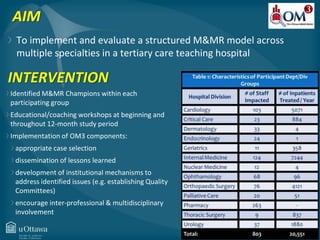
To implement and evaluate a structured M&MR model across 
multiple specialties in a tertiary care teaching hospital 
INTERVENTION 
Identified M&MR Champions within each 
participating group 
Educational/coaching workshops at beginning and 
throughout 12-month study period 
Implementation of OM3 components: 
appropriate case selection 
dissemination of lessons learned 
development of institutional mechanisms to 
address identified issues (e.g. establishing Quality 
Committees) 
encourage inter-professional & multidisciplinary 
involvement
MEASUREMENT 
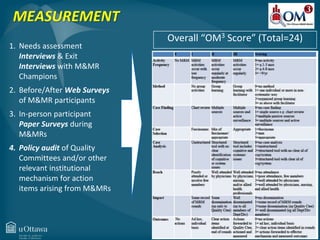
1. Needs assessment 
Interviews & Exit 
Interviews with M&MR 
Champions 
2. Before/After Web Surveys 
of M&MR participants 
3. In-person participant 
Paper Surveys during 
M&MRs 
4. Policy audit of Quality 
Committees and/or other 
relevant institutional 
mechanism for action 
items arising from M&MRs 
Overall “OM3 Score” (Total=24)
RESULTS: HOSPITAL-WIDE 
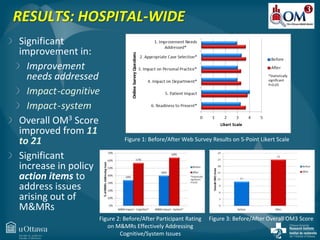
Significant 
improvement in: 
Improvement 
needs addressed 
Impact-cognitive 
Impact-system 
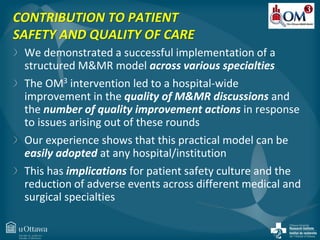
Overall OM3 Score 
improved from 11 
to 21 
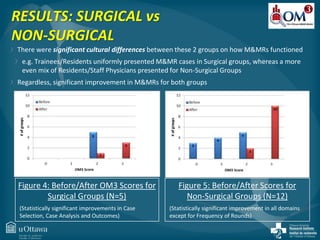
Significant 
increase in policy 
action items to 
address issues 
arising out of 
M&MRs 
Figure 1: Before/After Web Survey Results on 5-Point Likert Scale 
Figure 2: Before/After Participant Rating Figure 3: Before/After Overall OM3 Score 
on M&MRs Effectively Addressing 
Cognitive/System Issues
RESULTS: SURGICAL vs 
NON-SURGICAL 
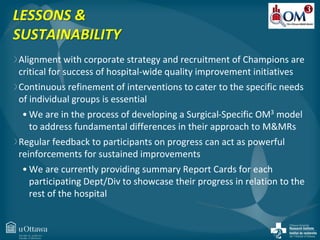
There were significant cultural differences between these 2 groups on how M&MRs functioned 
e.g. Trainees/Residents uniformly presented M&MR cases in Surgical groups, whereas a more 
even mix of Residents/Staff Physicians presented for Non-Surgical Groups 
Regardless, significant improvement in M&MRs for both groups 
Figure 4: Before/After OM3 Scores for 
Surgical Groups (N=5) 
(Statistically significant improvements in Case 
Selection, Case Analysis and Outcomes) 
Figure 5: Before/After Scores for 
Non-Surgical Groups (N=12) 
(Statistically significant improvement in all domains 
except for Frequency of Rounds)
CONTRIBUTION TO PATIENT 
SAFETY AND QUALITY OF CARE 
We demonstrated a successful implementation of a 
structured M&MR model across various specialties 
The OM3 intervention led to a hospital-wide 
improvement in the quality of M&MR discussions and 
the number of quality improvement actions in response 
to issues arising out of these rounds 
Our experience shows that this practical model can be 
easily adopted at any hospital/institution 
This has implications for patient safety culture and the 
reduction of adverse events across different medical and 
surgical specialties
LESSONS & 
SUSTAINABILITY 
Alignment with corporate strategy and recruitment of Champions are 
critical for success of hospital-wide quality improvement initiatives 
Continuous refinement of interventions to cater to the specific needs 
of individual groups is essential 
• We are in the process of developing a Surgical-Specific OM3 model 
to address fundamental differences in their approach to M&MRs 
Regular feedback to participants on progress can act as powerful 
reinforcements for sustained improvements 
• We are currently providing summary Report Cards for each 
participating Dept/Div to showcase their progress in relation to the 
rest of the hospital

Enhancing the Quality of Morbidity & Mortality rounds Hospital-wide: the Ottawa M&M Model (OM3)

  • 1.
    Enhancing the Qualityof Morbidity & Mortality rounds Hospital-wide: the Ottawa M&M Model (OM3) Kwok ES, Calder LA, Barlow-Krelina E, Seely AJ, Cwinn A, Worthington J, MacKie C, Frank JR Canada’s Forum on Patient Safety & Quality Improvement Edmonton AB October 2014 Dr. Edmund Kwok: ekwok@toh.on.ca
  • 2.
    PROBLEM /OPPORTUNITY Morbidity& Mortality Rounds (M&MR) traditionally used as potential opportunity for healthcare professionals to review errors and identify issues to be addressed Recent current state analysis of our institution revealed: not all Dept/Div held M&MR regularly for those who did, variable effectiveness in the quality of M&MR discussions and any resulting actions impacting quality of care We recently published a novel structured approach to M&MR1, but it has not been validated across specialties 1Calder LA, Kwok ES, Cwinn AA, Worthington J, Yelle JD, Waggott, Frank JR. Enhancing the quality of morbidity and mortality rounds: the Ottawa M&M model. Acad Emerg Med. 2014;21(3):314-21
  • 3.
    AIM To implementand evaluate a structured M&MR model across multiple specialties in a tertiary care teaching hospital INTERVENTION Identified M&MR Champions within each participating group Educational/coaching workshops at beginning and throughout 12-month study period Implementation of OM3 components: appropriate case selection dissemination of lessons learned development of institutional mechanisms to address identified issues (e.g. establishing Quality Committees) encourage inter-professional & multidisciplinary involvement
  • 4.
    MEASUREMENT 1. Needsassessment Interviews & Exit Interviews with M&MR Champions 2. Before/After Web Surveys of M&MR participants 3. In-person participant Paper Surveys during M&MRs 4. Policy audit of Quality Committees and/or other relevant institutional mechanism for action items arising from M&MRs Overall “OM3 Score” (Total=24)
  • 5.
    RESULTS: HOSPITAL-WIDE Significant improvement in: Improvement needs addressed Impact-cognitive Impact-system Overall OM3 Score improved from 11 to 21 Significant increase in policy action items to address issues arising out of M&MRs Figure 1: Before/After Web Survey Results on 5-Point Likert Scale Figure 2: Before/After Participant Rating Figure 3: Before/After Overall OM3 Score on M&MRs Effectively Addressing Cognitive/System Issues
  • 6.
    RESULTS: SURGICAL vs NON-SURGICAL There were significant cultural differences between these 2 groups on how M&MRs functioned e.g. Trainees/Residents uniformly presented M&MR cases in Surgical groups, whereas a more even mix of Residents/Staff Physicians presented for Non-Surgical Groups Regardless, significant improvement in M&MRs for both groups Figure 4: Before/After OM3 Scores for Surgical Groups (N=5) (Statistically significant improvements in Case Selection, Case Analysis and Outcomes) Figure 5: Before/After Scores for Non-Surgical Groups (N=12) (Statistically significant improvement in all domains except for Frequency of Rounds)
  • 7.
    CONTRIBUTION TO PATIENT SAFETY AND QUALITY OF CARE We demonstrated a successful implementation of a structured M&MR model across various specialties The OM3 intervention led to a hospital-wide improvement in the quality of M&MR discussions and the number of quality improvement actions in response to issues arising out of these rounds Our experience shows that this practical model can be easily adopted at any hospital/institution This has implications for patient safety culture and the reduction of adverse events across different medical and surgical specialties
  • 8.
    LESSONS & SUSTAINABILITY Alignment with corporate strategy and recruitment of Champions are critical for success of hospital-wide quality improvement initiatives Continuous refinement of interventions to cater to the specific needs of individual groups is essential • We are in the process of developing a Surgical-Specific OM3 model to address fundamental differences in their approach to M&MRs Regular feedback to participants on progress can act as powerful reinforcements for sustained improvements • We are currently providing summary Report Cards for each participating Dept/Div to showcase their progress in relation to the rest of the hospital