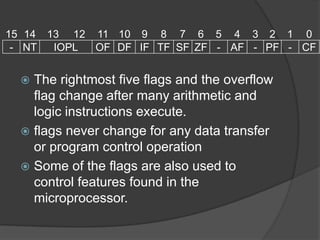
 The rightmost five flags and the overflow
flag change after many arithmetic and
logic instructions execute.
 flags never change for any data transfer
or program control operation
 Some of the flags are also used to
control features found in the
microprocessor.
15 14 13 12 11 10 9 8 7 6 5 4 3 2 1 0
- NT IOPL OF DF IF TF SF ZF - AF - PF - CF
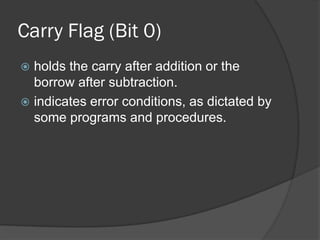
Carry Flag (Bit 0)
 holds the carry after addition or the
borrow after subtraction.
 indicates error conditions, as dictated by
some programs and procedures.
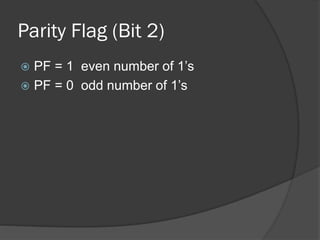
Parity Flag (Bit 2)
 PF = 1 even number of 1’s
 PF = 0 odd number of 1’s
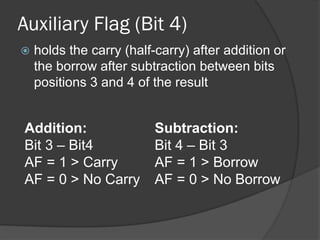
Auxiliary Flag (Bit 4)
 holds the carry (half-carry) after addition or
the borrow after subtraction between bits
positions 3 and 4 of the result
Addition:
Bit 3 – Bit4
AF = 1 > Carry
AF = 0 > No Carry
Subtraction:
Bit 4 – Bit 3
AF = 1 > Borrow
AF = 0 > No Borrow
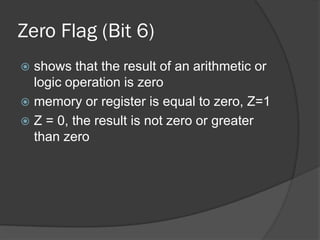
Zero Flag (Bit 6)
 shows that the result of an arithmetic or
logic operation is zero
 memory or register is equal to zero, Z=1
 Z = 0, the result is not zero or greater
than zero
Sign Flag (Bit 7)
 2’s complement
 Sign bit = 1, negative # in 2’s
complement
Trap Flag
 enables trapping through an on-chip-
debugging feature
 T =1, microprocessor interrupts the flow
of the program on conditions as
indicated by the debug registers and
control registers.
 T=0, the trapping (debugging) feature is
disabled.
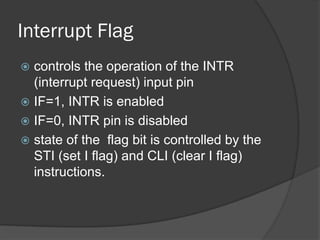
Interrupt Flag
 controls the operation of the INTR
(interrupt request) input pin
 IF=1, INTR is enabled
 IF=0, INTR pin is disabled
 state of the flag bit is controlled by the
STI (set I flag) and CLI (clear I flag)
instructions.
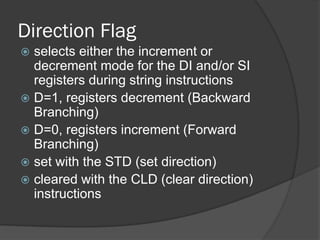
Direction Flag
 selects either the increment or
decrement mode for the DI and/or SI
registers during string instructions
 D=1, registers decrement (Backward
Branching)
 D=0, registers increment (Forward
Branching)
 set with the STD (set direction)
 cleared with the CLD (clear direction)
instructions
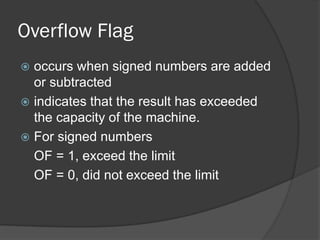
Overflow Flag
 occurs when signed numbers are added
or subtracted
 indicates that the result has exceeded
the capacity of the machine.
 For signed numbers
OF = 1, exceed the limit
OF = 0, did not exceed the limit
INPUT/OUTPUT PRIVILEGE LEVEL
 Priority of current task
NESTED TASK
 indicates if current task is nested

Cpe103 03 [processor flags]

  • 2.
     The rightmostfive flags and the overflow flag change after many arithmetic and logic instructions execute.  flags never change for any data transfer or program control operation  Some of the flags are also used to control features found in the microprocessor. 15 14 13 12 11 10 9 8 7 6 5 4 3 2 1 0 - NT IOPL OF DF IF TF SF ZF - AF - PF - CF
  • 3.
    Carry Flag (Bit0)  holds the carry after addition or the borrow after subtraction.  indicates error conditions, as dictated by some programs and procedures.
  • 4.
    Parity Flag (Bit2)  PF = 1 even number of 1’s  PF = 0 odd number of 1’s
  • 5.
    Auxiliary Flag (Bit4)  holds the carry (half-carry) after addition or the borrow after subtraction between bits positions 3 and 4 of the result Addition: Bit 3 – Bit4 AF = 1 > Carry AF = 0 > No Carry Subtraction: Bit 4 – Bit 3 AF = 1 > Borrow AF = 0 > No Borrow
  • 6.
    Zero Flag (Bit6)  shows that the result of an arithmetic or logic operation is zero  memory or register is equal to zero, Z=1  Z = 0, the result is not zero or greater than zero
  • 7.
    Sign Flag (Bit7)  2’s complement  Sign bit = 1, negative # in 2’s complement
  • 8.
    Trap Flag  enablestrapping through an on-chip- debugging feature  T =1, microprocessor interrupts the flow of the program on conditions as indicated by the debug registers and control registers.  T=0, the trapping (debugging) feature is disabled.
  • 9.
    Interrupt Flag  controlsthe operation of the INTR (interrupt request) input pin  IF=1, INTR is enabled  IF=0, INTR pin is disabled  state of the flag bit is controlled by the STI (set I flag) and CLI (clear I flag) instructions.
  • 10.
    Direction Flag  selectseither the increment or decrement mode for the DI and/or SI registers during string instructions  D=1, registers decrement (Backward Branching)  D=0, registers increment (Forward Branching)  set with the STD (set direction)  cleared with the CLD (clear direction) instructions
  • 11.
    Overflow Flag  occurswhen signed numbers are added or subtracted  indicates that the result has exceeded the capacity of the machine.  For signed numbers OF = 1, exceed the limit OF = 0, did not exceed the limit
  • 12.
    INPUT/OUTPUT PRIVILEGE LEVEL Priority of current task
  • 13.
    NESTED TASK  indicatesif current task is nested