Community Engagement Framework
Adopted June 2017
2 INNER WEST COUNCIL COMMUNITY ENGAGEMENT FRAMEWORK 2017
Contents
	
1. Introduction								 4
>> What is the purpose of the Community Engagement Framework?		 4
>> What are the benefits of effective engagement?				 4
>> How was the Community Engagement Framework developed?		 5
2. Local Democracy							 6
>> What is local democracy?							 6
>> Local democracy at Inner West Council - representative			 7
>> Local democracy at Inner West Council - participatory			 7
3. Community Engagement Framework				 9
>> Who is the Inner West community?						 9
>> How will Council engage?							 10
>> Principles							 10
>> Process							 11
>> Stakeholders
>> Explanatory Diagram					 12
>> External Stakeholders					 13
>> Inclusive participation					 13
>> Strategic Reference Groups, Statutory Committees and
Interagencies						 13
>> Internal Stakeholders					 13
>> Participation levels						 14
>> Program of communication and engagement activities		 15
>> Evaluation							 16
4. Community Engagement Framework Elements		 17
5. Framework Review							 18							
INNER WEST COUNCIL COMMUNITY ENGAGEMENT FRAMEWORK 2017 3
1.Introduction
Inner West Council, formed on 12 May 2016 through the amalgamation of Ashfield, Leichhardt and
Marrickville Councils, is committed to delivering effective, efficient services that meet the expectations
and needs of the community. Council recognises that local knowledge, ideas and feedback from the
community are essential to ensure Council’s decision-making improves community wellbeing and long-
term sustainability.
Community engagement is the process by which the community participates in and influences Council’s
decision-making.
What is the purpose of the Community
Engagement Framework?
The Community Engagement Framework guides how Council will engage so that a broad range of
perspectives are sought and the community has a strong voice in Council’s decision-making. The
Framework is based on a set of principles and recognises that engagement is a planned practice which
should be tailored to particular circumstances, taking into account factors such as complexity, risk,
significance, sensitivity, timing or opportunity.
The Framework is applicable to the array of engagement processes that shape programs, services and
infrastructure provided by Council, and plans that guide Council’s work. The Framework enables Council
to engage with the community in a strategic, ongoing, flexible and locally appropriate way.
Engaging with the community is one of the guiding principles for councils under the Local Government Act
1993 (section 8A) and is an important part of local democracy. Some engagement processes are already
prescribed by legislation and Council’s practice will always meet these minimum requirements.
Council will regularly review and update the Framework as required so that it remains current and complies
with any amendments to legislation and innovations in practice.
What are the benefits of effective engagement?
Good community engagement is the basis for understanding decisions, sharing perspectives,
improving outcomes and building trust between Council, the community, and other partners. Effective
engagement will:
>> ensure community needs and expectations are understood and reflected in the decisions and actions
of Council
>> result in better, more sustainable decisions
>> build trust and improve accountability through transparency of decision-making
>> value local knowledge and foster local problem-solving
>> improve understanding of Council’s planning, prioritising and resourcing
>> identify critical issues and opportunities early
>> optimise use of limited resources and maximise efficient resource allocation.
4 INNER WEST COUNCIL COMMUNITY ENGAGEMENT FRAMEWORK 2017
How was the Community Engagement Framework developed?
Community engagement was a high priority at each of the three former Councils that amalgamated
to form Inner West Council. Excellent practice was demonstrated through a variety of methods that
ensured a strong community voice in decision-making by the Councils. This legacy will be continued
and strengthened at Inner West Council.
The development of Inner West Council’s Draft Community Engagement Framework was informed by
engagement with staff and the Local Representation Advisory Committee (former Councillors); and the
engagement frameworks of the three former Councils.
The International Association for Public Participation (IAP2) Framework considered best practice
internationally and within Australia, underpinned the three former Councils’ Frameworks and forms the
foundation of the Inner West Council Community Engagement Framework.
The Draft Framework was on public exhibition for four weeks from Friday 28 April 2017 to Sunday
28 May 2017.
Input from the community, Council’s Interim Strategic Reference Groups and staff informed the
final version. It was adopted by Council on 27 June 2017.
INNER WEST COUNCIL COMMUNITY ENGAGEMENT FRAMEWORK 2017 5
What is local democracy?
The system of local government in New South Wales as set out in the Local Government Act provides for governed
bodies of councils that are democratically elected.
Councils make decisions through local democracy processes which are both representative and participatory.
Representative:
Representative democracy is the process by which the community elects Councillors to be the governing body of the
Council. The elected Council develops and implements policies, programs and long-term strategic plans, ensures
financial sustainability, monitors performance, and makes decisions to direct and control the affairs of the Council. The
elected Council is the final decision maker and is accountable to the community.
Participatory:
Participatory democracy is the process by which community members are actively involved in decisions that affect
them. The community can participate through a variety of community engagement processes that influence and
shape the elected Council’s decisions.
2.Local Democracy
Representative
Elected
community-based
Mayor and Councillors
Participatory
Community
engagement
The elected
Council makes
informed decisions
based on evidence
including robust
community
engagement
The Community
influences the
decisions and actions
of the elected
Council through
engagement processes
Influence
6 INNER WEST COUNCIL COMMUNITY ENGAGEMENT FRAMEWORK 2017
Local democracy at Inner West Council
– Representative
Inner West Council was proclaimed on 12 May 2016.
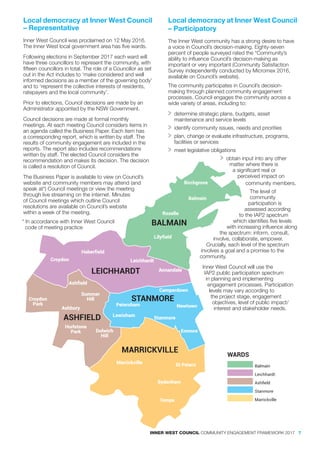
The Inner West local government area has five wards.
Following elections in September 2017 each ward will
have three councillors to represent the community, with
fifteen councillors in total. The role of a Councillor as set
out in the Act includes to ‘make considered and well
informed decisions as a member of the governing body’
and to ‘represent the collective interests of residents,
ratepayers and the local community’.
Prior to elections, Council decisions are made by an
Administrator appointed by the NSW Government.
Council decisions are made at formal monthly
meetings. At each meeting Council considers items in
an agenda called the Business Paper. Each item has
a corresponding report, which is written by staff. The
results of community engagement are included in the
reports. The report also includes recommendations
written by staff. The elected Council considers the
recommendation and makes its decision. The decision
is called a resolution of Council.
The Business Paper is available to view on Council’s
website and community members may attend (and
speak at*) Council meetings or view the meeting
through live streaming on the internet. Minutes
of Council meetings which outline Council
resolutions are available on Council’s website
within a week of the meeting.
Local democracy at Inner West Council
– Participatory
The Inner West community has a strong desire to have
a voice in Council’s decision-making. Eighty-seven
percent of people surveyed rated the “Community’s
ability to influence Council’s decision-making as
important or very important (Community Satisfaction
Survey independently conducted by Micromex 2016,
available on Council’s website).
The community participates in Council’s decision-
making through planned community engagement
processes. Council engages the community across a
wide variety of areas, including to:
>> determine strategic plans, budgets, asset
maintenance and service levels
>> identify community issues, needs and priorities
>> plan, change or evaluate infrastructure, programs,
facilities or services
>> meet legislative obligations
>> obtain input into any other
matter where there is
a significant real or
perceived impact on
community members.
The level of
community
participation is
assessed according
to the IAP2 spectrum
which identifies five levels
with increasing influence along
the spectrum: inform, consult,
involve, collaborate, empower.
Crucially, each level of the spectrum
involves a goal and a promise to the
community.
Inner West Council will use the
IAP2 public participation spectrum
in planning and implementing
engagement processes. Participation
levels may vary according to
the project stage, engagement
objectives, level of public impact/
interest and stakeholder needs.
Marrickville
Sydenham
St Peters
Enmore
Stanmore
Newtown
Tempe
Dulwich
Hill
Lewisham
Petersham
Camperdown
Annandale
Leichhardt
Summer
Hill
Haberfield
Lilyfield
Rozelle
Balmain
Birchgrove
Ashfield
Ashbury
Croydon
Croydon
Park
Hurlstone
Park
WARDS
Balmain
Leichhardt
Ashfield
Stanmore
Marrickville
INNER WEST COUNCIL
Local Government Area Ward Boundaries
BALMAIN
LEICHHARDT
ASHFIELD
STANMORE
MARRICKVILLE
D
Summer
Hill
Haberfie
Ashfield
Ashbury
Croydon
Croydon
Park
Hurlstone
Park
WARDS
Balmain
Leichhardt
Ashfield
Stanmore
Marrickville
INNER WEST COUNC
Local Government Area Ward Bou
LE
ASHFIELD
* In accordance with Inner West Council
code of meeting practice
INNER WEST COUNCIL COMMUNITY ENGAGEMENT FRAMEWORK 2017 7
8 INNER WEST COUNCIL COMMUNITY ENGAGEMENT FRAMEWORK 2017
3.Community Engagement Framework
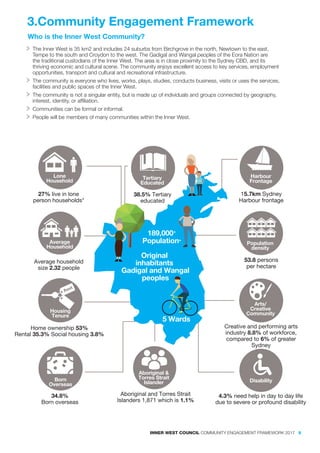
>> The Inner West is 35 km2 and includes 24 suburbs from Birchgrove in the north, Newtown to the east,
Tempe to the south and Croydon to the west. The Gadigal and Wangal peoples of the Eora Nation are
the traditional custodians of the Inner West. The area is in close proximity to the Sydney CBD, and its
thriving economic and cultural scene. The community enjoys excellent access to key services, employment
opportunities, transport and cultural and recreational infrastructure.
>> The community is everyone who lives, works, plays, studies, conducts business, visits or uses the services,
facilities and public spaces of the Inner West.
>> The community is not a singular entity, but is made up of individuals and groups connected by geography,
interest, identity, or affiliation.
>> Communities can be formal or informal.
>> People will be members of many communities within the Inner West.
Who is the Inner West Community?
Lone
Household
Tertiary
Educated
Population
density
Average
Household
Average household
size 2.32 people
27% live in lone
person households*
Housing
Tenure
Home ownership 53%
Rental 35.3% Social housing 3.8%
34.8%
Born overseas
Harbour
Frontage
15.7km Sydney
Harbour frontage
53.8 persons
per hectare
Arts/
Creative
Community
Creative and performing arts
industry 8.8% of workforce,
compared to 6% of greater
Sydney
Disability
4.3% need help in day to day life
due to severe or profound disability
38.5% Tertiary
educated
Aboriginal &
Torres Strait
Islander
Aboriginal and Torres Strait
Islanders 1,871 which is 1.1%
35km2
Born
Overseas
Original
inhabitants
Gadigal and Wangal
peoples
5 Wards
189,000+
Population*
INNER WEST COUNCIL COMMUNITY ENGAGEMENT FRAMEWORK 2017 9
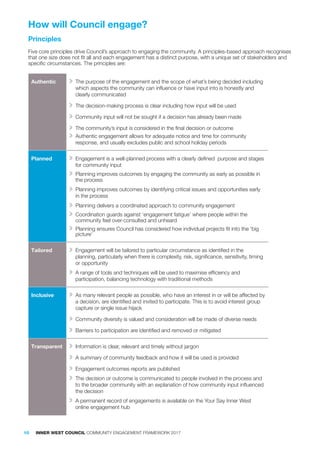
Authentic >> The purpose of the engagement and the scope of what’s being decided including
which aspects the community can influence or have input into is honestly and
clearly communicated
>> The decision-making process is clear including how input will be used
>> Community input will not be sought if a decision has already been made
>> The community’s input is considered in the final decision or outcome
>> Authentic engagement allows for adequate notice and time for community
response, and usually excludes public and school holiday periods
Planned >> Engagement is a well-planned process with a clearly defined purpose and stages
for community input
>> Planning improves outcomes by engaging the community as early as possible in
the process
>> Planning improves outcomes by identifying critical issues and opportunities early
in the process
>> Planning delivers a coordinated approach to community engagement
>> Coordination guards against ‘engagement fatigue’ where people within the
community feel over-consulted and unheard
>> Planning ensures Council has considered how individual projects fit into the ‘big
picture’
Tailored >> Engagement will be tailored to particular circumstance as identified in the
planning, particularly when there is complexity, risk, significance, sensitivity, timing
or opportunity
>> A range of tools and techniques will be used to maximise efficiency and
participation, balancing technology with traditional methods
Inclusive >> As many relevant people as possible, who have an interest in or will be affected by
a decision, are identified and invited to participate. This is to avoid interest group
capture or single issue hijack
>> Community diversity is valued and consideration will be made of diverse needs
>> Barriers to participation are identified and removed or mitigated
Transparent >> Information is clear, relevant and timely without jargon
>> A summary of community feedback and how it will be used is provided
>> Engagement outcomes reports are published
>> The decision or outcome is communicated to people involved in the process and
to the broader community with an explanation of how community input influenced
the decision
>> A permanent record of engagements is available on the Your Say Inner West
online engagement hub
How will Council engage?
Principles
Five core principles drive Council’s approach to engaging the community. A principles-based approach recognises
that one size does not fit all and each engagement has a distinct purpose, with a unique set of stakeholders and
specific circumstances. The principles are:
10 INNER WEST COUNCIL COMMUNITY ENGAGEMENT FRAMEWORK 2017
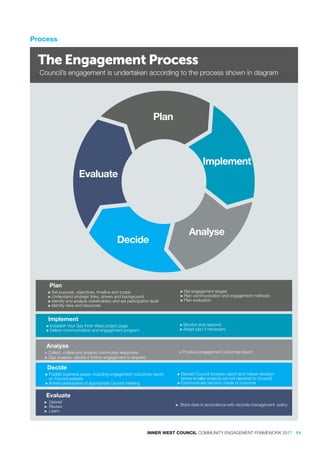
Plan
Implement
Analyse
Decide
Evaluate
Plan
> Set purpose, objectives, timeline and scope
> Understand strategic links, drivers and background
> Identify and analyse stakeholders and set participation level
> Identify risks and resources
Implement
> Establish Your Say Inner West project page
> Deliver communication and engagement program
The Engagement Process
> Set engagement stages
> Plan communication and engagement methods
> Plan evaluation
> Monitor and respond
> Adapt plan if necessary
Council’s engagement is undertaken according to the process shown in diagram
Decide
> Publish business paper, including engagement outcomes report
on Council website
> Advise participants of appropriate Council meeting
> Elected Council receives report and makes decision
(some smaller projects are not reported to Council)
> Communicate decision made or outcome
Evaluate
> Debrief
> Review
> Learn
> Store data in accordance with records-management policy
Analyse
> Collect, collate and analyse community responses
> Gap analysis- decide if further engagement is required
> Produce engagement outcomes report
Process
INNER WEST COUNCIL COMMUNITY ENGAGEMENT FRAMEWORK 2017 11
Non-
government
organisations
(NGOs) and
service
providers
Future
community
Community
groups
Working
groups and
project
groups
Schools and
Childcare
Centres
OPEN
Café
Service/
facility users
People with
a disability
Cultural
institutions and
Neighborhoods
Centres
Other
Councils
Youth
Children and
families
Ratepayers
Seniors
Visitors
Internal
stakeholders
across Council’s
service units
Aboriginal
and Torres
Strait Islander
Business and
Industry
Council’s
Strategic
Reference
Groups and
statutory
committees
State and
Federal
Government
departments
and agencies
Students
LGBTIQ
People from
culturally and
linguistically
diverse
backgrounds
People
connected
by a common
interest or
by a place
Councillors/
Administrators/
Local
Representation
Advisory
Committee
Residents
Stakeholders
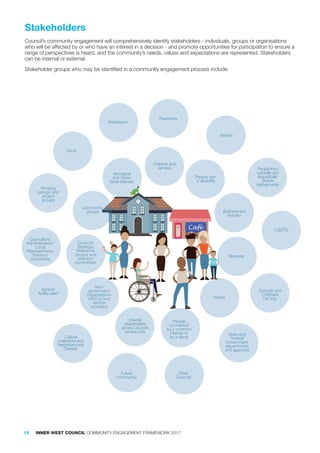
Council’s community engagement will comprehensively identify stakeholders - individuals, groups or organisations
who will be affected by or who have an interest in a decision - and promote opportunities for participation to ensure a
range of perspectives is heard, and the community’s needs, values and expectations are represented. Stakeholders
can be internal or external.
Stakeholder groups who may be identified in a community engagement process include:
12 INNER WEST COUNCIL COMMUNITY ENGAGEMENT FRAMEWORK 2017
External stakeholders
Stakeholders may include residents, businesses, ratepayers,
schools, service users, service providers, government agencies,
sporting clubs, and local groups etc.
Every engagement plan will identify relevant stakeholders and
their needs or interests. The stakeholder list may need to be
refined as information emerges during implementation.
Stakeholders should be carefully nurtured and provided with
resources or support where necessary. Council is aiming to
build long-term partnerships with the community; not just a
single contact for the purpose of a particular engagement.
Council’s reputation and the community’s trust in Council will be
impacted by each engagement.
Inclusive Participation
Some communities are ‘hard to reach’ as they may have
special needs or barriers to participation that impact on
inclusion. These barriers may include language, accessibility,
cultural, safety issues or even time constraints.
Community engagement activities should be sensitively
planned for the intended audience and may need to provide
opportunities that mitigate these barriers including
>> material in languages other than English and accessible
by people with a vision impairment or other disability
(including WCAG compliant online material)
>> provision for assistance where needed to participate
>> accessible venues
>> appropriate time and day for the target group
>> appropriate method for the target group
>> online as well as face-to-face or non-digital activities
Interim Strategic Reference Groups,
Statutory Committees and Interagencies
Council has appointed representatives from the community
to be members of Interim Strategic Reference Groups (SRGs)
during the transition to Inner West Council. The SRGs provide
feedback, guidance and recommendations to Council on
specific issues, including strategic planning and policy and
contribute local knowledge regarding community impacts,
emerging trends, opportunities and service gaps. The SRGs,
whose role is advisory include:
>> Young Leaders Reference Group
>> Social Inclusion Strategic Reference Group
>> Economic Development Strategic Reference Group
>> Housing and Affordability Reference Group
>> Transport Strategic Reference Group
>> Environment Strategic Reference Group
>> Planning and Heritage Strategic Reference Group
>> Aboriginal and Torres Strait Islander Reference Group
Council’s Interim Strategic Reference Groups and statutory
committees are recognised in the Framework as stakeholders
that will be identified in the engagement plans of relevant
projects. The Reference Groups will be asked to provide
feedback or input into specific engagements and may be
asked to review an engagement plan and/or provide
advice on reaching members of the demographic
group/s which the Reference Group represents.
Recommendations or advice will be included in
engagement outcomes reports as the opinion of the
SRG as a whole. SRG members may also participate in
engagement processes as individuals.
Council also has a number of statutory committees and
interagencies which may be stakeholders in a process.
Current statutory committees include:
>> The Local Traffic Committee advises Inner West
Council on traffic and parking control matters for
which Council has been delegated authority from
NSW Roads and Maritime Services.
>> The Inner West Flood Management Advisory
Committee helps develop and implement of Flood
Risk Management Plans (FRMP) for the Inner West
local government area.
>> The Local Emergency Management Committee
carries out emergency management as the
responsible authority for the Inner West local
government area.
>> The Inner West Council Aged Care Interagency is
a forum established to bring together the various
agencies working with older people in the Inner West
Council area.
Internal stakeholders
It is essential that internal stakeholders (staff across
Council service units) are included early in the
engagement process, before external stakeholders.
Effective collaboration and communication within the
organisation will improve processes and outcomes.
INNER WEST COUNCIL COMMUNITY ENGAGEMENT FRAMEWORK 2017 13
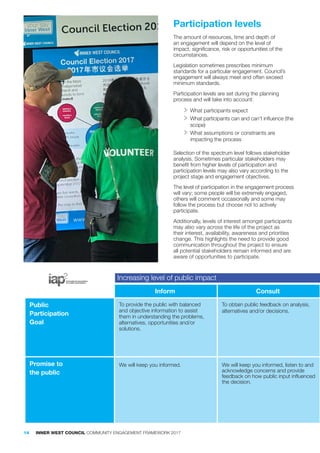
Participation levels
The amount of resources, time and depth of
an engagement will depend on the level of
impact, significance, risk or opportunities of the
circumstances.
Legislation sometimes prescribes minimum
standards for a particular engagement. Council’s
engagement will always meet and often exceed
minimum standards.
Participation levels are set during the planning
process and will take into account:
>> What participants expect
>> What participants can and can’t influence (the
scope)
>> What assumptions or constraints are
impacting the process
Selection of the spectrum level follows stakeholder
analysis. Sometimes particular stakeholders may
benefit from higher levels of participation and
participation levels may also vary according to the
project stage and engagement objectives.
The level of participation in the engagement process
will vary; some people will be extremely engaged,
others will comment occasionally and some may
follow the process but choose not to actively
participate.
Additionally, levels of interest amongst participants
may also vary across the life of the project as
their interest, availability, awareness and priorities
change. This highlights the need to provide good
communication throughout the project to ensure
all potential stakeholders remain informed and are
aware of opportunities to participate.
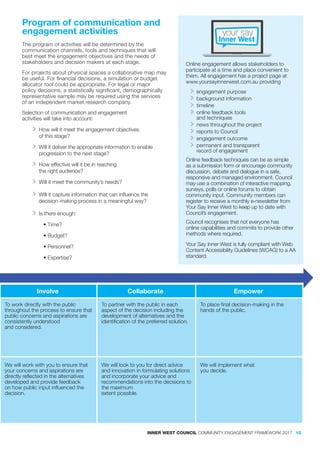
Increasing level of public impact
Inform Consult
Public
Participation
Goal
To provide the public with balanced
and objective information to assist
them in understanding the problems,
alternatives, opportunities and/or
solutions.
To obtain public feedback on analysis,
alternatives and/or decisions.
Promise to
the public
We will keep you informed. We will keep you informed, listen to and
acknowledge concerns and provide
feedback on how public input influenced
the decision.
14 INNER WEST COUNCIL COMMUNITY ENGAGEMENT FRAMEWORK 2017
Program of communication and
engagement activities
The program of activities will be determined by the
communication channels, tools and techniques that will
best meet the engagement objectives and the needs of
stakeholders and decision makers at each stage.
For projects about physical spaces a collaborative map may
be useful. For financial decisions, a simulation or budget
allocator tool could be appropriate. For legal or major
policy decisions, a statistically significant, demographically
representative sample may be required using the services
of an independent market research company.
Selection of communication and engagement
activities will take into account:
>> How will it meet the engagement objectives
of this stage?
>> Will it deliver the appropriate information to enable
progression to the next stage?
>> How effective will it be in reaching
the right audience?
>> Will it meet the community’s needs?
>> Will it capture information that can influence the
decision-making process in a meaningful way?
>> Is there enough:
• Time?
• Budget?
• Personnel?
• Expertise?
Online engagement allows stakeholders to
participate at a time and place convenient to
them. All engagement has a project page at
www.yoursayinnerwest.com.au providing
>> engagement purpose
>> background information
>> timeline
>> online feedback tools
and techniques
>> news throughout the project
>> reports to Council
>> engagement outcome
>> permanent and transparent
record of engagement
Online feedback techniques can be as simple
as a submission form or encourage community
discussion, debate and dialogue in a safe,
responsive and managed environment. Council
may use a combination of interactive mapping,
surveys, polls or online forums to obtain
community input. Community members can
register to receive a monthly e-newsletter from
Your Say Inner West to keep up to date with
Council’s engagement.
Council recognises that not everyone has
online capabilities and commits to provide other
methods where required.
Your Say Inner West is fully compliant with Web
Content Accessibility Guidelines (WCAG) to a AA
standard.
Involve Collaborate Empower
To work directly with the public
throughout the process to ensure that
public concerns and aspirations are
consistently understood
and considered.
To partner with the public in each
aspect of the decision including the
development of alternatives and the
identification of the preferred solution.
To place final decision-making in the
hands of the public.
We will work with you to ensure that
your concerns and aspirations are
directly reflected in the alternatives
developed and provide feedback
on how public input influenced the
decision.
We will look to you for direct advice
and innovation in formulating solutions
and incorporate your advice and
recommendations into the decisions to
the maximum
extent possible.
We will implement what
you decide.
INNER WEST COUNCIL COMMUNITY ENGAGEMENT FRAMEWORK 2017 15
Examples of community participation opportunities include:
>> Participating in long-term vision and strategic plan development
>> Providing input to develop options for an infrastructure project
>> Sharing stories, photos and local knowledge during Framework development
>> Taking part in a survey
>> Providing feedback about a plan on exhibition
>> Attending a workshop or community meeting
>> Speaking at a Council meeting
>> Providing feedback during a service review
>> Signing up and participating at www.yoursayinnerwest.com.au
>> Becoming a member of a Strategic Reference Group or statutory committee
>> Joining a project-specific working group
Evaluation
Council will evaluate engagement practice to identify how well the objectives were met. Evaluation will assist in:
>> Reporting on outcomes
>> Identifying gaps in data collections
>> Learning what worked and what didn’t
>> Strengthening Council’s and the community’s capacity for participation
>> Building knowledge and skills
>> Continuously improving processes
Evaluation criteria relevant to the engagement will be set. For example criteria may be around numbers of people
participating, the demographics of those who participated or the quality of the input.
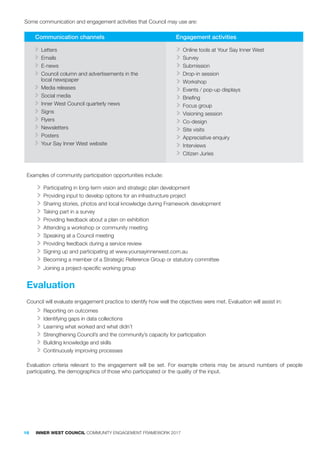
Some communication and engagement activities that Council may use are:
Communication channels Engagement activities
>> Letters
>> Emails
>> E-news
>> Council column and advertisements in the
local newspaper
>> Media releases
>> Social media
>> Inner West Council quarterly news
>> Signs
>> Flyers
>> Newsletters
>> Posters
>> Your Say Inner West website
>> Online tools at Your Say Inner West
>> Survey
>> Submission
>> Drop-in session
>> Workshop
>> Events / pop-up displays
>> Briefing
>> Focus group
>> Visioning session
>> Co-design
>> Site visits
>> Appreciative enquiry
>> Interviews
>> Citizen Juries
16 INNER WEST COUNCIL COMMUNITY ENGAGEMENT FRAMEWORK 2017
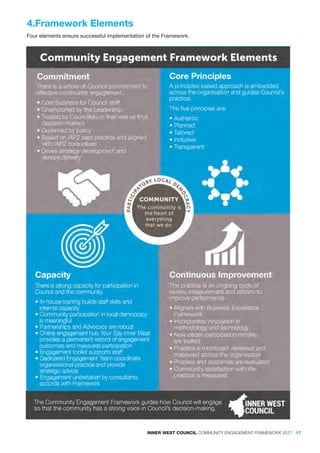
Four elements ensure successful implementation of the Framework.
4.Framework Elements
INNER WEST COUNCIL COMMUNITY ENGAGEMENT FRAMEWORK 2017 17
The Community Engagement Framework will be monitored and reviewed regularly to ensure compliance with legislative
change, innovation in practice and community expectations.
The Framework makes reference to the current period in which Council is under administration and the forthcoming
election in September 2017 at which Councillors will be elected. The Framework will therefore require review within
one year of adoption. The new Councillors and community will have opportunities to participate in the review and the
outcome will be made publicly available.
ACCESSIBLE FORMATS
This publication can be provided in large print or an alternative media format. If you need this service, please contact
02 9335 2222.
MORE INFORMATION
Contact Council’s Engagement Team on 02 9335 2222 or email council@innerwest.nsw.gov.au
Visit www.yoursayinnerwest.com.au
5.Framework Review
18 INNER WEST COUNCIL COMMUNITY ENGAGEMENT FRAMEWORK 2017
INNER WEST COUNCIL COMMUNITY ENGAGEMENT FRAMEWORK 2017 19
© 2017 Inner West Council

Inner West Council - Community engagement framework

  • 1.
  • 2.
    2 INNER WESTCOUNCIL COMMUNITY ENGAGEMENT FRAMEWORK 2017
  • 3.
    Contents 1. Introduction 4 >>What is the purpose of the Community Engagement Framework? 4 >> What are the benefits of effective engagement? 4 >> How was the Community Engagement Framework developed? 5 2. Local Democracy 6 >> What is local democracy? 6 >> Local democracy at Inner West Council - representative 7 >> Local democracy at Inner West Council - participatory 7 3. Community Engagement Framework 9 >> Who is the Inner West community? 9 >> How will Council engage? 10 >> Principles 10 >> Process 11 >> Stakeholders >> Explanatory Diagram 12 >> External Stakeholders 13 >> Inclusive participation 13 >> Strategic Reference Groups, Statutory Committees and Interagencies 13 >> Internal Stakeholders 13 >> Participation levels 14 >> Program of communication and engagement activities 15 >> Evaluation 16 4. Community Engagement Framework Elements 17 5. Framework Review 18 INNER WEST COUNCIL COMMUNITY ENGAGEMENT FRAMEWORK 2017 3
  • 4.
    1.Introduction Inner West Council,formed on 12 May 2016 through the amalgamation of Ashfield, Leichhardt and Marrickville Councils, is committed to delivering effective, efficient services that meet the expectations and needs of the community. Council recognises that local knowledge, ideas and feedback from the community are essential to ensure Council’s decision-making improves community wellbeing and long- term sustainability. Community engagement is the process by which the community participates in and influences Council’s decision-making. What is the purpose of the Community Engagement Framework? The Community Engagement Framework guides how Council will engage so that a broad range of perspectives are sought and the community has a strong voice in Council’s decision-making. The Framework is based on a set of principles and recognises that engagement is a planned practice which should be tailored to particular circumstances, taking into account factors such as complexity, risk, significance, sensitivity, timing or opportunity. The Framework is applicable to the array of engagement processes that shape programs, services and infrastructure provided by Council, and plans that guide Council’s work. The Framework enables Council to engage with the community in a strategic, ongoing, flexible and locally appropriate way. Engaging with the community is one of the guiding principles for councils under the Local Government Act 1993 (section 8A) and is an important part of local democracy. Some engagement processes are already prescribed by legislation and Council’s practice will always meet these minimum requirements. Council will regularly review and update the Framework as required so that it remains current and complies with any amendments to legislation and innovations in practice. What are the benefits of effective engagement? Good community engagement is the basis for understanding decisions, sharing perspectives, improving outcomes and building trust between Council, the community, and other partners. Effective engagement will: >> ensure community needs and expectations are understood and reflected in the decisions and actions of Council >> result in better, more sustainable decisions >> build trust and improve accountability through transparency of decision-making >> value local knowledge and foster local problem-solving >> improve understanding of Council’s planning, prioritising and resourcing >> identify critical issues and opportunities early >> optimise use of limited resources and maximise efficient resource allocation. 4 INNER WEST COUNCIL COMMUNITY ENGAGEMENT FRAMEWORK 2017
  • 5.
    How was theCommunity Engagement Framework developed? Community engagement was a high priority at each of the three former Councils that amalgamated to form Inner West Council. Excellent practice was demonstrated through a variety of methods that ensured a strong community voice in decision-making by the Councils. This legacy will be continued and strengthened at Inner West Council. The development of Inner West Council’s Draft Community Engagement Framework was informed by engagement with staff and the Local Representation Advisory Committee (former Councillors); and the engagement frameworks of the three former Councils. The International Association for Public Participation (IAP2) Framework considered best practice internationally and within Australia, underpinned the three former Councils’ Frameworks and forms the foundation of the Inner West Council Community Engagement Framework. The Draft Framework was on public exhibition for four weeks from Friday 28 April 2017 to Sunday 28 May 2017. Input from the community, Council’s Interim Strategic Reference Groups and staff informed the final version. It was adopted by Council on 27 June 2017. INNER WEST COUNCIL COMMUNITY ENGAGEMENT FRAMEWORK 2017 5
  • 6.
    What is localdemocracy? The system of local government in New South Wales as set out in the Local Government Act provides for governed bodies of councils that are democratically elected. Councils make decisions through local democracy processes which are both representative and participatory. Representative: Representative democracy is the process by which the community elects Councillors to be the governing body of the Council. The elected Council develops and implements policies, programs and long-term strategic plans, ensures financial sustainability, monitors performance, and makes decisions to direct and control the affairs of the Council. The elected Council is the final decision maker and is accountable to the community. Participatory: Participatory democracy is the process by which community members are actively involved in decisions that affect them. The community can participate through a variety of community engagement processes that influence and shape the elected Council’s decisions. 2.Local Democracy Representative Elected community-based Mayor and Councillors Participatory Community engagement The elected Council makes informed decisions based on evidence including robust community engagement The Community influences the decisions and actions of the elected Council through engagement processes Influence 6 INNER WEST COUNCIL COMMUNITY ENGAGEMENT FRAMEWORK 2017
  • 7.
    Local democracy atInner West Council – Representative Inner West Council was proclaimed on 12 May 2016. The Inner West local government area has five wards. Following elections in September 2017 each ward will have three councillors to represent the community, with fifteen councillors in total. The role of a Councillor as set out in the Act includes to ‘make considered and well informed decisions as a member of the governing body’ and to ‘represent the collective interests of residents, ratepayers and the local community’. Prior to elections, Council decisions are made by an Administrator appointed by the NSW Government. Council decisions are made at formal monthly meetings. At each meeting Council considers items in an agenda called the Business Paper. Each item has a corresponding report, which is written by staff. The results of community engagement are included in the reports. The report also includes recommendations written by staff. The elected Council considers the recommendation and makes its decision. The decision is called a resolution of Council. The Business Paper is available to view on Council’s website and community members may attend (and speak at*) Council meetings or view the meeting through live streaming on the internet. Minutes of Council meetings which outline Council resolutions are available on Council’s website within a week of the meeting. Local democracy at Inner West Council – Participatory The Inner West community has a strong desire to have a voice in Council’s decision-making. Eighty-seven percent of people surveyed rated the “Community’s ability to influence Council’s decision-making as important or very important (Community Satisfaction Survey independently conducted by Micromex 2016, available on Council’s website). The community participates in Council’s decision- making through planned community engagement processes. Council engages the community across a wide variety of areas, including to: >> determine strategic plans, budgets, asset maintenance and service levels >> identify community issues, needs and priorities >> plan, change or evaluate infrastructure, programs, facilities or services >> meet legislative obligations >> obtain input into any other matter where there is a significant real or perceived impact on community members. The level of community participation is assessed according to the IAP2 spectrum which identifies five levels with increasing influence along the spectrum: inform, consult, involve, collaborate, empower. Crucially, each level of the spectrum involves a goal and a promise to the community. Inner West Council will use the IAP2 public participation spectrum in planning and implementing engagement processes. Participation levels may vary according to the project stage, engagement objectives, level of public impact/ interest and stakeholder needs. Marrickville Sydenham St Peters Enmore Stanmore Newtown Tempe Dulwich Hill Lewisham Petersham Camperdown Annandale Leichhardt Summer Hill Haberfield Lilyfield Rozelle Balmain Birchgrove Ashfield Ashbury Croydon Croydon Park Hurlstone Park WARDS Balmain Leichhardt Ashfield Stanmore Marrickville INNER WEST COUNCIL Local Government Area Ward Boundaries BALMAIN LEICHHARDT ASHFIELD STANMORE MARRICKVILLE D Summer Hill Haberfie Ashfield Ashbury Croydon Croydon Park Hurlstone Park WARDS Balmain Leichhardt Ashfield Stanmore Marrickville INNER WEST COUNC Local Government Area Ward Bou LE ASHFIELD * In accordance with Inner West Council code of meeting practice INNER WEST COUNCIL COMMUNITY ENGAGEMENT FRAMEWORK 2017 7
  • 8.
    8 INNER WESTCOUNCIL COMMUNITY ENGAGEMENT FRAMEWORK 2017
  • 9.
    3.Community Engagement Framework >>The Inner West is 35 km2 and includes 24 suburbs from Birchgrove in the north, Newtown to the east, Tempe to the south and Croydon to the west. The Gadigal and Wangal peoples of the Eora Nation are the traditional custodians of the Inner West. The area is in close proximity to the Sydney CBD, and its thriving economic and cultural scene. The community enjoys excellent access to key services, employment opportunities, transport and cultural and recreational infrastructure. >> The community is everyone who lives, works, plays, studies, conducts business, visits or uses the services, facilities and public spaces of the Inner West. >> The community is not a singular entity, but is made up of individuals and groups connected by geography, interest, identity, or affiliation. >> Communities can be formal or informal. >> People will be members of many communities within the Inner West. Who is the Inner West Community? Lone Household Tertiary Educated Population density Average Household Average household size 2.32 people 27% live in lone person households* Housing Tenure Home ownership 53% Rental 35.3% Social housing 3.8% 34.8% Born overseas Harbour Frontage 15.7km Sydney Harbour frontage 53.8 persons per hectare Arts/ Creative Community Creative and performing arts industry 8.8% of workforce, compared to 6% of greater Sydney Disability 4.3% need help in day to day life due to severe or profound disability 38.5% Tertiary educated Aboriginal & Torres Strait Islander Aboriginal and Torres Strait Islanders 1,871 which is 1.1% 35km2 Born Overseas Original inhabitants Gadigal and Wangal peoples 5 Wards 189,000+ Population* INNER WEST COUNCIL COMMUNITY ENGAGEMENT FRAMEWORK 2017 9
  • 10.
    Authentic >> Thepurpose of the engagement and the scope of what’s being decided including which aspects the community can influence or have input into is honestly and clearly communicated >> The decision-making process is clear including how input will be used >> Community input will not be sought if a decision has already been made >> The community’s input is considered in the final decision or outcome >> Authentic engagement allows for adequate notice and time for community response, and usually excludes public and school holiday periods Planned >> Engagement is a well-planned process with a clearly defined purpose and stages for community input >> Planning improves outcomes by engaging the community as early as possible in the process >> Planning improves outcomes by identifying critical issues and opportunities early in the process >> Planning delivers a coordinated approach to community engagement >> Coordination guards against ‘engagement fatigue’ where people within the community feel over-consulted and unheard >> Planning ensures Council has considered how individual projects fit into the ‘big picture’ Tailored >> Engagement will be tailored to particular circumstance as identified in the planning, particularly when there is complexity, risk, significance, sensitivity, timing or opportunity >> A range of tools and techniques will be used to maximise efficiency and participation, balancing technology with traditional methods Inclusive >> As many relevant people as possible, who have an interest in or will be affected by a decision, are identified and invited to participate. This is to avoid interest group capture or single issue hijack >> Community diversity is valued and consideration will be made of diverse needs >> Barriers to participation are identified and removed or mitigated Transparent >> Information is clear, relevant and timely without jargon >> A summary of community feedback and how it will be used is provided >> Engagement outcomes reports are published >> The decision or outcome is communicated to people involved in the process and to the broader community with an explanation of how community input influenced the decision >> A permanent record of engagements is available on the Your Say Inner West online engagement hub How will Council engage? Principles Five core principles drive Council’s approach to engaging the community. A principles-based approach recognises that one size does not fit all and each engagement has a distinct purpose, with a unique set of stakeholders and specific circumstances. The principles are: 10 INNER WEST COUNCIL COMMUNITY ENGAGEMENT FRAMEWORK 2017
  • 11.
    Plan Implement Analyse Decide Evaluate Plan > Set purpose,objectives, timeline and scope > Understand strategic links, drivers and background > Identify and analyse stakeholders and set participation level > Identify risks and resources Implement > Establish Your Say Inner West project page > Deliver communication and engagement program The Engagement Process > Set engagement stages > Plan communication and engagement methods > Plan evaluation > Monitor and respond > Adapt plan if necessary Council’s engagement is undertaken according to the process shown in diagram Decide > Publish business paper, including engagement outcomes report on Council website > Advise participants of appropriate Council meeting > Elected Council receives report and makes decision (some smaller projects are not reported to Council) > Communicate decision made or outcome Evaluate > Debrief > Review > Learn > Store data in accordance with records-management policy Analyse > Collect, collate and analyse community responses > Gap analysis- decide if further engagement is required > Produce engagement outcomes report Process INNER WEST COUNCIL COMMUNITY ENGAGEMENT FRAMEWORK 2017 11
  • 12.
    Non- government organisations (NGOs) and service providers Future community Community groups Working groups and project groups Schoolsand Childcare Centres OPEN Café Service/ facility users People with a disability Cultural institutions and Neighborhoods Centres Other Councils Youth Children and families Ratepayers Seniors Visitors Internal stakeholders across Council’s service units Aboriginal and Torres Strait Islander Business and Industry Council’s Strategic Reference Groups and statutory committees State and Federal Government departments and agencies Students LGBTIQ People from culturally and linguistically diverse backgrounds People connected by a common interest or by a place Councillors/ Administrators/ Local Representation Advisory Committee Residents Stakeholders Council’s community engagement will comprehensively identify stakeholders - individuals, groups or organisations who will be affected by or who have an interest in a decision - and promote opportunities for participation to ensure a range of perspectives is heard, and the community’s needs, values and expectations are represented. Stakeholders can be internal or external. Stakeholder groups who may be identified in a community engagement process include: 12 INNER WEST COUNCIL COMMUNITY ENGAGEMENT FRAMEWORK 2017
  • 13.
    External stakeholders Stakeholders mayinclude residents, businesses, ratepayers, schools, service users, service providers, government agencies, sporting clubs, and local groups etc. Every engagement plan will identify relevant stakeholders and their needs or interests. The stakeholder list may need to be refined as information emerges during implementation. Stakeholders should be carefully nurtured and provided with resources or support where necessary. Council is aiming to build long-term partnerships with the community; not just a single contact for the purpose of a particular engagement. Council’s reputation and the community’s trust in Council will be impacted by each engagement. Inclusive Participation Some communities are ‘hard to reach’ as they may have special needs or barriers to participation that impact on inclusion. These barriers may include language, accessibility, cultural, safety issues or even time constraints. Community engagement activities should be sensitively planned for the intended audience and may need to provide opportunities that mitigate these barriers including >> material in languages other than English and accessible by people with a vision impairment or other disability (including WCAG compliant online material) >> provision for assistance where needed to participate >> accessible venues >> appropriate time and day for the target group >> appropriate method for the target group >> online as well as face-to-face or non-digital activities Interim Strategic Reference Groups, Statutory Committees and Interagencies Council has appointed representatives from the community to be members of Interim Strategic Reference Groups (SRGs) during the transition to Inner West Council. The SRGs provide feedback, guidance and recommendations to Council on specific issues, including strategic planning and policy and contribute local knowledge regarding community impacts, emerging trends, opportunities and service gaps. The SRGs, whose role is advisory include: >> Young Leaders Reference Group >> Social Inclusion Strategic Reference Group >> Economic Development Strategic Reference Group >> Housing and Affordability Reference Group >> Transport Strategic Reference Group >> Environment Strategic Reference Group >> Planning and Heritage Strategic Reference Group >> Aboriginal and Torres Strait Islander Reference Group Council’s Interim Strategic Reference Groups and statutory committees are recognised in the Framework as stakeholders that will be identified in the engagement plans of relevant projects. The Reference Groups will be asked to provide feedback or input into specific engagements and may be asked to review an engagement plan and/or provide advice on reaching members of the demographic group/s which the Reference Group represents. Recommendations or advice will be included in engagement outcomes reports as the opinion of the SRG as a whole. SRG members may also participate in engagement processes as individuals. Council also has a number of statutory committees and interagencies which may be stakeholders in a process. Current statutory committees include: >> The Local Traffic Committee advises Inner West Council on traffic and parking control matters for which Council has been delegated authority from NSW Roads and Maritime Services. >> The Inner West Flood Management Advisory Committee helps develop and implement of Flood Risk Management Plans (FRMP) for the Inner West local government area. >> The Local Emergency Management Committee carries out emergency management as the responsible authority for the Inner West local government area. >> The Inner West Council Aged Care Interagency is a forum established to bring together the various agencies working with older people in the Inner West Council area. Internal stakeholders It is essential that internal stakeholders (staff across Council service units) are included early in the engagement process, before external stakeholders. Effective collaboration and communication within the organisation will improve processes and outcomes. INNER WEST COUNCIL COMMUNITY ENGAGEMENT FRAMEWORK 2017 13
  • 14.
    Participation levels The amountof resources, time and depth of an engagement will depend on the level of impact, significance, risk or opportunities of the circumstances. Legislation sometimes prescribes minimum standards for a particular engagement. Council’s engagement will always meet and often exceed minimum standards. Participation levels are set during the planning process and will take into account: >> What participants expect >> What participants can and can’t influence (the scope) >> What assumptions or constraints are impacting the process Selection of the spectrum level follows stakeholder analysis. Sometimes particular stakeholders may benefit from higher levels of participation and participation levels may also vary according to the project stage and engagement objectives. The level of participation in the engagement process will vary; some people will be extremely engaged, others will comment occasionally and some may follow the process but choose not to actively participate. Additionally, levels of interest amongst participants may also vary across the life of the project as their interest, availability, awareness and priorities change. This highlights the need to provide good communication throughout the project to ensure all potential stakeholders remain informed and are aware of opportunities to participate. Increasing level of public impact Inform Consult Public Participation Goal To provide the public with balanced and objective information to assist them in understanding the problems, alternatives, opportunities and/or solutions. To obtain public feedback on analysis, alternatives and/or decisions. Promise to the public We will keep you informed. We will keep you informed, listen to and acknowledge concerns and provide feedback on how public input influenced the decision. 14 INNER WEST COUNCIL COMMUNITY ENGAGEMENT FRAMEWORK 2017
  • 15.
    Program of communicationand engagement activities The program of activities will be determined by the communication channels, tools and techniques that will best meet the engagement objectives and the needs of stakeholders and decision makers at each stage. For projects about physical spaces a collaborative map may be useful. For financial decisions, a simulation or budget allocator tool could be appropriate. For legal or major policy decisions, a statistically significant, demographically representative sample may be required using the services of an independent market research company. Selection of communication and engagement activities will take into account: >> How will it meet the engagement objectives of this stage? >> Will it deliver the appropriate information to enable progression to the next stage? >> How effective will it be in reaching the right audience? >> Will it meet the community’s needs? >> Will it capture information that can influence the decision-making process in a meaningful way? >> Is there enough: • Time? • Budget? • Personnel? • Expertise? Online engagement allows stakeholders to participate at a time and place convenient to them. All engagement has a project page at www.yoursayinnerwest.com.au providing >> engagement purpose >> background information >> timeline >> online feedback tools and techniques >> news throughout the project >> reports to Council >> engagement outcome >> permanent and transparent record of engagement Online feedback techniques can be as simple as a submission form or encourage community discussion, debate and dialogue in a safe, responsive and managed environment. Council may use a combination of interactive mapping, surveys, polls or online forums to obtain community input. Community members can register to receive a monthly e-newsletter from Your Say Inner West to keep up to date with Council’s engagement. Council recognises that not everyone has online capabilities and commits to provide other methods where required. Your Say Inner West is fully compliant with Web Content Accessibility Guidelines (WCAG) to a AA standard. Involve Collaborate Empower To work directly with the public throughout the process to ensure that public concerns and aspirations are consistently understood and considered. To partner with the public in each aspect of the decision including the development of alternatives and the identification of the preferred solution. To place final decision-making in the hands of the public. We will work with you to ensure that your concerns and aspirations are directly reflected in the alternatives developed and provide feedback on how public input influenced the decision. We will look to you for direct advice and innovation in formulating solutions and incorporate your advice and recommendations into the decisions to the maximum extent possible. We will implement what you decide. INNER WEST COUNCIL COMMUNITY ENGAGEMENT FRAMEWORK 2017 15
  • 16.
    Examples of communityparticipation opportunities include: >> Participating in long-term vision and strategic plan development >> Providing input to develop options for an infrastructure project >> Sharing stories, photos and local knowledge during Framework development >> Taking part in a survey >> Providing feedback about a plan on exhibition >> Attending a workshop or community meeting >> Speaking at a Council meeting >> Providing feedback during a service review >> Signing up and participating at www.yoursayinnerwest.com.au >> Becoming a member of a Strategic Reference Group or statutory committee >> Joining a project-specific working group Evaluation Council will evaluate engagement practice to identify how well the objectives were met. Evaluation will assist in: >> Reporting on outcomes >> Identifying gaps in data collections >> Learning what worked and what didn’t >> Strengthening Council’s and the community’s capacity for participation >> Building knowledge and skills >> Continuously improving processes Evaluation criteria relevant to the engagement will be set. For example criteria may be around numbers of people participating, the demographics of those who participated or the quality of the input. Some communication and engagement activities that Council may use are: Communication channels Engagement activities >> Letters >> Emails >> E-news >> Council column and advertisements in the local newspaper >> Media releases >> Social media >> Inner West Council quarterly news >> Signs >> Flyers >> Newsletters >> Posters >> Your Say Inner West website >> Online tools at Your Say Inner West >> Survey >> Submission >> Drop-in session >> Workshop >> Events / pop-up displays >> Briefing >> Focus group >> Visioning session >> Co-design >> Site visits >> Appreciative enquiry >> Interviews >> Citizen Juries 16 INNER WEST COUNCIL COMMUNITY ENGAGEMENT FRAMEWORK 2017
  • 17.
    Four elements ensuresuccessful implementation of the Framework. 4.Framework Elements INNER WEST COUNCIL COMMUNITY ENGAGEMENT FRAMEWORK 2017 17
  • 18.
    The Community EngagementFramework will be monitored and reviewed regularly to ensure compliance with legislative change, innovation in practice and community expectations. The Framework makes reference to the current period in which Council is under administration and the forthcoming election in September 2017 at which Councillors will be elected. The Framework will therefore require review within one year of adoption. The new Councillors and community will have opportunities to participate in the review and the outcome will be made publicly available. ACCESSIBLE FORMATS This publication can be provided in large print or an alternative media format. If you need this service, please contact 02 9335 2222. MORE INFORMATION Contact Council’s Engagement Team on 02 9335 2222 or email council@innerwest.nsw.gov.au Visit www.yoursayinnerwest.com.au 5.Framework Review 18 INNER WEST COUNCIL COMMUNITY ENGAGEMENT FRAMEWORK 2017
  • 19.
    INNER WEST COUNCILCOMMUNITY ENGAGEMENT FRAMEWORK 2017 19
  • 20.
    © 2017 InnerWest Council