Course vs. Program
Learning Outcomes:
Analogies and Examples
What Are Learning Outcomes?
• Specific, measurable statements of what
graduating/exiting students should know, be
able to do, believe, or value after completing
the program
• Observable behaviors whenever possible
• Focused on the results of student learning, not
on the learning process or on teaching
• Derived from the program’s mission
statement
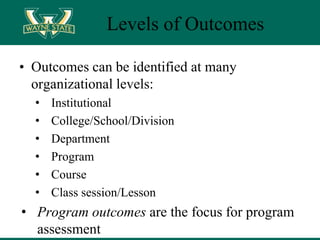
Levels of Outcomes
• Outcomes can be identified at many
organizational levels:
• Institutional
• College/School/Division
• Department
• Program
• Course
• Class session/Lesson
• Program outcomes are the focus for program
assessment
An Analogy: Salads and Outcomes
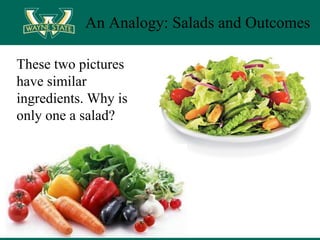
These two pictures
have similar
ingredients. Why is
only one a salad?
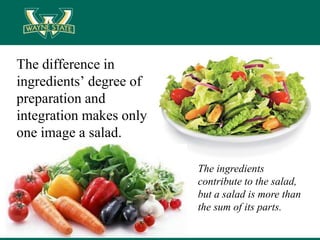
The difference in
ingredients’ degree of
preparation and
integration makes only
one image a salad.
The ingredients
contribute to the salad,
but a salad is more than
the sum of its parts.
From Salads to Outcomes
• Course outcomes identify “the ingredients”
that make up the program
• Incremental knowledge and skills that students
develop bit by bit throughout the program
• Aligned with – but typically narrower than –
program outcomes
• Program outcomes characterize “the salad” –
what individual ingredients make once they are
prepared and integrated
• Students’ cumulative learning across courses at
the end of the program
Program Mission: Professional development for
foreign language teachers
Program Outcome 1: Students
summarize second language
acquisition theory and research
Course
Outcome:
Students
critically
evaluate
research on
second
language
acquisition
Program Outcome 2:
Students evaluate
pedagogical materials
Course Outcome:
Students critically
evaluate various
pedagogical approaches
to the teaching of
speaking and writing
within students’ own
instructional contexts
Course Outcome:
Students apply
(an)understanding [of
research on valid
assessment] to the
critique of assessment
instruments appropriate
and useful to individual
teaching circumstances
Academic Program Example
More Information
• Would you like more information about
program assessment? Visit
assessment.wayne.edu for:
• Video tutorials
• PowerPoint presentations
• Templates
• Supporting documentation
• Examples
• WSU progress reports
• And more!

Course vs Program Learning Outcomes

  • 1.
    Course vs. Program LearningOutcomes: Analogies and Examples
  • 2.
    What Are LearningOutcomes? • Specific, measurable statements of what graduating/exiting students should know, be able to do, believe, or value after completing the program • Observable behaviors whenever possible • Focused on the results of student learning, not on the learning process or on teaching • Derived from the program’s mission statement
  • 3.
    Levels of Outcomes •Outcomes can be identified at many organizational levels: • Institutional • College/School/Division • Department • Program • Course • Class session/Lesson • Program outcomes are the focus for program assessment
  • 4.
    An Analogy: Saladsand Outcomes These two pictures have similar ingredients. Why is only one a salad?
  • 5.
    The difference in ingredients’degree of preparation and integration makes only one image a salad. The ingredients contribute to the salad, but a salad is more than the sum of its parts.
  • 6.
    From Salads toOutcomes • Course outcomes identify “the ingredients” that make up the program • Incremental knowledge and skills that students develop bit by bit throughout the program • Aligned with – but typically narrower than – program outcomes • Program outcomes characterize “the salad” – what individual ingredients make once they are prepared and integrated • Students’ cumulative learning across courses at the end of the program
  • 7.
    Program Mission: Professionaldevelopment for foreign language teachers Program Outcome 1: Students summarize second language acquisition theory and research Course Outcome: Students critically evaluate research on second language acquisition Program Outcome 2: Students evaluate pedagogical materials Course Outcome: Students critically evaluate various pedagogical approaches to the teaching of speaking and writing within students’ own instructional contexts Course Outcome: Students apply (an)understanding [of research on valid assessment] to the critique of assessment instruments appropriate and useful to individual teaching circumstances Academic Program Example
  • 8.
    More Information • Wouldyou like more information about program assessment? Visit assessment.wayne.edu for: • Video tutorials • PowerPoint presentations • Templates • Supporting documentation • Examples • WSU progress reports • And more!

Editor's Notes

  • #5 http://www.google.com/imgres?imgurl=http://www.cicispizza.com/images/mobile-template/salad.jpg%253Fsfvrsn%253D0&imgrefurl=http://www.cicispizza.com/menu-items/soup-salad/garden-salad&h=2386&w=3225&tbnid=MZGRhd1bvPbAuM:&zoom=1&docid=Apv5TzmuH8rcsM&ei=mrkBVbaJM5HbsATc7oKYDg&tbm=isch&ved=0CBwQMygAMAA
  • #6 http://www.google.com/imgres?imgurl=http://www.cicispizza.com/images/mobile-template/salad.jpg%253Fsfvrsn%253D0&imgrefurl=http://www.cicispizza.com/menu-items/soup-salad/garden-salad&h=2386&w=3225&tbnid=MZGRhd1bvPbAuM:&zoom=1&docid=Apv5TzmuH8rcsM&ei=mrkBVbaJM5HbsATc7oKYDg&tbm=isch&ved=0CBwQMygAMAA
  • #8 Course outcomes are from three MA in Language Learning courses: Theories of Second Language Acquisition, Teaching Foreign Languages: Productive Skills, and Foreign Language Testing