KIG2016
Product Design and
Innovation
Course Briefing
1
Course Coordinator
Prof Madya Dr. Mohd Faizul Bin Mohd Sabri
Room : L5R18 Menara Kejuruteraan
Email : faizul@um.edu.my
Dr. Raja Ariffin Raja Ghazila
Room : L7R15 Menara Kejuruteraan
Email : r_ariffin@um.edu.my
2
3
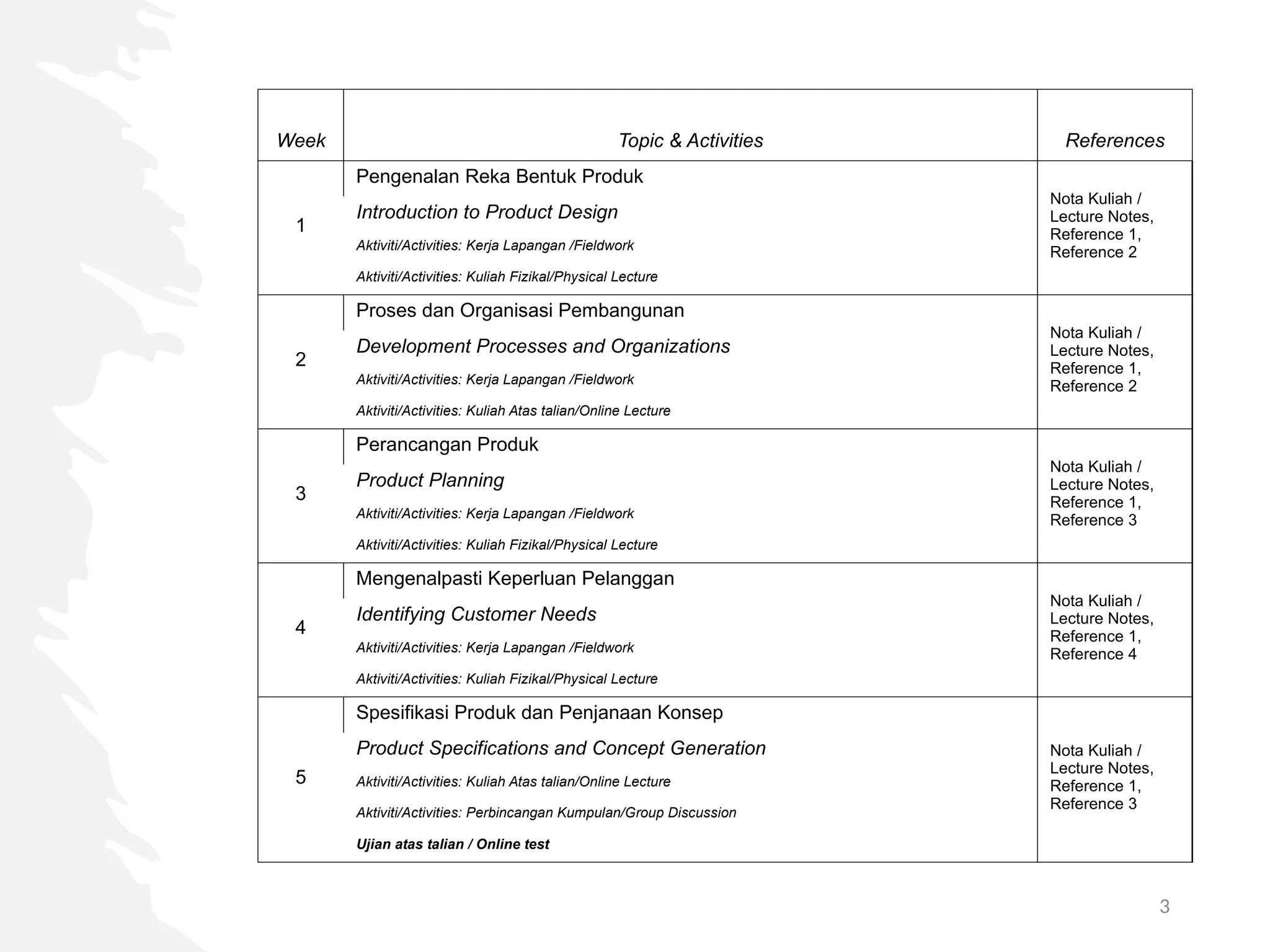
Minggu Topik & Aktiviti Rujukan
Week Topic & Activities References
1
Pengenalan Reka Bentuk Produk
Nota Kuliah /
Lecture Notes,
Reference 1,
Reference 2
Introduction to Product Design
Aktiviti/Activities: Kerja Lapangan /Fieldwork
Aktiviti/Activities: Kuliah Fizikal/Physical Lecture
2
Proses dan Organisasi Pembangunan
Nota Kuliah /
Lecture Notes,
Reference 1,
Reference 2
Development Processes and Organizations
Aktiviti/Activities: Kerja Lapangan /Fieldwork
Aktiviti/Activities: Kuliah Atas talian/Online Lecture
3
Perancangan Produk
Nota Kuliah /
Lecture Notes,
Reference 1,
Reference 3
Product Planning
Aktiviti/Activities: Kerja Lapangan /Fieldwork
Aktiviti/Activities: Kuliah Fizikal/Physical Lecture
4
Mengenalpasti Keperluan Pelanggan
Nota Kuliah /
Lecture Notes,
Reference 1,
Reference 4
Identifying Customer Needs
Aktiviti/Activities: Kerja Lapangan /Fieldwork
Aktiviti/Activities: Kuliah Fizikal/Physical Lecture
5
Spesifikasi Produk dan Penjanaan Konsep
Nota Kuliah /
Lecture Notes,
Reference 1,
Reference 3
Product Specifications and Concept Generation
Aktiviti/Activities: Kuliah Atas talian/Online Lecture
Aktiviti/Activities: Perbincangan Kumpulan/Group Discussion
Ujian atas talian / Online test
4
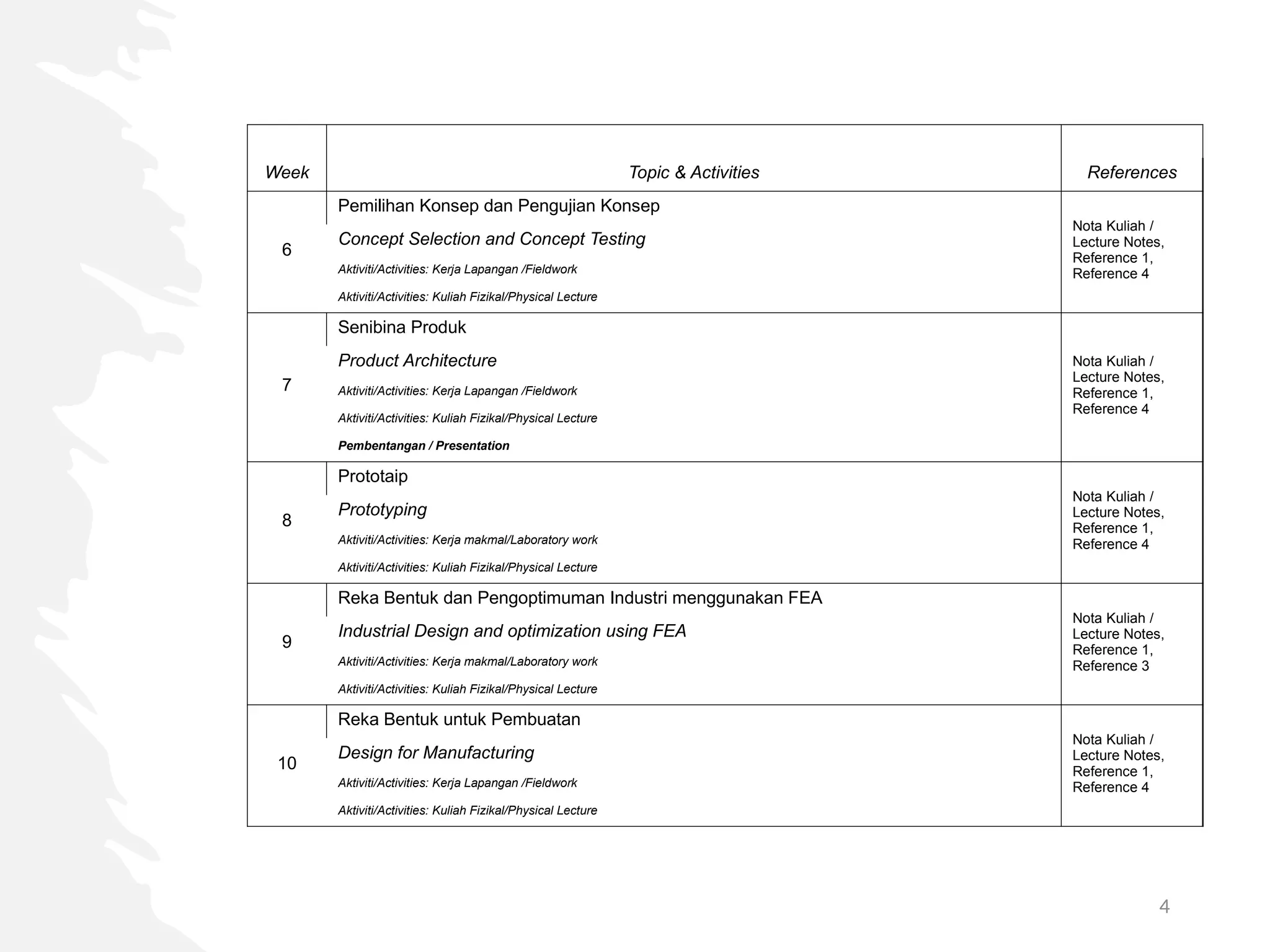
Minggu Topik & Aktiviti Rujukan
Week Topic & Activities References
6
Pemilihan Konsep dan Pengujian Konsep
Nota Kuliah /
Lecture Notes,
Reference 1,
Reference 4
Concept Selection and Concept Testing
Aktiviti/Activities: Kerja Lapangan /Fieldwork
Aktiviti/Activities: Kuliah Fizikal/Physical Lecture
7
Senibina Produk
Nota Kuliah /
Lecture Notes,
Reference 1,
Reference 4
Product Architecture
Aktiviti/Activities: Kerja Lapangan /Fieldwork
Aktiviti/Activities: Kuliah Fizikal/Physical Lecture
Pembentangan / Presentation
8
Prototaip
Nota Kuliah /
Lecture Notes,
Reference 1,
Reference 4
Prototyping
Aktiviti/Activities: Kerja makmal/Laboratory work
Aktiviti/Activities: Kuliah Fizikal/Physical Lecture
9
Reka Bentuk dan Pengoptimuman Industri menggunakan FEA
Nota Kuliah /
Lecture Notes,
Reference 1,
Reference 3
Industrial Design and optimization using FEA
Aktiviti/Activities: Kerja makmal/Laboratory work
Aktiviti/Activities: Kuliah Fizikal/Physical Lecture
10
Reka Bentuk untuk Pembuatan
Nota Kuliah /
Lecture Notes,
Reference 1,
Reference 4
Design for Manufacturing
Aktiviti/Activities: Kerja Lapangan /Fieldwork
Aktiviti/Activities: Kuliah Fizikal/Physical Lecture
5
Minggu Topik & Aktiviti Rujukan
Week Topic & Activities References
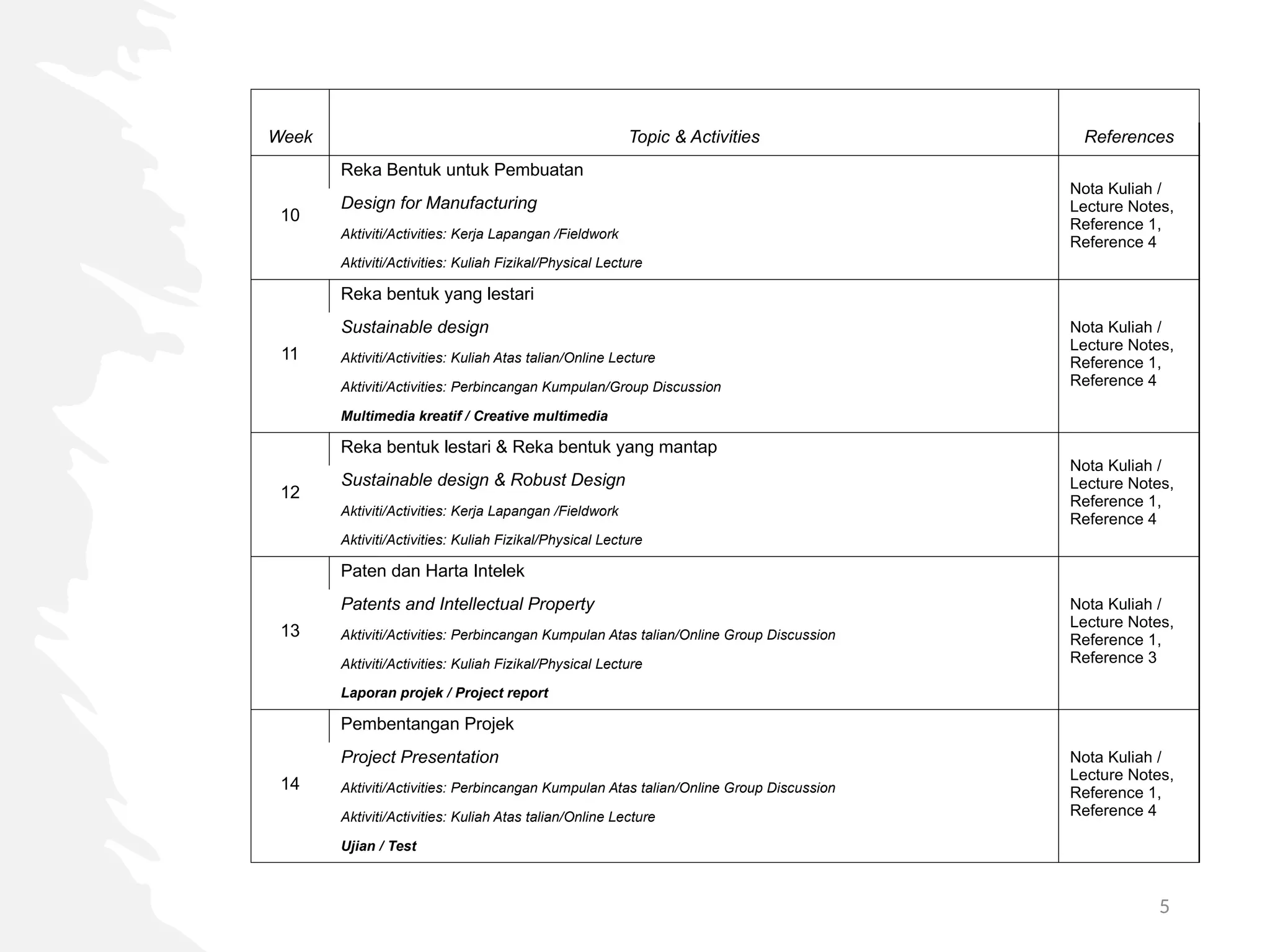
10
Reka Bentuk untuk Pembuatan
Nota Kuliah /
Lecture Notes,
Reference 1,
Reference 4
Design for Manufacturing
Aktiviti/Activities: Kerja Lapangan /Fieldwork
Aktiviti/Activities: Kuliah Fizikal/Physical Lecture
11
Reka bentuk yang lestari
Nota Kuliah /
Lecture Notes,
Reference 1,
Reference 4
Sustainable design
Aktiviti/Activities: Kuliah Atas talian/Online Lecture
Aktiviti/Activities: Perbincangan Kumpulan/Group Discussion
Multimedia kreatif / Creative multimedia
12
Reka bentuk lestari & Reka bentuk yang mantap
Nota Kuliah /
Lecture Notes,
Reference 1,
Reference 4
Sustainable design & Robust Design
Aktiviti/Activities: Kerja Lapangan /Fieldwork
Aktiviti/Activities: Kuliah Fizikal/Physical Lecture
13
Paten dan Harta Intelek
Nota Kuliah /
Lecture Notes,
Reference 1,
Reference 3
Patents and Intellectual Property
Aktiviti/Activities: Perbincangan Kumpulan Atas talian/Online Group Discussion
Aktiviti/Activities: Kuliah Fizikal/Physical Lecture
Laporan projek / Project report
14
Pembentangan Projek
Nota Kuliah /
Lecture Notes,
Reference 1,
Reference 4
Project Presentation
Aktiviti/Activities: Perbincangan Kumpulan Atas talian/Online Group Discussion
Aktiviti/Activities: Kuliah Atas talian/Online Lecture
Ujian / Test
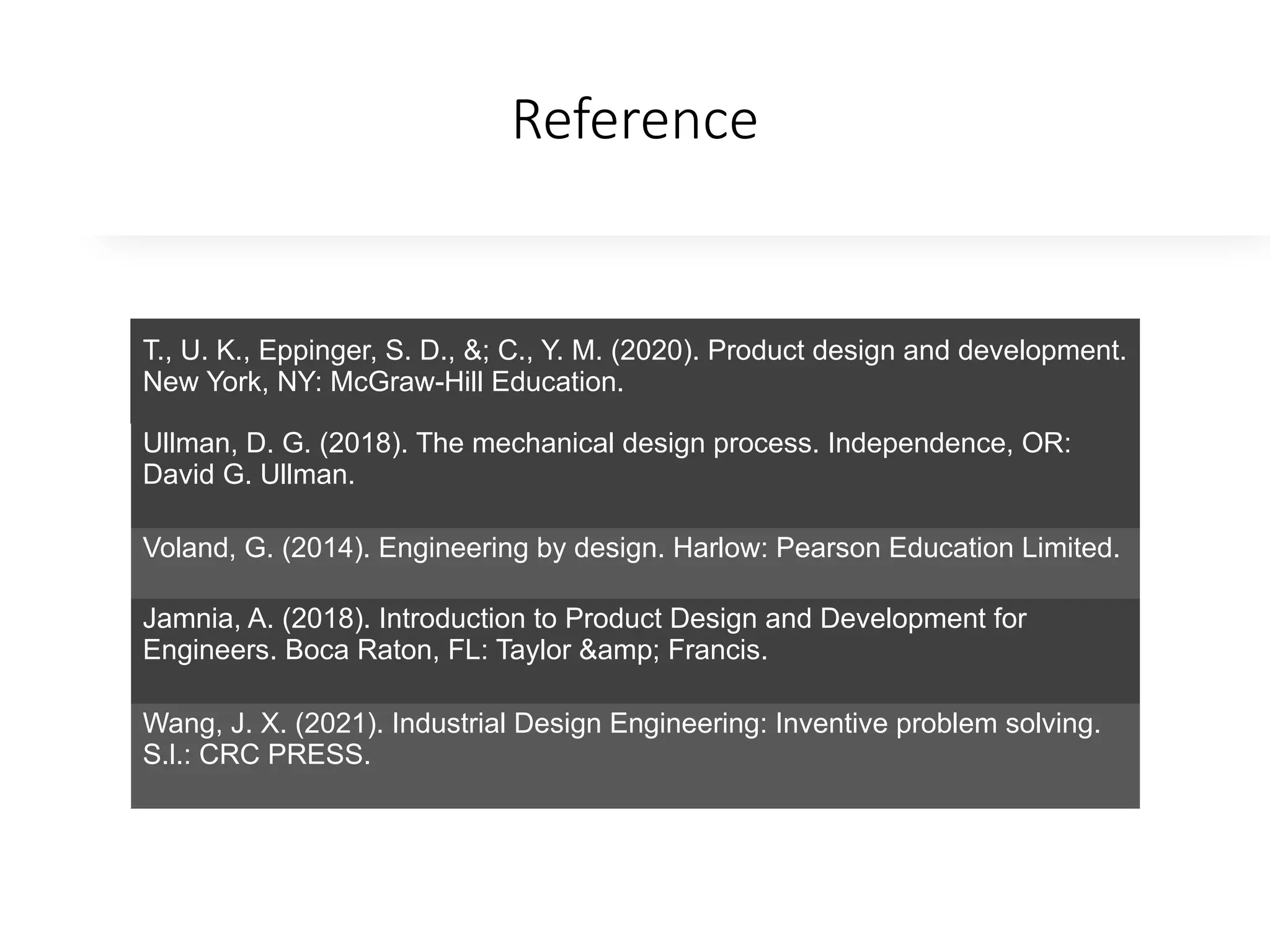
Reference
T., U. K., Eppinger, S. D., &; C., Y. M. (2020). Product design and development.
New York, NY: McGraw-Hill Education.
Ullman, D. G. (2018). The mechanical design process. Independence, OR:
David G. Ullman.
Voland, G. (2014). Engineering by design. Harlow: Pearson Education Limited.
Jamnia, A. (2018). Introduction to Product Design and Development for
Engineers. Boca Raton, FL: Taylor & Francis.
Wang, J. X. (2021). Industrial Design Engineering: Inventive problem solving.
S.l.: CRC PRESS.
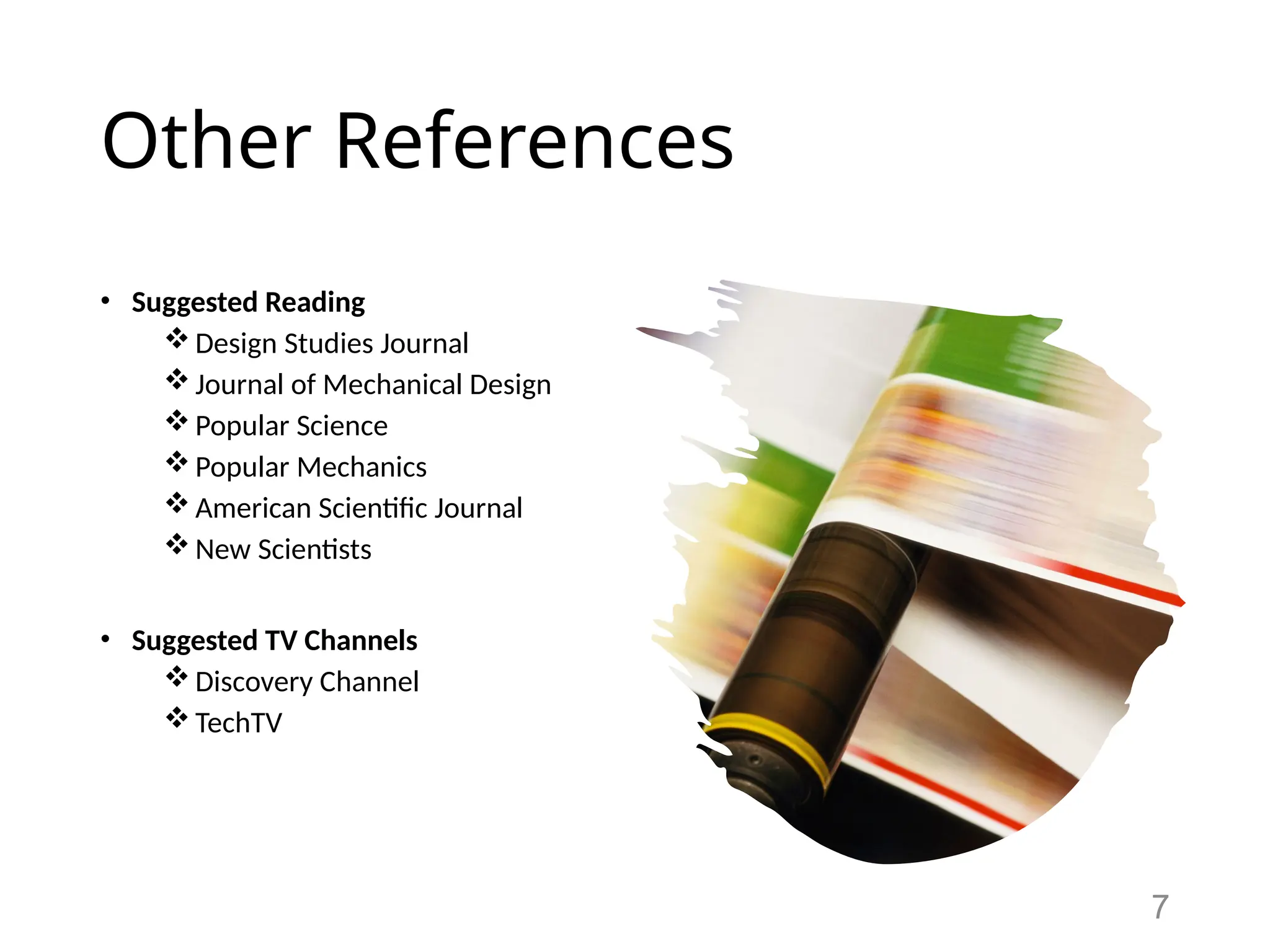
Other References
• Suggested Reading
Design Studies Journal
Journal of Mechanical Design
Popular Science
Popular Mechanics
American Scientific Journal
New Scientists
• Suggested TV Channels
Discovery Channel
TechTV
7
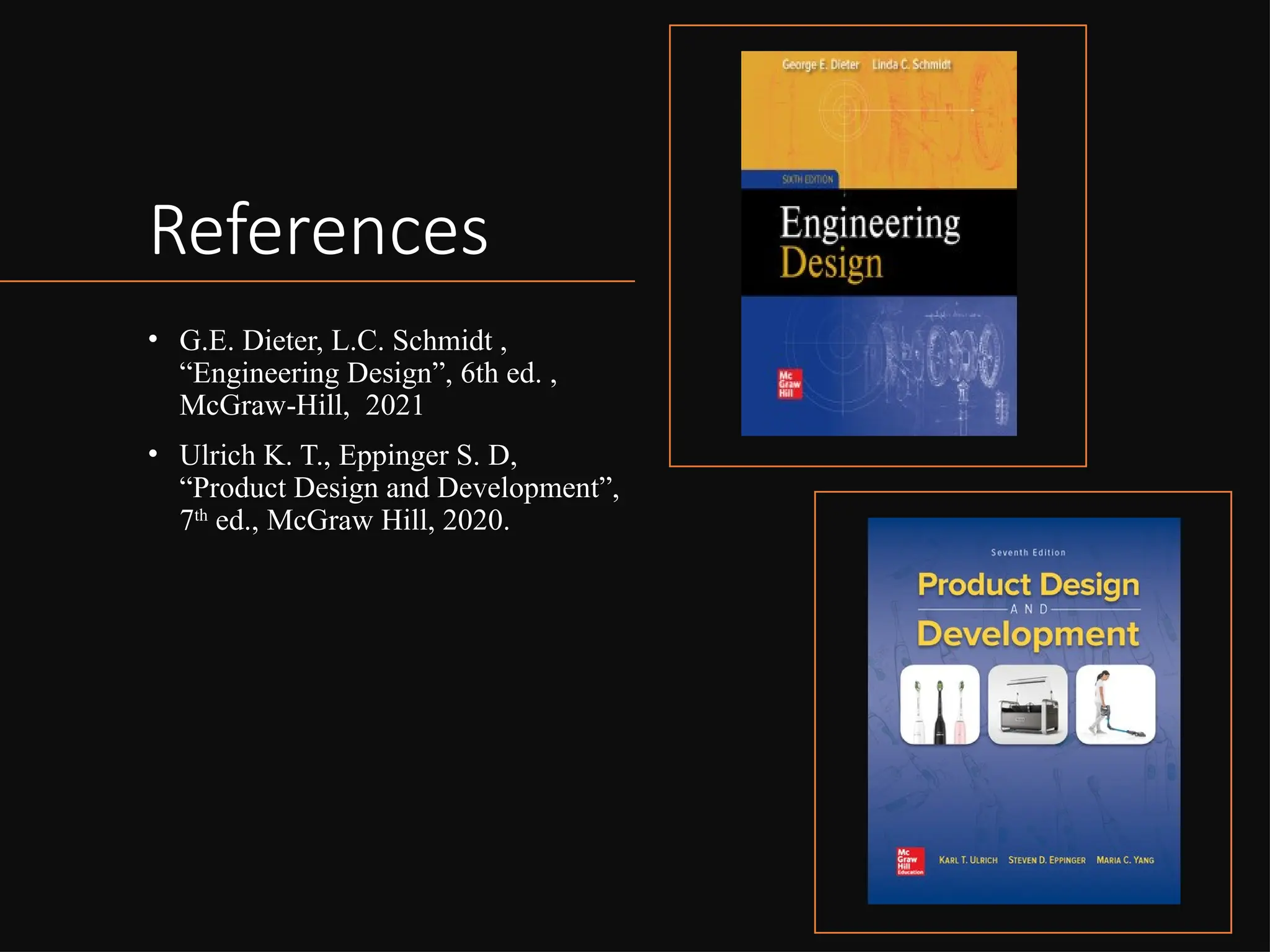
References
• G.E. Dieter, L.C. Schmidt ,
“Engineering Design”, 6th ed. ,
McGraw-Hill, 2021
• Ulrich K. T., Eppinger S. D,
“Product Design and Development”,
7th
ed., McGraw Hill, 2020.
Design Tools
• Recommended Design tools
 SolidWorks
9
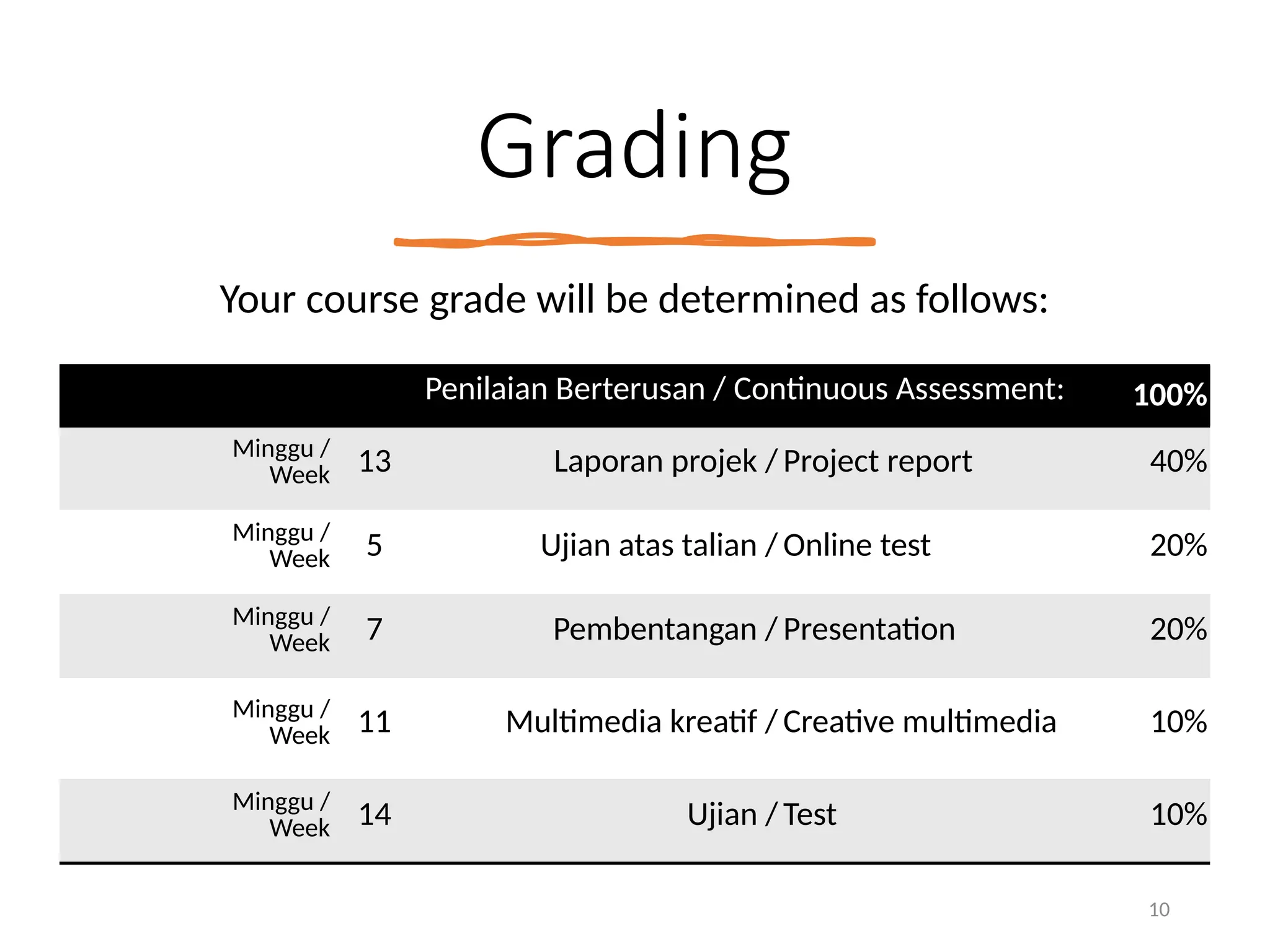
Grading
Your course grade will be determined as follows:
10
Penilaian Berterusan / Continuous Assessment: 100%
Minggu /
Week 13 Laporan projek / Project report 40%
Minggu /
Week 5 Ujian atas talian / Online test 20%
Minggu /
Week 7 Pembentangan / Presentation 20%
Minggu /
Week 11 Multimedia kreatif / Creative multimedia 10%
Minggu /
Week 14 Ujian / Test 10%
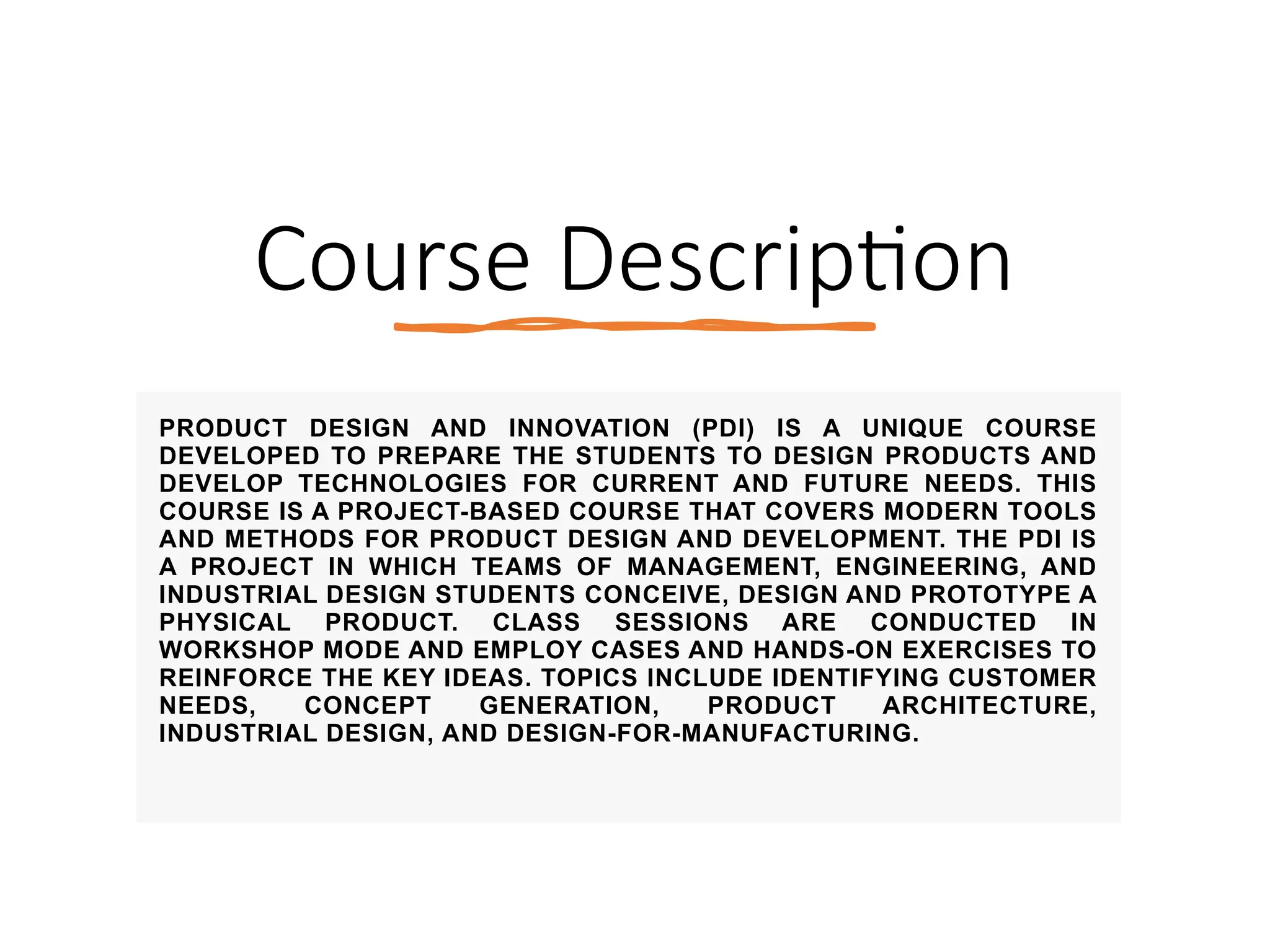
Course Description
PRODUCT DESIGN AND INNOVATION (PDI) IS A UNIQUE COURSE
DEVELOPED TO PREPARE THE STUDENTS TO DESIGN PRODUCTS AND
DEVELOP TECHNOLOGIES FOR CURRENT AND FUTURE NEEDS. THIS
COURSE IS A PROJECT-BASED COURSE THAT COVERS MODERN TOOLS
AND METHODS FOR PRODUCT DESIGN AND DEVELOPMENT. THE PDI IS
A PROJECT IN WHICH TEAMS OF MANAGEMENT, ENGINEERING, AND
INDUSTRIAL DESIGN STUDENTS CONCEIVE, DESIGN AND PROTOTYPE A
PHYSICAL PRODUCT. CLASS SESSIONS ARE CONDUCTED IN
WORKSHOP MODE AND EMPLOY CASES AND HANDS-ON EXERCISES TO
REINFORCE THE KEY IDEAS. TOPICS INCLUDE IDENTIFYING CUSTOMER
NEEDS, CONCEPT GENERATION, PRODUCT ARCHITECTURE,
INDUSTRIAL DESIGN, AND DESIGN-FOR-MANUFACTURING.
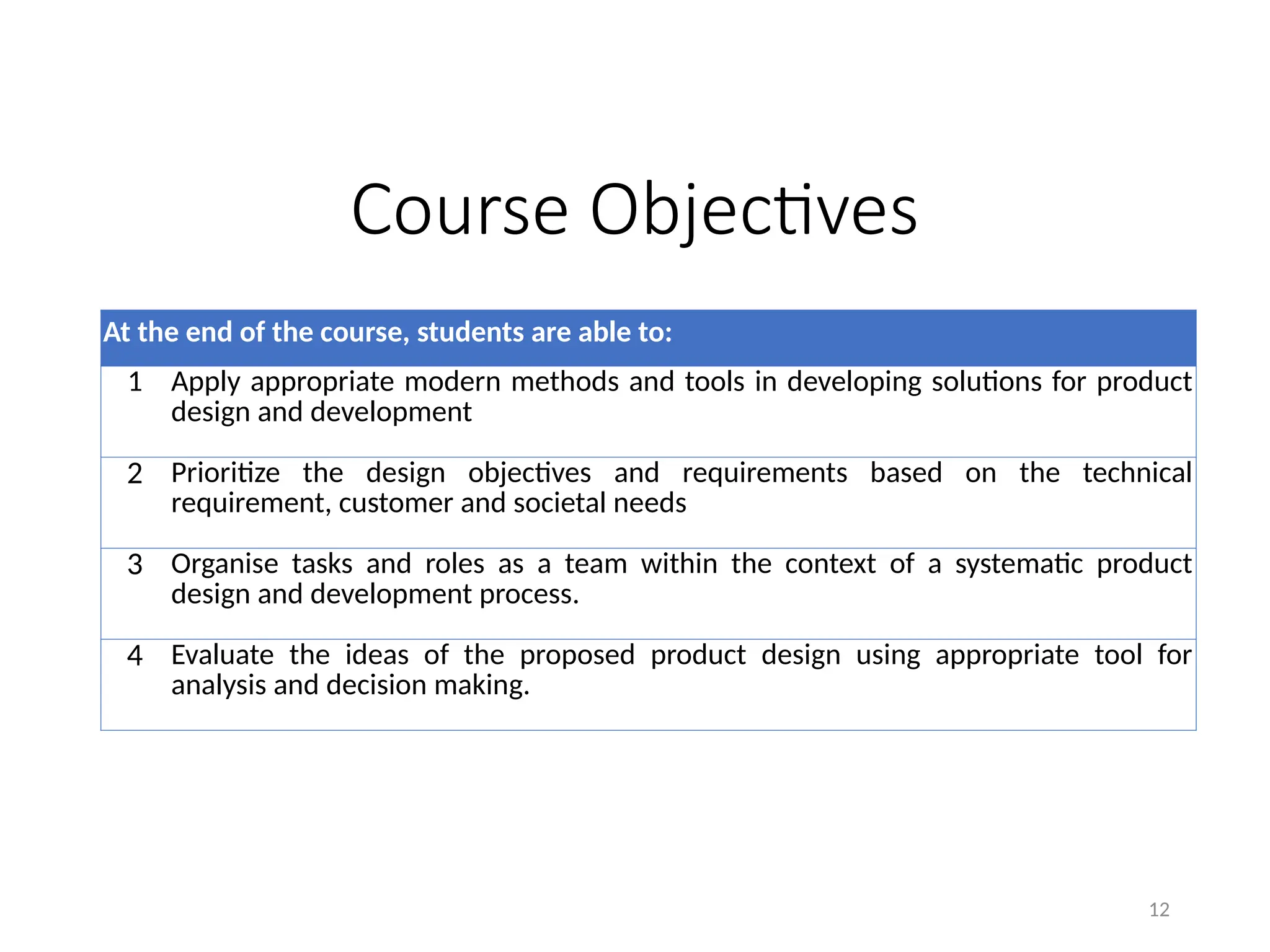
Course Objectives
12
At the end of the course, students are able to:
1 Apply appropriate modern methods and tools in developing solutions for product
design and development
2 Prioritize the design objectives and requirements based on the technical
requirement, customer and societal needs
3 Organise tasks and roles as a team within the context of a systematic product
design and development process.
4 Evaluate the ideas of the proposed product design using appropriate tool for
analysis and decision making.
Innovative Design
Project
• Assign yourselves to groups of 4 –5 Students
• Assign a Project Leader to Your Team
• In this Design Project exercise, you will be developing
the design of a .
•Your challenge in the project portion of this course is
to design a new product concept and to produce a
conceptual design of it.
•The goal of this exercise is to learn principles
and methods of product development in a realistic
context.
•Most product development professionals work
under tremendous time pressure and do not have
an opportunity to reflect on the development process.
•In this course, the project stress level will be low
enough that there will be time to experiment and
learn.
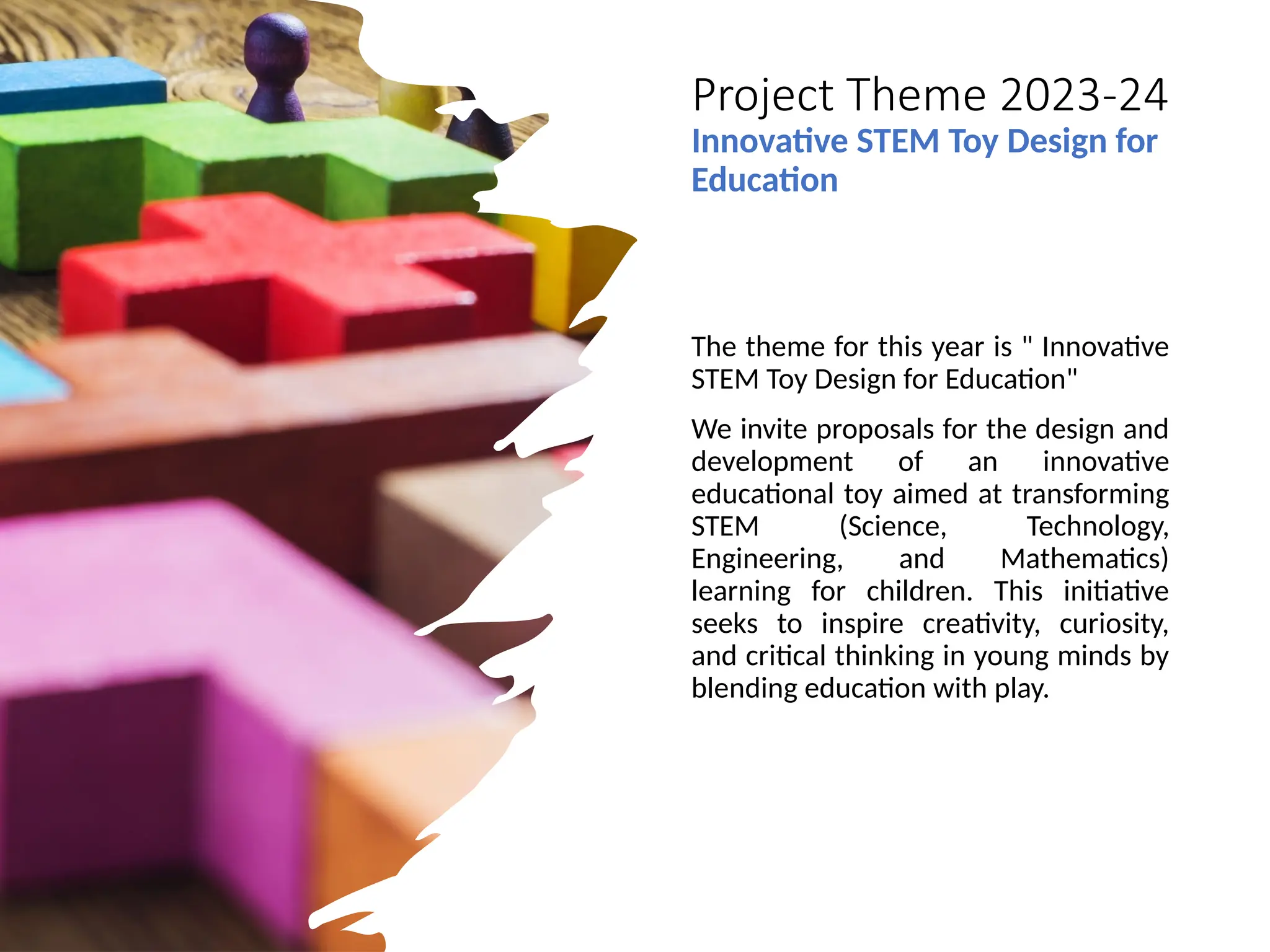
Project Theme 2023-24
Innovative STEM Toy Design for
Education
The theme for this year is " Innovative
STEM Toy Design for Education"
We invite proposals for the design and
development of an innovative
educational toy aimed at transforming
STEM (Science, Technology,
Engineering, and Mathematics)
learning for children. This initiative
seeks to inspire creativity, curiosity,
and critical thinking in young minds by
blending education with play.
Scope of
Project
• Proposal Scope: We are seeking innovative toy
designs that incorporate the following key
features:
• Interdisciplinary Learning: The toy should cover
a range of STEM disciplines, offering engaging
activities that promote exploration and
understanding of fundamental concepts.
• Hands-On Exploration: Emphasis should be
placed on hands-on learning through building,
experimenting, and problem-solving,
encouraging active participation and deeper
comprehension of STEM principles.
• Age-Adaptive Challenges: Proposals should
include a plan for offering age-appropriate
challenges and activities that evolve as children
grow, ensuring continued engagement and skill
development.
• Collaborative Learning: Design should
encourage collaborative play, nurturing
teamwork and communication skills as children
work together to solve problems and complete
projects.
• Educational Impact: Successful proposals will
demonstrate how the toy design aligns with
global educational standards and emphasizes
early exposure to STEM concepts, inclusivity, and
readiness for future STEM careers
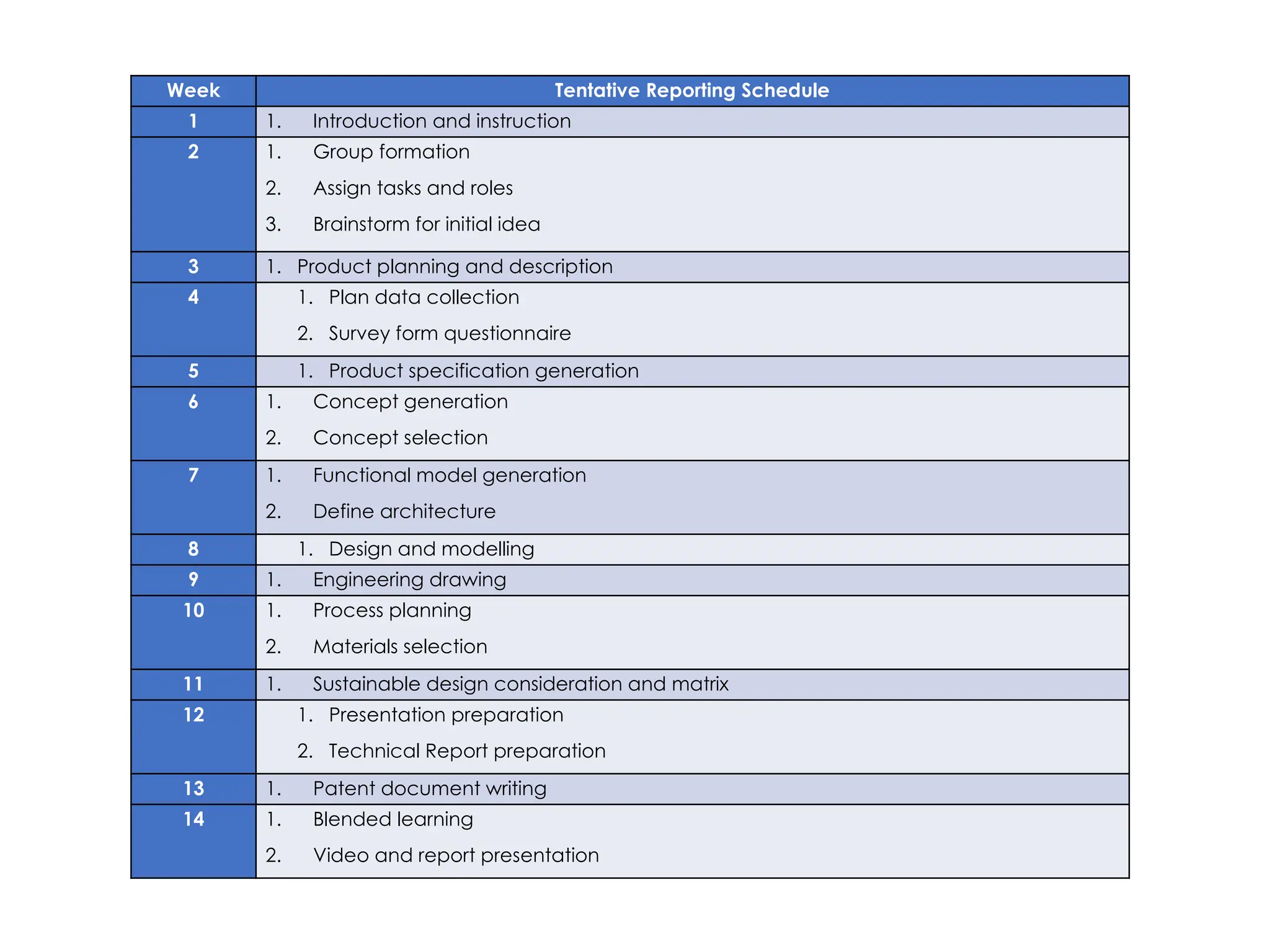
Week Tentative Reporting Schedule
1 1. Introduction and instruction
2 1. Group formation
2. Assign tasks and roles
3. Brainstorm for initial idea
3 1. Product planning and description
4 1. Plan data collection
2. Survey form questionnaire
5 1. Product specification generation
6 1. Concept generation
2. Concept selection
7 1. Functional model generation
2. Define architecture
8 1. Design and modelling
9 1. Engineering drawing
10 1. Process planning
2. Materials selection
11 1. Sustainable design consideration and matrix
12 1. Presentation preparation
2. Technical Report preparation
13 1. Patent document writing
14 1. Blended learning
2. Video and report presentation
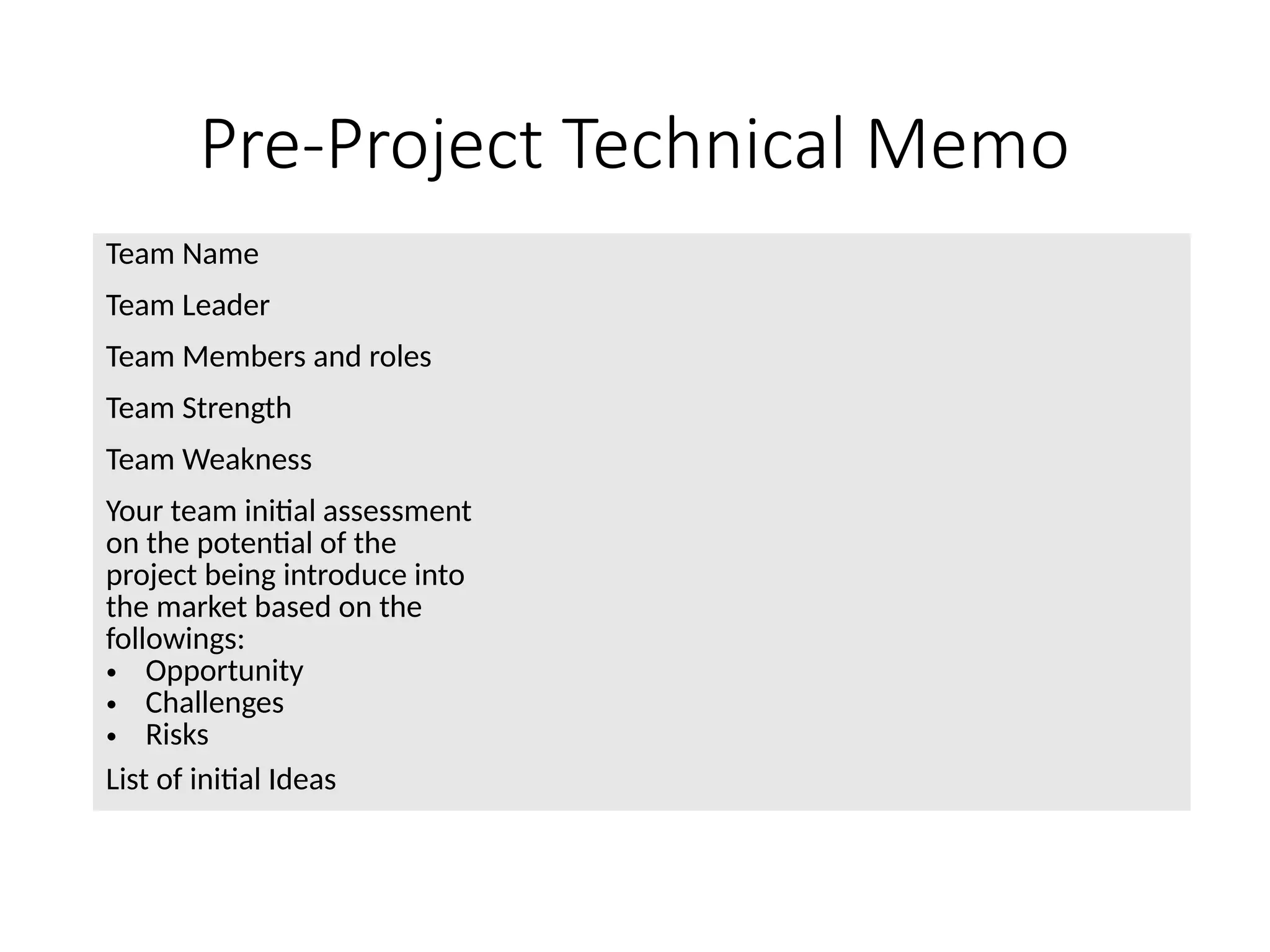
Pre-Project Technical Memo
Team Name
Team Leader
Team Members and roles
Team Strength
Team Weakness
Your team initial assessment
on the potential of the
project being introduce into
the market based on the
followings:
• Opportunity
• Challenges
• Risks
List of initial Ideas
Think about It
• Why we do design?
• Have you ever carryout design work?
• What did you design?
• What steps you take to do your design?
• Are you satisfied with your design?
• Why understanding Product Design is
important to Engineers?
• QUESTION?
19
Course Briefing KIG2016 mechanical engineering

Course Briefing KIG2016 mechanical engineering

  • 1.
  • 2.
    Course Coordinator Prof MadyaDr. Mohd Faizul Bin Mohd Sabri Room : L5R18 Menara Kejuruteraan Email : faizul@um.edu.my Dr. Raja Ariffin Raja Ghazila Room : L7R15 Menara Kejuruteraan Email : r_ariffin@um.edu.my 2
  • 3.
    3 Minggu Topik &Aktiviti Rujukan Week Topic & Activities References 1 Pengenalan Reka Bentuk Produk Nota Kuliah / Lecture Notes, Reference 1, Reference 2 Introduction to Product Design Aktiviti/Activities: Kerja Lapangan /Fieldwork Aktiviti/Activities: Kuliah Fizikal/Physical Lecture 2 Proses dan Organisasi Pembangunan Nota Kuliah / Lecture Notes, Reference 1, Reference 2 Development Processes and Organizations Aktiviti/Activities: Kerja Lapangan /Fieldwork Aktiviti/Activities: Kuliah Atas talian/Online Lecture 3 Perancangan Produk Nota Kuliah / Lecture Notes, Reference 1, Reference 3 Product Planning Aktiviti/Activities: Kerja Lapangan /Fieldwork Aktiviti/Activities: Kuliah Fizikal/Physical Lecture 4 Mengenalpasti Keperluan Pelanggan Nota Kuliah / Lecture Notes, Reference 1, Reference 4 Identifying Customer Needs Aktiviti/Activities: Kerja Lapangan /Fieldwork Aktiviti/Activities: Kuliah Fizikal/Physical Lecture 5 Spesifikasi Produk dan Penjanaan Konsep Nota Kuliah / Lecture Notes, Reference 1, Reference 3 Product Specifications and Concept Generation Aktiviti/Activities: Kuliah Atas talian/Online Lecture Aktiviti/Activities: Perbincangan Kumpulan/Group Discussion Ujian atas talian / Online test
  • 4.
    4 Minggu Topik &Aktiviti Rujukan Week Topic & Activities References 6 Pemilihan Konsep dan Pengujian Konsep Nota Kuliah / Lecture Notes, Reference 1, Reference 4 Concept Selection and Concept Testing Aktiviti/Activities: Kerja Lapangan /Fieldwork Aktiviti/Activities: Kuliah Fizikal/Physical Lecture 7 Senibina Produk Nota Kuliah / Lecture Notes, Reference 1, Reference 4 Product Architecture Aktiviti/Activities: Kerja Lapangan /Fieldwork Aktiviti/Activities: Kuliah Fizikal/Physical Lecture Pembentangan / Presentation 8 Prototaip Nota Kuliah / Lecture Notes, Reference 1, Reference 4 Prototyping Aktiviti/Activities: Kerja makmal/Laboratory work Aktiviti/Activities: Kuliah Fizikal/Physical Lecture 9 Reka Bentuk dan Pengoptimuman Industri menggunakan FEA Nota Kuliah / Lecture Notes, Reference 1, Reference 3 Industrial Design and optimization using FEA Aktiviti/Activities: Kerja makmal/Laboratory work Aktiviti/Activities: Kuliah Fizikal/Physical Lecture 10 Reka Bentuk untuk Pembuatan Nota Kuliah / Lecture Notes, Reference 1, Reference 4 Design for Manufacturing Aktiviti/Activities: Kerja Lapangan /Fieldwork Aktiviti/Activities: Kuliah Fizikal/Physical Lecture
  • 5.
    5 Minggu Topik &Aktiviti Rujukan Week Topic & Activities References 10 Reka Bentuk untuk Pembuatan Nota Kuliah / Lecture Notes, Reference 1, Reference 4 Design for Manufacturing Aktiviti/Activities: Kerja Lapangan /Fieldwork Aktiviti/Activities: Kuliah Fizikal/Physical Lecture 11 Reka bentuk yang lestari Nota Kuliah / Lecture Notes, Reference 1, Reference 4 Sustainable design Aktiviti/Activities: Kuliah Atas talian/Online Lecture Aktiviti/Activities: Perbincangan Kumpulan/Group Discussion Multimedia kreatif / Creative multimedia 12 Reka bentuk lestari & Reka bentuk yang mantap Nota Kuliah / Lecture Notes, Reference 1, Reference 4 Sustainable design & Robust Design Aktiviti/Activities: Kerja Lapangan /Fieldwork Aktiviti/Activities: Kuliah Fizikal/Physical Lecture 13 Paten dan Harta Intelek Nota Kuliah / Lecture Notes, Reference 1, Reference 3 Patents and Intellectual Property Aktiviti/Activities: Perbincangan Kumpulan Atas talian/Online Group Discussion Aktiviti/Activities: Kuliah Fizikal/Physical Lecture Laporan projek / Project report 14 Pembentangan Projek Nota Kuliah / Lecture Notes, Reference 1, Reference 4 Project Presentation Aktiviti/Activities: Perbincangan Kumpulan Atas talian/Online Group Discussion Aktiviti/Activities: Kuliah Atas talian/Online Lecture Ujian / Test
  • 6.
    Reference T., U. K.,Eppinger, S. D., &; C., Y. M. (2020). Product design and development. New York, NY: McGraw-Hill Education. Ullman, D. G. (2018). The mechanical design process. Independence, OR: David G. Ullman. Voland, G. (2014). Engineering by design. Harlow: Pearson Education Limited. Jamnia, A. (2018). Introduction to Product Design and Development for Engineers. Boca Raton, FL: Taylor & Francis. Wang, J. X. (2021). Industrial Design Engineering: Inventive problem solving. S.l.: CRC PRESS.
  • 7.
    Other References • SuggestedReading Design Studies Journal Journal of Mechanical Design Popular Science Popular Mechanics American Scientific Journal New Scientists • Suggested TV Channels Discovery Channel TechTV 7
  • 8.
    References • G.E. Dieter,L.C. Schmidt , “Engineering Design”, 6th ed. , McGraw-Hill, 2021 • Ulrich K. T., Eppinger S. D, “Product Design and Development”, 7th ed., McGraw Hill, 2020.
  • 9.
    Design Tools • RecommendedDesign tools  SolidWorks 9
  • 10.
    Grading Your course gradewill be determined as follows: 10 Penilaian Berterusan / Continuous Assessment: 100% Minggu / Week 13 Laporan projek / Project report 40% Minggu / Week 5 Ujian atas talian / Online test 20% Minggu / Week 7 Pembentangan / Presentation 20% Minggu / Week 11 Multimedia kreatif / Creative multimedia 10% Minggu / Week 14 Ujian / Test 10%
  • 11.
    Course Description PRODUCT DESIGNAND INNOVATION (PDI) IS A UNIQUE COURSE DEVELOPED TO PREPARE THE STUDENTS TO DESIGN PRODUCTS AND DEVELOP TECHNOLOGIES FOR CURRENT AND FUTURE NEEDS. THIS COURSE IS A PROJECT-BASED COURSE THAT COVERS MODERN TOOLS AND METHODS FOR PRODUCT DESIGN AND DEVELOPMENT. THE PDI IS A PROJECT IN WHICH TEAMS OF MANAGEMENT, ENGINEERING, AND INDUSTRIAL DESIGN STUDENTS CONCEIVE, DESIGN AND PROTOTYPE A PHYSICAL PRODUCT. CLASS SESSIONS ARE CONDUCTED IN WORKSHOP MODE AND EMPLOY CASES AND HANDS-ON EXERCISES TO REINFORCE THE KEY IDEAS. TOPICS INCLUDE IDENTIFYING CUSTOMER NEEDS, CONCEPT GENERATION, PRODUCT ARCHITECTURE, INDUSTRIAL DESIGN, AND DESIGN-FOR-MANUFACTURING.
  • 12.
    Course Objectives 12 At theend of the course, students are able to: 1 Apply appropriate modern methods and tools in developing solutions for product design and development 2 Prioritize the design objectives and requirements based on the technical requirement, customer and societal needs 3 Organise tasks and roles as a team within the context of a systematic product design and development process. 4 Evaluate the ideas of the proposed product design using appropriate tool for analysis and decision making.
  • 13.
    Innovative Design Project • Assignyourselves to groups of 4 –5 Students • Assign a Project Leader to Your Team • In this Design Project exercise, you will be developing the design of a . •Your challenge in the project portion of this course is to design a new product concept and to produce a conceptual design of it. •The goal of this exercise is to learn principles and methods of product development in a realistic context. •Most product development professionals work under tremendous time pressure and do not have an opportunity to reflect on the development process. •In this course, the project stress level will be low enough that there will be time to experiment and learn.
  • 14.
    Project Theme 2023-24 InnovativeSTEM Toy Design for Education The theme for this year is " Innovative STEM Toy Design for Education" We invite proposals for the design and development of an innovative educational toy aimed at transforming STEM (Science, Technology, Engineering, and Mathematics) learning for children. This initiative seeks to inspire creativity, curiosity, and critical thinking in young minds by blending education with play.
  • 15.
    Scope of Project • ProposalScope: We are seeking innovative toy designs that incorporate the following key features: • Interdisciplinary Learning: The toy should cover a range of STEM disciplines, offering engaging activities that promote exploration and understanding of fundamental concepts. • Hands-On Exploration: Emphasis should be placed on hands-on learning through building, experimenting, and problem-solving, encouraging active participation and deeper comprehension of STEM principles. • Age-Adaptive Challenges: Proposals should include a plan for offering age-appropriate challenges and activities that evolve as children grow, ensuring continued engagement and skill development. • Collaborative Learning: Design should encourage collaborative play, nurturing teamwork and communication skills as children work together to solve problems and complete projects. • Educational Impact: Successful proposals will demonstrate how the toy design aligns with global educational standards and emphasizes early exposure to STEM concepts, inclusivity, and readiness for future STEM careers
  • 16.
    Week Tentative ReportingSchedule 1 1. Introduction and instruction 2 1. Group formation 2. Assign tasks and roles 3. Brainstorm for initial idea 3 1. Product planning and description 4 1. Plan data collection 2. Survey form questionnaire 5 1. Product specification generation 6 1. Concept generation 2. Concept selection 7 1. Functional model generation 2. Define architecture 8 1. Design and modelling 9 1. Engineering drawing 10 1. Process planning 2. Materials selection 11 1. Sustainable design consideration and matrix 12 1. Presentation preparation 2. Technical Report preparation 13 1. Patent document writing 14 1. Blended learning 2. Video and report presentation
  • 17.
    Pre-Project Technical Memo TeamName Team Leader Team Members and roles Team Strength Team Weakness Your team initial assessment on the potential of the project being introduce into the market based on the followings: • Opportunity • Challenges • Risks List of initial Ideas
  • 18.
    Think about It •Why we do design? • Have you ever carryout design work? • What did you design? • What steps you take to do your design? • Are you satisfied with your design? • Why understanding Product Design is important to Engineers?
  • 19.