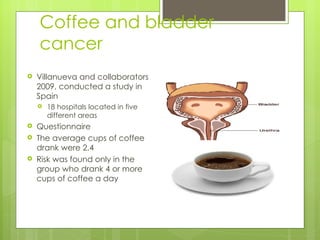
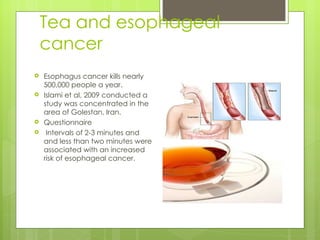
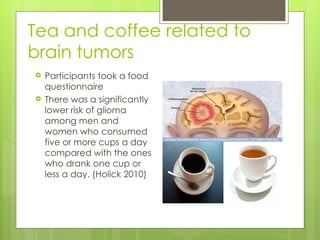
This document summarizes several studies on the relationship between coffee/tea consumption and health risks. It finds that coffee/tea intake can have contradictory effects depending on the type of cancer. A study in Spain found increased risk of bladder cancer only in those drinking 4 or more cups of coffee per day. A study in Iran associated intervals of drinking tea of 2-3 minutes or less than two minutes with higher risk of esophageal cancer. Another study found a lower risk of brain tumors among those drinking 5 or more cups of coffee per day. In conclusion, the effects of coffee/tea on cancer risk depend on the specific cancer and more research is needed to understand the active ingredients involved.

![References
Holick C, Smith S., Giovanucci E, Michaud D, 2010. Coffee, tea, caffeine
intake and risk of adult glioma 3 prospective study, Cancer
Epidemiology, Biomarkers & Prevention (Internet); (cited January 2010).
Doi: 10.1158/1055-9965.EPI-09-0732 (approximately 9 pages), available in
http://cebp.aacrjournals.org/content/19/1/39.long
Islami F, Purshams A, Nasrollahzadeh D, et al; Tea Drinking habits and
oseophageal cancer in a high risk area in northern Iran: Population
based case-control study; BMJ [Internet]; [Cited 2009 March 26]; 338 doi:
10.1136/bmj.b929, available at
http://www.bmj.com/content/338/bmj.b929
Naghma K, Mukhtar H, Cancer mestatasis: prevention and treatment by
green tea. BMC Cancer. [Published 2010 September 23] Doi: 10.1007/s
10555 010 92361, Available at:
http://www.biomedcentral.com/1471-2407/11/96](https://image.slidesharecdn.com/13-eduardopresentation-120518124818-phpapp01/85/Course-3095-Presentation-7-320.jpg)
![ Villanueva C, Silverman D, Murta Nascimiento C, et al; Coffee
consumption, genetic susceptibility and bladder cancer:
Cancer causes and control: [Published in formal form 2009
February 20]. Doi 10.1007/s10552-008-9226-6: (approximate 7
pages) Available at
http://www.ncbi.nlm.nih.gov/pubmed/18798002
Xiaofeng Yu, Zhijun Bao, Juan Zou, Jie Dong, Coffee
consumption and the risk cancer: a meta analysis of cohort
studies. PubMed. [Published 2011 March 15] Doi:
10.1186/1471-11-96, Available at
http://www.ncbi.nlm.nih.gov/pmc/articles/PMC3066123/?tool=pubmed](https://image.slidesharecdn.com/13-eduardopresentation-120518124818-phpapp01/85/Course-3095-Presentation-8-320.jpg)


![ONFH[AVN HIP] -TRIPLE REGIME -A NOVAL SURGICAL CONCEPT .pptx](https://cdn.slidesharecdn.com/ss_thumbnails/onfhavnhip2026koaconcalicutdrgokuldevdrmashraf-260210064517-213ec005-thumbnail.jpg?width=640&height=640&fit=bounds)


![PERI-PROSTHETIC FRACTURE NAIL-PLATE CONSTRUCT [NPC].pptx](https://cdn.slidesharecdn.com/ss_thumbnails/drarunkumardrmohamedashrafperiprostheticfrasturenail-plateconstructnpc-260209164459-7e9d15a1-thumbnail.jpg?width=640&height=640&fit=bounds)


![CTEV [ clubfoot] DR ARUN LAL ,DR MOHAMED ASHRAF travancore medical college k...](https://cdn.slidesharecdn.com/ss_thumbnails/ctevclubfootdrarunlaldrmohamedashraftravancoremedicalcollegekollamkeralaindia-260208063247-18fc466c-thumbnail.jpg?width=640&height=640&fit=bounds)