Travis M. Spencer, M.A.
1100 Balboa. Ave Capitol Heights MD 20032
(571) 357-2055
tspencer@lifesangha.com
https://www.linkedin.com/in/tmspencer
© 2015 Life Sangha and Life Education 1
Counseling Portfolio
Table of Contents
Introduction 3
Professional Mission Statement 3
Professional Organizations and Affiliations 3
Counseling Worldview 4
Projects and Proposals 6
Random Acts of Expression (RAE) Grant Proposal 6
Wandering Traveler Intervention 8
Photography, Poetry, and Prose Therapy (3PT) 9
The UJIMA Group 10
Expandable Database Solution 12
Bibliography 13
Counseling Portfolio
Introduction
I am Travis M. Spencer MA., a Behavioral Health Counselor in Washington DC. As a
counselor, I believe in the client’s right to autonomy, and the right to culturally sensitive
mental health care and support. This portfolio provides samples of my worldview, group
programming proposals, treatment conceptualization, and client-focused database
design.
Professional Mission Statement
As a Behavioral Health Counselor, I encourage the development of positive mental,
physical, emotional, and spiritual healing and growth. Specifically, through therapy, I
• Support client’s autonomy.
• Encourage personal expression.
• Promote life-long learning and personal achievement.
• Aid the development positive lifestyle attributes.
Professional Organizations and Affiliations
2009- current; Insight Meditation Community of Washington: http://imcw.org. Board
Member,volunteer.
2013- current; American Counseling Association (ACA) http://www.counseling.org.
Member
2013- current; MINDS: http://mindsincorporated.org: Meditation and Mindfulness
Facilitator
© 2015 Life Sangha and Life Education 3
Counseling Worldview
My fundamental approach to clients and group therapy is Gestalt Therapy.
Gestalt closely aligns to my personal philosophies about personal understanding,
acceptance, and growth. Additionally, Gestalt Therapy provides and supports my desire to
create and incorporate holistic treatment systems to individuals and groups.
Gestalt investigates neurosis through the inclusion of significant social and
environmental affects of an organism; additionally, Gestalt alternative treatment plans
and wellness strategies provide a variation to psychodynamic treatment applications
(Perls, Hefferline, & Goodman, 1951).
Gestalt offers a freeform stage for collaborative work and understanding for both
the client and therapist; furthermore, Gestalt does not restrict the therapeutic relationship
through regression, transference or countertransference. Psychoanalysis considers
regression, transference or countertransference as its fundamental components (Perls,
Hefferline, & Goodman, 1951).
GESTALT THERAPY IN LOW SOCIOECONOMIC AFRICAN AMERICAN COMMUNITIES
According to the Center for Disease Control (CDC), mental health risk for
African Americans is more likely than with their European American counterparts;
additionally, African Americans are less likely to seek treatment (OMHD/AMH/
Factsheet/Mental Health, 2007). Drug usage and abuse in low socioeconomic African
American communities (LSAAC) exist in part to self-medication because of mental
illness and trauma. My goal as a therapist is to promote mental health care in the low
socioeconomic African American Communities. Poor mental health care directly links to
drugs, domestic violence, and self-destructive behaviors.
African American youths/LSAAC (organism/environment) experience turmoil
and blockage causing neurosis, and their neurosis prevent the assimilation, change, and
growth (Perls, Hefferline, & Goodman, 1951). Assimilation does not refer to the
incorporation of the dominant culture’s values, traditions or morals, but in this context,
assimilation is the ability to grow through creative adjustment. Gestalt suggests that
contact produces creative adjustment with the environment; therefore, an organism/
environment survives and maintains a healthy state of being through a creative response
to contact (Perls, Hefferline, & Goodman, 1951). When an organism’s creative
adjustment is impeded, inhibited, or disrupted neurosis occurs (Perls, Hefferline, &
Goodman, 1951).
Gestalt Therapy helps clients rediscover balance and move toward self-
actualization, thus moving focus to what is necessary to achieve or maintain balance and
drive self-actualization. Clients rediscover balance by discovering present maladaptive
behaviors and stressors. Recognizing, accepting, and cultivating personal awareness
fosters self-actualization and growth.
Gestalt Therapy assists the discovery and cultivation of personal awareness
(Halbur & Halbur, 2011, p. 66). Additionally, Gestalt Therapy brings awareness to
possible mistrust and other perceptions produced by stressors or trauma. Growth begins
with awareness. For instance, Jack becomes injured as he walks from school. A signal
Counseling Portfolio
of pain will travel through the nervous system and alerts the brain to the injury. Jack can
treat the injury to prevent additional damage and begin the healing process or attempt to
ignore the wound. Ignoring the injury may aggravate, minimize, slow, or stop the healing
process and create a gateway to possible infections or additional injuries. The previous
scenario is physiological, but emotional and psychological injuries should merit the same
awareness.
My integration of Gestalt Therapy as a therapeutic support will empower future
clients to recognize, accept, and cultivate personal awareness and growth. Often I
struggle with my desire to “fix” others. Initially, I wanted to become a fixer. I quickly
discovered “fixing” others is about control and not healing. Even if my intentions are
good, and my plan is purposeful and well intended, I cannot fix broken emotions, spirits,
or lives. A therapist creates a space, provides the tools or techniques, advocates, and
empowers clients.
I worked with students during my graduate program because I wanted to focus on
the disparity of mental health services and psycho-education in LSAAC. Initially I
assisted teachers as an educational aide in the Pre-kindergarten classroom and special-
needs students.
In the elementary school, young students displayed aggressive behaviors to
resolve conflicts. These aggressive and maladaptive behaviors included fighting,
bullying, and verbally abusing timid or special-needs students. In the high school setting,
similar behaviors exist with the addition of sexuality and drug usage. Without
interventions, students may graduate from high school, and begin their adulthood with
poor conflict resolution abilities, poor communication skills, and poor self-esteem.
Students may experience mental breaks because of stressors at home, work, or
socioeconomic issues. My interventions and therapeutic goals incorporate Gestalt
Therapy to mitigate maladaptive behaviors and promote reeducation, reflection, and
personal acceptance. Consequently, the intervention and therapeutic goals facilitate
growth.
Reeducation is the process of dispelling myths surrounding maladaptive beliefs
and behaviors. Reeducation is accomplished by providing the truth or alternatives to
maladaptive beliefs. For instance, Steven fights anyone that challenges him. When
asked, Steven states that he does not back down from a fight. I would enlist the Here and
Now Gestalt exercise. Here and Now is an exercise designed to promote reflective
thought about the consequence of actions on present circumstances (McHenry &
McHenry, 2007). I would ask Steven to recall how fighting effects his life here and now.
Steven can reflect and accept the impact of his behaviors. Gestalt provides the
foundation to facilitate healing for teens and young adults.
My approach to client therapy incorporates a major concentration of Gestalt.
Treatment derives from the notion that personal change occurs in awareness, thinking,
and behavior; therefore, before behavior changes or thinking will change, an individual
must cultivate awareness. A person cannot change self-defeating beliefs and actions
unless there is awareness of maladaptive or misguided behaviors and beliefs.
© 2015 Life Sangha and Life Education 5
Projects and Proposals
Random Acts of Expression (RAE) Grant Proposal
UNIVERSITY OF MARYLAND- College Park, Maryland: Counseling and Group
Facilitator; 2013- 2014
The transition from childhood to adulthood is one of the most significant periods in the
human lifespan, and the University of Maryland Pre-College Programs supports many
students during this critical developmental period. Frank Parsons, a pioneer of career
development and academics for students, states, “We guide our boys and girls to some
extent through school, then drop them into this complex world to sink or swim as the
case may be. There is no part of life where the need for guidance is more emphatic than
in the transition from school to work—the choice of a vocation, adequate preparation for
it, and the attain-ment of efficiency and success (Wood & Kaszubowski, 2008).”
Pre-College Programs creates and offers diverse college and career awareness and
readiness programming to foster academic achievement and positive psychosocial
development. Additionally, Pre-College Programs thrives on remaining relevant to
students needs through creative programing. The Random Acts of Expression (RAE)
Program signifies an addition to Pre-College Programs' special programming, and the
University of Maryland's strategic plan to attract the world's best academic talents.
Additionally, the University of Maryland strategic plans includes transforming the
surrounding community into an economically, socially, and culturally vibrant community.
The Random Acts of Expression (RAE) Program supports the University of Maryland’s
strategic plan to attract the world’s best academic talents and to transform the
surrounding community into an economically, socially, and culturally vibrant community.
Additionally, RAE supports the University of Maryland’s strategic plan by providing an
opportunity for local first generation college-bound high school students to participate in
Pre-College Programs career exploration, academic studies and artistic expression (The
University of Maryland, 2008). RAE support the University of Maryland by preparing
the high school students for possible college careers at the University of Maryland and
exploring future careers in marketing, sound engineering and music production, writing,
public relations, and event planning. Students participating in RAE may add or eliminate
career choices; additionally,
Random Acts of Expression (RAE) occurs during the six-week summer residency
program for first generation college-bound students actively enrolled in Pre-College
Programs. A cohort of 10-15 students creates and performs audio art for the Pre-College
Community. Any recorded artistic expression represents audio art. For instance, audio art
includes spoken word, poetry, vocal performances, and instrumental art. Under the
supervision of an academic advisor/ instructor, student participants collaborate, organize,
plan, market and host a listening party. Typically, a listening party is an event for local,
national, or international artists to showcase their latest music compositions for a small
group of fans; however, RAE listening party will host an intimate gathering of students,
Counseling Portfolio
parents and Pre-College Programs community members to share the creative
achievements of the participating students.
RAE provides empowering experiences and information about careers in marketing,
sound engineering and music production, writing, public relations, and event planning.
RAE also supports and reinforces the mission of the Pre-College Programs by promoting
positive psychosocial interactions, diversity, career exploration, personal expression, and
academic excellence. RAE introduces students to group collaboration and project
management, conflict management and resolution, and compromise. Students will
explore interest- related careers by participating with RAE.
The Pre-College Programs supports many first-generation college-bound students from
disadvantaged socioeconomic backgrounds. Pre-College Programs provides exposure to
the necessary skills to achieve their post-secondary school visions and career and lifestyle
goals. The attached expense sheet details funding needs to support the RAE. Funding for
the project will support technology resources, supplies, and room fees.
© 2015 Life Sangha and Life Education 7
Wandering Traveler Intervention
UNIVERSITY OF MARYLAND- College Park, Maryland: Counseling Intern,
Counselor, Group Facilitator; 2013.
Purpose
This eight-week intervention promotes mindfulness and critical-thinking skills and
focuses students on their personal and collective goals. This program’s namesake
is Wandering Traveler Intervention (WTI). A Wandering Traveler(s) is a nomadic
individual or group with no social roots or commitment to a community.
• Type: Psycho-educational Group
• Targeted Audience: at-risk 15-19 years old male/female students
• Session length: 8- 45 minute sessions
• Assessments: No pre or post assessment
Objectives
The Wandering Traveler Intervention mitigates maladaptive behaviors by promoting
critical thinking, self-expression, empowerment, and introspection. WTI provides:
• An introduction to meditation and mindfulness through
o Silence and breathing
o Music and movement
o The examination of current events.
• Psycho-educational classes that examine the immediate and long-term
repercussions of
o Limited education
o Goal setting
o No vocational or academic skills set.
• A safe forum for students to express opinions, ideas, and collaborative
solutions by
o Promoting critical thinking skills relating to short-term and long-term
goals.
o Acknowledging and supporting the student’s “real-world issues;”
subsequently, this intervention builds rapport and trust.
Approach
WTI incorporates Gestalt philosophy and a free flow therapeutic approach. Gestalt
philosophy states that the whole individual must be considered for growth. This includes
all direct or indirect elements. A gestalt is a structure created by an individual to interact
with the world. An individual’s gestalts (structures) directly contribute to behaviors,
perception, emotions and mentality (Perls, M.D., Hefferline, Ph.D., & Goodman, Ph.D.,
1951).
Counseling Portfolio
Photography, Poetry, and Prose Therapy (3PT)
Trinity University, Washington DC: Student; 2009,2011-2013.
Purpose
Photography, Poetry, and Prose Therapy (3PT) is the intentional use of photography,
poetry, and prose as therapeutic instruments in an individual or group counseling setting.
This intervention promotes client self-reflection and a directive approach by the therapist
to challenge client’s weak structures (gestalts). The client artistically expresses goals,
pitfalls, emotional and mental states, vulnerabilities and strengths through photographs,
poetry, short stories or written commentary.
• Type: Individual/Group settings
• Targeted Audience: adolescents and adults
• Session length: 45 minute sessions
• Assessments: No pre or post assessment
Objectives
3PT promotes change by promoting the examination of an individual’s self-perception,
person perception and psychosocial ideologies.
• Self-perception is the mental process that determines how we perceive ourselves
in our world.
• Person perception is the mental processes that determine how we view others in
our world (Cherry, 2012).
• Person perception forms our impressions of others based on our social norms
(Macrae, 2001).
• Psychosocial ideologies are the affects of environment on an individual's manner
of thinking.
Approach
3PT uses Gestalt approach to challenge ill-formed structures that affect the client's
emotional and mental health. The gestalt approach to psychopathology radically differs
because gestalt focuses on the present state versus the investigatory practices of
psychodynamics. Additionally, gestalt does not separate any environmental or social
elements from the organism (Perls, Hefferline, & Goodman, 1951, p. 4).
© 2015 Life Sangha and Life Education 9
The UJIMA Group
!
Malcolm X Elementary School, Washington DC: Educational Aide; 2010-2013.
Purpose
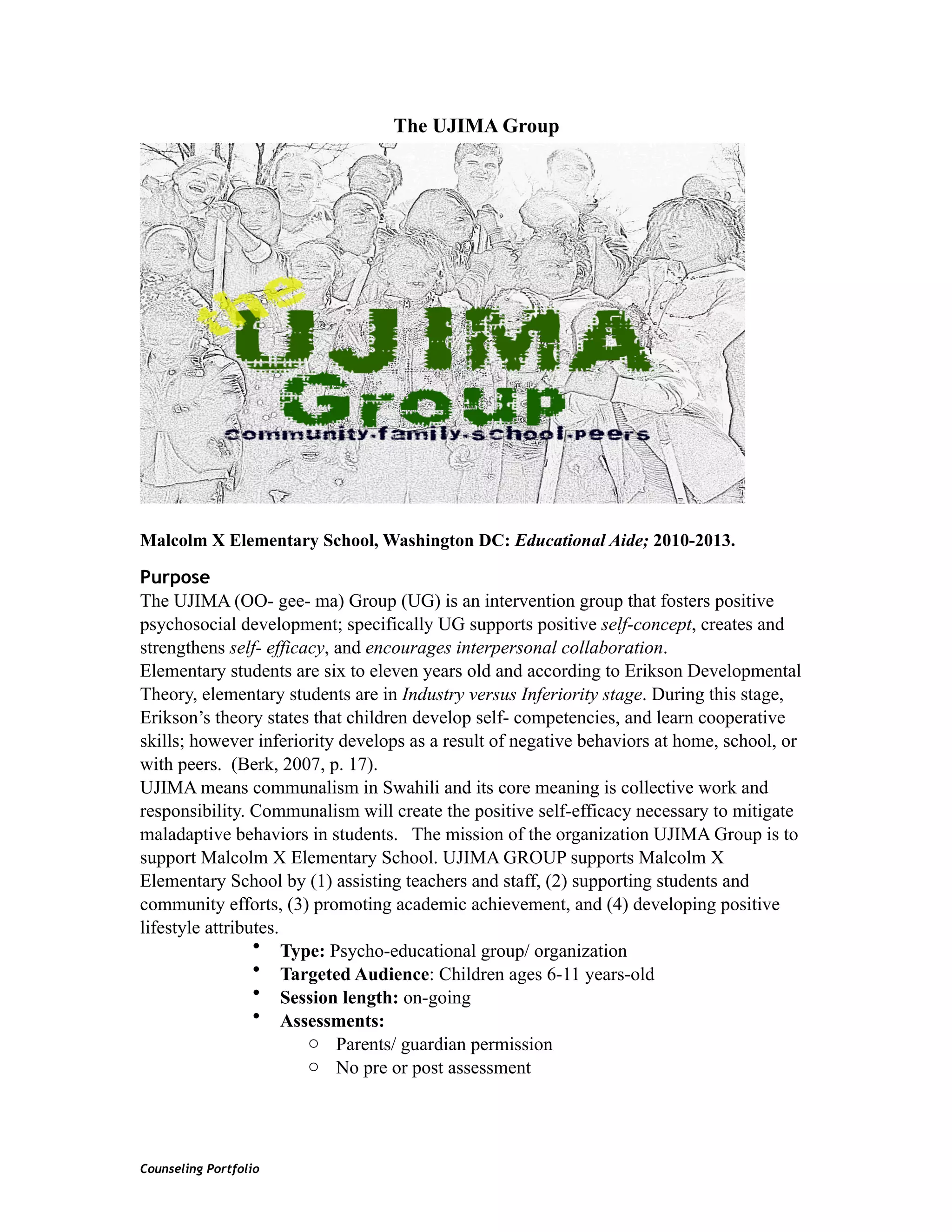
The UJIMA (OO- gee- ma) Group (UG) is an intervention group that fosters positive
psychosocial development; specifically UG supports positive self-concept, creates and
strengthens self- efficacy, and encourages interpersonal collaboration.
Elementary students are six to eleven years old and according to Erikson Developmental
Theory, elementary students are in Industry versus Inferiority stage. During this stage,
Erikson’s theory states that children develop self- competencies, and learn cooperative
skills; however inferiority develops as a result of negative behaviors at home, school, or
with peers. (Berk, 2007, p. 17).
UJIMA means communalism in Swahili and its core meaning is collective work and
responsibility. Communalism will create the positive self-efficacy necessary to mitigate
maladaptive behaviors in students. The mission of the organization UJIMA Group is to
support Malcolm X Elementary School. UJIMA GROUP supports Malcolm X
Elementary School by (1) assisting teachers and staff, (2) supporting students and
community efforts, (3) promoting academic achievement, and (4) developing positive
lifestyle attributes.
• Type: Psycho-educational group/ organization
• Targeted Audience: Children ages 6-11 years-old
• Session length: on-going
• Assessments:
o Parents/ guardian permission
o No pre or post assessment
Counseling Portfolio
Objectives
The UJIMA Group (UG) will service Malcolm X Elementary School by:
• Creating and maintaining a school blog/ newspaper called The UJIMA
Gazette. This blog will consist of Local (neighborhood and school) news,
interviews, sports, entertainment, fashion, and specials (career
information).
• Participating in fundraising events and community exploration.
• Creating activities to enhance student life in school and the community.
The UG will host an annual talent show, maintain monthly bulletin
boards, provide peer mentoring, and sponsor movie nights.
• Working with community organizations and providing services to
community members.
Approach
Gestalt is the foundation of therapeutic approach for UG. Gestalt does not separate any
environmental or social elements from the organism; therefore the approach consist of
promoting positive environmental and individual growth (Perls, Hefferline, & Goodman,
1951, p. 4). Positive environmental and individual inclusivity promotes growth and
transforms behaviors and the communal environment simultaneously. Overall UG
believes that positive Reciprocal Determinism transforms the environment and the
student. According to Bandura's Social Learning Theory, reciprocal determinism states
that behavior effects environment and environment effects behavior; therefore, a hostile
environment creates aggressive behaviors and vice versa (Social Learning Theory
(Bandura) at Learning-Theories.com, 2011).
The UJIMA Group is a holistic program, which best supports positive psychosocial
development of a child. A holistic program supports positive self-concept, creates and
strengthens self- efficacy, and encourages interpersonal collaboration; additionally, UG
addresses the whole child by creating an environment that fosters the (1) physical, (2)
mental, (3) social, and (4) emotional wellbeing of each child. The UG program includes
activities to address positive psychosocial development in students; namely, students
actively participate in a school blog/ newspaper, UJIMA Group volunteer services,
fundraising, and event planning.
© 2015 Life Sangha and Life Education
11
Expandable Database Solution
The Life Therapists Therapist Incorporated (LTTI) software support therapists/
organizations serving low-socioeconomic communities; specifically, therapists/
organizations serving families systems in low socioeconomic communities.
The design and construction of this relational database began in 2013 at the University of
Maryland. As an intern for University of Maryland Pre-College Program, I designed the
inventory database and a rudimentary database to support the counseling efforts of
serviced students. My software solutions support my current and future practice and
clients.
• Individual Therapy Solutions: is an expandable database solution to organize
and maintain consumer wellness programing and services data for individual
therapist.
• Organizational Therapy Solutions: is an expandable multi-user database
solution to organize and maintain an mental health servicing organization.
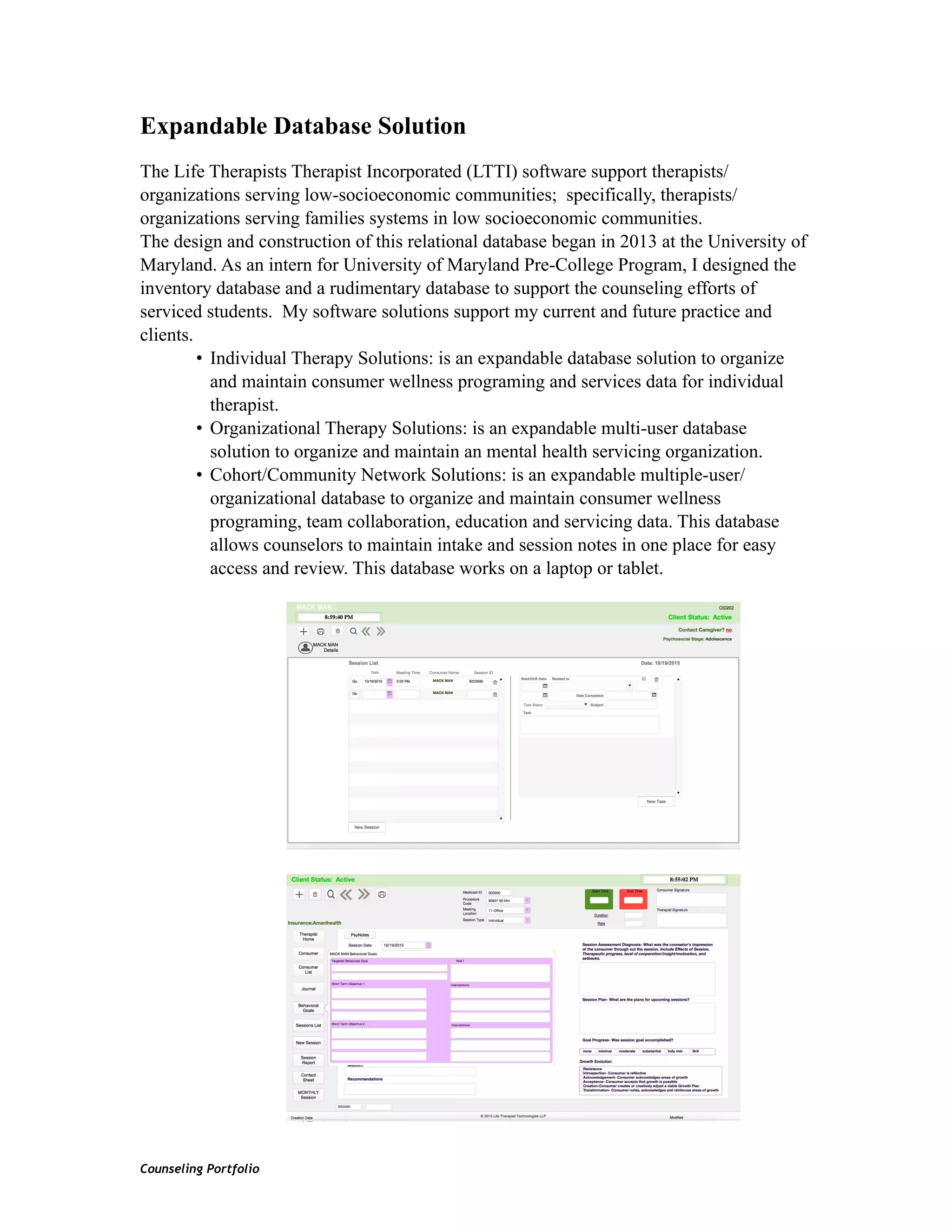
• Cohort/Community Network Solutions: is an expandable multiple-user/
organizational database to organize and maintain consumer wellness
programing, team collaboration, education and servicing data. This database
allows counselors to maintain intake and session notes in one place for easy
access and review. This database works on a laptop or tablet.
Counseling Portfolio
Bibliography
Berk, L. E. (2007). Development through the lifespan (4th Edition ed.). (S. Hartman,
Ed.) Boston, MA: Pearson, Education Inc.
Heffner Media Group, Inc. (2011, November 29). ALLPSYCH Online. Retrieved July
09, 2013, from ALLPSYCH Online: http://allpsych.com/
Cherry, K. (2012). Person Perception. Retrieved from
http://psychology.about.com/od/socialpsychology/a/person-
perception.htm
Macrae, C. N. (2001). Social cognition: Categorical person perception. Retrieved from
http://faculty.wcas.northwestern.edu/bodenhausen/BJP.pdf
National Association of Cognitive-Behavioral Therapist. (2007, April 5). NACBT
Online Headquaters. Retrieved Feburary 24, 2014, from NACBT Online
Headquaters: www.nacbt.org/whatiscbt.htm
Perls, M.D., F., Hefferline, Ph.D., R., & Goodman, Ph.D., P. (1951). «Gestalt Therapy:
Excitement and growth in human personality». Gouldsboro, ME: The Gestalt
Journal Press.
Social Learning Theory (Bandura) at Learning-Theories.com. (2011 October).
Retrieved Feburary 17th, 2014 from Learning Theories Knowledgebase :
http://www.learning-theories.com/social-learning-theory-bandura.html
The University of Maryland. (2008). Transforming Maryland: Higher Expectations.
Retrieved Febuary 16, 2014, from Stretegic Planning 2007-08:
http://www.sp07.umd.edu/StrategicPlanFinalCompact.pdf
Wood, C., & Kaszubowski, Y. (2008). The career development needs of rural
elementary school students. The Elementary School Journal , 108 (5), 431-
444.
© 2015 Life Sangha and Life Education
13

Counseling Portfolio

  • 1.
    Travis M. Spencer,M.A. 1100 Balboa. Ave Capitol Heights MD 20032 (571) 357-2055 tspencer@lifesangha.com https://www.linkedin.com/in/tmspencer © 2015 Life Sangha and Life Education 1 Counseling Portfolio
  • 2.
    Table of Contents Introduction3 Professional Mission Statement 3 Professional Organizations and Affiliations 3 Counseling Worldview 4 Projects and Proposals 6 Random Acts of Expression (RAE) Grant Proposal 6 Wandering Traveler Intervention 8 Photography, Poetry, and Prose Therapy (3PT) 9 The UJIMA Group 10 Expandable Database Solution 12 Bibliography 13 Counseling Portfolio
  • 3.
    Introduction I am TravisM. Spencer MA., a Behavioral Health Counselor in Washington DC. As a counselor, I believe in the client’s right to autonomy, and the right to culturally sensitive mental health care and support. This portfolio provides samples of my worldview, group programming proposals, treatment conceptualization, and client-focused database design. Professional Mission Statement As a Behavioral Health Counselor, I encourage the development of positive mental, physical, emotional, and spiritual healing and growth. Specifically, through therapy, I • Support client’s autonomy. • Encourage personal expression. • Promote life-long learning and personal achievement. • Aid the development positive lifestyle attributes. Professional Organizations and Affiliations 2009- current; Insight Meditation Community of Washington: http://imcw.org. Board Member,volunteer. 2013- current; American Counseling Association (ACA) http://www.counseling.org. Member 2013- current; MINDS: http://mindsincorporated.org: Meditation and Mindfulness Facilitator © 2015 Life Sangha and Life Education 3
  • 4.
    Counseling Worldview My fundamentalapproach to clients and group therapy is Gestalt Therapy. Gestalt closely aligns to my personal philosophies about personal understanding, acceptance, and growth. Additionally, Gestalt Therapy provides and supports my desire to create and incorporate holistic treatment systems to individuals and groups. Gestalt investigates neurosis through the inclusion of significant social and environmental affects of an organism; additionally, Gestalt alternative treatment plans and wellness strategies provide a variation to psychodynamic treatment applications (Perls, Hefferline, & Goodman, 1951). Gestalt offers a freeform stage for collaborative work and understanding for both the client and therapist; furthermore, Gestalt does not restrict the therapeutic relationship through regression, transference or countertransference. Psychoanalysis considers regression, transference or countertransference as its fundamental components (Perls, Hefferline, & Goodman, 1951). GESTALT THERAPY IN LOW SOCIOECONOMIC AFRICAN AMERICAN COMMUNITIES According to the Center for Disease Control (CDC), mental health risk for African Americans is more likely than with their European American counterparts; additionally, African Americans are less likely to seek treatment (OMHD/AMH/ Factsheet/Mental Health, 2007). Drug usage and abuse in low socioeconomic African American communities (LSAAC) exist in part to self-medication because of mental illness and trauma. My goal as a therapist is to promote mental health care in the low socioeconomic African American Communities. Poor mental health care directly links to drugs, domestic violence, and self-destructive behaviors. African American youths/LSAAC (organism/environment) experience turmoil and blockage causing neurosis, and their neurosis prevent the assimilation, change, and growth (Perls, Hefferline, & Goodman, 1951). Assimilation does not refer to the incorporation of the dominant culture’s values, traditions or morals, but in this context, assimilation is the ability to grow through creative adjustment. Gestalt suggests that contact produces creative adjustment with the environment; therefore, an organism/ environment survives and maintains a healthy state of being through a creative response to contact (Perls, Hefferline, & Goodman, 1951). When an organism’s creative adjustment is impeded, inhibited, or disrupted neurosis occurs (Perls, Hefferline, & Goodman, 1951). Gestalt Therapy helps clients rediscover balance and move toward self- actualization, thus moving focus to what is necessary to achieve or maintain balance and drive self-actualization. Clients rediscover balance by discovering present maladaptive behaviors and stressors. Recognizing, accepting, and cultivating personal awareness fosters self-actualization and growth. Gestalt Therapy assists the discovery and cultivation of personal awareness (Halbur & Halbur, 2011, p. 66). Additionally, Gestalt Therapy brings awareness to possible mistrust and other perceptions produced by stressors or trauma. Growth begins with awareness. For instance, Jack becomes injured as he walks from school. A signal Counseling Portfolio
  • 5.
    of pain willtravel through the nervous system and alerts the brain to the injury. Jack can treat the injury to prevent additional damage and begin the healing process or attempt to ignore the wound. Ignoring the injury may aggravate, minimize, slow, or stop the healing process and create a gateway to possible infections or additional injuries. The previous scenario is physiological, but emotional and psychological injuries should merit the same awareness. My integration of Gestalt Therapy as a therapeutic support will empower future clients to recognize, accept, and cultivate personal awareness and growth. Often I struggle with my desire to “fix” others. Initially, I wanted to become a fixer. I quickly discovered “fixing” others is about control and not healing. Even if my intentions are good, and my plan is purposeful and well intended, I cannot fix broken emotions, spirits, or lives. A therapist creates a space, provides the tools or techniques, advocates, and empowers clients. I worked with students during my graduate program because I wanted to focus on the disparity of mental health services and psycho-education in LSAAC. Initially I assisted teachers as an educational aide in the Pre-kindergarten classroom and special- needs students. In the elementary school, young students displayed aggressive behaviors to resolve conflicts. These aggressive and maladaptive behaviors included fighting, bullying, and verbally abusing timid or special-needs students. In the high school setting, similar behaviors exist with the addition of sexuality and drug usage. Without interventions, students may graduate from high school, and begin their adulthood with poor conflict resolution abilities, poor communication skills, and poor self-esteem. Students may experience mental breaks because of stressors at home, work, or socioeconomic issues. My interventions and therapeutic goals incorporate Gestalt Therapy to mitigate maladaptive behaviors and promote reeducation, reflection, and personal acceptance. Consequently, the intervention and therapeutic goals facilitate growth. Reeducation is the process of dispelling myths surrounding maladaptive beliefs and behaviors. Reeducation is accomplished by providing the truth or alternatives to maladaptive beliefs. For instance, Steven fights anyone that challenges him. When asked, Steven states that he does not back down from a fight. I would enlist the Here and Now Gestalt exercise. Here and Now is an exercise designed to promote reflective thought about the consequence of actions on present circumstances (McHenry & McHenry, 2007). I would ask Steven to recall how fighting effects his life here and now. Steven can reflect and accept the impact of his behaviors. Gestalt provides the foundation to facilitate healing for teens and young adults. My approach to client therapy incorporates a major concentration of Gestalt. Treatment derives from the notion that personal change occurs in awareness, thinking, and behavior; therefore, before behavior changes or thinking will change, an individual must cultivate awareness. A person cannot change self-defeating beliefs and actions unless there is awareness of maladaptive or misguided behaviors and beliefs. © 2015 Life Sangha and Life Education 5
  • 6.
    Projects and Proposals RandomActs of Expression (RAE) Grant Proposal UNIVERSITY OF MARYLAND- College Park, Maryland: Counseling and Group Facilitator; 2013- 2014 The transition from childhood to adulthood is one of the most significant periods in the human lifespan, and the University of Maryland Pre-College Programs supports many students during this critical developmental period. Frank Parsons, a pioneer of career development and academics for students, states, “We guide our boys and girls to some extent through school, then drop them into this complex world to sink or swim as the case may be. There is no part of life where the need for guidance is more emphatic than in the transition from school to work—the choice of a vocation, adequate preparation for it, and the attain-ment of efficiency and success (Wood & Kaszubowski, 2008).” Pre-College Programs creates and offers diverse college and career awareness and readiness programming to foster academic achievement and positive psychosocial development. Additionally, Pre-College Programs thrives on remaining relevant to students needs through creative programing. The Random Acts of Expression (RAE) Program signifies an addition to Pre-College Programs' special programming, and the University of Maryland's strategic plan to attract the world's best academic talents. Additionally, the University of Maryland strategic plans includes transforming the surrounding community into an economically, socially, and culturally vibrant community. The Random Acts of Expression (RAE) Program supports the University of Maryland’s strategic plan to attract the world’s best academic talents and to transform the surrounding community into an economically, socially, and culturally vibrant community. Additionally, RAE supports the University of Maryland’s strategic plan by providing an opportunity for local first generation college-bound high school students to participate in Pre-College Programs career exploration, academic studies and artistic expression (The University of Maryland, 2008). RAE support the University of Maryland by preparing the high school students for possible college careers at the University of Maryland and exploring future careers in marketing, sound engineering and music production, writing, public relations, and event planning. Students participating in RAE may add or eliminate career choices; additionally, Random Acts of Expression (RAE) occurs during the six-week summer residency program for first generation college-bound students actively enrolled in Pre-College Programs. A cohort of 10-15 students creates and performs audio art for the Pre-College Community. Any recorded artistic expression represents audio art. For instance, audio art includes spoken word, poetry, vocal performances, and instrumental art. Under the supervision of an academic advisor/ instructor, student participants collaborate, organize, plan, market and host a listening party. Typically, a listening party is an event for local, national, or international artists to showcase their latest music compositions for a small group of fans; however, RAE listening party will host an intimate gathering of students, Counseling Portfolio
  • 7.
    parents and Pre-CollegePrograms community members to share the creative achievements of the participating students. RAE provides empowering experiences and information about careers in marketing, sound engineering and music production, writing, public relations, and event planning. RAE also supports and reinforces the mission of the Pre-College Programs by promoting positive psychosocial interactions, diversity, career exploration, personal expression, and academic excellence. RAE introduces students to group collaboration and project management, conflict management and resolution, and compromise. Students will explore interest- related careers by participating with RAE. The Pre-College Programs supports many first-generation college-bound students from disadvantaged socioeconomic backgrounds. Pre-College Programs provides exposure to the necessary skills to achieve their post-secondary school visions and career and lifestyle goals. The attached expense sheet details funding needs to support the RAE. Funding for the project will support technology resources, supplies, and room fees. © 2015 Life Sangha and Life Education 7
  • 8.
    Wandering Traveler Intervention UNIVERSITYOF MARYLAND- College Park, Maryland: Counseling Intern, Counselor, Group Facilitator; 2013. Purpose This eight-week intervention promotes mindfulness and critical-thinking skills and focuses students on their personal and collective goals. This program’s namesake is Wandering Traveler Intervention (WTI). A Wandering Traveler(s) is a nomadic individual or group with no social roots or commitment to a community. • Type: Psycho-educational Group • Targeted Audience: at-risk 15-19 years old male/female students • Session length: 8- 45 minute sessions • Assessments: No pre or post assessment Objectives The Wandering Traveler Intervention mitigates maladaptive behaviors by promoting critical thinking, self-expression, empowerment, and introspection. WTI provides: • An introduction to meditation and mindfulness through o Silence and breathing o Music and movement o The examination of current events. • Psycho-educational classes that examine the immediate and long-term repercussions of o Limited education o Goal setting o No vocational or academic skills set. • A safe forum for students to express opinions, ideas, and collaborative solutions by o Promoting critical thinking skills relating to short-term and long-term goals. o Acknowledging and supporting the student’s “real-world issues;” subsequently, this intervention builds rapport and trust. Approach WTI incorporates Gestalt philosophy and a free flow therapeutic approach. Gestalt philosophy states that the whole individual must be considered for growth. This includes all direct or indirect elements. A gestalt is a structure created by an individual to interact with the world. An individual’s gestalts (structures) directly contribute to behaviors, perception, emotions and mentality (Perls, M.D., Hefferline, Ph.D., & Goodman, Ph.D., 1951). Counseling Portfolio
  • 9.
    Photography, Poetry, andProse Therapy (3PT) Trinity University, Washington DC: Student; 2009,2011-2013. Purpose Photography, Poetry, and Prose Therapy (3PT) is the intentional use of photography, poetry, and prose as therapeutic instruments in an individual or group counseling setting. This intervention promotes client self-reflection and a directive approach by the therapist to challenge client’s weak structures (gestalts). The client artistically expresses goals, pitfalls, emotional and mental states, vulnerabilities and strengths through photographs, poetry, short stories or written commentary. • Type: Individual/Group settings • Targeted Audience: adolescents and adults • Session length: 45 minute sessions • Assessments: No pre or post assessment Objectives 3PT promotes change by promoting the examination of an individual’s self-perception, person perception and psychosocial ideologies. • Self-perception is the mental process that determines how we perceive ourselves in our world. • Person perception is the mental processes that determine how we view others in our world (Cherry, 2012). • Person perception forms our impressions of others based on our social norms (Macrae, 2001). • Psychosocial ideologies are the affects of environment on an individual's manner of thinking. Approach 3PT uses Gestalt approach to challenge ill-formed structures that affect the client's emotional and mental health. The gestalt approach to psychopathology radically differs because gestalt focuses on the present state versus the investigatory practices of psychodynamics. Additionally, gestalt does not separate any environmental or social elements from the organism (Perls, Hefferline, & Goodman, 1951, p. 4). © 2015 Life Sangha and Life Education 9
  • 10.
    The UJIMA Group ! MalcolmX Elementary School, Washington DC: Educational Aide; 2010-2013. Purpose The UJIMA (OO- gee- ma) Group (UG) is an intervention group that fosters positive psychosocial development; specifically UG supports positive self-concept, creates and strengthens self- efficacy, and encourages interpersonal collaboration. Elementary students are six to eleven years old and according to Erikson Developmental Theory, elementary students are in Industry versus Inferiority stage. During this stage, Erikson’s theory states that children develop self- competencies, and learn cooperative skills; however inferiority develops as a result of negative behaviors at home, school, or with peers. (Berk, 2007, p. 17). UJIMA means communalism in Swahili and its core meaning is collective work and responsibility. Communalism will create the positive self-efficacy necessary to mitigate maladaptive behaviors in students. The mission of the organization UJIMA Group is to support Malcolm X Elementary School. UJIMA GROUP supports Malcolm X Elementary School by (1) assisting teachers and staff, (2) supporting students and community efforts, (3) promoting academic achievement, and (4) developing positive lifestyle attributes. • Type: Psycho-educational group/ organization • Targeted Audience: Children ages 6-11 years-old • Session length: on-going • Assessments: o Parents/ guardian permission o No pre or post assessment Counseling Portfolio
  • 11.
    Objectives The UJIMA Group(UG) will service Malcolm X Elementary School by: • Creating and maintaining a school blog/ newspaper called The UJIMA Gazette. This blog will consist of Local (neighborhood and school) news, interviews, sports, entertainment, fashion, and specials (career information). • Participating in fundraising events and community exploration. • Creating activities to enhance student life in school and the community. The UG will host an annual talent show, maintain monthly bulletin boards, provide peer mentoring, and sponsor movie nights. • Working with community organizations and providing services to community members. Approach Gestalt is the foundation of therapeutic approach for UG. Gestalt does not separate any environmental or social elements from the organism; therefore the approach consist of promoting positive environmental and individual growth (Perls, Hefferline, & Goodman, 1951, p. 4). Positive environmental and individual inclusivity promotes growth and transforms behaviors and the communal environment simultaneously. Overall UG believes that positive Reciprocal Determinism transforms the environment and the student. According to Bandura's Social Learning Theory, reciprocal determinism states that behavior effects environment and environment effects behavior; therefore, a hostile environment creates aggressive behaviors and vice versa (Social Learning Theory (Bandura) at Learning-Theories.com, 2011). The UJIMA Group is a holistic program, which best supports positive psychosocial development of a child. A holistic program supports positive self-concept, creates and strengthens self- efficacy, and encourages interpersonal collaboration; additionally, UG addresses the whole child by creating an environment that fosters the (1) physical, (2) mental, (3) social, and (4) emotional wellbeing of each child. The UG program includes activities to address positive psychosocial development in students; namely, students actively participate in a school blog/ newspaper, UJIMA Group volunteer services, fundraising, and event planning. © 2015 Life Sangha and Life Education 11
  • 12.
    Expandable Database Solution TheLife Therapists Therapist Incorporated (LTTI) software support therapists/ organizations serving low-socioeconomic communities; specifically, therapists/ organizations serving families systems in low socioeconomic communities. The design and construction of this relational database began in 2013 at the University of Maryland. As an intern for University of Maryland Pre-College Program, I designed the inventory database and a rudimentary database to support the counseling efforts of serviced students. My software solutions support my current and future practice and clients. • Individual Therapy Solutions: is an expandable database solution to organize and maintain consumer wellness programing and services data for individual therapist. • Organizational Therapy Solutions: is an expandable multi-user database solution to organize and maintain an mental health servicing organization. • Cohort/Community Network Solutions: is an expandable multiple-user/ organizational database to organize and maintain consumer wellness programing, team collaboration, education and servicing data. This database allows counselors to maintain intake and session notes in one place for easy access and review. This database works on a laptop or tablet. Counseling Portfolio
  • 13.
    Bibliography Berk, L. E.(2007). Development through the lifespan (4th Edition ed.). (S. Hartman, Ed.) Boston, MA: Pearson, Education Inc. Heffner Media Group, Inc. (2011, November 29). ALLPSYCH Online. Retrieved July 09, 2013, from ALLPSYCH Online: http://allpsych.com/ Cherry, K. (2012). Person Perception. Retrieved from http://psychology.about.com/od/socialpsychology/a/person- perception.htm Macrae, C. N. (2001). Social cognition: Categorical person perception. Retrieved from http://faculty.wcas.northwestern.edu/bodenhausen/BJP.pdf National Association of Cognitive-Behavioral Therapist. (2007, April 5). NACBT Online Headquaters. Retrieved Feburary 24, 2014, from NACBT Online Headquaters: www.nacbt.org/whatiscbt.htm Perls, M.D., F., Hefferline, Ph.D., R., & Goodman, Ph.D., P. (1951). «Gestalt Therapy: Excitement and growth in human personality». Gouldsboro, ME: The Gestalt Journal Press. Social Learning Theory (Bandura) at Learning-Theories.com. (2011 October). Retrieved Feburary 17th, 2014 from Learning Theories Knowledgebase : http://www.learning-theories.com/social-learning-theory-bandura.html The University of Maryland. (2008). Transforming Maryland: Higher Expectations. Retrieved Febuary 16, 2014, from Stretegic Planning 2007-08: http://www.sp07.umd.edu/StrategicPlanFinalCompact.pdf Wood, C., & Kaszubowski, Y. (2008). The career development needs of rural elementary school students. The Elementary School Journal , 108 (5), 431- 444. © 2015 Life Sangha and Life Education 13