Cough and Its treatment
Cough
 Cough is a protective reflex to remove irritants and accumulated
secretions from respiratory passages
 Cough occurs due to stimulation of mechano- or chemoreceptors in
throat, respiratory passages or stretch receptors in the lungs.
 Cough may be useful or useless.
 Useful (productive) cough serves to drain the airway, its suppression
is not desirable, may even be harmful, except if the amount of
expectoration achieved is small compared to the effort of continuous
coughing.
 Useless (non-productive) cough should be suppressed
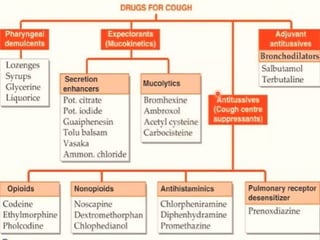
PHARYNGEAL DEMULCENTS
Sooth the throat and reduce afferent impulses from
the inflamed/irritated pharyngeal mucosa, thus
provide symptomatic relief in dry cough arising
from throat.
Lozenges
Cough drops
Linctus containing syrups
Glycerine liquorice
EXPECTORANTS AND MUCOLYTICS
EXPECTORANTS : increase the volume of
bronchial secretion and reduce viscosity of
sputum, and hence cough become less tiring and
productive which facilitating its removal by coughing.
MUCOLYTICS: Break thick tenacious sputum so
that sputum will come out easily with less effort
BRONCHIAL SECRETION ENHANCERS
Sodium and potassium citrate.
increase bronchial secretion by salt action.
KI is secreted by bronchial glands and can irritate the
airway mucosa.
ADR: Prolonged use can affect thyroid function and
produce iodism.
It is not used now.
BRONCHIAL SECRETION ENHANCERS
Guaiphenesin, vasaka, tolu balsum :
Plant products which are supposed to enhance
bronchial secretion and mucociliary function while
being secreted by tracheobronchial glands
Ammonium salts are nauseating—reflexly
increase respiratory secretions
MUCOLYTICS: BROMHEXINE &
AMBROXOL
 BROMHEXINE: Derivative of the alkaloid vasicine obtained from
Adhatoda vasica (Vasaka), is a potent mucolytic and mucokinetic
which capable of inducing thin copious bronchial secretion.
 AMBROXOL: metabolite of bromhexine having same action
 MOA: It depolymerises mucopolysaccharides directly as well as
by liberating lysosomal enzymes 4 break network of fibres in
tenacious sputum. It is particularly useful if mucus plugs are
present.
 ADR: Rhinorrhoea and Lacrimation, nausea, gastric irritation,
hypersensitivity
MUCOLYTICS
• ACETYLCYSTEINE
• It opens disulfide bonds in mucoproteins present in
sputum—makes it less viscid
• but has to be administered directly into the
respiratory tract.
MUCOLYTICS
CARBOCISTEINE
MOA: It liquefies viscid sputum in the same way as
acetyl cysteine (opens disulfide bonds) and is
administered orally (250-750 mg TDS).
CI: It may break gastric mucosal barrier
(contraindicated in peptic ulcer patients).
ADR: gastric discomfort and rashes.
USES: patients of chronic bronchitis.
ANTITUSSIVES
Drug used are
Opiods: Codeine, Pholcodiene
Nonopioids: Noscapine,Dextromethorphan,
Chlophendianol
Antihistamine: Chlorpheniramine, Diphenhydramine,
Promethazine
Peripherally acting: Prenoxdiazine.
CODEINE
opium alkaloid, qualitatively similar to and less potent
than morphine, but is more selective for cough centre.
Uses as standard antitussive; suppresses cough for 6
hours.
MOA: Act through opioid receptors in the brain
(antitussive action can be blocked by naloxone)
ADR:
A. Constipation.
B. Respiratory depression and drowsiness (At higher doses)
especially in children, Driving may be impaired.
CI: In asthmatics and in patients with diminished
respiratory
Reserve ; should be avoided in Children
ETHYL MORPHINE & PHOLCODEINE
ETHYLMORPHINE
It is closely related to codeine
has antitussive, respiratory depressant properties like
codeine, but is believed to be less constipating
PHOLCODEINE
It has practically no analgesic or addicting property,
similar in efficacy as antitussive to codeine and is
longer acting—acts for 12 hours
NOSCAPINE (NARCOTINE)
• Nonopioids equipotent antitussive as codeine
• useful in spasmodic cough.
• MOA: It depresses cough but has no narcotic,
analgesic or
• dependence inducing properties.
ADR:
Headache and nausea.
It can release histamine and produce
bronchoconstriction in asthmatic
NOSCAPINE (NARCOTINE)
• Nonopioids equipotent antitussive as codeine
• useful in spasmodic cough.
• MOA: It depresses cough but has no narcotic,
analgesic or
• dependence inducing properties.
ADR:
Headache and nausea.
It can release histamine and produce
bronchoconstriction in asthmatic
DEXTROMETHORPHAN
MOA: synthetic central NMDA (N-methyl D-aspartate)
receptor antagonist; the d-isomer has antitussive
action while I-isomer is analgesic.
Does not depress mucociliary function of the airway
mucosa
Devoid of constipating action.
Non addicting.
The antitussive action equivalent to codeine
ADR: Dizziness, nausea, drowsiness; at high doses
hallucinations and ataxia may occur.
NOSCAPINE (NARCOTINE)
Nonopioids equipotent antitussive as codeine
useful in spasmodic cough.
MOA: It depresses cough but has no narcotic,
analgesic or
dependence inducing properties.
ADR:
Headache and nausea.
It can release histamine and produce
bronchoconstriction in asthmatic
DEXTROMETHORPHAN
MOA: synthetic central NMDA (N-methyl D-aspartate)
receptor antagonist; the d-isomer has antitussive
action while I-isomer is analgesic.
does not depress mucociliary function of the airway
mucosa
devoid of constipating action.
Non addicting,
The antitussive action equivalent to codeine
ADR: Dizziness, nausea, drowsiness; at high doses
hallucinations and ataxia may occur.
ANTIHISTAMINE
Chlorpheniramine, Diphenhydramine,
Promethazine
Relief in cough due to their sedative and
anticholinergic actions, but lack selectivity for
the cough centre.
no expectorant property, may even reduce
secretions by anticholinergic action.
They have been specially promoted for cough
in respiratory allergic states, though their lack
of efficacy in asthma is legendary.
PRENOXDIAZINE
it acts peripherally which desensitizes the
pulmonary stretch receptors and reduces
tussal impulses originating in the lungs.
It is indicated in cough of bronchial origin. s
Efficacy is not impressive.
Cough prepared by dr .............. Sumera-

Cough prepared by dr .............. Sumera-

  • 1.
    Cough and Itstreatment
  • 2.
    Cough  Cough isa protective reflex to remove irritants and accumulated secretions from respiratory passages  Cough occurs due to stimulation of mechano- or chemoreceptors in throat, respiratory passages or stretch receptors in the lungs.  Cough may be useful or useless.  Useful (productive) cough serves to drain the airway, its suppression is not desirable, may even be harmful, except if the amount of expectoration achieved is small compared to the effort of continuous coughing.  Useless (non-productive) cough should be suppressed
  • 4.
    PHARYNGEAL DEMULCENTS Sooth thethroat and reduce afferent impulses from the inflamed/irritated pharyngeal mucosa, thus provide symptomatic relief in dry cough arising from throat. Lozenges Cough drops Linctus containing syrups Glycerine liquorice
  • 5.
    EXPECTORANTS AND MUCOLYTICS EXPECTORANTS: increase the volume of bronchial secretion and reduce viscosity of sputum, and hence cough become less tiring and productive which facilitating its removal by coughing. MUCOLYTICS: Break thick tenacious sputum so that sputum will come out easily with less effort
  • 6.
    BRONCHIAL SECRETION ENHANCERS Sodiumand potassium citrate. increase bronchial secretion by salt action. KI is secreted by bronchial glands and can irritate the airway mucosa. ADR: Prolonged use can affect thyroid function and produce iodism. It is not used now.
  • 7.
    BRONCHIAL SECRETION ENHANCERS Guaiphenesin,vasaka, tolu balsum : Plant products which are supposed to enhance bronchial secretion and mucociliary function while being secreted by tracheobronchial glands Ammonium salts are nauseating—reflexly increase respiratory secretions
  • 8.
    MUCOLYTICS: BROMHEXINE & AMBROXOL BROMHEXINE: Derivative of the alkaloid vasicine obtained from Adhatoda vasica (Vasaka), is a potent mucolytic and mucokinetic which capable of inducing thin copious bronchial secretion.  AMBROXOL: metabolite of bromhexine having same action  MOA: It depolymerises mucopolysaccharides directly as well as by liberating lysosomal enzymes 4 break network of fibres in tenacious sputum. It is particularly useful if mucus plugs are present.  ADR: Rhinorrhoea and Lacrimation, nausea, gastric irritation, hypersensitivity
  • 9.
    MUCOLYTICS • ACETYLCYSTEINE • Itopens disulfide bonds in mucoproteins present in sputum—makes it less viscid • but has to be administered directly into the respiratory tract.
  • 10.
    MUCOLYTICS CARBOCISTEINE MOA: It liquefiesviscid sputum in the same way as acetyl cysteine (opens disulfide bonds) and is administered orally (250-750 mg TDS). CI: It may break gastric mucosal barrier (contraindicated in peptic ulcer patients). ADR: gastric discomfort and rashes. USES: patients of chronic bronchitis.
  • 11.
    ANTITUSSIVES Drug used are Opiods:Codeine, Pholcodiene Nonopioids: Noscapine,Dextromethorphan, Chlophendianol Antihistamine: Chlorpheniramine, Diphenhydramine, Promethazine Peripherally acting: Prenoxdiazine.
  • 12.
    CODEINE opium alkaloid, qualitativelysimilar to and less potent than morphine, but is more selective for cough centre. Uses as standard antitussive; suppresses cough for 6 hours. MOA: Act through opioid receptors in the brain (antitussive action can be blocked by naloxone) ADR: A. Constipation. B. Respiratory depression and drowsiness (At higher doses) especially in children, Driving may be impaired. CI: In asthmatics and in patients with diminished respiratory Reserve ; should be avoided in Children
  • 13.
    ETHYL MORPHINE &PHOLCODEINE ETHYLMORPHINE It is closely related to codeine has antitussive, respiratory depressant properties like codeine, but is believed to be less constipating PHOLCODEINE It has practically no analgesic or addicting property, similar in efficacy as antitussive to codeine and is longer acting—acts for 12 hours
  • 14.
    NOSCAPINE (NARCOTINE) • Nonopioidsequipotent antitussive as codeine • useful in spasmodic cough. • MOA: It depresses cough but has no narcotic, analgesic or • dependence inducing properties. ADR: Headache and nausea. It can release histamine and produce bronchoconstriction in asthmatic
  • 15.
    NOSCAPINE (NARCOTINE) • Nonopioidsequipotent antitussive as codeine • useful in spasmodic cough. • MOA: It depresses cough but has no narcotic, analgesic or • dependence inducing properties. ADR: Headache and nausea. It can release histamine and produce bronchoconstriction in asthmatic
  • 16.
    DEXTROMETHORPHAN MOA: synthetic centralNMDA (N-methyl D-aspartate) receptor antagonist; the d-isomer has antitussive action while I-isomer is analgesic. Does not depress mucociliary function of the airway mucosa Devoid of constipating action. Non addicting. The antitussive action equivalent to codeine ADR: Dizziness, nausea, drowsiness; at high doses hallucinations and ataxia may occur.
  • 17.
    NOSCAPINE (NARCOTINE) Nonopioids equipotentantitussive as codeine useful in spasmodic cough. MOA: It depresses cough but has no narcotic, analgesic or dependence inducing properties. ADR: Headache and nausea. It can release histamine and produce bronchoconstriction in asthmatic
  • 18.
    DEXTROMETHORPHAN MOA: synthetic centralNMDA (N-methyl D-aspartate) receptor antagonist; the d-isomer has antitussive action while I-isomer is analgesic. does not depress mucociliary function of the airway mucosa devoid of constipating action. Non addicting, The antitussive action equivalent to codeine ADR: Dizziness, nausea, drowsiness; at high doses hallucinations and ataxia may occur.
  • 19.
    ANTIHISTAMINE Chlorpheniramine, Diphenhydramine, Promethazine Relief incough due to their sedative and anticholinergic actions, but lack selectivity for the cough centre. no expectorant property, may even reduce secretions by anticholinergic action. They have been specially promoted for cough in respiratory allergic states, though their lack of efficacy in asthma is legendary.
  • 20.
    PRENOXDIAZINE it acts peripherallywhich desensitizes the pulmonary stretch receptors and reduces tussal impulses originating in the lungs. It is indicated in cough of bronchial origin. s Efficacy is not impressive.