CUSTOMIZED LEARNING
COMENIUS PROJECT,
April 2015, Sweden
ITALY
Liceo Scientifico A. Gramsci
STUDENTS WITH
DISABILITIES
GIFTED AND TALENTED
STUDENTS
CASE STUDY OF OUR SCHOOL
ITALIAN INCLUSIVE EDUCATION:
“WHERE DIVERSITY BECOMES NORMAL”
A SCHOOL WHERE EVERY
STUDENT IS WELCOMED
A SCHOOL WHERE STUDENTS
CAN LEARN AT THEIR OWN
PACE
A SCHOOL WHERE ALL
STUDENTS CAN PARTICIPATE
THESE ARE FACTORS THAT IMPROVE SCHOOL QUALITY
PRINCIPLES OF GOOD SCHOOL QUALITY
Students with disabilities
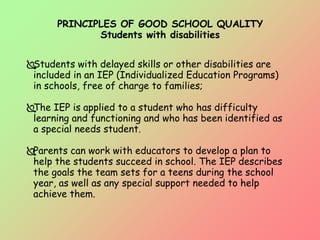
Students with delayed skills or other disabilities are
included in an IEP (Individualized Education Programs)
in schools, free of charge to families;
The IEP is applied to a student who has difficulty
learning and functioning and who has been identified as
a special needs student.
Parents can work with educators to develop a plan to
help the students succeed in school. The IEP describes
the goals the team sets for a teens during the school
year, as well as any special support needed to help
achieve them.
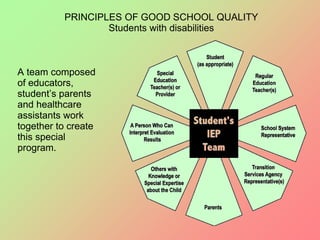
A team composed
of educators,
student’s parents
and healthcare
assistants work
together to create
this special
program.
PRINCIPLES OF GOOD SCHOOL QUALITY
Students with disabilities
PRINCIPLES OF GOOD SCHOOL QUALITY
Students with disabilities
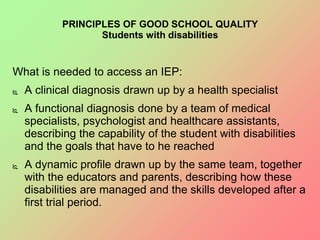
What is needed to access an IEP:
 A clinical diagnosis drawn up by a health specialist
 A functional diagnosis done by a team of medical
specialists, psychologist and healthcare assistants,
describing the capability of the student with disabilities
and the goals that have to he reached
 A dynamic profile drawn up by the same team, together
with the educators and parents, describing how these
disabilities are managed and the skills developed after a
first trial period.
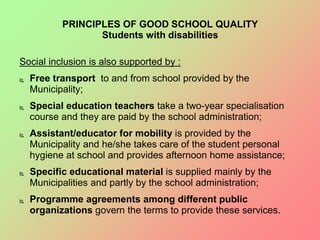
Social inclusion is also supported by :
 Free transport to and from school provided by the
Municipality;
 Special education teachers take a two-year specialisation
course and they are paid by the school administration;
 Assistant/educator for mobility is provided by the
Municipality and he/she takes care of the student personal
hygiene at school and provides afternoon home assistance;
 Specific educational material is supplied mainly by the
Municipalities and partly by the school administration;
 Programme agreements among different public
organizations govern the terms to provide these services.
PRINCIPLES OF GOOD SCHOOL QUALITY
Students with disabilities
PRINCIPLES OF GOOD SCHOOL QUALITY
ACTIVITIES FOR GIFTED AND TALENTED STUDENTS
 Our school provides a
large range of activities
to enable the talents of
students to flourish and
improve.
 The activities are related
to the specific subject
studied at our school
For example:
The students who are good at
Physics have the chance to
apply their knowledge to
sailing, first in theory and lately
in practise.
The students who are good at
Physics can also serve an
internship at the University
The students who are good at
English can participate in
specific cultural and foreign
exchange program
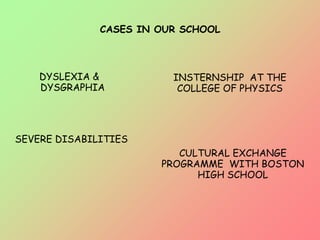
CASES IN OUR SCHOOL
DYSLEXIA &
DYSGRAPHIA
SEVERE DISABILITIES
INSTERNSHIP AT THE
COLLEGE OF PHYSICS
CULTURAL EXCHANGE
PROGRAMME WITH BOSTON
HIGH SCHOOL
DYSLEXIA
Dyslexia is a specific learning difficulty that primarily affects the skills involved in
accurate and fluent word reading and spelling.
Our school supports students suffering from dyslexia by giving them simpler and
shorter tests and for severe cases of dyslexia the students take specific courses.
DYSGRAPHIA
Dysgraphia is a transcription disability, i.e., a writing disorder associated with
impaired handwriting, orthographic coding (orthography, the storing process of
written words and processing the letters in those words), and finger sequencing
(the movement of muscles required to write).
In this case, at school the students affected by this disorder write directly on the
computer and also take specific courses.
SEVERE DISABILITIES
The students affected by severe disabilities, e.g. Down
Syndrome, Autism, Hearing loss and Deafness, Cognitive
and Physical disabilities, etc. are placed in regular
classrooms together with non-disable students, they are
supported by a special educator and they follow a different
educational program.
CULTURAL EXCHANGE PROGRAM
The students that prove to be good at English are included in a
cultural exchange program with Boston High School. This is a long
lasting tradition in our school, that has been taking place for many
years now.
INSTERNSHIP AT THE COLLEGE OF PHYSICS
The students that are good at Physics are invited to attend and
internship at the college of Physics of the University of Florence.
This internship lasts five days and during it the students do a
number of experiments regarding different fields of Physics. At the
end they choose one of these experiments and produce a report
about it.
IMPROVEMENTS
It’s our opinion that some improvements can be done to
increase quality of education:
-Students with disabilities: it would be important not to change
the team that prepares the IEP and assesses the student’s
achievement of goals;
-Talented and regular students: a more efficient and further
interaction between university and school and also between the
job market and school is needed.

Costumized learning1

  • 1.
    CUSTOMIZED LEARNING COMENIUS PROJECT, April2015, Sweden ITALY Liceo Scientifico A. Gramsci
  • 2.
    STUDENTS WITH DISABILITIES GIFTED ANDTALENTED STUDENTS CASE STUDY OF OUR SCHOOL
  • 3.
    ITALIAN INCLUSIVE EDUCATION: “WHEREDIVERSITY BECOMES NORMAL” A SCHOOL WHERE EVERY STUDENT IS WELCOMED A SCHOOL WHERE STUDENTS CAN LEARN AT THEIR OWN PACE A SCHOOL WHERE ALL STUDENTS CAN PARTICIPATE THESE ARE FACTORS THAT IMPROVE SCHOOL QUALITY
  • 4.
    PRINCIPLES OF GOODSCHOOL QUALITY Students with disabilities Students with delayed skills or other disabilities are included in an IEP (Individualized Education Programs) in schools, free of charge to families; The IEP is applied to a student who has difficulty learning and functioning and who has been identified as a special needs student. Parents can work with educators to develop a plan to help the students succeed in school. The IEP describes the goals the team sets for a teens during the school year, as well as any special support needed to help achieve them.
  • 5.
    A team composed ofeducators, student’s parents and healthcare assistants work together to create this special program. PRINCIPLES OF GOOD SCHOOL QUALITY Students with disabilities
  • 6.
    PRINCIPLES OF GOODSCHOOL QUALITY Students with disabilities What is needed to access an IEP:  A clinical diagnosis drawn up by a health specialist  A functional diagnosis done by a team of medical specialists, psychologist and healthcare assistants, describing the capability of the student with disabilities and the goals that have to he reached  A dynamic profile drawn up by the same team, together with the educators and parents, describing how these disabilities are managed and the skills developed after a first trial period.
  • 7.
    Social inclusion isalso supported by :  Free transport to and from school provided by the Municipality;  Special education teachers take a two-year specialisation course and they are paid by the school administration;  Assistant/educator for mobility is provided by the Municipality and he/she takes care of the student personal hygiene at school and provides afternoon home assistance;  Specific educational material is supplied mainly by the Municipalities and partly by the school administration;  Programme agreements among different public organizations govern the terms to provide these services. PRINCIPLES OF GOOD SCHOOL QUALITY Students with disabilities
  • 8.
    PRINCIPLES OF GOODSCHOOL QUALITY ACTIVITIES FOR GIFTED AND TALENTED STUDENTS  Our school provides a large range of activities to enable the talents of students to flourish and improve.  The activities are related to the specific subject studied at our school For example: The students who are good at Physics have the chance to apply their knowledge to sailing, first in theory and lately in practise. The students who are good at Physics can also serve an internship at the University The students who are good at English can participate in specific cultural and foreign exchange program
  • 9.
    CASES IN OURSCHOOL DYSLEXIA & DYSGRAPHIA SEVERE DISABILITIES INSTERNSHIP AT THE COLLEGE OF PHYSICS CULTURAL EXCHANGE PROGRAMME WITH BOSTON HIGH SCHOOL
  • 10.
    DYSLEXIA Dyslexia is aspecific learning difficulty that primarily affects the skills involved in accurate and fluent word reading and spelling. Our school supports students suffering from dyslexia by giving them simpler and shorter tests and for severe cases of dyslexia the students take specific courses. DYSGRAPHIA Dysgraphia is a transcription disability, i.e., a writing disorder associated with impaired handwriting, orthographic coding (orthography, the storing process of written words and processing the letters in those words), and finger sequencing (the movement of muscles required to write). In this case, at school the students affected by this disorder write directly on the computer and also take specific courses.
  • 11.
    SEVERE DISABILITIES The studentsaffected by severe disabilities, e.g. Down Syndrome, Autism, Hearing loss and Deafness, Cognitive and Physical disabilities, etc. are placed in regular classrooms together with non-disable students, they are supported by a special educator and they follow a different educational program.
  • 12.
    CULTURAL EXCHANGE PROGRAM Thestudents that prove to be good at English are included in a cultural exchange program with Boston High School. This is a long lasting tradition in our school, that has been taking place for many years now.
  • 13.
    INSTERNSHIP AT THECOLLEGE OF PHYSICS The students that are good at Physics are invited to attend and internship at the college of Physics of the University of Florence. This internship lasts five days and during it the students do a number of experiments regarding different fields of Physics. At the end they choose one of these experiments and produce a report about it.
  • 14.
    IMPROVEMENTS It’s our opinionthat some improvements can be done to increase quality of education: -Students with disabilities: it would be important not to change the team that prepares the IEP and assesses the student’s achievement of goals; -Talented and regular students: a more efficient and further interaction between university and school and also between the job market and school is needed.