Economics for Engineers
Module 1
INDEX
Economic
Decision
Making
Engineering
Costs &
Estimation
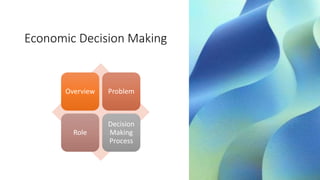
Economic Decision Making
Overview Problem
Role
Decision
Making
Process
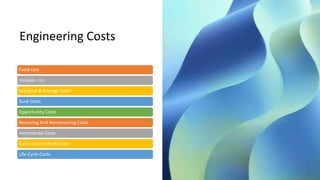
Engineering Costs
Fixed cost
Variable cost
Marginal & Average Costs
Sunk Costs
Opportunity Costs
Recurring And Nonrecurring Costs
Incremental Costs
Cash Costs vs Book Costs
Life-Cycle Costs
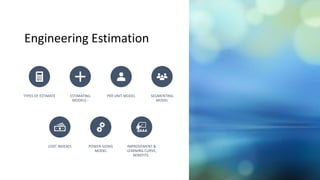
Engineering Estimation
TYPES OF ESTIMATE ESTIMATING
MODELS -
PER UNIT MODEL SEGMENTING
MODEL
COST INDEXES POWER-SIZING
MODEL
IMPROVEMENT &
LEARNING CURVE,
BENEFITS.
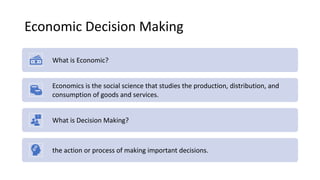
Economic Decision Making
What is Economic?
Economics is the social science that studies the production, distribution, and
consumption of goods and services.
What is Decision Making?
the action or process of making important decisions.
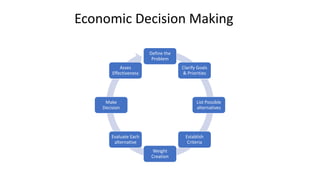
Economic Decision Making
Define the
Problem
Clarify Goals
& Priorities
List Possible
alternatives
Establish
Criteria
Weight
Creation
Evaluate Each
alternative
Make
Decision
Asses
Effectiveness
City of
Dholakpur
Define Problem
What should we develop on the land?
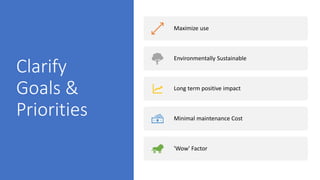
Clarify
Goals &
Priorities
Maximize use
Environmentally Sustainable
Long term positive impact
Minimal maintenance Cost
'Wow' Factor
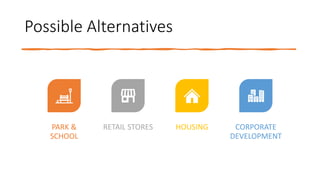
Possible Alternatives
PARK &
SCHOOL
RETAIL STORES HOUSING CORPORATE
DEVELOPMENT
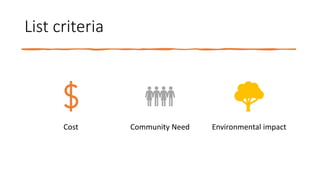
List criteria
Cost Community Need Environmental impact
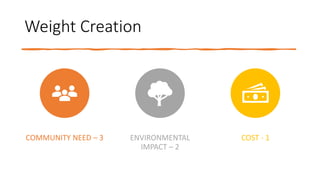
Weight Creation
COMMUNITY NEED – 3 ENVIRONMENTAL
IMPACT – 2
COST - 1
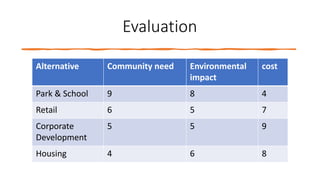
Evaluation
Alternative Community need Environmental
impact
cost
Park & School 9 8 4
Retail 6 5 7
Corporate
Development
5 5 9
Housing 4 6 8
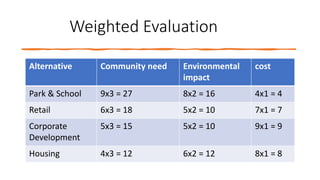
Weighted Evaluation
Alternative​ Community need​ Environmental
impact​
cost​
Park & School​ 9​x3 = 27 8​x2 = 16 4​x1 = 4
Retail​ 6​x3 = 18 5​x2 = 10 7​x1 = 7
Corporate
Development​
5​x3 = 15 5​x2 = 10 9​x1 = 9
Housing​ 4​x3 = 12 6​x2 = 12 8x1​ = 8
Possible
alternatives
• Park & School - 47
• Retail stores - 35
• Housing - 32
• Corporate
Development - 34
Make Decision
Asses Effectiveness
Engineering Costs
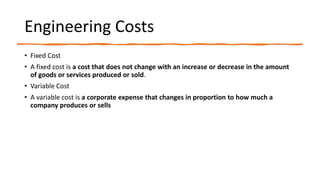
Engineering Costs
• Fixed Cost
• A fixed cost is a cost that does not change with an increase or decrease in the amount
of goods or services produced or sold.
• Variable Cost
• A variable cost is a corporate expense that changes in proportion to how much a
company produces or sells
Engineering
Costs
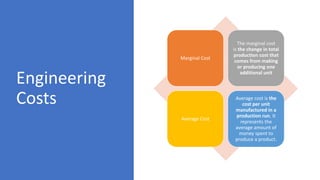
Marginal Cost
The marginal cost
is the change in total
production cost that
comes from making
or producing one
additional unit
Average Cost
Average cost is the
cost per unit
manufactured in a
production run. It
represents the
average amount of
money spent to
produce a product.
Engineering
Costs
Sunk cost
A sunk cost is money that has already been spent
and cannot be recovered.
Opportunity cost
Opportunity cost is the potential forgone profit
from a missed opportunity—the result of
choosing one alternative and forgoing another.
Engineering
Costs
Recurring Cost
Recurrent Cost is the regular expenditure cost that is repeatedly
occur for the similar goods or services on a continuing basis.
Non recurring cost
A nonrecurring cost is a expense that is considered a one-time
or rare expense and is unlikely to happen again.
Incremental Cost
Incremental cost is the total cost incurred due to an additional
unit of product being produced
Engineering
Costs
Cash Cost
Cash Costs are the costs Which are paid by the business
while using cash or cheque, but not credit.
Book Cost
In any business, there are purchases of equipment and
other facilities. The total money spent in
buying that equipment and other facilities is called Book
cost.
Engineering
Costs
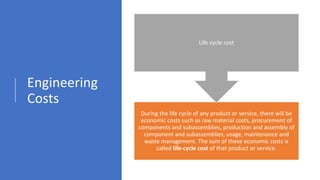
During the life cycle of any product or service, there will be
economic costs such as raw material costs, procurement of
components and subassemblies, production and assembly of
component and subassemblies, usage, maintenance and
waste management. The sum of these economic costs is
called life-cycle cost of that product or service.
Life cycle cost
Engineering Estimation
In a Manufacturing/service
organization, estimating the
cost of product/service requires
utmost accuracy so that
deviation between the actual
cost and the estimated cost is
minimal.
Engineering Estimation helps us
in doing the estimation.
Per Unit Model
Segmentation
Model
• The segmentation model of cost
estimation splits the task of the
product/service into different
segments. Then the cost of each
segment is to be estimated and
finally, the cost of the product is
obtained by summing the costs
of all the segments of
product/service.
Cost index
Model
• The cost index describes changes
in prices of cost factors relative
to the selected base year.
Power sizing
model
• The ‘power sizing model’ of cost estimation is
based on economies of scale. It is used for
estimating the cost of equipment and other
industrial items.
Learning curve
• Learning Curve is based on the
concept that the more an
individual repeats a process or
activity, the more adept they
become at that activity. This
translates to lower input costs
and higher overall output.
Thank you

cost estimation for economics for engineering