CORWIN ONCORWIN ON
CONTAINERSCONTAINERS
WHO AM I?WHO AM I?
Corwin Brown
But you can call me Kory.
Traditionally come from a DevOps background.
Worked at places like:
Rackspace
Fitbit
Plus a bunch of places you haven't heard of.
Currently a Full-Stack Developer at BloomReach here in
Dallas.
WHAT ARE WE TALKING ABOUTWHAT ARE WE TALKING ABOUT
TODAY?TODAY?
CONTAINERS!CONTAINERS!
What is Containerization?
The History fo Containers.
How containers work.
Process Namespaces.
Control Groups.
How we can use containers here at BloomReach.
Questions at marked sections.
QUICK ASIDE ON DEVOPSQUICK ASIDE ON DEVOPS
"DevOps is about recognizing that the
backing infrastructure is not separate from
your application, but rather a vital part of
it."
CONTAINERSCONTAINERS
LINUX CRASH COURSELINUX CRASH COURSE
Everything in Linux is a file.
Network sockets.
Hardware devices.
etc
User space:
The Section of system memory that User Processes run
in.
Contrasted with Kernel space, where the Kernel
executes processes.
CONTAINERSCONTAINERS
WHAT IS CONTAINERIZATION?WHAT IS CONTAINERIZATION?
OS feature that allows for the existance of multiple
isolated User Spaces.
These user-space slices are known as containers.
Each container is made aware of only specific
resources.
A container can contain anything from a single running
process to an entire operating system.
VERY SIMILAR TO VIRTUALVERY SIMILAR TO VIRTUAL
MACHINESMACHINES
But no need to maintain a bunch of different OS installs.
No backups.
No policies around backups.
No upgrades.
No patches.
etc
Ship your application's context alongside your
application.
CONTAINERS TEND TO BE LIGHTERCONTAINERS TEND TO BE LIGHTER
THAN VMSTHAN VMS
Each VM would require significant overhead that comes
with running an OS.
Both in compute resources, and human time.
Allows you to efficiently bin-pack resources onto a
machine.
HISTORY OFHISTORY OF
CONTAINERSCONTAINERS
CHROOTCHROOT
"Change-Root"
Provided file system isolation.
Convinces a process its root directory is something
other than "/".
FREEBSD JAILS AND SOLARIS ZONESFREEBSD JAILS AND SOLARIS ZONES
File system and network isolation
Zones also provided also snapshots courtesy of ZFS.
LXCLXC
Originally the backend for Docker.
Generally works closer to a traditional Virtual Machine.
Generally runs an entire OS.
Produced containers tend to be less portable than Docker.
Designed to be a lightweight system, as opposed to a
lightweight service.
DOCKERDOCKER
Currently the most popular container engine.
Succeeded largely because of it's focus on ecosystem.
RKTRKT
Potentially the future.
Takes a lot of Docker concepts, and improves upon them.
Follows a more Linux-like process model.
Built to strongly adhere to the Open Container
Standard, but also be backwards compatible with
Docker.
As a drop in replacement, has a lot of potential promise
for the future.
HOW DO CONTAINERSHOW DO CONTAINERS
WORK?WORK?
PROCESS NAMESPACESPROCESS NAMESPACES
CONTROL GROUPS (CGROUPS)CONTROL GROUPS (CGROUPS)
PROCESS NAMESPACESPROCESS NAMESPACES
Allows the Kernel to isolate and virtualize system
resources.
Seven Namespaces:
mnt
pid
net
ipc
UTS
user
cgroup
EXAMPLEEXAMPLE
Instead of communicating with eth0:
Create a virtual interface.
Present that to a process instead of the hardware.
Allows for each container to be walled off from the
hadware.
Allows for each container to have it's own networking
information.
CONTROL GROUPSCONTROL GROUPS
Developed at Google in 2006 and merged into the Linux
Kernel in 2007.
Feature that limits, accounts for, and isolates system
resources.
Provides:
Resource limiting.
Prioritization.
Accounting.
Control.
CGROUP IMPLEMENTATIONCGROUP IMPLEMENTATION
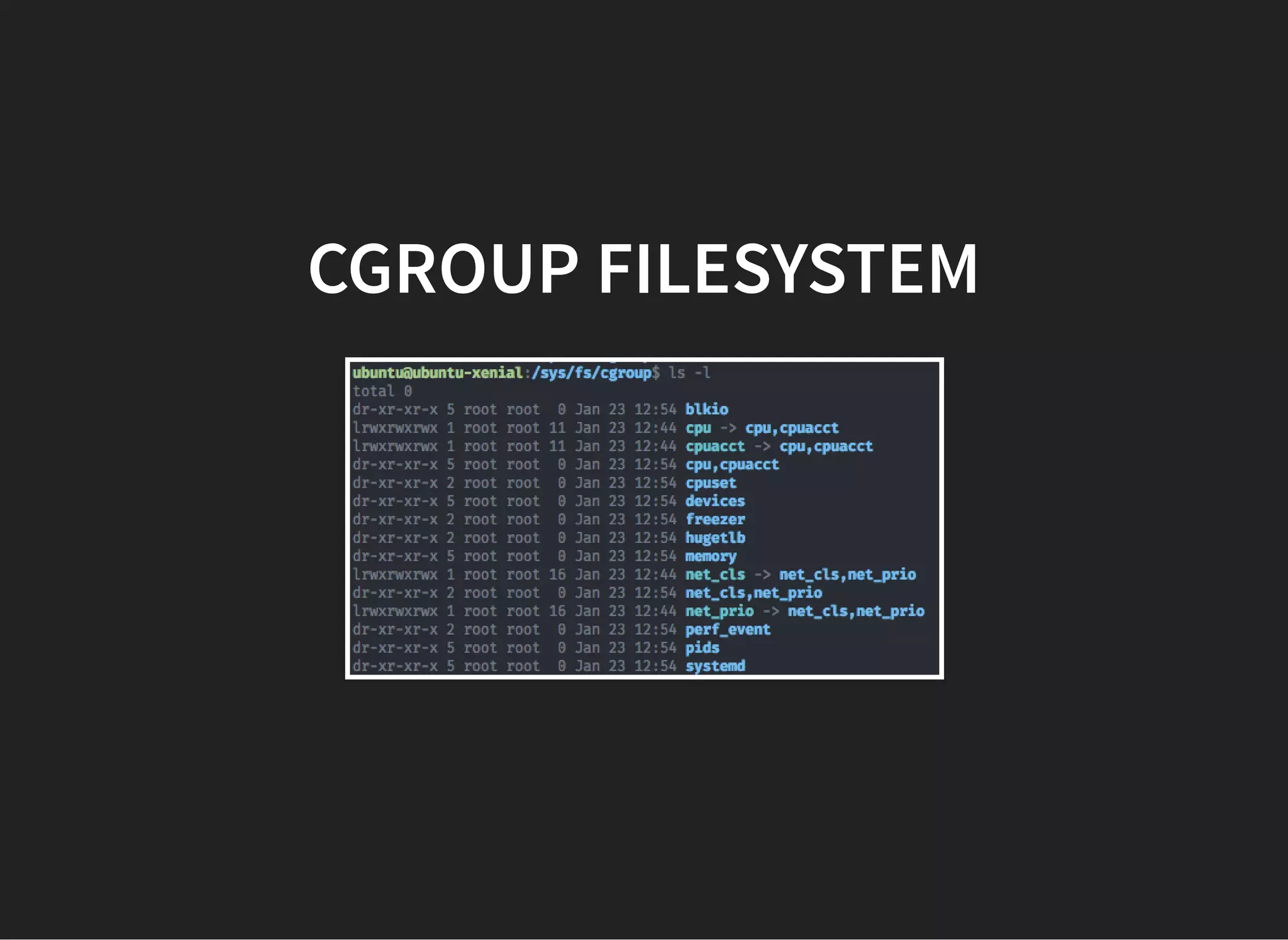
Like most things with Linux, CGroups are represented on
the file system.
In Ubuntu 16.04, they exist at "/sys/fs/cgroup".
CGROUP FILESYSTEMCGROUP FILESYSTEM
CGROUP MEMORY LIMITINGCGROUP MEMORY LIMITING
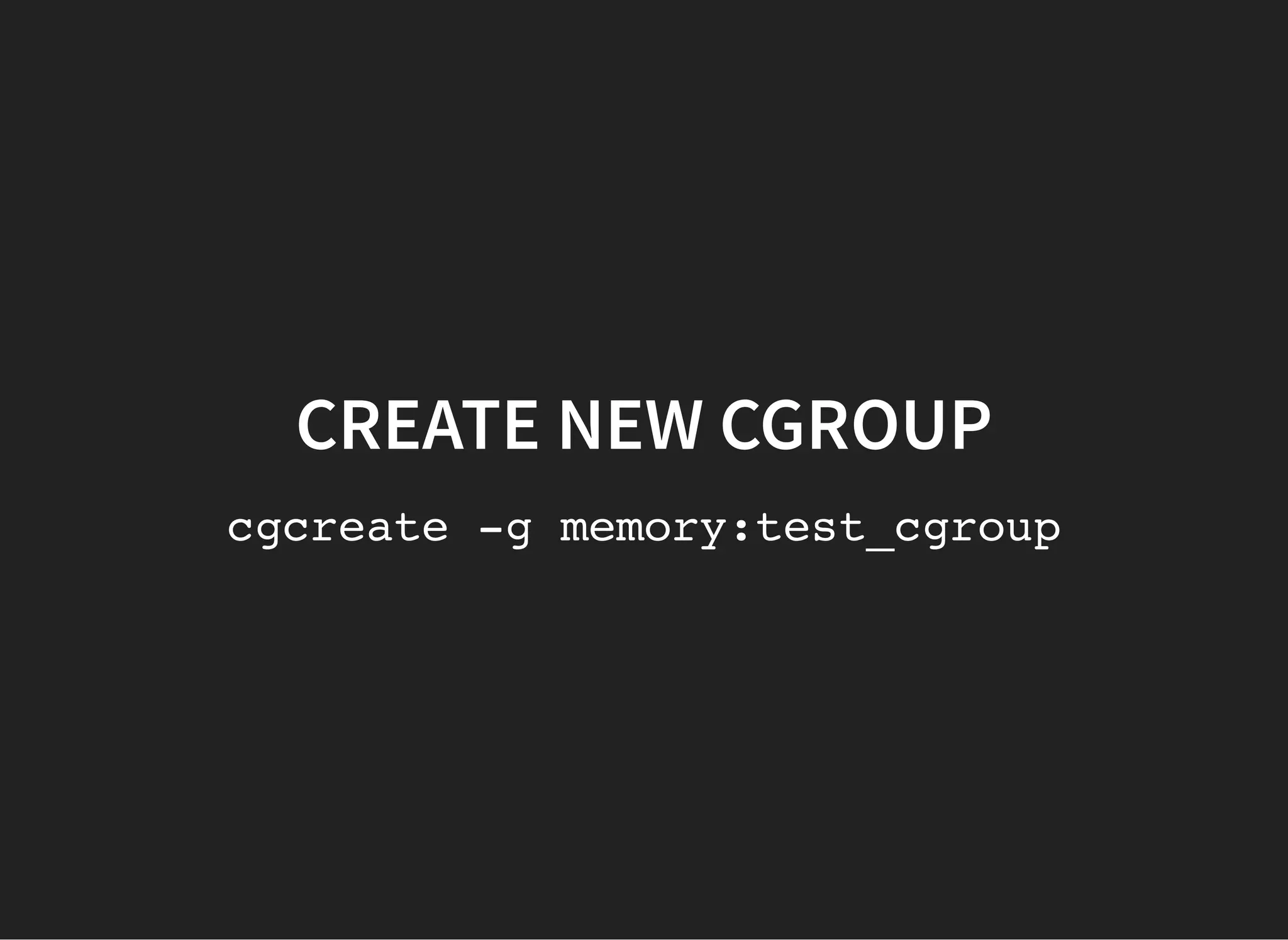
CREATE NEW CGROUPCREATE NEW CGROUP
cgcreate -g memory:test_cgroup
SEE THE NEW GROUP!SEE THE NEW GROUP!
INSIDE THE NEW CGROUPINSIDE THE NEW CGROUP
IN SUMMARYIN SUMMARY
Process Namespaces: Control what you can see.
Control Groups: Control what you can do.
FURTHER READINGFURTHER READING
Mocker
https://github.com/tonybaloney/mocker
WHAT CAN YOU DOWHAT CAN YOU DO
WITH CONTAINERS?WITH CONTAINERS?
TESTING NEW TECHNOLOGIESTESTING NEW TECHNOLOGIES
Wanted to try out a monitoring backend for an alerting
service.
I'd used Prometheus in the past, and was interested in
testing it out.
... but I really didn't want to set it all up locally or maintain
a VM for ten minutes of vetting.
IN CASE OF DEMO FAILUREIN CASE OF DEMO FAILURE
$ docker run --rm -p9090:9090
prom/prometheus
DEVELOPING WITH SPECIFICDEVELOPING WITH SPECIFIC
DEPEDENCIESDEPEDENCIES
Project requires Postgres 9.6.
Not interested in installing Postgres locally.
What if I need a different version later?
Maintaining different installs is a pain.
I don't want my laptop chugging to run a database
when I don't need it.
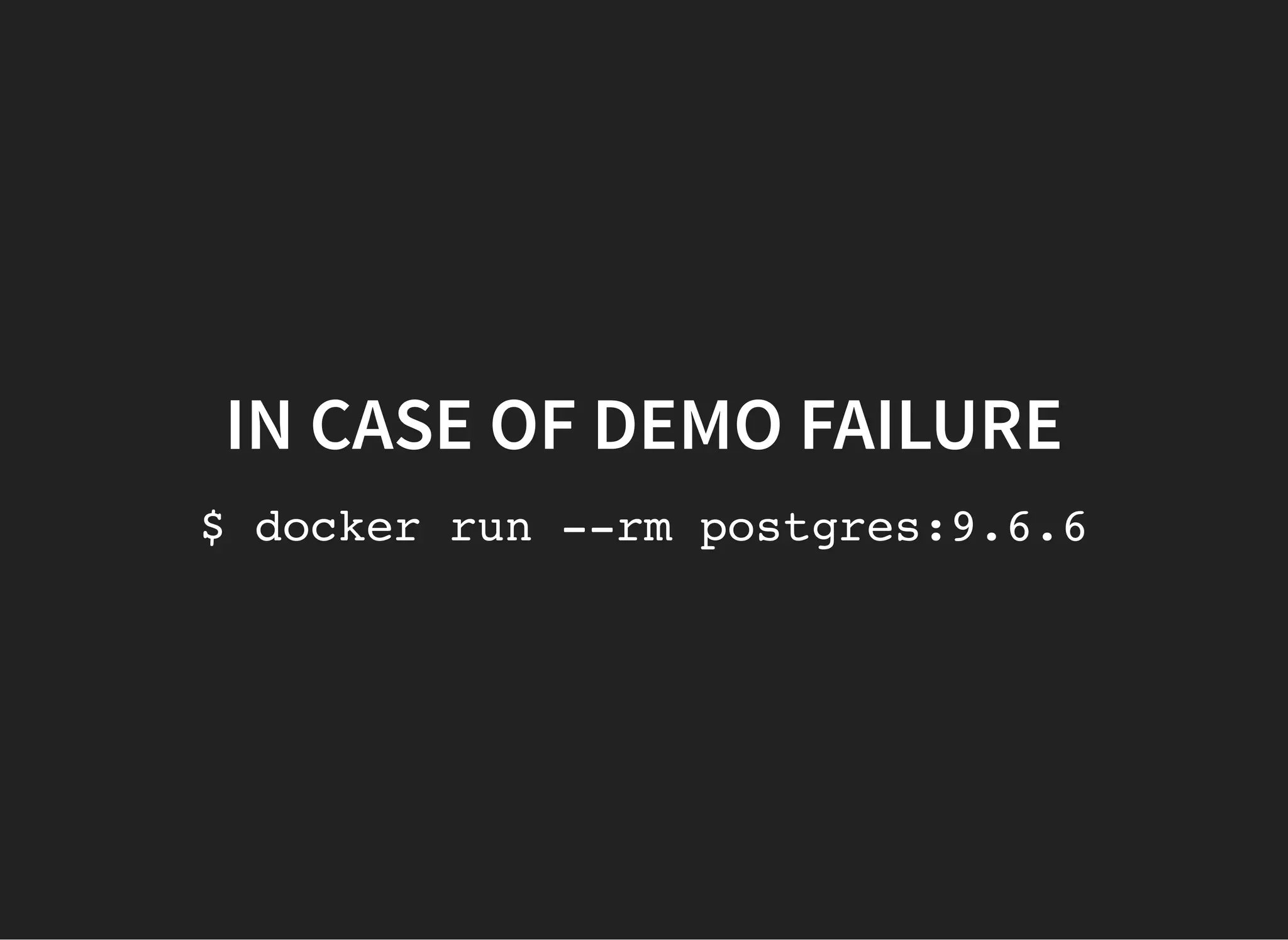
IN CASE OF DEMO FAILUREIN CASE OF DEMO FAILURE
$ docker run --rm postgres:9.6.6
POSTGRESQL (CONTD)POSTGRESQL (CONTD)
Still need psql to interact with PostgreSQL.
Still have to install junk on my laptop.
...Or do you?
POSTGRESQL (CONTD)POSTGRESQL (CONTD)
I can spin up a container with PostgreSQL...
I can spin up a container with PSQL...
... and I can link them with a "Docker network".
IN CASE OF DEMO FAILUREIN CASE OF DEMO FAILURE
$ docker network create dbnet
$ docker run --rm --net dbnet --name db postgres:9.6.6
$ docker run --rm --net dbnet -it postgres:9.6.6 psql -h db -U postgr
POSTGRESQL (CONTD)POSTGRESQL (CONTD)
Actual workflow we use:.
To get a development environment setup, do the
following:
1. Open the src directory in a terminal.
2. Run some Make commands.
IN CASE OF DEMO FAILUREIN CASE OF DEMO FAILURE
$ make postgres-start
$ make populate-postgres
$ make postgres-shell
TESTINGTESTING
Can be difficult to test data oriented so ware.
Tends to lead to lots of Mocks...
... at which point you o en end up just checking if the
"return" keyword works.
Uness of course your tests involve spinning up a database
and checking against real data.
IN CASE OF DEMO FAILUREIN CASE OF DEMO FAILURE
$ make test
TESTING (CONTD)TESTING (CONTD)
This test process sets up a local PostgreSQL instance.
Including populating it with data.
Runs tests inside a container linked to that database.
Bam, testing against a production-ish database.
More over, a good end to end test you can run on Jenkins.
FRONTEND TESTINGFRONTEND TESTING
These workflows can benefit frontend developers too!
Spin up headless Chrome in a container and run end to
end tests!
Spin up a framework like Zalenium!
This one actually records and outputs video of test
failures!
BUILDINGBUILDING
Let's say you're running into problems with the bulid
machine.
You don't have access to make changes on that box.
Just build your application inside a container you DO have
control over.
DevStudio builds it's Javascript bits in a container.
THE FUTURETHE FUTURE
Imagine we get out of the business of running EC2
instances.
Batch jobs are just scheduled to run in our
Kubernetes/Mesos cluster.
Autoscale the number of container's deployed for any
service.
Deployments are less "Run this fabric script", more "Tell
Kubernetes to ensure X instances are running".
Get out of the business of maintaining servers, and into
the business of running services.
Ensure we get the box utilzation we pay for.
Datacenter as an Operating System
QUESTIONS?QUESTIONS?

Corwin on Containers

  • 1.
  • 2.
    WHO AM I?WHOAM I? Corwin Brown But you can call me Kory. Traditionally come from a DevOps background. Worked at places like: Rackspace Fitbit Plus a bunch of places you haven't heard of. Currently a Full-Stack Developer at BloomReach here in Dallas.
  • 3.
    WHAT ARE WETALKING ABOUTWHAT ARE WE TALKING ABOUT TODAY?TODAY?
  • 4.
    CONTAINERS!CONTAINERS! What is Containerization? TheHistory fo Containers. How containers work. Process Namespaces. Control Groups. How we can use containers here at BloomReach. Questions at marked sections.
  • 5.
    QUICK ASIDE ONDEVOPSQUICK ASIDE ON DEVOPS
  • 6.
    "DevOps is aboutrecognizing that the backing infrastructure is not separate from your application, but rather a vital part of it."
  • 7.
  • 8.
    LINUX CRASH COURSELINUXCRASH COURSE Everything in Linux is a file. Network sockets. Hardware devices. etc User space: The Section of system memory that User Processes run in. Contrasted with Kernel space, where the Kernel executes processes.
  • 9.
  • 10.
    WHAT IS CONTAINERIZATION?WHATIS CONTAINERIZATION? OS feature that allows for the existance of multiple isolated User Spaces. These user-space slices are known as containers. Each container is made aware of only specific resources. A container can contain anything from a single running process to an entire operating system.
  • 11.
    VERY SIMILAR TOVIRTUALVERY SIMILAR TO VIRTUAL MACHINESMACHINES But no need to maintain a bunch of different OS installs. No backups. No policies around backups. No upgrades. No patches. etc Ship your application's context alongside your application.
  • 12.
    CONTAINERS TEND TOBE LIGHTERCONTAINERS TEND TO BE LIGHTER THAN VMSTHAN VMS Each VM would require significant overhead that comes with running an OS. Both in compute resources, and human time. Allows you to efficiently bin-pack resources onto a machine.
  • 13.
  • 14.
    CHROOTCHROOT "Change-Root" Provided file systemisolation. Convinces a process its root directory is something other than "/".
  • 15.
    FREEBSD JAILS ANDSOLARIS ZONESFREEBSD JAILS AND SOLARIS ZONES File system and network isolation Zones also provided also snapshots courtesy of ZFS.
  • 16.
    LXCLXC Originally the backendfor Docker. Generally works closer to a traditional Virtual Machine. Generally runs an entire OS. Produced containers tend to be less portable than Docker. Designed to be a lightweight system, as opposed to a lightweight service.
  • 17.
    DOCKERDOCKER Currently the mostpopular container engine. Succeeded largely because of it's focus on ecosystem.
  • 18.
    RKTRKT Potentially the future. Takesa lot of Docker concepts, and improves upon them. Follows a more Linux-like process model. Built to strongly adhere to the Open Container Standard, but also be backwards compatible with Docker. As a drop in replacement, has a lot of potential promise for the future.
  • 19.
    HOW DO CONTAINERSHOWDO CONTAINERS WORK?WORK?
  • 20.
    PROCESS NAMESPACESPROCESS NAMESPACES CONTROLGROUPS (CGROUPS)CONTROL GROUPS (CGROUPS)
  • 21.
    PROCESS NAMESPACESPROCESS NAMESPACES Allowsthe Kernel to isolate and virtualize system resources. Seven Namespaces: mnt pid net ipc UTS user cgroup
  • 22.
    EXAMPLEEXAMPLE Instead of communicatingwith eth0: Create a virtual interface. Present that to a process instead of the hardware. Allows for each container to be walled off from the hadware. Allows for each container to have it's own networking information.
  • 23.
    CONTROL GROUPSCONTROL GROUPS Developedat Google in 2006 and merged into the Linux Kernel in 2007. Feature that limits, accounts for, and isolates system resources. Provides: Resource limiting. Prioritization. Accounting. Control.
  • 24.
    CGROUP IMPLEMENTATIONCGROUP IMPLEMENTATION Likemost things with Linux, CGroups are represented on the file system. In Ubuntu 16.04, they exist at "/sys/fs/cgroup".
  • 25.
  • 26.
  • 27.
    CREATE NEW CGROUPCREATENEW CGROUP cgcreate -g memory:test_cgroup
  • 28.
    SEE THE NEWGROUP!SEE THE NEW GROUP!
  • 29.
    INSIDE THE NEWCGROUPINSIDE THE NEW CGROUP
  • 30.
    IN SUMMARYIN SUMMARY ProcessNamespaces: Control what you can see. Control Groups: Control what you can do.
  • 31.
  • 32.
    WHAT CAN YOUDOWHAT CAN YOU DO WITH CONTAINERS?WITH CONTAINERS?
  • 33.
    TESTING NEW TECHNOLOGIESTESTINGNEW TECHNOLOGIES Wanted to try out a monitoring backend for an alerting service. I'd used Prometheus in the past, and was interested in testing it out. ... but I really didn't want to set it all up locally or maintain a VM for ten minutes of vetting.
  • 34.
    IN CASE OFDEMO FAILUREIN CASE OF DEMO FAILURE $ docker run --rm -p9090:9090 prom/prometheus
  • 35.
    DEVELOPING WITH SPECIFICDEVELOPINGWITH SPECIFIC DEPEDENCIESDEPEDENCIES Project requires Postgres 9.6. Not interested in installing Postgres locally. What if I need a different version later? Maintaining different installs is a pain. I don't want my laptop chugging to run a database when I don't need it.
  • 36.
    IN CASE OFDEMO FAILUREIN CASE OF DEMO FAILURE $ docker run --rm postgres:9.6.6
  • 37.
    POSTGRESQL (CONTD)POSTGRESQL (CONTD) Stillneed psql to interact with PostgreSQL. Still have to install junk on my laptop. ...Or do you?
  • 38.
    POSTGRESQL (CONTD)POSTGRESQL (CONTD) Ican spin up a container with PostgreSQL... I can spin up a container with PSQL... ... and I can link them with a "Docker network".
  • 39.
    IN CASE OFDEMO FAILUREIN CASE OF DEMO FAILURE $ docker network create dbnet $ docker run --rm --net dbnet --name db postgres:9.6.6 $ docker run --rm --net dbnet -it postgres:9.6.6 psql -h db -U postgr
  • 40.
    POSTGRESQL (CONTD)POSTGRESQL (CONTD) Actualworkflow we use:. To get a development environment setup, do the following: 1. Open the src directory in a terminal. 2. Run some Make commands.
  • 41.
    IN CASE OFDEMO FAILUREIN CASE OF DEMO FAILURE $ make postgres-start $ make populate-postgres $ make postgres-shell
  • 42.
    TESTINGTESTING Can be difficultto test data oriented so ware. Tends to lead to lots of Mocks... ... at which point you o en end up just checking if the "return" keyword works. Uness of course your tests involve spinning up a database and checking against real data.
  • 43.
    IN CASE OFDEMO FAILUREIN CASE OF DEMO FAILURE $ make test
  • 44.
    TESTING (CONTD)TESTING (CONTD) Thistest process sets up a local PostgreSQL instance. Including populating it with data. Runs tests inside a container linked to that database. Bam, testing against a production-ish database. More over, a good end to end test you can run on Jenkins.
  • 45.
    FRONTEND TESTINGFRONTEND TESTING Theseworkflows can benefit frontend developers too! Spin up headless Chrome in a container and run end to end tests! Spin up a framework like Zalenium! This one actually records and outputs video of test failures!
  • 46.
    BUILDINGBUILDING Let's say you'rerunning into problems with the bulid machine. You don't have access to make changes on that box. Just build your application inside a container you DO have control over. DevStudio builds it's Javascript bits in a container.
  • 47.
    THE FUTURETHE FUTURE Imaginewe get out of the business of running EC2 instances. Batch jobs are just scheduled to run in our Kubernetes/Mesos cluster. Autoscale the number of container's deployed for any service. Deployments are less "Run this fabric script", more "Tell Kubernetes to ensure X instances are running". Get out of the business of maintaining servers, and into the business of running services. Ensure we get the box utilzation we pay for. Datacenter as an Operating System
  • 48.