“ ROLE OF ASSOCIATION FOR
IMPLEMENTATION
OF
CORPORATE SOCIAL
RESPONSIBILITY”
DR (MS) MANJULA JAGATRAMKA
“ACCELERATE TO EXCEL ”L”
ALL INDIA HPCL SC/ST EMPLOYEES WELFARE ASSOCIATION
IIND ALL INDIA CONFERENCE OF OFFICE BEARERS ON 21 &
22 JANUARY 2015 AT THE TAJ GATEWAY –VIZAG (AP)
3
Basic concepts
of
C S R
CATEGORIES OF ORGANIZATIONS
For profits:
Seek gain for their owners, i.e. financial returns
to keep the company running.
Governments:
Exist to define rules and structures within which
all organizations must operate.
Non profits:
Emerge to do social good when political will or the
profit motive is insufficient to address society’s
needs.
Preliminary definitions of CSR
The impact of a company’s
actions on society
Requires a manager to consider
his acts in terms of a whole
social system, and holds him
responsible for the effects of
his acts anywhere in that system
"the continuing commitment by
business to behave ethically and
contribute to economic
development while improving the
quality of life of the workforce
and their families as well as of
the local community and society
at large".
Corporate Social Responsibility is
concerned with treating the
stakeholders of a company or
institution ethically or in a
responsible manner. ‘Ethically or
responsible‘, simply put, means
treating key stakeholders in a
manner deemed acceptable
according to international norms
Corporate social responsibility
emphasizes obligation and accountability
to society
Corporate social responsiveness
emphasizes action, activity
Corporate social performance
emphasizes outcomes, results
Corporate Citizenship Concepts
"People, planet and profit"
succinctly describes the triple
bottom lines and the goal of
sustainability. The phrase,
"people, planet, profit", was
coined by John Elkington in
1995
KEY ISSUES IN CSR
 Labour rights
 child labour
 forced labour
 right to organize
 safety and health
 Environmental
conditions
 water & air emissions
 climate change
 Human rights
 cooperation with
paramilitary forces
 complicity in extra-
judicial killings
 Poverty Alleviation
 job creation
 public revenues
 skills and technology
SUSTAINABLE DEVELOPMENT
Development that meets the
needs of the
present without compromising
the ability of
future generations
to meet their own needs
CARROLL’S FOUR PART DEFINITION
 Philanthropic Responsibilities :
-Be a good corporate citizen.
 Ethical Responsibilities : Be ethical
 Legal Responsibilities : Obey the law
 Economic Responsibilities :
-Be profitable
CSR IN EQUATION FORM IS THE SUM
OF….
 Economic Responsibilities -(Make a profit)
 Legal Responsibilities - (Obey the law)
 Ethical Responsibilities - (Be ethical)
 Philanthropic Responsibilities
(Good corporate citizen)
CSR IN THE PUBLIC SECTOR
GUIDELINES, MARCH 2010
Corporate Social Responsibility
is a concept whereby organisations
serve the interests of society by
taking responsibility for the impact
of their activities on customers,
employees, shareholders,
communities, and the environment in
all aspects of their operations
”CSR spending”
According to voluntary guidelines;
Identification of
projects/activities
Physichal targets with
time frame
Implementation and monitoring
CHANGE IN APPROACH
With the rapidly changing corporate
environment, more functional
autonomy, operational freedom etc.,
CPSEs today are required to adopt
CSR as a strategic tool for
sustainable growth.
CSR in the present
context, means not only
investment of funds for
social activities but also
integration of business
processes with social
processes.
NEED FOR LINKAGE WITH COMMUNITY
An Enterprise needs to address the
concerns of the society in which the
enterprise is operating. There should be
free interaction between enterprises and
community leaders.
In order to address the social needs of
the community, viable projects need to be
identified to meet its requirements.
OVERARCHING CONCEPT
CPSEs may approach Corporate Social
Responsibility as a professional
management process with a long-term
strategy integrating it with corporate
strategies.
CSR activities may be planned in parallel
to the business plan, looking at every
possible opportunity to link and integrate
business plans with the social and
environmental concerns available.
PLANNING THE CSR
INITIATIVE
A long-term Corporate Social Responsibility
Plan needs to be prepared matching with
the
long-term business plan;
This may be broken down into short-term
and medium term plans, specifying activities
to be undertaken, budgets allocated,
responsibilities and authorities defined, and
measurable results expected.
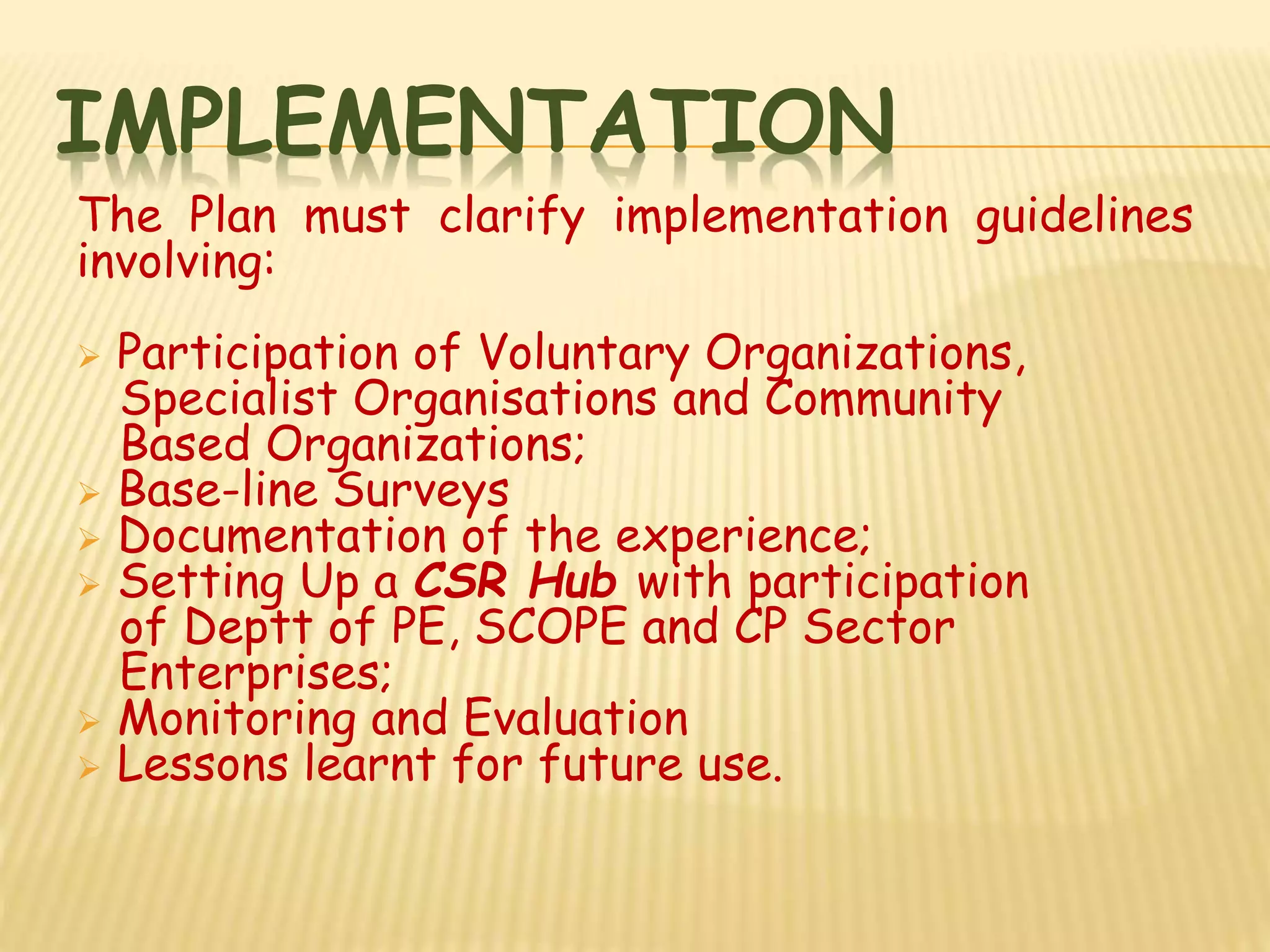
IMPLEMENTATION
The Plan must clarify implementation guidelines
involving:
 Participation of Voluntary Organizations,
Specialist Organisations and Community
Based Organizations;
 Base-line Surveys
 Documentation of the experience;
 Setting Up a CSR Hub with participation
of Deptt of PE, SCOPE and CP Sector
Enterprises;
 Monitoring and Evaluation
 Lessons learnt for future use.
THRUST AREAS
 Areas related to the business of the PSE as a natural corollary to
the business.
 Assistance to be mostly project based rather than donation, so as
to generate community goodwill, create social impact and visibility.
 Finalizing of time-frames and various milestones before
commencement of a project.
 Involving of suppliers in order to ensure that the supply- chain also
follows the CSR principles.
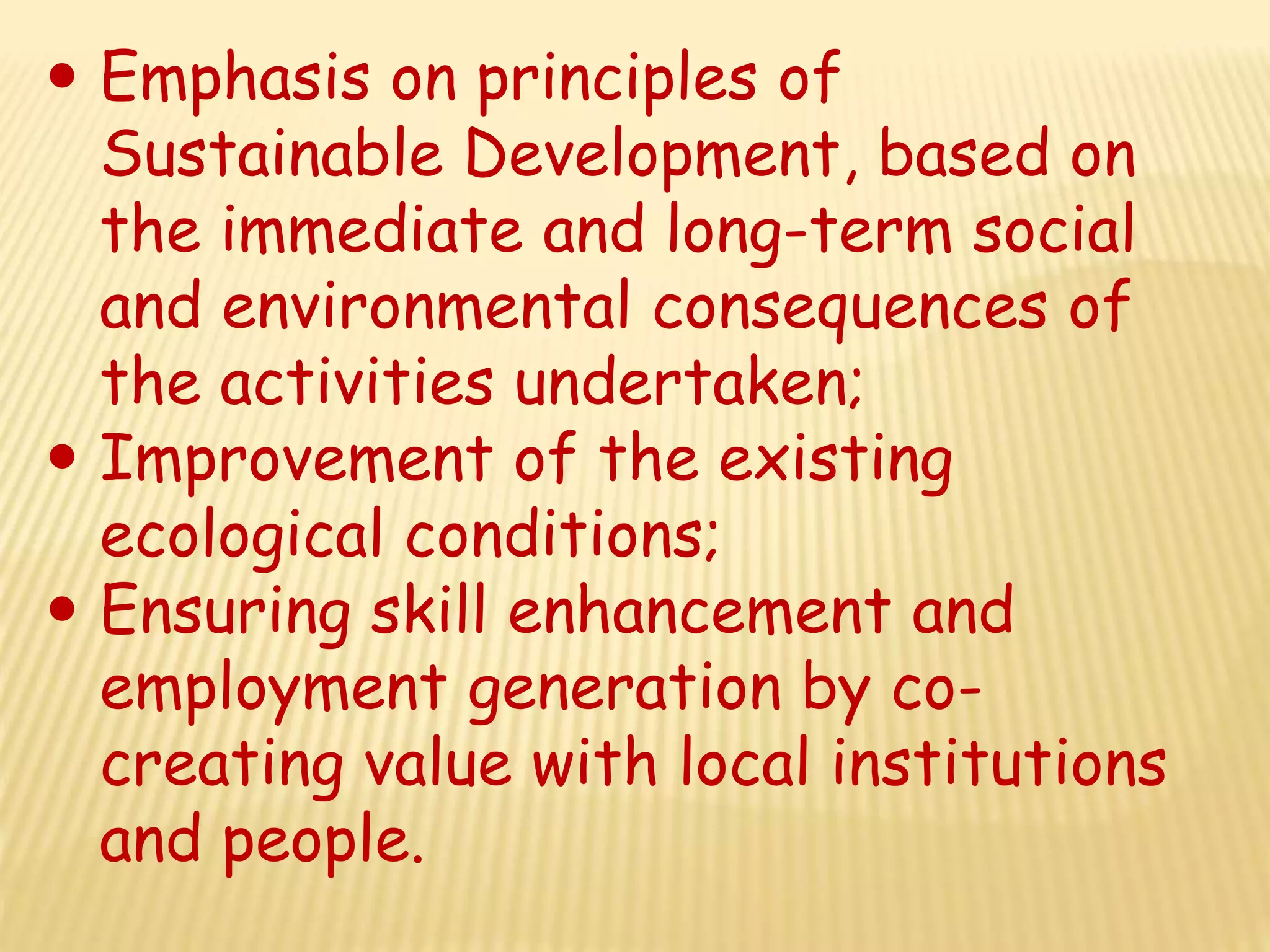
 Emphasis on principles of
Sustainable Development, based on
the immediate and long-term social
and environmental consequences of
the activities undertaken;
 Improvement of the existing
ecological conditions;
 Ensuring skill enhancement and
employment generation by co-
creating value with local institutions
and people.
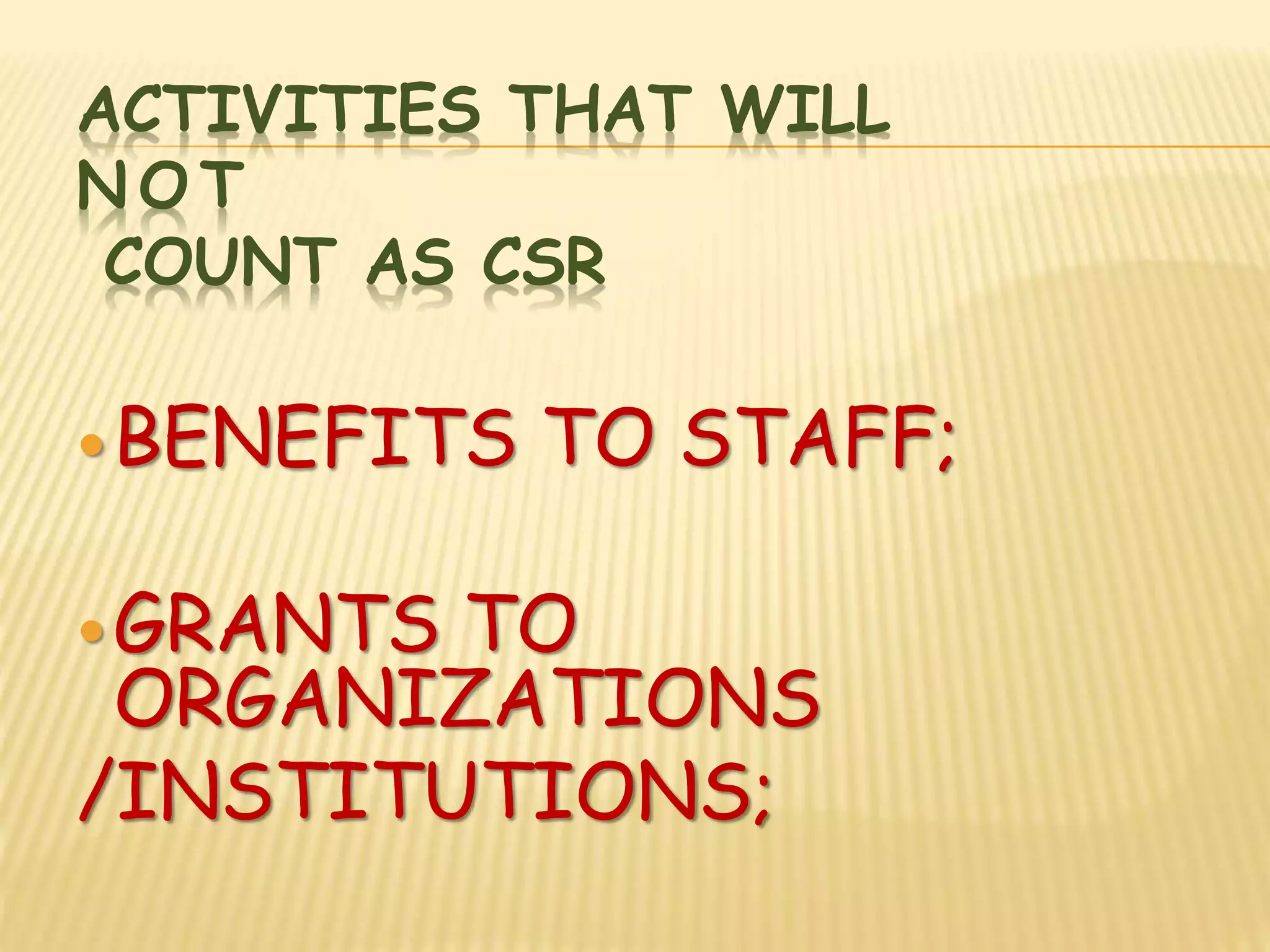
ACTIVITIES THAT WILL
N O T
COUNT AS CSR
BENEFITS TO STAFF;
GRANTS TO
ORGANIZATIONS
/INSTITUTIONS;
IMPLEMENTATION MODALITIES
 CSR Activities to be carried out by Specialist
Agencies;
 Such activities generally not to be conducted by CPSE
employees/staff;
 Specialist Agencies to include NGOs, Institutes,
Academic Organizations, Civil Society/Community-
based orgns., Trusts, Missions etc., who have requisite
expertise.
IMPLEMENTATION MODALITIES
CONTD…
 Utmost efforts to be made to find out the
reliability, and track record of the
NGOs/Orgns entrusted with CSR activities.
 Initiatives of State Governments as well as
Central Government Departments /Agencies
could be dovetailed/ synergised with CSR
activities.
 Avoidance of any duplication of CSR
activities by the CPSEs, the State
Governments and local level Programmes.
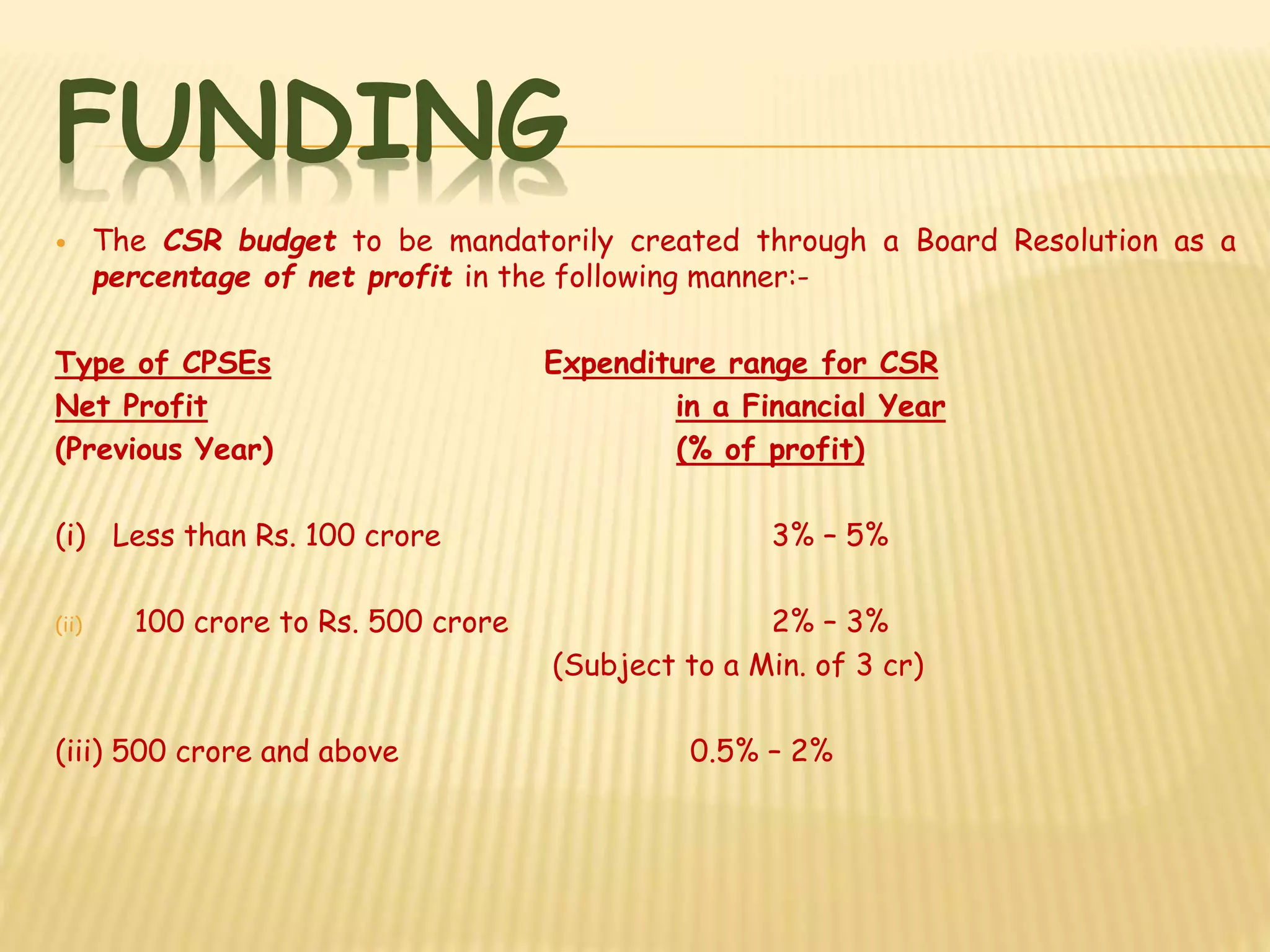
FUNDING
 The CSR budget to be mandatorily created through a Board Resolution as a
percentage of net profit in the following manner:-
Type of CPSEs Expenditure range for CSR
Net Profit in a Financial Year
(Previous Year) (% of profit)
(i) Less than Rs. 100 crore 3% – 5%
(ii) 100 crore to Rs. 500 crore 2% – 3%
(Subject to a Min. of 3 cr)
(iii) 500 crore and above 0.5% – 2%
The CSR Budget to be fixed for each
financial year. This funding not to lapse
– must be transferred to a CSR Fund,
which will accumulate – as in the case of
non-lapsable pool for North East.
In case CPSEs have different Profit
Centers like Factories / Plant locations,
they may be allocated separate CSR
budgets to be spent by them under the
Annual CSR Budget allocations.
MONITORING
 Monitoring of the CSR projects is very
crucial and needs to be a periodic activity of
the Enterprise.
 The Board of CPSEs should discuss the
implementation of CSR activities in their
Board meetings.
 The CPSE should bring a separate
paragraph/chapter in the Annual Report on
the implementation of CSR
activities/projects including the facts
relating to physical and financial progress.
The implementation of CSR guidelines
to form a part of the Memorandum of
Understanding to be signed between
CPSE and the Government;
The performance of CSR should be
monitored by the Ministry/Department
on regular basis.
In MoU Guidelines from 2010-11
onwards, 20% has been earmarked out
of the non-financial parameters for
performance under CSR.
MONITORING &
EVALUATION
 For proper monitoring of CSR activities,
companies may appoint a CSR committee or
a Social Audit Committee or a suitable,
credible agency to critically assess
fulfillment of social obligations.
 CSR projects should also be evaluated by
an independent external agency. This
evaluation should be both concurrent and
final.
BASELINE SURVEYS AND
DOCUMENTATION
 Impacts made may be quantified to the best
possible extent with reference to base line data,
which need to be created by the CPSEs before the
start of any project. Hence Base-line Surveys
mandatory.
 The documentation relating to CSR approaches,
policies, programmes, expenditures, procurement,
etc. to be put in the public domain, particularly
through the internet.
CSR HUB
The Deptt. Of Public Enterprises, in conjunction with SCOPE and the CPSEs will
create a CSR Hub which will undertake/facilitate the following activities:
 Nation-wide compilation, documentation, and
creation of database;
 Advocacy;
 Research;
 Preparation of Panels of Implementing Orgns.;
 Promotional activities, including production of
short films, printing of brochures, pamphlets etc.;
 Conferences, Seminars, Workshops – both
national and international;
 Act as a Think Tank;
 Any other matter as entrusted to it from time to
time by the DPE
The Hub will begin operations with funding provided
by Deptt. PE;
It will, however, be free to receive funds from;
 SCOPE and both Central as well as State CPSEs;
 UN Agencies, reputed international agencies such as
World Bank, EU and other multilateral bodies and
orgns.;
 Reputed National and State Bodies;
 Govt. Deptts., Autonomous Orgns., Planning
Commission, Attached and Subordinate Offices,
Corporations etc.
 Philanthropic Missions, Trusts, etc. of national and
international repute.
Decisions relating to the location and functioning of the
HUB will be taken by DPE. SCOPE will be kept informed
of such decisions and will be free to offer suggestions,
inputs etc.
Corporate Social Responsibility”

Corporate Social Responsibility”

  • 3.
    “ ROLE OFASSOCIATION FOR IMPLEMENTATION OF CORPORATE SOCIAL RESPONSIBILITY” DR (MS) MANJULA JAGATRAMKA “ACCELERATE TO EXCEL ”L” ALL INDIA HPCL SC/ST EMPLOYEES WELFARE ASSOCIATION IIND ALL INDIA CONFERENCE OF OFFICE BEARERS ON 21 & 22 JANUARY 2015 AT THE TAJ GATEWAY –VIZAG (AP) 3
  • 4.
  • 5.
    CATEGORIES OF ORGANIZATIONS Forprofits: Seek gain for their owners, i.e. financial returns to keep the company running. Governments: Exist to define rules and structures within which all organizations must operate. Non profits: Emerge to do social good when political will or the profit motive is insufficient to address society’s needs.
  • 6.
    Preliminary definitions ofCSR The impact of a company’s actions on society Requires a manager to consider his acts in terms of a whole social system, and holds him responsible for the effects of his acts anywhere in that system
  • 7.
    "the continuing commitmentby business to behave ethically and contribute to economic development while improving the quality of life of the workforce and their families as well as of the local community and society at large".
  • 8.
    Corporate Social Responsibilityis concerned with treating the stakeholders of a company or institution ethically or in a responsible manner. ‘Ethically or responsible‘, simply put, means treating key stakeholders in a manner deemed acceptable according to international norms
  • 9.
    Corporate social responsibility emphasizesobligation and accountability to society Corporate social responsiveness emphasizes action, activity Corporate social performance emphasizes outcomes, results Corporate Citizenship Concepts
  • 10.
    "People, planet andprofit" succinctly describes the triple bottom lines and the goal of sustainability. The phrase, "people, planet, profit", was coined by John Elkington in 1995
  • 11.
    KEY ISSUES INCSR  Labour rights  child labour  forced labour  right to organize  safety and health  Environmental conditions  water & air emissions  climate change  Human rights  cooperation with paramilitary forces  complicity in extra- judicial killings  Poverty Alleviation  job creation  public revenues  skills and technology
  • 12.
    SUSTAINABLE DEVELOPMENT Development thatmeets the needs of the present without compromising the ability of future generations to meet their own needs
  • 13.
    CARROLL’S FOUR PARTDEFINITION  Philanthropic Responsibilities : -Be a good corporate citizen.  Ethical Responsibilities : Be ethical  Legal Responsibilities : Obey the law  Economic Responsibilities : -Be profitable
  • 14.
    CSR IN EQUATIONFORM IS THE SUM OF….  Economic Responsibilities -(Make a profit)  Legal Responsibilities - (Obey the law)  Ethical Responsibilities - (Be ethical)  Philanthropic Responsibilities (Good corporate citizen)
  • 15.
    CSR IN THEPUBLIC SECTOR GUIDELINES, MARCH 2010 Corporate Social Responsibility is a concept whereby organisations serve the interests of society by taking responsibility for the impact of their activities on customers, employees, shareholders, communities, and the environment in all aspects of their operations
  • 16.
    ”CSR spending” According tovoluntary guidelines; Identification of projects/activities Physichal targets with time frame Implementation and monitoring
  • 17.
    CHANGE IN APPROACH Withthe rapidly changing corporate environment, more functional autonomy, operational freedom etc., CPSEs today are required to adopt CSR as a strategic tool for sustainable growth.
  • 18.
    CSR in thepresent context, means not only investment of funds for social activities but also integration of business processes with social processes.
  • 19.
    NEED FOR LINKAGEWITH COMMUNITY An Enterprise needs to address the concerns of the society in which the enterprise is operating. There should be free interaction between enterprises and community leaders. In order to address the social needs of the community, viable projects need to be identified to meet its requirements.
  • 20.
    OVERARCHING CONCEPT CPSEs mayapproach Corporate Social Responsibility as a professional management process with a long-term strategy integrating it with corporate strategies. CSR activities may be planned in parallel to the business plan, looking at every possible opportunity to link and integrate business plans with the social and environmental concerns available.
  • 21.
    PLANNING THE CSR INITIATIVE Along-term Corporate Social Responsibility Plan needs to be prepared matching with the long-term business plan; This may be broken down into short-term and medium term plans, specifying activities to be undertaken, budgets allocated, responsibilities and authorities defined, and measurable results expected.
  • 22.
    IMPLEMENTATION The Plan mustclarify implementation guidelines involving:  Participation of Voluntary Organizations, Specialist Organisations and Community Based Organizations;  Base-line Surveys  Documentation of the experience;  Setting Up a CSR Hub with participation of Deptt of PE, SCOPE and CP Sector Enterprises;  Monitoring and Evaluation  Lessons learnt for future use.
  • 23.
    THRUST AREAS  Areasrelated to the business of the PSE as a natural corollary to the business.  Assistance to be mostly project based rather than donation, so as to generate community goodwill, create social impact and visibility.  Finalizing of time-frames and various milestones before commencement of a project.  Involving of suppliers in order to ensure that the supply- chain also follows the CSR principles.
  • 24.
     Emphasis onprinciples of Sustainable Development, based on the immediate and long-term social and environmental consequences of the activities undertaken;  Improvement of the existing ecological conditions;  Ensuring skill enhancement and employment generation by co- creating value with local institutions and people.
  • 25.
    ACTIVITIES THAT WILL NO T COUNT AS CSR BENEFITS TO STAFF; GRANTS TO ORGANIZATIONS /INSTITUTIONS;
  • 26.
    IMPLEMENTATION MODALITIES  CSRActivities to be carried out by Specialist Agencies;  Such activities generally not to be conducted by CPSE employees/staff;  Specialist Agencies to include NGOs, Institutes, Academic Organizations, Civil Society/Community- based orgns., Trusts, Missions etc., who have requisite expertise.
  • 27.
    IMPLEMENTATION MODALITIES CONTD…  Utmostefforts to be made to find out the reliability, and track record of the NGOs/Orgns entrusted with CSR activities.  Initiatives of State Governments as well as Central Government Departments /Agencies could be dovetailed/ synergised with CSR activities.  Avoidance of any duplication of CSR activities by the CPSEs, the State Governments and local level Programmes.
  • 28.
    FUNDING  The CSRbudget to be mandatorily created through a Board Resolution as a percentage of net profit in the following manner:- Type of CPSEs Expenditure range for CSR Net Profit in a Financial Year (Previous Year) (% of profit) (i) Less than Rs. 100 crore 3% – 5% (ii) 100 crore to Rs. 500 crore 2% – 3% (Subject to a Min. of 3 cr) (iii) 500 crore and above 0.5% – 2%
  • 29.
    The CSR Budgetto be fixed for each financial year. This funding not to lapse – must be transferred to a CSR Fund, which will accumulate – as in the case of non-lapsable pool for North East. In case CPSEs have different Profit Centers like Factories / Plant locations, they may be allocated separate CSR budgets to be spent by them under the Annual CSR Budget allocations.
  • 30.
    MONITORING  Monitoring ofthe CSR projects is very crucial and needs to be a periodic activity of the Enterprise.  The Board of CPSEs should discuss the implementation of CSR activities in their Board meetings.  The CPSE should bring a separate paragraph/chapter in the Annual Report on the implementation of CSR activities/projects including the facts relating to physical and financial progress.
  • 31.
    The implementation ofCSR guidelines to form a part of the Memorandum of Understanding to be signed between CPSE and the Government; The performance of CSR should be monitored by the Ministry/Department on regular basis. In MoU Guidelines from 2010-11 onwards, 20% has been earmarked out of the non-financial parameters for performance under CSR.
  • 32.
    MONITORING & EVALUATION  Forproper monitoring of CSR activities, companies may appoint a CSR committee or a Social Audit Committee or a suitable, credible agency to critically assess fulfillment of social obligations.  CSR projects should also be evaluated by an independent external agency. This evaluation should be both concurrent and final.
  • 33.
    BASELINE SURVEYS AND DOCUMENTATION Impacts made may be quantified to the best possible extent with reference to base line data, which need to be created by the CPSEs before the start of any project. Hence Base-line Surveys mandatory.  The documentation relating to CSR approaches, policies, programmes, expenditures, procurement, etc. to be put in the public domain, particularly through the internet.
  • 34.
    CSR HUB The Deptt.Of Public Enterprises, in conjunction with SCOPE and the CPSEs will create a CSR Hub which will undertake/facilitate the following activities:  Nation-wide compilation, documentation, and creation of database;  Advocacy;  Research;  Preparation of Panels of Implementing Orgns.;  Promotional activities, including production of short films, printing of brochures, pamphlets etc.;  Conferences, Seminars, Workshops – both national and international;  Act as a Think Tank;  Any other matter as entrusted to it from time to time by the DPE
  • 35.
    The Hub willbegin operations with funding provided by Deptt. PE; It will, however, be free to receive funds from;  SCOPE and both Central as well as State CPSEs;  UN Agencies, reputed international agencies such as World Bank, EU and other multilateral bodies and orgns.;  Reputed National and State Bodies;  Govt. Deptts., Autonomous Orgns., Planning Commission, Attached and Subordinate Offices, Corporations etc.  Philanthropic Missions, Trusts, etc. of national and international repute. Decisions relating to the location and functioning of the HUB will be taken by DPE. SCOPE will be kept informed of such decisions and will be free to offer suggestions, inputs etc.