
Corporate Restructuring
Takeover, Buy Back &
Delisting
Presented by – Manoj Kumar
Introduction
Takeovers, Buy Back & Delisting are key tools of Corporate Restructuring and Planning which
are facilitated by Company Law and in case of Listed Company also governed by SEBI Laws
What is Takeover?
Acquisition of Substantial Shares and Control over a Target Company to expand
the business in an inorganic manner.
Ensure Fair Exit Opportunity to the
public shareholders;
Provide Fair Play in exit opportunity
of the Company;
Timely Information Dissemination
about change in shareholding of
Listed companies
Purpose of Takeover Code?
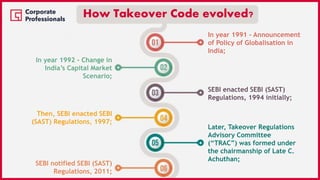
In year 1991 - Announcement
of Policy of Globalisation in
India;
In year 1992 - Change in
India’s Capital Market
Scenario;
SEBI enacted SEBI (SAST)
Regulations, 1994 initially;
Then, SEBI enacted SEBI
(SAST) Regulations, 1997;
Later, Takeover Regulations
Advisory Committee
(“TRAC”) was formed under
the chairmanship of Late C.
Achuthan;
SEBI notified SEBI (SAST)
Regulations, 2011;
How Takeover Code evolved?
SEBI (Substantial Acquisition of Shares
and Takeovers) Regulations, 2011
The term Company is defined under the provisions of Companies Act, 2013;
Company means a company incorporated under this Act or under any other company law;
Listed Company means a company of which any of its securities listed on any recognized stock exchange;
Takeover Code only deals with Companies of which Equity/Voting Shares are listed
Listed Company?
Means any person who directly or indirectly acquires or agrees to acquire
whether by himself or through with Person Acting in Concert shares or voting
rights or control over the Target Company.
Acquirer?
Persons who for a common objective acquire shares or voting rights or
control over Target Company, pursuant to an agreement or understanding,
formal or informal, directly or indirectly co-operate for acquisition of shares
or voting rights or control over the Target Company.
Person acting in Concert?
Acquiring or agreeing to acquire
Shares or Voting Rights in or Control
Over the Target Company
Directly or Indirectly
Acquisition?
Shares means shares in the equity share capital of a target company carrying voting rights, and includes
any security which entitles the holder thereof to exercise voting rights;
Explanation  For the purpose of this clause shares will include all depository receipts carrying
entitlement to exercise voting rights in all the Target Company.
Define Shares?
Control?
It is very Subjective, inclusively defined
Right to appoint majority of the directors; or
Right to control the management; or
Right to policy decisions exercisable;
May be Direct or Indirect
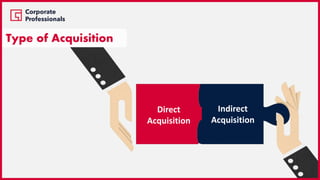
Direct
Acquisition
Indirect
Acquisition
Type of Acquisition
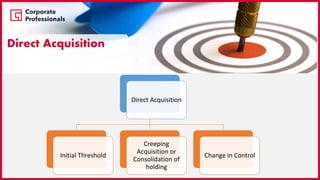
Direct Acquisition
Initial Threshold
Creeping
Acquisition or
Consolidation of
holding
Change in Control
Direct Acquisition
Initial Threshold – 25% of the voting rights in Target Company
Creeping Acquisition or Consolidation of holdings – [if already holds 25% or more but less than 75%] in
excess of 5% of voting rights in any financial year
Acquisition of Control – irrespective of any shares or voting
Direct Acquisition
Acquisition of voting rights or control over other entity that enable the Acquirer to exercise such
percentage of voting or control over the Target Company.
Indirect Acquisition
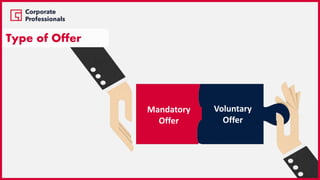
Mandatory
Offer
Voluntary
Offer
Type of Offer
Mandatory Offer – Offer Size shall be 26% of the capital of Target Company
Voluntary Offer – Offer Size shall be 10% of the capital of Target Company
Size of Takeover Open Offer
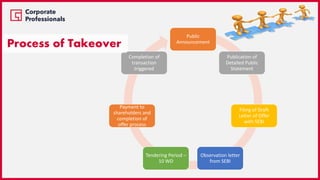
Public
Announcement
Publication of
Detailed Public
Statement
Filing of Draft
Letter of Offer
with SEBI
Observation letter
from SEBI
Tendering Period –
10 WD
Payment to
shareholders and
completion of
offer process
Completion of
transaction
triggered
Process of Takeover
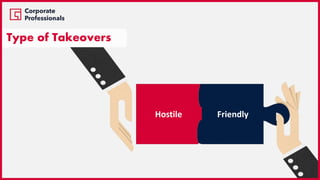
Hostile Friendly
Type of Takeovers
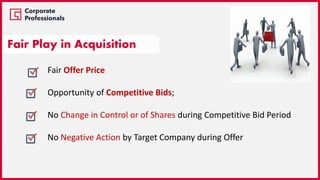
Fair Play in Acquisition
Fair Offer Price
Opportunity of Competitive Bids;
No Change in Control or of Shares during Competitive Bid Period
No Negative Action by Target Company during Offer
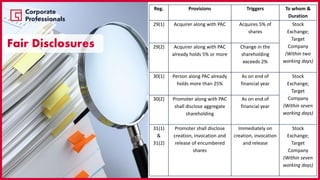
Reg. Provisions Triggers To whom &
Duration
29(1) Acquirer along with PAC Acquires 5% of
shares
Stock
Exchange;
Target
Company
(Within two
working days)
29(2) Acquirer along with PAC
already holds 5% or more
Change in the
shareholding
exceeds 2%
30(1) Person along PAC already
holds more than 25%
As on end of
financial year
Stock
Exchange;
Target
Company
(Within seven
working days)
30(2) Promoter along with PAC
shall disclose aggregate
shareholding
As on end of
financial year
31(1)
&
31(2)
Promoter shall disclose
creation, invocation and
release of encumbered
shares
Immediately on
creation, invocation
and release
Stock
Exchange;
Target
Company
(Within seven
working days)
Fair Disclosures
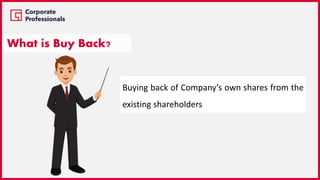
Buying back of Company’s own shares from the
existing shareholders
What is Buy Back?
Companies Act, 2013
&
SEBI (Buy Back of Securities)
Regulations, 1998
Governing Provisions
Rationalize the capital structure by writing off capital not
represented by available assets.
To encourage faith in the minds of shareholders at the
time of slump in the market price
To pay surplus cash not required by business
Why to Buy Back
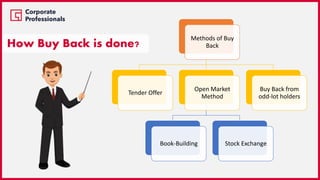
Methods of Buy
Back
Tender Offer
Open Market
Method
Book-Building Stock Exchange
Buy Back from
odd-lot holders
How Buy Back is done?
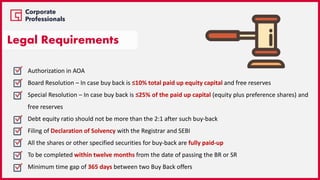
Authorization in AOA
Board Resolution – In case buy back is ≤10% total paid up equity capital and free reserves
Special Resolution – In case buy back is ≤25% of the paid up capital (equity plus preference shares) and
free reserves
Debt equity ratio should not be more than the 2:1 after such buy-back
Filing of Declaration of Solvency with the Registrar and SEBI
All the shares or other specified securities for buy-back are fully paid-up
To be completed within twelve months from the date of passing the BR or SR
Minimum time gap of 365 days between two Buy Back offers
Legal Requirements
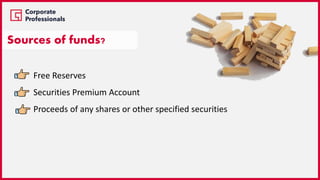
Free Reserves
Securities Premium Account
Proceeds of any shares or other specified securities
Sources of funds?
Buy-back shall not be done for delisting of securities
Buy-back shall not be done from any person through negotiated deals, spot transactions and private
arrangements
No issuance and allotment of any Equity Shares shall be done
In Market Purchase -Promoters & Controlling persons cannot participate
Promoters shall not deal in shares or other specifies securities during the Offer period
The consideration shall be paid only by way of cash
Restrictions?
Company shall not withdraw the offer of buy back after the public announcement is made
The company shall not buy back the locked in shares or other specified securities and non-transferable
shares or other specified securities
No fresh issue of Equity Shares or other specified securities from the date of closure of Buy Back upto
six months [except by way of bonus issue or in the discharge of subsisting obligations such as
conversions of warrants, stock options schemes, sweat equity or conversion of preference shares or
debentures into equity shares]
Restrictions?
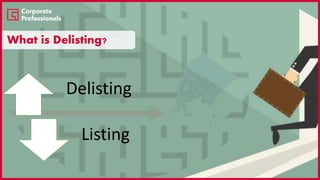
Delisting
Listing
What is Delisting?
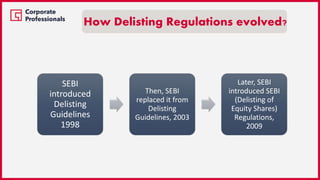
How Delisting Regulations evolved?
SEBI
introduced
Delisting
Guidelines
1998
Then, SEBI
replaced it from
Delisting
Guidelines, 2003
Later, SEBI
introduced SEBI
(Delisting of
Equity Shares)
Regulations,
2009
SEBI (Delisting of Equity Shares)
Regulations, 2009
Methods of Delisting?
Compulsory
Delisting Voluntary
Delisting
Compulsory Delisting?
Due to the non-compliance of various
regulations, stock exchange may ask for
compulsory delisting for the shares of
certain companies, whose listing can be
risky for the investors.
Voluntary Delisting?
True Value not getting reflected in Market
No liquidity or very few shareholders
Promoters’ Strategic planning
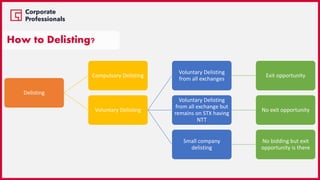
Delisting
Compulsory Delisting
Voluntary Delisting
Voluntary Delisting
from all exchanges
Exit opportunity
Voluntary Delisting
from all exchange but
remains on STX having
NTT
No exit opportunity
Small company
delisting
No bidding but exit
opportunity is there
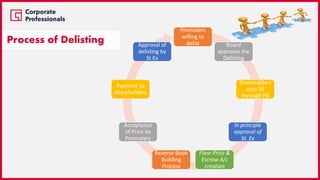
How to Delisting?
Promoters
willing to
delist Board
approves the
Delisting
Shareholders
pass SR
through PB
In principle
approval of
St. Ex
Floor Price &
Escrow A/c
creation
Reverse Book
Building
Process
Acceptance
of Price by
Promoters
Payment to
shareholders
Approval of
delisting by
St Ex
Process of Delisting
Manoj Kumar
Partner and Head - M&A and Transactions
D-28, South Extn. Part- I,
New Delhi – 110049
M: +91 9910688433
T: +91 11 40622228 (D)
manoj@indiacp.com
www.corporateprofessionals.com

Corporate Restructuring Takeover, Buy Back & Delisting

  • 1.
    Corporate Restructuring Takeover, BuyBack & Delisting Presented by – Manoj Kumar
  • 2.
    Introduction Takeovers, Buy Back& Delisting are key tools of Corporate Restructuring and Planning which are facilitated by Company Law and in case of Listed Company also governed by SEBI Laws
  • 3.
    What is Takeover? Acquisitionof Substantial Shares and Control over a Target Company to expand the business in an inorganic manner.
  • 4.
    Ensure Fair ExitOpportunity to the public shareholders; Provide Fair Play in exit opportunity of the Company; Timely Information Dissemination about change in shareholding of Listed companies Purpose of Takeover Code?
  • 5.
    In year 1991- Announcement of Policy of Globalisation in India; In year 1992 - Change in India’s Capital Market Scenario; SEBI enacted SEBI (SAST) Regulations, 1994 initially; Then, SEBI enacted SEBI (SAST) Regulations, 1997; Later, Takeover Regulations Advisory Committee (“TRAC”) was formed under the chairmanship of Late C. Achuthan; SEBI notified SEBI (SAST) Regulations, 2011; How Takeover Code evolved?
  • 6.
    SEBI (Substantial Acquisitionof Shares and Takeovers) Regulations, 2011
  • 7.
    The term Companyis defined under the provisions of Companies Act, 2013; Company means a company incorporated under this Act or under any other company law; Listed Company means a company of which any of its securities listed on any recognized stock exchange; Takeover Code only deals with Companies of which Equity/Voting Shares are listed Listed Company?
  • 8.
    Means any personwho directly or indirectly acquires or agrees to acquire whether by himself or through with Person Acting in Concert shares or voting rights or control over the Target Company. Acquirer?
  • 9.
    Persons who fora common objective acquire shares or voting rights or control over Target Company, pursuant to an agreement or understanding, formal or informal, directly or indirectly co-operate for acquisition of shares or voting rights or control over the Target Company. Person acting in Concert?
  • 10.
    Acquiring or agreeingto acquire Shares or Voting Rights in or Control Over the Target Company Directly or Indirectly Acquisition?
  • 11.
    Shares means sharesin the equity share capital of a target company carrying voting rights, and includes any security which entitles the holder thereof to exercise voting rights; Explanation  For the purpose of this clause shares will include all depository receipts carrying entitlement to exercise voting rights in all the Target Company. Define Shares?
  • 12.
    Control? It is verySubjective, inclusively defined Right to appoint majority of the directors; or Right to control the management; or Right to policy decisions exercisable; May be Direct or Indirect
  • 14.
  • 15.
    Direct Acquisition Initial Threshold Creeping Acquisitionor Consolidation of holding Change in Control Direct Acquisition
  • 16.
    Initial Threshold –25% of the voting rights in Target Company Creeping Acquisition or Consolidation of holdings – [if already holds 25% or more but less than 75%] in excess of 5% of voting rights in any financial year Acquisition of Control – irrespective of any shares or voting Direct Acquisition
  • 17.
    Acquisition of votingrights or control over other entity that enable the Acquirer to exercise such percentage of voting or control over the Target Company. Indirect Acquisition
  • 18.
  • 19.
    Mandatory Offer –Offer Size shall be 26% of the capital of Target Company Voluntary Offer – Offer Size shall be 10% of the capital of Target Company Size of Takeover Open Offer
  • 20.
    Public Announcement Publication of Detailed Public Statement Filingof Draft Letter of Offer with SEBI Observation letter from SEBI Tendering Period – 10 WD Payment to shareholders and completion of offer process Completion of transaction triggered Process of Takeover
  • 21.
  • 22.
    Fair Play inAcquisition Fair Offer Price Opportunity of Competitive Bids; No Change in Control or of Shares during Competitive Bid Period No Negative Action by Target Company during Offer
  • 23.
    Reg. Provisions TriggersTo whom & Duration 29(1) Acquirer along with PAC Acquires 5% of shares Stock Exchange; Target Company (Within two working days) 29(2) Acquirer along with PAC already holds 5% or more Change in the shareholding exceeds 2% 30(1) Person along PAC already holds more than 25% As on end of financial year Stock Exchange; Target Company (Within seven working days) 30(2) Promoter along with PAC shall disclose aggregate shareholding As on end of financial year 31(1) & 31(2) Promoter shall disclose creation, invocation and release of encumbered shares Immediately on creation, invocation and release Stock Exchange; Target Company (Within seven working days) Fair Disclosures
  • 25.
    Buying back ofCompany’s own shares from the existing shareholders What is Buy Back?
  • 26.
    Companies Act, 2013 & SEBI(Buy Back of Securities) Regulations, 1998 Governing Provisions
  • 27.
    Rationalize the capitalstructure by writing off capital not represented by available assets. To encourage faith in the minds of shareholders at the time of slump in the market price To pay surplus cash not required by business Why to Buy Back
  • 28.
    Methods of Buy Back TenderOffer Open Market Method Book-Building Stock Exchange Buy Back from odd-lot holders How Buy Back is done?
  • 29.
    Authorization in AOA BoardResolution – In case buy back is ≤10% total paid up equity capital and free reserves Special Resolution – In case buy back is ≤25% of the paid up capital (equity plus preference shares) and free reserves Debt equity ratio should not be more than the 2:1 after such buy-back Filing of Declaration of Solvency with the Registrar and SEBI All the shares or other specified securities for buy-back are fully paid-up To be completed within twelve months from the date of passing the BR or SR Minimum time gap of 365 days between two Buy Back offers Legal Requirements
  • 30.
    Free Reserves Securities PremiumAccount Proceeds of any shares or other specified securities Sources of funds?
  • 31.
    Buy-back shall notbe done for delisting of securities Buy-back shall not be done from any person through negotiated deals, spot transactions and private arrangements No issuance and allotment of any Equity Shares shall be done In Market Purchase -Promoters & Controlling persons cannot participate Promoters shall not deal in shares or other specifies securities during the Offer period The consideration shall be paid only by way of cash Restrictions?
  • 32.
    Company shall notwithdraw the offer of buy back after the public announcement is made The company shall not buy back the locked in shares or other specified securities and non-transferable shares or other specified securities No fresh issue of Equity Shares or other specified securities from the date of closure of Buy Back upto six months [except by way of bonus issue or in the discharge of subsisting obligations such as conversions of warrants, stock options schemes, sweat equity or conversion of preference shares or debentures into equity shares] Restrictions?
  • 33.
  • 34.
    How Delisting Regulationsevolved? SEBI introduced Delisting Guidelines 1998 Then, SEBI replaced it from Delisting Guidelines, 2003 Later, SEBI introduced SEBI (Delisting of Equity Shares) Regulations, 2009
  • 35.
    SEBI (Delisting ofEquity Shares) Regulations, 2009
  • 36.
  • 37.
    Compulsory Delisting? Due tothe non-compliance of various regulations, stock exchange may ask for compulsory delisting for the shares of certain companies, whose listing can be risky for the investors.
  • 38.
    Voluntary Delisting? True Valuenot getting reflected in Market No liquidity or very few shareholders Promoters’ Strategic planning
  • 39.
    Delisting Compulsory Delisting Voluntary Delisting VoluntaryDelisting from all exchanges Exit opportunity Voluntary Delisting from all exchange but remains on STX having NTT No exit opportunity Small company delisting No bidding but exit opportunity is there How to Delisting?
  • 40.
    Promoters willing to delist Board approvesthe Delisting Shareholders pass SR through PB In principle approval of St. Ex Floor Price & Escrow A/c creation Reverse Book Building Process Acceptance of Price by Promoters Payment to shareholders Approval of delisting by St Ex Process of Delisting
  • 41.
    Manoj Kumar Partner andHead - M&A and Transactions D-28, South Extn. Part- I, New Delhi – 110049 M: +91 9910688433 T: +91 11 40622228 (D) manoj@indiacp.com www.corporateprofessionals.com

Editor's Notes

  • #10 K.K. Modi Vs MK Modi – even within promoters there may be different intentions
  • #13 Recent case in DLF vs. SEBI – significant influence in decision making – 20% equity is mere a rebuttable presumption Shubhkam Ventures – SAT said negative control is not a Control; SC did not conclude as facts got changed
  • #24 Hefty Penalty for delayed or Non-disclosure – Promoters of Presha Metallurgical– Rs. 3cr. – 29(2) Safal Herbals – Rs. 3 cr for 29(2) and Rs. 1 cr for 30(2)