CORPORATE MENTAL HEALTH Presented by  K.C.Lazar and Chaitali Shetty At IBM Chennai, on 22 nd  January 2008
NORMAL HUMAN DEVELOPMENT   Development task  A task which arises at or about a certain period in the life of the individual, successful achievement of which leads to happiness and to success with later tasks, while failure leads to unhappiness and difficulty with later tasks. - age appropriate behaviour  - social expectation  - as a result of physical maturation - cultural pressures - grow out of personal values and aspiration
NORMAL HUMAN DEVELOPMENT Early childhood (before the age of 2)  - learning to take solid food / walk / talk / (development milestones) Late childhood (by 12 years)  - learning to get along with age-mates - developing fundamental skills in reading / writing / and calculating Adolescence - (by 18)   - achieving new and more mature relations with age-mates of both sexes - emotional independence from parents and other adults - preparing for an economic career
NORMAL HUMAN DEVELOPMENT Early adulthood (25 - 40) - complete basic schooling and college  - decide and start a career - settle in a job  - start a family - rearing children - managing home Middle age (40 - 60)  - career development - assisting teenage children to become responsible and happy adults - maturing to marital relationship - adjusting to aging parents - taking up civic and social responsibilities
MENTAL HEALTH ...  a state of wellbeing in which the individual realizes his/her abilities, can cope with the normal stresses of life, can work productively and fruitfully and is able to make contribution to his/her community (WHO 2001) - It is the foundation for wellbeing and effective functioning of an individual and community. - Mental, physical and social functioning are interdependent
ATTRIBUTES OF A MENTALLY HEALTHY PERSON - free from internal conflicts / not at war with himself - well adjusted / gets along well with others - searches for identity (who am I) - has strong sense of self esteem - knows himself, his needs, problems and goals (self actualization) - good self-control / balances rationality and emotionality - faces problems and tries to solve them intelligently
ATTRIBUTES OF POOR MENTAL HEALTH   - constantly worrying - unable to concentrate - always unhappy without justified cause - loose temper easily - disturbed sleep - wide mood fluctuation - continually dislikes being with other people - easily upset if routine is disturbed - children getting on your nerves / low frustration tolerance - constantly bitter - afraid without real cause - others always wrong - vague aches and pains
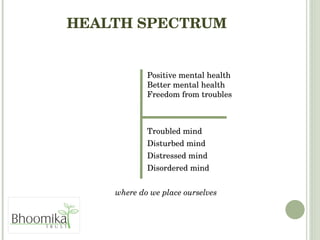
HEALTH SPECTRUM Positive mental health    Better mental health  Freedom from troubles Troubled mind Disturbed mind Distressed mind Disordered mind where do we place ourselves
HOW IS MY MENTAL HEALTH ? have i achieved my developmental tasks? am i progressing?  have i realized my own abilities? can i cope with the normal stresses of my life? am i working productively and fruitfully? am i contributing to my organization?  am i contributing to my community?
MENTAL ILLNESS a change in an individual’s behaviour mood, thinking and speech, which is distressful to self, others or both. It includes neurosis, psychosis, alcoholism, and drug abuse Major mental illness Minor mental illness Schizophrenia Neurosis Manic Depressive Illness   Personality / Behavioural  disorders Paranoia
MENTAL ILLNESS is the person’s role functioning affected? duration of problem does the person have insight? Multifactorial causes - unlike mosquito & malaria Has roots in biological, psychological and sociological factors Exact cause not known
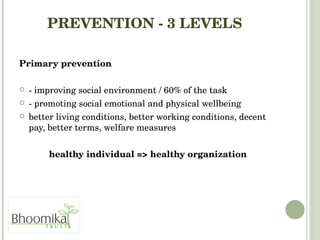
PREVENTION - 3 LEVELS  Primary prevention  - improving social environment / 60% of the task - promoting social emotional and physical wellbeing better living conditions, better working conditions, decent pay, better terms, welfare measures healthy individual => healthy organization
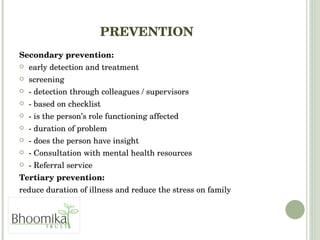
PREVENTION Secondary prevention: early detection and treatment screening  - detection through colleagues / supervisors  - based on checklist  - is the person’s role functioning affected - duration of problem - does the person have insight - Consultation with mental health resources  - Referral service  Tertiary prevention:   reduce duration of illness and reduce the stress on family
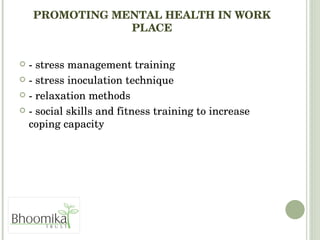
PROMOTING MENTAL HEALTH IN WORK PLACE - stress management training - stress inoculation technique - relaxation methods - social skills and fitness training to increase coping capacity
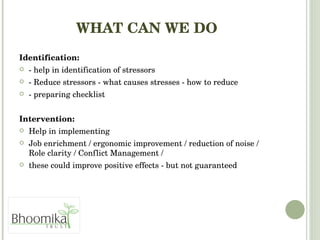
WHAT CAN WE DO Identification:   - help in identification of stressors  - Reduce stressors - what causes stresses - how to reduce - preparing checklist  Intervention:  Help in implementing  Job enrichment / ergonomic improvement / reduction of noise / Role clarity / Conflict Management /  these could improve positive effects - but not guaranteed

Corporate Mental Health

  • 1.
    CORPORATE MENTAL HEALTHPresented by K.C.Lazar and Chaitali Shetty At IBM Chennai, on 22 nd January 2008
  • 2.
    NORMAL HUMAN DEVELOPMENT Development task A task which arises at or about a certain period in the life of the individual, successful achievement of which leads to happiness and to success with later tasks, while failure leads to unhappiness and difficulty with later tasks. - age appropriate behaviour - social expectation - as a result of physical maturation - cultural pressures - grow out of personal values and aspiration
  • 3.
    NORMAL HUMAN DEVELOPMENTEarly childhood (before the age of 2) - learning to take solid food / walk / talk / (development milestones) Late childhood (by 12 years) - learning to get along with age-mates - developing fundamental skills in reading / writing / and calculating Adolescence - (by 18) - achieving new and more mature relations with age-mates of both sexes - emotional independence from parents and other adults - preparing for an economic career
  • 4.
    NORMAL HUMAN DEVELOPMENTEarly adulthood (25 - 40) - complete basic schooling and college - decide and start a career - settle in a job - start a family - rearing children - managing home Middle age (40 - 60) - career development - assisting teenage children to become responsible and happy adults - maturing to marital relationship - adjusting to aging parents - taking up civic and social responsibilities
  • 5.
    MENTAL HEALTH ... a state of wellbeing in which the individual realizes his/her abilities, can cope with the normal stresses of life, can work productively and fruitfully and is able to make contribution to his/her community (WHO 2001) - It is the foundation for wellbeing and effective functioning of an individual and community. - Mental, physical and social functioning are interdependent
  • 6.
    ATTRIBUTES OF AMENTALLY HEALTHY PERSON - free from internal conflicts / not at war with himself - well adjusted / gets along well with others - searches for identity (who am I) - has strong sense of self esteem - knows himself, his needs, problems and goals (self actualization) - good self-control / balances rationality and emotionality - faces problems and tries to solve them intelligently
  • 7.
    ATTRIBUTES OF POORMENTAL HEALTH - constantly worrying - unable to concentrate - always unhappy without justified cause - loose temper easily - disturbed sleep - wide mood fluctuation - continually dislikes being with other people - easily upset if routine is disturbed - children getting on your nerves / low frustration tolerance - constantly bitter - afraid without real cause - others always wrong - vague aches and pains
  • 8.
    HEALTH SPECTRUM Positivemental health Better mental health Freedom from troubles Troubled mind Disturbed mind Distressed mind Disordered mind where do we place ourselves
  • 9.
    HOW IS MYMENTAL HEALTH ? have i achieved my developmental tasks? am i progressing? have i realized my own abilities? can i cope with the normal stresses of my life? am i working productively and fruitfully? am i contributing to my organization? am i contributing to my community?
  • 10.
    MENTAL ILLNESS achange in an individual’s behaviour mood, thinking and speech, which is distressful to self, others or both. It includes neurosis, psychosis, alcoholism, and drug abuse Major mental illness Minor mental illness Schizophrenia Neurosis Manic Depressive Illness Personality / Behavioural disorders Paranoia
  • 11.
    MENTAL ILLNESS isthe person’s role functioning affected? duration of problem does the person have insight? Multifactorial causes - unlike mosquito & malaria Has roots in biological, psychological and sociological factors Exact cause not known
  • 12.
    PREVENTION - 3LEVELS Primary prevention - improving social environment / 60% of the task - promoting social emotional and physical wellbeing better living conditions, better working conditions, decent pay, better terms, welfare measures healthy individual => healthy organization
  • 13.
    PREVENTION Secondary prevention:early detection and treatment screening - detection through colleagues / supervisors - based on checklist - is the person’s role functioning affected - duration of problem - does the person have insight - Consultation with mental health resources - Referral service Tertiary prevention: reduce duration of illness and reduce the stress on family
  • 14.
    PROMOTING MENTAL HEALTHIN WORK PLACE - stress management training - stress inoculation technique - relaxation methods - social skills and fitness training to increase coping capacity
  • 15.
    WHAT CAN WEDO Identification: - help in identification of stressors - Reduce stressors - what causes stresses - how to reduce - preparing checklist Intervention: Help in implementing Job enrichment / ergonomic improvement / reduction of noise / Role clarity / Conflict Management / these could improve positive effects - but not guaranteed