
Corporate Governance
Harshad Mehta Gafla
Presented by-
Vidhisha Masrani Janak Sampat Malav Shah UrviVora
Kalpesh Rathod Gargi Shah YashVakharia
An Important note
Harshad Mehta Gafla Was Purely A
Banking Scam And Not A Stock Market
Scam
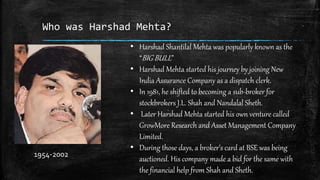
Who was Harshad Mehta?
• Harshad Shantilal Mehta was popularly known as the
“BIG BULL”
• Harshad Mehta started his journey by joining New
India Assurance Company as a dispatch clerk.
• In 1981, he shifted to becoming a sub-broker for
stockbrokers J.L. Shah and Nandalal Sheth.
• Later Harshad Mehta started his own venture called
GrowMore Research and Asset Management Company
Limited.
• During those days, a broker’s card at BSE was being
auctioned. His company made a bid for the same with
the financial help from Shah and Sheth.
1954-2002
Ready Forward Deal
▪ The RF is in essence a secured short-term (typically 15-day) loan from one bank
to another. Crudely put, the bank lends against government securities just as a
pawnbroker lends against jewellery….The borrowing bank actually sells the
securities to the lending bank and buys them back at the end of the period of
the loan, typically at a slightly higher price.
It was this ready forward deal that Harshad Mehta and his cronies used with
great success to channel money from the banking system.
▪ A typical ready forward deal involved two banks brought together by a broker
in lieu of a commission. The broker handles neither the cash nor the securities,
though that wasn’t the case in the lead-up to the scam.
Bank Receipts
▪ In an RF deal, as we have discussed it so far, the borrowing bank delivers the actual securities to
the lender and takes them back on repayment of the loan. In practice, however, this is not usually
done. Instead, the borrower gives a Bank Receipt (BR) which serves three functions:
▪ The BR confirms the sale of securities.
▪ It acts as a receipt for the money received by the selling bank. Hence the name – bank receipt.
▪ It promises to deliver the securities to the buyer. It also states that in the meantime the
▪ Seller holds the securities in trust for the buyer. In short, a BR is something like an IOU (I owe you
securities!), and the use of the BR de facto converts an RF deal into an unsecured loan. The
lending bank no longer has the securities; it has only the borrower's assurance that the borrower
has the securities which can/will be delivered if/when the need arises.
Harshad Mehta Gafla- Overview
▪ Harshad Mehta was dealing with many banks at the same time he could then keep some
capital with him at all times. The banks at that time were not allowed to invest in the equity
markets. Harshad Mehta very wisely welcomed this opportunity. He very cleverly squeezed
some capital out of the banking system. This capital he invested in the stock market and
managed to stoke a massive boom.His favorite scrips include ACC, Apollo Tyres, BPL,
Videocon. He took the price of ACC from 200 to 9,000. Since he had to book profits in the
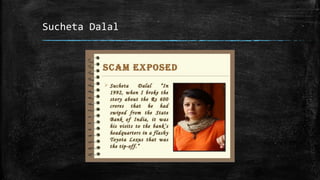
end, the day he sold was the day when the market crashed. On April 23, 1992, journalist
Sucheta Dalal in a column in The Times of India, exposed the scam.
▪ The immediate impact of the scam was a sharp fall in the share prices. The index fell from
4500 to 2500 representing a loss of Rs. 100,000 crores in market capitalization.
Sucheta Dalal
Total loss
▪ Nine years after Harsad Mehta died, the I-T department and public sector banks (PSBs)
have successfully recovered a significant portion of their claims emerging out of the
securities scam from his liquidated assets. The Supreme Court directed the Custodian of the
attached properties and assets of the Harshad Mehta Group (HMG) in March 2011 to make
payments of Rs1,995.66-crore to the I-T department and Rs 199.25-crore to the State Bank of
India (SBI), making the two institutions two of the earliest claimants to recover their dues.
▪ While the SBI’s total principal amount claim of Rs 1,000-crore have been largely settled,
financial institutions have also received some money. However, Standard Chartered Bank,
which had claimed Rs 500-crore, has yet to recover its dues it was one of the late claimants.
Although the total claim over the HMG is of more than Rs 20,000-crore, the apex court has
said that for the present, it would only consider claims towards the principal amount.
Changes After Harshad Mehta Gafla
▪ The first boost to Sebi's arsenal was the Securities Laws (Amendments) Act
1995. This widened Sebi's jurisdiction and allowed it to regulate depositories,
FIIs, venture capital funds and credit-rating agencies. To secure investor
interest, Sebi could also make it mandatory for disclosures by companies
issuing securities
▪ Sebi was also empowered to penalise capital-market violations with a fine of Rs
10 lakhs. And allowed its investigative arm could summon persons, enforce
production of books of accounts, and conduct enquiries, audits and inspections
of MFs, stock exchanges and other intermediaries.
Continue....
▪ The Securities Appellate Tribunal was established to give Sebi greater credibility.
Sebi (Amendment) Act of 2002 gave Sebi the power to call for records from any
bank, authority or board. It also empowered the regulator to inspect books of
any listed public company.
▪ Offences like insider trading and unfair trade practices were spelt out better,
and expressly forbidden. More power also came in the own of higher punitive
powers. So fines of upto Rs 25 cr or three times the unlawful gains, whichever is
higher, were allowed and were jail terms from 1 to 10 years were introduced.
Thankyou…..

Corporate governance Harshad Mehta

  • 1.
    Corporate Governance Harshad MehtaGafla Presented by- Vidhisha Masrani Janak Sampat Malav Shah UrviVora Kalpesh Rathod Gargi Shah YashVakharia
  • 2.
    An Important note HarshadMehta Gafla Was Purely A Banking Scam And Not A Stock Market Scam
  • 3.
    Who was HarshadMehta? • Harshad Shantilal Mehta was popularly known as the “BIG BULL” • Harshad Mehta started his journey by joining New India Assurance Company as a dispatch clerk. • In 1981, he shifted to becoming a sub-broker for stockbrokers J.L. Shah and Nandalal Sheth. • Later Harshad Mehta started his own venture called GrowMore Research and Asset Management Company Limited. • During those days, a broker’s card at BSE was being auctioned. His company made a bid for the same with the financial help from Shah and Sheth. 1954-2002
  • 4.
    Ready Forward Deal ▪The RF is in essence a secured short-term (typically 15-day) loan from one bank to another. Crudely put, the bank lends against government securities just as a pawnbroker lends against jewellery….The borrowing bank actually sells the securities to the lending bank and buys them back at the end of the period of the loan, typically at a slightly higher price. It was this ready forward deal that Harshad Mehta and his cronies used with great success to channel money from the banking system. ▪ A typical ready forward deal involved two banks brought together by a broker in lieu of a commission. The broker handles neither the cash nor the securities, though that wasn’t the case in the lead-up to the scam.
  • 5.
    Bank Receipts ▪ Inan RF deal, as we have discussed it so far, the borrowing bank delivers the actual securities to the lender and takes them back on repayment of the loan. In practice, however, this is not usually done. Instead, the borrower gives a Bank Receipt (BR) which serves three functions: ▪ The BR confirms the sale of securities. ▪ It acts as a receipt for the money received by the selling bank. Hence the name – bank receipt. ▪ It promises to deliver the securities to the buyer. It also states that in the meantime the ▪ Seller holds the securities in trust for the buyer. In short, a BR is something like an IOU (I owe you securities!), and the use of the BR de facto converts an RF deal into an unsecured loan. The lending bank no longer has the securities; it has only the borrower's assurance that the borrower has the securities which can/will be delivered if/when the need arises.
  • 6.
    Harshad Mehta Gafla-Overview ▪ Harshad Mehta was dealing with many banks at the same time he could then keep some capital with him at all times. The banks at that time were not allowed to invest in the equity markets. Harshad Mehta very wisely welcomed this opportunity. He very cleverly squeezed some capital out of the banking system. This capital he invested in the stock market and managed to stoke a massive boom.His favorite scrips include ACC, Apollo Tyres, BPL, Videocon. He took the price of ACC from 200 to 9,000. Since he had to book profits in the end, the day he sold was the day when the market crashed. On April 23, 1992, journalist Sucheta Dalal in a column in The Times of India, exposed the scam. ▪ The immediate impact of the scam was a sharp fall in the share prices. The index fell from 4500 to 2500 representing a loss of Rs. 100,000 crores in market capitalization.
  • 7.
  • 8.
    Total loss ▪ Nineyears after Harsad Mehta died, the I-T department and public sector banks (PSBs) have successfully recovered a significant portion of their claims emerging out of the securities scam from his liquidated assets. The Supreme Court directed the Custodian of the attached properties and assets of the Harshad Mehta Group (HMG) in March 2011 to make payments of Rs1,995.66-crore to the I-T department and Rs 199.25-crore to the State Bank of India (SBI), making the two institutions two of the earliest claimants to recover their dues. ▪ While the SBI’s total principal amount claim of Rs 1,000-crore have been largely settled, financial institutions have also received some money. However, Standard Chartered Bank, which had claimed Rs 500-crore, has yet to recover its dues it was one of the late claimants. Although the total claim over the HMG is of more than Rs 20,000-crore, the apex court has said that for the present, it would only consider claims towards the principal amount.
  • 9.
    Changes After HarshadMehta Gafla ▪ The first boost to Sebi's arsenal was the Securities Laws (Amendments) Act 1995. This widened Sebi's jurisdiction and allowed it to regulate depositories, FIIs, venture capital funds and credit-rating agencies. To secure investor interest, Sebi could also make it mandatory for disclosures by companies issuing securities ▪ Sebi was also empowered to penalise capital-market violations with a fine of Rs 10 lakhs. And allowed its investigative arm could summon persons, enforce production of books of accounts, and conduct enquiries, audits and inspections of MFs, stock exchanges and other intermediaries.
  • 10.
    Continue.... ▪ The SecuritiesAppellate Tribunal was established to give Sebi greater credibility. Sebi (Amendment) Act of 2002 gave Sebi the power to call for records from any bank, authority or board. It also empowered the regulator to inspect books of any listed public company. ▪ Offences like insider trading and unfair trade practices were spelt out better, and expressly forbidden. More power also came in the own of higher punitive powers. So fines of upto Rs 25 cr or three times the unlawful gains, whichever is higher, were allowed and were jail terms from 1 to 10 years were introduced.
  • 11.