Coronaviruses
Submitted By: Asif Shahzad
Submitted To: Dr. Arruje Hameed
M.Phill biochemistry
Government College University Faisalabad (GCUF)
Introduction
• Family Coronaviridae
• Enveloped viruses ( protein layer called a capsid
between the envelope and their genome)
• Genome – Non-segmented
• RNA genome
• 26–32 kilobases in size
• 120 nm in diameter
• Incubation period is 12 to 14 days
• 16 nonstructural proteins (nsp1 through nsp16)
Difference between SARS & MERS
SARS (Severe Acute
Respiratory Syndrome)
• Beta coronaviruses
• RNA genome
• Sothern China in 2002/2003
• 8422 patients in 29 countries before
January 2010.
• Mortality rate 11%
• Zoonotic sources, e.g. bat or camel
• Genome size 29.3 kb
• Incubation period is 2 to 10 days
MERS (Middle East
Respiratory Syndrome)
• Beta coronaviruses
• RNA genome
• Saudi Arabia in 2012
• 2500 patients in 27 countries before May
2015
• Mortality rate 30%
• Zoonotic sources, e.g. bat or camel
• Genome size 29.9 kb
• Incubation period is 2 to 14 days
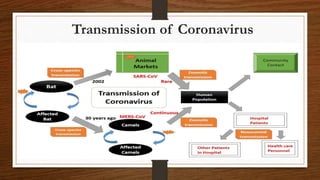
Chain of infections of Virus
Transmission of Coronavirus
Steps of Mode of Actions of SARS-CoV2
The coronavirus replication cycle is divided into several steps:
• Attachment and entry
• Translation of viral replicase
• Genome transcription and replication
• Translation of structural proteins
• Virion assembly and release.
Mode of Actions of SARS CoV-2
Treatments of SARS CoV-2
• Antiviral or retroviral medications
• Breathing support, such as mechanical ventilation
• Steroids to reduce lung swelling
• Blood plasma transfusions
Chloroquine & Hydroxychloroquine
• The US food and drug administration (FDA) approved limited emergency use
for chloroquine and hydroxychloroquine as a treatment for COVID-19.
• Coronavirus cell entry occurs through the endolysosomal pathway, it block
pathway.
• Chloroquine is probably the first molecule to be used as a treatment of severe
SARS-CoV-2 infections.
Mode of Action of Chloroquine &
Hydroxychloroquine
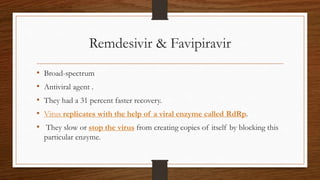
Remdesivir & Favipiravir
• Broad-spectrum
• Antiviral agent .
• They had a 31 percent faster recovery.
• Virus replicates with the help of a viral enzyme called RdRp.
• They slow or stop the virus from creating copies of itself by blocking this
particular enzyme.
An Argument on Biopharmaceuticals Development of
SARS-CoV 2
If Bacteria...
 Easy to Scale up
 High expression
 Short turnaround time
 Low cost
 Established regulatory
 Easy to manipulate
Disadvantages
 Improper folding
 Lack of posttranslational modification
 Endotoxin accumulation
ADVANTAGES
If Insect cell…
Advantages
• High expression
• Ability to produced complex
protein like membrane protein
• Proper folding and post
translational modification
Disadvantages
• High cost
• Time consuming
• Expensive media required to grow
• Optimum culture conditions
required
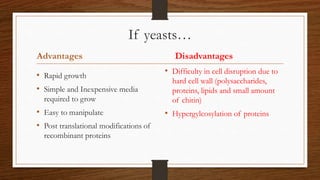
If yeasts…
Advantages
• Rapid growth
• Simple and Inexpensive media
required to grow
• Easy to manipulate
• Post translational modifications of
recombinant proteins
Disadvantages
• Difficulty in cell disruption due to
hard cell wall (polysaccharides,
proteins, lipids and small amount
of chitin)
• Hypergylcosylation of proteins
If Mammalian cells….
Advantages
• Proper folding
• Post translational modification
• Existing regulatory approval
Disadvantages
• High production cost
• Expensive media are required to grow
• Optimum culture condition required
If plants….
Advantages
• Rapid and affordable
• Optimized growth condition
• Economical
• Post translational modification
Similar as mammalian cell
• Free from pathogen
Disadvantages
• Regulatory compliance
• Limited glycosylation capacity
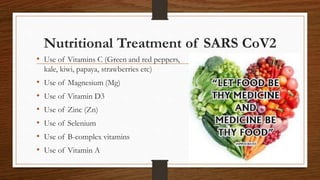
Nutritional Treatment of SARS CoV2
• Use of Vitamins C (Green and red peppers,
kale, kiwi, papaya, strawberries etc)
• Use of Magnesium (Mg)
• Use of Vitamin D3
• Use of Zinc (Zn)
• Use of Selenium
• Use of B-complex vitamins
• Use of Vitamin A
Summary
• Health problems in the whole world are started to increase due to new viruses, with the
beginning of 20th century. Wuhan coronavirus (which is also known as nCoV-2019) is one
of current examples of such type of viruses. Wuhan (city of China) more than 50 deaths
with thousands of cases have been reported, up till now due to infection of novel CoV-2019
• . Chloroquine is recognized to block infection with the virus by increasing the endosome pH
desirable for virus/cell fusion and by distressing the glycosylation of SARS-CoV.66 cell
receptors Recent advancements in plant biotechnology proved that plants have the ability to
produce vaccines or biopharmaceuticals rapidly in a short time. Major countries involving in
developing plant pharmaceuticals against numerous diseases of human are India, Korea,
Thailand, Japan & Europe community several reports reviewed that against infectious
diseases plant expression system has its importance produce therapeutic antibodies and
candidate vaccine.
Conclusion
• Coronavirus recognized for the first time in Wuhan (city of China) in December
2019, where people were in contact with markets of seafood. The infection caused
by this virus results the respiratory impairment with signs & indications of sore
throat, frequent coughs, flue, and fever. Severe respiratory infections, pneumonia,
and various organs failure are involved in death cases. Acuteness & transmission of
Coronavirus-2019 show milder effect than other corona viruses such as SARS
(Severe acute respiratory syndrome) and MERS (Middle East respiratory syndrome)
of humans. The replication of coronavirus encoded by two huge covering ORFs
(ORF1a and ORF1b) involving around 66% of genome and straight forwardly
deciphered from the genomic RNA. The basic and attachment genes, in spite of the
fact that are interpreted from sub genomic RNAs (sgRNAs) created through
genome transcription/replication as labeled underneath.
References
• Reed, M. L., Dove, B. K., Jackson, R. M., Collins, R., Brooks, G., & Hiscox, J. A.
(2006). Delineation and modelling of a nucleolar retention signal in the coronavirus
nucleocapsid protein. Traffic, 7(7), 833-848.
• Jiang, X. S., Tang, L. Y., Dai, J., Zhou, H., Li, S. J., Xia, Q. C., ... & Zeng, R. (2005).
Quantitative analysis of severe acute respiratory syndrome (SARS)-associated
coronavirus-infected cells using proteomic approaches: implications for cellular
responses to virus infection. Molecular & Cellular Proteomics, 4(7), 902-913.
• Ashour, H. M., Elkhatib, W. F., Rahman, M., & Elshabrawy, H. A. (2020). Insights
into the recent 2019 novel coronavirus (SARS-CoV-2) in light of past human
coronavirus outbreaks. Pathogens, 9(3), 186.
• Martinez, M. A. (2020). Compounds with therapeutic potential against novel
respiratory 2019 coronavirus. Antimicrobial agents and chemotherapy, 64(5).
Coronaviruse

Coronaviruse

  • 2.
    Coronaviruses Submitted By: AsifShahzad Submitted To: Dr. Arruje Hameed M.Phill biochemistry Government College University Faisalabad (GCUF)
  • 3.
    Introduction • Family Coronaviridae •Enveloped viruses ( protein layer called a capsid between the envelope and their genome) • Genome – Non-segmented • RNA genome • 26–32 kilobases in size • 120 nm in diameter • Incubation period is 12 to 14 days • 16 nonstructural proteins (nsp1 through nsp16)
  • 4.
    Difference between SARS& MERS SARS (Severe Acute Respiratory Syndrome) • Beta coronaviruses • RNA genome • Sothern China in 2002/2003 • 8422 patients in 29 countries before January 2010. • Mortality rate 11% • Zoonotic sources, e.g. bat or camel • Genome size 29.3 kb • Incubation period is 2 to 10 days MERS (Middle East Respiratory Syndrome) • Beta coronaviruses • RNA genome • Saudi Arabia in 2012 • 2500 patients in 27 countries before May 2015 • Mortality rate 30% • Zoonotic sources, e.g. bat or camel • Genome size 29.9 kb • Incubation period is 2 to 14 days
  • 5.
  • 6.
  • 7.
    Steps of Modeof Actions of SARS-CoV2 The coronavirus replication cycle is divided into several steps: • Attachment and entry • Translation of viral replicase • Genome transcription and replication • Translation of structural proteins • Virion assembly and release.
  • 8.
    Mode of Actionsof SARS CoV-2
  • 9.
    Treatments of SARSCoV-2 • Antiviral or retroviral medications • Breathing support, such as mechanical ventilation • Steroids to reduce lung swelling • Blood plasma transfusions
  • 10.
    Chloroquine & Hydroxychloroquine •The US food and drug administration (FDA) approved limited emergency use for chloroquine and hydroxychloroquine as a treatment for COVID-19. • Coronavirus cell entry occurs through the endolysosomal pathway, it block pathway. • Chloroquine is probably the first molecule to be used as a treatment of severe SARS-CoV-2 infections.
  • 11.
    Mode of Actionof Chloroquine & Hydroxychloroquine
  • 12.
    Remdesivir & Favipiravir •Broad-spectrum • Antiviral agent . • They had a 31 percent faster recovery. • Virus replicates with the help of a viral enzyme called RdRp. • They slow or stop the virus from creating copies of itself by blocking this particular enzyme.
  • 14.
    An Argument onBiopharmaceuticals Development of SARS-CoV 2 If Bacteria...  Easy to Scale up  High expression  Short turnaround time  Low cost  Established regulatory  Easy to manipulate Disadvantages  Improper folding  Lack of posttranslational modification  Endotoxin accumulation ADVANTAGES
  • 15.
    If Insect cell… Advantages •High expression • Ability to produced complex protein like membrane protein • Proper folding and post translational modification Disadvantages • High cost • Time consuming • Expensive media required to grow • Optimum culture conditions required
  • 16.
    If yeasts… Advantages • Rapidgrowth • Simple and Inexpensive media required to grow • Easy to manipulate • Post translational modifications of recombinant proteins Disadvantages • Difficulty in cell disruption due to hard cell wall (polysaccharides, proteins, lipids and small amount of chitin) • Hypergylcosylation of proteins
  • 17.
    If Mammalian cells…. Advantages •Proper folding • Post translational modification • Existing regulatory approval Disadvantages • High production cost • Expensive media are required to grow • Optimum culture condition required
  • 18.
    If plants…. Advantages • Rapidand affordable • Optimized growth condition • Economical • Post translational modification Similar as mammalian cell • Free from pathogen Disadvantages • Regulatory compliance • Limited glycosylation capacity
  • 19.
    Nutritional Treatment ofSARS CoV2 • Use of Vitamins C (Green and red peppers, kale, kiwi, papaya, strawberries etc) • Use of Magnesium (Mg) • Use of Vitamin D3 • Use of Zinc (Zn) • Use of Selenium • Use of B-complex vitamins • Use of Vitamin A
  • 20.
    Summary • Health problemsin the whole world are started to increase due to new viruses, with the beginning of 20th century. Wuhan coronavirus (which is also known as nCoV-2019) is one of current examples of such type of viruses. Wuhan (city of China) more than 50 deaths with thousands of cases have been reported, up till now due to infection of novel CoV-2019 • . Chloroquine is recognized to block infection with the virus by increasing the endosome pH desirable for virus/cell fusion and by distressing the glycosylation of SARS-CoV.66 cell receptors Recent advancements in plant biotechnology proved that plants have the ability to produce vaccines or biopharmaceuticals rapidly in a short time. Major countries involving in developing plant pharmaceuticals against numerous diseases of human are India, Korea, Thailand, Japan & Europe community several reports reviewed that against infectious diseases plant expression system has its importance produce therapeutic antibodies and candidate vaccine.
  • 21.
    Conclusion • Coronavirus recognizedfor the first time in Wuhan (city of China) in December 2019, where people were in contact with markets of seafood. The infection caused by this virus results the respiratory impairment with signs & indications of sore throat, frequent coughs, flue, and fever. Severe respiratory infections, pneumonia, and various organs failure are involved in death cases. Acuteness & transmission of Coronavirus-2019 show milder effect than other corona viruses such as SARS (Severe acute respiratory syndrome) and MERS (Middle East respiratory syndrome) of humans. The replication of coronavirus encoded by two huge covering ORFs (ORF1a and ORF1b) involving around 66% of genome and straight forwardly deciphered from the genomic RNA. The basic and attachment genes, in spite of the fact that are interpreted from sub genomic RNAs (sgRNAs) created through genome transcription/replication as labeled underneath.
  • 22.
    References • Reed, M.L., Dove, B. K., Jackson, R. M., Collins, R., Brooks, G., & Hiscox, J. A. (2006). Delineation and modelling of a nucleolar retention signal in the coronavirus nucleocapsid protein. Traffic, 7(7), 833-848. • Jiang, X. S., Tang, L. Y., Dai, J., Zhou, H., Li, S. J., Xia, Q. C., ... & Zeng, R. (2005). Quantitative analysis of severe acute respiratory syndrome (SARS)-associated coronavirus-infected cells using proteomic approaches: implications for cellular responses to virus infection. Molecular & Cellular Proteomics, 4(7), 902-913. • Ashour, H. M., Elkhatib, W. F., Rahman, M., & Elshabrawy, H. A. (2020). Insights into the recent 2019 novel coronavirus (SARS-CoV-2) in light of past human coronavirus outbreaks. Pathogens, 9(3), 186. • Martinez, M. A. (2020). Compounds with therapeutic potential against novel respiratory 2019 coronavirus. Antimicrobial agents and chemotherapy, 64(5).