Core Measures
Core measures are evidence based practice standards that
have been researched and shown to improve patient
outcomes
Center for Medicare and Medicaid Services (CMS)
established the core measures in 2000
Reporting core measures is a CMS requirement for
reimbursement
The scores obtained on the quality measures are reported
quarterly to CMS
 The data is then reported publicly on Hospital Compare
This can be considered a public report card on how all
hospitals perform in regard to quality
Core Measures
At WCMC we currently report on and/or monitor:
          • Acute Myocardial Infarction (AMI)
          • Heart Failure (HF)
          • Pneumonia (PN)
          • Surgical Care Improvement Project (SCIP)
          • VTE protocols
          • Stroke
Each clinical focus has a team composed of a physician, managers,
administrative staff, staff nurses, and case managers that collect
data and review processes to improve WCMC’s performance
Patients admitted with one of the clinical focuses will have an
identifiable red chart
Core Measures (continued)

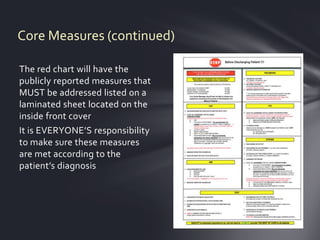
The red chart will have the
publicly reported measures that
MUST be addressed listed on a
laminated sheet located on the
inside front cover
It is EVERYONE’S responsibility
to make sure these measures
are met according to the
patient’s diagnosis
Core Measures - AMI
AMI patients will have:
• ACE/ARB on discharge for LVSD (EF < 40%)
• PCI within 90 minutes of arrival (STEMI or LBBB, or MI with any
  mention of location if described as acute or evolving)
• Smoking Cessation
• Beta-Blocker AND Statin at discharge
• ASA on arrival AND at discharge
Any medication contraindication must be documented in the
medical record and it must also be documented that it is the
reason for not prescribing the drug
Core Measures - HF
HF or CHF patients will have:
• LV function assessment or           Discharge on these
  documentation of EF in chart        patients is a three part
• ACE/ARB for LVSD (EF < 40%) at      process:
  discharge                           (1) Nursing Discharge
• Smoking Cessation                   Summary must match
• Written discharge instructions to   the (2)MD’s medication
  address ALL of the following;       reconciliation and that
 •   Medications                      must match (3)the MD’s
 •   Diet                             Discharge summary
 •   Activity
 •   F/U with MD
 •   Weight monitoring
 •   Worsening symptoms
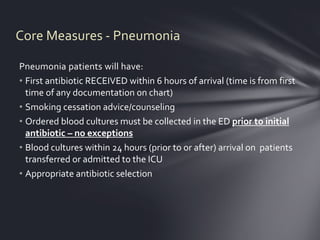
Core Measures - Pneumonia

Pneumonia patients will have:
• First antibiotic RECEIVED within 6 hours of arrival (time is from first
  time of any documentation on chart)
• Smoking cessation advice/counseling
• Ordered blood cultures must be collected in the ED prior to initial
  antibiotic – no exceptions
• Blood cultures within 24 hours (prior to or after) arrival on patients
  transferred or admitted to the ICU
• Appropriate antibiotic selection
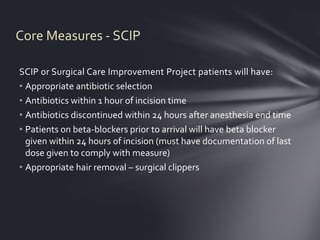
Core Measures - SCIP

SCIP or Surgical Care Improvement Project patients will have:
• Appropriate antibiotic selection
• Antibiotics within 1 hour of incision time
• Antibiotics discontinued within 24 hours after anesthesia end time
• Patients on beta-blockers prior to arrival will have beta blocker
  given within 24 hours of incision (must have documentation of last
  dose given to comply with measure)
• Appropriate hair removal – surgical clippers
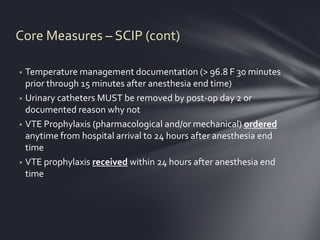
Core Measures – SCIP (cont)

 Temperature management documentation (> 96.8 F 30 minutes
  prior through 15 minutes after anesthesia end time)
 Urinary catheters MUST be removed by post-op day 2 or
  documented reason why not
 VTE Prophylaxis (pharmacological and/or mechanical) ordered
  anytime from hospital arrival to 24 hours after anesthesia end
  time
 VTE prophylaxis received within 24 hours after anesthesia end
  time
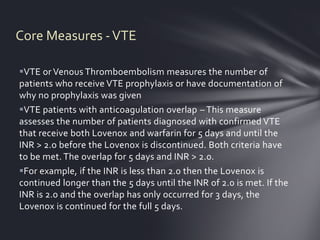
Core Measures - VTE

VTE or Venous Thromboembolism measures the number of
patients who receive VTE prophylaxis or have documentation of
why no prophylaxis was given
VTE patients with anticoagulation overlap – This measure
assesses the number of patients diagnosed with confirmed VTE
that receive both Lovenox and warfarin for 5 days and until the
INR > 2.o before the Lovenox is discontinued. Both criteria have
to be met. The overlap for 5 days and INR > 2.0.
For example, if the INR is less than 2.0 then the Lovenox is
continued longer than the 5 days until the INR of 2.0 is met. If the
INR is 2.0 and the overlap has only occurred for 3 days, the
Lovenox is continued for the full 5 days.
Core Measures – VTE (cont)

 VTE Discharge instructions – This measure assesses the number
  of patients diagnosed with confirmed VTE that are discharged
  to home, home health, court/law enforcement or home on
  hospice care on warfarin with written discharge instructions
  that address all four criteria: Compliance issues, dietary advice,
  follow-up monitoring, and information about the potential for
  adverse drug reactions
 Incidence of potentially preventable VTE – This measure
  assesses the number of patients diagnosed with confirmed VTE
  prophylaxis during hospitalization (not present on admission)
  who did not receive VTE prophylaxis between hospital
  admission and the day before the VTE diagnostic testing order
  date
Core Measures – VTE (cont)

Discharge instructions on Coumadin is imperative whether a home
med or a new med
• Click the box under educational needs for patients discharged on
  Coumadin, review Coumadin education packet with patient.
• Address F/U monitoring including name and number of MD/office
• Date for next PT/INR blood draw
Patients must be discharged on BOTH Lovenox and Warfarin unless
BOTH criteria are met;
• Has had 5 days of Lovenox
• INR greater than 2
Core Measures - Stroke

Stroke patients will have;
• Received VTE prophylaxis or have documentation why none was
  given the day of or the day after hospital admission
• Stroke patients will have SCD’s instead of the anti-embolic
  stockings
• Antithrombic therapy and Statin at discharge
• Anticoagulation therapy for A-Fib/Flutter at discharge
• Assessed for Rehab during stay
Core Measures – Stroke (cont)

The following will be addressed
• Follow up appointment (not as needed - document specifics Dr.
  Spock in 1 week, or date and time)
• Discharge Medications (be sure they are clearly identified)
• Discharge instructions; check the stroke box under educational
  needs and provide the required education elements reviewing with
  patient
  • Activation of the emergency medical system (EMS)
  • Risk factors for stroke
  • Warning signs and symptoms of a stroke

Core measures

  • 1.
    Core Measures Core measuresare evidence based practice standards that have been researched and shown to improve patient outcomes Center for Medicare and Medicaid Services (CMS) established the core measures in 2000 Reporting core measures is a CMS requirement for reimbursement The scores obtained on the quality measures are reported quarterly to CMS  The data is then reported publicly on Hospital Compare This can be considered a public report card on how all hospitals perform in regard to quality
  • 2.
    Core Measures At WCMCwe currently report on and/or monitor: • Acute Myocardial Infarction (AMI) • Heart Failure (HF) • Pneumonia (PN) • Surgical Care Improvement Project (SCIP) • VTE protocols • Stroke Each clinical focus has a team composed of a physician, managers, administrative staff, staff nurses, and case managers that collect data and review processes to improve WCMC’s performance Patients admitted with one of the clinical focuses will have an identifiable red chart
  • 3.
    Core Measures (continued) Thered chart will have the publicly reported measures that MUST be addressed listed on a laminated sheet located on the inside front cover It is EVERYONE’S responsibility to make sure these measures are met according to the patient’s diagnosis
  • 4.
    Core Measures -AMI AMI patients will have: • ACE/ARB on discharge for LVSD (EF < 40%) • PCI within 90 minutes of arrival (STEMI or LBBB, or MI with any mention of location if described as acute or evolving) • Smoking Cessation • Beta-Blocker AND Statin at discharge • ASA on arrival AND at discharge Any medication contraindication must be documented in the medical record and it must also be documented that it is the reason for not prescribing the drug
  • 5.
    Core Measures -HF HF or CHF patients will have: • LV function assessment or Discharge on these documentation of EF in chart patients is a three part • ACE/ARB for LVSD (EF < 40%) at process: discharge (1) Nursing Discharge • Smoking Cessation Summary must match • Written discharge instructions to the (2)MD’s medication address ALL of the following; reconciliation and that • Medications must match (3)the MD’s • Diet Discharge summary • Activity • F/U with MD • Weight monitoring • Worsening symptoms
  • 6.
    Core Measures -Pneumonia Pneumonia patients will have: • First antibiotic RECEIVED within 6 hours of arrival (time is from first time of any documentation on chart) • Smoking cessation advice/counseling • Ordered blood cultures must be collected in the ED prior to initial antibiotic – no exceptions • Blood cultures within 24 hours (prior to or after) arrival on patients transferred or admitted to the ICU • Appropriate antibiotic selection
  • 7.
    Core Measures -SCIP SCIP or Surgical Care Improvement Project patients will have: • Appropriate antibiotic selection • Antibiotics within 1 hour of incision time • Antibiotics discontinued within 24 hours after anesthesia end time • Patients on beta-blockers prior to arrival will have beta blocker given within 24 hours of incision (must have documentation of last dose given to comply with measure) • Appropriate hair removal – surgical clippers
  • 8.
    Core Measures –SCIP (cont)  Temperature management documentation (> 96.8 F 30 minutes prior through 15 minutes after anesthesia end time)  Urinary catheters MUST be removed by post-op day 2 or documented reason why not  VTE Prophylaxis (pharmacological and/or mechanical) ordered anytime from hospital arrival to 24 hours after anesthesia end time  VTE prophylaxis received within 24 hours after anesthesia end time
  • 9.
    Core Measures -VTE VTE or Venous Thromboembolism measures the number of patients who receive VTE prophylaxis or have documentation of why no prophylaxis was given VTE patients with anticoagulation overlap – This measure assesses the number of patients diagnosed with confirmed VTE that receive both Lovenox and warfarin for 5 days and until the INR > 2.o before the Lovenox is discontinued. Both criteria have to be met. The overlap for 5 days and INR > 2.0. For example, if the INR is less than 2.0 then the Lovenox is continued longer than the 5 days until the INR of 2.0 is met. If the INR is 2.0 and the overlap has only occurred for 3 days, the Lovenox is continued for the full 5 days.
  • 10.
    Core Measures –VTE (cont)  VTE Discharge instructions – This measure assesses the number of patients diagnosed with confirmed VTE that are discharged to home, home health, court/law enforcement or home on hospice care on warfarin with written discharge instructions that address all four criteria: Compliance issues, dietary advice, follow-up monitoring, and information about the potential for adverse drug reactions  Incidence of potentially preventable VTE – This measure assesses the number of patients diagnosed with confirmed VTE prophylaxis during hospitalization (not present on admission) who did not receive VTE prophylaxis between hospital admission and the day before the VTE diagnostic testing order date
  • 11.
    Core Measures –VTE (cont) Discharge instructions on Coumadin is imperative whether a home med or a new med • Click the box under educational needs for patients discharged on Coumadin, review Coumadin education packet with patient. • Address F/U monitoring including name and number of MD/office • Date for next PT/INR blood draw Patients must be discharged on BOTH Lovenox and Warfarin unless BOTH criteria are met; • Has had 5 days of Lovenox • INR greater than 2
  • 12.
    Core Measures -Stroke Stroke patients will have; • Received VTE prophylaxis or have documentation why none was given the day of or the day after hospital admission • Stroke patients will have SCD’s instead of the anti-embolic stockings • Antithrombic therapy and Statin at discharge • Anticoagulation therapy for A-Fib/Flutter at discharge • Assessed for Rehab during stay
  • 13.
    Core Measures –Stroke (cont) The following will be addressed • Follow up appointment (not as needed - document specifics Dr. Spock in 1 week, or date and time) • Discharge Medications (be sure they are clearly identified) • Discharge instructions; check the stroke box under educational needs and provide the required education elements reviewing with patient • Activation of the emergency medical system (EMS) • Risk factors for stroke • Warning signs and symptoms of a stroke