www.webstackacademy.com
Java Programming Language SE – 6
Module 11: Console I/O and File I/O
www.webstackacademy.com
Objectives
● Read data from the console
● Write data to the console
● Describe files and file I/O
www.webstackacademy.com
Console I/O
● The variable System.out enables you to write to standard output.
System.out is an object of type PrintStream.
● The variable System.in enables you to read from standard input.
System.in is an object of type InputStream.
● The variable System.err enables you to write to standard error.
System.err is an object of type PrintStream.
www.webstackacademy.com
Writing to Standard Output
● The println methods print the argument and a newline character (n).
● The print methods print the argument without a newline character.
● The print and println methods are overloaded for most primitive types
(boolean, char, int, long, float, and double) and for char[], Object, and
String.
● The print(Object) and println(Object) methods call the toString method
on the argument.
www.webstackacademy.com
Reading From Standard
Input
public class KeyboardInput {
public static void main (String args[]) {
String s;
// Create a buffered reader to read
// each line from the keyboard.
InputStreamReader ir
= new InputStreamReader(System.in);
BufferedReader in = new BufferedReader(ir);
System.out.println("Unix: Type ctrl-d to exit." +
"nWindows: Type ctrl-z to exit");
www.webstackacademy.com
Reading From Standard
Input
try {
// Read each input line and echo it to the screen.
s = in.readLine();
while ( s != null ) {
System.out.println("Read: " + s);
s = in.readLine();
}
// Close the buffered reader.
in.close();
} catch (IOException e) { // Catch any IO exceptions.
e.printStackTrace();
}}}
www.webstackacademy.com
Simple Formatted Output
● You can use the formatting functionality as follows:
out.printf(“name countn”);
String s = String.format(“%s %5d%n”, user, total);
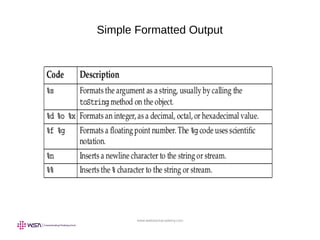
● Common formatting codes are listed in this table.
www.webstackacademy.com
Simple Formatted Output
www.webstackacademy.com
Simple Formatted Input
The Scanner class provides a formatted input function.
A Scanner class can be used with console input streams as well as file or
network streams.
www.webstackacademy.com
Simple Formatted Input
You can read console input as follows:
import java.io.*;
import java.util.Scanner;
public class ScanTest {
public static void main(String [] args) {
Scanner s = new Scanner(System.in);
String param = s.next();
System.out.println("the param 1" + param);
int value = s.nextInt();
System.out.println("second param" + value);
s.close();
}}
www.webstackacademy.com
Files and File I/O
The java.io package enables you to do the following:
– Create File objects
– Manipulate File objects
– Read and write to file streams
www.webstackacademy.com
Creating a New File Object
The File class provides several utilities:
– File myFile;
– myFile = new File("myfile.txt");
– myFile = new File("MyDocs", "myfile.txt");
www.webstackacademy.com
Creating a New File Object
● Directories are treated like files in the Java programming
language. You can create a File object that represents a
directory and then use it to identify other files, for example:
File myDir = new File("MyDocs");
myFile = new File(myDir, "myfile.txt");
www.webstackacademy.com
The File Tests and Utilities
● File information:
– String getName()
– String getPath()
– String getAbsolutePath()
– String getParent()
– long lastModified()
– long length()
www.webstackacademy.com
The File Tests and Utilities
● File modification:
– boolean renameTo(File newName)
– boolean delete()
● Directory utilities:
– boolean mkdir()
– String[] list()
www.webstackacademy.com
The File Tests and Utilities
● File tests:
– Boolean exists()
– Boolean cabRead()
– Boolean canRead()
– Boolean isFile()
– Boolean isDirectory()
– Boolean isAbsolute();
– Boolean is Hidden();
www.webstackacademy.com
File Stream I/O
● For file input:
– Use the FileReader class to read characters.
– Use the BufferedReader class to use the readLine method.
● For file output:
– Use the FileWriter class to write characters.
– Use the PrintWriter class to use the print and println methods.
www.webstackacademy.com
File Input Example
public class ReadFile {
public static void main (String[] args) {
// Create file
File file = new File(args[0]);
try {
// Create a buffered reader
// to read each line from a file.
BufferedReader in
= new BufferedReader(new FileReader(file));
String s;
www.webstackacademy.com
Printing a File
s = in.readLine();
while ( s != null ) {
System.out.println("Read: " + s);
s = in.readLine();
}
// Close the buffered reader
in.close();
} catch (FileNotFoundException e1) {
// If this file does not exist
System.err.println("File not found: " + file);
} catch (IOException e2) {
// Catch any other IO exceptions.
e2.printStackTrace();
}}}
www.webstackacademy.com
File Output Example
public class WriteFile {
public static void main (String[] args) {
// Create file
File file = new File(args[0]);
try {
// Create a buffered reader to read each line from standard in.
InputStreamReader isr
= new InputStreamReader(System.in);
BufferedReader in
= new BufferedReader(isr);
// Create a print writer on this file.
PrintWriter out
= new PrintWriter(new FileWriter(file));
String s;
www.webstackacademy.com
File Output Example
System.out.print("Enter file text. ");
System.out.println("[Type ctrl-d to stop.]");
// Read each input line and echo it to the screen.
while ((s = in.readLine()) != null) {
out.println(s);
}
// Close the buffered reader and the file print writer.
in.close();
out.close();
} catch (IOException e) {
// Catch any IO exceptions.
e.printStackTrace();
}}}
www.webstackacademy.com
Web Stack Academy (P) Ltd
#83, Farah Towers,
1st floor,MG Road,
Bangalore – 560001
M: +91-80-4128 9576
T: +91-98862 69112
E: info@www.webstackacademy.com

Core Java Programming Language (JSE) : Chapter XI - Console I/O and File I/O

  • 1.
    www.webstackacademy.com Java Programming LanguageSE – 6 Module 11: Console I/O and File I/O
  • 2.
    www.webstackacademy.com Objectives ● Read datafrom the console ● Write data to the console ● Describe files and file I/O
  • 3.
    www.webstackacademy.com Console I/O ● Thevariable System.out enables you to write to standard output. System.out is an object of type PrintStream. ● The variable System.in enables you to read from standard input. System.in is an object of type InputStream. ● The variable System.err enables you to write to standard error. System.err is an object of type PrintStream.
  • 4.
    www.webstackacademy.com Writing to StandardOutput ● The println methods print the argument and a newline character (n). ● The print methods print the argument without a newline character. ● The print and println methods are overloaded for most primitive types (boolean, char, int, long, float, and double) and for char[], Object, and String. ● The print(Object) and println(Object) methods call the toString method on the argument.
  • 5.
    www.webstackacademy.com Reading From Standard Input publicclass KeyboardInput { public static void main (String args[]) { String s; // Create a buffered reader to read // each line from the keyboard. InputStreamReader ir = new InputStreamReader(System.in); BufferedReader in = new BufferedReader(ir); System.out.println("Unix: Type ctrl-d to exit." + "nWindows: Type ctrl-z to exit");
  • 6.
    www.webstackacademy.com Reading From Standard Input try{ // Read each input line and echo it to the screen. s = in.readLine(); while ( s != null ) { System.out.println("Read: " + s); s = in.readLine(); } // Close the buffered reader. in.close(); } catch (IOException e) { // Catch any IO exceptions. e.printStackTrace(); }}}
  • 7.
    www.webstackacademy.com Simple Formatted Output ●You can use the formatting functionality as follows: out.printf(“name countn”); String s = String.format(“%s %5d%n”, user, total); ● Common formatting codes are listed in this table.
  • 8.
  • 9.
    www.webstackacademy.com Simple Formatted Input TheScanner class provides a formatted input function. A Scanner class can be used with console input streams as well as file or network streams.
  • 10.
    www.webstackacademy.com Simple Formatted Input Youcan read console input as follows: import java.io.*; import java.util.Scanner; public class ScanTest { public static void main(String [] args) { Scanner s = new Scanner(System.in); String param = s.next(); System.out.println("the param 1" + param); int value = s.nextInt(); System.out.println("second param" + value); s.close(); }}
  • 11.
    www.webstackacademy.com Files and FileI/O The java.io package enables you to do the following: – Create File objects – Manipulate File objects – Read and write to file streams
  • 12.
    www.webstackacademy.com Creating a NewFile Object The File class provides several utilities: – File myFile; – myFile = new File("myfile.txt"); – myFile = new File("MyDocs", "myfile.txt");
  • 13.
    www.webstackacademy.com Creating a NewFile Object ● Directories are treated like files in the Java programming language. You can create a File object that represents a directory and then use it to identify other files, for example: File myDir = new File("MyDocs"); myFile = new File(myDir, "myfile.txt");
  • 14.
    www.webstackacademy.com The File Testsand Utilities ● File information: – String getName() – String getPath() – String getAbsolutePath() – String getParent() – long lastModified() – long length()
  • 15.
    www.webstackacademy.com The File Testsand Utilities ● File modification: – boolean renameTo(File newName) – boolean delete() ● Directory utilities: – boolean mkdir() – String[] list()
  • 16.
    www.webstackacademy.com The File Testsand Utilities ● File tests: – Boolean exists() – Boolean cabRead() – Boolean canRead() – Boolean isFile() – Boolean isDirectory() – Boolean isAbsolute(); – Boolean is Hidden();
  • 17.
    www.webstackacademy.com File Stream I/O ●For file input: – Use the FileReader class to read characters. – Use the BufferedReader class to use the readLine method. ● For file output: – Use the FileWriter class to write characters. – Use the PrintWriter class to use the print and println methods.
  • 18.
    www.webstackacademy.com File Input Example publicclass ReadFile { public static void main (String[] args) { // Create file File file = new File(args[0]); try { // Create a buffered reader // to read each line from a file. BufferedReader in = new BufferedReader(new FileReader(file)); String s;
  • 19.
    www.webstackacademy.com Printing a File s= in.readLine(); while ( s != null ) { System.out.println("Read: " + s); s = in.readLine(); } // Close the buffered reader in.close(); } catch (FileNotFoundException e1) { // If this file does not exist System.err.println("File not found: " + file); } catch (IOException e2) { // Catch any other IO exceptions. e2.printStackTrace(); }}}
  • 20.
    www.webstackacademy.com File Output Example publicclass WriteFile { public static void main (String[] args) { // Create file File file = new File(args[0]); try { // Create a buffered reader to read each line from standard in. InputStreamReader isr = new InputStreamReader(System.in); BufferedReader in = new BufferedReader(isr); // Create a print writer on this file. PrintWriter out = new PrintWriter(new FileWriter(file)); String s;
  • 21.
    www.webstackacademy.com File Output Example System.out.print("Enterfile text. "); System.out.println("[Type ctrl-d to stop.]"); // Read each input line and echo it to the screen. while ((s = in.readLine()) != null) { out.println(s); } // Close the buffered reader and the file print writer. in.close(); out.close(); } catch (IOException e) { // Catch any IO exceptions. e.printStackTrace(); }}}
  • 22.
    www.webstackacademy.com Web Stack Academy(P) Ltd #83, Farah Towers, 1st floor,MG Road, Bangalore – 560001 M: +91-80-4128 9576 T: +91-98862 69112 E: info@www.webstackacademy.com