Provided by courtesy of:
The Law Office of Sunisha S. Choksi
    4601 Washington Ave., Suite 200
             Houston, Texas 77007
              Phone: (832) 319-6724
                 Fax: (832) 319-6714
           sunisha@choksilaw.com
WHAT IS A COPYRIGHT?
An original, creative expression (work of
authorship) affixed to a tangible medium.
A type of intellectual property protection
established by the U.S. Constitution....

                        Article I, Section 8, Clause 8
                    Empowers the United States Congress

                      “ To promote the Progress of Science
                      and useful Arts, by securing for limited
                      Times to Authors and Inventors the
                      exclusive Right to their respective
                      Writings and Discoveries.”
A COPYRIGHT PROTECTS
           ORIGINAL & CREATIVE...


Literary works
Musical works, including any accompanying words
Dramatic works, including any accompanying music
Pantomimes and choreographic works
Pictorial, graphic, and sculptural works
Motion pictures and other audiovisual works
Sound recordings
Architectural works
Computer programs
Maps

  Author has to have exercised some independent,
  intellectual effort to claim a copyright in a given
  work.
A COPYRIGHT DOES NOT PROTECT...
 Works not fixed in a tangible form
 Facts
 Ideas
 Concepts
 Systems
 Methods of operation
 Short phrases, slogans, titles and names
 Mere listing of ingredients
 Familiar symbols & designs
 Typographical ornamentation, lettering or
 coloring
 Information that is common property- ex. lists or
 tables taken from public documents from Fed.
 Govt.
WHEN COPYRIGHT PROTECTION
           VESTS

                   At the moment creation
                               +
 original work of authorship fixed in a tangible form that it is
                   perceptible either directly or
             with the aid of a machine or device.
                   Ex. Print copy, digital file


The copyright immediately becomes the property of the author(s)
who created the work. Registration of work of authorship with
the Copyright Office not required to establish a copyright
protection.
"BUNDLE OF RIGHTS" AFFORDED
   TO COPYRIGHT OWNERS
        The exclusive right to...

      Reproduce the work (make copies),

          Prepare derivative works,

        Distribute copies of the work,

        Publicly perform the work &

          Publicly display the work.
WHAT IS A DERIVATIVE WORK?
Defined in 17 U.S.C. § 101: A work based upon one or more pre-
existing works, such as-
      translation,
      musical arrangement,
      dramatization,
      fictionalization,
      motion picture version,
      sound recording,
      art reproduction,
      abridgment,
      condensation, or
      any other form in which a work may be recast, transformed,
      or adapted.

A work consisting of editorial revisions, annotations, elaborations,
or other modifications which, as a whole, represent an original
work of authorship, is a “derivative work”.
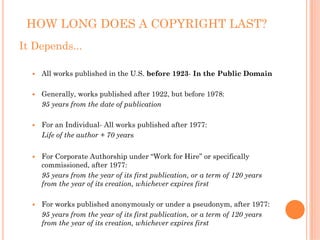
HOW LONG DOES A COPYRIGHT LAST?
It Depends...

    All works published in the U.S. before 1923- In the Public Domain

    Generally, works published after 1922, but before 1978:
    95 years from the date of publication

    For an Individual- All works published after 1977:
    Life of the author + 70 years


    For Corporate Authorship under “Work for Hire” or specifically
    commissioned, after 1977:
    95 years from the year of its first publication, or a term of 120 years
    from the year of its creation, whichever expires first

    For works published anonymously or under a pseudonym, after 1977:
    95 years from the year of its first publication, or a term of 120 years
    from the year of its creation, whichever expires first
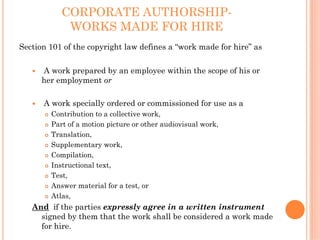
CORPORATE AUTHORSHIP-
            WORKS MADE FOR HIRE
Section 101 of the copyright law defines a “work made for hire” as

      A work prepared by an employee within the scope of his or
      her employment or

      A work specially ordered or commissioned for use as a
        Contribution to a collective work,
        Part of a motion picture or other audiovisual work,
        Translation,
        Supplementary work,
        Compilation,
        Instructional text,
        Test,
        Answer material for a test, or
        Atlas,
   And if the parties expressly agree in a written instrument
     signed by them that the work shall be considered a work made
     for hire.
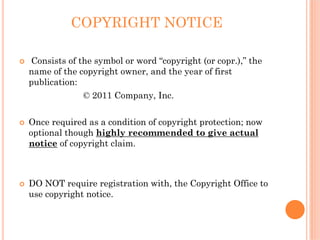
COPYRIGHT NOTICE

Consists of the symbol or word “copyright (or copr.),” the
name of the copyright owner, and the year of first
publication:
             © 2011 Company, Inc.


Once required as a condition of copyright protection; now
optional though highly recommended to give actual
notice of copyright claim.


DO NOT require registration with, the Copyright Office to
use copyright notice.
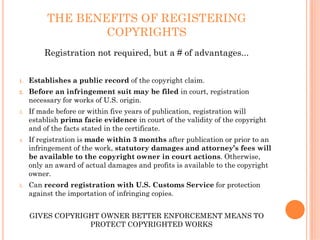
THE BENEFITS OF REGISTERING
                  COPYRIGHTS
         Registration not required, but a # of advantages...


1.   Establishes a public record of the copyright claim.
2.   Before an infringement suit may be filed in court, registration
     necessary for works of U.S. origin.
3.   If made before or within five years of publication, registration will
     establish prima facie evidence in court of the validity of the copyright
     and of the facts stated in the certificate.
4.   If registration is made within 3 months after publication or prior to an
     infringement of the work, statutory damages and attorney’s fees will
     be available to the copyright owner in court actions. Otherwise,
     only an award of actual damages and profits is available to the copyright
     owner.
5.   Can record registration with U.S. Customs Service for protection
     against the importation of infringing copies.


     GIVES COPYRIGHT OWNER BETTER ENFORCEMENT MEANS TO
                  PROTECT COPYRIGHTED WORKS
COPYRIGHTS AS BUSINESS ASSETS-
  ASSIGNMENTS AND LICENSES
Any or all of the copyright owner’s exclusive rights may be
transferred. The transfer of exclusive rights (exclusive
license or assignment) is not valid unless that transfer is in
writing and signed by the owner of the rights conveyed or
the owner’s authorized agent.


Copyrights may also be conveyed by operation of law and
may be bequeathed by will or pass as personal property by
the applicable laws of intestate succession.


Types of transfers:
   Licenses – Owner retains copyright but allows 3rd parties the
   right to use copyrighted content under certain terms and
   conditions.

   Assignment- Owner transfers all rights, title & interest to a 3rd
   party.
COPYRIGHT INFRINGEMENT

Violation of the “bundle of rights” afforded to the
  copyright owner.

Alleged Infringer- Anyone who, without the
  permission or consent of the copyright owner...

  Reproduces the work (make copies),
  Prepares derivative works,
  Distributes copies of the work,
  Publicly performs the work &/or
  Publicly displays the work.


Prove infringement by showing: 1) infringer had access
  to the copyrighted work & 2) infringer’s work is
  substantially similar to the copyrighted work.
INFRINGEMENT-
FAIR USE (SECTION 107 OF THE COPYRIGHT
                                LAW)

Reproduction of a particular work may be considered fair when:
   Criticism
   Commentary
   News reporting
   Teaching
   Scholarship
   Research


Parody (often found by courts to be “fair use”)

Section 107 also sets out four factors to be considered in
determining whether or not a particular use is fair:
   The purpose and character of the use, including whether such use is of
   commercial nature or is for nonprofit educational purposes.
   The nature of the copyrighted work.
   The amount and substantiality of the portion used in relation to the
   copyrighted work as a whole.
   The effect of the use upon the potential market for, or value of, the
   copyrighted work.
DMCA TAKE DOWN NOTICE PROVISION
 Created under the Digital Millennium Copyright Act as a
 “Safe Harbor” provision to shield Internet Service
 Providers (ISP) from contributory infringement.


 ISP required to maintain and record information with the
 U.S. Copyright Office regarding their DMCA agent
 designated to address copyright infringement issues.


 Copyright owners can demand removal of allegedly
 infringing content by sending a take-down notice to ISP’s
 designated DMCA agent.


 If complete, ISP will either remove or disable website
 containing alleged infringing work.
BASICS
     ON
TRADEMARKS
WHAT IS A TRADEMARK?

A Trademark can be…

 a word, ex: “EXXON” for oil products

 a phrase, ex: “JUST DO IT” for sports apparel

 a symbol, ex: the NIKE “Swoosh” for sports
 apparel

 a design, ex: The DISNEY “Cinderella Castle”
 for children’s toys
WHAT IS A TRADEMARK?

As well as…

 sounds, ex: NBC chimes

 3D objects, ex: the Coca-Cola bottle

 or a combination of the above, that identifies
 and distinguishes the source of the goods of
 one party from those of others.
WHAT IS A SERVICE MARK?

 Like a trademark, except that it identifies and
 distinguishes the source of a service rather
 than a product.

 Throughout this presentation, the terms
 "trademark" and "mark" refer to both trademarks
 and service marks.
A trademark is never a word or logo by itself…it
is used to identify specific goods and services.

Helps your customers to make purchasing
decisions regarding your goods and services
because of a prior experience with the products or
from recognition of a marketing or advertising
campaign.

There is an expectation by the customer
regarding the quality associated with the
branded products or services. (Good Will)
KEY POINTS TO REMEMBER ABOUT
TRADEMARKS:


 Function as a source identifier of the goods and/ or
 services that your business offers in the market place.

 Create tangible business assets related to the
 goodwill and reputation generated by the use of mark.

  Is a type of property right that can be sold,
 transferred, and/or licensed creating additional
 streams of revenue for your business.

 An important business asset that you want to protect
 from competitors. Want to avoid a likelihood of
 confusion by consumers with competitors’ brands.
WHEN CAN I USE THE TRADEMARK SYMBOLS
TM, SM AND ® IN THE UNITED STATES?


 "TM" (trademark) or "SM" (service mark):
 Use any time you claim rights in a mark, in order to
 alert the public to your claim, regardless of whether
 you have filed an application with the USPTO. Be
 aware of conflicts with prior, senior users.

 Federal Trademark Registration symbol "®":
 Use only after the USPTO actually registers a mark,
 and not while an application is pending. Also, you
 may use the registration symbol with the mark only
 on or in connection with the goods and/or services
 listed in the federal trademark registration.
IS REGISTRATION OF MY MARK REQUIRED IN
THE UNITED STATES?


 No. You can establish rights in a mark based on
 legitimate, actual use of the mark in commerce.

 This is based on common law rights you develop
 in a mark if you are the senior user of the mark
 in conjunction with specific goods and services in
 the commerce.

 However, there a number of benefits to
 registering you trademarks.
REGISTERING YOUR BUSINESS’
TRADEMARKS- LOCATION MATTERS
 You can also register your trademarks at the
 state level, federal level, as well as in foreign
 markets, depending on the type of commerce your
 business is engaged in.

 If just selling goods and services in Texas to
 Texas customer…engaging in intrastate
 commerce…can file for a state trademark
 registration.

 If selling goods over seas markets, such as UK or
 Mexico…may want to register for trademarks in
 those countries.
BENEFITS OF REGISTERING YOUR
                TRADEMARKS—
    U.S. FEDERAL TRADEMARK REGISTRATION
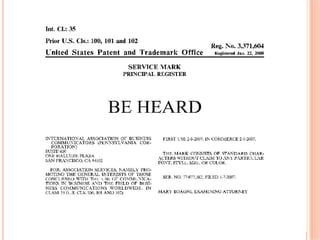
Owning a federal trademark registration on the Principal Register
  provides several advantages:

  constructive notice to the public of the registrant's claim of ownership
  of the mark;

  a legal presumption of the registrant's ownership of the mark and the
  registrant's exclusive right to use the mark nationwide on or in
  connection with the goods and/or services listed in the registration;

  the ability to bring an action concerning the mark in federal court;

  the use of the U.S registration as a basis to obtain registration in
  foreign countries; and

  the ability to file the U.S. registration with the U.S. Customs Service
  to prevent importation of infringing foreign goods.
FIRST STEP IN THE TRADEMARK PROCESS-
BRAND SELECTION…NOT ALL TRADEMARKS ARE
CREATED EQUAL.


 Marks that are made-up, fanciful, arbitrary, or
 suggestive marks are inherently distinctive, and
 are given greater weight in enforcement of
 trademark rights. Ex: KODAK for film products.

 With some exceptions (secondary meaning &
 acquired distinctiveness), descriptive words or
 designs that convey an idea about the quality,
 characteristic or ingredient of the good or service
 the mark is used in conjunction with are weak
 trademarks and are afforded little
 protection. Ex: COMPUTER-FIX-IT for
 computer repair services.
Generic words or designs that are the common
 words or designs for the good or service offered or
 sold have NO TRADEMARK PROTECTION.

Ex. WINDOW CLEANERS offering window
 cleaning services will not be afforded any
 trademark protection because the word elements
 are essentially the generic or common words to
 describe the service offered.
HELPFUL WEBSITES


U.S. Copyright Office-
 www.copyright.gov

United States Patent & Trademark Office-
 www.uspto.gov


              THANK YOU!

Copyrights 101

  • 1.
    Provided by courtesyof: The Law Office of Sunisha S. Choksi 4601 Washington Ave., Suite 200 Houston, Texas 77007 Phone: (832) 319-6724 Fax: (832) 319-6714 sunisha@choksilaw.com
  • 2.
    WHAT IS ACOPYRIGHT? An original, creative expression (work of authorship) affixed to a tangible medium. A type of intellectual property protection established by the U.S. Constitution.... Article I, Section 8, Clause 8 Empowers the United States Congress “ To promote the Progress of Science and useful Arts, by securing for limited Times to Authors and Inventors the exclusive Right to their respective Writings and Discoveries.”
  • 3.
    A COPYRIGHT PROTECTS ORIGINAL & CREATIVE... Literary works Musical works, including any accompanying words Dramatic works, including any accompanying music Pantomimes and choreographic works Pictorial, graphic, and sculptural works Motion pictures and other audiovisual works Sound recordings Architectural works Computer programs Maps Author has to have exercised some independent, intellectual effort to claim a copyright in a given work.
  • 4.
    A COPYRIGHT DOESNOT PROTECT... Works not fixed in a tangible form Facts Ideas Concepts Systems Methods of operation Short phrases, slogans, titles and names Mere listing of ingredients Familiar symbols & designs Typographical ornamentation, lettering or coloring Information that is common property- ex. lists or tables taken from public documents from Fed. Govt.
  • 5.
    WHEN COPYRIGHT PROTECTION VESTS At the moment creation + original work of authorship fixed in a tangible form that it is perceptible either directly or with the aid of a machine or device. Ex. Print copy, digital file The copyright immediately becomes the property of the author(s) who created the work. Registration of work of authorship with the Copyright Office not required to establish a copyright protection.
  • 6.
    "BUNDLE OF RIGHTS"AFFORDED TO COPYRIGHT OWNERS The exclusive right to... Reproduce the work (make copies), Prepare derivative works, Distribute copies of the work, Publicly perform the work & Publicly display the work.
  • 7.
    WHAT IS ADERIVATIVE WORK? Defined in 17 U.S.C. § 101: A work based upon one or more pre- existing works, such as- translation, musical arrangement, dramatization, fictionalization, motion picture version, sound recording, art reproduction, abridgment, condensation, or any other form in which a work may be recast, transformed, or adapted. A work consisting of editorial revisions, annotations, elaborations, or other modifications which, as a whole, represent an original work of authorship, is a “derivative work”.
  • 8.
    HOW LONG DOESA COPYRIGHT LAST? It Depends... All works published in the U.S. before 1923- In the Public Domain Generally, works published after 1922, but before 1978: 95 years from the date of publication For an Individual- All works published after 1977: Life of the author + 70 years For Corporate Authorship under “Work for Hire” or specifically commissioned, after 1977: 95 years from the year of its first publication, or a term of 120 years from the year of its creation, whichever expires first For works published anonymously or under a pseudonym, after 1977: 95 years from the year of its first publication, or a term of 120 years from the year of its creation, whichever expires first
  • 9.
    CORPORATE AUTHORSHIP- WORKS MADE FOR HIRE Section 101 of the copyright law defines a “work made for hire” as A work prepared by an employee within the scope of his or her employment or A work specially ordered or commissioned for use as a Contribution to a collective work, Part of a motion picture or other audiovisual work, Translation, Supplementary work, Compilation, Instructional text, Test, Answer material for a test, or Atlas, And if the parties expressly agree in a written instrument signed by them that the work shall be considered a work made for hire.
  • 10.
    COPYRIGHT NOTICE Consists ofthe symbol or word “copyright (or copr.),” the name of the copyright owner, and the year of first publication: © 2011 Company, Inc. Once required as a condition of copyright protection; now optional though highly recommended to give actual notice of copyright claim. DO NOT require registration with, the Copyright Office to use copyright notice.
  • 11.
    THE BENEFITS OFREGISTERING COPYRIGHTS Registration not required, but a # of advantages... 1. Establishes a public record of the copyright claim. 2. Before an infringement suit may be filed in court, registration necessary for works of U.S. origin. 3. If made before or within five years of publication, registration will establish prima facie evidence in court of the validity of the copyright and of the facts stated in the certificate. 4. If registration is made within 3 months after publication or prior to an infringement of the work, statutory damages and attorney’s fees will be available to the copyright owner in court actions. Otherwise, only an award of actual damages and profits is available to the copyright owner. 5. Can record registration with U.S. Customs Service for protection against the importation of infringing copies. GIVES COPYRIGHT OWNER BETTER ENFORCEMENT MEANS TO PROTECT COPYRIGHTED WORKS
  • 12.
    COPYRIGHTS AS BUSINESSASSETS- ASSIGNMENTS AND LICENSES Any or all of the copyright owner’s exclusive rights may be transferred. The transfer of exclusive rights (exclusive license or assignment) is not valid unless that transfer is in writing and signed by the owner of the rights conveyed or the owner’s authorized agent. Copyrights may also be conveyed by operation of law and may be bequeathed by will or pass as personal property by the applicable laws of intestate succession. Types of transfers: Licenses – Owner retains copyright but allows 3rd parties the right to use copyrighted content under certain terms and conditions. Assignment- Owner transfers all rights, title & interest to a 3rd party.
  • 13.
    COPYRIGHT INFRINGEMENT Violation ofthe “bundle of rights” afforded to the copyright owner. Alleged Infringer- Anyone who, without the permission or consent of the copyright owner... Reproduces the work (make copies), Prepares derivative works, Distributes copies of the work, Publicly performs the work &/or Publicly displays the work. Prove infringement by showing: 1) infringer had access to the copyrighted work & 2) infringer’s work is substantially similar to the copyrighted work.
  • 14.
    INFRINGEMENT- FAIR USE (SECTION107 OF THE COPYRIGHT LAW) Reproduction of a particular work may be considered fair when: Criticism Commentary News reporting Teaching Scholarship Research Parody (often found by courts to be “fair use”) Section 107 also sets out four factors to be considered in determining whether or not a particular use is fair: The purpose and character of the use, including whether such use is of commercial nature or is for nonprofit educational purposes. The nature of the copyrighted work. The amount and substantiality of the portion used in relation to the copyrighted work as a whole. The effect of the use upon the potential market for, or value of, the copyrighted work.
  • 15.
    DMCA TAKE DOWNNOTICE PROVISION Created under the Digital Millennium Copyright Act as a “Safe Harbor” provision to shield Internet Service Providers (ISP) from contributory infringement. ISP required to maintain and record information with the U.S. Copyright Office regarding their DMCA agent designated to address copyright infringement issues. Copyright owners can demand removal of allegedly infringing content by sending a take-down notice to ISP’s designated DMCA agent. If complete, ISP will either remove or disable website containing alleged infringing work.
  • 16.
    BASICS ON TRADEMARKS
  • 17.
    WHAT IS ATRADEMARK? A Trademark can be… a word, ex: “EXXON” for oil products a phrase, ex: “JUST DO IT” for sports apparel a symbol, ex: the NIKE “Swoosh” for sports apparel a design, ex: The DISNEY “Cinderella Castle” for children’s toys
  • 18.
    WHAT IS ATRADEMARK? As well as… sounds, ex: NBC chimes 3D objects, ex: the Coca-Cola bottle or a combination of the above, that identifies and distinguishes the source of the goods of one party from those of others.
  • 19.
    WHAT IS ASERVICE MARK? Like a trademark, except that it identifies and distinguishes the source of a service rather than a product. Throughout this presentation, the terms "trademark" and "mark" refer to both trademarks and service marks.
  • 20.
    A trademark isnever a word or logo by itself…it is used to identify specific goods and services. Helps your customers to make purchasing decisions regarding your goods and services because of a prior experience with the products or from recognition of a marketing or advertising campaign. There is an expectation by the customer regarding the quality associated with the branded products or services. (Good Will)
  • 21.
    KEY POINTS TOREMEMBER ABOUT TRADEMARKS: Function as a source identifier of the goods and/ or services that your business offers in the market place. Create tangible business assets related to the goodwill and reputation generated by the use of mark. Is a type of property right that can be sold, transferred, and/or licensed creating additional streams of revenue for your business. An important business asset that you want to protect from competitors. Want to avoid a likelihood of confusion by consumers with competitors’ brands.
  • 22.
    WHEN CAN IUSE THE TRADEMARK SYMBOLS TM, SM AND ® IN THE UNITED STATES? "TM" (trademark) or "SM" (service mark): Use any time you claim rights in a mark, in order to alert the public to your claim, regardless of whether you have filed an application with the USPTO. Be aware of conflicts with prior, senior users. Federal Trademark Registration symbol "®": Use only after the USPTO actually registers a mark, and not while an application is pending. Also, you may use the registration symbol with the mark only on or in connection with the goods and/or services listed in the federal trademark registration.
  • 23.
    IS REGISTRATION OFMY MARK REQUIRED IN THE UNITED STATES? No. You can establish rights in a mark based on legitimate, actual use of the mark in commerce. This is based on common law rights you develop in a mark if you are the senior user of the mark in conjunction with specific goods and services in the commerce. However, there a number of benefits to registering you trademarks.
  • 24.
    REGISTERING YOUR BUSINESS’ TRADEMARKS-LOCATION MATTERS You can also register your trademarks at the state level, federal level, as well as in foreign markets, depending on the type of commerce your business is engaged in. If just selling goods and services in Texas to Texas customer…engaging in intrastate commerce…can file for a state trademark registration. If selling goods over seas markets, such as UK or Mexico…may want to register for trademarks in those countries.
  • 25.
    BENEFITS OF REGISTERINGYOUR TRADEMARKS— U.S. FEDERAL TRADEMARK REGISTRATION Owning a federal trademark registration on the Principal Register provides several advantages: constructive notice to the public of the registrant's claim of ownership of the mark; a legal presumption of the registrant's ownership of the mark and the registrant's exclusive right to use the mark nationwide on or in connection with the goods and/or services listed in the registration; the ability to bring an action concerning the mark in federal court; the use of the U.S registration as a basis to obtain registration in foreign countries; and the ability to file the U.S. registration with the U.S. Customs Service to prevent importation of infringing foreign goods.
  • 27.
    FIRST STEP INTHE TRADEMARK PROCESS- BRAND SELECTION…NOT ALL TRADEMARKS ARE CREATED EQUAL. Marks that are made-up, fanciful, arbitrary, or suggestive marks are inherently distinctive, and are given greater weight in enforcement of trademark rights. Ex: KODAK for film products. With some exceptions (secondary meaning & acquired distinctiveness), descriptive words or designs that convey an idea about the quality, characteristic or ingredient of the good or service the mark is used in conjunction with are weak trademarks and are afforded little protection. Ex: COMPUTER-FIX-IT for computer repair services.
  • 28.
    Generic words ordesigns that are the common words or designs for the good or service offered or sold have NO TRADEMARK PROTECTION. Ex. WINDOW CLEANERS offering window cleaning services will not be afforded any trademark protection because the word elements are essentially the generic or common words to describe the service offered.
  • 29.
    HELPFUL WEBSITES U.S. CopyrightOffice- www.copyright.gov United States Patent & Trademark Office- www.uspto.gov THANK YOU!