Richard Wilson
    02/11/2012
    Revision 3
What is copyright?
   A legal statement enforced
    by the courts to protect
    intellectual property.

   Comprehensive by default
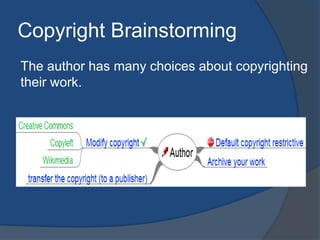
Copyright Brainstorming
The author has many choices about copyrighting
their work.
Handling Orphan Works
   The author cannot be found

   Legislation protects orphan works

   Overprotection is culturally limiting
   Google, UT others developing tools to
    help free what is in public domain
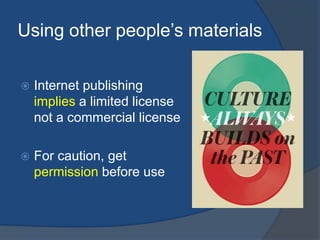
Using other people’s materials

   Internet publishing
    implies a limited license
    not a commercial license

   For caution, get
    permission before use
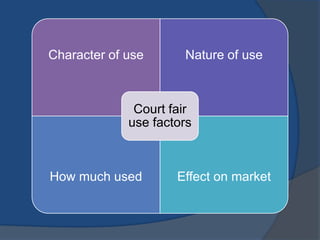
Character of use      Nature of use


              Court fair
             use factors


How much used        Effect on market
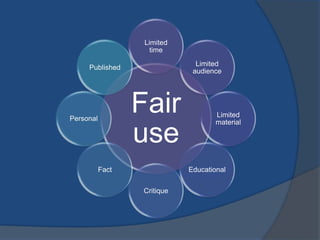
Limited
                     time
                                Limited
     Published
                               audience


Personal
                  Fair                Limited
                                      material

                  use
           Fact               Educational

                   Critique
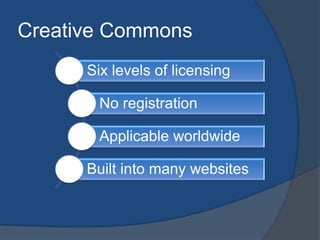
Creative Commons
      Six levels of licensing

        No registration

        Applicable worldwide

      Built into many websites
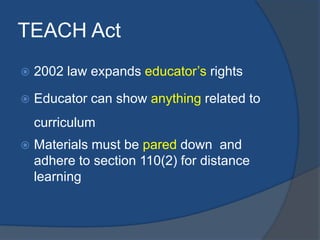
TEACH Act
   2002 law expands educator’s rights

   Educator can show anything related to
    curriculum
   Materials must be pared down and
    adhere to section 110(2) for distance
    learning
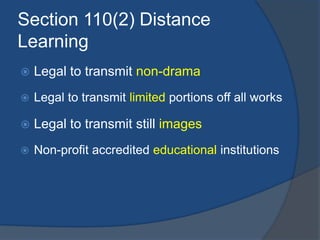
Section 110(2) Distance
Learning
   Legal to transmit non-drama
   Legal to transmit limited portions off all works

   Legal to transmit still images
   Non-profit accredited educational institutions
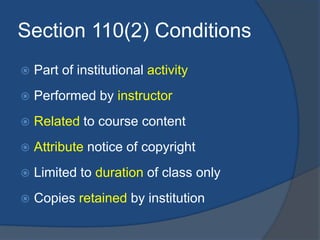
Section 110(2) Conditions
   Part of institutional activity
   Performed by instructor
   Related to course content
   Attribute notice of copyright
   Limited to duration of class only
   Copies retained by institution
References
Colindunn, (2012). Culture Builds. Retrieved from
       http://www.flickr.com/photos/colindunn/5161119769/size
       s/o/in/photostream/

Creative Commons, (2012). Who uses CC ?. Retrieved from
       http://creativecommons.org/who-uses-cc

University of Texas Libraries, (2007). Copyright Crash Course.
       Retrieved from http://copyright.lib.utexas.edu/

Copyright rev0.3

  • 1.
    Richard Wilson 02/11/2012 Revision 3
  • 2.
    What is copyright?  A legal statement enforced by the courts to protect intellectual property.  Comprehensive by default
  • 3.
    Copyright Brainstorming The authorhas many choices about copyrighting their work.
  • 4.
    Handling Orphan Works  The author cannot be found  Legislation protects orphan works  Overprotection is culturally limiting  Google, UT others developing tools to help free what is in public domain
  • 5.
    Using other people’smaterials  Internet publishing implies a limited license not a commercial license  For caution, get permission before use
  • 6.
    Character of use Nature of use Court fair use factors How much used Effect on market
  • 7.
    Limited time Limited Published audience Personal Fair Limited material use Fact Educational Critique
  • 8.
    Creative Commons Six levels of licensing No registration Applicable worldwide Built into many websites
  • 9.
    TEACH Act  2002 law expands educator’s rights  Educator can show anything related to curriculum  Materials must be pared down and adhere to section 110(2) for distance learning
  • 10.
    Section 110(2) Distance Learning  Legal to transmit non-drama  Legal to transmit limited portions off all works  Legal to transmit still images  Non-profit accredited educational institutions
  • 11.
    Section 110(2) Conditions  Part of institutional activity  Performed by instructor  Related to course content  Attribute notice of copyright  Limited to duration of class only  Copies retained by institution
  • 12.
    References Colindunn, (2012). CultureBuilds. Retrieved from http://www.flickr.com/photos/colindunn/5161119769/size s/o/in/photostream/ Creative Commons, (2012). Who uses CC ?. Retrieved from http://creativecommons.org/who-uses-cc University of Texas Libraries, (2007). Copyright Crash Course. Retrieved from http://copyright.lib.utexas.edu/