Copyright © Cengage Learning. All rights reserved.
CHAPTER 3
The Interorganizational Context of Public Administration
1. Understanding the relationships among the many groups—
public, private, and
nonprofit—that drive the effectiveness of public programs and
affect the work of the
public manager
2. Learning about the federal system of government and the
complexities of
intergovernmental relations that result from federalism
3. Understanding how the relationship and power division
between federal and state
governments has evolved
4. Exploring the issues associated with privatization and
contracting and public-private
partnerships
5. Understanding the unique challenges of nonprofit
organizations
This chapter is concerned with relationships among public-
sector organizations, an issue that has
become an increasingly important focus for public
administrators at all levels. Given the
complexity of modern society, the work of a public
administrator likely will involve an intricate
set of relationships with a variety of groups external to the
administrator’s own agency, including
public, nonprofit, and private organizations. The chapter
includes a comprehensive discussion
about the concept of intergovernmental relations (IGR), which
the authors define as “the complex
and interdependent relationships among those at various levels
of government as they seek to
develop and implement public programs,” and federalism, which
is the relationship and division
of power between the federal government and state
governments.
This discussion addresses the changing patterns of funding for
public programs, which is
instrumental to an understanding of intergovernmental relations,
and touches on the various
approaches to federalism that have been employed in the United
States. This includes a
description of how recent presidential administrations, from
Reagan to Obama, have approached
the relationship between the federal government and the states,
and offers insights into the courts’
influence in this area as well. This chapter also addresses IGR
from the perspective of states and
localities, including funding and the use of preemptions and
mandates, and includes a discussion
of subnational relationships, including state-to-state, state-to-
local, and local-to-local.
This is followed by an examination of the relationships between
governmental and
nongovernmental organizations in the public sector,
highlighting the role of the latter in the
policy process. As the authors note, not only have nonprofit,
for-profit, and faith-based
organizations taken a leading role in delivering public services,
they also play an important part in
bringing issues to the public agenda and influencing decisions
about public problems. An
important theme running throughout this discussion concerns a
description and an evaluation of
30 Chapter 3: The Interorganizational Context of Public
Administration
Copyright © Cengage Learning. All rights reserved.
privatization and contracting and public-private partnership
trends. This includes an exploration
into the rationale for these approaches and the challenges and
benefits associated with each.
The chapter concludes with a consideration of the management
of nonprofit organizations.
Because these organizations face distinct challenges, and
because they play an increasingly
important role in defining and delivering public programs, an
understanding of the way in which
these organizations operate is important to the public
administrator in order to develop more
effective interorganizational or cross-sector relationships. In
closing, the authors note that
because public programs in today’s society operate through vast
and complex webs of people and
organizations, including public, private, and nonprofit, public
managers need to develop the
ability to identify the network of people and organizations that
is or should be involved in a
particular situation and assess the effectiveness of that network.
Understanding how the various
people and organizations operate is a key to this ability.
MANAGEMENT
I. THE DEVELOPMENT OF INTERGOVERNMENTAL
RELATIONS
A. Dual Federalism
B. Cooperative Federalism
C. Picket-Fence Federalism
D. The Reagan and First Bush Years
E. The Clinton Presidency
F. The Bush Administration
GOVERNANCE:
GLOBALIZATION, DEVOLUTION, AND THE ROLE OF
GOVERNMENT
G. Obama and Federalism
H. Judicial Influence
I. The State and Local Perspective
J. Funding Patterns
K. Preemptions and Mandates
1. Preemptions
2. Mandates
L. Subnational Relationships
1. State to State
2. State to Local
3. Local to Local
II. WORKING WITH NONGOVERNMENTAL
ORGANIZATIONS
A. Privatization and Contracting
Chapter 3: The Interorganizational Context of Public
Administration 31
Copyright © Cengage Learning. All rights reserved.
III. THE MANAGEMENT OF NONPROFIT ORGANIZATIONS
A. Operational Leadership
B. Resource Development
C. Financial Management
D. Board Governance
E. Board-Staff Relations
F. Advocacy
IV. SUMMARY AND ACTION IMPLICATIONS
Block grants Grants in which the money can be used for nearly
any purpose within a specific
functional field.
Capital grants Grants for use in construction or renovation.
Categorical or project grants Grants requiring that the money
may be spent for only a limited
purpose; typically available on a competitive basis.
Charter Local government’s equivalent of a constitution.
Cooperative federalism Greater sharing of responsibilities
between federal and state
governments.
Coproduction Using volunteer activity to supplement or
supplant the work of government
officials.
Councils of government Oversight bodies representing various
localities to help coordinate
local affairs.
Cross-cutting requirements Rules that apply to most grant
programs.
Dillon’s Rule Municipalities have only those powers granted in
their charters; cities are creatures
of the state.
Direct orders Requirements or restrictions that are enforced by
one government over another.
Dual federalism Pattern in which federal and state governments
are struggling for power and
influence with little intergovernmental cooperation.
Entitlement grants Grants that provide assistance to persons
who meet certain criteria.
Formula grants Grants that employ a specific division rule to
indicate how much money any
given jurisdiction will receive.
Franchise Exclusive award to one firm (or a limited number) to
operate a certain business within
a jurisdiction.
Grants Transfers of money (and/or property) from one
government to another.
Home rule Provision allowing cities greater autonomy over
local activities.
Intergovernmental relations A term encompassing all the
complex and interdependent relations
among those at various levels of government.
32 Chapter 3: The Interorganizational Context of Public
Administration
Copyright © Cengage Learning. All rights reserved.
Interorganizational networks Pattern of relationships within
and among various groups and
organizations working in a single policy area.
Mandate Order requiring a government to do something.
Negotiated investment strategy Bringing together
representatives of all affected groups to set
priorities for funding.
Operating grants Grants for use in development and operation
of specific programs.
Picket-fence federalism Pattern of intergovernmental relations
in which the horizontal bars
represent levels of government and the vertical slats represent
various substantive fields.
Preemption Federal government efforts to preempt an area
traditionally associated with state
government.
Privatization Use of nongovernmental agencies to provide
goods and services previously
provided by government.
Revenue sharing Grant pattern in which the money can be used
any way the recipient
government chooses.
Special districts Local governments created for a specific
purpose within a specific area.
Supply-side economies Argument that decreased taxes and
government spending will stimulate
capital investment and economic growth.
Urban renewal Government program designed to provide cities
with money for public housing
an urban redevelopment.
The following are links to basic information about federal-state-
local interactions:
USA.gov: (www.usa.gov).
The White House: (www.whitehouse.gov).
Governing magazine: (www.governing.com).
The following are links to data related to federal funding for
state and local governments:
Statistical Abstract of the United States:
(http://www.census.gov/compendia/statab/).
Office of Budget and Management:
(http://www.whitehouse.gov/omb/budget/Overview//).
The following are links to information about innovative
practices in government and
nonprofit organizations:
Alliance for Innovation: (http://transformgov.org).
Ash Institute for Democratic Governance and Innovation,
Harvard University:
(http://www.ash.harvard.edu/).
Leader to Leader: (http://www.hesselbeininstitute.org/).
The following are links to information nonprofit management:
Aspen Institute: (www.aspeninstitute.org).
Hauser Center for Nonprofit Organizations, Harvard University:
(www.ksghauser.harvard.edu).
http://www.usa.gov/
http://www.whitehouse.gov/
http://www.governing.com/
http://www.census.gov/compendia/statab/
http://www.whitehouse.gov/omb/budget/Overview/
http://transformgov.org/
http://www.hesselbeininstitute.org/
http://www.aspeninstitute.org/
http://www.ksghauser.harvard.edu/
Title
ABC/123 Version X
1
Conflict Program Proposal
PSY/400 Version 6
1
University of Phoenix Material
Conflict Program Proposal
Approved Topic/At-Risk Group: (Your topic has to be approved
before the proposal is submitted.)
Target Audience: (Who do you want to convince to help with
the issue?)
Central Strategy: (What delivery method or medium will you
use to physically reach your target audience?)
Copyright © XXXX by University of Phoenix. All rights
reserved.
Copyright © 2017 by University of Phoenix. All rights reserved.
Copyright © Cengage Learning. All rights reserved.
CHAPTER 2
The Political Context of Public Administration
1. Understanding the organization and function of the branches
of the federal government
2. Understanding the organization and function of the other
levels of government
3. Understanding the policy process
4. Exploring the controls exerted by the legislative branch on
administrators
5. Exploring the controls exerted by the judicial branch on
administrators
VERVIEW
This chapter explores the political context in which public
administrators operate, including
things administrators need to know in order to operate
effectively. Three themes characterize the
chapter, focusing on the structure of the three levels of
government and the resulting relationship
with public administration. The authors point out that the
complexity of the policy process in this
country derives from the Founders’ fear of concentrating power
in too few hands, which they
tried to allay by organizing the federal government into three
branches. Thus, the relations
between and among the various branches remain a central issue
in the creation and management
of public agencies and programs. The chapter offers insight into
the relationship between public
administrators and the executive, the legislature, and the
judiciary as they work together to
achieve policy goals.
The first theme concerns the history, powers, organization, and
activities of the executive branch
at all levels of government in the United States. The chapter
includes a discussion about the
development of the president’s role as chief executive officer as
the increasing size and scope of
the government created a need for greater attention to
management and organization, along with a
growing understanding of how the work of government might be
accomplished more effectively.
The organization and structure of state and local governments
are contrasted with those of the
federal government, exploring both the commonalities and
distinctive features. The authors
emphasize that understanding the role of executive leadership in
administrative organizations will
enable public administrators to act with greater confidence and
authority.
The second theme provides an account of the structure of
Congress, its operations, policy roles,
and interactions with administrative agencies. Particular
attention is devoted in this context to the
stages in the policy process and the differences between various
types of policy. The chapter also
includes an examination of sources of bureaucratic power and,
in turn, the controls exerted by the
legislative branch over bureaucratic agencies. An understanding
of these issues is crucial to
public administrators, whose work centers on the
implementation of public policies and who
often are involved in designing and evaluating policy as well.
Finally, Chapter 2 examines the role that the courts play in
administrative systems. Like the
executive and legislative branches, the judiciary also serves as a
check on the conduct of public
agencies by interpreting legislative mandates and delegation to
agencies and reviewing the
16 Chapter 2: The Political Context of Public Administration
Copyright © Cengage Learning. All rights reserved.
appropriateness of agency actions. Because the involvement of
the courts in the work of
administration is both intense and inevitable, public
administrators’ understanding of the legal
system and their ability to interact with legal and judicial
officials is necessary in order to
improve their effectiveness.
I. ADMINISTRATIVE ORGANIZATIONS AND EXECUTIVE
LEADERSHIP
A. Administrative Organizations
1. The Executive Office of the President
2. Cabinet-Level Executive Departments
3. Independent Agencies, Regulatory Commissions, and Public
Corporations
4. Agencies Supporting the Legislature and the Judiciary
B. The State Level
C. The Local Level
1. Cities
2. Counties
3. Native American Tribes
4. Special Purpose Governments
5. Nonprofit Organizations and Associations
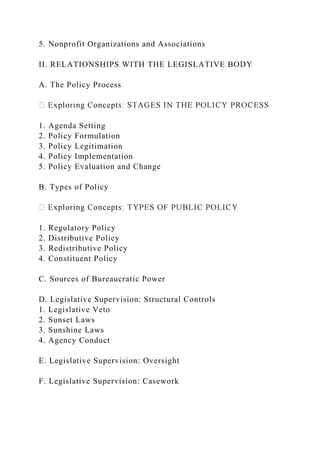
II. RELATIONSHIPS WITH THE LEGISLATIVE BODY
A. The Policy Process
1. Agenda Setting
2. Policy Formulation
3. Policy Legitimation
4. Policy Implementation
5. Policy Evaluation and Change
B. Types of Policy
1. Regulatory Policy
2. Distributive Policy
3. Redistributive Policy
4. Constituent Policy
C. Sources of Bureaucratic Power
D. Legislative Supervision: Structural Controls
1. Legislative Veto
2. Sunset Laws
3. Sunshine Laws
4. Agency Conduct
E. Legislative Supervision: Oversight
F. Legislative Supervision: Casework
Chapter 2: The Political Context of Public Administration 17
Copyright © Cengage Learning. All rights reserved.
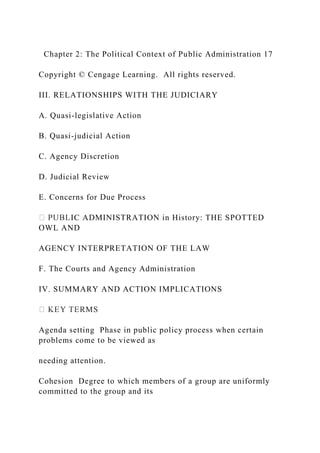
III. RELATIONSHIPS WITH THE JUDICIARY
A. Quasi-legislative Action
B. Quasi-judicial Action
C. Agency Discretion
D. Judicial Review
E. Concerns for Due Process
IC ADMINISTRATION in History: THE SPOTTED
OWL AND
AGENCY INTERPRETATION OF THE LAW
F. The Courts and Agency Administration
IV. SUMMARY AND ACTION IMPLICATIONS
Agenda setting Phase in public policy process when certain
problems come to be viewed as
needing attention.
Cohesion Degree to which members of a group are uniformly
committed to the group and its
goals.
Constituent policy Policy designed to benefit the public
generally or to serve the government.
Distributive policy Policy involving use of general tax funds to
provide assistance and benefits
to individuals or groups.
Executive order A presidential mandate directed to and
governing, with the effect of law, the
actions of government officials and agencies.
Independent agencies Agencies intentionally created outside
the normal cabinet organization.
Iron triangle Term given to a coalition of interest groups,
agency personnel, and members of
Congress created to exert influence on a particular policy issue.
Legislative veto Statutory provision that gives Congress the
authority to approve or disapprove
certain executive actions.
Nonprofit organizations Organizations prohibited by law from
distributing surplus revenues to
individuals.
Ombudsman Permanent office that receives complaints and acts
on behalf of citizens to secure
information, request services, or pursue grievances.
Policy Statement of goals and intentions with respect to a
particular problem or set of problems.
Policy entrepreneur A person willing to invest personal time,
energy, and money in pursuit of
particular policy changes.
Public corporation An essentially commercial agency in which
work requires greater latitude
and acquires at least a portion of its funding in the marketplace
(e.g., Tennessee Valley
Authority).
Public policy Authoritative statements made by legitimate
governmental actors about public
problems.
18 Chapter 2: The Political Context of Public Administration
Copyright © Cengage Learning. All rights reserved.
Redistributive policy Policy designed to take taxes from certain
groups and give them to
another group.
Regulatory commission Group formed to regulate a particular
area of the economy; usually
headed by a group of individuals appointed by the president and
confirmed by the Senate.
Regulatory policy Policy designed to limit actions of persons
or groups to protect all or parts of
the general public.
Rule making Administrative establishment of general
guidelines for application to a class of
people or a class of actions at some future time.
Sunset law Provision that sets a specific termination date for a
program.
Sunshine law Provision that requires agencies to conduct
business in public view.
The following are links to websites that can provide information
about the executive branch
of the federal government and of state and local governments:
The White House: (www.whitehouse.gov).
The federal executive branch:
(www.usa.gov/Agencies//Federal/Executive.shtml).
Executive orders: (http://www.whitehouse.gov/briefing-
room/presidential-actions/executive-
orders).
State, local, and tribal governments:
(http://www.usa.gov/Agencies.shtml).
Council of State Governments: (www.csg.org).
National League of Cities: (www.nlc.org/).
National Civic League: (www.ncl.org).
U.S. Conference of Mayors: (www.usmayors.org/).
International City Management Association: (www.icma.org).
The following are links to websites that can provide information
about nonprofit
organizations:
Alliance for Nonprofit Management: (www.allianceonline.org/).
CompassPoint Nonprofit Services:
(http://www.compasspoint.org/).
Foundations: (www.cof.org and www.foundations.org/).
The following are links to sources about policy making and
legislative and judiciary
controls:
The United States Congress: (http://house.gov/).
The United States Senate: (http://www.senate.gov/).
The Library of Congress: (http://www.loc.gov/index.html).
The United States Supreme Court:
(http://www.supremecourt.gov/).
The Brookings Institution: (www.brookings.edu).
The American Enterprise Institute: (http://www.aei.org/).
http://www.whitehouse.gov/
http://www.usa.gov/Agencies/Federal/Executive.shtml
http://www.whitehouse.gov/briefing-room/presidential-
actions/executive-orders
http://www.whitehouse.gov/briefing-room/presidential-
actions/executive-orders
http://www.usa.gov/Agencies.shtml
http://www.csg.org/
http://www.nlc.org/
http://www.ncl.org/
http://www.usmayors.org/
http://www.icma.org/
http://www.allianceonline.org/
http://www.compasspoint.org/
http://www.cof.org/
http://www.foundations.org/
http://house.gov/
http://www.senate.gov/
http://www.loc.gov/index.html
http://www.supremecourt.gov/
http://www.brookings.edu/
http://www.aei.org/
Chapter 2: The Political Context of Public Administration 19
Copyright © Cengage Learning. All rights reserved.
The Urban Institute: (http://www.urban.org/).
Center for Lobbying in the Public Interest:
(http://www.clpi.org/).
The Nonprofit Lobbying Guide:
(http://www.independentsector.org/lobby_guide).
Administrative law research:
(http://public.findlaw.com/library/pa-administrative-law.html).
http://www.urban.org/
http://www.clpi.org/
http://www.independentsector.org/lobby_guide
http://public.findlaw.com/library/pa-administrative-law.html
Copyright © Cengage Learning. All rights reserved.
CHAPTER 1
Personal Action in Public Organizations
1. Defining public administration
2. Understanding the differences between public and business
administration
3. Identifying values and conflicts of public administration and
the complexity of the work
4. Understanding why one should study public administration
5. Understanding the issues that underlie the intellectual and
practical context of public
administration
The purpose of Chapter 1 is to introduce students to the
complexity of public administration and
the work of the public administrator. Approaching the topic
from both a theoretical and practical
point of view, the authors offer a detailed description of the
field of public administration. The
chapter includes a definition of public administration along with
a brief history of the field, with a
special emphasis on how the values of democracy affect the
practice of public administration.
The authors outline the reasons for their view that public
administrators are obligated not only to
achieve efficiency and effectiveness but to be responsive to the
many stakeholders who help
define the public interest and discuss the concerns that
administrators need to keep in mind as
they meet this obligation.
In addition, the chapter explores the differences between public
and business administration,
particularly in the areas of ambiguity, decision-making
processes, and visibility. Emphasizing the
concept of “publicness,” the authors address the inevitable
tension between efficiency and
responsiveness that is central to the work of public
administrators and also highlight the
increasing importance of understanding the activities of
political and administrative officials in a
global context. A key component of Chapter 1 is a focus on
what public and nonprofit managers
actually do, including a discussion about the characteristics of
the most effective and responsible
public and nonprofit managers and the kinds of skills the work
of public administration requires.
The chapter also includes a discussion about the reasons why
various people study public
administration and how the study of public administration can
help prepare for administrative
positions. The authors touch on the interaction of government
and business and the importance of
public administration in everyday life and emphasize that
understanding the world of
administrative action not only is the basis for good scholarship
but also for making things happen
in the public service.
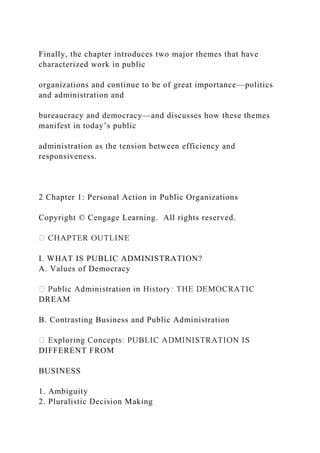
Finally, the chapter introduces two major themes that have
characterized work in public
organizations and continue to be of great importance—politics
and administration and
bureaucracy and democracy—and discusses how these themes
manifest in today’s public
administration as the tension between efficiency and
responsiveness.
2 Chapter 1: Personal Action in Public Organizations
Copyright © Cengage Learning. All rights reserved.
I. WHAT IS PUBLIC ADMINISTRATION?
A. Values of Democracy
DREAM
B. Contrasting Business and Public Administration
DIFFERENT FROM
BUSINESS
1. Ambiguity
2. Pluralistic Decision Making
3. Visibility
C. Thinking about Public Administration Today
1. Publicness
2. The Global Context
II. WHAT DO PUBLIC ADMINISTRATORS DO?
A. An Inventory of Public Management Skills
B. Voices of Public Administrators
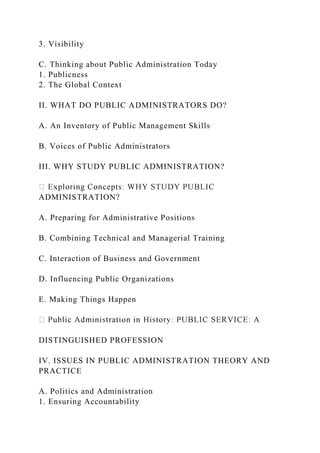
III. WHY STUDY PUBLIC ADMINISTRATION?
ADMINISTRATION?
A. Preparing for Administrative Positions
B. Combining Technical and Managerial Training
C. Interaction of Business and Government
D. Influencing Public Organizations
E. Making Things Happen
DISTINGUISHED PROFESSION
IV. ISSUES IN PUBLIC ADMINISTRATION THEORY AND
PRACTICE
A. Politics and Administration
1. Ensuring Accountability
B. Bureaucracy and Democracy
C. Efficiency versus Responsiveness
V. SUMMARY AND ACTION IMPLICATIONS
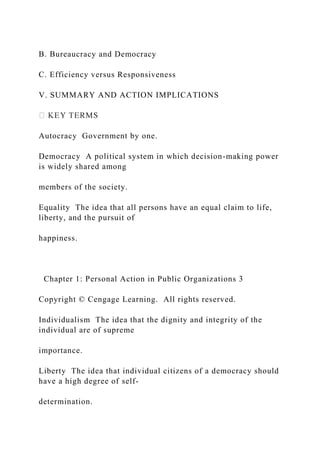
Autocracy Government by one.
Democracy A political system in which decision-making power
is widely shared among
members of the society.
Equality The idea that all persons have an equal claim to life,
liberty, and the pursuit of
happiness.
Chapter 1: Personal Action in Public Organizations 3
Copyright © Cengage Learning. All rights reserved.
Individualism The idea that the dignity and integrity of the
individual are of supreme
importance.
Liberty The idea that individual citizens of a democracy should
have a high degree of self-
determination.
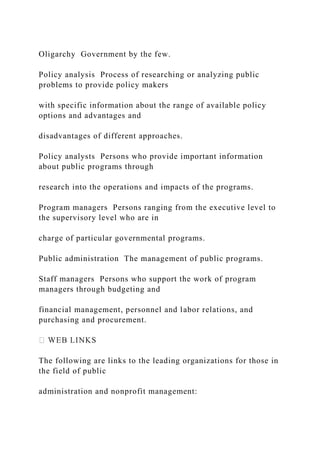
Oligarchy Government by the few.
Policy analysis Process of researching or analyzing public
problems to provide policy makers
with specific information about the range of available policy
options and advantages and
disadvantages of different approaches.
Policy analysts Persons who provide important information
about public programs through
research into the operations and impacts of the programs.
Program managers Persons ranging from the executive level to
the supervisory level who are in
charge of particular governmental programs.
Public administration The management of public programs.
Staff managers Persons who support the work of program
managers through budgeting and
financial management, personnel and labor relations, and
purchasing and procurement.
The following are links to the leading organizations for those in
the field of public
administration and nonprofit management:
Academy of Management, Public and Nonprofit Division:
(http://division.aomonline.org/pnp/).
Alliance for Nonprofit Management: (www.allianceonline.org).
American Political Science Association: (www.apsanet.org).
American Society for Public Administration:
(www.aspanet.org).
Association for Public Policy Analysis and Management:
(www.appam.org).
Independent Sector: (www.independentsector.org).
International City Management Association: (www.icma.org).
National Academy of Public Administration:
(www.napawash.org).
The National Association of Schools of Public Affairs and
Administration: (www.naspaa.org).
The following are links to other helpful sources for both public
and non-profit managers:
Chronicle of Philanthropy: (www.philanthropy.com).
Government Executive magazine: (www.govexec.com).
Office of Personnel Management: (www.opm.gov).
The Public Manager: (www.thepublicmanager.org).
U.S. Census Bureau: (www.census.gov/).
U.S. Government Official Web Portal: (www.governing.com).
http://division.aomonline.org/pnp/
http://www.allianceonline.org/
http://www.apsanet.org/
http://www.aspanet.org/
http://www.appam.org/
http://www.independentsector.org/
http://www.icma.org/
http://www.napawash.org/
http://www.naspaa.org/
http://www.philanthropy.com/
http://www.govexec.com/
http://www.opm.gov/
http://www.thepublicmanager.org/
http://www.census.gov/
http://www.governing.com/

Copyright © Cengage Learning. All rights reserved. CHAPTE.docx

  • 1.
    Copyright © CengageLearning. All rights reserved. CHAPTER 3 The Interorganizational Context of Public Administration 1. Understanding the relationships among the many groups— public, private, and nonprofit—that drive the effectiveness of public programs and affect the work of the public manager 2. Learning about the federal system of government and the complexities of intergovernmental relations that result from federalism 3. Understanding how the relationship and power division between federal and state governments has evolved 4. Exploring the issues associated with privatization and contracting and public-private partnerships 5. Understanding the unique challenges of nonprofit organizations
  • 2.
    This chapter isconcerned with relationships among public- sector organizations, an issue that has become an increasingly important focus for public administrators at all levels. Given the complexity of modern society, the work of a public administrator likely will involve an intricate set of relationships with a variety of groups external to the administrator’s own agency, including public, nonprofit, and private organizations. The chapter includes a comprehensive discussion about the concept of intergovernmental relations (IGR), which the authors define as “the complex and interdependent relationships among those at various levels of government as they seek to develop and implement public programs,” and federalism, which is the relationship and division of power between the federal government and state governments. This discussion addresses the changing patterns of funding for public programs, which is instrumental to an understanding of intergovernmental relations, and touches on the various approaches to federalism that have been employed in the United States. This includes a
  • 3.
    description of howrecent presidential administrations, from Reagan to Obama, have approached the relationship between the federal government and the states, and offers insights into the courts’ influence in this area as well. This chapter also addresses IGR from the perspective of states and localities, including funding and the use of preemptions and mandates, and includes a discussion of subnational relationships, including state-to-state, state-to- local, and local-to-local. This is followed by an examination of the relationships between governmental and nongovernmental organizations in the public sector, highlighting the role of the latter in the policy process. As the authors note, not only have nonprofit, for-profit, and faith-based organizations taken a leading role in delivering public services, they also play an important part in bringing issues to the public agenda and influencing decisions about public problems. An important theme running throughout this discussion concerns a description and an evaluation of 30 Chapter 3: The Interorganizational Context of Public
  • 4.
    Administration Copyright © CengageLearning. All rights reserved. privatization and contracting and public-private partnership trends. This includes an exploration into the rationale for these approaches and the challenges and benefits associated with each. The chapter concludes with a consideration of the management of nonprofit organizations. Because these organizations face distinct challenges, and because they play an increasingly important role in defining and delivering public programs, an understanding of the way in which these organizations operate is important to the public administrator in order to develop more effective interorganizational or cross-sector relationships. In closing, the authors note that because public programs in today’s society operate through vast and complex webs of people and organizations, including public, private, and nonprofit, public managers need to develop the ability to identify the network of people and organizations that is or should be involved in a particular situation and assess the effectiveness of that network. Understanding how the various
  • 5.
    people and organizationsoperate is a key to this ability. MANAGEMENT I. THE DEVELOPMENT OF INTERGOVERNMENTAL RELATIONS A. Dual Federalism B. Cooperative Federalism C. Picket-Fence Federalism D. The Reagan and First Bush Years E. The Clinton Presidency F. The Bush Administration GOVERNANCE: GLOBALIZATION, DEVOLUTION, AND THE ROLE OF GOVERNMENT G. Obama and Federalism H. Judicial Influence I. The State and Local Perspective
  • 6.
    J. Funding Patterns K.Preemptions and Mandates 1. Preemptions 2. Mandates L. Subnational Relationships 1. State to State 2. State to Local 3. Local to Local II. WORKING WITH NONGOVERNMENTAL ORGANIZATIONS A. Privatization and Contracting Chapter 3: The Interorganizational Context of Public Administration 31 Copyright © Cengage Learning. All rights reserved. III. THE MANAGEMENT OF NONPROFIT ORGANIZATIONS A. Operational Leadership B. Resource Development C. Financial Management D. Board Governance E. Board-Staff Relations
  • 7.
    F. Advocacy IV. SUMMARYAND ACTION IMPLICATIONS Block grants Grants in which the money can be used for nearly any purpose within a specific functional field. Capital grants Grants for use in construction or renovation. Categorical or project grants Grants requiring that the money may be spent for only a limited purpose; typically available on a competitive basis. Charter Local government’s equivalent of a constitution. Cooperative federalism Greater sharing of responsibilities between federal and state governments. Coproduction Using volunteer activity to supplement or supplant the work of government officials. Councils of government Oversight bodies representing various localities to help coordinate local affairs.
  • 8.
    Cross-cutting requirements Rulesthat apply to most grant programs. Dillon’s Rule Municipalities have only those powers granted in their charters; cities are creatures of the state. Direct orders Requirements or restrictions that are enforced by one government over another. Dual federalism Pattern in which federal and state governments are struggling for power and influence with little intergovernmental cooperation. Entitlement grants Grants that provide assistance to persons who meet certain criteria. Formula grants Grants that employ a specific division rule to indicate how much money any given jurisdiction will receive. Franchise Exclusive award to one firm (or a limited number) to operate a certain business within a jurisdiction. Grants Transfers of money (and/or property) from one government to another. Home rule Provision allowing cities greater autonomy over local activities. Intergovernmental relations A term encompassing all the
  • 9.
    complex and interdependentrelations among those at various levels of government. 32 Chapter 3: The Interorganizational Context of Public Administration Copyright © Cengage Learning. All rights reserved. Interorganizational networks Pattern of relationships within and among various groups and organizations working in a single policy area. Mandate Order requiring a government to do something. Negotiated investment strategy Bringing together representatives of all affected groups to set priorities for funding. Operating grants Grants for use in development and operation of specific programs. Picket-fence federalism Pattern of intergovernmental relations in which the horizontal bars represent levels of government and the vertical slats represent various substantive fields. Preemption Federal government efforts to preempt an area traditionally associated with state government.
  • 10.
    Privatization Use ofnongovernmental agencies to provide goods and services previously provided by government. Revenue sharing Grant pattern in which the money can be used any way the recipient government chooses. Special districts Local governments created for a specific purpose within a specific area. Supply-side economies Argument that decreased taxes and government spending will stimulate capital investment and economic growth. Urban renewal Government program designed to provide cities with money for public housing an urban redevelopment. The following are links to basic information about federal-state- local interactions: USA.gov: (www.usa.gov). The White House: (www.whitehouse.gov). Governing magazine: (www.governing.com). The following are links to data related to federal funding for
  • 11.
    state and localgovernments: Statistical Abstract of the United States: (http://www.census.gov/compendia/statab/). Office of Budget and Management: (http://www.whitehouse.gov/omb/budget/Overview//). The following are links to information about innovative practices in government and nonprofit organizations: Alliance for Innovation: (http://transformgov.org). Ash Institute for Democratic Governance and Innovation, Harvard University: (http://www.ash.harvard.edu/). Leader to Leader: (http://www.hesselbeininstitute.org/). The following are links to information nonprofit management: Aspen Institute: (www.aspeninstitute.org). Hauser Center for Nonprofit Organizations, Harvard University: (www.ksghauser.harvard.edu). http://www.usa.gov/ http://www.whitehouse.gov/ http://www.governing.com/ http://www.census.gov/compendia/statab/ http://www.whitehouse.gov/omb/budget/Overview/ http://www.whitehouse.gov/omb/budget/Overview/ http://transformgov.org/
  • 12.
    http://www.hesselbeininstitute.org/ http://www.aspeninstitute.org/ http://www.ksghauser.harvard.edu/ Title ABC/123 Version X 1 ConflictProgram Proposal PSY/400 Version 6 1 University of Phoenix Material Conflict Program Proposal Approved Topic/At-Risk Group: (Your topic has to be approved before the proposal is submitted.) Target Audience: (Who do you want to convince to help with the issue?) Central Strategy: (What delivery method or medium will you use to physically reach your target audience?) Copyright © XXXX by University of Phoenix. All rights reserved. Copyright © 2017 by University of Phoenix. All rights reserved. Copyright © Cengage Learning. All rights reserved. CHAPTER 2
  • 13.
    The Political Contextof Public Administration 1. Understanding the organization and function of the branches of the federal government 2. Understanding the organization and function of the other levels of government 3. Understanding the policy process 4. Exploring the controls exerted by the legislative branch on administrators 5. Exploring the controls exerted by the judicial branch on administrators VERVIEW This chapter explores the political context in which public administrators operate, including things administrators need to know in order to operate effectively. Three themes characterize the chapter, focusing on the structure of the three levels of government and the resulting relationship with public administration. The authors point out that the complexity of the policy process in this country derives from the Founders’ fear of concentrating power in too few hands, which they
  • 14.
    tried to allayby organizing the federal government into three branches. Thus, the relations between and among the various branches remain a central issue in the creation and management of public agencies and programs. The chapter offers insight into the relationship between public administrators and the executive, the legislature, and the judiciary as they work together to achieve policy goals. The first theme concerns the history, powers, organization, and activities of the executive branch at all levels of government in the United States. The chapter includes a discussion about the development of the president’s role as chief executive officer as the increasing size and scope of the government created a need for greater attention to management and organization, along with a growing understanding of how the work of government might be accomplished more effectively. The organization and structure of state and local governments are contrasted with those of the federal government, exploring both the commonalities and distinctive features. The authors emphasize that understanding the role of executive leadership in
  • 15.
    administrative organizations will enablepublic administrators to act with greater confidence and authority. The second theme provides an account of the structure of Congress, its operations, policy roles, and interactions with administrative agencies. Particular attention is devoted in this context to the stages in the policy process and the differences between various types of policy. The chapter also includes an examination of sources of bureaucratic power and, in turn, the controls exerted by the legislative branch over bureaucratic agencies. An understanding of these issues is crucial to public administrators, whose work centers on the implementation of public policies and who often are involved in designing and evaluating policy as well. Finally, Chapter 2 examines the role that the courts play in administrative systems. Like the executive and legislative branches, the judiciary also serves as a check on the conduct of public agencies by interpreting legislative mandates and delegation to agencies and reviewing the
  • 16.
    16 Chapter 2:The Political Context of Public Administration Copyright © Cengage Learning. All rights reserved. appropriateness of agency actions. Because the involvement of the courts in the work of administration is both intense and inevitable, public administrators’ understanding of the legal system and their ability to interact with legal and judicial officials is necessary in order to improve their effectiveness. I. ADMINISTRATIVE ORGANIZATIONS AND EXECUTIVE LEADERSHIP A. Administrative Organizations 1. The Executive Office of the President 2. Cabinet-Level Executive Departments 3. Independent Agencies, Regulatory Commissions, and Public Corporations 4. Agencies Supporting the Legislature and the Judiciary B. The State Level C. The Local Level 1. Cities 2. Counties 3. Native American Tribes 4. Special Purpose Governments
  • 17.
    5. Nonprofit Organizationsand Associations II. RELATIONSHIPS WITH THE LEGISLATIVE BODY A. The Policy Process 1. Agenda Setting 2. Policy Formulation 3. Policy Legitimation 4. Policy Implementation 5. Policy Evaluation and Change B. Types of Policy 1. Regulatory Policy 2. Distributive Policy 3. Redistributive Policy 4. Constituent Policy C. Sources of Bureaucratic Power D. Legislative Supervision: Structural Controls 1. Legislative Veto 2. Sunset Laws 3. Sunshine Laws 4. Agency Conduct E. Legislative Supervision: Oversight F. Legislative Supervision: Casework
  • 18.
    Chapter 2: ThePolitical Context of Public Administration 17 Copyright © Cengage Learning. All rights reserved. III. RELATIONSHIPS WITH THE JUDICIARY A. Quasi-legislative Action B. Quasi-judicial Action C. Agency Discretion D. Judicial Review E. Concerns for Due Process IC ADMINISTRATION in History: THE SPOTTED OWL AND AGENCY INTERPRETATION OF THE LAW F. The Courts and Agency Administration IV. SUMMARY AND ACTION IMPLICATIONS Agenda setting Phase in public policy process when certain problems come to be viewed as needing attention. Cohesion Degree to which members of a group are uniformly committed to the group and its
  • 19.
    goals. Constituent policy Policydesigned to benefit the public generally or to serve the government. Distributive policy Policy involving use of general tax funds to provide assistance and benefits to individuals or groups. Executive order A presidential mandate directed to and governing, with the effect of law, the actions of government officials and agencies. Independent agencies Agencies intentionally created outside the normal cabinet organization. Iron triangle Term given to a coalition of interest groups, agency personnel, and members of Congress created to exert influence on a particular policy issue. Legislative veto Statutory provision that gives Congress the authority to approve or disapprove certain executive actions. Nonprofit organizations Organizations prohibited by law from distributing surplus revenues to individuals. Ombudsman Permanent office that receives complaints and acts on behalf of citizens to secure
  • 20.
    information, request services,or pursue grievances. Policy Statement of goals and intentions with respect to a particular problem or set of problems. Policy entrepreneur A person willing to invest personal time, energy, and money in pursuit of particular policy changes. Public corporation An essentially commercial agency in which work requires greater latitude and acquires at least a portion of its funding in the marketplace (e.g., Tennessee Valley Authority). Public policy Authoritative statements made by legitimate governmental actors about public problems. 18 Chapter 2: The Political Context of Public Administration Copyright © Cengage Learning. All rights reserved. Redistributive policy Policy designed to take taxes from certain groups and give them to another group. Regulatory commission Group formed to regulate a particular area of the economy; usually
  • 21.
    headed by agroup of individuals appointed by the president and confirmed by the Senate. Regulatory policy Policy designed to limit actions of persons or groups to protect all or parts of the general public. Rule making Administrative establishment of general guidelines for application to a class of people or a class of actions at some future time. Sunset law Provision that sets a specific termination date for a program. Sunshine law Provision that requires agencies to conduct business in public view. The following are links to websites that can provide information about the executive branch of the federal government and of state and local governments: The White House: (www.whitehouse.gov). The federal executive branch: (www.usa.gov/Agencies//Federal/Executive.shtml). Executive orders: (http://www.whitehouse.gov/briefing- room/presidential-actions/executive- orders).
  • 22.
    State, local, andtribal governments: (http://www.usa.gov/Agencies.shtml). Council of State Governments: (www.csg.org). National League of Cities: (www.nlc.org/). National Civic League: (www.ncl.org). U.S. Conference of Mayors: (www.usmayors.org/). International City Management Association: (www.icma.org). The following are links to websites that can provide information about nonprofit organizations: Alliance for Nonprofit Management: (www.allianceonline.org/). CompassPoint Nonprofit Services: (http://www.compasspoint.org/). Foundations: (www.cof.org and www.foundations.org/). The following are links to sources about policy making and legislative and judiciary controls: The United States Congress: (http://house.gov/). The United States Senate: (http://www.senate.gov/). The Library of Congress: (http://www.loc.gov/index.html).
  • 23.
    The United StatesSupreme Court: (http://www.supremecourt.gov/). The Brookings Institution: (www.brookings.edu). The American Enterprise Institute: (http://www.aei.org/). http://www.whitehouse.gov/ http://www.usa.gov/Agencies/Federal/Executive.shtml http://www.whitehouse.gov/briefing-room/presidential- actions/executive-orders http://www.whitehouse.gov/briefing-room/presidential- actions/executive-orders http://www.usa.gov/Agencies.shtml http://www.csg.org/ http://www.nlc.org/ http://www.ncl.org/ http://www.usmayors.org/ http://www.icma.org/ http://www.allianceonline.org/ http://www.compasspoint.org/ http://www.cof.org/ http://www.foundations.org/ http://house.gov/ http://www.senate.gov/ http://www.loc.gov/index.html http://www.supremecourt.gov/ http://www.brookings.edu/ http://www.aei.org/ Chapter 2: The Political Context of Public Administration 19 Copyright © Cengage Learning. All rights reserved.
  • 24.
    The Urban Institute:(http://www.urban.org/). Center for Lobbying in the Public Interest: (http://www.clpi.org/). The Nonprofit Lobbying Guide: (http://www.independentsector.org/lobby_guide). Administrative law research: (http://public.findlaw.com/library/pa-administrative-law.html). http://www.urban.org/ http://www.clpi.org/ http://www.independentsector.org/lobby_guide http://public.findlaw.com/library/pa-administrative-law.html Copyright © Cengage Learning. All rights reserved. CHAPTER 1 Personal Action in Public Organizations 1. Defining public administration 2. Understanding the differences between public and business administration 3. Identifying values and conflicts of public administration and the complexity of the work 4. Understanding why one should study public administration
  • 25.
    5. Understanding theissues that underlie the intellectual and practical context of public administration The purpose of Chapter 1 is to introduce students to the complexity of public administration and the work of the public administrator. Approaching the topic from both a theoretical and practical point of view, the authors offer a detailed description of the field of public administration. The chapter includes a definition of public administration along with a brief history of the field, with a special emphasis on how the values of democracy affect the practice of public administration. The authors outline the reasons for their view that public administrators are obligated not only to achieve efficiency and effectiveness but to be responsive to the many stakeholders who help define the public interest and discuss the concerns that administrators need to keep in mind as they meet this obligation. In addition, the chapter explores the differences between public and business administration, particularly in the areas of ambiguity, decision-making
  • 26.
    processes, and visibility.Emphasizing the concept of “publicness,” the authors address the inevitable tension between efficiency and responsiveness that is central to the work of public administrators and also highlight the increasing importance of understanding the activities of political and administrative officials in a global context. A key component of Chapter 1 is a focus on what public and nonprofit managers actually do, including a discussion about the characteristics of the most effective and responsible public and nonprofit managers and the kinds of skills the work of public administration requires. The chapter also includes a discussion about the reasons why various people study public administration and how the study of public administration can help prepare for administrative positions. The authors touch on the interaction of government and business and the importance of public administration in everyday life and emphasize that understanding the world of administrative action not only is the basis for good scholarship but also for making things happen in the public service.
  • 27.
    Finally, the chapterintroduces two major themes that have characterized work in public organizations and continue to be of great importance—politics and administration and bureaucracy and democracy—and discusses how these themes manifest in today’s public administration as the tension between efficiency and responsiveness. 2 Chapter 1: Personal Action in Public Organizations Copyright © Cengage Learning. All rights reserved. I. WHAT IS PUBLIC ADMINISTRATION? A. Values of Democracy DREAM B. Contrasting Business and Public Administration DIFFERENT FROM BUSINESS 1. Ambiguity 2. Pluralistic Decision Making
  • 28.
    3. Visibility C. Thinkingabout Public Administration Today 1. Publicness 2. The Global Context II. WHAT DO PUBLIC ADMINISTRATORS DO? A. An Inventory of Public Management Skills B. Voices of Public Administrators III. WHY STUDY PUBLIC ADMINISTRATION? ADMINISTRATION? A. Preparing for Administrative Positions B. Combining Technical and Managerial Training C. Interaction of Business and Government D. Influencing Public Organizations E. Making Things Happen DISTINGUISHED PROFESSION IV. ISSUES IN PUBLIC ADMINISTRATION THEORY AND PRACTICE A. Politics and Administration 1. Ensuring Accountability
  • 29.
    B. Bureaucracy andDemocracy C. Efficiency versus Responsiveness V. SUMMARY AND ACTION IMPLICATIONS Autocracy Government by one. Democracy A political system in which decision-making power is widely shared among members of the society. Equality The idea that all persons have an equal claim to life, liberty, and the pursuit of happiness. Chapter 1: Personal Action in Public Organizations 3 Copyright © Cengage Learning. All rights reserved. Individualism The idea that the dignity and integrity of the individual are of supreme importance. Liberty The idea that individual citizens of a democracy should have a high degree of self- determination.
  • 30.
    Oligarchy Government bythe few. Policy analysis Process of researching or analyzing public problems to provide policy makers with specific information about the range of available policy options and advantages and disadvantages of different approaches. Policy analysts Persons who provide important information about public programs through research into the operations and impacts of the programs. Program managers Persons ranging from the executive level to the supervisory level who are in charge of particular governmental programs. Public administration The management of public programs. Staff managers Persons who support the work of program managers through budgeting and financial management, personnel and labor relations, and purchasing and procurement. The following are links to the leading organizations for those in the field of public administration and nonprofit management:
  • 31.
    Academy of Management,Public and Nonprofit Division: (http://division.aomonline.org/pnp/). Alliance for Nonprofit Management: (www.allianceonline.org). American Political Science Association: (www.apsanet.org). American Society for Public Administration: (www.aspanet.org). Association for Public Policy Analysis and Management: (www.appam.org). Independent Sector: (www.independentsector.org). International City Management Association: (www.icma.org). National Academy of Public Administration: (www.napawash.org). The National Association of Schools of Public Affairs and Administration: (www.naspaa.org). The following are links to other helpful sources for both public and non-profit managers: Chronicle of Philanthropy: (www.philanthropy.com). Government Executive magazine: (www.govexec.com). Office of Personnel Management: (www.opm.gov). The Public Manager: (www.thepublicmanager.org). U.S. Census Bureau: (www.census.gov/).
  • 32.
    U.S. Government OfficialWeb Portal: (www.governing.com). http://division.aomonline.org/pnp/ http://www.allianceonline.org/ http://www.apsanet.org/ http://www.aspanet.org/ http://www.appam.org/ http://www.independentsector.org/ http://www.icma.org/ http://www.napawash.org/ http://www.naspaa.org/ http://www.philanthropy.com/ http://www.govexec.com/ http://www.opm.gov/ http://www.thepublicmanager.org/ http://www.census.gov/ http://www.governing.com/