By Tori Small Copyrights
Copyright  Five Fundamental Rights: Reproduction, Adaptation, Publication, Performance, and Display
Fair use The copy is used in a non-profit educational institution or with homebound students. The copy is used in face-to-face instruction.  The copy is used in support of curricular objectives. The copy is legally obtained.
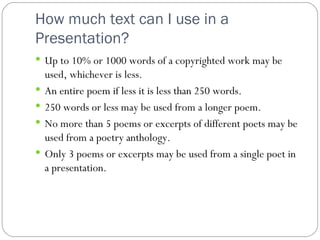
How much text can I use in a Presentation? Up to 10% or 1000 words of a copyrighted work may be used, whichever is less. An entire poem if less it is less than 250 words. 250 words or less may be used from a longer poem. No more than 5 poems or excerpts of different poets may be used from a poetry anthology.  Only 3 poems or excerpts may be used from a single poet in a presentation.
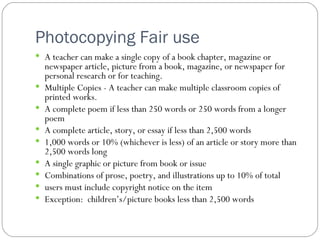
Photocopying Fair use A teacher can make a single copy of a book chapter, magazine or newspaper article, picture from a book, magazine, or newspaper for personal research or for teaching. Multiple Copies - A teacher can make multiple classroom copies of printed works. A complete poem if less than 250 words or 250 words from a longer poem  A complete article, story, or essay if less than 2,500 words  1,000 words or 10% (whichever is less) of an article or story more than 2,500 words long  A single graphic or picture from book or issue Combinations of prose, poetry, and illustrations up to 10% of total users must include copyright notice on the item Exception:  children’s/picture books less than 2,500 words
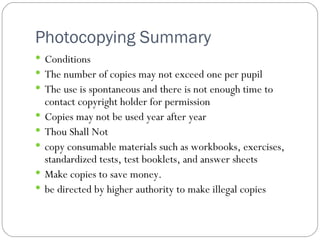
Photocopying Summary  Conditions The number of copies may not exceed one per pupil The use is spontaneous and there is not enough time to contact copyright holder for permission Copies may not be used year after year Thou Shall Not copy consumable materials such as workbooks, exercises, standardized tests, test booklets, and answer sheets Make copies to save money. be directed by higher authority to make illegal copies
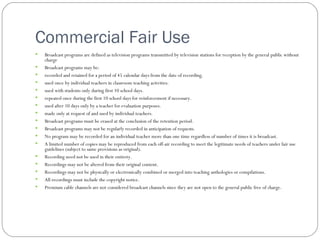
Commercial Fair Use Broadcast programs are defined as television programs transmitted by television stations for reception by the general public without charge Broadcast programs may be: recorded and retained for a period of 45 calendar days from the date of recording.  used once by individual teachers in classroom teaching activities. used with students only during first 10 school days. repeated once during the first 10 school days for reinforcement if necessary. used after 10 days only by a teacher for evaluation purposes. made only at request of and used by individual teachers. Broadcast programs must be erased at the conclusion of the retention period. Broadcast programs may not be regularly recorded in anticipation of requests. No program may be recorded for an individual teacher more than one time regardless of number of times it is broadcast. A limited number of copies may be reproduced from each off-air recording to meet the legitimate needs of teachers under fair use guidelines (subject to same provisions as original). Recording need not be used in their entirety. Recordings may not be altered from their original content. Recordings may not be physically or electronically combined or merged into teaching anthologies or compilations. All recordings must include the copyright notice. Premium cable channels are not considered broadcast channels since they are not open to the general public free of charge.
Microcomputer Fair Use 1980 amendment to 1976 Copyright Act that defined computer programs. Copying is an infringement whether it is done for sale, free distribution, or copier’s own personal use. Liability for infringement usually falls on party owning the computer. Lending, renting, or leasing software is illegal without permission.
Adaption Adaptation is changing the media format of an original work or modifying the work.  You may NOT enlarge, modify, or convert a copyrighted work to a different medium without permission.

Copyrights2

  • 1.
    By Tori SmallCopyrights
  • 2.
    Copyright FiveFundamental Rights: Reproduction, Adaptation, Publication, Performance, and Display
  • 3.
    Fair use Thecopy is used in a non-profit educational institution or with homebound students. The copy is used in face-to-face instruction. The copy is used in support of curricular objectives. The copy is legally obtained.
  • 4.
    How much textcan I use in a Presentation? Up to 10% or 1000 words of a copyrighted work may be used, whichever is less. An entire poem if less it is less than 250 words. 250 words or less may be used from a longer poem. No more than 5 poems or excerpts of different poets may be used from a poetry anthology. Only 3 poems or excerpts may be used from a single poet in a presentation.
  • 5.
    Photocopying Fair useA teacher can make a single copy of a book chapter, magazine or newspaper article, picture from a book, magazine, or newspaper for personal research or for teaching. Multiple Copies - A teacher can make multiple classroom copies of printed works. A complete poem if less than 250 words or 250 words from a longer poem A complete article, story, or essay if less than 2,500 words 1,000 words or 10% (whichever is less) of an article or story more than 2,500 words long A single graphic or picture from book or issue Combinations of prose, poetry, and illustrations up to 10% of total users must include copyright notice on the item Exception: children’s/picture books less than 2,500 words
  • 6.
    Photocopying Summary Conditions The number of copies may not exceed one per pupil The use is spontaneous and there is not enough time to contact copyright holder for permission Copies may not be used year after year Thou Shall Not copy consumable materials such as workbooks, exercises, standardized tests, test booklets, and answer sheets Make copies to save money. be directed by higher authority to make illegal copies
  • 7.
    Commercial Fair UseBroadcast programs are defined as television programs transmitted by television stations for reception by the general public without charge Broadcast programs may be: recorded and retained for a period of 45 calendar days from the date of recording. used once by individual teachers in classroom teaching activities. used with students only during first 10 school days. repeated once during the first 10 school days for reinforcement if necessary. used after 10 days only by a teacher for evaluation purposes. made only at request of and used by individual teachers. Broadcast programs must be erased at the conclusion of the retention period. Broadcast programs may not be regularly recorded in anticipation of requests. No program may be recorded for an individual teacher more than one time regardless of number of times it is broadcast. A limited number of copies may be reproduced from each off-air recording to meet the legitimate needs of teachers under fair use guidelines (subject to same provisions as original). Recording need not be used in their entirety. Recordings may not be altered from their original content. Recordings may not be physically or electronically combined or merged into teaching anthologies or compilations. All recordings must include the copyright notice. Premium cable channels are not considered broadcast channels since they are not open to the general public free of charge.
  • 8.
    Microcomputer Fair Use1980 amendment to 1976 Copyright Act that defined computer programs. Copying is an infringement whether it is done for sale, free distribution, or copier’s own personal use. Liability for infringement usually falls on party owning the computer. Lending, renting, or leasing software is illegal without permission.
  • 9.
    Adaption Adaptation ischanging the media format of an original work or modifying the work. You may NOT enlarge, modify, or convert a copyrighted work to a different medium without permission.