Professor Anne Fitzgerald
Queensland University of Technology
Creative Commons and Innovation
QUT, Brisbane
1 February 2012
© 2012 Anne Fitzgerald. Licensed under Creative Commons Attribution 3.0 Australia.
This session …
 Copyright
 What Creative Commons (CC) is
 Overview of how CC is being used
© 2012 Anne Fitzgerald..
Copyright
 Governed by the Copyright Act (Cth)
 No registration required
 Copyright exists automatically once criteria in the Act
are satisfied
 Copyright protects original expression
 Not ideas, information or facts
 But the form in which those ideas, information or facts
are expressed
© 2012 Anne Fitzgerald..
Generic 2.0 ‘take the old machine’ by Angelo González, http://www.flickr.com/photos/21251150@N04/5291456294
Photographs, paintings,
images, sculptures…(artistic works)
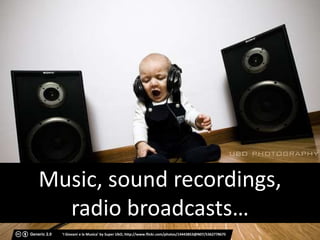
Generic 2.0 ‘I Giovani e la Musica’ by Super UbO, http://www.flickr.com/photos/14443853@N07/5362778675
Music, sound recordings,
radio broadcasts…
Generic 2.0 ‘Apollo 11 Video Restoration Press Conference / Newseum’ by NASA Goddard Space Flight Centre, http://www.flickr.com/photos/24662369@N07/3726614425
Films, Videos, Theatre,
TV broadcasts…(cinematograph films, dramatical works, television broadcasts)
Blogs, books, articles, essays…
(literary works, published editions of works)
Generic 2.0 ‘_MG_0318’ by Zitona, http://www.flickr.com/photos/zitona/5021203226/
Compilations of data…
("literary work" includes: … a table, or compilation , expressed in words, figures or symbols – s 10, Copyright Act 1968)
)
Generic 2.0 ‘_MG_0318’ by Zitona, http://www.flickr.com/photos/zitona/5021203226/
Copyright as a bundle of
exclusive rights
 For example, for literary, dramatic and musical works
the rights are to:
 reproduce in material form
 publish
 publicly perform
 communicate to the public in electronic form
 transmit;
 make available
 make an adaptation or translation
 control rental, where work is a computer program or is
reproduced in a sound recording: s 31(1)
© 2012 Anne Fitzgerald..
Copyright in the digital
environment
 When we use digital technology, we automatically
reproduce content and thereby enter the copyright “zone”,
 because digital technology needs to reproduce material
so it can be played, run or even viewed.
 Copyright has been further extended to protect
 Broader subject matter – e.g. Computer programs
 Broader rights – e.g. right to communicate electronically to the
public
 Technological Protection Measures (TPMs) (eg encryption/anti-
copying devices) applied to control access or copying;
 Electronic Rights Management Information (ERMI)
© 2012 Anne Fitzgerald..
Copyright
In a nutshell…
 copyright automatically applies to a lot of material
 exclusive rights of the copyright owner are very broad
 remedies are strong and enforcement is effective
(through civil and criminal actions)
 limited exceptions (e.g. fair dealing) available
Which means that.....
 the consequences of infringement will deter use/reuse
unless it is clear that the use is permitted
© 2012 Anne Fitzgerald..
Copyright
 General rule = You need permission/licence to
exercise exclusive economic rights of copyright owner
unless the law provides otherwise
 express permission to use should be obtained
 importance of clear statement of permitted uses
 any other rights/obligations (other than copyright) also
need to be considered
© 2012 Anne Fitzgerald..
Copyright licensing –
traditional practice
 All (or most) rights reserved
 Requires prior permission from copyright owner unless
within an exception to owner’s rights (e.g. fair dealing)
under the Copyright Act
 Negotiating terms is cumbersome, time consuming,
expensive – inefficiency means high transaction costs
 Has led to multiple non-standard licences
 Problem of “orphan” works – no identifiable copyright
owner from whom permission may be obtained
 Arose from pre-internet era - not geared to the immediate
and global nature of the internet
© 2012 Anne Fitzgerald..
©all rights reserved
Creative Commons
 a standardised system for licensing the use of
copyright materials
 a suite of 6 standardised licences
 available in 3 forms: plain english (summary); legal code
and machine-readable code
 Each licence grants baseline permissions to users to
use copyright material
 that is, to copy, publish, distribute in digital form,
publicly perform
 whether the whole or a substantial part of it
 on specified, standardised core conditions
© 2012 Anne Fitzgerald..
Copyright licensing – with CC licences
 Some rights only reserved
 Relatively short, simplified, standardised licences which provide
permission in advance
 Based on copyright
 BUT
 do not cover all possible kinds of permissions – other kinds of
permissions will have to be negotiated
 Do not contain detailed provisions covering all relevant aspects of
the law
 Must be read in the context of copyright law (legislation &
judgments) and often other relevant bodies of law (e.g. private
international law – “jurisdictional” issues and applicable law)
 Also have to be read in context of other relevant “information” laws
notably privacy (data protection), security, and interception of
communications (telecommunications) - See Chang v. Virgin
Mobile USA, LLC, 2009 WL 111570 (N.D.Tex. January 16, 2009)
© 2012 Anne Fitzgerald..
Creative Commons IS NOT…
 anti-copyright
Creative Commons IS…
 A copyright licence (permission)
 Cannot exist without copyright
 A new way of managing copyright
 Free for everyone to use
© 2012 Anne Fitzgerald..
Rethinking the Commons
 “Public domain” traditionally referred to materials not
subject to copyright protection because
 copyright had expired; or
 the materials did not quality for copyright protection.
 Concept of “public domain” has been recast more
broadly to mean ‘open’ knowledge and content
 public domain is not just a no rights “wasteland [or] dump on
the outskirts of respectable culture” (Bollier, “Viral Spiral”)
 something of value in its own right – open knowledge and
content that can be accessed, reused and distributed
 encompasses materials that are copyright-protected and
made available for access and reuse under open source
software and open content licences
© 2012 Anne Fitzgerald..
Building the commons
 Openness is not a naturally occurring (or enduring)
state
 Openness must be constructed
 When dealing with intangible interests in intangibles,
openness is achieved using legal tools (Uhlir,
Reichmann, Stallman, Lessig)
 “free beer” vs “free as in speech”
 Stallman – the latter, not the former;
 the free beer approach will not achieve openness for data
– instead, can lead to lock up/lock out
© 2012 Anne Fitzgerald..
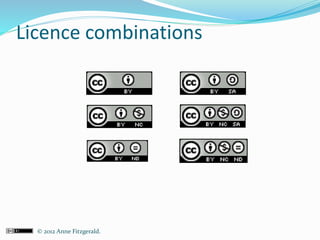
Licence combinations
© 2012 Anne Fitzgerald..
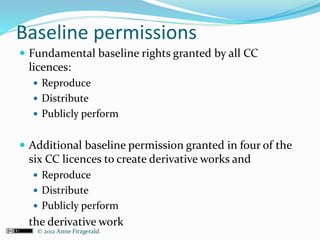
Baseline permissions
 Fundamental baseline rights granted by all CC
licences:
 Reproduce
 Distribute
 Publicly perform
 Additional baseline permission granted in four of the
six CC licences to create derivative works and
 Reproduce
 Distribute
 Publicly perform
the derivative work
© 2012 Anne Fitzgerald..
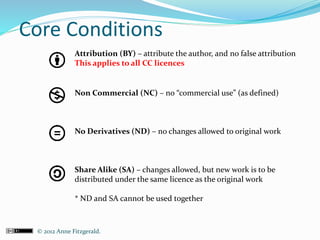
Core Conditions
Attribution (BY) – attribute the author, and no false attribution
This applies to all CC licences
Non Commercial (NC) – no “commercial use” (as defined)
No Derivatives (ND) – no changes allowed to original work
Share Alike (SA) – changes allowed, but new work is to be
distributed under the same licence as the original work
* ND and SA cannot be used together
© 2012 Anne Fitzgerald..
Adam Curry v Audax (2006)
 Curry uploaded photos to Flickr under a CC BY NC SA
licence
 The photos from Flickr were reproduced in a magazine
sold commercially in The Netherlands
 Court held there was no permission to use the photos -
as this was commercial use – only Non Commercial
was licensed
© 2012 Anne Fitzgerald..
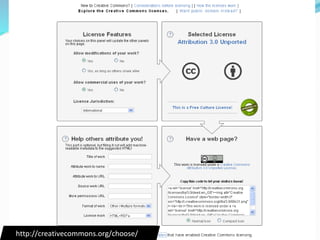
http://creativecommons.org/choose/
Human-readable summary
“Legal Code”
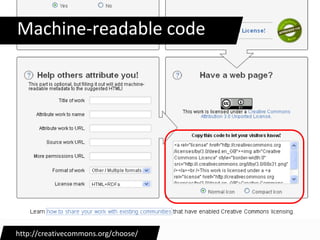
http://creativecommons.org/choose/
Machine-readable code
CC operates as a direct licence,
from copyright owner to user
© 2012 Anne Fitzgerald..
Legal Validity of Licences
Jacobsen v. Katzer, 535 F.3d 1373 (Fed. Cir. 2008)
“Copyright holders who engage in open source
licensing have the right to control the modification
and distribution of copyrighted material. ….
The choice to exact consideration in the form of
compliance with the open source requirements of
disclosure and explanation of changes, rather than as
a dollar denominated fee, is entitled to no less legal
recognition.”
© 2012 Anne Fitzgerald..
Why use CC licences?
 Other standardised licences e.g. UK Open Government Licence
(OGL) are not fully internationally recognised
 Permits international platforms (collaborations and
contributions across various sectors)
 No other standardised licence has an equally supportive and
viable central organisation
 CC applies to all government and non-government copyright
material (except software)
 CC uses icons (which have gained full international recognition
and which are not language specific)
 CC’s licence metadata / digital code is embedded, making it
machine-readable, searchable & retrievable
 CC provides for a clear statement about the source of the data
(attribution/provenance) – increased user confidence
© 2012 Anne Fitzgerald..
How do people use CC?
 Licensing out: use CC on copyright materials you create
 enable others to find your material online through using the standard
search engines; give permission to others to lawfully use your material
(eg copy, on-distribute, post to a website, value add, mashup
 e.g.
 Repositories – Wikipedia, Flickr, YouTube
 Institutions/Organisations – ABC, Al Jazeera
 Licensing in: use copyright materials created by others that
are licensed under CC
 enable you to find their material online through using the standard
search engines; give permission to you to lawfully use their material eg
copy, on-distribute, post to a website, value add, mashup e.g.
 use of CC licensing scream in Children of Men (a Hollywood film)
 students using CC material in their projects
 In both cases, the scope of re-use will depend on which CC licence
selected
© 2012 Anne Fitzgerald..

Copy right and creative commons

  • 1.
    Professor Anne Fitzgerald QueenslandUniversity of Technology Creative Commons and Innovation QUT, Brisbane 1 February 2012 © 2012 Anne Fitzgerald. Licensed under Creative Commons Attribution 3.0 Australia.
  • 2.
    This session … Copyright  What Creative Commons (CC) is  Overview of how CC is being used © 2012 Anne Fitzgerald..
  • 3.
    Copyright  Governed bythe Copyright Act (Cth)  No registration required  Copyright exists automatically once criteria in the Act are satisfied  Copyright protects original expression  Not ideas, information or facts  But the form in which those ideas, information or facts are expressed © 2012 Anne Fitzgerald..
  • 4.
    Generic 2.0 ‘takethe old machine’ by Angelo González, http://www.flickr.com/photos/21251150@N04/5291456294 Photographs, paintings, images, sculptures…(artistic works)
  • 5.
    Generic 2.0 ‘IGiovani e la Musica’ by Super UbO, http://www.flickr.com/photos/14443853@N07/5362778675 Music, sound recordings, radio broadcasts…
  • 6.
    Generic 2.0 ‘Apollo11 Video Restoration Press Conference / Newseum’ by NASA Goddard Space Flight Centre, http://www.flickr.com/photos/24662369@N07/3726614425 Films, Videos, Theatre, TV broadcasts…(cinematograph films, dramatical works, television broadcasts)
  • 7.
    Blogs, books, articles,essays… (literary works, published editions of works) Generic 2.0 ‘_MG_0318’ by Zitona, http://www.flickr.com/photos/zitona/5021203226/
  • 8.
    Compilations of data… ("literarywork" includes: … a table, or compilation , expressed in words, figures or symbols – s 10, Copyright Act 1968) ) Generic 2.0 ‘_MG_0318’ by Zitona, http://www.flickr.com/photos/zitona/5021203226/
  • 9.
    Copyright as abundle of exclusive rights  For example, for literary, dramatic and musical works the rights are to:  reproduce in material form  publish  publicly perform  communicate to the public in electronic form  transmit;  make available  make an adaptation or translation  control rental, where work is a computer program or is reproduced in a sound recording: s 31(1) © 2012 Anne Fitzgerald..
  • 10.
    Copyright in thedigital environment  When we use digital technology, we automatically reproduce content and thereby enter the copyright “zone”,  because digital technology needs to reproduce material so it can be played, run or even viewed.  Copyright has been further extended to protect  Broader subject matter – e.g. Computer programs  Broader rights – e.g. right to communicate electronically to the public  Technological Protection Measures (TPMs) (eg encryption/anti- copying devices) applied to control access or copying;  Electronic Rights Management Information (ERMI) © 2012 Anne Fitzgerald..
  • 11.
    Copyright In a nutshell… copyright automatically applies to a lot of material  exclusive rights of the copyright owner are very broad  remedies are strong and enforcement is effective (through civil and criminal actions)  limited exceptions (e.g. fair dealing) available Which means that.....  the consequences of infringement will deter use/reuse unless it is clear that the use is permitted © 2012 Anne Fitzgerald..
  • 12.
    Copyright  General rule= You need permission/licence to exercise exclusive economic rights of copyright owner unless the law provides otherwise  express permission to use should be obtained  importance of clear statement of permitted uses  any other rights/obligations (other than copyright) also need to be considered © 2012 Anne Fitzgerald..
  • 13.
    Copyright licensing – traditionalpractice  All (or most) rights reserved  Requires prior permission from copyright owner unless within an exception to owner’s rights (e.g. fair dealing) under the Copyright Act  Negotiating terms is cumbersome, time consuming, expensive – inefficiency means high transaction costs  Has led to multiple non-standard licences  Problem of “orphan” works – no identifiable copyright owner from whom permission may be obtained  Arose from pre-internet era - not geared to the immediate and global nature of the internet © 2012 Anne Fitzgerald.. ©all rights reserved
  • 14.
    Creative Commons  astandardised system for licensing the use of copyright materials  a suite of 6 standardised licences  available in 3 forms: plain english (summary); legal code and machine-readable code  Each licence grants baseline permissions to users to use copyright material  that is, to copy, publish, distribute in digital form, publicly perform  whether the whole or a substantial part of it  on specified, standardised core conditions © 2012 Anne Fitzgerald..
  • 15.
    Copyright licensing –with CC licences  Some rights only reserved  Relatively short, simplified, standardised licences which provide permission in advance  Based on copyright  BUT  do not cover all possible kinds of permissions – other kinds of permissions will have to be negotiated  Do not contain detailed provisions covering all relevant aspects of the law  Must be read in the context of copyright law (legislation & judgments) and often other relevant bodies of law (e.g. private international law – “jurisdictional” issues and applicable law)  Also have to be read in context of other relevant “information” laws notably privacy (data protection), security, and interception of communications (telecommunications) - See Chang v. Virgin Mobile USA, LLC, 2009 WL 111570 (N.D.Tex. January 16, 2009) © 2012 Anne Fitzgerald..
  • 16.
    Creative Commons ISNOT…  anti-copyright Creative Commons IS…  A copyright licence (permission)  Cannot exist without copyright  A new way of managing copyright  Free for everyone to use © 2012 Anne Fitzgerald..
  • 17.
    Rethinking the Commons “Public domain” traditionally referred to materials not subject to copyright protection because  copyright had expired; or  the materials did not quality for copyright protection.  Concept of “public domain” has been recast more broadly to mean ‘open’ knowledge and content  public domain is not just a no rights “wasteland [or] dump on the outskirts of respectable culture” (Bollier, “Viral Spiral”)  something of value in its own right – open knowledge and content that can be accessed, reused and distributed  encompasses materials that are copyright-protected and made available for access and reuse under open source software and open content licences © 2012 Anne Fitzgerald..
  • 18.
    Building the commons Openness is not a naturally occurring (or enduring) state  Openness must be constructed  When dealing with intangible interests in intangibles, openness is achieved using legal tools (Uhlir, Reichmann, Stallman, Lessig)  “free beer” vs “free as in speech”  Stallman – the latter, not the former;  the free beer approach will not achieve openness for data – instead, can lead to lock up/lock out © 2012 Anne Fitzgerald..
  • 19.
  • 20.
    Baseline permissions  Fundamentalbaseline rights granted by all CC licences:  Reproduce  Distribute  Publicly perform  Additional baseline permission granted in four of the six CC licences to create derivative works and  Reproduce  Distribute  Publicly perform the derivative work © 2012 Anne Fitzgerald..
  • 21.
    Core Conditions Attribution (BY)– attribute the author, and no false attribution This applies to all CC licences Non Commercial (NC) – no “commercial use” (as defined) No Derivatives (ND) – no changes allowed to original work Share Alike (SA) – changes allowed, but new work is to be distributed under the same licence as the original work * ND and SA cannot be used together © 2012 Anne Fitzgerald..
  • 22.
    Adam Curry vAudax (2006)  Curry uploaded photos to Flickr under a CC BY NC SA licence  The photos from Flickr were reproduced in a magazine sold commercially in The Netherlands  Court held there was no permission to use the photos - as this was commercial use – only Non Commercial was licensed © 2012 Anne Fitzgerald..
  • 23.
  • 24.
  • 25.
  • 26.
  • 27.
    CC operates asa direct licence, from copyright owner to user © 2012 Anne Fitzgerald..
  • 28.
    Legal Validity ofLicences Jacobsen v. Katzer, 535 F.3d 1373 (Fed. Cir. 2008) “Copyright holders who engage in open source licensing have the right to control the modification and distribution of copyrighted material. …. The choice to exact consideration in the form of compliance with the open source requirements of disclosure and explanation of changes, rather than as a dollar denominated fee, is entitled to no less legal recognition.” © 2012 Anne Fitzgerald..
  • 29.
    Why use CClicences?  Other standardised licences e.g. UK Open Government Licence (OGL) are not fully internationally recognised  Permits international platforms (collaborations and contributions across various sectors)  No other standardised licence has an equally supportive and viable central organisation  CC applies to all government and non-government copyright material (except software)  CC uses icons (which have gained full international recognition and which are not language specific)  CC’s licence metadata / digital code is embedded, making it machine-readable, searchable & retrievable  CC provides for a clear statement about the source of the data (attribution/provenance) – increased user confidence © 2012 Anne Fitzgerald..
  • 30.
    How do peopleuse CC?  Licensing out: use CC on copyright materials you create  enable others to find your material online through using the standard search engines; give permission to others to lawfully use your material (eg copy, on-distribute, post to a website, value add, mashup  e.g.  Repositories – Wikipedia, Flickr, YouTube  Institutions/Organisations – ABC, Al Jazeera  Licensing in: use copyright materials created by others that are licensed under CC  enable you to find their material online through using the standard search engines; give permission to you to lawfully use their material eg copy, on-distribute, post to a website, value add, mashup e.g.  use of CC licensing scream in Children of Men (a Hollywood film)  students using CC material in their projects  In both cases, the scope of re-use will depend on which CC licence selected © 2012 Anne Fitzgerald..

Editor's Notes

  • #29  “The District Court interpreted the Artistic License to permit a user to ‘‘modify the material in any way’’ and did not find that any of the ‘‘provided that’’ limitations in the Artistic License served to limit this grant. The District Court’s interpretation of the conditions of the Artistic License does not credit the explicit restrictions in the license that govern a downloader’s right to modify and distribute the copyrighted work. The copyright holder here expressly stated the terms upon which the right to modify and distribute the material depended and invited direct contact if a downloader wished to negotiate other terms. These restrictions were both clear and necessary to accomplish the objectives of the open source licensing collaboration, including economic benefit. Moreover, the District Court did not address the other restrictions of the license, such as the requirement that all modification from the original be clearly shown with a new name and a separate page for any such modification that shows how it differs from the original. Copyright holders who engage in open source licensing have the right to control the modification and distribution of copyrighted material. As the Second Circuit explained in Gilliam v. ABC, 538 F.2d 14, 21 (2d Cir.1976), the ‘‘unauthorized editing of the underlying work, if proven, would constitute an infringement of the copyright in that work similar to any other use of a work that exceeded the license granted by the proprietor of the copyright.’’ Copyright licenses are designed to support the right to exclude; money damages alone do not support or enforce that right. The choice to exact consideration in the form of compliance with the open source requirements of disclosure and explanation of changes, rather than as a dollar denominated fee, is entitled to no less legal recognition. Indeed, because a calculation of damages is inherently speculative, these types of license restrictions might well be rendered meaningless absent the ability to enforce through injunctive relief.”