2
The learners shouldbe able to...
To know the Differences of this Theories (Krestchmer
and Sheldon Theory).
Know the impact of this theories in human
characteristics in body physique
Importance in studying the theories.
3.
3
What is Deviantbehavior?
-Deviant behavior is behavior that violates the
normative rules, understandings, or expectations
of social systems.
- deviance describes an action or behavior
that violates social norms, including a
formally enacted rule (e.g., crime),as well as
informal violations of social norms (e.g.,
rejecting folkways and mores).
4.
4
Ernst Kretschmer
Kretschmer wasborn in Wüstenrot near Heilbronn. He
attended Cannstatt Gymnasium, one of the oldest Latin
schools in Stuttgart area. From 1906 to 1912 he
studied theology, medicine, and philosophy at the
universities of Tübingen, Munich and Hamburg. From
1913 he was assistant of Robert Gaupp in Tübingen,
where he received his habilitation in 1918. He
continued as assistant medical director until 1926.
5.
In 1926 hebecame the director of the psychiatric
clinic at Marburg University.
Kretschmer was a founding member of the
International General Medical Society for Psycho
therapy
(AÄGP) which was founded on January 12,
1927. He was the president of AÄGP from 1929.
In 1933 he resigned from the AÄGP for political
reasons.
From 1946 until 1959, Kretschmer was the
director of the psychiatric clinic of the
University of Tübingen. He died, aged 75, in
6.
6
Cooperating with theNazis
After he resigned from the AÄGP, he started to
support the SS and signed the "Vow of
allegiance of the professors of the German
universities and high-schools to Adolf Hitler and
the National Socialistic state." (German
: "Bekenntnis der Professoren an den
deutschen Universitäten und Hochschulen zu
Adolf Hitler und dem nationalsozialistischen
Staat").
7.
7
7
Scientific contribution
Persistent vegetativestate and sensitive paranoia
research
Kretschmer was the first to describe the
persistent vegetative state which has also been
called Kretschmer's syndrome. Another medical term
coined after him is Kretschmer’s sensitive paranoia.
This classification has the merit of singling out "a type
of paranoia that was unknown" prior to Kretschmer,
and which "does not resemble the stereotypical image
of sthenic paranoia". Furthermore, between 1915 and
1921 he developed a differential diagnosis between
schizophrenia and manic depression.
8.
8
8
8
Types of physique
Kretschmeris also known for developing a
classification system that can be seen as one of
the earliest exponents of a constitutional (the total
plan or philosophy on which something is
constructed) approach. His classification system
was based on four main body types:
9.
You can alsosplit your content
9
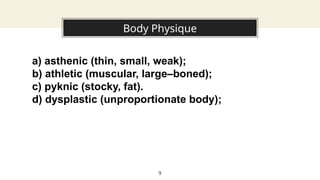
Body Physique
a) asthenic (thin, small, weak);
b) athletic (muscular, large–boned);
c) pyknic (stocky, fat).
d) dysplastic (unproportionate body);
10.
10
10
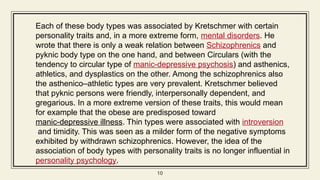
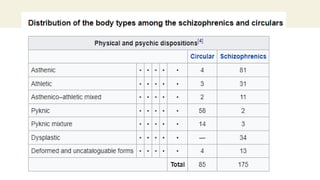
Each of thesebody types was associated by Kretschmer with certain
personality traits and, in a more extreme form, mental disorders. He
wrote that there is only a weak relation between Schizophrenics and
pyknic body type on the one hand, and between Circulars (with the
tendency to circular type of manic-depressive psychosis) and asthenics,
athletics, and dysplastics on the other. Among the schizophrenics also
the asthenico–athletic types are very prevalent. Kretschmer believed
that pyknic persons were friendly, interpersonally dependent, and
gregarious. In a more extreme version of these traits, this would mean
for example that the obese are predisposed toward
manic-depressive illness. Thin types were associated with introversion
and timidity. This was seen as a milder form of the negative symptoms
exhibited by withdrawn schizophrenics. However, the idea of the
association of body types with personality traits is no longer influential in
personality psychology.
11.
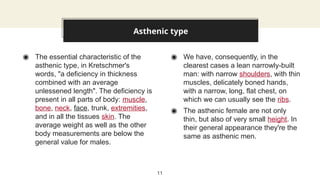
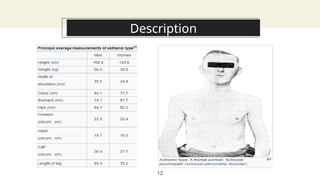
◉ The essentialcharacteristic of the
asthenic type, in Kretschmer's
words, "a deficiency in thickness
combined with an average
unlessened length". The deficiency is
present in all parts of body: muscle,
bone, neck, face, trunk, extremities,
and in all the tissues skin. The
average weight as well as the other
body measurements are below the
general value for males.
◉ We have, consequently, in the
clearest cases a lean narrowly-built
man: with narrow shoulders, with thin
muscles, delicately boned hands,
with a narrow, long, flat chest, on
which we can usually see the ribs.
◉ The asthenic female are not only
thin, but also of very small height. In
their general appearance they're the
same as asthenic men.
Asthenic type
11
Athletic type
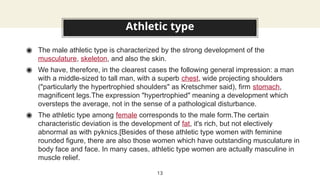
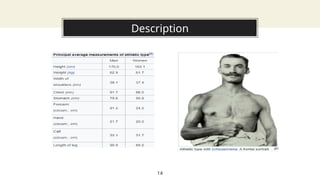
◉ Themale athletic type is characterized by the strong development of the
musculature, skeleton, and also the skin.
◉ We have, therefore, in the clearest cases the following general impression: a man
with a middle-sized to tall man, with a superb chest, wide projecting shoulders
("particularly the hypertrophied shoulders" as Kretschmer said), firm stomach,
magnificent legs.The expression "hypertrophied" meaning a development which
oversteps the average, not in the sense of a pathological disturbance.
◉ The athletic type among female corresponds to the male form.The certain
characteristic deviation is the development of fat, it's rich, but not electively
abnormal as with pyknics.[Besides of these athletic type women with feminine
rounded figure, there are also those women which have outstanding musculature in
body face and face. In many cases, athletic type women are actually masculine in
muscle relief.
13
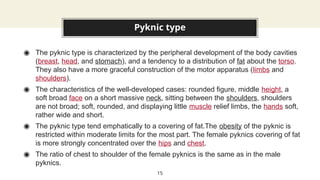
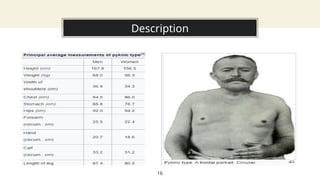
Pyknic type
◉ Thepyknic type is characterized by the peripheral development of the body cavities
(breast, head, and stomach), and a tendency to a distribution of fat about the torso.
They also have a more graceful construction of the motor apparatus (limbs and
shoulders).
◉ The characteristics of the well-developed cases: rounded figure, middle height, a
soft broad face on a short massive neck, sitting between the shoulders, shoulders
are not broad; soft, rounded, and displaying little muscle relief limbs, the hands soft,
rather wide and short.
◉ The pyknic type tend emphatically to a covering of fat.The obesity of the pyknic is
restricted within moderate limits for the most part. The female pyknics covering of fat
is more strongly concentrated over the hips and chest.
◉ The ratio of chest to shoulder of the female pyknics is the same as in the male
pyknics.
15
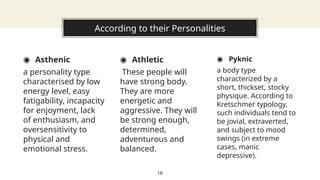
◉ Asthenic
a personalitytype
characterised by low
energy level, easy
fatigability, incapacity
for enjoyment, lack
of enthusiasm, and
oversensitivity to
physical and
emotional stress.
◉ Athletic
These people will
have strong body.
They are more
energetic and
aggressive. They will
be strong enough,
determined,
adventurous and
balanced.
◉ Pyknic
a body type
characterized by a
short, thickset, stocky
physique. According to
Kretschmer typology,
such individuals tend to
be jovial, extraverted,
and subject to mood
swings (in extreme
cases, manic
depressive).
According to their Personalities
18
19.
The temperaments
◉ Kretschmerdivided the temperaments into the two "constitutional groups":
schizothymic, which contain a "psychæsthetic proportion" between sensitive and
cold poles, and cyclothymes which contain a "diathetic" proportion between raised (
happy) and sad. The modern term for light version of 'circular' insanity is cyclothymia
. Psychic tempo of schizothymic people is between unstable and tenacious and they
have alternation mode of feeling and thought, and cyclothymes psychic tempo is
between mobile and comfortable.[4] Schizothymic's psychomotility is often
inadequate to stimulus: inhibited, restrained, lamed, stiff, etc., and psychomotility of
cyclothymes is adequate to stimulus and natural. Cyclothymes are often pyknics,
schizothymes – athletic, asthenic, dysplastic, and their mixtures.
◉ The Schizoids consist of the hyperæsthetic (sensitive) and anæsthetic (cold)
characters.
19
20.
20
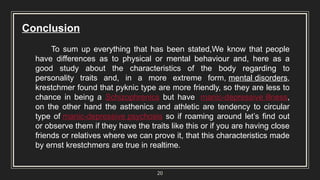
Conclusion
To sum upeverything that has been stated,We know that people
have differences as to physical or mental behaviour and, here as a
good study about the characteristics of the body regarding to
personality traits and, in a more extreme form, mental disorders,
krestchmer found that pyknic type are more friendly, so they are less to
chance in being a Schizophrenics but have manic-depressive illness,
on the other hand the asthenics and athletic are tendency to circular
type of manic-depressive psychosis so if roaming around let’s find out
or observe them if they have the traits like this or if you are having close
friends or relatives where we can prove it, that this characteristics made
by ernst krestchmers are true in realtime.
![The temperaments
◉ Kretschmer divided the temperaments into the two "constitutional groups":
schizothymic, which contain a "psychæsthetic proportion" between sensitive and
cold poles, and cyclothymes which contain a "diathetic" proportion between raised (
happy) and sad. The modern term for light version of 'circular' insanity is cyclothymia
. Psychic tempo of schizothymic people is between unstable and tenacious and they
have alternation mode of feeling and thought, and cyclothymes psychic tempo is
between mobile and comfortable.[4] Schizothymic's psychomotility is often
inadequate to stimulus: inhibited, restrained, lamed, stiff, etc., and psychomotility of
cyclothymes is adequate to stimulus and natural. Cyclothymes are often pyknics,
schizothymes – athletic, asthenic, dysplastic, and their mixtures.
◉ The Schizoids consist of the hyperæsthetic (sensitive) and anæsthetic (cold)
characters.
19](https://image.slidesharecdn.com/copybagasalabjdeviantbehaviorreportppt-250311000943-cdfd3df9/85/Copy-Bagasala-BJ_Deviant-Behavior-Report-PPT-pptx-19-320.jpg)