​
Groundwork of
the Metaphysics
of Morals
Micua
Flaris
Velasco
Presentation title 2
Introduction
MORAL LAW - We must examine the
actions and motives commonly
called good or bad, and try to
discover the principle according to
which they are judged. When this
criterion has been found, we shall
know what lies at the bottom of all
morality and might then, if we
choose, by considering the nature of
man and the conditions of life,
deduce an ethical system, containing
at least the most general laws.
Presentation title 3
Moral relativism - is the view that moral judgments are true
or false only relative to some particular standpoint (for
instance, that of a culture or a historical period) and that no
standpoint is uniquely privileged over all others. It has often
been associated with other claims about morality: notably, the
thesis that different cultures often exhibit radically different
moral values; the denial that there are universal moral values
shared by every human society; and the insistence that we
should refrain from passing moral judgments on beliefs and
practices characteristic of cultures other than our own.
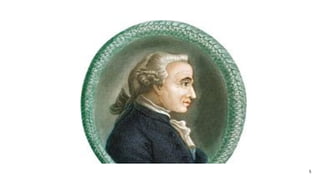
Immanuel Kant
One of the most influential intellectuals in the field of
political philosophy. Today, justice systems in democracies
are fundamentally based on Kant’s writings. The
philosopher’s work provides a compelling account of a
single set of moral principles that can be used to design just
institutions for governing society perfectly. The United
Nations, formed centuries after Kant’s first book was
published, is largely based on his vision of an international
government that binds nation-states together and maintains
peace.
One of the foremost thinkers of the Enlightenment and
arguably one of the greatest philosophers of all time.
5
6
• Kant’s Definition of Morality
- Kant's moral philosophy is deontological normative,
rejecting utilitarian ideas that the rightness of an action is
determined by its outcome. He believes that human beings,
with their unique ability to reason, are different from other
forms of physical existence. Kant advocates for universal
virtue, treating all humans as ends in themselves. He believes
that stealing is immoral regardless of circumstances and
murder is wrong even in self-defense. Kant also introduces
the idea of respect as essential to humanity, different from
sentiments like love, sympathy, or altruism. This concept,
known as the Formula for Humanity, remains his least
controversial formulation.
7
• LAW AND MORALITY: A KANTIAN PERSPECTIVE
• Kantianism is a key version of the broader ethical perspective known as
deontology. According to deontology, there are certain absolute (or nearly
absolute) ethical rules that must be followed. This implies that certain actions
are absolutely prohibited.
• In the modern day, deontology manifests itself in a focus on human rights—
roughly, the idea that there are certain things that must never be done to
human beings, as such. Such rights are typically thought of as
being universal, applying to all persons everywhere, regardless of the political
or legal system under which they live.
• In Moral Law, Kant argues that a human action is only morally good if it is
done from a sense of duty, and that a duty is a formal principle based not on
self-interest or from a consideration of what results might follow.
8
Groundwork of the Metaphysics of Morals
Kant's Groundwork of the Metaphysics of Morals aims to clarify the basic
principle of morality. Kant presents the basic principle of morality as
the categorical imperative, which is the basis for the moral law and
source of rational duty. Kant's Groundwork of the Metaphysics of
Morals summary shows how acting out of respect for the categorical
imperative and in conformity with it is the only route to acting
rationally and autonomously. Autonomy means "freedom" in the sense
of being self-determined. Moral autonomy means acting from one's
own reason, rather than letting the objects of one's desires determine
one's actions. Some of its central themes – that every human being is
an end in himself or herself, not to be used as a mere means by
others; that respect for one’s own humanity find its fullest expression
in respect for that of others; and that morality is freedom, and evil a
form of enslavement-have become not only well-established themes in
9
Kant’s Philosophical Project
• All our knowledge , as well as our moral ideas, is derived from
experience.
Two distinctions that apply to judgements in the groundwork (in order
to formulate the questions he wants to raise about morality)
1. Analytic/Synthetic Distinction- concerns what makes a judgement
true or false.
1.1 Analytic – the predicate is contained in the concept of the
subject.
1.1 Synthetic – the predicate adds something new to our
conception of the subject.
2. a priori/a posteriori Distinction - Concerns the way the judgement is
true.
a posteriori if it is known from experience.
10
Three Possible Types of Judgement
1.Analytic a priori Judgement - analytically true for we do
not need experience to tell us what is contained in our
concepts.
2. Posteriori Judgement- It must be synthetic for the subject
and the predicate are “synthesized” in our experience.
3. Synthetic a priori Judgement – one which tells us
something new about its subject, and yet which is known
independently of experience – on the basis of reasoning
alone. If pure reason tells us anything substantial and
important , either about the world or about what we ought
11
Synthetic a priori Judgement
• This judgement is not based on experience, for we can have no experience of every
possible event; nor it is not analytic judgement, for it is not part of the concept of an
event that it has a cause.
• body of such knowledge is called “ a metaphysics.
Metaphysics of Nature – if it is true that every event has a cause.
Metaphysics of Morals – Morality is concerned with practical questions- not with
the things are, but with the things ought to be. Since experience only tells us the
ways things are, it cannot by itself provide answers to our practical questions.
Moral judgements must therefore be a priori.
• if there are moral requirements, then there must be a metaphysics of
morals, a body of synthetic a priori judgement concerning what we
ought to do.
Presentation title 12
Groundwork – aim to establish the most preliminary and fundamental
point of the subject: That there is a domain of laws applying to our
conduct, that there is such thing as morality.
Kant Divides philosophy into three parts:
1. Logic – applies to all thought, deals with the laws of thought, domain
of pure reason.
2. Physics – deals with the way the world is. deals with the laws of
nature.
3. Ethics – deals with what we ought to do. Calls the laws of freedom,
that is the laws governing the conduct of free beings .
• physics and ethics each have both a pure and an imperial part.
13
Categorical
Imperative:
Laws of
Nature
- The supreme principle of morality.
- Commands simply that our actions should have the form of moral conduct. They should be derivable from universal principles. When we act, we are to ask whether the reasons for which we propose
to act could be made universal, embodied in a principle. Kant believed that this formal requirements yields substantive constraints on our conduct.
- We have moral obligations. No conditions.
Remember that the moral law, if it exists, has to be obligatory and universal. Therefore, hypothetical imperatives—which hold true only if one accepts a certain end—could never serve as the foundation of a
moral law. Instead, the moral law-related imperative needs to be a categorical imperative. All rational agents are subject to the categorical imperative, regardless of their personal goals. The moral law would
be provided by the categorical imperative, if we could identify it.
14
• How might the categorical imperative be expressed? It is evident that
the specific goals people choose to provide guidelines for their own
behavior cannot serve as its foundation. There is only one option left,
in Kant's opinion, and that is for the categorical imperative to be
predicated on the idea of a rule itself. By definition, laws (or
directives) are applicable to everyone. The categorical imperative,
which mandates that moral actors behave only in a way that the
principle of their will might become a universal law, is derived by
Kant from this insight. The categorical imperative does not produce a
list of obligations by itself; rather, it is a test of suggested maxims.
Though Kant offers three distinct formulations of this broad
assertion, the categorical imperative is his overall exposition of the
ultimate moral principle.
15
• Three Kinds of Motivation:
1.From duty – because you think it is the right thing to do.
2.Immediate Inclination – because you want to do it for
its own sake, or you enjoy doing its actions for its kind.
3.Impelled to through another inclination – as a means to
some further end. Doing what is right, but only as a
means of further end.
• Morality depends on the possibility of establishing a
synthetic a priori principle.
16
The Formula of the Universal Law of Nature
According to the first formulation, a course of action may only be considered
morally acceptable if it can be adopted by all agents without leading to any of two
types of contradictions. One should "act as if the maxim of your action were to
become by your will a universal law of nature," according to what is known as the
Formula for the global Law of Nature. A suggested maxim may not satisfy this
condition in one of two ways.
Contradiction in conception - First, in a world where one's proposed maxim is
universalized, one may come into a situation where it becomes impossible. Let's say,
for instance, that someone in financial need makes it their mission to obtain a loan
by falsely promising to repay it. The institution of promise-making would be
shattered if everyone adhered to this idea since no one would believe someone else
when they made a promise. But universalizing this principle damages the
fundamental institution of promise-making, which is the foundation of the maxim of
lying to get a loan. Since the maxim cannot possibly be conceived of being universal,
Kant refers to this as a "contradiction in conception".
17
The Formula of the Universal Law of Nature
Contradiction in willing - Second, if a universalized maxim contradicts something that
rational agents necessarily will, it may lead to what Kant refers to as a "contradiction in
willing," which is a contradiction that fails. For instance, someone may live by the dictum that
you should never assist those who are in need. Kant, however, believes that every agent must
occasionally want for assistance from others. The agent cannot, therefore, will that his or her
maxim be followed by everyone. What Kant refers to as a perfect duty is broken when an
attempt to universalize a maxim leads to a conceptual contradiction. If it results in a
contradiction in willing, it violates what Kant calls an imperfect duty. Perfect duties are
negative duties, that is duties not to commit or engage in certain actions or activities (for
example theft). Imperfect duties are positive duties, duties to commit or engage in certain
actions or activities (for example, giving to charity).
It is commonly assumed that when Kant states in the Groundwork that perfect responsibilities
never permit exceptions for the sake of inclination, he means that imperfect duties do permit
exceptions for the sake of inclination. Nonetheless, Kant contends that imperfect obligations
simply permit flexibility in how one chooses to carry them out in a later work titled The
Metaphysics of Morals. According to Kant, we have obligations to others as well as to
ourselves that are both perfect and defective.
18
The
Formula of
Humanity
Kant comes at the Formula of Humanity, the second formulation of the categorical imperative, by taking into account the categorical imperative's driving principle. The moral law requires an absolute
worth as its motivating premise since it is both essential and universal. If we could discover something that is so absolute—that is, an end in and of itself—that would be the sole basis for a
categorical imperative. "A human being and generally every rational being exists as an end in itself," according to Kant. Treating others as simple means to our own purposes is a perfect
responsibility. The equivalent imperative, the Formula of Humanity, mandates that "you use humanity, whether in your own persona or in the person of any other, always at the same time as an end,
never merely as a means." Kant does, however, believe that we have an imperfect obligation to further humanity's welfare. For instance, treating someone's rational nature as merely a means to an
end—such as getting money—by making a false promise to them is an example of treating them unfairly. Thus, this is a transgression of an ideal obligation. On the other hand, it is conceivable to
neglect charitable contributions without viewing another person as merely a means to an end; but, in doing so, we fail to further humanity's goal and so breach an imperfect responsibility.
19
The
Formula of
Autonomy
and the
Kingdom
of Ends
Both the Formula for the Universal Law of Nature and the Formula for Humanity provide valuable information that the Formula of Autonomy borrows.
While the Formula of Humanity is more subjective and focuses on how you treat the individual you are interacting with, the Formula for the Universal Law
of Nature asks you to consider your maxim as though it were an objective law. The Formula of Autonomy asks the agent to consider what universal law they
would accept, combining the subjectivity and objectivity of the two. In order to accomplish this, he or she would compare their moral principles to the
moral code they have enacted. "The principle of every human will as a will universally legislating through all its maxims" is the definition of the Principle of
Autonomy.
20
• Kinds of Motivation
1. Heteronomous Motivation – because we are bound to the law by
something outside of ourselves – God, the state, or nature – that
attaches the sanction to the law.
2. Autonomous Motivation – we bind ourselves to the law. The principle
that we give universal law through our maxims suggests that moral
motivation is autonomous.
• Moral motivation must be autonomous. We should so act that we may
think of ourselves as a legislating universal law through our maxims.
When we follow this principle, we conceive ourselves as legislative
citizen in the Kingdom of Ends.
21
Kant believes that the Formula of Autonomy yields another “fruitful concept,” the kingdom of ends.
The kingdom of ends is the “systematic union” of all ends in themselves (rational agents) and the
ends that they set. All ends that rational agents set have a price and can be exchanged for one
another. Ends in themselves, however, have dignity and have no equivalent. In addition to being the
basis for the Formula of Autonomy and the kingdom of ends, autonomy itself plays an important
role in Kant's moral philosophy. The ability to establish morality for oneself, or to be its legislator, is
what is meant by autonomy. Heteronomy, which is defined as having one's will dictate by external
factors, is contrasted with autonomy. Kant holds that autonomy is the sole foundation for a non-
contingent moral norm because alien powers could only determine human acts contingently. Kant
thinks his forebears failed in their attempts to distinguish between the two: all of their theories
were heteronomous. Kant has now painted a picture for us of what, should there be a universal
and necessary law, it would look like. He hasn't yet demonstrated, though, that it exists or that it
pertains to us.
Kingdom of Ends
22
- The laws of freedom, both because it is the mark of free citizen to make their own
laws, because the content of those laws directs us to respect each citizen’s free
use of his or her own reason. The conception of ourselves as legislative citizens.
Unconditional value – it is nothing less than the share it affords a rational being
in the giving of universal laws, by which it makes him fit to be a member of a
possible kingdom of ends.
A free person is one whose actions are not determined by any external force, not
even by his own desires.
Kingdom of Ends
23
• Conclusion
• To complete the argument, Kant has to show hat we and all rational beings
really have the kind of autonomous wills for which the moral law is
authoritative. This is not an analytic claim yet if it is to hold for all rational
beings it must be an a priori one.
• Kant's moral philosophy focuses on the "good will" as the only intrinsically
valuable good. He distinguishes between acting in conformity with duty and
acting from duty, stating that only one action has moral worth. Duties are
principles that guide our actions, and Kant distinguishes between
hypothetical and categorical imperatives. Hypothetical imperatives are
directed by certain goals or interests, while categorical imperatives are
necessary and always binding.
• Kant's moral theory has three formulas for the categorical imperative.
Formula one states that we ought to act in a way that the maxim of our act
can be willed a universal law. If the maxim cannot be universalized, that act is
morally off limits. Formula two states that we
24
ought to treat humanity (self and others) as an end and never as a
mere means. This entails treating all persons with respect and
dignity, helping others achieve their goals when possible, and
avoiding using them as tools or objects to further our own goals.
• Formula three states that we act on principles that could be
accepted within a community of other rational agents. The third
formula, "the kingdom of ends," moves us from the individual
level to the social level.
• In summary, Kant's moral philosophy emphasizes fairness and
the value of the individual, focusing on reason, autonomy, and
logical consistency. Absolute duties, which are binding
regardless of desires, goals, or outcomes, are also offered as an
objective sense of morality.
Thank you
Micua
Flaris
Velasco

GROUP-3.pptx BILLY John Bagasala for. Crim

  • 1.
    ​ Groundwork of the Metaphysics ofMorals Micua Flaris Velasco
  • 2.
    Presentation title 2 Introduction MORALLAW - We must examine the actions and motives commonly called good or bad, and try to discover the principle according to which they are judged. When this criterion has been found, we shall know what lies at the bottom of all morality and might then, if we choose, by considering the nature of man and the conditions of life, deduce an ethical system, containing at least the most general laws.
  • 3.
    Presentation title 3 Moralrelativism - is the view that moral judgments are true or false only relative to some particular standpoint (for instance, that of a culture or a historical period) and that no standpoint is uniquely privileged over all others. It has often been associated with other claims about morality: notably, the thesis that different cultures often exhibit radically different moral values; the denial that there are universal moral values shared by every human society; and the insistence that we should refrain from passing moral judgments on beliefs and practices characteristic of cultures other than our own.
  • 4.
    Immanuel Kant One ofthe most influential intellectuals in the field of political philosophy. Today, justice systems in democracies are fundamentally based on Kant’s writings. The philosopher’s work provides a compelling account of a single set of moral principles that can be used to design just institutions for governing society perfectly. The United Nations, formed centuries after Kant’s first book was published, is largely based on his vision of an international government that binds nation-states together and maintains peace. One of the foremost thinkers of the Enlightenment and arguably one of the greatest philosophers of all time.
  • 5.
  • 6.
    6 • Kant’s Definitionof Morality - Kant's moral philosophy is deontological normative, rejecting utilitarian ideas that the rightness of an action is determined by its outcome. He believes that human beings, with their unique ability to reason, are different from other forms of physical existence. Kant advocates for universal virtue, treating all humans as ends in themselves. He believes that stealing is immoral regardless of circumstances and murder is wrong even in self-defense. Kant also introduces the idea of respect as essential to humanity, different from sentiments like love, sympathy, or altruism. This concept, known as the Formula for Humanity, remains his least controversial formulation.
  • 7.
    7 • LAW ANDMORALITY: A KANTIAN PERSPECTIVE • Kantianism is a key version of the broader ethical perspective known as deontology. According to deontology, there are certain absolute (or nearly absolute) ethical rules that must be followed. This implies that certain actions are absolutely prohibited. • In the modern day, deontology manifests itself in a focus on human rights— roughly, the idea that there are certain things that must never be done to human beings, as such. Such rights are typically thought of as being universal, applying to all persons everywhere, regardless of the political or legal system under which they live. • In Moral Law, Kant argues that a human action is only morally good if it is done from a sense of duty, and that a duty is a formal principle based not on self-interest or from a consideration of what results might follow.
  • 8.
    8 Groundwork of theMetaphysics of Morals Kant's Groundwork of the Metaphysics of Morals aims to clarify the basic principle of morality. Kant presents the basic principle of morality as the categorical imperative, which is the basis for the moral law and source of rational duty. Kant's Groundwork of the Metaphysics of Morals summary shows how acting out of respect for the categorical imperative and in conformity with it is the only route to acting rationally and autonomously. Autonomy means "freedom" in the sense of being self-determined. Moral autonomy means acting from one's own reason, rather than letting the objects of one's desires determine one's actions. Some of its central themes – that every human being is an end in himself or herself, not to be used as a mere means by others; that respect for one’s own humanity find its fullest expression in respect for that of others; and that morality is freedom, and evil a form of enslavement-have become not only well-established themes in
  • 9.
    9 Kant’s Philosophical Project •All our knowledge , as well as our moral ideas, is derived from experience. Two distinctions that apply to judgements in the groundwork (in order to formulate the questions he wants to raise about morality) 1. Analytic/Synthetic Distinction- concerns what makes a judgement true or false. 1.1 Analytic – the predicate is contained in the concept of the subject. 1.1 Synthetic – the predicate adds something new to our conception of the subject. 2. a priori/a posteriori Distinction - Concerns the way the judgement is true. a posteriori if it is known from experience.
  • 10.
    10 Three Possible Typesof Judgement 1.Analytic a priori Judgement - analytically true for we do not need experience to tell us what is contained in our concepts. 2. Posteriori Judgement- It must be synthetic for the subject and the predicate are “synthesized” in our experience. 3. Synthetic a priori Judgement – one which tells us something new about its subject, and yet which is known independently of experience – on the basis of reasoning alone. If pure reason tells us anything substantial and important , either about the world or about what we ought
  • 11.
    11 Synthetic a prioriJudgement • This judgement is not based on experience, for we can have no experience of every possible event; nor it is not analytic judgement, for it is not part of the concept of an event that it has a cause. • body of such knowledge is called “ a metaphysics. Metaphysics of Nature – if it is true that every event has a cause. Metaphysics of Morals – Morality is concerned with practical questions- not with the things are, but with the things ought to be. Since experience only tells us the ways things are, it cannot by itself provide answers to our practical questions. Moral judgements must therefore be a priori. • if there are moral requirements, then there must be a metaphysics of morals, a body of synthetic a priori judgement concerning what we ought to do.
  • 12.
    Presentation title 12 Groundwork– aim to establish the most preliminary and fundamental point of the subject: That there is a domain of laws applying to our conduct, that there is such thing as morality. Kant Divides philosophy into three parts: 1. Logic – applies to all thought, deals with the laws of thought, domain of pure reason. 2. Physics – deals with the way the world is. deals with the laws of nature. 3. Ethics – deals with what we ought to do. Calls the laws of freedom, that is the laws governing the conduct of free beings . • physics and ethics each have both a pure and an imperial part.
  • 13.
    13 Categorical Imperative: Laws of Nature - Thesupreme principle of morality. - Commands simply that our actions should have the form of moral conduct. They should be derivable from universal principles. When we act, we are to ask whether the reasons for which we propose to act could be made universal, embodied in a principle. Kant believed that this formal requirements yields substantive constraints on our conduct. - We have moral obligations. No conditions. Remember that the moral law, if it exists, has to be obligatory and universal. Therefore, hypothetical imperatives—which hold true only if one accepts a certain end—could never serve as the foundation of a moral law. Instead, the moral law-related imperative needs to be a categorical imperative. All rational agents are subject to the categorical imperative, regardless of their personal goals. The moral law would be provided by the categorical imperative, if we could identify it.
  • 14.
    14 • How mightthe categorical imperative be expressed? It is evident that the specific goals people choose to provide guidelines for their own behavior cannot serve as its foundation. There is only one option left, in Kant's opinion, and that is for the categorical imperative to be predicated on the idea of a rule itself. By definition, laws (or directives) are applicable to everyone. The categorical imperative, which mandates that moral actors behave only in a way that the principle of their will might become a universal law, is derived by Kant from this insight. The categorical imperative does not produce a list of obligations by itself; rather, it is a test of suggested maxims. Though Kant offers three distinct formulations of this broad assertion, the categorical imperative is his overall exposition of the ultimate moral principle.
  • 15.
    15 • Three Kindsof Motivation: 1.From duty – because you think it is the right thing to do. 2.Immediate Inclination – because you want to do it for its own sake, or you enjoy doing its actions for its kind. 3.Impelled to through another inclination – as a means to some further end. Doing what is right, but only as a means of further end. • Morality depends on the possibility of establishing a synthetic a priori principle.
  • 16.
    16 The Formula ofthe Universal Law of Nature According to the first formulation, a course of action may only be considered morally acceptable if it can be adopted by all agents without leading to any of two types of contradictions. One should "act as if the maxim of your action were to become by your will a universal law of nature," according to what is known as the Formula for the global Law of Nature. A suggested maxim may not satisfy this condition in one of two ways. Contradiction in conception - First, in a world where one's proposed maxim is universalized, one may come into a situation where it becomes impossible. Let's say, for instance, that someone in financial need makes it their mission to obtain a loan by falsely promising to repay it. The institution of promise-making would be shattered if everyone adhered to this idea since no one would believe someone else when they made a promise. But universalizing this principle damages the fundamental institution of promise-making, which is the foundation of the maxim of lying to get a loan. Since the maxim cannot possibly be conceived of being universal, Kant refers to this as a "contradiction in conception".
  • 17.
    17 The Formula ofthe Universal Law of Nature Contradiction in willing - Second, if a universalized maxim contradicts something that rational agents necessarily will, it may lead to what Kant refers to as a "contradiction in willing," which is a contradiction that fails. For instance, someone may live by the dictum that you should never assist those who are in need. Kant, however, believes that every agent must occasionally want for assistance from others. The agent cannot, therefore, will that his or her maxim be followed by everyone. What Kant refers to as a perfect duty is broken when an attempt to universalize a maxim leads to a conceptual contradiction. If it results in a contradiction in willing, it violates what Kant calls an imperfect duty. Perfect duties are negative duties, that is duties not to commit or engage in certain actions or activities (for example theft). Imperfect duties are positive duties, duties to commit or engage in certain actions or activities (for example, giving to charity). It is commonly assumed that when Kant states in the Groundwork that perfect responsibilities never permit exceptions for the sake of inclination, he means that imperfect duties do permit exceptions for the sake of inclination. Nonetheless, Kant contends that imperfect obligations simply permit flexibility in how one chooses to carry them out in a later work titled The Metaphysics of Morals. According to Kant, we have obligations to others as well as to ourselves that are both perfect and defective.
  • 18.
    18 The Formula of Humanity Kant comesat the Formula of Humanity, the second formulation of the categorical imperative, by taking into account the categorical imperative's driving principle. The moral law requires an absolute worth as its motivating premise since it is both essential and universal. If we could discover something that is so absolute—that is, an end in and of itself—that would be the sole basis for a categorical imperative. "A human being and generally every rational being exists as an end in itself," according to Kant. Treating others as simple means to our own purposes is a perfect responsibility. The equivalent imperative, the Formula of Humanity, mandates that "you use humanity, whether in your own persona or in the person of any other, always at the same time as an end, never merely as a means." Kant does, however, believe that we have an imperfect obligation to further humanity's welfare. For instance, treating someone's rational nature as merely a means to an end—such as getting money—by making a false promise to them is an example of treating them unfairly. Thus, this is a transgression of an ideal obligation. On the other hand, it is conceivable to neglect charitable contributions without viewing another person as merely a means to an end; but, in doing so, we fail to further humanity's goal and so breach an imperfect responsibility.
  • 19.
    19 The Formula of Autonomy and the Kingdom ofEnds Both the Formula for the Universal Law of Nature and the Formula for Humanity provide valuable information that the Formula of Autonomy borrows. While the Formula of Humanity is more subjective and focuses on how you treat the individual you are interacting with, the Formula for the Universal Law of Nature asks you to consider your maxim as though it were an objective law. The Formula of Autonomy asks the agent to consider what universal law they would accept, combining the subjectivity and objectivity of the two. In order to accomplish this, he or she would compare their moral principles to the moral code they have enacted. "The principle of every human will as a will universally legislating through all its maxims" is the definition of the Principle of Autonomy.
  • 20.
    20 • Kinds ofMotivation 1. Heteronomous Motivation – because we are bound to the law by something outside of ourselves – God, the state, or nature – that attaches the sanction to the law. 2. Autonomous Motivation – we bind ourselves to the law. The principle that we give universal law through our maxims suggests that moral motivation is autonomous. • Moral motivation must be autonomous. We should so act that we may think of ourselves as a legislating universal law through our maxims. When we follow this principle, we conceive ourselves as legislative citizen in the Kingdom of Ends.
  • 21.
    21 Kant believes thatthe Formula of Autonomy yields another “fruitful concept,” the kingdom of ends. The kingdom of ends is the “systematic union” of all ends in themselves (rational agents) and the ends that they set. All ends that rational agents set have a price and can be exchanged for one another. Ends in themselves, however, have dignity and have no equivalent. In addition to being the basis for the Formula of Autonomy and the kingdom of ends, autonomy itself plays an important role in Kant's moral philosophy. The ability to establish morality for oneself, or to be its legislator, is what is meant by autonomy. Heteronomy, which is defined as having one's will dictate by external factors, is contrasted with autonomy. Kant holds that autonomy is the sole foundation for a non- contingent moral norm because alien powers could only determine human acts contingently. Kant thinks his forebears failed in their attempts to distinguish between the two: all of their theories were heteronomous. Kant has now painted a picture for us of what, should there be a universal and necessary law, it would look like. He hasn't yet demonstrated, though, that it exists or that it pertains to us. Kingdom of Ends
  • 22.
    22 - The lawsof freedom, both because it is the mark of free citizen to make their own laws, because the content of those laws directs us to respect each citizen’s free use of his or her own reason. The conception of ourselves as legislative citizens. Unconditional value – it is nothing less than the share it affords a rational being in the giving of universal laws, by which it makes him fit to be a member of a possible kingdom of ends. A free person is one whose actions are not determined by any external force, not even by his own desires. Kingdom of Ends
  • 23.
    23 • Conclusion • Tocomplete the argument, Kant has to show hat we and all rational beings really have the kind of autonomous wills for which the moral law is authoritative. This is not an analytic claim yet if it is to hold for all rational beings it must be an a priori one. • Kant's moral philosophy focuses on the "good will" as the only intrinsically valuable good. He distinguishes between acting in conformity with duty and acting from duty, stating that only one action has moral worth. Duties are principles that guide our actions, and Kant distinguishes between hypothetical and categorical imperatives. Hypothetical imperatives are directed by certain goals or interests, while categorical imperatives are necessary and always binding. • Kant's moral theory has three formulas for the categorical imperative. Formula one states that we ought to act in a way that the maxim of our act can be willed a universal law. If the maxim cannot be universalized, that act is morally off limits. Formula two states that we
  • 24.
    24 ought to treathumanity (self and others) as an end and never as a mere means. This entails treating all persons with respect and dignity, helping others achieve their goals when possible, and avoiding using them as tools or objects to further our own goals. • Formula three states that we act on principles that could be accepted within a community of other rational agents. The third formula, "the kingdom of ends," moves us from the individual level to the social level. • In summary, Kant's moral philosophy emphasizes fairness and the value of the individual, focusing on reason, autonomy, and logical consistency. Absolute duties, which are binding regardless of desires, goals, or outcomes, are also offered as an objective sense of morality.
  • 25.