Coping with Loss
Presented by : Ritika soni
INTRODUCTION
• Loss is a universal experience that occurs throughout
the lifespan
• Loss is a part of life cycle.
• Loss is anything that is perceived as such by the
individual.
• All the people experience loss in the form of change ,
growth.
• The experience of loss is painful , frightening and
lonely
• It triggers an array of emotional responses.
• When loss is not acknowledged or there are multiple
losses , anxiety , depression health problems may
occur.
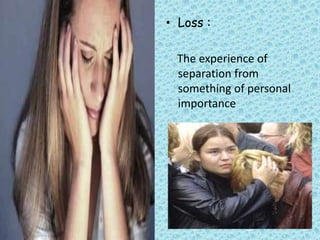
• Loss :
The experience of
separation from
something of personal
importance
Types of loss
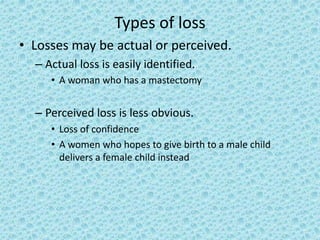
• Losses may be actual or perceived.
– Actual loss is easily identified.
• A woman who has a mastectomy
– Perceived loss is less obvious.
• Loss of confidence
• A women who hopes to give birth to a male child
delivers a female child instead
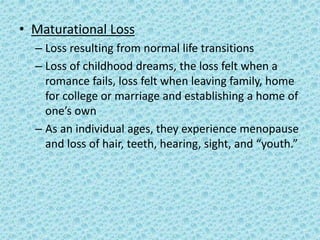
• Maturational Loss
– Loss resulting from normal life transitions
– Loss of childhood dreams, the loss felt when a
romance fails, loss felt when leaving family, home
for college or marriage and establishing a home of
one’s own
– As an individual ages, they experience menopause
and loss of hair, teeth, hearing, sight, and “youth.”
• Situational Loss
– A loss occurring suddenly in response to a specific
external event
– Sudden death of a loved one, or the unemployed
person who suffers low self-esteem
• Personal Loss
– Any loss that requires adaptation through the
grieving process
– Loss occurring when something or someone can
no longer be seen, felt, heard, known, or
experienced; individuals respond to loss
differently
Necessary loss
• integral part of each persons life
• Something natural and positive
eg : growing up process.
start and leave school , change friends , begin career
and form relationships.
These type of losses are discovered and replaced by
something different or better.
loss of known environment
Loss occurs through maturational and
situational event and through injury or illness
Loneliness or new unfamiliar setting threatens
self esteem and makes grieving difficult
Eg.: hospitalization , a new job.
Loss of significant others
• Loss of family member , friend , trusted nurse ,
acquaintances.
loss of an aspect of life
Illness , injury , or developmental changes result
in loss of aspect of self that causes grief and
permanent changes in the body image.
Eg. Body part , physiological functions.
Coping with loss
Coping Strategies
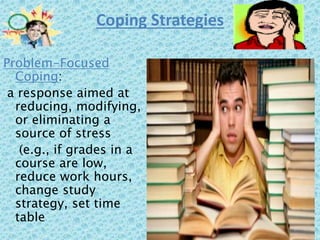
Problem-Focused
Coping:
a response aimed at
reducing, modifying,
or eliminating a
source of stress
(e.g., if grades in a
course are low,
reduce work hours,
change study
strategy, set time
table
Emotion-Focused
Coping:
a response aimed at
reducing the emotional
impact of the stressor
(e.g., denial,
religious faith, wishful
thinking,
humor , alcohol/drugs,
promiscuous sex).
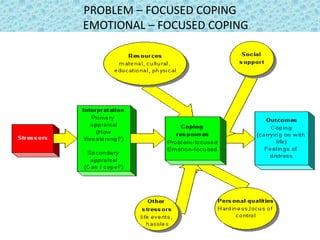
PROBLEM – FOCUSED COPING
EMOTIONAL – FOCUSED COPING
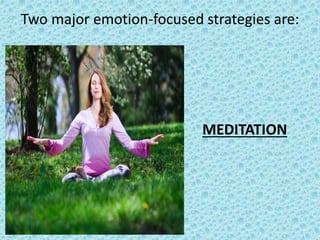
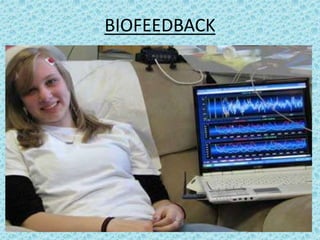
Two major emotion-focused strategies are:
MEDITATION
BIOFEEDBACK
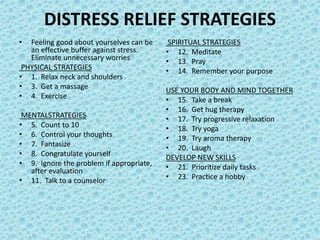
DISTRESS RELIEF STRATEGIES
• Feeling good about yourselves can be
an effective buffer against stress.
Eliminate unnecessary worries
PHYSICAL STRATEGIES
• 1. Relax neck and shoulders
• 3. Get a massage
• 4. Exercise
MENTALSTRATEGIES
• 5. Count to 10
• 6. Control your thoughts
• 7. Fantasize
• 8. Congratulate yourself
• 9. Ignore the problem if appropriate,
after evaluation
• 11. Talk to a counselor
SPIRITUAL STRATEGIES
• 12. Meditate
• 13. Pray
• 14. Remember your purpose
USE YOUR BODY AND MIND TOGETHER
• 15. Take a break
• 16. Get hug therapy
• 17. Try progressive relaxation
• 18. Try yoga
• 19. Try aroma therapy
• 20. Laugh
DEVELOP NEW SKILLS
• 21. Prioritize daily tasks
• 23. Practice a hobby

Coping with loss , and death ppt- By Ms. Ritika soni

  • 1.
  • 2.
    INTRODUCTION • Loss isa universal experience that occurs throughout the lifespan • Loss is a part of life cycle. • Loss is anything that is perceived as such by the individual. • All the people experience loss in the form of change , growth. • The experience of loss is painful , frightening and lonely • It triggers an array of emotional responses. • When loss is not acknowledged or there are multiple losses , anxiety , depression health problems may occur.
  • 3.
    • Loss : Theexperience of separation from something of personal importance
  • 6.
    Types of loss •Losses may be actual or perceived. – Actual loss is easily identified. • A woman who has a mastectomy – Perceived loss is less obvious. • Loss of confidence • A women who hopes to give birth to a male child delivers a female child instead
  • 7.
    • Maturational Loss –Loss resulting from normal life transitions – Loss of childhood dreams, the loss felt when a romance fails, loss felt when leaving family, home for college or marriage and establishing a home of one’s own – As an individual ages, they experience menopause and loss of hair, teeth, hearing, sight, and “youth.”
  • 8.
    • Situational Loss –A loss occurring suddenly in response to a specific external event – Sudden death of a loved one, or the unemployed person who suffers low self-esteem • Personal Loss – Any loss that requires adaptation through the grieving process – Loss occurring when something or someone can no longer be seen, felt, heard, known, or experienced; individuals respond to loss differently
  • 9.
    Necessary loss • integralpart of each persons life • Something natural and positive eg : growing up process. start and leave school , change friends , begin career and form relationships. These type of losses are discovered and replaced by something different or better.
  • 10.
    loss of knownenvironment Loss occurs through maturational and situational event and through injury or illness Loneliness or new unfamiliar setting threatens self esteem and makes grieving difficult Eg.: hospitalization , a new job.
  • 11.
    Loss of significantothers • Loss of family member , friend , trusted nurse , acquaintances. loss of an aspect of life Illness , injury , or developmental changes result in loss of aspect of self that causes grief and permanent changes in the body image. Eg. Body part , physiological functions.
  • 12.
  • 25.
    Coping Strategies Problem-Focused Coping: a responseaimed at reducing, modifying, or eliminating a source of stress (e.g., if grades in a course are low, reduce work hours, change study strategy, set time table
  • 26.
    Emotion-Focused Coping: a response aimedat reducing the emotional impact of the stressor (e.g., denial, religious faith, wishful thinking, humor , alcohol/drugs, promiscuous sex).
  • 27.
    PROBLEM – FOCUSEDCOPING EMOTIONAL – FOCUSED COPING
  • 28.
    Two major emotion-focusedstrategies are: MEDITATION
  • 29.
  • 30.
    DISTRESS RELIEF STRATEGIES •Feeling good about yourselves can be an effective buffer against stress. Eliminate unnecessary worries PHYSICAL STRATEGIES • 1. Relax neck and shoulders • 3. Get a massage • 4. Exercise MENTALSTRATEGIES • 5. Count to 10 • 6. Control your thoughts • 7. Fantasize • 8. Congratulate yourself • 9. Ignore the problem if appropriate, after evaluation • 11. Talk to a counselor SPIRITUAL STRATEGIES • 12. Meditate • 13. Pray • 14. Remember your purpose USE YOUR BODY AND MIND TOGETHER • 15. Take a break • 16. Get hug therapy • 17. Try progressive relaxation • 18. Try yoga • 19. Try aroma therapy • 20. Laugh DEVELOP NEW SKILLS • 21. Prioritize daily tasks • 23. Practice a hobby