Obstructive
lung disease
Presented by : Farah Alamleh
Supervisor : Dr-mazen Almasri
Outlines
• COPD:
- general characteristics
- clinical features
- diagnosis
- treatment
- complications
• Bronchiectasis:
- general characteristics
- causes
- clinical features
- diagnosis
- treatment
• Case scenario
COPD- General Characteristics
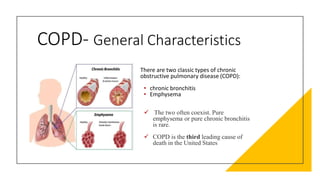
There are two classic types of chronic
obstructive pulmonary disease (COPD):
• chronic bronchitis
• Emphysema
 The two often coexist. Pure
emphysema or pure chronic bronchitis
is rare.
 COPD is the third leading cause of
death in the United States
Risk
factors
and
causes:
a. Tobacco smoke (indicated in almost 90%
of COPD cases)
b. α1 -Antitrypsin deficiency—risk is
even worse in combination with smoking
c. Environmental factors (e.g., second-
hand smoke)
d. Chronic asthma—which may be
attributed to asthma–COPD overlap
syndrome
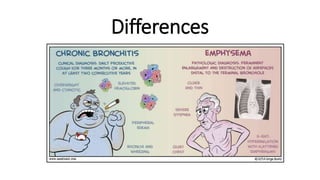
Chronic bronchitis
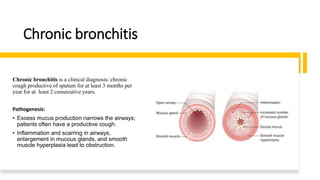
Chronic bronchitis is a clinical diagnosis: chronic
cough productive of sputum for at least 3 months per
year for at least 2 consecutive years.
Pathogenesis:
• Excess mucus production narrows the airways;
patients often have a productive cough.
• Inflammation and scarring in airways,
enlargement in mucous glands, and smooth
muscle hyperplasia lead to obstruction.
Emphysema
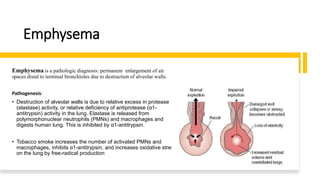
Emphysema is a pathologic diagnosis: permanent enlargement of air
spaces distal to terminal bronchioles due to destruction of alveolar walls.
Pathogenesis:
• Destruction of alveolar walls is due to relative excess in protease
(elastase) activity, or relative deficiency of antiprotease (α1-
antitrypsin) activity in the lung. Elastase is released from
polymorphonuclear neutrophils (PMNs) and macrophages and
digests human lung. This is inhibited by α1-antitrypsin.
• Tobacco smoke increases the number of activated PMNs and
macrophages, inhibits α1-antitrypsin, and increases oxidative stress
on the lung by free-radical production
Emphysema
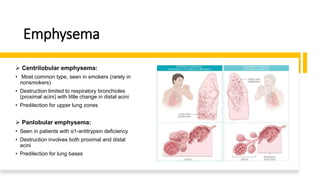
 Centrilobular emphysema:
• Most common type, seen in smokers (rarely in
nonsmokers)
• Destruction limited to respiratory bronchioles
(proximal acini) with little change in distal acini
• Predilection for upper lung zones
 Panlobular emphysema:
• Seen in patients with α1-antitrypsin deficiency
• Destruction involves both proximal and distal
acini
• Predilection for lung bases
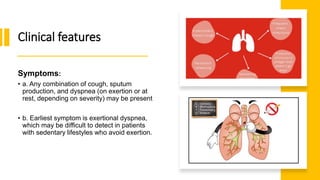
Clinical features
Symptoms:
• a. Any combination of cough, sputum
production, and dyspnea (on exertion or at
rest, depending on severity) may be present
• b. Earliest symptom is exertional dyspnea,
which may be difficult to detect in patients
with sedentary lifestyles who avoid exertion.
Clinical features
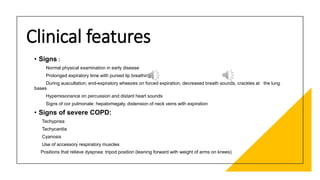
• Signs :
Normal physical examination in early disease
Prolonged expiratory time with pursed lip breathing
During auscultation, end-expiratory wheezes on forced expiration, decreased breath sounds, crackles at the lung
bases
Hyperresonance on percussion and distant heart sounds
Signs of cor pulmonale: hepatomegaly, distension of neck veins with expiration
• Signs of severe COPD:
Tachypnea
Tachycardia
Cyanosis
Use of accessory respiratory muscles
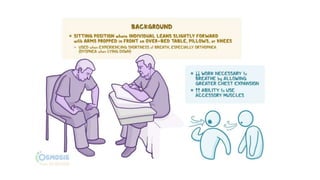
Positions that relieve dyspnea: tripod position (leaning forward with weight of arms on knees)
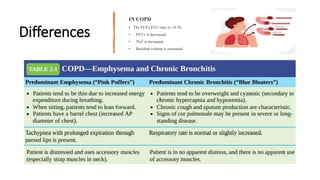
Differences
IN COPD
• The FEV1/FVC ratio is <0.70.
• FEV1 is decreased.
• TLC is increased.
• Residual volume is increased.
Differences
Diagnosis
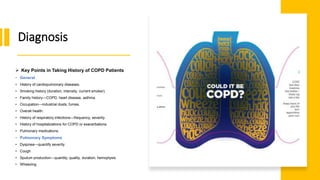
 Key Points in Taking History of COPD Patients
• General
• History of cardiopulmonary diseases.
• Smoking history (duration, intensity, current smoker).
• Family history—COPD, heart disease, asthma.
• Occupation—industrial dusts, fumes.
• Overall health.
• History of respiratory infections—frequency, severity.
• History of hospitalizations for COPD or exacerbations.
• Pulmonary medications.
• Pulmonary Symptoms
• Dyspnea—quantify severity
• Cough
• Sputum production—quantity, quality, duration, hemoptysis
• Wheezing
Diagnosis
• 1. PFT (definitive diagnostic test):
 decreased FEV1/FVC ratio
 Increased TLC
 Decreased vital capacity
Gold staging of COPD severity:
FEV1 ≥80% of predicted value is mild disease,
• 50% to 80% is moderate disease,
• 30% to 50% is severe disease,
• and <30% is very severe disease
Diagnosis
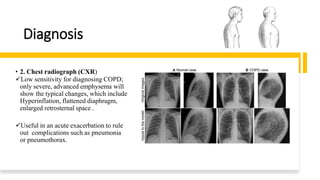
• 2. Chest radiograph (CXR)
Low sensitivity for diagnosing COPD;
only severe, advanced emphysema will
show the typical changes, which include
Hyperinflation, flattened diaphragm,
enlarged retrosternal space .
Useful in an acute exacerbation to rule
out complications such as pneumonia
or pneumothorax.
Diagnosis
• 3. Measure α1-antitrypsin levels in
patients with a personal or family
history of premature emphysema
(≤45 years old) or emphysema in
nonsmokers
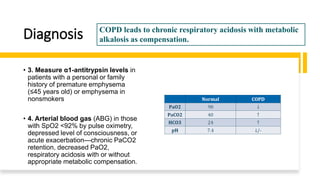
• 4. Arterial blood gas (ABG) in those
with SpO2 <92% by pulse oximetry,
depressed level of consciousness, or
acute exacerbation—chronic PaCO2
retention, decreased PaO2,
respiratory acidosis with or without
appropriate metabolic compensation.
COPD leads to chronic respiratory acidosis with metabolic
alkalosis as compensation.
Treatment of acute attacks
•Oxygen titrated to 88-92% O2
saturation
•Nebulized albuterol +/-ipratropium
(Combivent)
•IV or oral corticosteroids
•Antibiotics(severe, hospitalized
patients)
COPD Chronic Therapy
• Bronchodilator
•Chronic oxygen therapy
 Associated with increased survival
 Only used in patients with hypoxemia
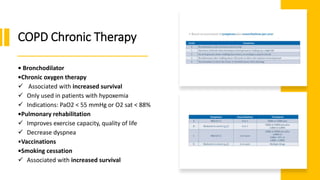
 Indications: PaO2 < 55 mmHg or O2 sat < 88%
•Pulmonary rehabilitation
 Improves exercise capacity, quality of life
 Decrease dyspnea
•Vaccinations
•Smoking cessation
 Associated with increased survival
Complication of
COPD
• 1. Acute exacerbations—most common
causes are infection, nonadherence
with therapy, and cardiac disease.
• 2. Secondary polycythemia (Hct >55%
in men or >47% in women)—
compensatory response to chronic
hypoxemia.
• 3. Pulmonary HTN and cor
pulmonale—may occur in patients with
severe, long-standing COPD who have
chronic hypoxemia.
Bronchiectasis
A. General Characteristics
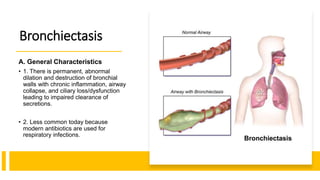
• 1. There is permanent, abnormal
dilation and destruction of bronchial
walls with chronic inflammation, airway
collapse, and ciliary loss/dysfunction
leading to impaired clearance of
secretions.
• 2. Less common today because
modern antibiotics are used for
respiratory infections.
Bronchiectasis
B. Causes
• 1. Recurrent infections (airway obstruction,
immunodeficiency, allergic
bronchopulmonary aspergillosis,
mycobacterium).
• 2. Cystic fibrosis (CF) is the most common
cause of bronchiectasis (accounts for half
of all cases).
• 3. Primary ciliary dyskinesia (e.g.,
Kartagener syndrome).
• 4. Autoimmune disease (rheumatoid
arthritis, systemic lupus erythematosus,
Crohn disease, etc.).
• 5. Humoral immunodeficiency (abnormal
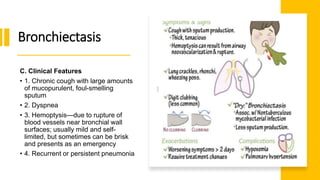
lung defense), airway obstruction.
Bronchiectasis
C. Clinical Features
• 1. Chronic cough with large amounts
of mucopurulent, foul-smelling
sputum
• 2. Dyspnea
• 3. Hemoptysis—due to rupture of
blood vessels near bronchial wall
surfaces; usually mild and self-
limited, but sometimes can be brisk
and presents as an emergency
• 4. Recurrent or persistent pneumonia
Bronchiectasis
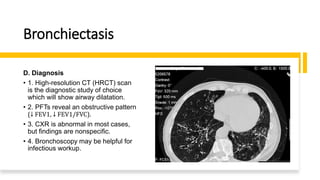
D. Diagnosis
• 1. High-resolution CT (HRCT) scan
is the diagnostic study of choice
which will show airway dilatation.
• 2. PFTs reveal an obstructive pattern
(↓ FEV1, ↓ FEV1/FVC).
• 3. CXR is abnormal in most cases,
but findings are nonspecific.
• 4. Bronchoscopy may be helpful for
infectious workup.
Bronchiectasis
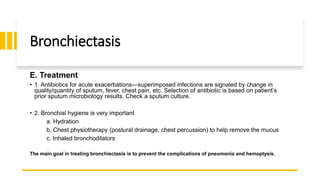
E. Treatment
• 1. Antibiotics for acute exacerbations—superimposed infections are signaled by change in
quality/quantity of sputum, fever, chest pain, etc. Selection of antibiotic is based on patient’s
prior sputum microbiology results. Check a sputum culture.
• 2. Bronchial hygiene is very important
a. Hydration
b. Chest physiotherapy (postural drainage, chest percussion) to help remove the mucus
c. Inhaled bronchodilators
The main goal in treating bronchiectasis is to prevent the complications of pneumonia and hemoptysis.
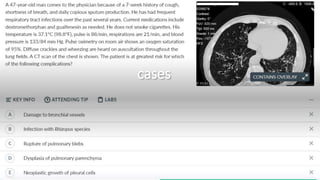
cases

COPD.pptx

  • 1.
    Obstructive lung disease Presented by: Farah Alamleh Supervisor : Dr-mazen Almasri
  • 2.
    Outlines • COPD: - generalcharacteristics - clinical features - diagnosis - treatment - complications • Bronchiectasis: - general characteristics - causes - clinical features - diagnosis - treatment • Case scenario
  • 3.
    COPD- General Characteristics Thereare two classic types of chronic obstructive pulmonary disease (COPD): • chronic bronchitis • Emphysema  The two often coexist. Pure emphysema or pure chronic bronchitis is rare.  COPD is the third leading cause of death in the United States
  • 4.
    Risk factors and causes: a. Tobacco smoke(indicated in almost 90% of COPD cases) b. α1 -Antitrypsin deficiency—risk is even worse in combination with smoking c. Environmental factors (e.g., second- hand smoke) d. Chronic asthma—which may be attributed to asthma–COPD overlap syndrome
  • 5.
    Chronic bronchitis Chronic bronchitisis a clinical diagnosis: chronic cough productive of sputum for at least 3 months per year for at least 2 consecutive years. Pathogenesis: • Excess mucus production narrows the airways; patients often have a productive cough. • Inflammation and scarring in airways, enlargement in mucous glands, and smooth muscle hyperplasia lead to obstruction.
  • 6.
    Emphysema Emphysema is apathologic diagnosis: permanent enlargement of air spaces distal to terminal bronchioles due to destruction of alveolar walls. Pathogenesis: • Destruction of alveolar walls is due to relative excess in protease (elastase) activity, or relative deficiency of antiprotease (α1- antitrypsin) activity in the lung. Elastase is released from polymorphonuclear neutrophils (PMNs) and macrophages and digests human lung. This is inhibited by α1-antitrypsin. • Tobacco smoke increases the number of activated PMNs and macrophages, inhibits α1-antitrypsin, and increases oxidative stress on the lung by free-radical production
  • 7.
    Emphysema  Centrilobular emphysema: •Most common type, seen in smokers (rarely in nonsmokers) • Destruction limited to respiratory bronchioles (proximal acini) with little change in distal acini • Predilection for upper lung zones  Panlobular emphysema: • Seen in patients with α1-antitrypsin deficiency • Destruction involves both proximal and distal acini • Predilection for lung bases
  • 8.
    Clinical features Symptoms: • a.Any combination of cough, sputum production, and dyspnea (on exertion or at rest, depending on severity) may be present • b. Earliest symptom is exertional dyspnea, which may be difficult to detect in patients with sedentary lifestyles who avoid exertion.
  • 9.
    Clinical features • Signs: Normal physical examination in early disease Prolonged expiratory time with pursed lip breathing During auscultation, end-expiratory wheezes on forced expiration, decreased breath sounds, crackles at the lung bases Hyperresonance on percussion and distant heart sounds Signs of cor pulmonale: hepatomegaly, distension of neck veins with expiration • Signs of severe COPD: Tachypnea Tachycardia Cyanosis Use of accessory respiratory muscles Positions that relieve dyspnea: tripod position (leaning forward with weight of arms on knees)
  • 11.
    Differences IN COPD • TheFEV1/FVC ratio is <0.70. • FEV1 is decreased. • TLC is increased. • Residual volume is increased.
  • 12.
  • 13.
    Diagnosis  Key Pointsin Taking History of COPD Patients • General • History of cardiopulmonary diseases. • Smoking history (duration, intensity, current smoker). • Family history—COPD, heart disease, asthma. • Occupation—industrial dusts, fumes. • Overall health. • History of respiratory infections—frequency, severity. • History of hospitalizations for COPD or exacerbations. • Pulmonary medications. • Pulmonary Symptoms • Dyspnea—quantify severity • Cough • Sputum production—quantity, quality, duration, hemoptysis • Wheezing
  • 14.
    Diagnosis • 1. PFT(definitive diagnostic test):  decreased FEV1/FVC ratio  Increased TLC  Decreased vital capacity Gold staging of COPD severity: FEV1 ≥80% of predicted value is mild disease, • 50% to 80% is moderate disease, • 30% to 50% is severe disease, • and <30% is very severe disease
  • 15.
    Diagnosis • 2. Chestradiograph (CXR) Low sensitivity for diagnosing COPD; only severe, advanced emphysema will show the typical changes, which include Hyperinflation, flattened diaphragm, enlarged retrosternal space . Useful in an acute exacerbation to rule out complications such as pneumonia or pneumothorax.
  • 16.
    Diagnosis • 3. Measureα1-antitrypsin levels in patients with a personal or family history of premature emphysema (≤45 years old) or emphysema in nonsmokers • 4. Arterial blood gas (ABG) in those with SpO2 <92% by pulse oximetry, depressed level of consciousness, or acute exacerbation—chronic PaCO2 retention, decreased PaO2, respiratory acidosis with or without appropriate metabolic compensation. COPD leads to chronic respiratory acidosis with metabolic alkalosis as compensation.
  • 17.
    Treatment of acuteattacks •Oxygen titrated to 88-92% O2 saturation •Nebulized albuterol +/-ipratropium (Combivent) •IV or oral corticosteroids •Antibiotics(severe, hospitalized patients)
  • 18.
    COPD Chronic Therapy •Bronchodilator •Chronic oxygen therapy  Associated with increased survival  Only used in patients with hypoxemia  Indications: PaO2 < 55 mmHg or O2 sat < 88% •Pulmonary rehabilitation  Improves exercise capacity, quality of life  Decrease dyspnea •Vaccinations •Smoking cessation  Associated with increased survival
  • 19.
    Complication of COPD • 1.Acute exacerbations—most common causes are infection, nonadherence with therapy, and cardiac disease. • 2. Secondary polycythemia (Hct >55% in men or >47% in women)— compensatory response to chronic hypoxemia. • 3. Pulmonary HTN and cor pulmonale—may occur in patients with severe, long-standing COPD who have chronic hypoxemia.
  • 20.
    Bronchiectasis A. General Characteristics •1. There is permanent, abnormal dilation and destruction of bronchial walls with chronic inflammation, airway collapse, and ciliary loss/dysfunction leading to impaired clearance of secretions. • 2. Less common today because modern antibiotics are used for respiratory infections.
  • 21.
    Bronchiectasis B. Causes • 1.Recurrent infections (airway obstruction, immunodeficiency, allergic bronchopulmonary aspergillosis, mycobacterium). • 2. Cystic fibrosis (CF) is the most common cause of bronchiectasis (accounts for half of all cases). • 3. Primary ciliary dyskinesia (e.g., Kartagener syndrome). • 4. Autoimmune disease (rheumatoid arthritis, systemic lupus erythematosus, Crohn disease, etc.). • 5. Humoral immunodeficiency (abnormal lung defense), airway obstruction.
  • 22.
    Bronchiectasis C. Clinical Features •1. Chronic cough with large amounts of mucopurulent, foul-smelling sputum • 2. Dyspnea • 3. Hemoptysis—due to rupture of blood vessels near bronchial wall surfaces; usually mild and self- limited, but sometimes can be brisk and presents as an emergency • 4. Recurrent or persistent pneumonia
  • 23.
    Bronchiectasis D. Diagnosis • 1.High-resolution CT (HRCT) scan is the diagnostic study of choice which will show airway dilatation. • 2. PFTs reveal an obstructive pattern (↓ FEV1, ↓ FEV1/FVC). • 3. CXR is abnormal in most cases, but findings are nonspecific. • 4. Bronchoscopy may be helpful for infectious workup.
  • 24.
    Bronchiectasis E. Treatment • 1.Antibiotics for acute exacerbations—superimposed infections are signaled by change in quality/quantity of sputum, fever, chest pain, etc. Selection of antibiotic is based on patient’s prior sputum microbiology results. Check a sputum culture. • 2. Bronchial hygiene is very important a. Hydration b. Chest physiotherapy (postural drainage, chest percussion) to help remove the mucus c. Inhaled bronchodilators The main goal in treating bronchiectasis is to prevent the complications of pneumonia and hemoptysis.
  • 25.