




14/18/2018REENA BHAGAT
PRESENTED BY:
REENA BHAGAT
MN 1ST YEAR, 2017
 Introduction
 Definition of convulsion
 Causes
 Pathophysiology
 Signs & symptoms
 Diagnosis
 Management
 Complications
 Prognosis
4/18/2018 3REENA BHAGAT
 Convulsion can be due to asphyxia, birth
injury or hypoglycemia and also are a sign of
meningitis or neurological problems.
 Overall incidence ranges from 2-14 in 1000
live births.
4/18/2018 4REENA BHAGAT
A sudden, violent, irregular movement of the body,
caused by involuntary contraction of muscles and
associated especially with brain disorders such as
epilepsy, the presence of certain toxins or other
agents in the blood, or fever in children.
4/18/2018 5REENA BHAGAT
i) Early Neonatal Period:
 Birth asphyxia eg. difficult or obstructed labor
 Pyridoxine deficiency
 Intracranial hemorrhage
 Hypoglycemic
 Hypocalcemia
 Hyponatremia/ Hypernatremia
 Inborn errors of metabolism
 Maternal withdrawal ( narcotics, drugs)
4/18/2018 6REENA BHAGAT
ii) Late Neonatal Period:
 Hypocalcemia
 Hypomagnesemia,
 Hypoglycemia
 Kernicterus
 Developmental malformation eg. microcephaly
 Meningitis, Septicemia
 Intrauterine TORCH infection
 Tetanus neonatarum
4/18/2018 7REENA BHAGAT
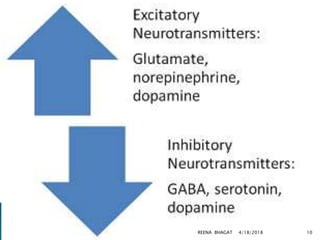
The basic mechanism is excessive depolarization
(excitation ) of neurons within the CNS. Three possible
reasons for excessive depolarization are proposed:
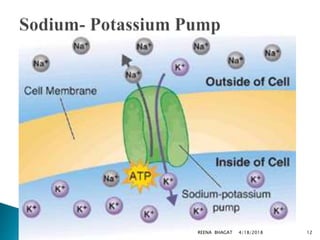
 Failure of sodium potassium pump operation.
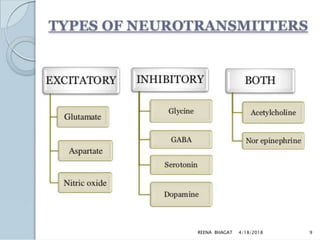
 Relative excess of excitatory neurotransmitter
compared to the inhibitory ones.
 Relative deficiency of inhibitory neurotransmitters.
4/18/2018 8REENA BHAGAT
4/18/2018REENA BHAGAT 9
4/18/2018REENA BHAGAT 10
 The neurons within the CNS undergo depolarization
due to inward migration of sodium and repolarization
due to efflux of potassium.
4/18/2018 11REENA BHAGAT
4/18/2018REENA BHAGAT 12
i) Generalized convulsions:
 Repetitive jerking movements of limbs and face.
 Continuous extension or flexion of arms and legs
either synchronous or asynchronous
 Apnea
 Baby may be unconscious or awake but
unresponsive.
4/18/2018 13REENA BHAGAT
ii) Subtle convulsion:
 Repetitive blinking, eye deviation or startling
 Repetitive movements of mouth or tongue
 Purposeless movements of the limbs as of bicycling
or swimming
 Apnea
 Baby may be unconscious
iii) Spasms:
 Involuntary contractions of muscles that last a few
seconds to few minutes.
4/18/2018 14REENA BHAGAT
 History:
 Details of delivery, Apgar score at birth, breast
feeding or not, maternal drug history, family history
of seizures, inborn errors of metabolism, withdrawl
of narcotic drugs.
4/18/2018 15REENA BHAGAT
 Investigations:
 Full blood count
 Blood and CSF cultures
 Serum IgM & IgG- specific TORCH titres.
 Blood biochemical- estimation for glucose, calcium,
magnesium, bilirubin, & electrolytes
 Blood gas levels to detect acidosis & hypoxia
 EEG
4/18/2018 16REENA BHAGAT
 Imaging studies:
 Ultrasonography or CT scan of head- to detect
intraventricular and/or subarachnoid hemorrhage.
They are also useful to detect any congenital
malformations.
4/18/2018 17REENA BHAGAT
The principles of management are:
 To control convulsions
 To stabilize the vital functions
 To treat the underlying pathology
 To maintain supportive therapy, nutrition, ventilation,
cardiac output, serum electrolytes and pH.
4/18/2018 18REENA BHAGAT
 To control convulsions:
 Intravenous administration of phenobarbitone. 20
mg/kg body wt. slowly over a period of 10-15
minutes is effective.
The maintenance dose of 2.5-4 mg/kg body wt. per
day administered orally or intramuscularly for at least
a period of 2 weeks or even longer.
 In resistant cases, iv phenytoin ( Dilantin) 20 mg/kg
at the rate of 1mg/kg/min is administered.
The maintenance dose of 5-8 mg/kg/day divided 12
hourly. Fosphenytoin is preferred.
4/18/2018 19REENA BHAGAT
 To treat the underlying causes:
 Hypoglycemia: glucose infusion, 2ml/kg of 10%
glucose through iv lines is given over 2-3 minutes.
Glucose infusion is continued at a rate of 6-8/
mg/kg/min. blood glucose should be maintained at
70-100 mg/dl.
 Hypomagnesemia: magnesium sulphate ( 0.4-0.8
mEq/kg) is given iv every 12 hrs until magnesium
level is normal.
4/18/2018 20REENA BHAGAT
 Infection : Appropriate antibiotic therapy following
complete septic work up.
 Hypocalcemia: iv administration of 2ml/kg of 10%
calcium gluconate taken over 5 minutes. This is to be
followed by oral calcium chloride 50 mg with each
feed for few days.
4/18/2018 21REENA BHAGAT
 Pyridoxine deficiency: iv administration of 50 mg
pyridoxine is effective. To relieve intracranial
tension- 10 ml of 20% mannitol is given
intravenously over 30-60 minutes.
4/18/2018 22REENA BHAGAT
Complications of neonatal convulsion may include the
following:
 Cerebral palsy
 Cerebral atrophy
 Epilepsy
 Feeding difficulties
4/18/2018 23REENA BHAGAT
 Varies with the etiology.
 Hypocalcemia convulsions have an excellent
prognosis whereas seizures secondary to congenital
malformations have poor outcomes.
 The overall mortality rate has decreased but
neurological sequelae are still around 30-40%.
4/18/2018 24REENA BHAGAT
4/18/2018 25REENA BHAGAT
4/18/2018 26REENA BHAGAT
1. What are the drugs used for convulsion treatment?
2. The term “Neonates” is used for the newborn upto
a) 2 months b) 1 year
c) 28 days d) 6 months
3. For diagnosing severe asphyxia , Apgar score must
be
a) 1-3 b) 7-10
c) 9-12 d) 4-9
4/18/2018 27REENA BHAGAT
4. Pyridoxine is also called vitamin ………………
5. EEG stands for ….…………………….
6.TORCH infection stands for ………………………
7. IgG can pass across placenta.
a) True b) False
4/18/2018 28REENA BHAGAT
 Prepare nursing care plan on convulsion.
4/18/2018 29REENA BHAGAT
 Ranabhat, R.D & Niraula, H.(2017) A textbook of
midwifery & reproductive health (1st ed.).
Kathmandu, Page no: 583-584
 Tuitui, R. (2016) Manual of midwifery III (11th ed.).
Vidyarthi Pustak Bhandar, Kathmandu, Page no: 235-
237
 Dutta, D.C. (2011). A textbook of obstetrics including
perinatology and contraception (7th ed.). A central
book agency(P) ltd., Hyderabad, page no: 481-482
4/18/2018 30REENA BHAGAT
4/18/2018 31REENA BHAGAT

Convulsion in newborns

  • 1.
  • 2.
  • 3.
     Introduction  Definitionof convulsion  Causes  Pathophysiology  Signs & symptoms  Diagnosis  Management  Complications  Prognosis 4/18/2018 3REENA BHAGAT
  • 4.
     Convulsion canbe due to asphyxia, birth injury or hypoglycemia and also are a sign of meningitis or neurological problems.  Overall incidence ranges from 2-14 in 1000 live births. 4/18/2018 4REENA BHAGAT
  • 5.
    A sudden, violent,irregular movement of the body, caused by involuntary contraction of muscles and associated especially with brain disorders such as epilepsy, the presence of certain toxins or other agents in the blood, or fever in children. 4/18/2018 5REENA BHAGAT
  • 6.
    i) Early NeonatalPeriod:  Birth asphyxia eg. difficult or obstructed labor  Pyridoxine deficiency  Intracranial hemorrhage  Hypoglycemic  Hypocalcemia  Hyponatremia/ Hypernatremia  Inborn errors of metabolism  Maternal withdrawal ( narcotics, drugs) 4/18/2018 6REENA BHAGAT
  • 7.
    ii) Late NeonatalPeriod:  Hypocalcemia  Hypomagnesemia,  Hypoglycemia  Kernicterus  Developmental malformation eg. microcephaly  Meningitis, Septicemia  Intrauterine TORCH infection  Tetanus neonatarum 4/18/2018 7REENA BHAGAT
  • 8.
    The basic mechanismis excessive depolarization (excitation ) of neurons within the CNS. Three possible reasons for excessive depolarization are proposed:  Failure of sodium potassium pump operation.  Relative excess of excitatory neurotransmitter compared to the inhibitory ones.  Relative deficiency of inhibitory neurotransmitters. 4/18/2018 8REENA BHAGAT
  • 9.
  • 10.
  • 11.
     The neuronswithin the CNS undergo depolarization due to inward migration of sodium and repolarization due to efflux of potassium. 4/18/2018 11REENA BHAGAT
  • 12.
  • 13.
    i) Generalized convulsions: Repetitive jerking movements of limbs and face.  Continuous extension or flexion of arms and legs either synchronous or asynchronous  Apnea  Baby may be unconscious or awake but unresponsive. 4/18/2018 13REENA BHAGAT
  • 14.
    ii) Subtle convulsion: Repetitive blinking, eye deviation or startling  Repetitive movements of mouth or tongue  Purposeless movements of the limbs as of bicycling or swimming  Apnea  Baby may be unconscious iii) Spasms:  Involuntary contractions of muscles that last a few seconds to few minutes. 4/18/2018 14REENA BHAGAT
  • 15.
     History:  Detailsof delivery, Apgar score at birth, breast feeding or not, maternal drug history, family history of seizures, inborn errors of metabolism, withdrawl of narcotic drugs. 4/18/2018 15REENA BHAGAT
  • 16.
     Investigations:  Fullblood count  Blood and CSF cultures  Serum IgM & IgG- specific TORCH titres.  Blood biochemical- estimation for glucose, calcium, magnesium, bilirubin, & electrolytes  Blood gas levels to detect acidosis & hypoxia  EEG 4/18/2018 16REENA BHAGAT
  • 17.
     Imaging studies: Ultrasonography or CT scan of head- to detect intraventricular and/or subarachnoid hemorrhage. They are also useful to detect any congenital malformations. 4/18/2018 17REENA BHAGAT
  • 18.
    The principles ofmanagement are:  To control convulsions  To stabilize the vital functions  To treat the underlying pathology  To maintain supportive therapy, nutrition, ventilation, cardiac output, serum electrolytes and pH. 4/18/2018 18REENA BHAGAT
  • 19.
     To controlconvulsions:  Intravenous administration of phenobarbitone. 20 mg/kg body wt. slowly over a period of 10-15 minutes is effective. The maintenance dose of 2.5-4 mg/kg body wt. per day administered orally or intramuscularly for at least a period of 2 weeks or even longer.  In resistant cases, iv phenytoin ( Dilantin) 20 mg/kg at the rate of 1mg/kg/min is administered. The maintenance dose of 5-8 mg/kg/day divided 12 hourly. Fosphenytoin is preferred. 4/18/2018 19REENA BHAGAT
  • 20.
     To treatthe underlying causes:  Hypoglycemia: glucose infusion, 2ml/kg of 10% glucose through iv lines is given over 2-3 minutes. Glucose infusion is continued at a rate of 6-8/ mg/kg/min. blood glucose should be maintained at 70-100 mg/dl.  Hypomagnesemia: magnesium sulphate ( 0.4-0.8 mEq/kg) is given iv every 12 hrs until magnesium level is normal. 4/18/2018 20REENA BHAGAT
  • 21.
     Infection :Appropriate antibiotic therapy following complete septic work up.  Hypocalcemia: iv administration of 2ml/kg of 10% calcium gluconate taken over 5 minutes. This is to be followed by oral calcium chloride 50 mg with each feed for few days. 4/18/2018 21REENA BHAGAT
  • 22.
     Pyridoxine deficiency:iv administration of 50 mg pyridoxine is effective. To relieve intracranial tension- 10 ml of 20% mannitol is given intravenously over 30-60 minutes. 4/18/2018 22REENA BHAGAT
  • 23.
    Complications of neonatalconvulsion may include the following:  Cerebral palsy  Cerebral atrophy  Epilepsy  Feeding difficulties 4/18/2018 23REENA BHAGAT
  • 24.
     Varies withthe etiology.  Hypocalcemia convulsions have an excellent prognosis whereas seizures secondary to congenital malformations have poor outcomes.  The overall mortality rate has decreased but neurological sequelae are still around 30-40%. 4/18/2018 24REENA BHAGAT
  • 25.
  • 26.
  • 27.
    1. What arethe drugs used for convulsion treatment? 2. The term “Neonates” is used for the newborn upto a) 2 months b) 1 year c) 28 days d) 6 months 3. For diagnosing severe asphyxia , Apgar score must be a) 1-3 b) 7-10 c) 9-12 d) 4-9 4/18/2018 27REENA BHAGAT
  • 28.
    4. Pyridoxine isalso called vitamin ……………… 5. EEG stands for ….……………………. 6.TORCH infection stands for ……………………… 7. IgG can pass across placenta. a) True b) False 4/18/2018 28REENA BHAGAT
  • 29.
     Prepare nursingcare plan on convulsion. 4/18/2018 29REENA BHAGAT
  • 30.
     Ranabhat, R.D& Niraula, H.(2017) A textbook of midwifery & reproductive health (1st ed.). Kathmandu, Page no: 583-584  Tuitui, R. (2016) Manual of midwifery III (11th ed.). Vidyarthi Pustak Bhandar, Kathmandu, Page no: 235- 237  Dutta, D.C. (2011). A textbook of obstetrics including perinatology and contraception (7th ed.). A central book agency(P) ltd., Hyderabad, page no: 481-482 4/18/2018 30REENA BHAGAT
  • 31.