CONVOLUTIONAL NEURAL NETWORK FOR TEXT CLASSIFICATION
{ANAIS ADDAD, BRIAN ZHEN, GAVIN POE, LING XIE - GITHUB: BZHEN/STAT198-GICF }
INTRODUCTION
Sentiment analysis is one of the key challenges in
extracting meaning from online user generated content.
In this work, we focus on Amazon reviews for the "cell
phones and assessories" category from a dataset of
42.8 million reviews collected by McAuley Leskovec
between May 1996 and 2014. The goal is to binary
classify each review as positive or negative using a
Convolutional Neural Network (CNN).
CNNs use several layers of convolutions over the input
layer to compute the output where different filters,
automatically learned by CNN, are applied to each
layer. The framework consists of four steps: (1) embed
each word as a row in a matrix; (2) tune filter sizes over
rows; (3) max-pool to produce a feature vector; (4) add
softmax classification layer for prediction.
Amazon Dataset
MODEL (CONT.)
• Pooling of maps to reduce output dimensionality
• Final softmax layer receives feature vector as input
used for binary classification
3. TensorFlow training procedure
• Minimize our loss function using Adam opti-
mizer
• Keep track of our accuracy and loss
• Iterate over batches of our data by calling the
train_step function
• Run training procedure with default parameters:
128-dimensional embedding, filter sizes of 1,2,3
and 4, dropout of 0.5 ad 128 filter per sizes
• Train/Test Split: 9000/1000
4. Training and Test Data
• Train Data: we assumed that reviews with a rat-
ing of 1 are negative and those with a rating of 5
are positive; we adjusted our samples to have the
same amount of positive and negative reviews
• Test Data: we tested both on a manually labelled
(0/1) dataset of sentences from Amazon, IMDB
and Yelp and we also used a data set similar to
that of our training set
RESULTS 1
Key Parameters
BATCH_SIZE 64
DEV_SAMPLE_PERCENTAGE 0.1
DROPOUT_KEEP_PROB 0.5
EMBEDDING_DIM 128
FILTER_SIZES 3,4,5
NUM_EPOCHS 44
NUM_FILTERS 128
Vocabulary Size 10084
Train/Dev Split 9000/1000
batch_size: number of samples propagated through net-
work
dev_sample_percentage: fraction of data used for eval-
uation
dropout_keep_prob: fraction of neurons to keep en-
abled
filter_sizes: number of words covered by filter
num_epochs: number of passes through data
num_filters: number of filters per filter_size
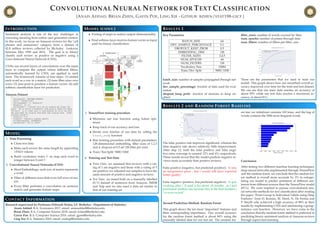
These are the parameters that we used to train our
model. This graph shows how our smoothed overall ac-
curacy improved over time for the train and test dataset.
We can see that our train data reaches an accuracy of
about 95% while our test data reaches a maximum ac-
curacy of about 81%.
CONTACT INFORMATION
Research supervised by Professor Deborah Nolan, UC Berkeley - Department of Statistics
Anais Addad: B.A. Economics 2017, email: anaisaddad@berkeley.edu
Brian Zhen: B.A. Computer Science 2018, email: bzhen@berkeley.edu
Gavin Poe: B.A. Computer Science 2019, email: gpoe@berkeley.edu
Ling Xie: B.A. Statistics 2019, email: xieling@berkeley.edu
RESULTS 2 AND RANDOM FOREST BASELINE
The false positive rate improves significant, whereas the
false negative rate shows relatively little improvement.
After step 12, both the false positive and false nega-
tive rates converge to around 12% and 6%, respectively.
These results reveal that the model predicts negative re-
views more accurately than positive reviews.
False positive (negative, but predicted positive): "it was
an inexpensive piece , but i would still have expected
better quality"
False negative (positive, but predicted negative): "it quit
working after i ’d used it for about 18 months , so i just
purchased another one because this is the best headset i
’ve ever owned"
Second Prediction Method: Random Forest
This graph shows the ten most "important" features and
their corresponding importance. Our overall accuracy
for the random forest method is about 84% using the
manually labeled data for our test set. The random for-
est tree we initialized contains 100 trees, and the bag of
words contains the 5000 most frequent words.
Conclusion
After testing two different machine learning techniques:
deep neural networks implemented through TensorFlow
and the random forest, we conclude that the random for-
est method is overall more accurate by 3% in extrapo-
lating our model to predict sentiment of different sen-
tences from different sources than the TensorFlow model
(81%). We were inspired to pursue convolutional neu-
ral networks methods for text classification after reading
the paper “From Group to Individual Labels using Deep
Features” from D. Kotzias, M. Denil, N. De Freitas and
P. Smyth who achieved a high accuracy of 88% in their
results by implementing CNN and minimizing a group-
instance cost function. However, we have come to the
conclusion that the random forest method is preferred in
predicting binary sentiment analysis of Amazon reviews
through supervised learning.
MODEL
1. Data Processing
• Clean text data
• Make each review the same length by appending
<PAD> tokens
• Build vocabulary index V an map each word to
integer between 0 and V
2. Convolutional Neural Networks (CNN)
• Word Embeddings: each row of matrix represents
a word
• Filter of different sizes slide over full rows of ma-
trix
• Every filter performs a convolution on sentence
matrix and generates feature maps

Convolutional Neural Network for Text Classification

  • 1.
    CONVOLUTIONAL NEURAL NETWORKFOR TEXT CLASSIFICATION {ANAIS ADDAD, BRIAN ZHEN, GAVIN POE, LING XIE - GITHUB: BZHEN/STAT198-GICF } INTRODUCTION Sentiment analysis is one of the key challenges in extracting meaning from online user generated content. In this work, we focus on Amazon reviews for the "cell phones and assessories" category from a dataset of 42.8 million reviews collected by McAuley Leskovec between May 1996 and 2014. The goal is to binary classify each review as positive or negative using a Convolutional Neural Network (CNN). CNNs use several layers of convolutions over the input layer to compute the output where different filters, automatically learned by CNN, are applied to each layer. The framework consists of four steps: (1) embed each word as a row in a matrix; (2) tune filter sizes over rows; (3) max-pool to produce a feature vector; (4) add softmax classification layer for prediction. Amazon Dataset MODEL (CONT.) • Pooling of maps to reduce output dimensionality • Final softmax layer receives feature vector as input used for binary classification 3. TensorFlow training procedure • Minimize our loss function using Adam opti- mizer • Keep track of our accuracy and loss • Iterate over batches of our data by calling the train_step function • Run training procedure with default parameters: 128-dimensional embedding, filter sizes of 1,2,3 and 4, dropout of 0.5 ad 128 filter per sizes • Train/Test Split: 9000/1000 4. Training and Test Data • Train Data: we assumed that reviews with a rat- ing of 1 are negative and those with a rating of 5 are positive; we adjusted our samples to have the same amount of positive and negative reviews • Test Data: we tested both on a manually labelled (0/1) dataset of sentences from Amazon, IMDB and Yelp and we also used a data set similar to that of our training set RESULTS 1 Key Parameters BATCH_SIZE 64 DEV_SAMPLE_PERCENTAGE 0.1 DROPOUT_KEEP_PROB 0.5 EMBEDDING_DIM 128 FILTER_SIZES 3,4,5 NUM_EPOCHS 44 NUM_FILTERS 128 Vocabulary Size 10084 Train/Dev Split 9000/1000 batch_size: number of samples propagated through net- work dev_sample_percentage: fraction of data used for eval- uation dropout_keep_prob: fraction of neurons to keep en- abled filter_sizes: number of words covered by filter num_epochs: number of passes through data num_filters: number of filters per filter_size These are the parameters that we used to train our model. This graph shows how our smoothed overall ac- curacy improved over time for the train and test dataset. We can see that our train data reaches an accuracy of about 95% while our test data reaches a maximum ac- curacy of about 81%. CONTACT INFORMATION Research supervised by Professor Deborah Nolan, UC Berkeley - Department of Statistics Anais Addad: B.A. Economics 2017, email: anaisaddad@berkeley.edu Brian Zhen: B.A. Computer Science 2018, email: bzhen@berkeley.edu Gavin Poe: B.A. Computer Science 2019, email: gpoe@berkeley.edu Ling Xie: B.A. Statistics 2019, email: xieling@berkeley.edu RESULTS 2 AND RANDOM FOREST BASELINE The false positive rate improves significant, whereas the false negative rate shows relatively little improvement. After step 12, both the false positive and false nega- tive rates converge to around 12% and 6%, respectively. These results reveal that the model predicts negative re- views more accurately than positive reviews. False positive (negative, but predicted positive): "it was an inexpensive piece , but i would still have expected better quality" False negative (positive, but predicted negative): "it quit working after i ’d used it for about 18 months , so i just purchased another one because this is the best headset i ’ve ever owned" Second Prediction Method: Random Forest This graph shows the ten most "important" features and their corresponding importance. Our overall accuracy for the random forest method is about 84% using the manually labeled data for our test set. The random for- est tree we initialized contains 100 trees, and the bag of words contains the 5000 most frequent words. Conclusion After testing two different machine learning techniques: deep neural networks implemented through TensorFlow and the random forest, we conclude that the random for- est method is overall more accurate by 3% in extrapo- lating our model to predict sentiment of different sen- tences from different sources than the TensorFlow model (81%). We were inspired to pursue convolutional neu- ral networks methods for text classification after reading the paper “From Group to Individual Labels using Deep Features” from D. Kotzias, M. Denil, N. De Freitas and P. Smyth who achieved a high accuracy of 88% in their results by implementing CNN and minimizing a group- instance cost function. However, we have come to the conclusion that the random forest method is preferred in predicting binary sentiment analysis of Amazon reviews through supervised learning. MODEL 1. Data Processing • Clean text data • Make each review the same length by appending <PAD> tokens • Build vocabulary index V an map each word to integer between 0 and V 2. Convolutional Neural Networks (CNN) • Word Embeddings: each row of matrix represents a word • Filter of different sizes slide over full rows of ma- trix • Every filter performs a convolution on sentence matrix and generates feature maps