Sentiment Classification
Unsupervised Sentiment Classification
 Unsupervised methods do not require labeled
examples.
 Knowledge about the task is usually added by
using lexical resources and
 hard-coded heuristics, e.g.:
 Lexicons + patterns: VADER
 Patterns + Simple language model: SO-PMI
 Neural language models have been found that
they learn to recognize
 sentiment with no explicit knowledge about the
task.
Supervised/unsupervised
 Supervised learning methods are the most commonly used one,
yet also
 some unsupervised methods have been successfully.
 Unsupervised methods rely on the shared and recurrent
characteristics of the
 sentiment dimension across topics to perform classification by
means of
 hand-made heuristics and simple language models.
 Supervised methods rely on a training set of labeled examples that
describe
 the correct classification label to be assigned to a number of
documents.
 A learning algorithm then exploits the examples to model a general
 classification function.
VADER
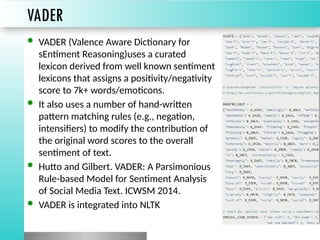
 VADER (Valence Aware Dictionary for
sEntiment Reasoning)uses a curated
lexicon derived from well known sentiment
lexicons that assigns a positivity/negativity
score to 7k+ words/emoticons.
 It also uses a number of hand-written
pattern matching rules (e.g., negation,
intensifiers) to modify the contribution of
the original word scores to the overall
sentiment of text.
 Hutto and Gilbert. VADER: A Parsimonious
Rule-based Model for Sentiment Analysis
of Social Media Text. ICWSM 2014.
 VADER is integrated into NLTK
The classification pipeline
The elements of a classification pipeline are:
1. Tokenization
2. Feature extraction
3. Feature selection
4. Weighting
5. Learning
 Steps from 1 to 4 define the feature space and
how text is converted into vectors.
 Step 5 creates the classification model.
Skikit-learn
 The scikit-learn library defines a rich number of
data processing and machine learning algorithms.
 Most modules in scikit implement a 'fit-transform'
interface:
 fit method learns the parameter of the module from
input data
 transform method apply the method implemented by
the module to the data
 fit_transform does both actions in sequence, and is
useful to connect modules in a pipeline.
Deep Learning for Sentiment Analysis
Convolutional Neural Network
 A convolutional layer in a NN is composed by a set of filters.
 A filter combines a "local" selection of input values into an output value.
 All filters are "sweeped" across all input.
• A filter using a window length of 5 is applied to all the sequences of 5 words
in a text.
• 3 filters using a window of 5 applied to a text of 10 words produce 18 output
values. Why?
• Filters have additional parameters that define their behavior at the start/end
of documents (padding), the size of the sweep step (stride), the eventual
presence of holes in the filter window (dilation).
 During training each filter specializes into recognizing some kind
of relevant combination of features.
 CNNs work well on stationary feats, i.e., those independent
from position.
-
Not
going
to
the
beach
tomorrow
:-(
+
-
convolutional layer with
multiple filters
Multilayer perceptron
with dropout
embeddings
for each word
max over time pooling
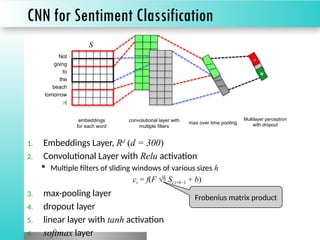
CNN for Sentiment Classification
1. Embeddings Layer, Rd
(d = 300)
2. Convolutional Layer with Relu activation
 Multiple filters of sliding windows of various sizes h
ci = f(F  Si:i+h−1 + b)
3. max-pooling layer
4. dropout layer
5. linear layer with tanh activation
6. softmax layer
S
Frobenius matrix product
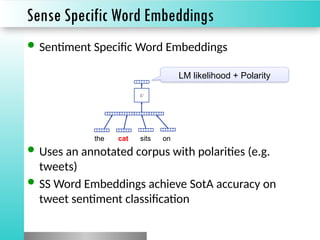
Sense Specific Word Embeddings
 Sentiment Specific Word Embeddings
 Uses an annotated corpus with polarities (e.g.
tweets)
 SS Word Embeddings achieve SotA accuracy on
tweet sentiment classification
U
the cat sits on
LM likelihood + Polarity
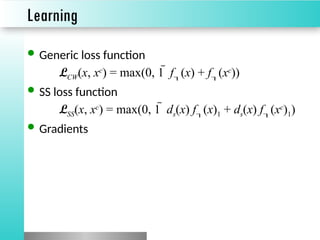
Learning
 Generic loss function
LCW(x, xc
) = max(0, 1  f(x) + f(xc
))
 SS loss function
LSS(x, xc
) = max(0, 1  ds(x) f(x)1 + ds(x) f(xc
)1)
 Gradients
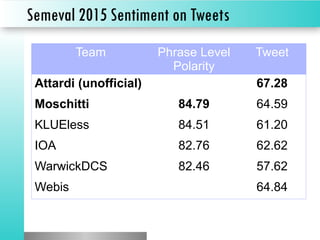
Semeval 2015 Sentiment on Tweets
Team Phrase Level
Polarity
Tweet
Attardi (unofficial) 67.28
Moschitti 84.79 64.59
KLUEless 84.51 61.20
IOA 82.76 62.62
WarwickDCS 82.46 57.62
Webis 64.84
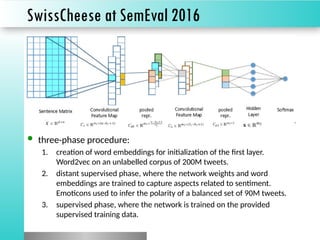
SwissCheese at SemEval 2016
 three-phase procedure:
1. creation of word embeddings for initialization of the first layer.
Word2vec on an unlabelled corpus of 200M tweets.
2. distant supervised phase, where the network weights and word
embeddings are trained to capture aspects related to sentiment.
Emoticons used to infer the polarity of a balanced set of 90M tweets.
3. supervised phase, where the network is trained on the provided
supervised training data.
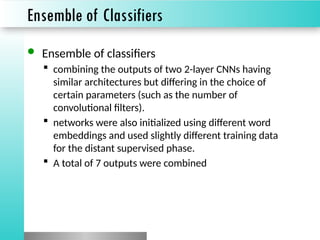
Ensemble of Classifiers
 Ensemble of classifiers
 combining the outputs of two 2-layer CNNs having
similar architectures but differing in the choice of
certain parameters (such as the number of
convolutional filters).
 networks were also initialized using different word
embeddings and used slightly different training data
for the distant supervised phase.
 A total of 7 outputs were combined
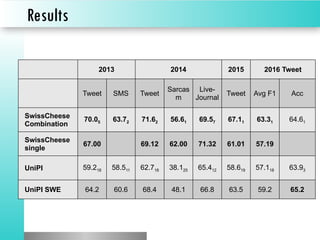
Results
2013 2014 2015 2016 Tweet
Tweet SMS Tweet
Sarcas
m
Live-
Journal
Tweet Avg F1 Acc
SwissCheese
Combination
70.05 63.72 71.62 56.61 69.57 67.11 63.31 64.61
SwissCheese
single
67.00 69.12 62.00 71.32 61.01 57.19
UniPI 59.218 58.511 62.718 38.125 65.412 58.619 57.118 63.93
UniPI SWE 64.2 60.6 68.4 48.1 66.8 63.5 59.2 65.2
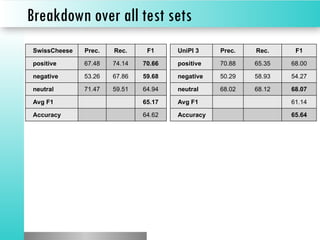
Breakdown over all test sets
SwissCheese Prec. Rec. F1
positive 67.48 74.14 70.66
negative 53.26 67.86 59.68
neutral 71.47 59.51 64.94
Avg F1 65.17
Accuracy 64.62
UniPI 3 Prec. Rec. F1
positive 70.88 65.35 68.00
negative 50.29 58.93 54.27
neutral 68.02 68.12 68.07
Avg F1 61.14
Accuracy 65.64
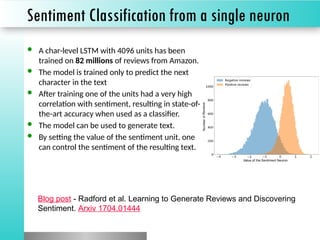
Sentiment Classification from a single neuron
 A char-level LSTM with 4096 units has been
trained on 82 millions of reviews from Amazon.
 The model is trained only to predict the next
character in the text
 After training one of the units had a very high
correlation with sentiment, resulting in state-of-
the-art accuracy when used as a classifier.
 The model can be used to generate text.
 By setting the value of the sentiment unit, one
can control the sentiment of the resulting text.
Blog post - Radford et al. Learning to Generate Reviews and Discovering
Sentiment. Arxiv 1704.01444

sentiment analysis using machine learning

  • 1.
  • 2.
    Unsupervised Sentiment Classification Unsupervised methods do not require labeled examples.  Knowledge about the task is usually added by using lexical resources and  hard-coded heuristics, e.g.:  Lexicons + patterns: VADER  Patterns + Simple language model: SO-PMI  Neural language models have been found that they learn to recognize  sentiment with no explicit knowledge about the task.
  • 3.
    Supervised/unsupervised  Supervised learningmethods are the most commonly used one, yet also  some unsupervised methods have been successfully.  Unsupervised methods rely on the shared and recurrent characteristics of the  sentiment dimension across topics to perform classification by means of  hand-made heuristics and simple language models.  Supervised methods rely on a training set of labeled examples that describe  the correct classification label to be assigned to a number of documents.  A learning algorithm then exploits the examples to model a general  classification function.
  • 4.
    VADER  VADER (ValenceAware Dictionary for sEntiment Reasoning)uses a curated lexicon derived from well known sentiment lexicons that assigns a positivity/negativity score to 7k+ words/emoticons.  It also uses a number of hand-written pattern matching rules (e.g., negation, intensifiers) to modify the contribution of the original word scores to the overall sentiment of text.  Hutto and Gilbert. VADER: A Parsimonious Rule-based Model for Sentiment Analysis of Social Media Text. ICWSM 2014.  VADER is integrated into NLTK
  • 5.
    The classification pipeline Theelements of a classification pipeline are: 1. Tokenization 2. Feature extraction 3. Feature selection 4. Weighting 5. Learning  Steps from 1 to 4 define the feature space and how text is converted into vectors.  Step 5 creates the classification model.
  • 6.
    Skikit-learn  The scikit-learnlibrary defines a rich number of data processing and machine learning algorithms.  Most modules in scikit implement a 'fit-transform' interface:  fit method learns the parameter of the module from input data  transform method apply the method implemented by the module to the data  fit_transform does both actions in sequence, and is useful to connect modules in a pipeline.
  • 7.
    Deep Learning forSentiment Analysis
  • 8.
    Convolutional Neural Network A convolutional layer in a NN is composed by a set of filters.  A filter combines a "local" selection of input values into an output value.  All filters are "sweeped" across all input. • A filter using a window length of 5 is applied to all the sequences of 5 words in a text. • 3 filters using a window of 5 applied to a text of 10 words produce 18 output values. Why? • Filters have additional parameters that define their behavior at the start/end of documents (padding), the size of the sweep step (stride), the eventual presence of holes in the filter window (dilation).  During training each filter specializes into recognizing some kind of relevant combination of features.  CNNs work well on stationary feats, i.e., those independent from position.
  • 9.
    - Not going to the beach tomorrow :-( + - convolutional layer with multiplefilters Multilayer perceptron with dropout embeddings for each word max over time pooling CNN for Sentiment Classification 1. Embeddings Layer, Rd (d = 300) 2. Convolutional Layer with Relu activation  Multiple filters of sliding windows of various sizes h ci = f(F  Si:i+h−1 + b) 3. max-pooling layer 4. dropout layer 5. linear layer with tanh activation 6. softmax layer S Frobenius matrix product
  • 10.
    Sense Specific WordEmbeddings  Sentiment Specific Word Embeddings  Uses an annotated corpus with polarities (e.g. tweets)  SS Word Embeddings achieve SotA accuracy on tweet sentiment classification U the cat sits on LM likelihood + Polarity
  • 11.
    Learning  Generic lossfunction LCW(x, xc ) = max(0, 1  f(x) + f(xc ))  SS loss function LSS(x, xc ) = max(0, 1  ds(x) f(x)1 + ds(x) f(xc )1)  Gradients
  • 12.
    Semeval 2015 Sentimenton Tweets Team Phrase Level Polarity Tweet Attardi (unofficial) 67.28 Moschitti 84.79 64.59 KLUEless 84.51 61.20 IOA 82.76 62.62 WarwickDCS 82.46 57.62 Webis 64.84
  • 13.
    SwissCheese at SemEval2016  three-phase procedure: 1. creation of word embeddings for initialization of the first layer. Word2vec on an unlabelled corpus of 200M tweets. 2. distant supervised phase, where the network weights and word embeddings are trained to capture aspects related to sentiment. Emoticons used to infer the polarity of a balanced set of 90M tweets. 3. supervised phase, where the network is trained on the provided supervised training data.
  • 14.
    Ensemble of Classifiers Ensemble of classifiers  combining the outputs of two 2-layer CNNs having similar architectures but differing in the choice of certain parameters (such as the number of convolutional filters).  networks were also initialized using different word embeddings and used slightly different training data for the distant supervised phase.  A total of 7 outputs were combined
  • 15.
    Results 2013 2014 20152016 Tweet Tweet SMS Tweet Sarcas m Live- Journal Tweet Avg F1 Acc SwissCheese Combination 70.05 63.72 71.62 56.61 69.57 67.11 63.31 64.61 SwissCheese single 67.00 69.12 62.00 71.32 61.01 57.19 UniPI 59.218 58.511 62.718 38.125 65.412 58.619 57.118 63.93 UniPI SWE 64.2 60.6 68.4 48.1 66.8 63.5 59.2 65.2
  • 16.
    Breakdown over alltest sets SwissCheese Prec. Rec. F1 positive 67.48 74.14 70.66 negative 53.26 67.86 59.68 neutral 71.47 59.51 64.94 Avg F1 65.17 Accuracy 64.62 UniPI 3 Prec. Rec. F1 positive 70.88 65.35 68.00 negative 50.29 58.93 54.27 neutral 68.02 68.12 68.07 Avg F1 61.14 Accuracy 65.64
  • 17.
    Sentiment Classification froma single neuron  A char-level LSTM with 4096 units has been trained on 82 millions of reviews from Amazon.  The model is trained only to predict the next character in the text  After training one of the units had a very high correlation with sentiment, resulting in state-of- the-art accuracy when used as a classifier.  The model can be used to generate text.  By setting the value of the sentiment unit, one can control the sentiment of the resulting text. Blog post - Radford et al. Learning to Generate Reviews and Discovering Sentiment. Arxiv 1704.01444