






CONVERSION
OPTIMIZATION
Annemarie Klaassen
Analytics & Optimization Expert @ Online Dialogue
@AM_Klaassen
About Me
About Online Dialogue
• Combination of data analysts, psychologists and marketers
• To improve their conversion rate
• And help businesses grow
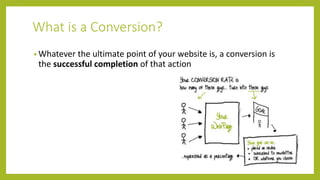
What is a Conversion?
• Whatever the ultimate point of your website is, a conversion is
the successful completion of that action
What is Conversion Optimization?
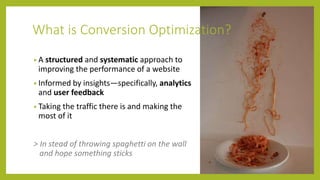
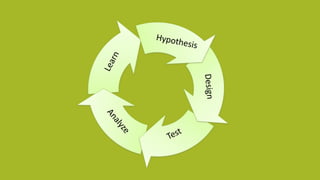
• A structured and systematic approach to
improving the performance of a website
• Informed by insights—specifically, analytics
and user feedback
• Taking the traffic there is and making the
most of it
> In stead of throwing spaghetti on the wall
and hope something sticks
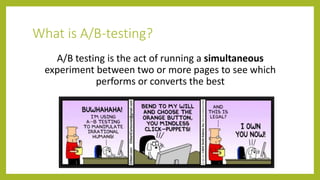
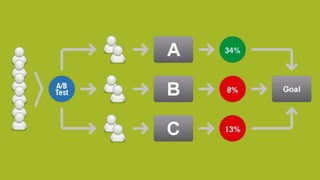
What is A/B-testing?
A/B testing is the act of running a simultaneous
experiment between two or more pages to see which
performs or converts the best
Advantages A/B-testing over Spaghetti
throwing
• A/B testing is straightforward: based on facts not opinions
• You can make a solid business case: by changing this, you will get
x% more profit
• You can run A/B tests before making expensive, and difficult-to-
change, technical investments
WHAT SHOULD I OPTIMIZE?
What should I test?
LEASED OVER $80 MILLION
IN CARS IN 2012!
www.lingscars.com
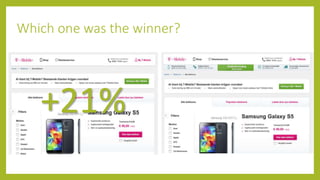
Which one was the winner?
+21%
OPINIONS ARE LIKE **SHOLES
everybody’s got one
YOU NEED A SYSTEMATIC
APPROACH
1. Conduct Research
• What are visitors doing on the website?
• What should they be doing?
• Where is the website leaking money?
• Why aren’t they doing what they’re supposed to?
 Combine quantitative and qualitative data
Without an analyzed reason to start, it doesn’t make any sense to start at all
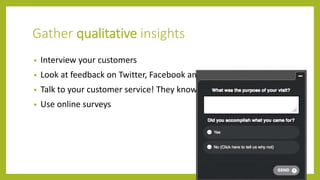
Gather qualitative insights
• Interview your customers
• Look at feedback on Twitter, Facebook and other social media
• Talk to your customer service! They know where visitors struggle
• Use online surveys
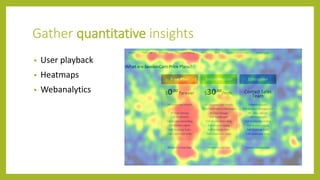
Gather quantitative insights
• User playback
• Heatmaps
• Webanalytics
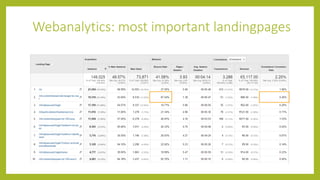
Webanalytics: most important landingpages
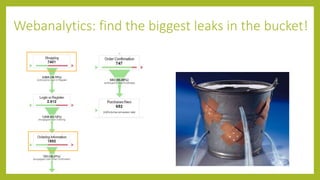
Webanalytics: find the biggest leaks in the bucket!
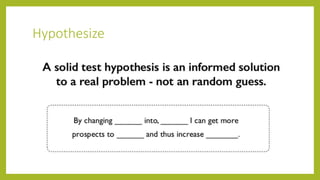
Hypothesize
CRO meets Psychology!
• The consumer is a brain
• The brain can be persuaded
towards a desired action
There’s more to it than Cialdini’s 6 techniques
1. Scarcity
2. Liking
3. Authority
4. Social proof
5. Reciprocity
6. Commitment & Consistency
> 250 techniques
 Wheel-of-Persuasion.com
2 Main things
1. You must attract the attention of the visitor
2. You must motivate the visitor to make a conversion
and remove the friction they may experience
ATTENTION & PERCEPTION
Attention & Perception
• We see things that are not really there
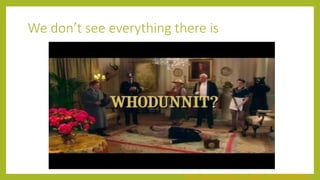
• We don’t see everything there is
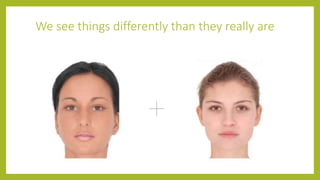
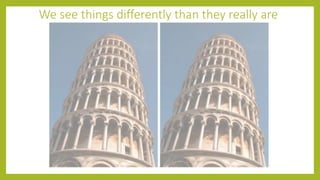
• We see things differently than they really are
We don’t see everything there is
https://www.youtube.com/watch?v=ubNF9QNEQLA
We see things differently than they really are
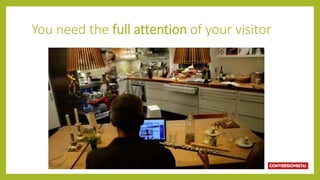
You need the full attention of your visitor
Visual Cueing
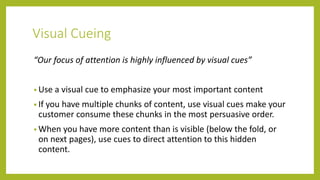
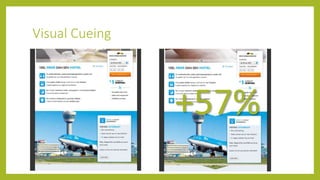
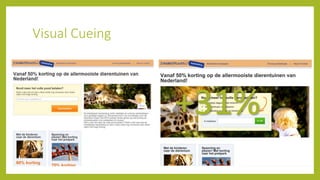
“Our focus of attention is highly influenced by visual cues”
• Use a visual cue to emphasize your most important content
• If you have multiple chunks of content, use visual cues make your
customer consume these chunks in the most persuasive order.
• When you have more content than is visible (below the fold, or
on next pages), use cues to direct attention to this hidden
content.
Visual Cueing
+57%
Visual Cueing
+31%
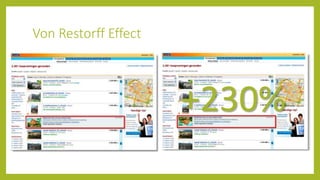
Von Restorff Effect
“We automatically pay more attention to things that are significantly
different”
• Highlight products you want visitors to pay attention to
• Do something completely different from your competitors in SEA
Von Restorff Effect
+230%
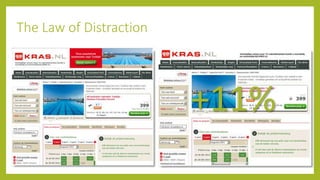
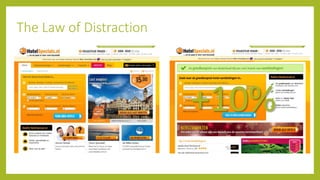
The Law of Distraction
“Our rational thinking can’t deal with distraction”
• Make your web / app page as clean as possible, leaving out
navigation, social sharing buttons, (external) banners,…
• Offer a ‘let’s do this later’ functionality
The Law of Distraction
+11%
The Law of Distraction
+10%
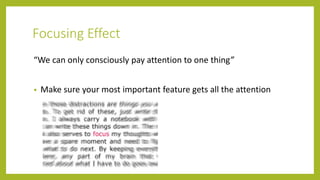
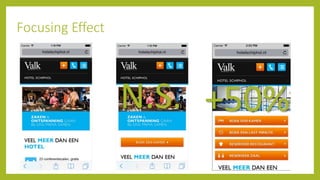
Focusing Effect
“We can only consciously pay attention to one thing”
• Make sure your most important feature gets all the attention
Focusing Effect
+50%N.S.
2 Main things
1. You must attract the attention of the visitor
2. You must motivate the visitor to make a conversion
and remove the friction they may experience
MOTIVATION & FRICTION
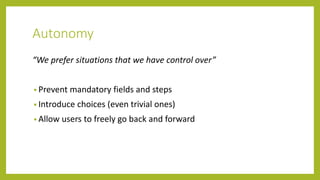
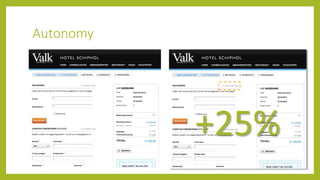
Autonomy
“We prefer situations that we have control over”
• Prevent mandatory fields and steps
• Introduce choices (even trivial ones)
• Allow users to freely go back and forward
Autonomy
+25%
Self-efficacy
“We are more likely to perform actions when we believe in our own
competence”
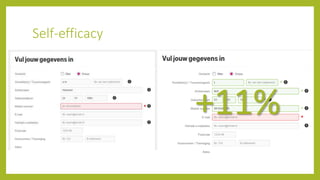
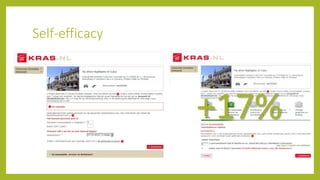
• Provide instant feedback on correct behavior
• Visualize the simplicity of procedures (a progress indicator)
• Use ‘how-to’ pages
• Use social proof
Self-efficacy
+11%
Self-efficacy
+17%
Money & Motivation
Imagine you need someone to help loading a sofa into your van. What’s
your best option?
• Just ask someone
• Just ask AND offer him/her a candy
• Just ask AND offer him/her a candy AND mentioning it’s worth € 0,50
• Just ask AND offer him/her € 0,50
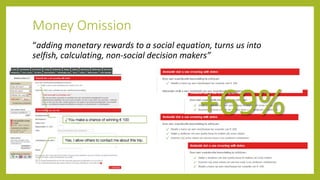
Money Omission
“adding monetary rewards to a social equation, turns us into
selfish, calculating, non-social decision makers”
+69%
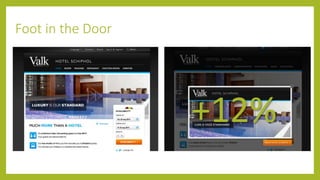
Foot in the Door
“We like something more as soon as we touch it”
• Get that first click!
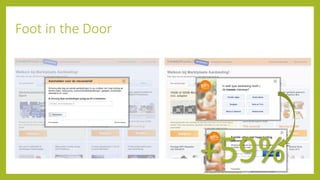
Foot in the Door
+59%
Foot in the Door
+12%
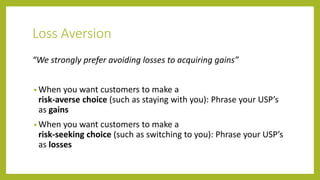
Loss Aversion
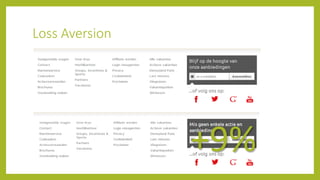
“We strongly prefer avoiding losses to acquiring gains”
• When you want customers to make a
risk-averse choice (such as staying with you): Phrase your USP’s
as gains
• When you want customers to make a
risk-seeking choice (such as switching to you): Phrase your USP’s
as losses
Loss Aversion
+9%
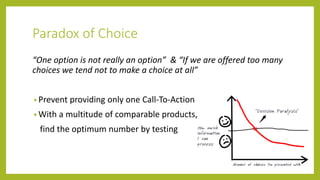
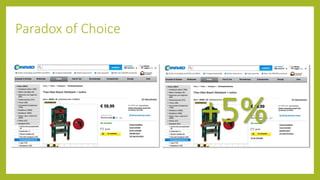
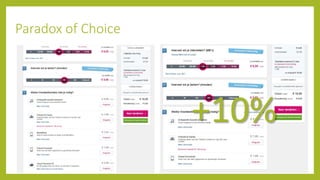
Paradox of Choice
“One option is not really an option” & “If we are offered too many
choices we tend not to make a choice at all”
• Prevent providing only one Call-To-Action
• With a multitude of comparable products,
find the optimum number by testing
Paradox of Choice
+5%
Paradox of Choice
+10%
ONE MORE TIP…
Peak-end Rule
“The ending and the highest peak of an experience, determine
how we remember it”
• Bring your ‘enlightening moments‘ from your sales dialogue together
in one happy climax
• Use enticing extras, such as the good old ‘unexpected gift on your
thank you page!’
Peak-end Rule
https://www.youtube.com/watch?v=chdEpyhh_EM
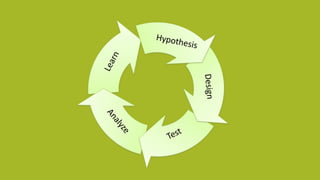
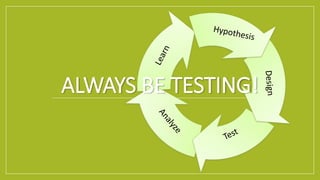
ALWAYS BE TESTING!
THANK YOU!

Conversion Optimization

  • 1.
    CONVERSION OPTIMIZATION Annemarie Klaassen Analytics &Optimization Expert @ Online Dialogue @AM_Klaassen
  • 2.
  • 3.
    About Online Dialogue •Combination of data analysts, psychologists and marketers • To improve their conversion rate • And help businesses grow
  • 4.
    What is aConversion? • Whatever the ultimate point of your website is, a conversion is the successful completion of that action
  • 5.
    What is ConversionOptimization? • A structured and systematic approach to improving the performance of a website • Informed by insights—specifically, analytics and user feedback • Taking the traffic there is and making the most of it > In stead of throwing spaghetti on the wall and hope something sticks
  • 6.
    What is A/B-testing? A/Btesting is the act of running a simultaneous experiment between two or more pages to see which performs or converts the best
  • 8.
    Advantages A/B-testing overSpaghetti throwing • A/B testing is straightforward: based on facts not opinions • You can make a solid business case: by changing this, you will get x% more profit • You can run A/B tests before making expensive, and difficult-to- change, technical investments
  • 9.
    WHAT SHOULD IOPTIMIZE? What should I test?
  • 10.
    LEASED OVER $80MILLION IN CARS IN 2012! www.lingscars.com
  • 11.
    Which one wasthe winner? +21%
  • 12.
    OPINIONS ARE LIKE**SHOLES everybody’s got one
  • 13.
    YOU NEED ASYSTEMATIC APPROACH
  • 15.
    1. Conduct Research •What are visitors doing on the website? • What should they be doing? • Where is the website leaking money? • Why aren’t they doing what they’re supposed to?  Combine quantitative and qualitative data Without an analyzed reason to start, it doesn’t make any sense to start at all
  • 16.
    Gather qualitative insights •Interview your customers • Look at feedback on Twitter, Facebook and other social media • Talk to your customer service! They know where visitors struggle • Use online surveys
  • 17.
    Gather quantitative insights •User playback • Heatmaps • Webanalytics
  • 18.
  • 19.
    Webanalytics: find thebiggest leaks in the bucket!
  • 21.
  • 23.
    CRO meets Psychology! •The consumer is a brain • The brain can be persuaded towards a desired action
  • 24.
    There’s more toit than Cialdini’s 6 techniques 1. Scarcity 2. Liking 3. Authority 4. Social proof 5. Reciprocity 6. Commitment & Consistency > 250 techniques  Wheel-of-Persuasion.com
  • 25.
    2 Main things 1.You must attract the attention of the visitor 2. You must motivate the visitor to make a conversion and remove the friction they may experience
  • 26.
  • 27.
    Attention & Perception •We see things that are not really there • We don’t see everything there is • We see things differently than they really are
  • 29.
    We don’t seeeverything there is https://www.youtube.com/watch?v=ubNF9QNEQLA
  • 30.
    We see thingsdifferently than they really are
  • 31.
    We see thingsdifferently than they really are
  • 32.
    You need thefull attention of your visitor
  • 33.
    Visual Cueing “Our focusof attention is highly influenced by visual cues” • Use a visual cue to emphasize your most important content • If you have multiple chunks of content, use visual cues make your customer consume these chunks in the most persuasive order. • When you have more content than is visible (below the fold, or on next pages), use cues to direct attention to this hidden content.
  • 34.
  • 35.
  • 36.
    Von Restorff Effect “Weautomatically pay more attention to things that are significantly different” • Highlight products you want visitors to pay attention to • Do something completely different from your competitors in SEA
  • 37.
  • 38.
    The Law ofDistraction “Our rational thinking can’t deal with distraction” • Make your web / app page as clean as possible, leaving out navigation, social sharing buttons, (external) banners,… • Offer a ‘let’s do this later’ functionality
  • 39.
    The Law ofDistraction +11%
  • 40.
    The Law ofDistraction +10%
  • 41.
    Focusing Effect “We canonly consciously pay attention to one thing” • Make sure your most important feature gets all the attention
  • 42.
  • 43.
    2 Main things 1.You must attract the attention of the visitor 2. You must motivate the visitor to make a conversion and remove the friction they may experience
  • 44.
  • 45.
    Autonomy “We prefer situationsthat we have control over” • Prevent mandatory fields and steps • Introduce choices (even trivial ones) • Allow users to freely go back and forward
  • 46.
  • 47.
    Self-efficacy “We are morelikely to perform actions when we believe in our own competence” • Provide instant feedback on correct behavior • Visualize the simplicity of procedures (a progress indicator) • Use ‘how-to’ pages • Use social proof
  • 48.
  • 49.
  • 50.
    Money & Motivation Imagineyou need someone to help loading a sofa into your van. What’s your best option? • Just ask someone • Just ask AND offer him/her a candy • Just ask AND offer him/her a candy AND mentioning it’s worth € 0,50 • Just ask AND offer him/her € 0,50
  • 51.
    Money Omission “adding monetaryrewards to a social equation, turns us into selfish, calculating, non-social decision makers” +69%
  • 52.
    Foot in theDoor “We like something more as soon as we touch it” • Get that first click!
  • 53.
    Foot in theDoor +59%
  • 54.
    Foot in theDoor +12%
  • 55.
    Loss Aversion “We stronglyprefer avoiding losses to acquiring gains” • When you want customers to make a risk-averse choice (such as staying with you): Phrase your USP’s as gains • When you want customers to make a risk-seeking choice (such as switching to you): Phrase your USP’s as losses
  • 56.
  • 57.
    Paradox of Choice “Oneoption is not really an option” & “If we are offered too many choices we tend not to make a choice at all” • Prevent providing only one Call-To-Action • With a multitude of comparable products, find the optimum number by testing
  • 58.
  • 59.
  • 60.
  • 61.
    Peak-end Rule “The endingand the highest peak of an experience, determine how we remember it” • Bring your ‘enlightening moments‘ from your sales dialogue together in one happy climax • Use enticing extras, such as the good old ‘unexpected gift on your thank you page!’
  • 62.
  • 63.
  • 64.

Editor's Notes

  • #11 Leased over 80 million dollars in cars in 2012
  • #19 Not everybody enters on the homepage!
  • #25 6 key principles of influence by Robert Cialdini[edit] Reciprocity – People tend to return a favor Commitment and Consistency – If people commit, orally or in writing, to an idea or goal, they are more likely to honor that commitment because of establishing that idea or goal as being congruent with their self-image. Social Proof – People will do things that they see other people are doing. Authority – People will tend to obey authority figures, even if they are asked to perform objectionable acts. Liking – People are easily persuaded by other people that they like. Scarcity – Perceived scarcity will generate demand. For example, saying offers are available for a "limited time only" encourages sales.