E-Score
Conversation
Analysis
Handbook
This little booklet is designed to help you
remember some of the elements that happen
in conversations you should observed
© All Rights Reserved Morris Pentel
Step 2 – Analysing Conversations
“Conversation is designed to be understood – that is its purpose”*
Conversation is the single richest source of actionable customer insight available to every organisation
that can change outcomes. It is also the most underused.
Conversations are habits and patterns. It doesn’t matter if it’s a phone call an instore
conversation or a digital chat unlocking the patterns of conversation will be the next step change in
Customer Experience
By analysing conversation you can create a habit based transformation programme that is
cheap, easy to role out and gives a bigger bang per buck than any other methodology and you can see
the results through your normal Metrics.
© All Rights Reserved Morris Pentel
* Professor Liz Stokoe
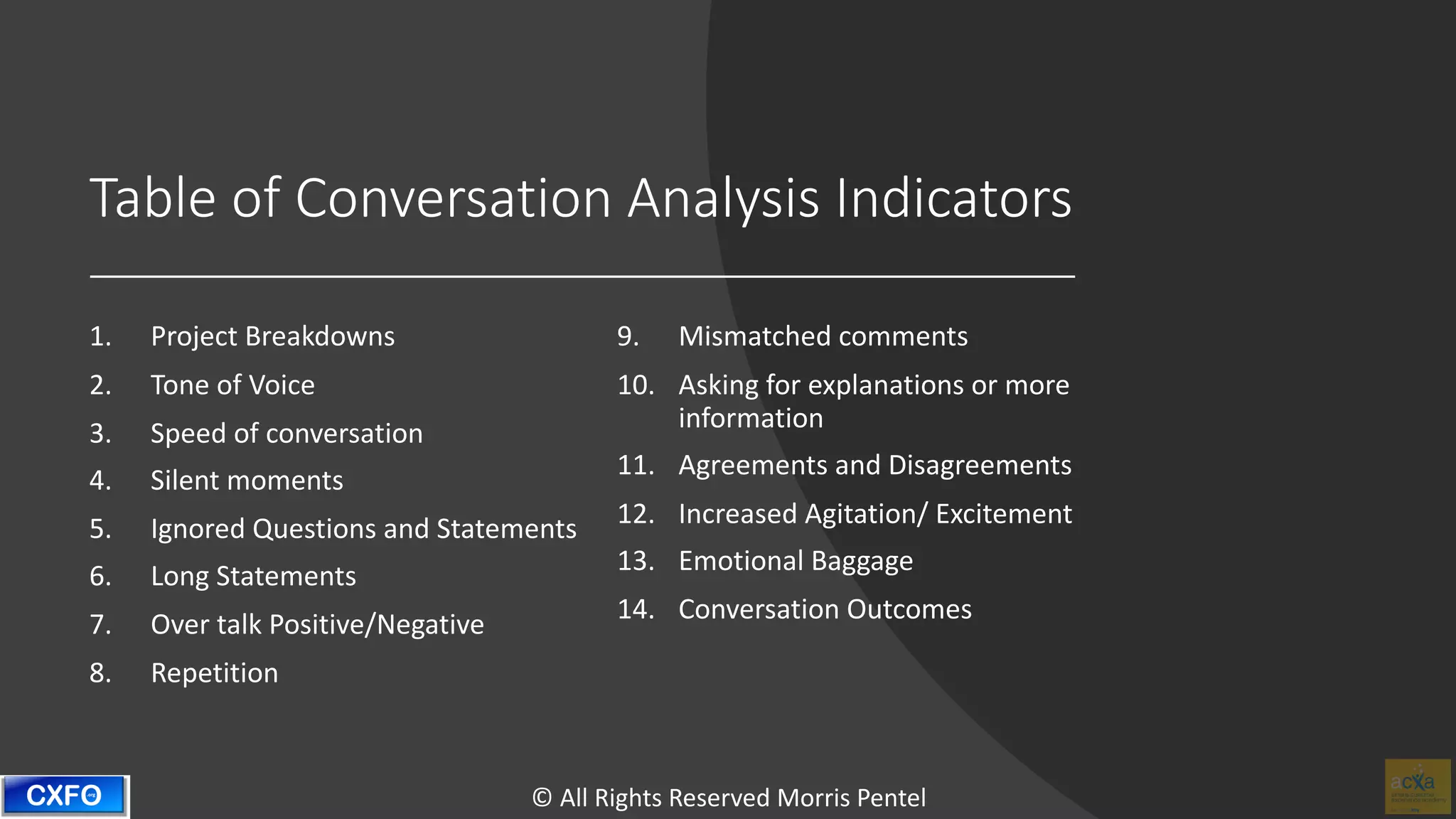
Table of Conversation Analysis Indicators
1. Project Breakdowns
2. Tone of Voice
3. Speed of conversation
4. Silent moments
5. Ignored Questions and Statements
6. Long Statements
7. Over talk Positive/Negative
8. Repetition
9. Mismatched comments
10. Asking for explanations or more
information
11. Agreements and Disagreements
12. Increased Agitation/ Excitement
13. Emotional Baggage
14. Conversation Outcomes
© All Rights Reserved Morris Pentel
1. Project
Breakdowns
Conversations are a series of micro projects on a raceway
starting at the beginning of a conversation and ending
with goodbye
1. Each project has a simple structure that can be
thought of as a type of habit. These are social in
nature but are at the core of conversation
2. After a party initiates any project it is important to
look at the beginning and ending of the project as
well as its outcome to find emotional efficiency and
to score the conversational value
3. We will look at detailed examples of this through
this section what successful and unsuccessful
projects will be
4. Think of each project as a building block for the
Analyst to understand and to score
© All Rights Reserved Morris Pentel
2. Tone of Voice
In the CC environment we are looking at the tone of
voice for both the Customer and the agent so here are
some basic questions about tone that should be used
to score a conversation
1. What is the starting tone of both sides of the
call?
2. Do both sides start to match?
3. Does the tone improve during the call?
4. How is that indicated
5. What caused the change
© All Rights Reserved Morris Pentel
3. Speed of
conversation
The speed of a conversation plays a vital role in the
outcome (successful or otherwise)
1. Is the customer in a hurry or want to talk slowly to
make sure they understand?
2. Are you using empathy to match the customers pace
and able to control the pace of the conversation?
3. Can you shorten the call for a customer in a hurry by
taking some of the actions after the call where
appropriate?
4. How much Customer time is wasted in the
conversation by processes or the need for agents to
use complicated processes that add to the stress?
5. Does the agent have enough time to complete the
appropriate tasks in the conversation?
© All Rights Reserved Morris Pentel
4. Silences
There are several patterns of Silence to be aware of in conversation analysis
and each can indicate different things. Over time you can develop and start
to score these silences . As you come to understand them better you can
use them to improve your outcomes
1. Is your agent and customer silent at the right points in the
conversation
2. Is the customer silent because they are listening to what the agent is
saying?
3. Is the agent silent because they are trying to concentrate on
navigating through different systems rather than paying attention?
4. At the end of a silence is the response is a clear indicator of how the
silence worked?
5. What are the different silence that occur in your calls?
6. Does the call end on a silence?
© All Rights Reserved Morris Pentel
5. Ignored Questions
and Statements
Ignored questions by either side are indicators of several different
issues. Is the question ignored by the customer because:
1. it is asked at the wrong time – is the same true if you move
its place in a conversation
2. It is not appropriate
3. It is ignored by either parties because it is not important?
4. The wording is not the most efficient way of explaining or
asking the question
5. You must ask why of the customer and yourselves -
compare the answers
© All Rights Reserved Morris Pentel
6. Long Statements
When only one person is talking for a long period of time
it is a clear indicator of a vital section of a call
1. It might be the key moment or purpose of the call
2. It might be the compliance element of the call
3. It is a danger to the bond between the caller and the
agent so are there natural pauses?
4. How long is too long
5. How can you use long customer statements to build
rapport?
© All Rights Reserved Morris Pentel
7. Over Talk
There are several different types of over talk
1. Interruption – this project is failing or permission
2. Close Down – This is where the customer or agent
has already understood the point being made but
will not accept it
3. Agreement - This is where the customer or agent
has already understood the point and starts to agree
before the other person has finished
4. Passive Negative – This could range from sounds to
sarcasm generally at low volume but clearly
indicating mood
5. Passive Positives – as with negatives but the
positive equivalent. (Low yes umm I see of course)
© All Rights Reserved Morris Pentel
8. Repetition
There are several different types of repetition
1. Positive re- statements of understanding by other
party
2. Negative re-statements of understanding by
other party
3. Summary of conversation
4. Lack of understanding or clarity
5. Lack of agreement
6. Process failure
7. Building Rapport
© All Rights Reserved Morris Pentel
9. Mismatched
Comments
Mismatches are a clear indicator of the progress of any
conversation and there are many different types to look
out for. Poor responses to openings are a good place to
start.
A> Hello this is Anna how are you today?
B> Hello
A> Hello Bill this is Anna
B> Hello
B> Good Morning
B> Yes?
© All Rights Reserved Morris Pentel
10. Asking for explanations
or more information
When asking for explanations or more information one of 2 states
may exist. These are not the same and do not have the same
impact.
Explanations are a clear indicator that you have not been clear
enough or that the process itself is not efficient. It indicates
clearly that the conversation has gone off the rails and that there
is something wrong with the conversation.
More information could mean the same negatives as above but
might also be part of a good process. In selling it might indicate
buying signals and in general conversation it may mean that the
conversation is moving down its runway.
© All Rights Reserved Morris Pentel
11.Agreements and
Disagreements
There are often enough agreements and disagreements in
conversations and this is a very important area to consider in CA.
Agreements may only be to end an encounter or because of the
mismatch between the power within a relationship. When
listening to agreements in conversation ask the following
1. Is there a real sense of both parties really agreeing
2. Are both parties happy with the agreement
3. Are there agreed next steps that both parties will be doing in
a short time frame. The longer the timeframe to the next
action the less likely that an agreement will stand.
4. How many agreements like this are made every day and are
kept to
© All Rights Reserved Morris Pentel
11. Agreements and
Disagreements
Disagreements are a key focus for CA
Disagreements may indicate
1. A key failure in a process
2. A failure to understand context
3. A step outside of fairness by either party
4. A social behaviour that is part of a particular culture
© All Rights Reserved Morris Pentel
12.Increased Agitation/
Excitement
Conversation Analysis is all about understanding the changes to the
emotional states of the parties
ANY STAGE of any conversation the analyst must be looking for those changes and scoring them.
Increased Agitation happens in stages and can be found through the other items you are listening
for. Failure to react to this will escalate into anger with the associated impacts. Aggressive
questions or responses, Over Talk Increased volume, Sarcasm and other indicators can be listened
for and as with disagreements agitation must be subjected to root cause analysis.
Excitement is generally a good indicator of positive outcomes but may mean that the offer is too
good or that the other party on the call is no longer paying attention
© All Rights Reserved Morris Pentel
13.EB (Emotional
Baggage)
EB is a natural part of the narrative and projects that take place in a
conversation. It explains the context, importance to the customer of
the situation and as a standard part of the building of rapport
between caller and agent.
1. You are listening for the recognition of the EB
2. You are listening for the transfer of EB to the agent. This can be
scored by the number of times each party refers to the EB and in
what circumstances
3. Failure to recognize and to take ownership of EB by the agent will
also be detected by the repetition of the caller and will increase
AHT
4. It can also result in all the other negatives you have learned in
this session such as agitation disagreement etc.
© All Rights Reserved Morris Pentel
14.Conversation
Outcomes
At the end of each conversation it is wise to think of it in terms
of Outcome
1. Was it a success for both parties?
2. What words and phases worked better than others?
3. Did the conversation flow?
4. Was there a lot of effort for either party and if so what can
be done to reduce the effort for instance are there parts of
the conversation that might be better handled through
different channels or in a different order
5. If this was a conversation with your parent or child how
happy would you be?
© All Rights Reserved Morris Pentel
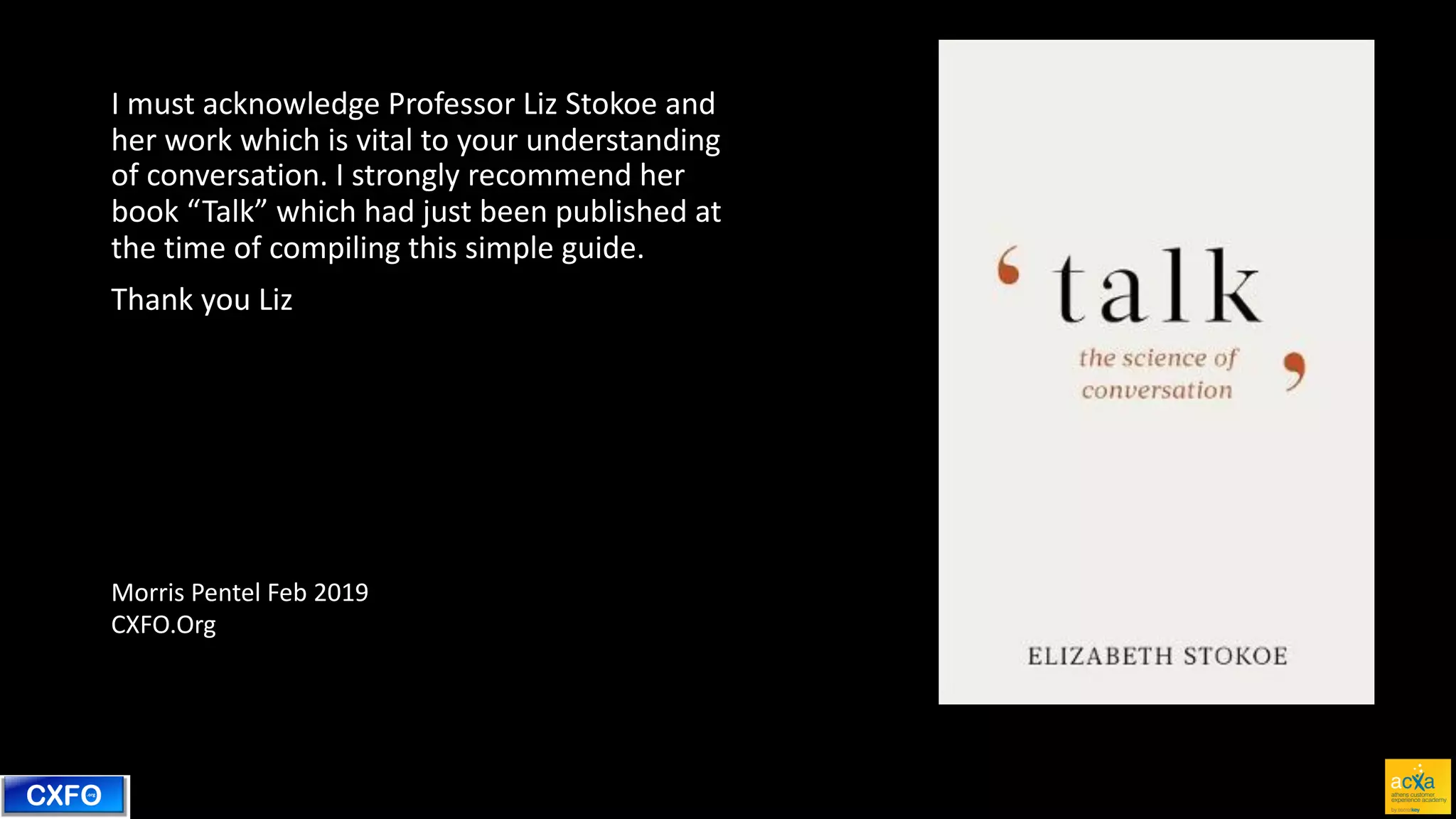
I must acknowledge Professor Liz Stokoe and
her work which is vital to your understanding
of conversation. I strongly recommend her
book “Talk” which had just been published at
the time of compiling this simple guide.
Thank you Liz
© All Rights Reserved Morris Pentel
Morris Pentel Feb 2019
CXFO.Org

Conversation Analysis Handbook

  • 1.
    E-Score Conversation Analysis Handbook This little bookletis designed to help you remember some of the elements that happen in conversations you should observed © All Rights Reserved Morris Pentel
  • 2.
    Step 2 –Analysing Conversations “Conversation is designed to be understood – that is its purpose”* Conversation is the single richest source of actionable customer insight available to every organisation that can change outcomes. It is also the most underused. Conversations are habits and patterns. It doesn’t matter if it’s a phone call an instore conversation or a digital chat unlocking the patterns of conversation will be the next step change in Customer Experience By analysing conversation you can create a habit based transformation programme that is cheap, easy to role out and gives a bigger bang per buck than any other methodology and you can see the results through your normal Metrics. © All Rights Reserved Morris Pentel * Professor Liz Stokoe
  • 3.
    Table of ConversationAnalysis Indicators 1. Project Breakdowns 2. Tone of Voice 3. Speed of conversation 4. Silent moments 5. Ignored Questions and Statements 6. Long Statements 7. Over talk Positive/Negative 8. Repetition 9. Mismatched comments 10. Asking for explanations or more information 11. Agreements and Disagreements 12. Increased Agitation/ Excitement 13. Emotional Baggage 14. Conversation Outcomes © All Rights Reserved Morris Pentel
  • 4.
    1. Project Breakdowns Conversations area series of micro projects on a raceway starting at the beginning of a conversation and ending with goodbye 1. Each project has a simple structure that can be thought of as a type of habit. These are social in nature but are at the core of conversation 2. After a party initiates any project it is important to look at the beginning and ending of the project as well as its outcome to find emotional efficiency and to score the conversational value 3. We will look at detailed examples of this through this section what successful and unsuccessful projects will be 4. Think of each project as a building block for the Analyst to understand and to score © All Rights Reserved Morris Pentel
  • 5.
    2. Tone ofVoice In the CC environment we are looking at the tone of voice for both the Customer and the agent so here are some basic questions about tone that should be used to score a conversation 1. What is the starting tone of both sides of the call? 2. Do both sides start to match? 3. Does the tone improve during the call? 4. How is that indicated 5. What caused the change © All Rights Reserved Morris Pentel
  • 6.
    3. Speed of conversation Thespeed of a conversation plays a vital role in the outcome (successful or otherwise) 1. Is the customer in a hurry or want to talk slowly to make sure they understand? 2. Are you using empathy to match the customers pace and able to control the pace of the conversation? 3. Can you shorten the call for a customer in a hurry by taking some of the actions after the call where appropriate? 4. How much Customer time is wasted in the conversation by processes or the need for agents to use complicated processes that add to the stress? 5. Does the agent have enough time to complete the appropriate tasks in the conversation? © All Rights Reserved Morris Pentel
  • 7.
    4. Silences There areseveral patterns of Silence to be aware of in conversation analysis and each can indicate different things. Over time you can develop and start to score these silences . As you come to understand them better you can use them to improve your outcomes 1. Is your agent and customer silent at the right points in the conversation 2. Is the customer silent because they are listening to what the agent is saying? 3. Is the agent silent because they are trying to concentrate on navigating through different systems rather than paying attention? 4. At the end of a silence is the response is a clear indicator of how the silence worked? 5. What are the different silence that occur in your calls? 6. Does the call end on a silence? © All Rights Reserved Morris Pentel
  • 8.
    5. Ignored Questions andStatements Ignored questions by either side are indicators of several different issues. Is the question ignored by the customer because: 1. it is asked at the wrong time – is the same true if you move its place in a conversation 2. It is not appropriate 3. It is ignored by either parties because it is not important? 4. The wording is not the most efficient way of explaining or asking the question 5. You must ask why of the customer and yourselves - compare the answers © All Rights Reserved Morris Pentel
  • 9.
    6. Long Statements Whenonly one person is talking for a long period of time it is a clear indicator of a vital section of a call 1. It might be the key moment or purpose of the call 2. It might be the compliance element of the call 3. It is a danger to the bond between the caller and the agent so are there natural pauses? 4. How long is too long 5. How can you use long customer statements to build rapport? © All Rights Reserved Morris Pentel
  • 10.
    7. Over Talk Thereare several different types of over talk 1. Interruption – this project is failing or permission 2. Close Down – This is where the customer or agent has already understood the point being made but will not accept it 3. Agreement - This is where the customer or agent has already understood the point and starts to agree before the other person has finished 4. Passive Negative – This could range from sounds to sarcasm generally at low volume but clearly indicating mood 5. Passive Positives – as with negatives but the positive equivalent. (Low yes umm I see of course) © All Rights Reserved Morris Pentel
  • 11.
    8. Repetition There areseveral different types of repetition 1. Positive re- statements of understanding by other party 2. Negative re-statements of understanding by other party 3. Summary of conversation 4. Lack of understanding or clarity 5. Lack of agreement 6. Process failure 7. Building Rapport © All Rights Reserved Morris Pentel
  • 12.
    9. Mismatched Comments Mismatches area clear indicator of the progress of any conversation and there are many different types to look out for. Poor responses to openings are a good place to start. A> Hello this is Anna how are you today? B> Hello A> Hello Bill this is Anna B> Hello B> Good Morning B> Yes? © All Rights Reserved Morris Pentel
  • 13.
    10. Asking forexplanations or more information When asking for explanations or more information one of 2 states may exist. These are not the same and do not have the same impact. Explanations are a clear indicator that you have not been clear enough or that the process itself is not efficient. It indicates clearly that the conversation has gone off the rails and that there is something wrong with the conversation. More information could mean the same negatives as above but might also be part of a good process. In selling it might indicate buying signals and in general conversation it may mean that the conversation is moving down its runway. © All Rights Reserved Morris Pentel
  • 14.
    11.Agreements and Disagreements There areoften enough agreements and disagreements in conversations and this is a very important area to consider in CA. Agreements may only be to end an encounter or because of the mismatch between the power within a relationship. When listening to agreements in conversation ask the following 1. Is there a real sense of both parties really agreeing 2. Are both parties happy with the agreement 3. Are there agreed next steps that both parties will be doing in a short time frame. The longer the timeframe to the next action the less likely that an agreement will stand. 4. How many agreements like this are made every day and are kept to © All Rights Reserved Morris Pentel
  • 15.
    11. Agreements and Disagreements Disagreementsare a key focus for CA Disagreements may indicate 1. A key failure in a process 2. A failure to understand context 3. A step outside of fairness by either party 4. A social behaviour that is part of a particular culture © All Rights Reserved Morris Pentel
  • 16.
    12.Increased Agitation/ Excitement Conversation Analysisis all about understanding the changes to the emotional states of the parties ANY STAGE of any conversation the analyst must be looking for those changes and scoring them. Increased Agitation happens in stages and can be found through the other items you are listening for. Failure to react to this will escalate into anger with the associated impacts. Aggressive questions or responses, Over Talk Increased volume, Sarcasm and other indicators can be listened for and as with disagreements agitation must be subjected to root cause analysis. Excitement is generally a good indicator of positive outcomes but may mean that the offer is too good or that the other party on the call is no longer paying attention © All Rights Reserved Morris Pentel
  • 17.
    13.EB (Emotional Baggage) EB isa natural part of the narrative and projects that take place in a conversation. It explains the context, importance to the customer of the situation and as a standard part of the building of rapport between caller and agent. 1. You are listening for the recognition of the EB 2. You are listening for the transfer of EB to the agent. This can be scored by the number of times each party refers to the EB and in what circumstances 3. Failure to recognize and to take ownership of EB by the agent will also be detected by the repetition of the caller and will increase AHT 4. It can also result in all the other negatives you have learned in this session such as agitation disagreement etc. © All Rights Reserved Morris Pentel
  • 18.
    14.Conversation Outcomes At the endof each conversation it is wise to think of it in terms of Outcome 1. Was it a success for both parties? 2. What words and phases worked better than others? 3. Did the conversation flow? 4. Was there a lot of effort for either party and if so what can be done to reduce the effort for instance are there parts of the conversation that might be better handled through different channels or in a different order 5. If this was a conversation with your parent or child how happy would you be? © All Rights Reserved Morris Pentel
  • 19.
    I must acknowledgeProfessor Liz Stokoe and her work which is vital to your understanding of conversation. I strongly recommend her book “Talk” which had just been published at the time of compiling this simple guide. Thank you Liz © All Rights Reserved Morris Pentel Morris Pentel Feb 2019 CXFO.Org