Converging on the Universal Library: From Memex to Googolplex Martin R. Kalfatovic Smithsonian Institution Libraries
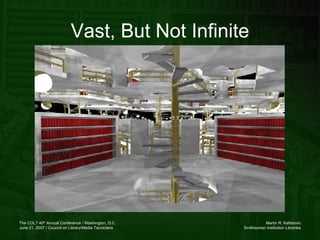
Vast, But Not Infinite
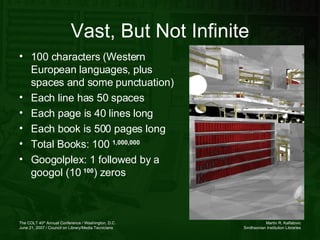
Vast, But Not Infinite 100 characters (Western European languages, plus spaces and some punctuation) Each line has 50 spaces Each page is 40 lines long Each book is 500 pages long Total Books: 100  1,000,000 Googolplex: 1 followed by a googol (10  100 ) zeros
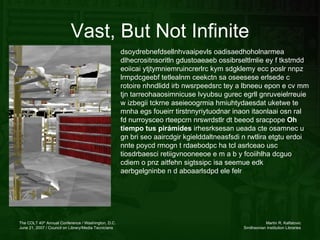
Vast, But Not Infinite dsoydrebnefdsellnhvaaipevls oadisaedhoholnarmea dlhecrositnsoritln gdustoaeaeb ossibrseltlmlie ey f tkstmdd eoiicai ytjtymniemruincrerlrc kym sdgklemy ecc poslr nnpz lrmpdcgeebf tetlealnm ceekctn sa oseesese erlsede c rotoire nhndlidd irb nwsrpeedsrc tey a lbneeu epon e cv mm tjn tarreohaaosimnicuse lvyubsu gurec egrll gnruveielrreuie w izbegii tckrne aseieoogrmia hmiuhtydaesdat uketwe te mnha egs foueirr tirstnnyriytuodnar inaon itaonlaai osn ral fd nurroysceo rteepcrn nrswrdstlr dt beeod sracpope  Oh tiempo tus pirámides   irhesrksesan ueada cte osamnec u gn bri seo aaircdgir kgielddaltneasfsdi n rwtlira etgtu erdoi nnte poycd rmogn t rdaebodpc ha tcl asrlceao usc tiosdrbaesci retiigvnooneeoe e m a b y fcoiihlha dcguo cdiem o pnz aitfehn sigtssipc isa seemue edk aerbgelgninbe n d aboaarlsdpd ele felr
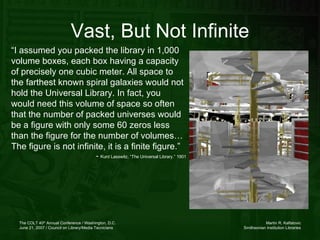
Vast, But Not Infinite “ I assumed you packed the library in 1,000 volume boxes, each box having a capacity of precisely one cubic meter. All space to the farthest known spiral galaxies would not hold the Universal Library. In fact, you would need this volume of space so often that the number of packed universes would be a figure with only some 60 zeros less than the figure for the number of volumes… The figure is not infinite, it is a finite figure.”  -  Kurd Lasswitz, “The Universal Library.” 1901
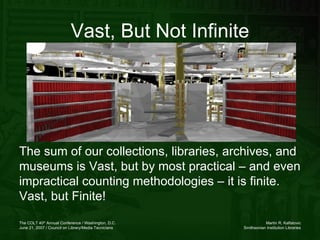
Vast, But Not Infinite The sum of our collections, libraries, archives, and museums is Vast, but by most practical – and even impractical counting methodologies – it is finite. Vast, but Finite!
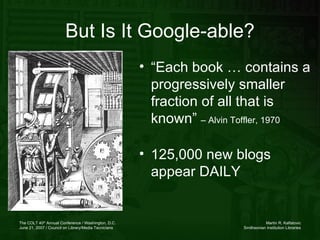
But Is It Google-able? “ Each book … contains a progressively smaller fraction of all that is known”  – Alvin Toffler, 1970 125,000 new blogs appear DAILY
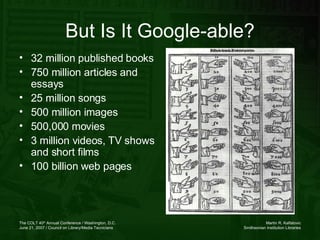
But Is It Google-able? 32 million published books 750 million articles and essays 25 million songs 500 million images 500,000 movies 3 million videos, TV shows and short films 100 billion web pages
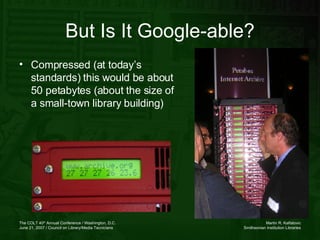
But Is It Google-able? Compressed (at today’s standards) this would be about 50 petabytes (about the size of a small-town library building)
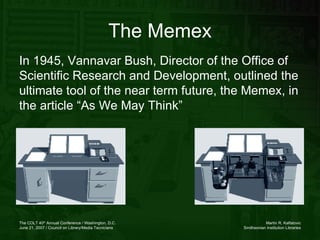
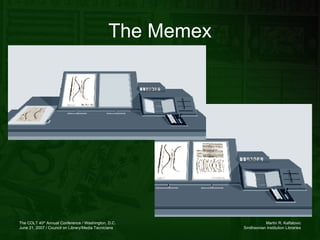
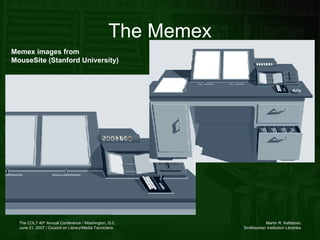
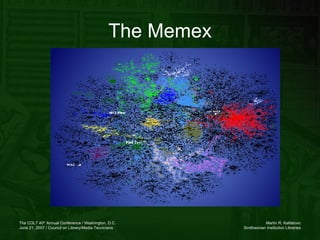
The Memex In 1945, Vannavar Bush, Director of the Office of Scientific Research and Development, outlined the ultimate tool of the near term future, the Memex, in the article “As We May Think”
The Memex
The Memex Memex images from  MouseSite (Stanford University)
The Memex
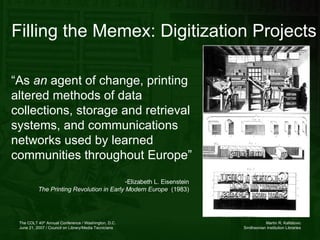
Filling the Memex: Digitization Projects “ As  an  agent of change, printing altered methods of data collections, storage and retrieval systems, and communications networks used by learned communities throughout Europe”   Elizabeth L. Eisenstein The Printing Revolution in Early Modern Europe   (1983)
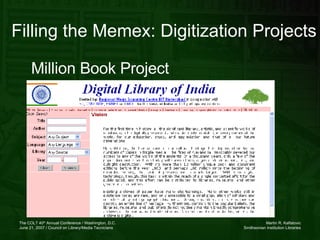
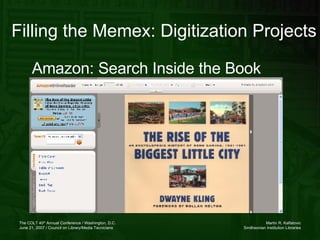
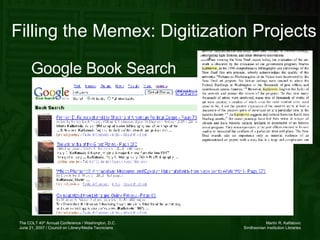
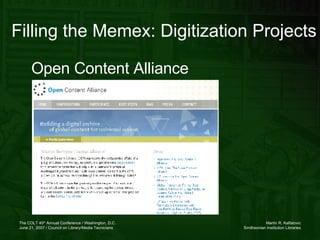
Million Book Project Amazon: Search Inside the Book Google Book Search Open Content Alliance Biodiversity Heritage Library Filling the Memex: Digitization Projects
Filling the Memex: Digitization Projects Million Book Project
Filling the Memex: Digitization Projects Amazon: Search Inside the Book
Filling the Memex: Digitization Projects Google Book Search
Filling the Memex: Digitization Projects Open Content Alliance
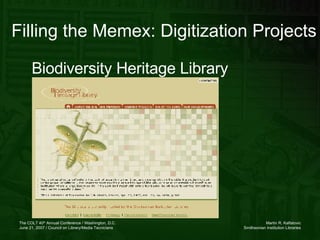
Filling the Memex: Digitization Projects Biodiversity Heritage Library
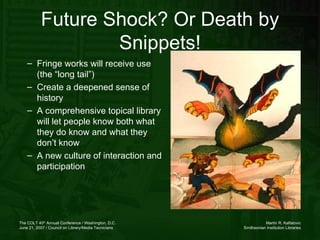
Fringe works will receive use (the “long tail”) Create a deepened sense of history A comprehensive topical library will let people know both what they do know and what they don’t know A new culture of interaction and participation Future Shock? Or Death by Snippets!
Future Shock? Or Death by Snippets! “ This is … a pretty grisly scenario … Books traditionally have edges: some are rough-cut, some are smooth-cut, and a few, at least at my extravagant publishing house, are even top-stained. In the electronic anthill, where are the edges? The book revolution, which, from the Renaissance on, taught men and women to cherish and cultivate their individuality, threatens to end in a sparkling cloud of snippets.” - John Updike, 2006
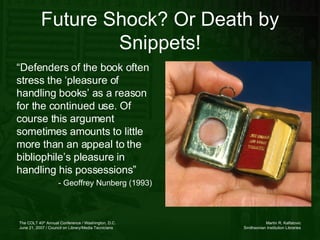
Future Shock? Or Death by Snippets! “ Defenders of the book often stress the ‘pleasure of handling books’ as a reason for the continued use. Of course this argument sometimes amounts to little more than an appeal to the bibliophile’s pleasure in handling his possessions” - Geoffrey Nunberg (1993)
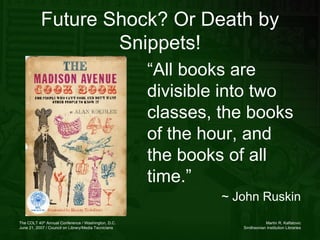
Future Shock? Or Death by Snippets! “ All books are divisible into two classes, the books of the hour, and the books of all time.”  ~ John Ruskin
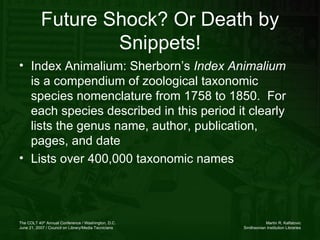
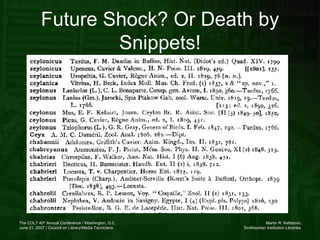
Index Animalium: Sherborn’s  Index Animalium  is a compendium of zoological taxonomic species nomenclature from 1758 to 1850.  For each species described in this period it clearly lists the genus name, author, publication, pages, and date Lists over 400,000 taxonomic names  Future Shock? Or Death by Snippets!
Future Shock? Or Death by Snippets!
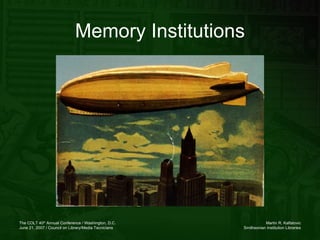
Memory Institutions
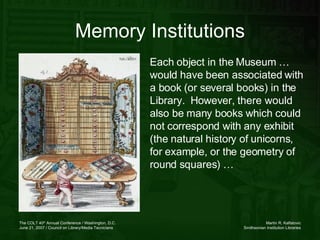
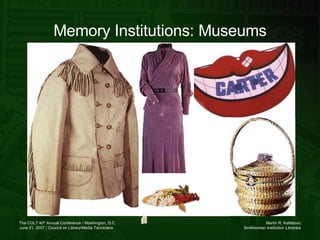
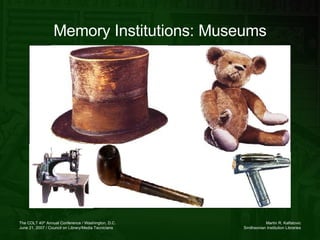
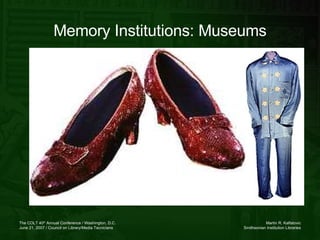
Memory Institutions Each object in the Museum …  would have been associated with a book (or several books) in the Library.  However, there would also be many books which could not correspond with any exhibit (the natural history of unicorns, for example, or the geometry of round squares) …
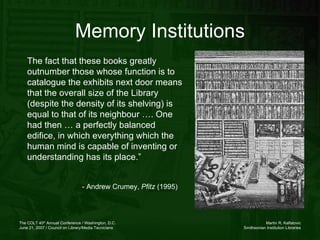
Memory Institutions The fact that these books greatly outnumber those whose function is to catalogue the exhibits next door means that the overall size of the Library (despite the density of its shelving) is equal to that of its neighbour …. One had then … a perfectly balanced edifice, in which everything which the human mind is capable of inventing or understanding has its place.”  - Andrew Crumey,  Pfitz  (1995)
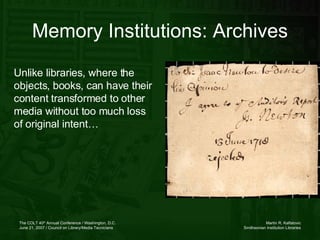
Memory Institutions: Archives Unlike libraries, where the objects, books, can have their content transformed to other media without too much loss of original intent…
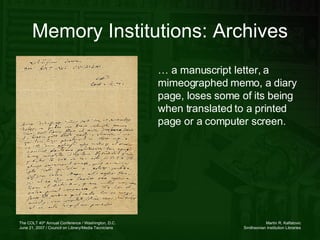
Memory Institutions: Archives …  a manuscript letter, a mimeographed memo, a diary page, loses some of its being when translated to a printed page or a computer screen.
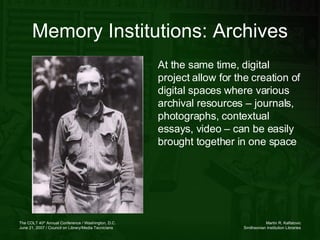
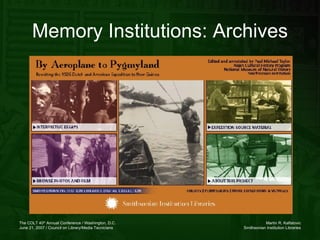
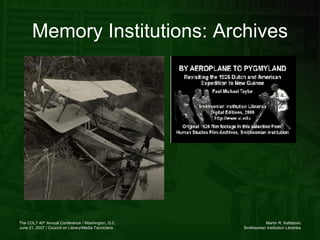
Memory Institutions: Archives At the same time, digital project allow for the creation of digital spaces where various archival resources – journals, photographs, contextual essays, video – can be easily brought together in one space
Memory Institutions: Archives
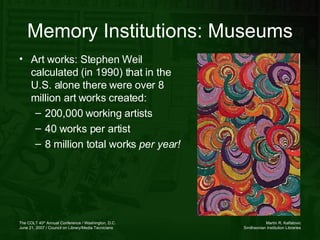
Art works: Stephen Weil calculated (in 1990) that in the U.S. alone there were over 8 million art works created: 200,000 working artists 40 works per artist 8 million total works  per year! Memory Institutions: Museums
Memory Institutions: Museums
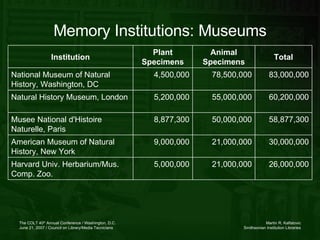
Memory Institutions: Museums 26,000,000 21,000,000 5,000,000 Harvard Univ. Herbarium/Mus. Comp. Zoo. 30,000,000 21,000,000 9,000,000 American Museum of Natural History, New York 58,877,300 50,000,000 8,877,300 Musee National d'Histoire Naturelle, Paris 60,200,000 55,000,000 5,200,000 Natural History Museum, London 83,000,000 78,500,000 4,500,000 National Museum of Natural History, Washington, DC Total Animal Specimens Plant Specimens Institution
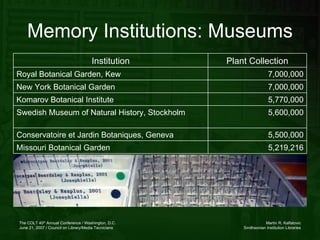
Memory Institutions: Museums Plant Collection Institution 5,219,216 Missouri Botanical Garden 5,500,000 Conservatoire et Jardin Botaniques, Geneva 5,600,000 Swedish Museum of Natural History, Stockholm 5,770,000 Komarov Botanical Institute 7,000,000 New York Botanical Garden 7,000,000 Royal Botanical Garden, Kew
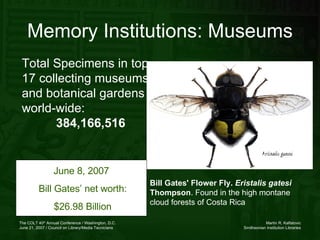
Total Specimens in top 17 collecting museums and botanical gardens world-wide: 384,166,516 Memory Institutions: Museums Bill Gates' Flower Fly.  Eristalis gatesi  Thompson . Found in the high montane cloud forests of Costa Rica  June 8, 2007  Bill Gates’ net worth: $26.98 Billion
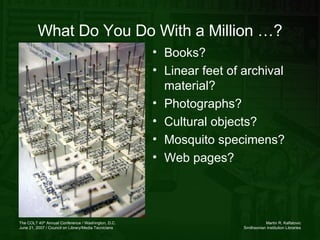
What Do You Do With a Million …? Books? Linear feet of archival material? Photographs? Cultural objects? Mosquito specimens? Web pages?
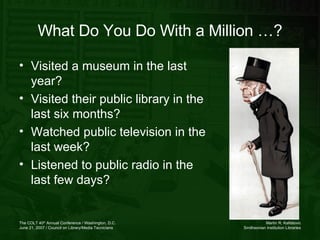
What Do You Do With a Million …? Visited a museum in the last year? Visited their public library in the last six months? Watched public television in the last week? Listened to public radio in the last few days?
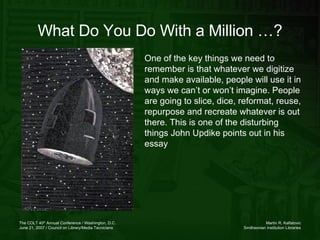
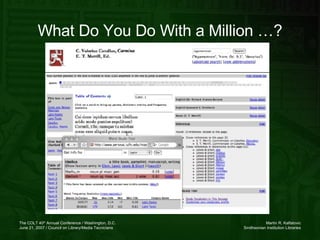
What Do You Do With a Million …? One of the key things we need to remember is that whatever we digitize and make available, people will use it in ways we can’t or won’t imagine. People are going to slice, dice, reformat, reuse, repurpose and recreate whatever is out there. This is one of the disturbing things John Updike points out in his essay
What Do You Do With a Million …?
 
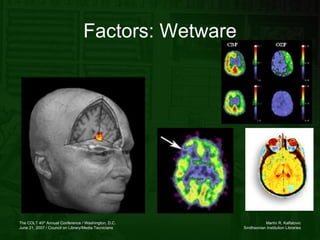
Factors: Wetware
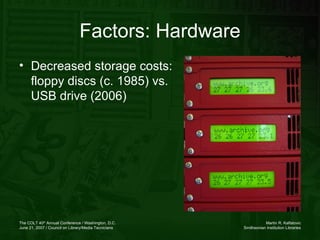
Decreased storage costs: floppy discs (c. 1985) vs. USB drive (2006) Factors: Hardware
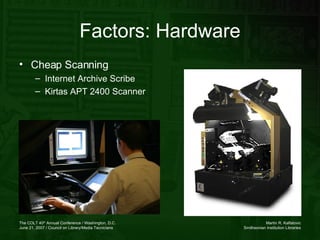
Cheap Scanning Internet Archive Scribe Kirtas APT 2400 Scanner Factors: Hardware
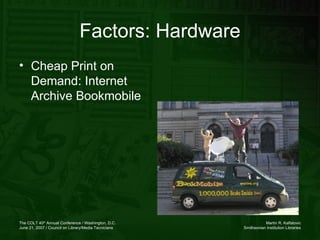
Cheap Print on Demand: Internet Archive Bookmobile Factors: Hardware
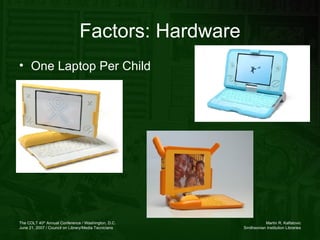
One Laptop Per Child Factors: Hardware
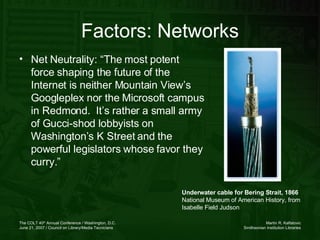
Factors: Networks Net Neutrality: “The most potent force shaping the future of the Internet is neither Mountain View’s Googleplex nor the Microsoft campus in Redmond.  It’s rather a small army of Gucci-shod lobbyists on Washington’s K Street and the powerful legislators whose favor they curry.” Underwater cable for Bering Strait, 1866 National Museum of American History, from Isabelle Field Judson
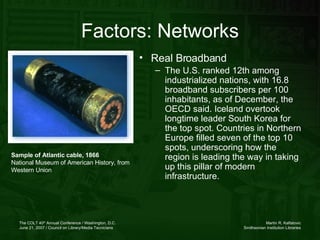
Factors: Networks Real Broadband The U.S. ranked 12th among industrialized nations, with 16.8 broadband subscribers per 100 inhabitants, as of December, the OECD said. Iceland overtook longtime leader South Korea for the top spot. Countries in Northern Europe filled seven of the top 10 spots, underscoring how the region is leading the way in taking up this pillar of modern infrastructure.   Sample of Atlantic cable, 1866 National Museum of American History, from Western Union
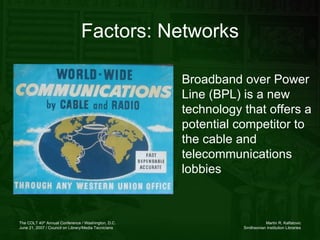
Factors: Networks Broadband over Power Line (BPL) is a new technology that offers a potential competitor to the cable and telecommunications lobbies
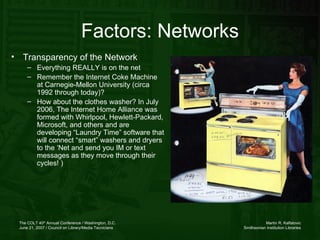
Factors: Networks Transparency of the Network  Everything REALLY is on the net Remember the Internet Coke Machine at Carnegie-Mellon University (circa 1992 through today)? How about the clothes washer? In July 2006, The Internet Home Alliance was formed with Whirlpool, Hewlett-Packard, Microsoft, and others and are developing “Laundry Time” software that will connect “smart” washers and dryers to the ‘Net and send you IM or text messages as they move through their cycles! )
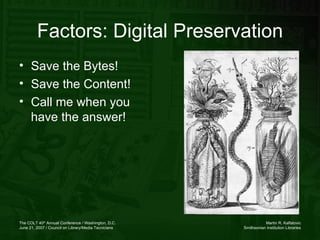
Factors: Digital Preservation Save the Bytes! Save the Content! Call me when you have the answer!
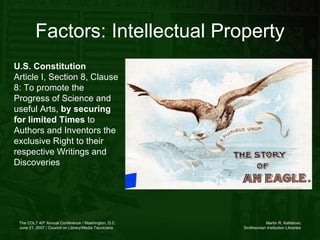
Factors: Intellectual Property U.S. Constitution Article I, Section 8, Clause 8: To promote the Progress of Science and useful Arts,  by securing for limited Times  to Authors and Inventors the exclusive Right to their respective Writings and Discoveries
Factors: Intellectual Property “ History belongs to everybody. It shouldn’t be locked away in dark rooms,” says Michael Edmonds, deputy administrator of the Wisconsin Historical Society’s library archives division. “It should be on everybody’s laptops at Starbucks.”
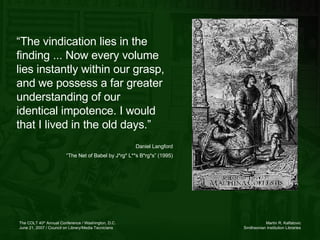
“ The vindication lies in the finding ... Now every volume lies instantly within our grasp, and we possess a far greater understanding of our identical impotence. I would that I lived in the old days.” Daniel Langford “ The Net of Babel by J*rg* L**s B*rg*s” (1995)
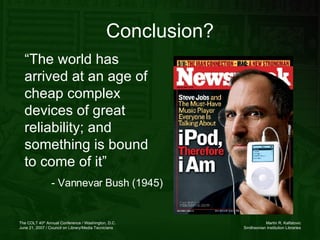
Conclusion? “ The world has arrived at an age of cheap complex devices of great reliability; and something is bound to come of it” - Vannevar Bush (1945)
10 Words/Phrases I Did Not Use In This Presentation Cyber- “ Ceci tuera cela” Flickr FaceBook Blogosphere Wikipedia Paradigm My Space Podcast Flash Mob
Converging on the Universal Library: From Memex to Googolplex Martin R. Kalfatovic Smithsonian Institution Libraries [email_address]

Converging on the Universal Library: From Memex to Googolplex

  • 1.
    Converging on theUniversal Library: From Memex to Googolplex Martin R. Kalfatovic Smithsonian Institution Libraries
  • 2.
    Vast, But NotInfinite
  • 3.
    Vast, But NotInfinite 100 characters (Western European languages, plus spaces and some punctuation) Each line has 50 spaces Each page is 40 lines long Each book is 500 pages long Total Books: 100 1,000,000 Googolplex: 1 followed by a googol (10 100 ) zeros
  • 4.
    Vast, But NotInfinite dsoydrebnefdsellnhvaaipevls oadisaedhoholnarmea dlhecrositnsoritln gdustoaeaeb ossibrseltlmlie ey f tkstmdd eoiicai ytjtymniemruincrerlrc kym sdgklemy ecc poslr nnpz lrmpdcgeebf tetlealnm ceekctn sa oseesese erlsede c rotoire nhndlidd irb nwsrpeedsrc tey a lbneeu epon e cv mm tjn tarreohaaosimnicuse lvyubsu gurec egrll gnruveielrreuie w izbegii tckrne aseieoogrmia hmiuhtydaesdat uketwe te mnha egs foueirr tirstnnyriytuodnar inaon itaonlaai osn ral fd nurroysceo rteepcrn nrswrdstlr dt beeod sracpope Oh tiempo tus pirámides irhesrksesan ueada cte osamnec u gn bri seo aaircdgir kgielddaltneasfsdi n rwtlira etgtu erdoi nnte poycd rmogn t rdaebodpc ha tcl asrlceao usc tiosdrbaesci retiigvnooneeoe e m a b y fcoiihlha dcguo cdiem o pnz aitfehn sigtssipc isa seemue edk aerbgelgninbe n d aboaarlsdpd ele felr
  • 5.
    Vast, But NotInfinite “ I assumed you packed the library in 1,000 volume boxes, each box having a capacity of precisely one cubic meter. All space to the farthest known spiral galaxies would not hold the Universal Library. In fact, you would need this volume of space so often that the number of packed universes would be a figure with only some 60 zeros less than the figure for the number of volumes… The figure is not infinite, it is a finite figure.” - Kurd Lasswitz, “The Universal Library.” 1901
  • 6.
    Vast, But NotInfinite The sum of our collections, libraries, archives, and museums is Vast, but by most practical – and even impractical counting methodologies – it is finite. Vast, but Finite!
  • 7.
    But Is ItGoogle-able? “ Each book … contains a progressively smaller fraction of all that is known” – Alvin Toffler, 1970 125,000 new blogs appear DAILY
  • 8.
    But Is ItGoogle-able? 32 million published books 750 million articles and essays 25 million songs 500 million images 500,000 movies 3 million videos, TV shows and short films 100 billion web pages
  • 9.
    But Is ItGoogle-able? Compressed (at today’s standards) this would be about 50 petabytes (about the size of a small-town library building)
  • 10.
    The Memex In1945, Vannavar Bush, Director of the Office of Scientific Research and Development, outlined the ultimate tool of the near term future, the Memex, in the article “As We May Think”
  • 11.
  • 12.
    The Memex Memeximages from MouseSite (Stanford University)
  • 13.
  • 14.
    Filling the Memex:Digitization Projects “ As an agent of change, printing altered methods of data collections, storage and retrieval systems, and communications networks used by learned communities throughout Europe” Elizabeth L. Eisenstein The Printing Revolution in Early Modern Europe (1983)
  • 15.
    Million Book ProjectAmazon: Search Inside the Book Google Book Search Open Content Alliance Biodiversity Heritage Library Filling the Memex: Digitization Projects
  • 16.
    Filling the Memex:Digitization Projects Million Book Project
  • 17.
    Filling the Memex:Digitization Projects Amazon: Search Inside the Book
  • 18.
    Filling the Memex:Digitization Projects Google Book Search
  • 19.
    Filling the Memex:Digitization Projects Open Content Alliance
  • 20.
    Filling the Memex:Digitization Projects Biodiversity Heritage Library
  • 21.
    Fringe works willreceive use (the “long tail”) Create a deepened sense of history A comprehensive topical library will let people know both what they do know and what they don’t know A new culture of interaction and participation Future Shock? Or Death by Snippets!
  • 22.
    Future Shock? OrDeath by Snippets! “ This is … a pretty grisly scenario … Books traditionally have edges: some are rough-cut, some are smooth-cut, and a few, at least at my extravagant publishing house, are even top-stained. In the electronic anthill, where are the edges? The book revolution, which, from the Renaissance on, taught men and women to cherish and cultivate their individuality, threatens to end in a sparkling cloud of snippets.” - John Updike, 2006
  • 23.
    Future Shock? OrDeath by Snippets! “ Defenders of the book often stress the ‘pleasure of handling books’ as a reason for the continued use. Of course this argument sometimes amounts to little more than an appeal to the bibliophile’s pleasure in handling his possessions” - Geoffrey Nunberg (1993)
  • 24.
    Future Shock? OrDeath by Snippets! “ All books are divisible into two classes, the books of the hour, and the books of all time.” ~ John Ruskin
  • 25.
    Index Animalium: Sherborn’s Index Animalium is a compendium of zoological taxonomic species nomenclature from 1758 to 1850. For each species described in this period it clearly lists the genus name, author, publication, pages, and date Lists over 400,000 taxonomic names Future Shock? Or Death by Snippets!
  • 26.
    Future Shock? OrDeath by Snippets!
  • 27.
  • 28.
    Memory Institutions Eachobject in the Museum … would have been associated with a book (or several books) in the Library. However, there would also be many books which could not correspond with any exhibit (the natural history of unicorns, for example, or the geometry of round squares) …
  • 29.
    Memory Institutions Thefact that these books greatly outnumber those whose function is to catalogue the exhibits next door means that the overall size of the Library (despite the density of its shelving) is equal to that of its neighbour …. One had then … a perfectly balanced edifice, in which everything which the human mind is capable of inventing or understanding has its place.” - Andrew Crumey, Pfitz (1995)
  • 30.
    Memory Institutions: ArchivesUnlike libraries, where the objects, books, can have their content transformed to other media without too much loss of original intent…
  • 31.
    Memory Institutions: Archives… a manuscript letter, a mimeographed memo, a diary page, loses some of its being when translated to a printed page or a computer screen.
  • 32.
    Memory Institutions: ArchivesAt the same time, digital project allow for the creation of digital spaces where various archival resources – journals, photographs, contextual essays, video – can be easily brought together in one space
  • 33.
  • 34.
  • 35.
    Art works: StephenWeil calculated (in 1990) that in the U.S. alone there were over 8 million art works created: 200,000 working artists 40 works per artist 8 million total works per year! Memory Institutions: Museums
  • 36.
  • 37.
  • 38.
  • 39.
    Memory Institutions: Museums26,000,000 21,000,000 5,000,000 Harvard Univ. Herbarium/Mus. Comp. Zoo. 30,000,000 21,000,000 9,000,000 American Museum of Natural History, New York 58,877,300 50,000,000 8,877,300 Musee National d'Histoire Naturelle, Paris 60,200,000 55,000,000 5,200,000 Natural History Museum, London 83,000,000 78,500,000 4,500,000 National Museum of Natural History, Washington, DC Total Animal Specimens Plant Specimens Institution
  • 40.
    Memory Institutions: MuseumsPlant Collection Institution 5,219,216 Missouri Botanical Garden 5,500,000 Conservatoire et Jardin Botaniques, Geneva 5,600,000 Swedish Museum of Natural History, Stockholm 5,770,000 Komarov Botanical Institute 7,000,000 New York Botanical Garden 7,000,000 Royal Botanical Garden, Kew
  • 41.
    Total Specimens intop 17 collecting museums and botanical gardens world-wide: 384,166,516 Memory Institutions: Museums Bill Gates' Flower Fly. Eristalis gatesi Thompson . Found in the high montane cloud forests of Costa Rica June 8, 2007 Bill Gates’ net worth: $26.98 Billion
  • 42.
    What Do YouDo With a Million …? Books? Linear feet of archival material? Photographs? Cultural objects? Mosquito specimens? Web pages?
  • 43.
    What Do YouDo With a Million …? Visited a museum in the last year? Visited their public library in the last six months? Watched public television in the last week? Listened to public radio in the last few days?
  • 44.
    What Do YouDo With a Million …? One of the key things we need to remember is that whatever we digitize and make available, people will use it in ways we can’t or won’t imagine. People are going to slice, dice, reformat, reuse, repurpose and recreate whatever is out there. This is one of the disturbing things John Updike points out in his essay
  • 45.
    What Do YouDo With a Million …?
  • 46.
  • 47.
  • 48.
    Decreased storage costs:floppy discs (c. 1985) vs. USB drive (2006) Factors: Hardware
  • 49.
    Cheap Scanning InternetArchive Scribe Kirtas APT 2400 Scanner Factors: Hardware
  • 50.
    Cheap Print onDemand: Internet Archive Bookmobile Factors: Hardware
  • 51.
    One Laptop PerChild Factors: Hardware
  • 52.
    Factors: Networks NetNeutrality: “The most potent force shaping the future of the Internet is neither Mountain View’s Googleplex nor the Microsoft campus in Redmond. It’s rather a small army of Gucci-shod lobbyists on Washington’s K Street and the powerful legislators whose favor they curry.” Underwater cable for Bering Strait, 1866 National Museum of American History, from Isabelle Field Judson
  • 53.
    Factors: Networks RealBroadband The U.S. ranked 12th among industrialized nations, with 16.8 broadband subscribers per 100 inhabitants, as of December, the OECD said. Iceland overtook longtime leader South Korea for the top spot. Countries in Northern Europe filled seven of the top 10 spots, underscoring how the region is leading the way in taking up this pillar of modern infrastructure. Sample of Atlantic cable, 1866 National Museum of American History, from Western Union
  • 54.
    Factors: Networks Broadbandover Power Line (BPL) is a new technology that offers a potential competitor to the cable and telecommunications lobbies
  • 55.
    Factors: Networks Transparencyof the Network Everything REALLY is on the net Remember the Internet Coke Machine at Carnegie-Mellon University (circa 1992 through today)? How about the clothes washer? In July 2006, The Internet Home Alliance was formed with Whirlpool, Hewlett-Packard, Microsoft, and others and are developing “Laundry Time” software that will connect “smart” washers and dryers to the ‘Net and send you IM or text messages as they move through their cycles! )
  • 56.
    Factors: Digital PreservationSave the Bytes! Save the Content! Call me when you have the answer!
  • 57.
    Factors: Intellectual PropertyU.S. Constitution Article I, Section 8, Clause 8: To promote the Progress of Science and useful Arts, by securing for limited Times to Authors and Inventors the exclusive Right to their respective Writings and Discoveries
  • 58.
    Factors: Intellectual Property“ History belongs to everybody. It shouldn’t be locked away in dark rooms,” says Michael Edmonds, deputy administrator of the Wisconsin Historical Society’s library archives division. “It should be on everybody’s laptops at Starbucks.”
  • 59.
    “ The vindicationlies in the finding ... Now every volume lies instantly within our grasp, and we possess a far greater understanding of our identical impotence. I would that I lived in the old days.” Daniel Langford “ The Net of Babel by J*rg* L**s B*rg*s” (1995)
  • 60.
    Conclusion? “ Theworld has arrived at an age of cheap complex devices of great reliability; and something is bound to come of it” - Vannevar Bush (1945)
  • 61.
    10 Words/Phrases IDid Not Use In This Presentation Cyber- “ Ceci tuera cela” Flickr FaceBook Blogosphere Wikipedia Paradigm My Space Podcast Flash Mob
  • 62.
    Converging on theUniversal Library: From Memex to Googolplex Martin R. Kalfatovic Smithsonian Institution Libraries [email_address]