Film Noir By Nic Bunby
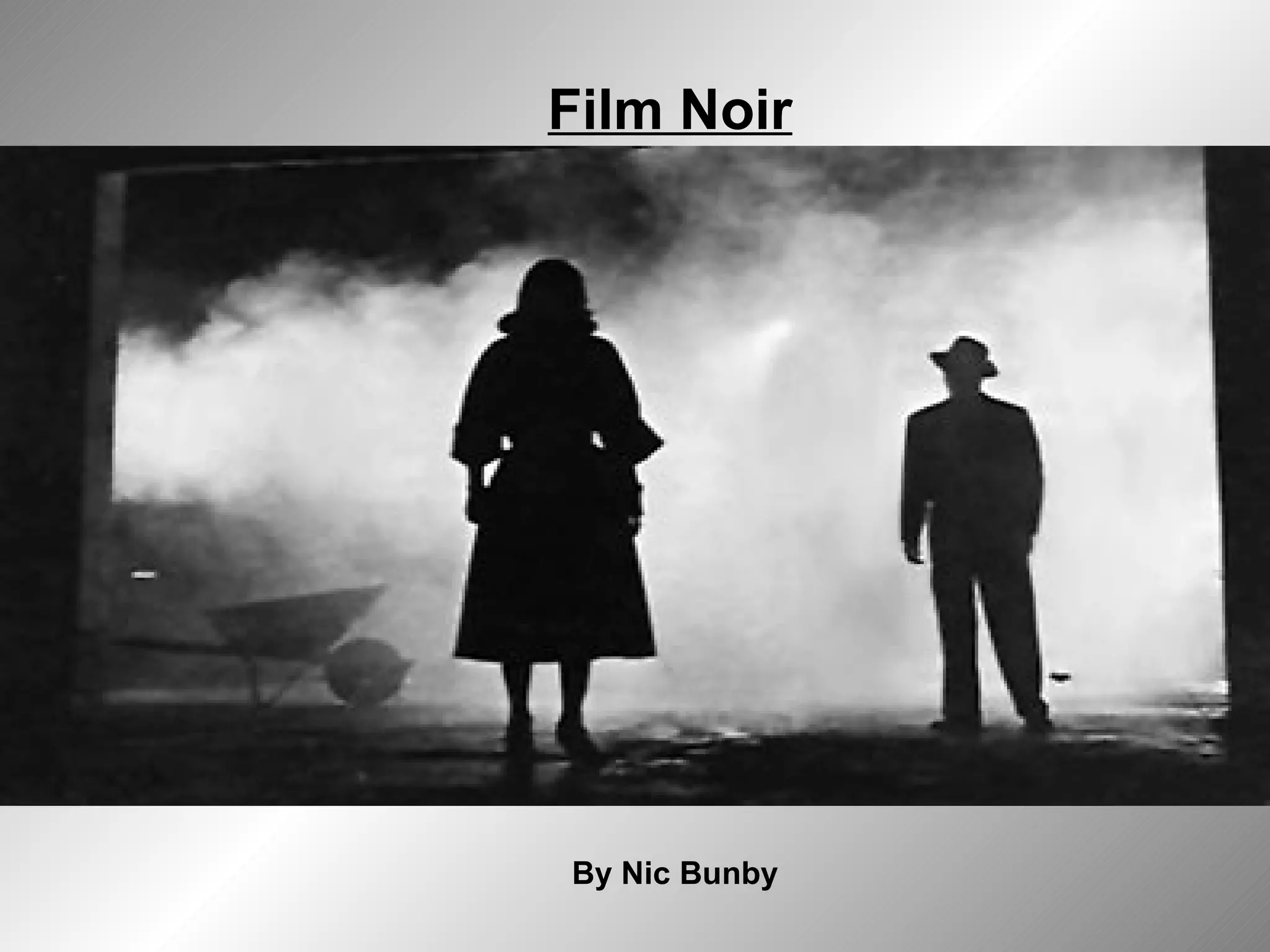
What Is It? Film noir is a cinematic term used primarily to describe stylish Hollywood crime dramas, particularly those that emphasize cynical attitudes and sexual motivations .  Film noir is associated with a low-key black-and-white visual style that has roots in German Expressionist cinematography.   Many of the prototypical stories and much of the attitude of classic noir derive from the hardboiled school of crime fiction that emerged in the United States during the Depression.   Film noirs encompass a range of plots—the central figure may be a private eye ( The Big Sleep ), a plainclothes policeman ( The Big Heat ), an aging boxer ( The Set-Up ), a hapless grifter ( Night and the City ), a law-abiding citizen lured into a life of crime ( Gun Crazy ), or simply a victim of circumstance ( D.O.A. )
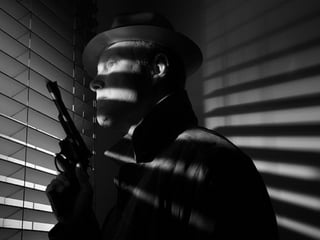
Visual Setting The low-key lighting schemes of many classic film noirs are associated with stark light/dark contrasts and dramatic shadow patterning  The shadows of Venetian blinds or banister rods, cast upon an actor, a wall, or an entire set, are an iconic visual in noir  Characters' faces may be partially or wholly obscured by darkness  While black-and-white cinematography is considered by many to be one of the essential attributes of classic noir  Film noir is also known for its use of low-angle, wide-angle, and skewed, or Dutch angle shots.  Other devices of disorientation relatively common in film noir include shots of people reflected in one or more mirrors, shots through curved or frosted glass or other distorting objects 
 
Structure And Narrational Devices Film noirs tend to have unusually complicated story lines, frequently involving flashbacks and other editing techniques that disrupt and sometimes obscure the narrative sequence.   Framing the entire primary narrative as a flashback is also a standard device.  Voiceover narration, sometimes used as a structuring device, came to be seen as a noir hallmark; while classic noir is generally associated with first-person narration   Bold experiments in cinematic storytelling were sometimes attempted during the classic era:  Lady in the Lake , for example, is shot entirely from the point of view of protagonist Philip Marlowe; the face of star (and director) Robert Montgomery is seen only in mirrors  Latter-day noir has been in the forefront of structural experimentation in popular cinema, as exemplified by such films as  Pulp Fiction ,  Fight Club , and  Memento .
Plots, Characters and Settings Crime, usually murder, is an element of almost all film noirs; in addition to standard-issue greed, jealousy is frequently the criminal motivation.  A crime investigation—by a private eye, a police detective (sometimes acting alone), or a concerned amateur—is the most prevalent, but far from dominant, basic plot  In other common plots the protagonists are implicated in heists or con games, or in murderous conspiracies often involving adulterous affairs. False suspicions and accusations of crime are frequent plot elements, as are betrayals and double-crosses.    Film noirs tend to revolve around heroes who are more flawed and morally questionable than the norm, often fall guys of one sort or another. The characteristic protagonists of noir are described by many critics as "alienated"
Continued Certain archetypal characters appear in many film noirs—hardboiled detectives, femme fatales, corrupt policemen, jealous husbands, intrepid claims adjusters, and down-and-out writers. Among characters of every stripe, cigarette smoking is rampant  Film noir is often associated with an urban setting, and a few cities—Los Angeles, San Francisco, New York, and Chicago, in particular—are the location of many of the classic films.  In the eyes of many critics, the city is presented in noir as a "labyrinth" or "maze".  Bars, lounges, nightclubs, and gambling dens are frequently the scene of action.  The climaxes of a substantial number of film noirs take place in visually complex, often industrial settings, such as refineries, factories, trainyards, power plants—most famously the explosive conclusion of  White Heat , set at a chemical plant. In the popular (and, frequently enough, critical) imagination, in noir it is always night and it always rains.

A Powepoint Presentation On Film Noir

  • 1.
    Film Noir ByNic Bunby
  • 2.
    What Is It?Film noir is a cinematic term used primarily to describe stylish Hollywood crime dramas, particularly those that emphasize cynical attitudes and sexual motivations .  Film noir is associated with a low-key black-and-white visual style that has roots in German Expressionist cinematography.   Many of the prototypical stories and much of the attitude of classic noir derive from the hardboiled school of crime fiction that emerged in the United States during the Depression. Film noirs encompass a range of plots—the central figure may be a private eye ( The Big Sleep ), a plainclothes policeman ( The Big Heat ), an aging boxer ( The Set-Up ), a hapless grifter ( Night and the City ), a law-abiding citizen lured into a life of crime ( Gun Crazy ), or simply a victim of circumstance ( D.O.A. )
  • 3.
    Visual Setting The low-keylighting schemes of many classic film noirs are associated with stark light/dark contrasts and dramatic shadow patterning The shadows of Venetian blinds or banister rods, cast upon an actor, a wall, or an entire set, are an iconic visual in noir Characters' faces may be partially or wholly obscured by darkness While black-and-white cinematography is considered by many to be one of the essential attributes of classic noir Film noir is also known for its use of low-angle, wide-angle, and skewed, or Dutch angle shots. Other devices of disorientation relatively common in film noir include shots of people reflected in one or more mirrors, shots through curved or frosted glass or other distorting objects 
  • 4.
  • 5.
    Structure And NarrationalDevices Film noirs tend to have unusually complicated story lines, frequently involving flashbacks and other editing techniques that disrupt and sometimes obscure the narrative sequence.  Framing the entire primary narrative as a flashback is also a standard device. Voiceover narration, sometimes used as a structuring device, came to be seen as a noir hallmark; while classic noir is generally associated with first-person narration  Bold experiments in cinematic storytelling were sometimes attempted during the classic era: Lady in the Lake , for example, is shot entirely from the point of view of protagonist Philip Marlowe; the face of star (and director) Robert Montgomery is seen only in mirrors Latter-day noir has been in the forefront of structural experimentation in popular cinema, as exemplified by such films as  Pulp Fiction ,  Fight Club , and  Memento .
  • 6.
    Plots, Characters andSettings Crime, usually murder, is an element of almost all film noirs; in addition to standard-issue greed, jealousy is frequently the criminal motivation. A crime investigation—by a private eye, a police detective (sometimes acting alone), or a concerned amateur—is the most prevalent, but far from dominant, basic plot In other common plots the protagonists are implicated in heists or con games, or in murderous conspiracies often involving adulterous affairs. False suspicions and accusations of crime are frequent plot elements, as are betrayals and double-crosses.  Film noirs tend to revolve around heroes who are more flawed and morally questionable than the norm, often fall guys of one sort or another. The characteristic protagonists of noir are described by many critics as "alienated"
  • 7.
    Continued Certain archetypalcharacters appear in many film noirs—hardboiled detectives, femme fatales, corrupt policemen, jealous husbands, intrepid claims adjusters, and down-and-out writers. Among characters of every stripe, cigarette smoking is rampant Film noir is often associated with an urban setting, and a few cities—Los Angeles, San Francisco, New York, and Chicago, in particular—are the location of many of the classic films. In the eyes of many critics, the city is presented in noir as a "labyrinth" or "maze".  Bars, lounges, nightclubs, and gambling dens are frequently the scene of action. The climaxes of a substantial number of film noirs take place in visually complex, often industrial settings, such as refineries, factories, trainyards, power plants—most famously the explosive conclusion of  White Heat , set at a chemical plant. In the popular (and, frequently enough, critical) imagination, in noir it is always night and it always rains.