Control Of
microbial
contamination in
sterile and non
sterile Products
Presented by : Arslan Ahmad
Presented to : Dr.Maria Rasool
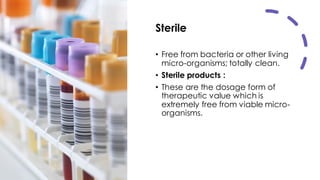
Sterile
• Free from bacteria or other living
micro-organisms; totally clean.
• Sterile products :
• These are the dosage form of
therapeutic value which is
extremely free from viable micro-
organisms.
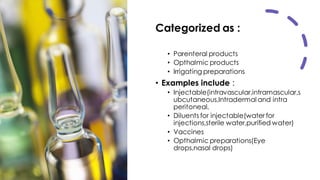
Categorized as :
• Parenteral products
• Opthalmic products
• Irrigating preparations
• Examples include :
• Injectable(intravascular,intramascular,s
ubcutaneous,Intradermal and intra
peritoneal.
• Diluents for injectable(water for
injections,sterile water,purified water)
• Vaccines
• Opthalmic preparations(Eye
drops,nasal drops)
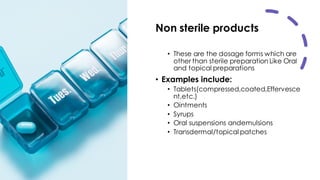
Non sterile products
• These are the dosage forms which are
other than sterile preparation Like Oral
and topical preparations
• Examples include:
• Tablets(compressed,coated,Effervesce
nt,etc.)
• Ointments
• Syrups
• Oral suspensions andemulsions
• Transdermal/topical patches
Sources of microbial
contamination
• External atmosphericair inside the
room
• Personnel contamination
• Surface contamination
• Water contamination
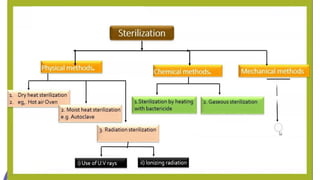
• Sterilization
• a process that destroys or eliminates all
forms of microbial life and is carried out
in health-care facilities by physical or
chemical methods.
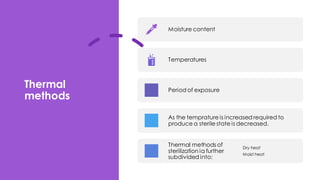
Thermal
methods
Moisture content
Temperatures
Period of exposure
As the temprature is increased required to
produce a sterile state is decreased.
Thermal methods of
sterilization ia further
subdivided into:
Dry heat
Moist heat
Dry heat
• The substances which get degraded at
a temprature range of approximately
140°C
• Contact for 2 hours at 180°C or at
260°C for 45 minutes can produce
killingof all kind of bacteria and there
spores.
• Dry heat Sterilization can be
achieved by :
• Hot air ovens
• Dry heat tunnels
Moist heat
In thermal sterilization rather
than dry heat moist heat is
considered more efficient.
However it should be made
into consideration that moist
heat cannot terminate
pyrogens.
Moist heat
sterilization can
be achieved by
Autoclave
Air steam
mixture
Non thermal
methods of
sterilization
It is also known as cold
sterilization or non-thermal
method of sterilization.
Further
classified as :
Physical method
Chemical
method
Physical
Sterilization
methods:
It can be further
classified as:
Radiation
sterilization
Filtration
sterilization
Radiation Sterilization
• (a) Ultraviolet light:
• For the sterilizationof contamination in
atmosphere and on surfaces, ultraviolet
light is usually employed.
• (b) Ionizing radiations:
• These are the radiations of elevated
energy which are emittedfrom
radioactiveisotopes like caesium-135
(gamma rays) or by highly accelerated
electrons at higher velocity (cathode ray
& ẞ-ray)
Chemical
methods of
sterilization
Gas sterilization:
Gases like formaldehyde and sulfur
dioxide are been use from many
years for sterilization purpose.
These chemicals are very reactive
and sometimes are very difficult to
remove from surfaces after exposure
thus have very limiteduse only.
Continued…
• Few examples:
• Alkylating gases: Ethylene oxide,
propylene oxide, formaldehyde
and ẞ-propiolactone.
• Oxidizing gases: hydrogen
peroxide, ozone, per- acetic acid
and calcium dioxide.
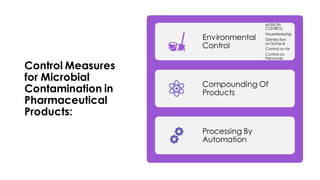
Control Measures
for Microbial
Contamination in
Pharmaceutical
Products:
Environmental
Control
MISSION
CONTROL
Housekeeping
Disinfection
on Surface
Control on Air
Control on
Personnel
Compounding Of
Products
Processing By
Automation
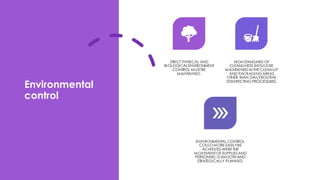
Environmental
control
STRICT PHYSICAL AND
BIOLOGICAL ENVIRONMENT
CONTROL MUSTBE
MAINTAINED.
HIGH STANDARD OF
CLEANLINESS SHOULD BE
MAINTAINED IN THE CLEAN-UP
AND PACKAGINGAREAS
OTHER THAN DAILYROUTINE
DISINFECTING PROCEDURES.
ENVIRONMENTAL CONTROL
COULD MORE EASILYBE
ACHIEVED WERE THE
MOVEMENTOF SUPPLIES AND
PERSONNEL IS SMOOTH AND
STRATEGICALLY PLANNED.
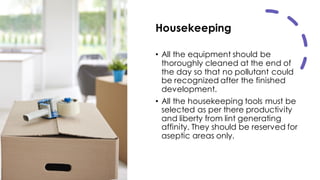
Housekeeping
• All the equipment should be
thoroughly cleaned at the end of
the day so that no pollutant could
be recognized after the finished
development.
• All the housekeeping tools must be
selected as per there productivity
and liberty from lint generating
affinity. They should be reserved for
aseptic areas only.
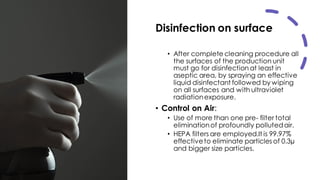
Disinfection on surface
• After complete cleaning procedure all
the surfaces of the production unit
must go for disinfection at least in
aseptic area, by spraying an effective
liquid disinfectant followed by wiping
on all surfaces and with ultraviolet
radiationexposure.
• Control on Air:
• Use of more than one pre- filter total
eliminationof profoundly pollutedair.
• HEPA filters are employed.It is 99.97%
effectiveto eliminate particles of 0.3µ
and bigger size particles.
Continued...
• Laminar air flow principle has
upgraded the effectiveness of
environmental control of aseptic area
to achieve class 100 area. This means
there are not more than 100 particles in
the air of 100 cubic foot area with0.5µ
or more in size.
• Control on Personnel:
• All the employees must examine for
their good health and must be
subjected to regular physical
examination.
Continued...
• Sterile overalls, hoods, face mask
and shoe covers are the different
component of apparel worn by a
personnel entering in sterile area.
• A preparatory procedure must be
followed by the personnel while
entering in aseptic area.
• Processing By Automation:
• Machine can be developed to
carry out certain procedures and
functions more efficiently,
accurately and precisely then a
human.
• Moreover the biggest advantage is
the infection caused by human
body as a source of biological
contamination. 11
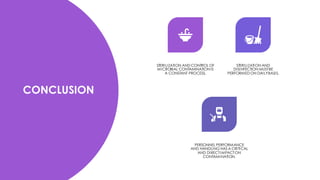
CONCLUSION
STERILIZATION AND CONTROL OF
MICROBIAL CONTAMINATION IS
A CONSTANT PROCESS.
STERILIZATION AND
DISINFECTION MUSTBE
PERFORMED ON DAILYBASIS.
PERSONNEL PERFORMANCE
AND HANDLING HAS A CRITICAL
AND DIRECTIMPACTON
CONTAMINATION.
Control of microbial contamination.2.pdf

Control of microbial contamination.2.pdf

  • 1.
    Control Of microbial contamination in sterileand non sterile Products Presented by : Arslan Ahmad Presented to : Dr.Maria Rasool
  • 2.
    Sterile • Free frombacteria or other living micro-organisms; totally clean. • Sterile products : • These are the dosage form of therapeutic value which is extremely free from viable micro- organisms.
  • 3.
    Categorized as : •Parenteral products • Opthalmic products • Irrigating preparations • Examples include : • Injectable(intravascular,intramascular,s ubcutaneous,Intradermal and intra peritoneal. • Diluents for injectable(water for injections,sterile water,purified water) • Vaccines • Opthalmic preparations(Eye drops,nasal drops)
  • 4.
    Non sterile products •These are the dosage forms which are other than sterile preparation Like Oral and topical preparations • Examples include: • Tablets(compressed,coated,Effervesce nt,etc.) • Ointments • Syrups • Oral suspensions andemulsions • Transdermal/topical patches
  • 5.
    Sources of microbial contamination •External atmosphericair inside the room • Personnel contamination • Surface contamination • Water contamination • Sterilization • a process that destroys or eliminates all forms of microbial life and is carried out in health-care facilities by physical or chemical methods.
  • 7.
    Thermal methods Moisture content Temperatures Period ofexposure As the temprature is increased required to produce a sterile state is decreased. Thermal methods of sterilization ia further subdivided into: Dry heat Moist heat
  • 8.
    Dry heat • Thesubstances which get degraded at a temprature range of approximately 140°C • Contact for 2 hours at 180°C or at 260°C for 45 minutes can produce killingof all kind of bacteria and there spores. • Dry heat Sterilization can be achieved by : • Hot air ovens • Dry heat tunnels
  • 9.
    Moist heat In thermalsterilization rather than dry heat moist heat is considered more efficient. However it should be made into consideration that moist heat cannot terminate pyrogens. Moist heat sterilization can be achieved by Autoclave Air steam mixture
  • 10.
    Non thermal methods of sterilization Itis also known as cold sterilization or non-thermal method of sterilization. Further classified as : Physical method Chemical method Physical Sterilization methods: It can be further classified as: Radiation sterilization Filtration sterilization
  • 11.
    Radiation Sterilization • (a)Ultraviolet light: • For the sterilizationof contamination in atmosphere and on surfaces, ultraviolet light is usually employed. • (b) Ionizing radiations: • These are the radiations of elevated energy which are emittedfrom radioactiveisotopes like caesium-135 (gamma rays) or by highly accelerated electrons at higher velocity (cathode ray & ẞ-ray)
  • 12.
    Chemical methods of sterilization Gas sterilization: Gaseslike formaldehyde and sulfur dioxide are been use from many years for sterilization purpose. These chemicals are very reactive and sometimes are very difficult to remove from surfaces after exposure thus have very limiteduse only.
  • 13.
    Continued… • Few examples: •Alkylating gases: Ethylene oxide, propylene oxide, formaldehyde and ẞ-propiolactone. • Oxidizing gases: hydrogen peroxide, ozone, per- acetic acid and calcium dioxide.
  • 14.
    Control Measures for Microbial Contaminationin Pharmaceutical Products: Environmental Control MISSION CONTROL Housekeeping Disinfection on Surface Control on Air Control on Personnel Compounding Of Products Processing By Automation
  • 15.
    Environmental control STRICT PHYSICAL AND BIOLOGICALENVIRONMENT CONTROL MUSTBE MAINTAINED. HIGH STANDARD OF CLEANLINESS SHOULD BE MAINTAINED IN THE CLEAN-UP AND PACKAGINGAREAS OTHER THAN DAILYROUTINE DISINFECTING PROCEDURES. ENVIRONMENTAL CONTROL COULD MORE EASILYBE ACHIEVED WERE THE MOVEMENTOF SUPPLIES AND PERSONNEL IS SMOOTH AND STRATEGICALLY PLANNED.
  • 16.
    Housekeeping • All theequipment should be thoroughly cleaned at the end of the day so that no pollutant could be recognized after the finished development. • All the housekeeping tools must be selected as per there productivity and liberty from lint generating affinity. They should be reserved for aseptic areas only.
  • 17.
    Disinfection on surface •After complete cleaning procedure all the surfaces of the production unit must go for disinfection at least in aseptic area, by spraying an effective liquid disinfectant followed by wiping on all surfaces and with ultraviolet radiationexposure. • Control on Air: • Use of more than one pre- filter total eliminationof profoundly pollutedair. • HEPA filters are employed.It is 99.97% effectiveto eliminate particles of 0.3µ and bigger size particles.
  • 18.
    Continued... • Laminar airflow principle has upgraded the effectiveness of environmental control of aseptic area to achieve class 100 area. This means there are not more than 100 particles in the air of 100 cubic foot area with0.5µ or more in size. • Control on Personnel: • All the employees must examine for their good health and must be subjected to regular physical examination.
  • 19.
    Continued... • Sterile overalls,hoods, face mask and shoe covers are the different component of apparel worn by a personnel entering in sterile area. • A preparatory procedure must be followed by the personnel while entering in aseptic area. • Processing By Automation: • Machine can be developed to carry out certain procedures and functions more efficiently, accurately and precisely then a human. • Moreover the biggest advantage is the infection caused by human body as a source of biological contamination. 11
  • 20.
    CONCLUSION STERILIZATION AND CONTROLOF MICROBIAL CONTAMINATION IS A CONSTANT PROCESS. STERILIZATION AND DISINFECTION MUSTBE PERFORMED ON DAILYBASIS. PERSONNEL PERFORMANCE AND HANDLING HAS A CRITICAL AND DIRECTIMPACTON CONTAMINATION.