Automated Sterilization And Disinfection In Operation
Theatre
Prof: Susan Lovino
Healthcare Operations (HINF-505-A)
Manogna Potthuru
Naga Venkata Bala Sri Harsha Kandregula
Nikitha Surkanti
Gayathri Konduru
Content
• Sterilization
• Techniques for automatics
sterilization
• Steam sterilization process
(Five distinct phases)
• Automated Ultrasonic
washer
• Disinfection
• Sterisafe
• Summary
• References
Sterilization
Sterilization is the process in which the killing or removal of all
microorganisms, including bacterial spores, are highly resistant. Sterilization is
usually carried out by autoclaving, which consists of exposure to steam at
121ºС under the pressure of [15 lb. / l in 2 ] for 15 minutes.
Hydrogen Peroxide Vapor Sterilization
This technique involves the use of
hydrogen peroxide gas, which is released into
a sealed chamber where it sterilizes the
objects placed inside. It is a fast and effective
method and is commonly used in hospitals
and laboratories.
Microwave Sterilization
This technique involves the use of
microwaves to sterilize objects. It is a relatively
new technique and is still being researched,
but it has shown promise in sterilizing medical
equipment quickly and effectively.
Ethylene Oxide Sterilization
Ethylene oxide is a gas that is used to
sterilize medical devices and equipment.
Plasma Sterilization
This technique involves the use of plasma,
which is a highly reactive gas, to sterilize objects.
Ultraviolet Germicidal Irradiation
This technique uses ultraviolet light to
destroy microorganisms. It is often used for air and
water purification, as well as for sterilizing
surfaces.
Steam Sterilization
Process (Five
Distinct Phases)
PHASE I Loading phase
• In which the objects or packs are loaded in the sterilizer.
PHASE II Heating phase
• In which the steam is brought to proper temperature &
allowed to penetrate through the objects in the chamber.
PHASE III Destroying phase (or time temperature cycle )
• In which all microbial life is exposed to the killing effect of the
steam.
Steam Sterilization
Process (Five
Distinct Phases)
PHASE IV Drying and cooling phase
• Objects are dried & cooled.
• Then, filtered air is introduced into the chamber.
• Door is opened
• Packs are removed and stored.
PHASE V Testing phase
• In this phase, the efficiency of the sterilization process is
checked. All mechanical parts of sterilizers, including gauges,
steam lines & drains should be periodically checked by a
competent biomed engineer.
Automated Ultrasonic Washer
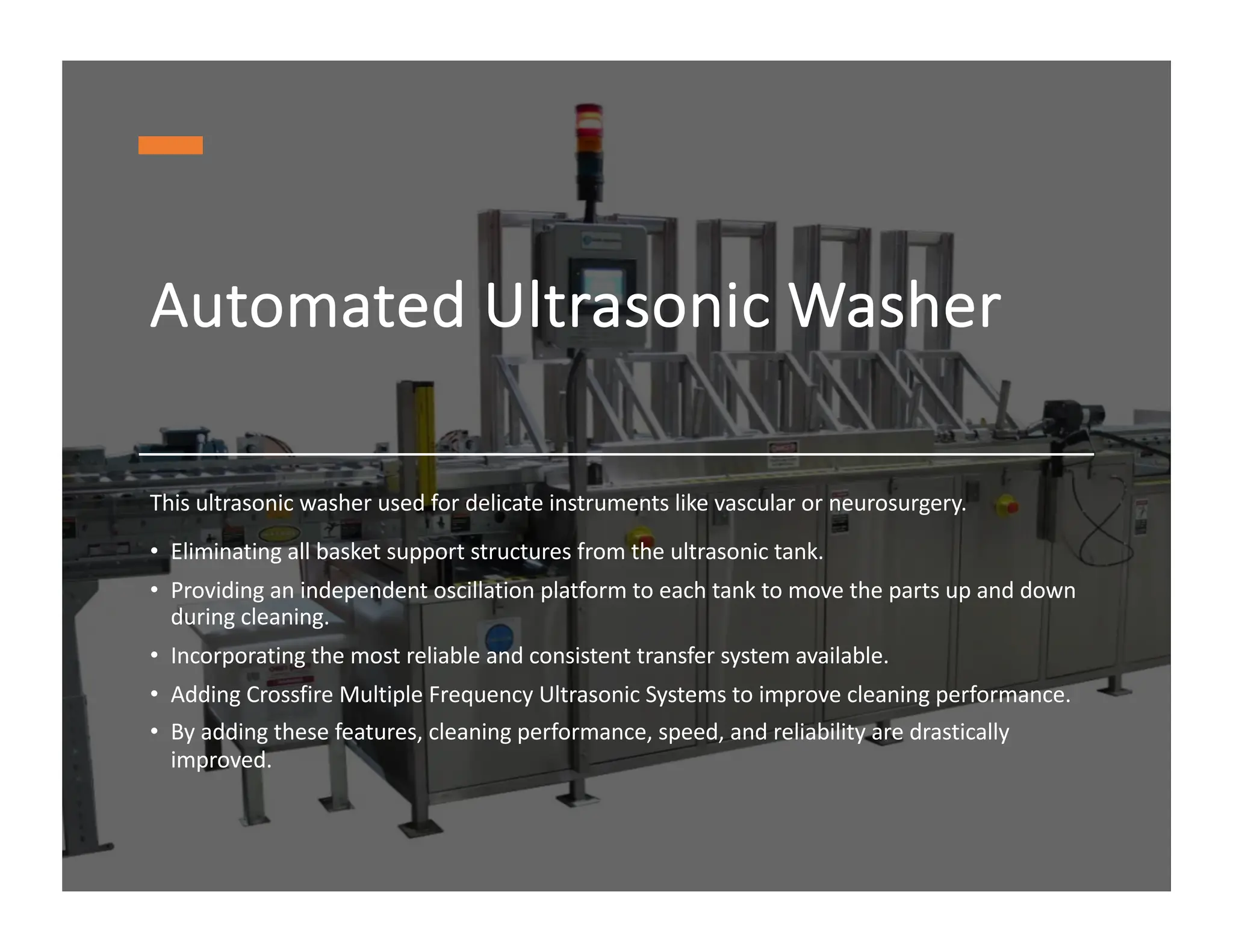
This ultrasonic washer used for delicate instruments like vascular or neurosurgery.
• Eliminating all basket support structures from the ultrasonic tank.
• Providing an independent oscillation platform to each tank to move the parts up and down
during cleaning.
• Incorporating the most reliable and consistent transfer system available.
• Adding Crossfire Multiple Frequency Ultrasonic Systems to improve cleaning performance.
• By adding these features, cleaning performance, speed, and reliability are drastically
improved.
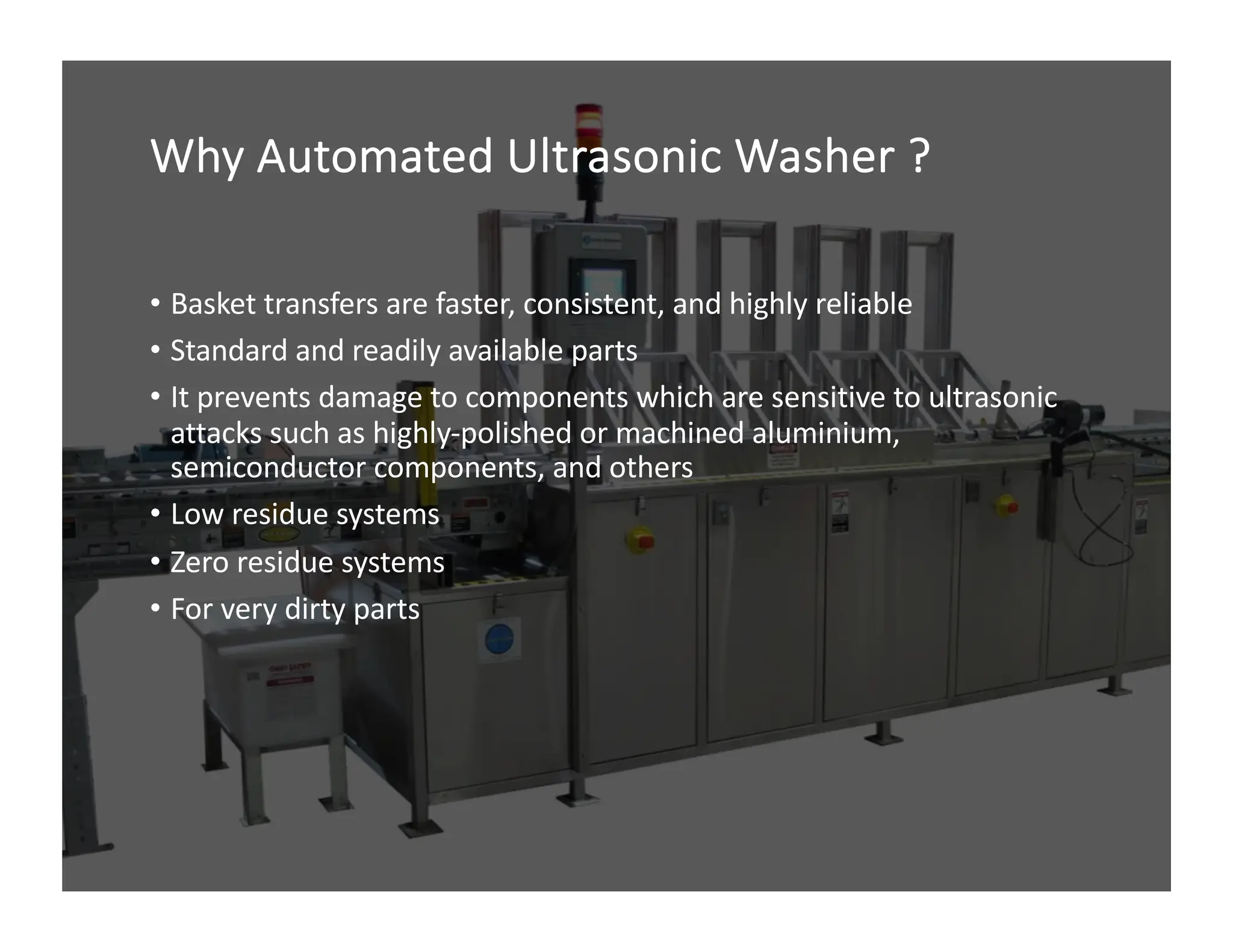
Why Automated Ultrasonic Washer ?
• Basket transfers are faster, consistent, and highly reliable
• Standard and readily available parts
• It prevents damage to components which are sensitive to ultrasonic
attacks such as highly-polished or machined aluminium,
semiconductor components, and others
• Low residue systems
• Zero residue systems
• For very dirty parts
Disinfection
• Disinfection is the process in which killing of
most, but not all microorganisms, mainly the
pathogenic ones. For adequate disinfection,
pathogens must be killed but some organisms and
bacterial spores may survive.
• Disinfectants vary in their tissue-damaging from
the corrosive phenol-containing compounds,
which should be used only on inanimate objects,
to lesser toxic materials such as ethanol and iodine
which can be used on skin surfaces.
• Chemicals used to kill microorganisms on the
surface of the skin and mucous membranes are
called antiseptics.
Levels of
Disinfection
• High: Kills all the organisms except
spores, and prions.
• Intermediate: Kills mycobacteria,
most viruses and bacteria
• Low: Kills some viruses and
bacteria.
General cleaning
• Scrubbing with detergents and rinsing with water.
• Spot cleaning of walls and ceiling daily
• For open shelves (clean daily)
• For closed cabinets (clean weekly)
• For furniture, lights, and equipment – clean the end of the day with Lysol
• Lights and other equipment – streamed weekly
• The floors should be scrubbed with warm water, and detergent and dried.
• The O.T. table and non-clinical equipment should be wiped to remove all the dirt and left to
dry.
Disinfection by radiation
Ultraviolet radiation Daily U.V. irradiation
for 12 – 16 hours.
To be switched off 2
hours before.
Procedure
• Close all doors and windows airtight and switch off fans and A.C.
• Heat formalin solution till boiling dry.
• Leave the O.T. unentered overnight.
• Enter the O.T. the next day morning with 300 ml of ammonia.
• Keep the ammonia solution for 2-3 hours to neutralize formalin
vapours.
• Open the O.T. to start surgery and advised fumigation at weekly
intervals.
STERISAFE
• STERISAFE is a sustainable ozone-based disinfection technology without use of
chemicals and activates oxygen from the surrounding air to disinfect.
• Simply joining three oxygen atoms produces ozone, a powerful biocide.
• Because ozone, like oxygen, is gas, it easily floods the room.
• It gets into cracks and under furniture.
• No germs survive when STERISAFE disinfects a room, no matter where they hide.
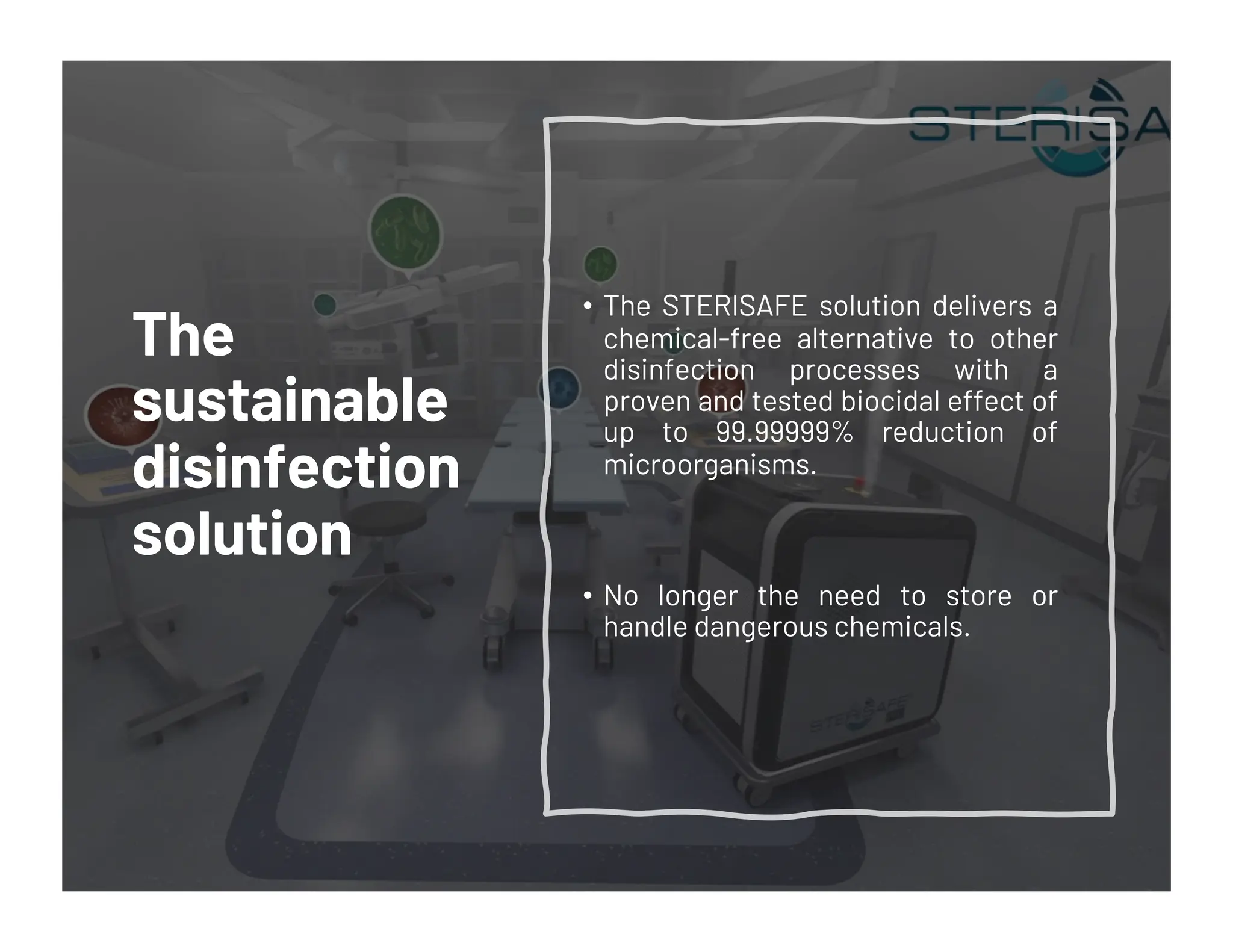
The
sustainable
disinfection
solution
• The STERISAFE solution delivers a
chemical-free alternative to other
disinfection processes with a
proven and tested biocidal effect of
up to 99.99999% reduction of
microorganisms.
• No longer the need to store or
handle dangerous chemicals.
Why Ozone?
• Ozone is a gaseous biocide, with inherent properties which
will spread much more easily to all areas of the room from
floor to ceiling
• This feature is especially used when surfaces were often large
and equipped with hard-to-reach fixtures and fittings
• No storage or use of liquid consumables
• Sustainable
• Effective oxidant
Benefits of Sterisafe
COST-EFFECTIVE SOLUTION ACTIVE ODOR REMOVAL NO CHEMICALS LIVE MONITORING AND
DOCUMENTATION OF
EVERY DISINFECTED BATCH
Validation is safety
Consistent results for better care
• Biocide concentrations
• Contact time
• At STERISAFE we have developed a solution that gives our clients full
control of the disinfection environment.
• By integrating disinfection with careful monitoring in an airtight
room, nothing is left to chance.
• We are in full control of all the parameters that make up for
consistent disinfection every time.
• 100% surface coverage
• Safety
Summary
Infection prevention and control are critical to improving care and ensuring the
safety of both the patient and the healthcare worker. Infection control addresses
factors that contribute to the spread of infections within the
operating room complex whether patient-to-patient, or patient-to-
staff, including prevention via hand hygiene/hand washing, cleaning/disinfection/st
erilization, vaccination, and monitoring.
References
Equipment disinfection. STERISAFE® automated room disinfection
robot. (2022, June 23). Retrieved March 18, 2023, from.
https://sterisafe.eu/equipment/
Automated ultrasonic cleaners. Zenith Ultrasonics. (2020, December
25). Retrieved March 18, 2023, from.
https://zenith- ultrasonics.com/automated-ultrasonic-cleaners/
Tarka, P., & Nitsch-Osuch, A. (2020, July 16). No-touch automated.
disinfection system for decontamination of surfaces in.
hospitals. MDPI. Retrieved March 18, 2023, from.
https://www.mdpi.com/1660-4601/17/14/5131
Thank you

Automated sterilization and disinfection in operation theatre

  • 1.
    Automated Sterilization AndDisinfection In Operation Theatre Prof: Susan Lovino Healthcare Operations (HINF-505-A) Manogna Potthuru Naga Venkata Bala Sri Harsha Kandregula Nikitha Surkanti Gayathri Konduru
  • 2.
    Content • Sterilization • Techniquesfor automatics sterilization • Steam sterilization process (Five distinct phases) • Automated Ultrasonic washer • Disinfection • Sterisafe • Summary • References
  • 3.
    Sterilization Sterilization is theprocess in which the killing or removal of all microorganisms, including bacterial spores, are highly resistant. Sterilization is usually carried out by autoclaving, which consists of exposure to steam at 121ºС under the pressure of [15 lb. / l in 2 ] for 15 minutes.
  • 4.
    Hydrogen Peroxide VaporSterilization This technique involves the use of hydrogen peroxide gas, which is released into a sealed chamber where it sterilizes the objects placed inside. It is a fast and effective method and is commonly used in hospitals and laboratories. Microwave Sterilization This technique involves the use of microwaves to sterilize objects. It is a relatively new technique and is still being researched, but it has shown promise in sterilizing medical equipment quickly and effectively.
  • 5.
    Ethylene Oxide Sterilization Ethyleneoxide is a gas that is used to sterilize medical devices and equipment. Plasma Sterilization This technique involves the use of plasma, which is a highly reactive gas, to sterilize objects. Ultraviolet Germicidal Irradiation This technique uses ultraviolet light to destroy microorganisms. It is often used for air and water purification, as well as for sterilizing surfaces.
  • 6.
    Steam Sterilization Process (Five DistinctPhases) PHASE I Loading phase • In which the objects or packs are loaded in the sterilizer. PHASE II Heating phase • In which the steam is brought to proper temperature & allowed to penetrate through the objects in the chamber. PHASE III Destroying phase (or time temperature cycle ) • In which all microbial life is exposed to the killing effect of the steam.
  • 7.
    Steam Sterilization Process (Five DistinctPhases) PHASE IV Drying and cooling phase • Objects are dried & cooled. • Then, filtered air is introduced into the chamber. • Door is opened • Packs are removed and stored. PHASE V Testing phase • In this phase, the efficiency of the sterilization process is checked. All mechanical parts of sterilizers, including gauges, steam lines & drains should be periodically checked by a competent biomed engineer.
  • 8.
    Automated Ultrasonic Washer Thisultrasonic washer used for delicate instruments like vascular or neurosurgery. • Eliminating all basket support structures from the ultrasonic tank. • Providing an independent oscillation platform to each tank to move the parts up and down during cleaning. • Incorporating the most reliable and consistent transfer system available. • Adding Crossfire Multiple Frequency Ultrasonic Systems to improve cleaning performance. • By adding these features, cleaning performance, speed, and reliability are drastically improved.
  • 9.
    Why Automated UltrasonicWasher ? • Basket transfers are faster, consistent, and highly reliable • Standard and readily available parts • It prevents damage to components which are sensitive to ultrasonic attacks such as highly-polished or machined aluminium, semiconductor components, and others • Low residue systems • Zero residue systems • For very dirty parts
  • 10.
    Disinfection • Disinfection isthe process in which killing of most, but not all microorganisms, mainly the pathogenic ones. For adequate disinfection, pathogens must be killed but some organisms and bacterial spores may survive. • Disinfectants vary in their tissue-damaging from the corrosive phenol-containing compounds, which should be used only on inanimate objects, to lesser toxic materials such as ethanol and iodine which can be used on skin surfaces. • Chemicals used to kill microorganisms on the surface of the skin and mucous membranes are called antiseptics.
  • 11.
    Levels of Disinfection • High:Kills all the organisms except spores, and prions. • Intermediate: Kills mycobacteria, most viruses and bacteria • Low: Kills some viruses and bacteria.
  • 12.
    General cleaning • Scrubbingwith detergents and rinsing with water. • Spot cleaning of walls and ceiling daily • For open shelves (clean daily) • For closed cabinets (clean weekly) • For furniture, lights, and equipment – clean the end of the day with Lysol • Lights and other equipment – streamed weekly • The floors should be scrubbed with warm water, and detergent and dried. • The O.T. table and non-clinical equipment should be wiped to remove all the dirt and left to dry.
  • 13.
    Disinfection by radiation Ultravioletradiation Daily U.V. irradiation for 12 – 16 hours. To be switched off 2 hours before.
  • 14.
    Procedure • Close alldoors and windows airtight and switch off fans and A.C. • Heat formalin solution till boiling dry. • Leave the O.T. unentered overnight. • Enter the O.T. the next day morning with 300 ml of ammonia. • Keep the ammonia solution for 2-3 hours to neutralize formalin vapours. • Open the O.T. to start surgery and advised fumigation at weekly intervals.
  • 15.
    STERISAFE • STERISAFE isa sustainable ozone-based disinfection technology without use of chemicals and activates oxygen from the surrounding air to disinfect. • Simply joining three oxygen atoms produces ozone, a powerful biocide. • Because ozone, like oxygen, is gas, it easily floods the room. • It gets into cracks and under furniture. • No germs survive when STERISAFE disinfects a room, no matter where they hide.
  • 17.
    The sustainable disinfection solution • The STERISAFEsolution delivers a chemical-free alternative to other disinfection processes with a proven and tested biocidal effect of up to 99.99999% reduction of microorganisms. • No longer the need to store or handle dangerous chemicals.
  • 18.
    Why Ozone? • Ozoneis a gaseous biocide, with inherent properties which will spread much more easily to all areas of the room from floor to ceiling • This feature is especially used when surfaces were often large and equipped with hard-to-reach fixtures and fittings • No storage or use of liquid consumables • Sustainable • Effective oxidant
  • 19.
    Benefits of Sterisafe COST-EFFECTIVESOLUTION ACTIVE ODOR REMOVAL NO CHEMICALS LIVE MONITORING AND DOCUMENTATION OF EVERY DISINFECTED BATCH
  • 21.
  • 22.
    Consistent results forbetter care • Biocide concentrations • Contact time • At STERISAFE we have developed a solution that gives our clients full control of the disinfection environment. • By integrating disinfection with careful monitoring in an airtight room, nothing is left to chance. • We are in full control of all the parameters that make up for consistent disinfection every time. • 100% surface coverage • Safety
  • 23.
    Summary Infection prevention andcontrol are critical to improving care and ensuring the safety of both the patient and the healthcare worker. Infection control addresses factors that contribute to the spread of infections within the operating room complex whether patient-to-patient, or patient-to- staff, including prevention via hand hygiene/hand washing, cleaning/disinfection/st erilization, vaccination, and monitoring.
  • 24.
    References Equipment disinfection. STERISAFE®automated room disinfection robot. (2022, June 23). Retrieved March 18, 2023, from. https://sterisafe.eu/equipment/ Automated ultrasonic cleaners. Zenith Ultrasonics. (2020, December 25). Retrieved March 18, 2023, from. https://zenith- ultrasonics.com/automated-ultrasonic-cleaners/ Tarka, P., & Nitsch-Osuch, A. (2020, July 16). No-touch automated. disinfection system for decontamination of surfaces in. hospitals. MDPI. Retrieved March 18, 2023, from. https://www.mdpi.com/1660-4601/17/14/5131
  • 25.