Quasi contracts
Meaning Not a contract at all One or the other essentials of a contract are absent An obligation imposed by law upon a person for the benefit of the other even in the absence of a contract. Based on the principle of equity
Features Imposed by law and does not arise from any agreement Duty of a party and  not the promise of any party is the basis of such contract Right under it is always a right to money Right under it is available against specific persons and not against the whole world
Types of quasi contracts Right to recover the price of necessaries supplied Right to recover money paid for another person Right to recover for non-gratuitous Act Responsibility of finder of goods Right to recover from a person to whom money is paid or thing is delivered, by mistake or under coercion
Quantum meruit “ as much as earned’ Payment in proportion to the amount of work done. When a person has begun the work and before he could complete it, the other party terminates the contract or does something which make it impossible for the other party to complete the contract, he can claim for work done under the contract.
Contd- He may also recover the value of the work done where the further performance of contract becomes impossible. The party claiming relief  has to establish the following: He has been ready and willing to perform the contract. He has made a part performance of the contract for which the remuneration is due.
Cases in which the claim of quantum meruit can arise In case of void agreement or contract that becomes void In case of non gratuitous act In case of preventing the completion of the contract In case of divisible contract In case of indivisible contract performed completely but badly.
Performance of contract
Meaning A contract is said to have performed when the parties to the contract either perform or offer to perform their respective promises. Sec 37 : “The parties to the contract must either perform or offer to perform their respective promises, unless such performance is dispensed with or excused under the provision of the Act, or any other law.”
Contd -  Types of performance: Actual performance Attempted performance
Contd - Persons who can demand performance Promisee Legal representatives Third party Joint promisee Persons who must perform Promisor Promisor’s agent Legal representative Third party Joint promisors
Time and place of performance The contract must be performed within a reasonable period of time.  The promise must be performed in the manner and at the time prescribed by the promisee.
Contd- Time  as essence of contract  – It is essential for the parties to a contract to perform their respective promises within the specified time.
Discharge of contract
Discharge of  a contract Discharge of a contract means the termination of contractual relations between the parties to a contract. A contract is said to be discharged when the rights and obligations of the parties under the contract come to an end.
Modes of discharge of contract Discharge by performance (a) By actual performance (b) By attempted performance Discharge by mutual agreement:  (a) Novation – Substitution of a new contract (b) Rescission – Cancellation of contract (c) Alteration – Change in terms of contract with mutual consent of parties. (d) Remission – Acceptance by promisee of a lesser fulfillment of the promise made
Contd - (e) Waiver – Intentional relinquishment of a right under the contract. Discharge by operation of law – (a) By death of promisor (b) By insolvency (c) By unauthorized material alteration (d) By the identity of the promisor and promisee
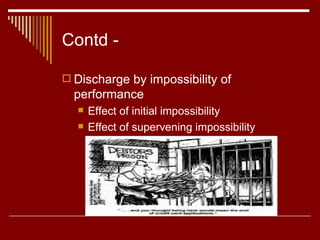
Contd - Discharge by impossibility of performance Effect of initial impossibility Effect of supervening impossibility
Breach of contract
Contd- Breaking of contract means a breaking of the obligation which a contract imposes Breach of contract is of two types: Actual breach of contract Anticipatory breach of contract
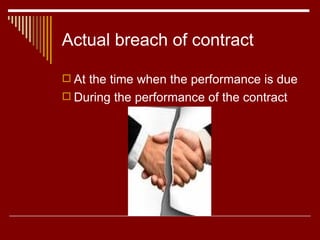
Actual breach of contract At the time when the performance is due During the performance of the contract
Anticipatory breach of contract Ex;  A undertakes to supply certain goods to B on 1 st  January. Before this date, he informs B that he is not going to supply goods. This is an anticipatory breach of contract  Anticipatory breach does not necessarily discharge the contract, unless the promisee (the aggrieved party) so chooses.
Remedies for breach of Contract When a contract is broken the injured party has one or more of the following remedies. Rescission of the contract Suit for damages Suit for quantum meruit Suit for specific performance of the contract Suit for injunction
Rescission A right not to perform obligation The aggrieved party is discharged from all the obligations under the contract. He is entitled to claim compensation for damage which he has sustained for the non performance of the contract
Suit for damages Monetary compensation allowed for the loss suffered by the aggrieved party due to the breach of the contract. Case;  Hadley vs Baxendale
Contd - Rule ; Where two parties have made a contract  which one of them has broken, the damages which the other party ought to receive in respect of such breach of contract should be as such as may fairly and reasonably be considered either arising naturally i.e., according to usual course of things, from such breach of contract itself, or such as may reasonably be supposed to have been in contemplation of both the parties, at the time they made the contract, as the probable result of the breach of it.
Section 73  Deals with compensation for loss Ordinary damages Special damages  Exemplary damages Nominal damages Damages for inconvenience and discomfort Liquidated damages and penalty Stipulation for interest Forfeiture of security deposit
Suit for specific performance Demanding the court’s direction to the defaulting party to carry out the promise according to the terms of the contract
Suit  for injunction Demanding court’s stay order Injunction means an order of the court which prohibits a person to do a particular act.
Suit for quantum meruit Right to claim compensation for the work already done. Ex: C an owner of a magazine engaged P to write a book to be published by installments in his magazine. After a few installments were published, the publication of the magazine was stopped. It was held that P could claim payment for the part already published.
Indemnity and Guarantee
Definition It is entered into with the object of protecting the promisee against anticipated loss. A contract by which one party promises to save the other from loss caused to him by the promisor himself or by the conduct of any other person, is called a contract of indemnity. (Sec 124)
Contd - A lost his share certificate. He applied to the company for the issue of a duplicate certificate. The company asked A to furnish an ‘indemnity bond’ in its favor to protect it against any claim that may be made by any person on the original certificate. A, accordingly executed the indemnity bond. It is a contract of indemnity between A and the Company. A is the indemnifier and the Company is the indemnified or indemnity holder.
Contracts of guarantee A contract of guarantee is a contract to perform the promise, or discharge the liability of a third person in case of his defeat. (Sec 126) Features Three parties Consent of surety Obligation arises in case of default  Types of contract Primary liability Consideration is necessary for contract of guarantee
Bailment  It involves change of possession of goods from one person to another for some specific purpose.  Bailment is concerned only with goods Ex:  A delivers a piece of cloth to B a tailor, to be stitched into a suit. There is a contract of bailment between A and B. Sec 148 : Delivery of goods by one person to another for some purpose upon a contract, that they shall, when the purpose is accomplished , be returned or otherwise disposed of according to the directions of the person delivering them.
Pledge Bailment of goods as security for payment of a debt or performance of a promise is called ‘pledge’. A pledge is bailment for security.. Ex: If A borrows Rs 200 from B and keeps his watch as security for payment of debt, the bailment of watch is a pledge.
Agency Sec 182: An agent is a person employed to do any act for another, or to represent another in dealings with a third person. Person for whom such Act is done –Principal Agent – connecting link between the principal and third parties.
Agency Two essentials  Agreement between the principal and agent –  agency depends on agreement but not necessarily on contract.  No consideration is necessary to create an agency. Intention of the agent to act on behalf of the principal.
Test of agency Has that person the capacity to bind the principal  Can he be made answerable to a third person by bringing him (the principal) into legal relations with the third person can a privity of contract be established between that person and the principal? If yes, he is an agent, otherwise not.

Contract+2

  • 1.
  • 2.
    Meaning Not acontract at all One or the other essentials of a contract are absent An obligation imposed by law upon a person for the benefit of the other even in the absence of a contract. Based on the principle of equity
  • 3.
    Features Imposed bylaw and does not arise from any agreement Duty of a party and not the promise of any party is the basis of such contract Right under it is always a right to money Right under it is available against specific persons and not against the whole world
  • 4.
    Types of quasicontracts Right to recover the price of necessaries supplied Right to recover money paid for another person Right to recover for non-gratuitous Act Responsibility of finder of goods Right to recover from a person to whom money is paid or thing is delivered, by mistake or under coercion
  • 5.
    Quantum meruit “as much as earned’ Payment in proportion to the amount of work done. When a person has begun the work and before he could complete it, the other party terminates the contract or does something which make it impossible for the other party to complete the contract, he can claim for work done under the contract.
  • 6.
    Contd- He mayalso recover the value of the work done where the further performance of contract becomes impossible. The party claiming relief has to establish the following: He has been ready and willing to perform the contract. He has made a part performance of the contract for which the remuneration is due.
  • 7.
    Cases in whichthe claim of quantum meruit can arise In case of void agreement or contract that becomes void In case of non gratuitous act In case of preventing the completion of the contract In case of divisible contract In case of indivisible contract performed completely but badly.
  • 8.
  • 9.
    Meaning A contractis said to have performed when the parties to the contract either perform or offer to perform their respective promises. Sec 37 : “The parties to the contract must either perform or offer to perform their respective promises, unless such performance is dispensed with or excused under the provision of the Act, or any other law.”
  • 10.
    Contd - Types of performance: Actual performance Attempted performance
  • 11.
    Contd - Personswho can demand performance Promisee Legal representatives Third party Joint promisee Persons who must perform Promisor Promisor’s agent Legal representative Third party Joint promisors
  • 12.
    Time and placeof performance The contract must be performed within a reasonable period of time. The promise must be performed in the manner and at the time prescribed by the promisee.
  • 13.
    Contd- Time as essence of contract – It is essential for the parties to a contract to perform their respective promises within the specified time.
  • 14.
  • 15.
    Discharge of a contract Discharge of a contract means the termination of contractual relations between the parties to a contract. A contract is said to be discharged when the rights and obligations of the parties under the contract come to an end.
  • 16.
    Modes of dischargeof contract Discharge by performance (a) By actual performance (b) By attempted performance Discharge by mutual agreement: (a) Novation – Substitution of a new contract (b) Rescission – Cancellation of contract (c) Alteration – Change in terms of contract with mutual consent of parties. (d) Remission – Acceptance by promisee of a lesser fulfillment of the promise made
  • 17.
    Contd - (e)Waiver – Intentional relinquishment of a right under the contract. Discharge by operation of law – (a) By death of promisor (b) By insolvency (c) By unauthorized material alteration (d) By the identity of the promisor and promisee
  • 18.
    Contd - Dischargeby impossibility of performance Effect of initial impossibility Effect of supervening impossibility
  • 19.
  • 20.
    Contd- Breaking ofcontract means a breaking of the obligation which a contract imposes Breach of contract is of two types: Actual breach of contract Anticipatory breach of contract
  • 21.
    Actual breach ofcontract At the time when the performance is due During the performance of the contract
  • 22.
    Anticipatory breach ofcontract Ex; A undertakes to supply certain goods to B on 1 st January. Before this date, he informs B that he is not going to supply goods. This is an anticipatory breach of contract Anticipatory breach does not necessarily discharge the contract, unless the promisee (the aggrieved party) so chooses.
  • 23.
    Remedies for breachof Contract When a contract is broken the injured party has one or more of the following remedies. Rescission of the contract Suit for damages Suit for quantum meruit Suit for specific performance of the contract Suit for injunction
  • 24.
    Rescission A rightnot to perform obligation The aggrieved party is discharged from all the obligations under the contract. He is entitled to claim compensation for damage which he has sustained for the non performance of the contract
  • 25.
    Suit for damagesMonetary compensation allowed for the loss suffered by the aggrieved party due to the breach of the contract. Case; Hadley vs Baxendale
  • 26.
    Contd - Rule; Where two parties have made a contract which one of them has broken, the damages which the other party ought to receive in respect of such breach of contract should be as such as may fairly and reasonably be considered either arising naturally i.e., according to usual course of things, from such breach of contract itself, or such as may reasonably be supposed to have been in contemplation of both the parties, at the time they made the contract, as the probable result of the breach of it.
  • 27.
    Section 73 Deals with compensation for loss Ordinary damages Special damages Exemplary damages Nominal damages Damages for inconvenience and discomfort Liquidated damages and penalty Stipulation for interest Forfeiture of security deposit
  • 28.
    Suit for specificperformance Demanding the court’s direction to the defaulting party to carry out the promise according to the terms of the contract
  • 29.
    Suit forinjunction Demanding court’s stay order Injunction means an order of the court which prohibits a person to do a particular act.
  • 30.
    Suit for quantummeruit Right to claim compensation for the work already done. Ex: C an owner of a magazine engaged P to write a book to be published by installments in his magazine. After a few installments were published, the publication of the magazine was stopped. It was held that P could claim payment for the part already published.
  • 31.
  • 32.
    Definition It isentered into with the object of protecting the promisee against anticipated loss. A contract by which one party promises to save the other from loss caused to him by the promisor himself or by the conduct of any other person, is called a contract of indemnity. (Sec 124)
  • 33.
    Contd - Alost his share certificate. He applied to the company for the issue of a duplicate certificate. The company asked A to furnish an ‘indemnity bond’ in its favor to protect it against any claim that may be made by any person on the original certificate. A, accordingly executed the indemnity bond. It is a contract of indemnity between A and the Company. A is the indemnifier and the Company is the indemnified or indemnity holder.
  • 34.
    Contracts of guaranteeA contract of guarantee is a contract to perform the promise, or discharge the liability of a third person in case of his defeat. (Sec 126) Features Three parties Consent of surety Obligation arises in case of default Types of contract Primary liability Consideration is necessary for contract of guarantee
  • 35.
    Bailment Itinvolves change of possession of goods from one person to another for some specific purpose. Bailment is concerned only with goods Ex: A delivers a piece of cloth to B a tailor, to be stitched into a suit. There is a contract of bailment between A and B. Sec 148 : Delivery of goods by one person to another for some purpose upon a contract, that they shall, when the purpose is accomplished , be returned or otherwise disposed of according to the directions of the person delivering them.
  • 36.
    Pledge Bailment ofgoods as security for payment of a debt or performance of a promise is called ‘pledge’. A pledge is bailment for security.. Ex: If A borrows Rs 200 from B and keeps his watch as security for payment of debt, the bailment of watch is a pledge.
  • 37.
    Agency Sec 182:An agent is a person employed to do any act for another, or to represent another in dealings with a third person. Person for whom such Act is done –Principal Agent – connecting link between the principal and third parties.
  • 38.
    Agency Two essentials Agreement between the principal and agent – agency depends on agreement but not necessarily on contract. No consideration is necessary to create an agency. Intention of the agent to act on behalf of the principal.
  • 39.
    Test of agencyHas that person the capacity to bind the principal Can he be made answerable to a third person by bringing him (the principal) into legal relations with the third person can a privity of contract be established between that person and the principal? If yes, he is an agent, otherwise not.