Content Server Installation Guide: (HP-UXB.11.31 U ia64)
Steps:
To operate the SAP Content Server for UNIXplatforms, yourequire ApacheWebServer 1.3.xx(wherexx is Version 22or higher).
Create Users and Groups
a. Create content server and a cache server user. Werecommendthat youuse thefollowingschema: <sid>cs and<sid>csc, respectively. This
helps identifyingwhich content server belongs towhich SAP system later. However, any otheruser names are fine.
b. Make both users members of thegroup sapsys.
c. Also create a dedicatedhome directoryfor eachuser, where the server configuration profiles andthe software will be installed.
Filesystem storage
If youare planningtouse a file system as your storage medium, be aware that all objects createdin therepositories are ownedby the content
server andcache server users.
a. Therefore, assign full access to the repositoryroot directories to these users.
Compileand install the Apache Web server software from a source distribution (useful Note: 664384)
Note “Installation should be done for both users <sid>cs and <sid>csc”
a. Copy distributions tohome directories of bothusers <sid>cs and<sid>csc andunpack.
sapcs:~$ gunzip < apache_1.3.26.tar.gz | tar xvf –
Some distribution appearcompilationerrorwhen user run configure apache, so followthebelowsteps tosave timeandfor smooth installation.
1) Change shell fromsh toksh usingcommandchsh.
2) Variables were set using
Apache WebServer 1.3.xx
export LDFLAGS="+DD64 +DSitanium2"
export CFLAGS="+DD64 +DSitanium2"
For Apache WebServer2.0/2.2 only
CFLAGS="-q64", LDFLAGS="-q64", EXTRA_LDFLAGS_SHLIB="-b64" OBJECT_MODE=64
3) Issue followingcommandwith users home directorypath. Beforerun this commandusers shouldbe switchedto “apache_1.3.33”
./configure –prefix=/usr/users/<sid>cs -enable-mods-shared=most -with-mpm=prefork
4) Issuedmake andmake install
5) Creatinga binary distribution
For the binarydistribution, youmust also set the requiredcompiler parameters andlinker parameters (Already set above)as environment
variables before youcall the generation commands. Thescript
"./src/helpers/binbuild. sh" (Apache 1.3)
"./build/binbuild.sh" (Apache 2.0/2.2)
6) Executes the three phases configure, make andinstall. In thestepinstall, thebinarydistributionis createdas a tape archive (tar). The script
outputs the name andstorage location ofthe archive. The binary distribution createdusing"binbuild.sh" supports Dynamic Shared
Objects (DSO).
After youunpackedthetararchivein the target host (where youcurrently install apache)performthe final installation usingthe followingscript:
./install-bindist.sh <InstDir>
If youdo not specify< InstDir>,the systeminstalls the Webserverin the directory/usr/local.Especiallywhen youuse theuser root to execute
this script,the Webserver may easilybe installedin an unrequitedlocationandit may be difficult toremove the Webserver again from this
location. Therefore,we recommendthat youperformthe installation usingtheuser ID under which the Webserver is torun in the future. Inthis
way, all group rights andowner rights arecorrectlyassignedfromthe beginning.
Nowinstallationpart of Apache Webserverandneedtosome cosmetic changes forconfigurationas follows.
7) Apache Webserver configurationfile is “httpd.conf”locatedunder path /usr/users/<sid>cs /conf/ andneedtosomechanges torun apacheweb
server.
Leave all the settingas its as default just modifybelowmentionedlines.
Find“#Listen3000” andreplace or append“ListenIP address:1090”
8) CommandtoStartedApache Webserver,this commandwill be available under path/usr/users/<sid>cs /bin
./apachectl start
Now time to install Content Server:
For Content Server installation use thelatest installation master for latest content server, We done through “ SAP EHP3FOR SAP
NETWEAVER 7.0” BS7i2011’. Run sapinst
Installationof content serveris very simple only important step is where systemmentionedboth users which was createdwhile installationof
apache webserver andrequire to share homedirectories of bothusers.
(Apply Note: 514500)
After Installation of Content Server here is neededto applycontent server patch if content server 4.5 is installed.
a) Downloadpatchfrommarket place “CONTSERVE650SP02P_1-10013601.SAR”.
b) Unpack SAR file in temporarydirectory.
c) Stop ApacheWebServer if running.
d) Replace the SharedLibraries in thedirectory "libexec" ofyour Content Server/Cache Server installationagainst thefiles fromthe ZIP/SAR
archive.
e) Check the execution rights ofthe programfiles. SomeUNIX variants require executionrights to be set for sharedlibraries.The relevant
commandis "chmod755<file name>".
f) Start Apache WebServer.
Creation of SAP Content Repository and related configuration
Login to SAP system andopenTcode “ OAC0” andopenanyavailable Repositorythat already exists.System appear withContent Repository
details. Nowyoucan edit thesame as your requiredor cancreatenewrepository.
Procedure
1. Choose a content server ora cache server.
- The first timeyoucall up Content ServerAdministration,the content server selectionscreenis displayedautomatically.
- If youare already in Content Server Administration, youcan choose a serverby choosing.
2. The followingoptions are available for callingup theadministration functions fora content server:
- On the Repositorytab, enter the nameof the content repository that you definedin theMaintainContent Repositories screen.
Choose F4 to displaya list of options.
- Alternatively, make theappropriate entries in the
HTTP Server, Port number, HTTP script, and Versions no. fields on the Servertab. Basic path andphysical pathshouldbe as
your content serverroot directoryor if youhave some otherdirectory mountedto point content root directory.
Choose F4 to displaya list of options.
If youdo not make an entry in the field HTTP script, the default setting ContentServer/ContentServer.dll is used.
3. Choose Entertoconfirmyour entries.
Result
The details of theHTTP server, port number, HTTP script,andversionappear in theheader
of the Content Server Administrationscreen.
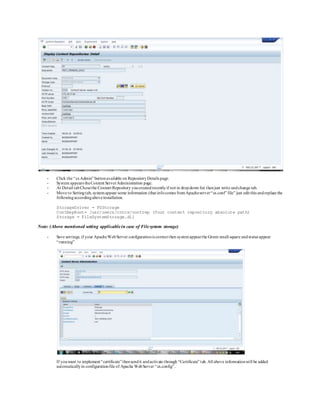
- Click the “cs Admin” buttonavailable on RepositoryDetails page.
- System appears theContent ServerAdministration page.
- At Detail tabChosethe Content Repository youcreatedrecentlyif not in dropdown list thenjust write andchange tab.
- Move to Settingtab, systemappear some information (that infocomes fromApacheserver“cs.conf” file” just edit this andreplace the
followingaccordingaboveinstallation.
StorageDriver = FSStorage
ContRepRoot= /usr/users/cntcs/contrep (Your content repository absolute path)
Storage = FileSystemStorage.dll
Note: (Above mentioned setting applicablein case of Filesystem storage)
- Save settings, if your ApacheWebServer configurationis correct then systemappearthe Green small square andstatus appear
“running”
If youwant to implement “certificate”thensendit andactivate through “Certificate” tab. All above informationwill be added
automaticallyin configurationfile of Apache WebServer “cs.config” .
When Content Repositoryis createdwith goodconfiguration settingsame time systemwill create “cs.conf” file in Apache server and
will make Directoryin content root as your content repository name.
If Content Repositoryis not runningor appearingwarningthencheck andcorrect your “cs.conf” file locatedin ApacheWebServer as
flows. Below informationplaced at bottom ofthe configurationfile.
Note: (Before edit Stop Apache Web Server. Ignore the linescommented with ;semicolon, only blueshaded linesare
important. Security is also optional)
[ContentServer]
TraceLevel=warning
;AdminSecurity=1
;AdminSecurityGroup=sapsys
;ContRepRoot=/usr/users/cntcs/contrep
;ContentStorageHost=@StorageHost@
;ContentStorageName=@StorageName@
;StorageDriver=FSStorage
;PSEDir=/usr/users/cntcs/security
;Storage=FileSystemStorage.dll
[contRep-ZP]
StorageDriver=FSStorage
ContRepRoot=/usr/users/cntcs/contrep
Storage=FileSystemStorage.dll
Security=1
ContRepDescription=TEST_PENSION_DOCS
DefaultDocProt=rucd
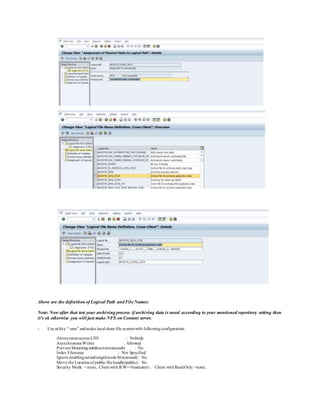
Defining Logical Path and FileNames:
1. Call transaction FILE .
Alternatively, fromthe initial screen for Archive Administration(transactionSARA ), choose: Customizing→ Basis-Customizing→
Cross-Client File
Name/Paths .
2. Mark an existingfile name,forexample, ARCHIVE_GLOBAL_PATH, orchoose newentries toenter a pathname. The name
shouldreflect its function.
3. Double click the dialogstructure Logical File Path Definitionin the substructure Assignment of Physical Paths to Logical Path.
Double click to select a syntax groupor create a newsyntaxgroup.
4. Assign a physical pathname to thelogical pathname.
Important whiledefining Logical Path and FileNames:
- When assigningpath names, the symbol <FILENAME> must appearat the end. This symbol is replacedat runtimeby the physical
file (or path) name.No part of the physical file name inthe pathname must be defined.
- If youwant to store your archive files, enter theplaceholder <F=ARCHIVELINK> in the logical path.With
<F=ARCHIVELINK><FILENAME> the files are createddirectlyin the basis path ofthe content repositorythat has been assignedto
the correspondingarchivingobject. This way you canavoidan internal copyprocess duringthe storephase.
Above are the definition of Logical Path and FileNames:
Note: Now after that test your archiving process if archiving data is saved according to your mentioned repository setting then
it’s ok otherwise you will just make NFS on Content server.
- Use utility “ sam” andmake local share file systemwith followingconfiguration:
Anonymous access UID : Nobody
Asynchronous Writes : Allowed
Prevent Mountingsubdirectories(nosub) : No
Index Filename : Not Specified
Ignore enablingsetuid/setgidmode bits(nosuid) : No
Move the Locationof public file handle(public) : No
Security Mode = none, Client with R/W=<hostname>, Client withReadOnly =none,
- Use utility “ sam” andmake”AutomountedRemoteFile Systems” withfollowingconfiguration onthe Productions Server:
Local-Directory Name: /contrep
Remote-ServerName: upgqas.pfira.com
Remote-Server port: Not Specified
Remote-Directory Name: /usr/user/cntcs/contrep
View Multiple Server Configuration... ] Single Server Configured
Automounter MapType: AutoDirect
Permission: read/write
- Nowjust make mount point referringto content repositoryroot pathwhich was mentionedin NFSat Content Server.
NowContent Server must be workingfine.
The End…………..

Content server installation guide

  • 1.
    Content Server InstallationGuide: (HP-UXB.11.31 U ia64) Steps: To operate the SAP Content Server for UNIXplatforms, yourequire ApacheWebServer 1.3.xx(wherexx is Version 22or higher). Create Users and Groups a. Create content server and a cache server user. Werecommendthat youuse thefollowingschema: <sid>cs and<sid>csc, respectively. This helps identifyingwhich content server belongs towhich SAP system later. However, any otheruser names are fine. b. Make both users members of thegroup sapsys. c. Also create a dedicatedhome directoryfor eachuser, where the server configuration profiles andthe software will be installed. Filesystem storage If youare planningtouse a file system as your storage medium, be aware that all objects createdin therepositories are ownedby the content server andcache server users. a. Therefore, assign full access to the repositoryroot directories to these users. Compileand install the Apache Web server software from a source distribution (useful Note: 664384) Note “Installation should be done for both users <sid>cs and <sid>csc” a. Copy distributions tohome directories of bothusers <sid>cs and<sid>csc andunpack. sapcs:~$ gunzip < apache_1.3.26.tar.gz | tar xvf – Some distribution appearcompilationerrorwhen user run configure apache, so followthebelowsteps tosave timeandfor smooth installation. 1) Change shell fromsh toksh usingcommandchsh. 2) Variables were set using Apache WebServer 1.3.xx export LDFLAGS="+DD64 +DSitanium2" export CFLAGS="+DD64 +DSitanium2" For Apache WebServer2.0/2.2 only CFLAGS="-q64", LDFLAGS="-q64", EXTRA_LDFLAGS_SHLIB="-b64" OBJECT_MODE=64 3) Issue followingcommandwith users home directorypath. Beforerun this commandusers shouldbe switchedto “apache_1.3.33” ./configure –prefix=/usr/users/<sid>cs -enable-mods-shared=most -with-mpm=prefork 4) Issuedmake andmake install 5) Creatinga binary distribution For the binarydistribution, youmust also set the requiredcompiler parameters andlinker parameters (Already set above)as environment variables before youcall the generation commands. Thescript "./src/helpers/binbuild. sh" (Apache 1.3) "./build/binbuild.sh" (Apache 2.0/2.2) 6) Executes the three phases configure, make andinstall. In thestepinstall, thebinarydistributionis createdas a tape archive (tar). The script outputs the name andstorage location ofthe archive. The binary distribution createdusing"binbuild.sh" supports Dynamic Shared Objects (DSO). After youunpackedthetararchivein the target host (where youcurrently install apache)performthe final installation usingthe followingscript: ./install-bindist.sh <InstDir> If youdo not specify< InstDir>,the systeminstalls the Webserverin the directory/usr/local.Especiallywhen youuse theuser root to execute this script,the Webserver may easilybe installedin an unrequitedlocationandit may be difficult toremove the Webserver again from this location. Therefore,we recommendthat youperformthe installation usingtheuser ID under which the Webserver is torun in the future. Inthis way, all group rights andowner rights arecorrectlyassignedfromthe beginning.
  • 2.
    Nowinstallationpart of ApacheWebserverandneedtosome cosmetic changes forconfigurationas follows. 7) Apache Webserver configurationfile is “httpd.conf”locatedunder path /usr/users/<sid>cs /conf/ andneedtosomechanges torun apacheweb server. Leave all the settingas its as default just modifybelowmentionedlines. Find“#Listen3000” andreplace or append“ListenIP address:1090” 8) CommandtoStartedApache Webserver,this commandwill be available under path/usr/users/<sid>cs /bin ./apachectl start Now time to install Content Server: For Content Server installation use thelatest installation master for latest content server, We done through “ SAP EHP3FOR SAP NETWEAVER 7.0” BS7i2011’. Run sapinst Installationof content serveris very simple only important step is where systemmentionedboth users which was createdwhile installationof apache webserver andrequire to share homedirectories of bothusers. (Apply Note: 514500) After Installation of Content Server here is neededto applycontent server patch if content server 4.5 is installed. a) Downloadpatchfrommarket place “CONTSERVE650SP02P_1-10013601.SAR”. b) Unpack SAR file in temporarydirectory. c) Stop ApacheWebServer if running. d) Replace the SharedLibraries in thedirectory "libexec" ofyour Content Server/Cache Server installationagainst thefiles fromthe ZIP/SAR archive. e) Check the execution rights ofthe programfiles. SomeUNIX variants require executionrights to be set for sharedlibraries.The relevant commandis "chmod755<file name>". f) Start Apache WebServer. Creation of SAP Content Repository and related configuration Login to SAP system andopenTcode “ OAC0” andopenanyavailable Repositorythat already exists.System appear withContent Repository details. Nowyoucan edit thesame as your requiredor cancreatenewrepository. Procedure 1. Choose a content server ora cache server. - The first timeyoucall up Content ServerAdministration,the content server selectionscreenis displayedautomatically. - If youare already in Content Server Administration, youcan choose a serverby choosing. 2. The followingoptions are available for callingup theadministration functions fora content server: - On the Repositorytab, enter the nameof the content repository that you definedin theMaintainContent Repositories screen. Choose F4 to displaya list of options. - Alternatively, make theappropriate entries in the HTTP Server, Port number, HTTP script, and Versions no. fields on the Servertab. Basic path andphysical pathshouldbe as your content serverroot directoryor if youhave some otherdirectory mountedto point content root directory. Choose F4 to displaya list of options. If youdo not make an entry in the field HTTP script, the default setting ContentServer/ContentServer.dll is used. 3. Choose Entertoconfirmyour entries. Result The details of theHTTP server, port number, HTTP script,andversionappear in theheader of the Content Server Administrationscreen.
  • 3.
    - Click the“cs Admin” buttonavailable on RepositoryDetails page. - System appears theContent ServerAdministration page. - At Detail tabChosethe Content Repository youcreatedrecentlyif not in dropdown list thenjust write andchange tab. - Move to Settingtab, systemappear some information (that infocomes fromApacheserver“cs.conf” file” just edit this andreplace the followingaccordingaboveinstallation. StorageDriver = FSStorage ContRepRoot= /usr/users/cntcs/contrep (Your content repository absolute path) Storage = FileSystemStorage.dll Note: (Above mentioned setting applicablein case of Filesystem storage) - Save settings, if your ApacheWebServer configurationis correct then systemappearthe Green small square andstatus appear “running” If youwant to implement “certificate”thensendit andactivate through “Certificate” tab. All above informationwill be added automaticallyin configurationfile of Apache WebServer “cs.config” .
  • 4.
    When Content Repositoryiscreatedwith goodconfiguration settingsame time systemwill create “cs.conf” file in Apache server and will make Directoryin content root as your content repository name. If Content Repositoryis not runningor appearingwarningthencheck andcorrect your “cs.conf” file locatedin ApacheWebServer as flows. Below informationplaced at bottom ofthe configurationfile. Note: (Before edit Stop Apache Web Server. Ignore the linescommented with ;semicolon, only blueshaded linesare important. Security is also optional) [ContentServer] TraceLevel=warning ;AdminSecurity=1 ;AdminSecurityGroup=sapsys ;ContRepRoot=/usr/users/cntcs/contrep ;ContentStorageHost=@StorageHost@ ;ContentStorageName=@StorageName@ ;StorageDriver=FSStorage ;PSEDir=/usr/users/cntcs/security ;Storage=FileSystemStorage.dll [contRep-ZP] StorageDriver=FSStorage ContRepRoot=/usr/users/cntcs/contrep Storage=FileSystemStorage.dll Security=1 ContRepDescription=TEST_PENSION_DOCS DefaultDocProt=rucd Defining Logical Path and FileNames: 1. Call transaction FILE . Alternatively, fromthe initial screen for Archive Administration(transactionSARA ), choose: Customizing→ Basis-Customizing→ Cross-Client File Name/Paths . 2. Mark an existingfile name,forexample, ARCHIVE_GLOBAL_PATH, orchoose newentries toenter a pathname. The name shouldreflect its function. 3. Double click the dialogstructure Logical File Path Definitionin the substructure Assignment of Physical Paths to Logical Path. Double click to select a syntax groupor create a newsyntaxgroup. 4. Assign a physical pathname to thelogical pathname. Important whiledefining Logical Path and FileNames: - When assigningpath names, the symbol <FILENAME> must appearat the end. This symbol is replacedat runtimeby the physical file (or path) name.No part of the physical file name inthe pathname must be defined. - If youwant to store your archive files, enter theplaceholder <F=ARCHIVELINK> in the logical path.With <F=ARCHIVELINK><FILENAME> the files are createddirectlyin the basis path ofthe content repositorythat has been assignedto the correspondingarchivingobject. This way you canavoidan internal copyprocess duringthe storephase.
  • 5.
    Above are thedefinition of Logical Path and FileNames: Note: Now after that test your archiving process if archiving data is saved according to your mentioned repository setting then it’s ok otherwise you will just make NFS on Content server. - Use utility “ sam” andmake local share file systemwith followingconfiguration: Anonymous access UID : Nobody Asynchronous Writes : Allowed Prevent Mountingsubdirectories(nosub) : No Index Filename : Not Specified Ignore enablingsetuid/setgidmode bits(nosuid) : No Move the Locationof public file handle(public) : No Security Mode = none, Client with R/W=<hostname>, Client withReadOnly =none,
  • 6.
    - Use utility“ sam” andmake”AutomountedRemoteFile Systems” withfollowingconfiguration onthe Productions Server: Local-Directory Name: /contrep Remote-ServerName: upgqas.pfira.com Remote-Server port: Not Specified Remote-Directory Name: /usr/user/cntcs/contrep View Multiple Server Configuration... ] Single Server Configured Automounter MapType: AutoDirect Permission: read/write - Nowjust make mount point referringto content repositoryroot pathwhich was mentionedin NFSat Content Server. NowContent Server must be workingfine. The End…………..