ENTERPRISE SOFTWARE COPYWRITING 
A GUIDE TO THE NEGLECTED COMPONENT 
Part 1: Interface copywriting
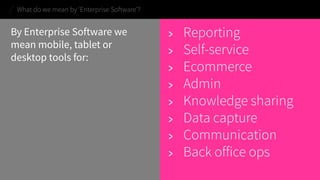
By Enterprise Software we mean mobile, tablet or desktop tools for: 
> 
Reporting 
> 
Self-service 
> 
Ecommerce 
> 
Admin 
> 
Knowledge sharing 
> 
Data capture 
> 
Communication 
> 
Back office ops 
What do we mean by ‘Enterprise Software’?
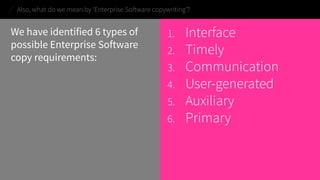
We have identified 6 types of possible Enterprise Software copy requirements: 
1. 
Interface 
2. 
Timely 
3. 
Communication 
4. 
User-generated 
5. 
Auxiliary 
6. 
Primary 
Also, what do we mean by ‘Enterprise Software copywriting’?
So what is the issue here? 
We often come across a belief that copy just happens. 
This tends to be due to a lack of understanding of the copy needs of software.
And what are the consequences? 
Such lack of understanding can lead to under-budgeted, badly planned, insufficient, low quality copy that compromises the overall user experience.
The guide to 
interface copy 
Part 1
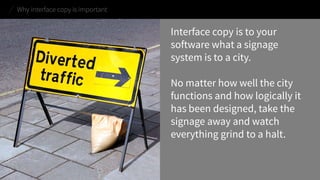
Interface copy is to your software what a signage system is to a city. 
No matter how well the city functions and how logically it has been designed, take the signage away and watch everything grind to a halt. 
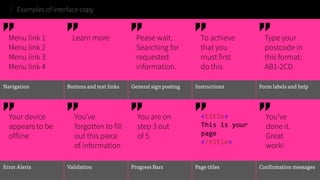
Why interface copy is important
Navigation 
Buttons and text links 
Generalsign posting 
Instructions 
Form labels and help 
Error Alerts 
Validation 
Progress Bars 
Page titles 
Confirmationmessages 
Examples of interface copy 
<title> 
This is your page 
</title> 
Menu link 1 
Menu link 2 
Menu link 3 
Menu link 4 
Learn more 
To achieve that you must first do this 
Type your postcode in this format: AB1-2CD 
Your device appears to be offline 
You’ve forgotten to fill out this piece of information 
You are on step 3 out of 5 
You’ve done it. Great work! 
Pease wait. Searching for requested information.
When should interface copy be written? 
1
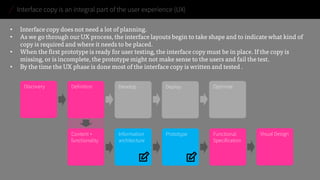
Interface copy is an integral part of the user experience (UX) 
• 
Interface copy does not need a lot of planning. 
• 
As we go through our UX process, the interface layouts begin to take shape and to indicate what kind of copy is required and where it needs to be placed. 
• 
When the first prototype is ready for user testing, the interface copy must be in place. If the copy is missing, or is incomplete, the prototype might not make sense to the users and fail the test. 
• 
By the time the UX phase is done most of the interface copy is written and tested . 
Information architecture 
Prototype 
Content + functionality 
Functional Specification 
Discovery 
Definition 
Develop 
Deploy 
Optimise 
Visual Design
Who should write 
the interface copy? 
2
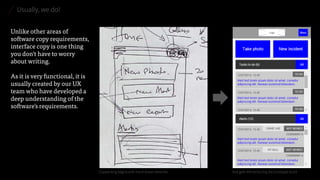
Usually, we do! 
Unlike other areas of software copy requirements, interface copy is one thing you don't have to worry about writing. 
As it is very functional, it is usually created by our UX team who have developed a deep understanding of the software's requirements. 
Copywriting begins with hand-drawn sketches 
And gets refined during the prototype build
Where should interface 
copy be stored? 
3
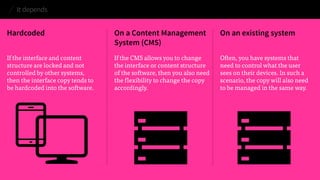
It depends 
Hardcoded 
If the interface and content structure are locked and not controlled by other systems, then the interface copy tends to be hardcoded into the software. 
On a Content Management System (CMS) 
If the CMS allows you to change the interface or content structure of the software, then you also need the flexibility to change the copy accordingly. 
On an existing system 
Often, you have systems that need to control what the user sees on their devices. In such a scenario, the copy will also need to be managed in the same way.
How can you review 
interface copy? 
4
It’s easy 
The good news is that you will 
not be burdened with another approval stage exclusively for interface copy. Because the copy 
is weaved into the user interface, as you review the prototype you will also be reviewing all the copy components.
Part 2 of this guide will cover timely copy such as news, alerts and notifications 
Crafted by 
@yannismarcou 
yannismarcou

Enterprise Software copywriting: A guide to the neglected component

  • 1.
    ENTERPRISE SOFTWARE COPYWRITING A GUIDE TO THE NEGLECTED COMPONENT Part 1: Interface copywriting
  • 2.
    By Enterprise Softwarewe mean mobile, tablet or desktop tools for: > Reporting > Self-service > Ecommerce > Admin > Knowledge sharing > Data capture > Communication > Back office ops What do we mean by ‘Enterprise Software’?
  • 3.
    We have identified6 types of possible Enterprise Software copy requirements: 1. Interface 2. Timely 3. Communication 4. User-generated 5. Auxiliary 6. Primary Also, what do we mean by ‘Enterprise Software copywriting’?
  • 4.
    So what isthe issue here? We often come across a belief that copy just happens. This tends to be due to a lack of understanding of the copy needs of software.
  • 5.
    And what arethe consequences? Such lack of understanding can lead to under-budgeted, badly planned, insufficient, low quality copy that compromises the overall user experience.
  • 6.
    The guide to interface copy Part 1
  • 7.
    Interface copy isto your software what a signage system is to a city. No matter how well the city functions and how logically it has been designed, take the signage away and watch everything grind to a halt. Why interface copy is important
  • 8.
    Navigation Buttons andtext links Generalsign posting Instructions Form labels and help Error Alerts Validation Progress Bars Page titles Confirmationmessages Examples of interface copy <title> This is your page </title> Menu link 1 Menu link 2 Menu link 3 Menu link 4 Learn more To achieve that you must first do this Type your postcode in this format: AB1-2CD Your device appears to be offline You’ve forgotten to fill out this piece of information You are on step 3 out of 5 You’ve done it. Great work! Pease wait. Searching for requested information.
  • 9.
    When should interfacecopy be written? 1
  • 10.
    Interface copy isan integral part of the user experience (UX) • Interface copy does not need a lot of planning. • As we go through our UX process, the interface layouts begin to take shape and to indicate what kind of copy is required and where it needs to be placed. • When the first prototype is ready for user testing, the interface copy must be in place. If the copy is missing, or is incomplete, the prototype might not make sense to the users and fail the test. • By the time the UX phase is done most of the interface copy is written and tested . Information architecture Prototype Content + functionality Functional Specification Discovery Definition Develop Deploy Optimise Visual Design
  • 11.
    Who should write the interface copy? 2
  • 12.
    Usually, we do! Unlike other areas of software copy requirements, interface copy is one thing you don't have to worry about writing. As it is very functional, it is usually created by our UX team who have developed a deep understanding of the software's requirements. Copywriting begins with hand-drawn sketches And gets refined during the prototype build
  • 13.
    Where should interface copy be stored? 3
  • 14.
    It depends Hardcoded If the interface and content structure are locked and not controlled by other systems, then the interface copy tends to be hardcoded into the software. On a Content Management System (CMS) If the CMS allows you to change the interface or content structure of the software, then you also need the flexibility to change the copy accordingly. On an existing system Often, you have systems that need to control what the user sees on their devices. In such a scenario, the copy will also need to be managed in the same way.
  • 15.
    How can youreview interface copy? 4
  • 16.
    It’s easy Thegood news is that you will not be burdened with another approval stage exclusively for interface copy. Because the copy is weaved into the user interface, as you review the prototype you will also be reviewing all the copy components.
  • 17.
    Part 2 ofthis guide will cover timely copy such as news, alerts and notifications Crafted by @yannismarcou yannismarcou