Download to read offline
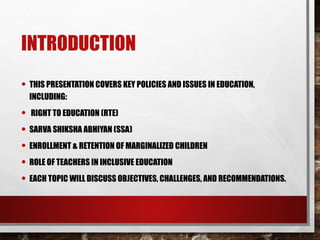
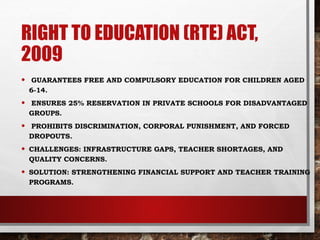
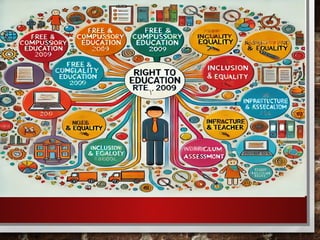
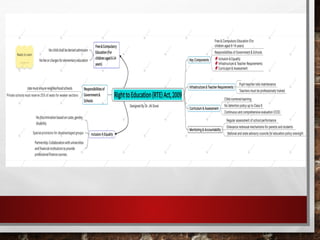
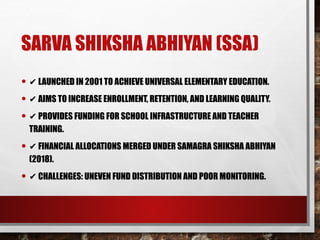

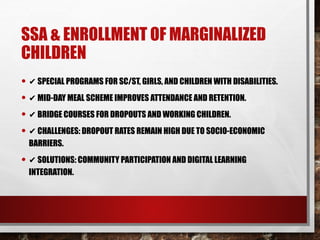
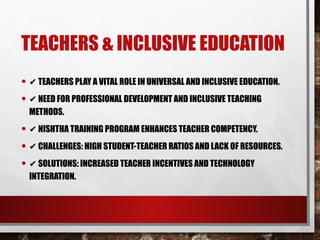
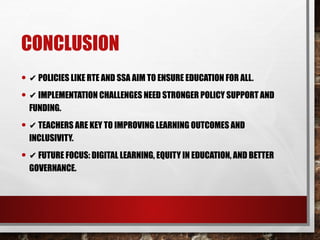

A. Right to Education (Policy Imperatives) 1. Introduction: The Right to Education (RTE) Act, 2009, ensures free and compulsory education for children aged 6–14 years. A constitutional amendment (the 86th Amendment, 2002) made education a fundamental right under Article 21A. 2. Key Features of the RTE Act: Free and compulsory education for all children. No child shall be held back, expelled, or required to pass a board exam until completion of elementary education. Schools must meet minimum infrastructure and teacher qualification standards. 25% reservation for disadvantaged groups in private schools. 3. Challenges and policy imperatives: Infrastructure Deficit: Many schools lack basic facilities. Teacher Shortage & Quality Issues: Need for well-trained and motivated teachers. Equity & Inclusion: Addressing issues of gender, caste, disability, and socio-economic background. Learning Outcomes: Shift from access to quality education. Funding & Implementation: Need for better financial support and monitoring. B. Sarva Shiksha Abhiyan (Objectives and Financial Allocations) 1. Introduction: Launched in 2001 as India's flagship program for achieving Universal Elementary Education (UEE). Aimed at bridging social, gender, and regional gaps in education. 2. Objectives: Ensure 100% enrollment and retention in primary education. Improve school infrastructure (classrooms, toilets, drinking water). Train teachers and ensure quality education. Promote inclusive education for marginalized communities. 3. Financial Allocations: Initially funded by the Government of India and state governments in a 75:25 ratio. Post-RTE, SSA became the primary vehicle for implementing RTE, leading to increased budget allocations. Funding has been integrated into the Samagra Shiksha Abhiyan (SSA 2.0) since 2018, combining SSA, RMSA, and teacher education. SSA and the Thrust Towards Enrolling and Retaining Marginalized Children 1. Focus on marginalized groups: Special provisions for SC/ST, girls, children with disabilities, and minority communities. Bridge courses and residential schools for out-of-school children. Special training for dropouts and working children. 2. Key Interventions: Mid-Day Meal Scheme: Helps in retaining children by providing nutrition. Beti Bachao, Beti Padhao & Kasturba Gandhi Balika Vidyalayas: Encourages girls’ education. Community Mobilization: Village Education Committees (VECs) and School Management Committees (SMCs) to increase local participation. 3. Challenges: Dropout Rates: Socio-economic barriers prevent continuous education. Quality of Education: Ensuring learning outcomes beyond mere enrollment. Teacher Absenteeism & Training Gaps: Need for motivation and accountability. Role and Agency of Teachers in Universal and Inclusive Education 1. Role of Teachers in UEE: a) Ensuring effective learning and inclusivity. b) Identifying and addressing learning difficulties.


