Copyright©2004 South-Western 1 of 36
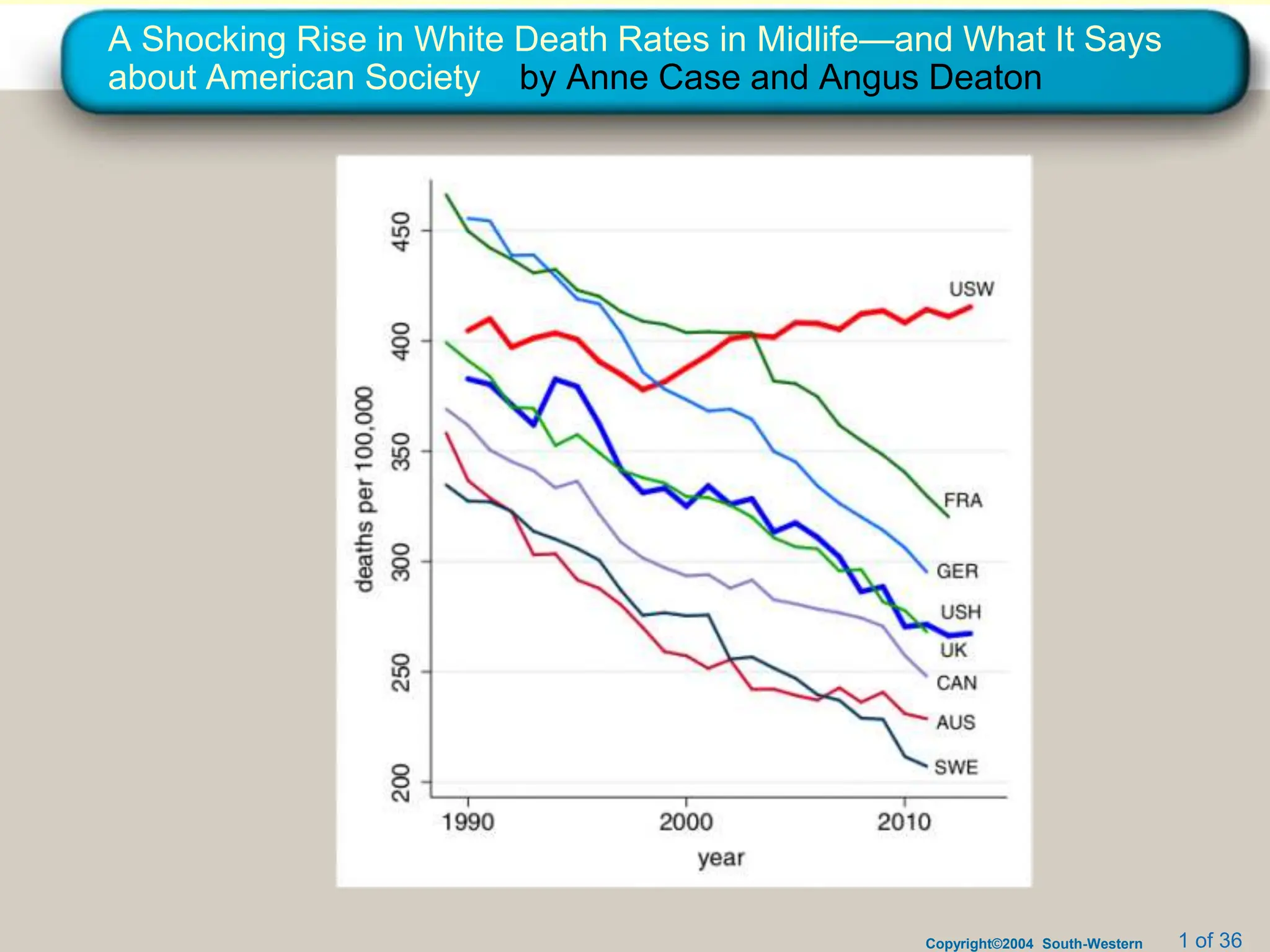
A Shocking Rise in White Death Rates in Midlife—and What It Says
about American Society by Anne Case and Angus Deaton
Copyright©2004 South-Western
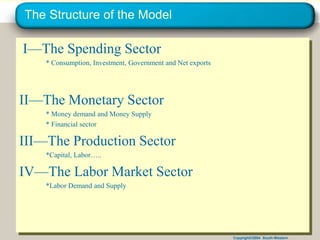
The Structure of the Model
I—The Spending Sector
* Consumption, Investment, Government and Net exports
II—The Monetary Sector
* Money demand and Money Supply
* Financial sector
III—The Production Sector
*Capital, Labor…..
IV—The Labor Market Sector
*Labor Demand and Supply
Copyright©2004 South-Western
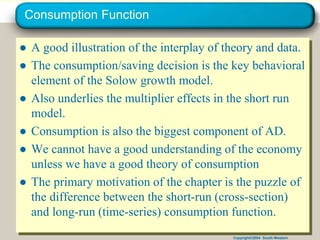
Consumption Function
● A good illustration of the interplay of theory and data.
● The consumption/saving decision is the key behavioral
element of the Solow growth model.
● Also underlies the multiplier effects in the short run
model.
● Consumption is also the biggest component of AD.
● We cannot have a good understanding of the economy
unless we have a good theory of consumption
● The primary motivation of the chapter is the puzzle of
the difference between the short-run (cross-section)
and long-run (time-series) consumption function.
Copyright©2004 South-Western
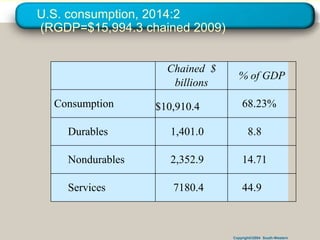
U.S. consumption, 2014:2
(RGDP=$15,994.3 chained 2009)
44.9
14.71
8.8
68.23%
7180.4
2,352.9
1,401.0
$10,910.4
Services
Nondurables
Durables
Consumption
% of GDP
Chained $
billions
Copyright©2004 South-Western
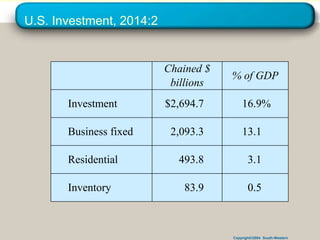
U.S. Investment, 2014:2
0.5
3.1
13.1
16.9%
83.9
493.8
2,093.3
$2,694.7
Inventory
Residential
Business fixed
Investment
% of GDP
Chained $
billions
Copyright©2004 South-Western
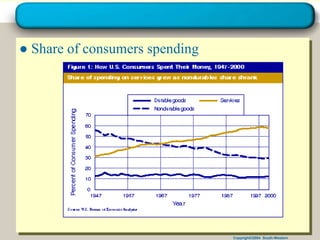
● Share of consumers spending
Copyright©2004 South-Western
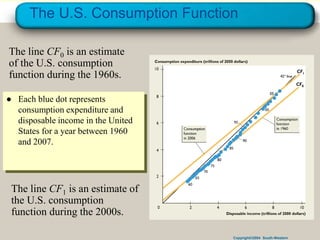
● Each blue dot represents
consumption expenditure and
disposable income in the United
States for a year between 1960
and 2007.
The U.S. Consumption Function
The line CF0 is an estimate
of the U.S. consumption
function during the 1960s.
The line CF1 is an estimate of
the U.S. consumption
function during the 2000s.
Copyright©2004 South-Western
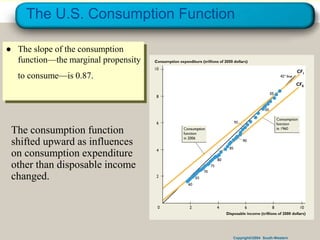
● The slope of the consumption
function—the marginal propensity
to consume—is 0.87.
The U.S. Consumption Function
The consumption function
shifted upward as influences
on consumption expenditure
other than disposable income
changed.
Copyright©2004 South-Western
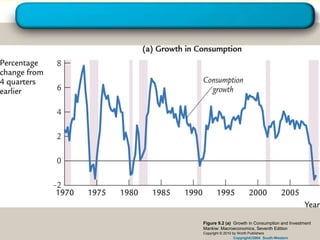
Figure 9.2 (a) Growth in Consumption and Investment
Mankiw: Macroeconomics, Seventh Edition
Copyright © 2010 by Worth Publishers
Copyright©2004 South-Western
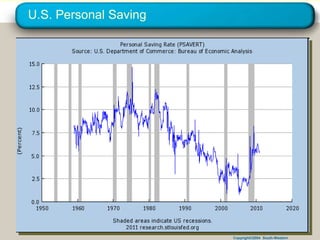
U.S. Personal Saving
Copyright©2004 South-Western
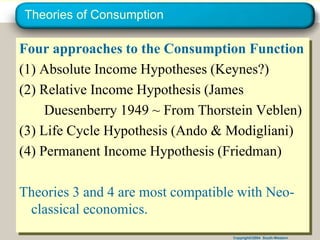
Theories of Consumption
Four approaches to the Consumption Function
(1) Absolute Income Hypotheses (Keynes?)
(2) Relative Income Hypothesis (James
Duesenberry 1949 ~ From Thorstein Veblen)
(3) Life Cycle Hypothesis (Ando & Modigliani)
(4) Permanent Income Hypothesis (Friedman)
Theories 3 and 4 are most compatible with Neo-
classical economics.
Copyright©2004 South-Western
Theories of Consumption
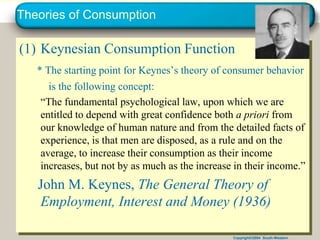
(1) Keynesian Consumption Function
* The starting point for Keynes’s theory of consumer behavior
is the following concept:
“The fundamental psychological law, upon which we are
entitled to depend with great confidence both a priori from
our knowledge of human nature and from the detailed facts of
experience, is that men are disposed, as a rule and on the
average, to increase their consumption as their income
increases, but not by as much as the increase in their income.”
John M. Keynes, The General Theory of
Employment, Interest and Money (1936)
Copyright©2004 South-Western
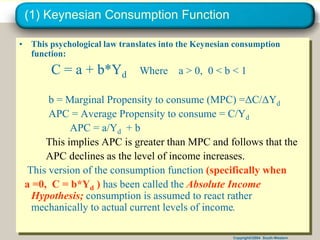
(1) Keynesian Consumption Function
• This psychological law translates into the Keynesian consumption
function:
C = a + b*Yd Where a > 0, 0 < b < 1
b = Marginal Propensity to consume (MPC) =ΔC/ΔYd
APC = Average Propensity to consume = C/Yd
APC = a/Yd + b
This implies APC is greater than MPC and follows that the
APC declines as the level of income increases.
This version of the consumption function (specifically when
a =0, C = b*Yd ) has been called the Absolute Income
Hypothesis; consumption is assumed to react rather
mechanically to actual current levels of income.
Copyright©2004 South-Western
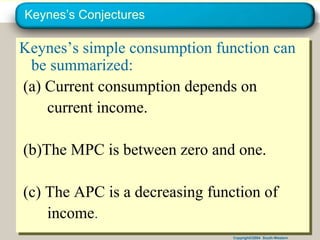
Keynes’s Conjectures
Keynes’s simple consumption function can
be summarized:
(a) Current consumption depends on
current income.
(b)The MPC is between zero and one.
(c) The APC is a decreasing function of
income.
Copyright©2004 South-Western
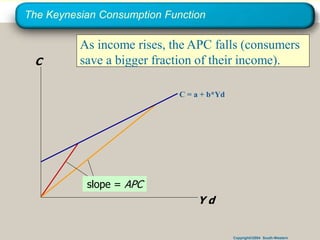
The Keynesian Consumption Function
slope = APC
As income rises, the APC falls (consumers
save a bigger fraction of their income).
C = a + b*Yd
C
Y d
Copyright©2004 South-Western
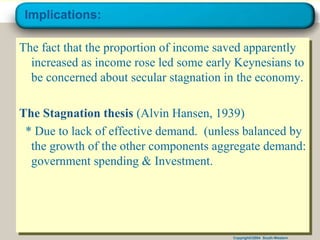
Implications:
The fact that the proportion of income saved apparently
increased as income rose led some early Keynesians to
be concerned about secular stagnation in the economy.
The Stagnation thesis (Alvin Hansen, 1939)
* Due to lack of effective demand. (unless balanced by
the growth of the other components aggregate demand:
government spending & Investment.
Copyright©2004 South-Western
Empirical Evidences
Using statistical techniques and annual data for a short
period, 1929-1941, Keynesian economists obtained the
following type of estimate for the consumption
function:
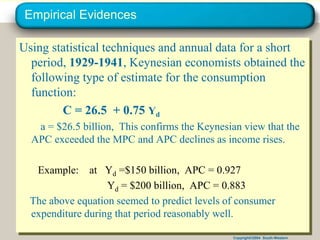
C = 26.5 + 0.75 Yd
a = $26.5 billion, This confirms the Keynesian view that the
APC exceeded the MPC and APC declines as income rises.
Example: at Yd =$150 billion, APC = 0.927
Yd = $200 billion, APC = 0.883
The above equation seemed to predict levels of consumer
expenditure during that period reasonably well.
Copyright©2004 South-Western
Empirical Evidences…
Further support for the Keynesian form of the
consumption function came from comparative
studies of families budgets.
*Looking at budgets for families at progressively higher
income levels, the absolute amount of consumption
increased (MPC > 0), But by less than the increase in
income ( 0 < MPC < 1)
* Families at a higher income levels consumed a smaller
proportion of income.  APC declined as income rose.
Copyright©2004 South-Western
Simon Kuznets’ Consumption Data
Kuznets, Simon. Uses of National Income in Peace
and War, Occasional Paper 6. NY: NBER, 1942.
 Time series estimates of consumption and
national income
 Overlapping decades 1879-1938, 5 year steps
 Each estimate is a decade average
Kuznets, Simon. National Product Since 1869.
NY: NBER, 1946.
 Extended data backward to 1869.
Copyright©2004 South-Western
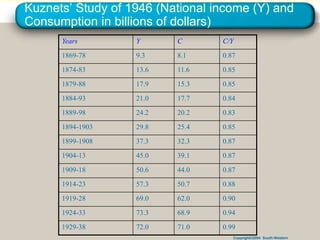
Kuznets’ Study of 1946 (National income (Y) and
Consumption in billions of dollars)
Years Y C C/Y
1869-78 9.3 8.1 0.87
1874-83 13.6 11.6 0.85
1879-88 17.9 15.3 0.85
1884-93 21.0 17.7 0.84
1889-98 24.2 20.2 0.83
1894-1903 29.8 25.4 0.85
1899-1908 37.3 32.3 0.87
1904-13 45.0 39.1 0.87
1909-18 50.6 44.0 0.87
1914-23 57.3 50.7 0.88
1919-28 69.0 62.0 0.90
1924-33 73.3 68.9 0.94
1929-38 72.0 71.0 0.99
Copyright©2004 South-Western
Kuznets’ Study
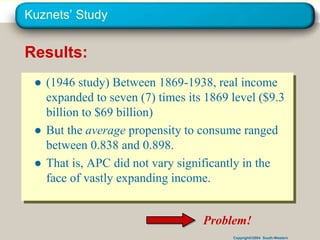
● (1946 study) Between 1869-1938, real income
expanded to seven (7) times its 1869 level ($9.3
billion to $69 billion)
● But the average propensity to consume ranged
between 0.838 and 0.898.
● That is, APC did not vary significantly in the
face of vastly expanding income.
Results:
Problem!
Copyright©2004 South-Western
Empirical Evidences…
● Consumption and National Income (1869-1938)
by Simon Kuznets
* There was no downward trend in the ratio real
consumption to real national income.
* Nor is there evidence for a downward trend in APC
in more recent years.
Example: 1950 APC=0.93
1970 APC=0.89
1990 APC=0.93
Copyright©2004 South-Western
Resolving the Empirical Puzzles
● Evidences from short-run annual time series
data (1929-41) and family budget studies
seemed to support the Keynesian view
● Times series data for a longer time period
(1969-1938) suggest that the consumption-
income relationship is proportional rather than
the non-proportional relationship given by
absolute income hypothesis.
● Resolving these puzzles has been the task of the
modern theory of the consumption function.
Copyright©2004 South-Western
The Consumption Puzzle
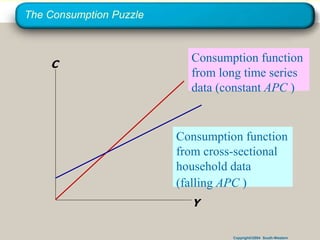
C
Y
Consumption function
from long time series
data (constant APC )
Consumption function
from cross-sectional
household data
(falling APC )
Copyright©2004 South-Western
Reconciliation with Keynes’ Theory?
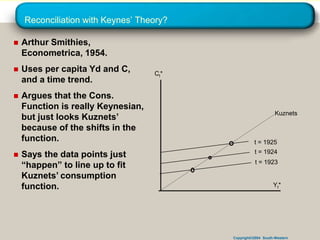
t = 1923
t = 1924
t = 1925
Kuznets
Yt*
Ct*
 Arthur Smithies,
Econometrica, 1954.
 Uses per capita Yd and C,
and a time trend.
 Argues that the Cons.
Function is really Keynesian,
but just looks Kuznets’
because of the shifts in the
function.
 Says the data points just
“happen” to line up to fit
Kuznets’ consumption
function.
Copyright©2004 South-Western
Second Failure of Keynesian Consumption
Function
● Predictions of post-WWII period are grossly wrong
● Keynesian Theory argues that the average propensity
to save (APS) rises with income (S = S0 + sY).
● Higher post-war incomes should imply excess saving.
Will we go straight back to the Depression?
● Comparison of the forecasts with the actual results
suggest that:
■ consumption was “under”-predicted
■ saving was “over”-predicted
● IMPLICATION: major determinants in the behavioral
equations must be missing!
Copyright©2004 South-Western
(2) The Relative Income Hypothesis
James Duesenberry’s approach says that people are not
just concerned about absolute levels of possession.
They are in fact concerned about their possessions
relative to others, “Keeping up with the Jones.”
● People are not necessarily happier if they have more
money. They do however report higher happiness if
they have more relative to others.
Current economists still support this idea. Ex: Robert
Frank
● Duesenberry argues that we have a greater tendency to
resist spending decreases relative to falls in income
than we do to increase expenditure relative to increases
of income. The reason is that we don’t want to alter
our standard of living downward. Duesenberry’s
Habit Persistence Theory
Copyright©2004 South-Western
Irving Fisher and Intertemporal Choice (1930)
● The consumption function by Keynes does not
consider how people make decisions over time.
In other words, when people decide how much
to consume and how much to save, they take
into account both the present and the future.
● People face a tradeoff
● Fisher developed an intertemporal model that
shows how households make decisions about
how much to consume and how much to save.
Copyright©2004 South-Western
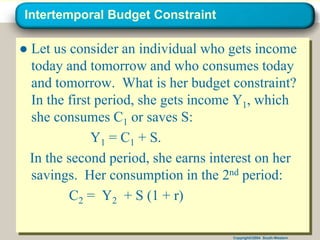
Intertemporal Budget Constraint
● Let us consider an individual who gets income
today and tomorrow and who consumes today
and tomorrow. What is her budget constraint?
In the first period, she gets income Y1, which
she consumes C1 or saves S:
Y1 = C1 + S.
In the second period, she earns interest on her
savings. Her consumption in the 2nd period:
C2 = Y2 + S (1 + r)
Copyright©2004 South-Western
Intertemporal Budget Constraint….
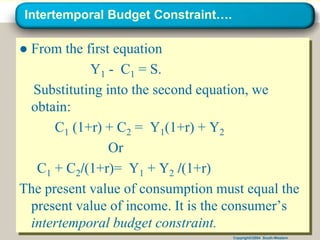
● From the first equation
Y1 - C1 = S.
Substituting into the second equation, we
obtain:
C1 (1+r) + C2 = Y1(1+r) + Y2
Or
C1 + C2/(1+r)= Y1 + Y2 /(1+r)
The present value of consumption must equal the
present value of income. It is the consumer’s
intertemporal budget constraint.
Copyright©2004 South-Western
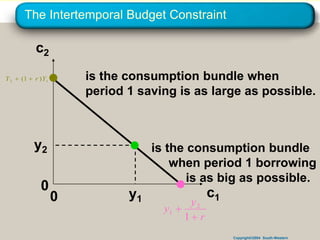
The Intertemporal Budget Constraint
c1
c2
y2
y1
0
0
is the consumption bundle
when period 1 borrowing
is as big as possible.
is the consumption bundle when
period 1 saving is as large as possible.
r
y
y


1
2
1
1
2 )
1
( Y
r
Y 

Copyright©2004 South-Western
Life Cycle Hypothesis (LCH)
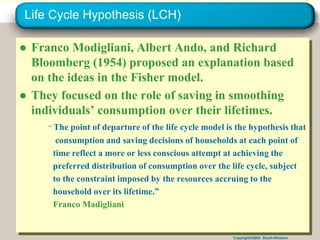
● Franco Modigliani, Albert Ando, and Richard
Bloomberg (1954) proposed an explanation based
on the ideas in the Fisher model.
● They focused on the role of saving in smoothing
individuals’ consumption over their lifetimes.
“ The point of departure of the life cycle model is the hypothesis that
consumption and saving decisions of households at each point of
time reflect a more or less conscious attempt at achieving the
preferred distribution of consumption over the life cycle, subject
to the constraint imposed by the resources accruing to the
household over its lifetime.”
Franco Madigliani
Copyright©2004 South-Western
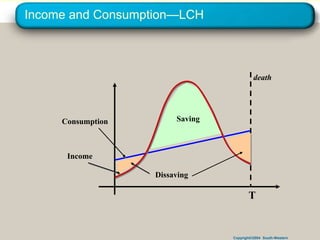
Income and Consumption—LCH
death
T
Consumption
Income
Dissaving
Saving
Copyright©2004 South-Western
Life Cycle….
● A stylized fact of economic data is that
consumption is much smoother than income.
● Let us consider the budget constraint of
someone who expects to live for T more
years, of which R will be spent working and
T-R will spent in retirement with zero
earnings.
● The consumer smoothes consumption
expenditure over his/her life, spending 1/T of
his/her life-time income each period.
Copyright©2004 South-Western
Income and Consumption—LCH
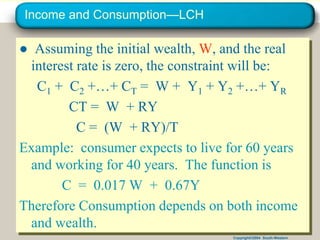
● Assuming the initial wealth, W, and the real
interest rate is zero, the constraint will be:
C1 + C2 +…+ CT = W + Y1 + Y2 +…+ YR
CT = W + RY
C = (W + RY)/T
Example: consumer expects to live for 60 years
and working for 40 years. The function is
C = 0.017 W + 0.67Y
Therefore Consumption depends on both income
and wealth.
Copyright©2004 South-Western
Testing the LCH
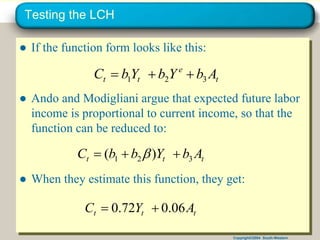
● If the function form looks like this:
● Ando and Modigliani argue that expected future labor
income is proportional to current income, so that the
function can be reduced to:
● When they estimate this function, they get:
t
e
t
t A
b
Y
b
Y
b
C 3
2
1 


t
t
t A
b
Y
b
b
C 3
2
1 )
( 

 
t
t
t A
Y
C 06
.
0
72
.
0 

Copyright©2004 South-Western
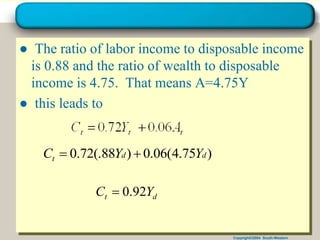
● The ratio of labor income to disposable income
is 0.88 and the ratio of wealth to disposable
income is 4.75. That means A=4.75Y
● this leads to
)
75
.
4
(
06
.
0
)
88
(.
72
.
0 d
d
t Y
Y
C 

d
t Y
C 92
.
0

Copyright©2004 South-Western
Policy Implications of LCH
● Changes in current income have a strong effect on
current consumption ONLY if they affect expected
lifetime income.
● In Q2 1975, a one-time tax rebate of $8 billion was
paid out to taxpayers to stimulate AD.
■ The rebate had little effect.
The only way there can be a significant effect is if
there is a strong liquidity constraint operating.
● This has implications for monetary policy.
Copyright©2004 South-Western
Criticisms of LCH
● The households, at all times, have a definite,
conscious vision of:
■ The family’s future size and composition, including
the life expectancy of each member,
■ The entire lifetime profile of the labor income of
each member—after the applicable taxes,
■ The present and future extent and terms of any
credit available, and
■ The future emergencies, opportunities, and social
pressures which might affect its consumption
spending.
● It does not take into account liquidity constraints.
Copyright©2004 South-Western
Permanent Income Hypothesis (PIH)
● Milton Friedman (A Theory of the Consumption Function. Princeton
Univ. Press, 1957)
● Assumptions:
■ Perfect certainty about:
♦ Future receipts
♦ Future interest rates
♦ Future prices, etc.
■ People save to reduce fluctuations in expenditures
■ People are immortal (or leave bequests)
● Individual’s utility function:
u = u(c,c1)
where c is current period consumption and c1 is next period consumption.
● People maximize utility based on their permanent (expected
life-time) income
● Allocate their income inter-temporally
Copyright©2004 South-Western
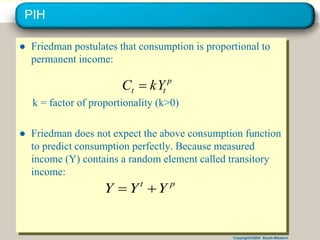
PIH
● Friedman postulates that consumption is proportional to
permanent income:
k = factor of proportionality (k>0)
● Friedman does not expect the above consumption function
to predict consumption perfectly. Because measured
income (Y) contains a random element called transitory
income:
p
t
t kY
C 
p
t
Y
Y
Y 

Copyright©2004 South-Western
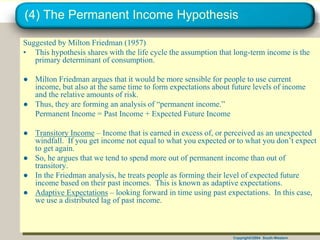
(4) The Permanent Income Hypothesis
Suggested by Milton Friedman (1957)
• This hypothesis shares with the life cycle the assumption that long-term income is the
primary determinant of consumption.
● Milton Friedman argues that it would be more sensible for people to use current
income, but also at the same time to form expectations about future levels of income
and the relative amounts of risk.
● Thus, they are forming an analysis of “permanent income.”
Permanent Income = Past Income + Expected Future Income
● Transitory Income – Income that is earned in excess of, or perceived as an unexpected
windfall. If you get income not equal to what you expected or to what you don’t expect
to get again.
● So, he argues that we tend to spend more out of permanent income than out of
transitory.
● In the Friedman analysis, he treats people as forming their level of expected future
income based on their past incomes. This is known as adaptive expectations.
● Adaptive Expectations – looking forward in time using past expectations. In this case,
we use a distributed lag of past income.
Copyright©2004 South-Western
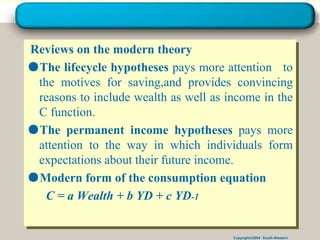
Reviews on the modern theory
●The lifecycle hypotheses pays more attention to
the motives for saving,and provides convincing
reasons to include wealth as well as income in the
C function.
●The permanent income hypotheses pays more
attention to the way in which individuals form
expectations about their future income.
●Modern form of the consumption equation
C = a Wealth + b YD + c YD-1
Copyright©2004 South-Western
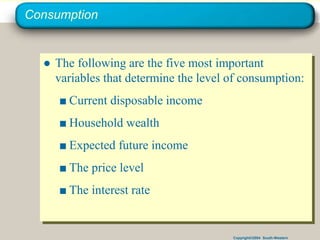
Consumption
● The following are the five most important
variables that determine the level of consumption:
■ Current disposable income
■ Household wealth
■ Expected future income
■ The price level
■ The interest rate

consumption function macro economics.ppt

  • 1.
    Copyright©2004 South-Western 1of 36 A Shocking Rise in White Death Rates in Midlife—and What It Says about American Society by Anne Case and Angus Deaton
  • 2.
    Copyright©2004 South-Western The Structureof the Model I—The Spending Sector * Consumption, Investment, Government and Net exports II—The Monetary Sector * Money demand and Money Supply * Financial sector III—The Production Sector *Capital, Labor….. IV—The Labor Market Sector *Labor Demand and Supply
  • 3.
    Copyright©2004 South-Western Consumption Function ●A good illustration of the interplay of theory and data. ● The consumption/saving decision is the key behavioral element of the Solow growth model. ● Also underlies the multiplier effects in the short run model. ● Consumption is also the biggest component of AD. ● We cannot have a good understanding of the economy unless we have a good theory of consumption ● The primary motivation of the chapter is the puzzle of the difference between the short-run (cross-section) and long-run (time-series) consumption function.
  • 4.
    Copyright©2004 South-Western U.S. consumption,2014:2 (RGDP=$15,994.3 chained 2009) 44.9 14.71 8.8 68.23% 7180.4 2,352.9 1,401.0 $10,910.4 Services Nondurables Durables Consumption % of GDP Chained $ billions
  • 5.
    Copyright©2004 South-Western U.S. Investment,2014:2 0.5 3.1 13.1 16.9% 83.9 493.8 2,093.3 $2,694.7 Inventory Residential Business fixed Investment % of GDP Chained $ billions
  • 6.
  • 7.
    Copyright©2004 South-Western ● Eachblue dot represents consumption expenditure and disposable income in the United States for a year between 1960 and 2007. The U.S. Consumption Function The line CF0 is an estimate of the U.S. consumption function during the 1960s. The line CF1 is an estimate of the U.S. consumption function during the 2000s.
  • 8.
    Copyright©2004 South-Western ● Theslope of the consumption function—the marginal propensity to consume—is 0.87. The U.S. Consumption Function The consumption function shifted upward as influences on consumption expenditure other than disposable income changed.
  • 9.
    Copyright©2004 South-Western Figure 9.2(a) Growth in Consumption and Investment Mankiw: Macroeconomics, Seventh Edition Copyright © 2010 by Worth Publishers
  • 10.
  • 11.
    Copyright©2004 South-Western Theories ofConsumption Four approaches to the Consumption Function (1) Absolute Income Hypotheses (Keynes?) (2) Relative Income Hypothesis (James Duesenberry 1949 ~ From Thorstein Veblen) (3) Life Cycle Hypothesis (Ando & Modigliani) (4) Permanent Income Hypothesis (Friedman) Theories 3 and 4 are most compatible with Neo- classical economics.
  • 12.
    Copyright©2004 South-Western Theories ofConsumption (1) Keynesian Consumption Function * The starting point for Keynes’s theory of consumer behavior is the following concept: “The fundamental psychological law, upon which we are entitled to depend with great confidence both a priori from our knowledge of human nature and from the detailed facts of experience, is that men are disposed, as a rule and on the average, to increase their consumption as their income increases, but not by as much as the increase in their income.” John M. Keynes, The General Theory of Employment, Interest and Money (1936)
  • 13.
    Copyright©2004 South-Western (1) KeynesianConsumption Function • This psychological law translates into the Keynesian consumption function: C = a + b*Yd Where a > 0, 0 < b < 1 b = Marginal Propensity to consume (MPC) =ΔC/ΔYd APC = Average Propensity to consume = C/Yd APC = a/Yd + b This implies APC is greater than MPC and follows that the APC declines as the level of income increases. This version of the consumption function (specifically when a =0, C = b*Yd ) has been called the Absolute Income Hypothesis; consumption is assumed to react rather mechanically to actual current levels of income.
  • 14.
    Copyright©2004 South-Western Keynes’s Conjectures Keynes’ssimple consumption function can be summarized: (a) Current consumption depends on current income. (b)The MPC is between zero and one. (c) The APC is a decreasing function of income.
  • 15.
    Copyright©2004 South-Western The KeynesianConsumption Function slope = APC As income rises, the APC falls (consumers save a bigger fraction of their income). C = a + b*Yd C Y d
  • 16.
    Copyright©2004 South-Western Implications: The factthat the proportion of income saved apparently increased as income rose led some early Keynesians to be concerned about secular stagnation in the economy. The Stagnation thesis (Alvin Hansen, 1939) * Due to lack of effective demand. (unless balanced by the growth of the other components aggregate demand: government spending & Investment.
  • 17.
    Copyright©2004 South-Western Empirical Evidences Usingstatistical techniques and annual data for a short period, 1929-1941, Keynesian economists obtained the following type of estimate for the consumption function: C = 26.5 + 0.75 Yd a = $26.5 billion, This confirms the Keynesian view that the APC exceeded the MPC and APC declines as income rises. Example: at Yd =$150 billion, APC = 0.927 Yd = $200 billion, APC = 0.883 The above equation seemed to predict levels of consumer expenditure during that period reasonably well.
  • 18.
    Copyright©2004 South-Western Empirical Evidences… Furthersupport for the Keynesian form of the consumption function came from comparative studies of families budgets. *Looking at budgets for families at progressively higher income levels, the absolute amount of consumption increased (MPC > 0), But by less than the increase in income ( 0 < MPC < 1) * Families at a higher income levels consumed a smaller proportion of income.  APC declined as income rose.
  • 19.
    Copyright©2004 South-Western Simon Kuznets’Consumption Data Kuznets, Simon. Uses of National Income in Peace and War, Occasional Paper 6. NY: NBER, 1942.  Time series estimates of consumption and national income  Overlapping decades 1879-1938, 5 year steps  Each estimate is a decade average Kuznets, Simon. National Product Since 1869. NY: NBER, 1946.  Extended data backward to 1869.
  • 20.
    Copyright©2004 South-Western Kuznets’ Studyof 1946 (National income (Y) and Consumption in billions of dollars) Years Y C C/Y 1869-78 9.3 8.1 0.87 1874-83 13.6 11.6 0.85 1879-88 17.9 15.3 0.85 1884-93 21.0 17.7 0.84 1889-98 24.2 20.2 0.83 1894-1903 29.8 25.4 0.85 1899-1908 37.3 32.3 0.87 1904-13 45.0 39.1 0.87 1909-18 50.6 44.0 0.87 1914-23 57.3 50.7 0.88 1919-28 69.0 62.0 0.90 1924-33 73.3 68.9 0.94 1929-38 72.0 71.0 0.99
  • 21.
    Copyright©2004 South-Western Kuznets’ Study ●(1946 study) Between 1869-1938, real income expanded to seven (7) times its 1869 level ($9.3 billion to $69 billion) ● But the average propensity to consume ranged between 0.838 and 0.898. ● That is, APC did not vary significantly in the face of vastly expanding income. Results: Problem!
  • 22.
    Copyright©2004 South-Western Empirical Evidences… ●Consumption and National Income (1869-1938) by Simon Kuznets * There was no downward trend in the ratio real consumption to real national income. * Nor is there evidence for a downward trend in APC in more recent years. Example: 1950 APC=0.93 1970 APC=0.89 1990 APC=0.93
  • 23.
    Copyright©2004 South-Western Resolving theEmpirical Puzzles ● Evidences from short-run annual time series data (1929-41) and family budget studies seemed to support the Keynesian view ● Times series data for a longer time period (1969-1938) suggest that the consumption- income relationship is proportional rather than the non-proportional relationship given by absolute income hypothesis. ● Resolving these puzzles has been the task of the modern theory of the consumption function.
  • 24.
    Copyright©2004 South-Western The ConsumptionPuzzle C Y Consumption function from long time series data (constant APC ) Consumption function from cross-sectional household data (falling APC )
  • 25.
    Copyright©2004 South-Western Reconciliation withKeynes’ Theory? t = 1923 t = 1924 t = 1925 Kuznets Yt* Ct*  Arthur Smithies, Econometrica, 1954.  Uses per capita Yd and C, and a time trend.  Argues that the Cons. Function is really Keynesian, but just looks Kuznets’ because of the shifts in the function.  Says the data points just “happen” to line up to fit Kuznets’ consumption function.
  • 26.
    Copyright©2004 South-Western Second Failureof Keynesian Consumption Function ● Predictions of post-WWII period are grossly wrong ● Keynesian Theory argues that the average propensity to save (APS) rises with income (S = S0 + sY). ● Higher post-war incomes should imply excess saving. Will we go straight back to the Depression? ● Comparison of the forecasts with the actual results suggest that: ■ consumption was “under”-predicted ■ saving was “over”-predicted ● IMPLICATION: major determinants in the behavioral equations must be missing!
  • 27.
    Copyright©2004 South-Western (2) TheRelative Income Hypothesis James Duesenberry’s approach says that people are not just concerned about absolute levels of possession. They are in fact concerned about their possessions relative to others, “Keeping up with the Jones.” ● People are not necessarily happier if they have more money. They do however report higher happiness if they have more relative to others. Current economists still support this idea. Ex: Robert Frank ● Duesenberry argues that we have a greater tendency to resist spending decreases relative to falls in income than we do to increase expenditure relative to increases of income. The reason is that we don’t want to alter our standard of living downward. Duesenberry’s Habit Persistence Theory
  • 28.
    Copyright©2004 South-Western Irving Fisherand Intertemporal Choice (1930) ● The consumption function by Keynes does not consider how people make decisions over time. In other words, when people decide how much to consume and how much to save, they take into account both the present and the future. ● People face a tradeoff ● Fisher developed an intertemporal model that shows how households make decisions about how much to consume and how much to save.
  • 29.
    Copyright©2004 South-Western Intertemporal BudgetConstraint ● Let us consider an individual who gets income today and tomorrow and who consumes today and tomorrow. What is her budget constraint? In the first period, she gets income Y1, which she consumes C1 or saves S: Y1 = C1 + S. In the second period, she earns interest on her savings. Her consumption in the 2nd period: C2 = Y2 + S (1 + r)
  • 30.
    Copyright©2004 South-Western Intertemporal BudgetConstraint…. ● From the first equation Y1 - C1 = S. Substituting into the second equation, we obtain: C1 (1+r) + C2 = Y1(1+r) + Y2 Or C1 + C2/(1+r)= Y1 + Y2 /(1+r) The present value of consumption must equal the present value of income. It is the consumer’s intertemporal budget constraint.
  • 31.
    Copyright©2004 South-Western The IntertemporalBudget Constraint c1 c2 y2 y1 0 0 is the consumption bundle when period 1 borrowing is as big as possible. is the consumption bundle when period 1 saving is as large as possible. r y y   1 2 1 1 2 ) 1 ( Y r Y  
  • 32.
    Copyright©2004 South-Western Life CycleHypothesis (LCH) ● Franco Modigliani, Albert Ando, and Richard Bloomberg (1954) proposed an explanation based on the ideas in the Fisher model. ● They focused on the role of saving in smoothing individuals’ consumption over their lifetimes. “ The point of departure of the life cycle model is the hypothesis that consumption and saving decisions of households at each point of time reflect a more or less conscious attempt at achieving the preferred distribution of consumption over the life cycle, subject to the constraint imposed by the resources accruing to the household over its lifetime.” Franco Madigliani
  • 33.
    Copyright©2004 South-Western Income andConsumption—LCH death T Consumption Income Dissaving Saving
  • 34.
    Copyright©2004 South-Western Life Cycle…. ●A stylized fact of economic data is that consumption is much smoother than income. ● Let us consider the budget constraint of someone who expects to live for T more years, of which R will be spent working and T-R will spent in retirement with zero earnings. ● The consumer smoothes consumption expenditure over his/her life, spending 1/T of his/her life-time income each period.
  • 35.
    Copyright©2004 South-Western Income andConsumption—LCH ● Assuming the initial wealth, W, and the real interest rate is zero, the constraint will be: C1 + C2 +…+ CT = W + Y1 + Y2 +…+ YR CT = W + RY C = (W + RY)/T Example: consumer expects to live for 60 years and working for 40 years. The function is C = 0.017 W + 0.67Y Therefore Consumption depends on both income and wealth.
  • 36.
    Copyright©2004 South-Western Testing theLCH ● If the function form looks like this: ● Ando and Modigliani argue that expected future labor income is proportional to current income, so that the function can be reduced to: ● When they estimate this function, they get: t e t t A b Y b Y b C 3 2 1    t t t A b Y b b C 3 2 1 ) (     t t t A Y C 06 . 0 72 . 0  
  • 37.
    Copyright©2004 South-Western ● Theratio of labor income to disposable income is 0.88 and the ratio of wealth to disposable income is 4.75. That means A=4.75Y ● this leads to ) 75 . 4 ( 06 . 0 ) 88 (. 72 . 0 d d t Y Y C   d t Y C 92 . 0 
  • 38.
    Copyright©2004 South-Western Policy Implicationsof LCH ● Changes in current income have a strong effect on current consumption ONLY if they affect expected lifetime income. ● In Q2 1975, a one-time tax rebate of $8 billion was paid out to taxpayers to stimulate AD. ■ The rebate had little effect. The only way there can be a significant effect is if there is a strong liquidity constraint operating. ● This has implications for monetary policy.
  • 39.
    Copyright©2004 South-Western Criticisms ofLCH ● The households, at all times, have a definite, conscious vision of: ■ The family’s future size and composition, including the life expectancy of each member, ■ The entire lifetime profile of the labor income of each member—after the applicable taxes, ■ The present and future extent and terms of any credit available, and ■ The future emergencies, opportunities, and social pressures which might affect its consumption spending. ● It does not take into account liquidity constraints.
  • 40.
    Copyright©2004 South-Western Permanent IncomeHypothesis (PIH) ● Milton Friedman (A Theory of the Consumption Function. Princeton Univ. Press, 1957) ● Assumptions: ■ Perfect certainty about: ♦ Future receipts ♦ Future interest rates ♦ Future prices, etc. ■ People save to reduce fluctuations in expenditures ■ People are immortal (or leave bequests) ● Individual’s utility function: u = u(c,c1) where c is current period consumption and c1 is next period consumption. ● People maximize utility based on their permanent (expected life-time) income ● Allocate their income inter-temporally
  • 41.
    Copyright©2004 South-Western PIH ● Friedmanpostulates that consumption is proportional to permanent income: k = factor of proportionality (k>0) ● Friedman does not expect the above consumption function to predict consumption perfectly. Because measured income (Y) contains a random element called transitory income: p t t kY C  p t Y Y Y  
  • 42.
    Copyright©2004 South-Western (4) ThePermanent Income Hypothesis Suggested by Milton Friedman (1957) • This hypothesis shares with the life cycle the assumption that long-term income is the primary determinant of consumption. ● Milton Friedman argues that it would be more sensible for people to use current income, but also at the same time to form expectations about future levels of income and the relative amounts of risk. ● Thus, they are forming an analysis of “permanent income.” Permanent Income = Past Income + Expected Future Income ● Transitory Income – Income that is earned in excess of, or perceived as an unexpected windfall. If you get income not equal to what you expected or to what you don’t expect to get again. ● So, he argues that we tend to spend more out of permanent income than out of transitory. ● In the Friedman analysis, he treats people as forming their level of expected future income based on their past incomes. This is known as adaptive expectations. ● Adaptive Expectations – looking forward in time using past expectations. In this case, we use a distributed lag of past income.
  • 43.
    Copyright©2004 South-Western Reviews onthe modern theory ●The lifecycle hypotheses pays more attention to the motives for saving,and provides convincing reasons to include wealth as well as income in the C function. ●The permanent income hypotheses pays more attention to the way in which individuals form expectations about their future income. ●Modern form of the consumption equation C = a Wealth + b YD + c YD-1
  • 44.
    Copyright©2004 South-Western Consumption ● Thefollowing are the five most important variables that determine the level of consumption: ■ Current disposable income ■ Household wealth ■ Expected future income ■ The price level ■ The interest rate