The Future of Business
The Essentials 4th
Edition
Gitman & McDaniel
Making Ethical
Decisions and
Managing a
Socially
Responsible
Business
CHAPTER
2
Chapter 2
Copyright ©2009 by South-Western, a division of Cengage Learning. All rights reserved
Prepared by
Deborah Baker
©
Workbook
Stock
/
Jupiterimages
2
Learning Goals
CHAPTER
2
1 What philosophies and concepts shape personal
ethical standards?
2 How can organizations encourage ethical
business behavior?
3 What is social responsibility?
4 How do businesses met their social
responsibilities to various stakeholders?
5 What are the trends in ethics and social
responsibility?
3
Learning Goals Appendix
CHAPTER
2
6 How does the legal system govern business
transactions and settle business disputes?
7 What are the required elements of a valid
contract; and what are the key types of
business law?
8 What are the most common taxes paid by
businesses?
4
Understanding Business Ethics
1
What philosophies and concepts shape
personal ethical standards?
1
5
ethics
A set of moral standards for judging whether
something is right or wrong.
1
Understanding Business Ethics
6
1
Individual Rights
Deontology
Utilitarianism
Justice
Factors Influencing Business Ethics
7
deontology
The philosophy that says people should meet their
obligations and duties when analyzing an ethical
dilemma.
1
Factors Influencing Business Ethics
8
CONCEPT check
How are individuals’ business ethics formed?
What is utilitarianism?
How can you recognize unethical activities?
1
9
How Organizations Influence Ethical Conduct
2
How can organizations encourage
ethical business behavior?
2
10
 Lead by example
 Offer ethics training programs
 Establish a formal code of ethics
 Conduct informal and formal programs
2
How Organizations Influence Ethical Conduct
11
code of ethics
A set of guidelines prepared by a firm
to provide its employees with the knowledge of what
the firm expects in terms of their responsibilities and
behavior toward fellow employees, customers, and
suppliers.
Establishing a Formal Code of Ethics
2
12
Top Best Corporate Citizens
Business Ethics Magazine 2007
1. Green Mountain Coffee Roasters, Inc.
2. Advanced Micro Devices, Inc.
3. NIKE, Inc.
4. Motorola, Inc.
5. Intel Corporation
6. International Business Machines Corporation
7. Agilent Technologies, Inc,
8. Timberland Company (The)
9. Starbucks Corporation
10. General Mills Incorporated
2
13
CONCEPT check
What is the role of top management
in organizational ethics?
What is a code of ethics?
2
14
Managing a Socially Responsible Business
3
What is social responsibility?
3
15
social responsibility
The concern of businesses for the welfare of
society as a whole. It consists of obligations
beyond those required by law or contracts.
Managing a Socially Responsible Business
3
1. Social responsibility is voluntary
2. Obligations of social responsibility are broad
16
Social Responsibility
3
Ethical
Legal
Economic
Philanthropic
Exhibit 2.3
17
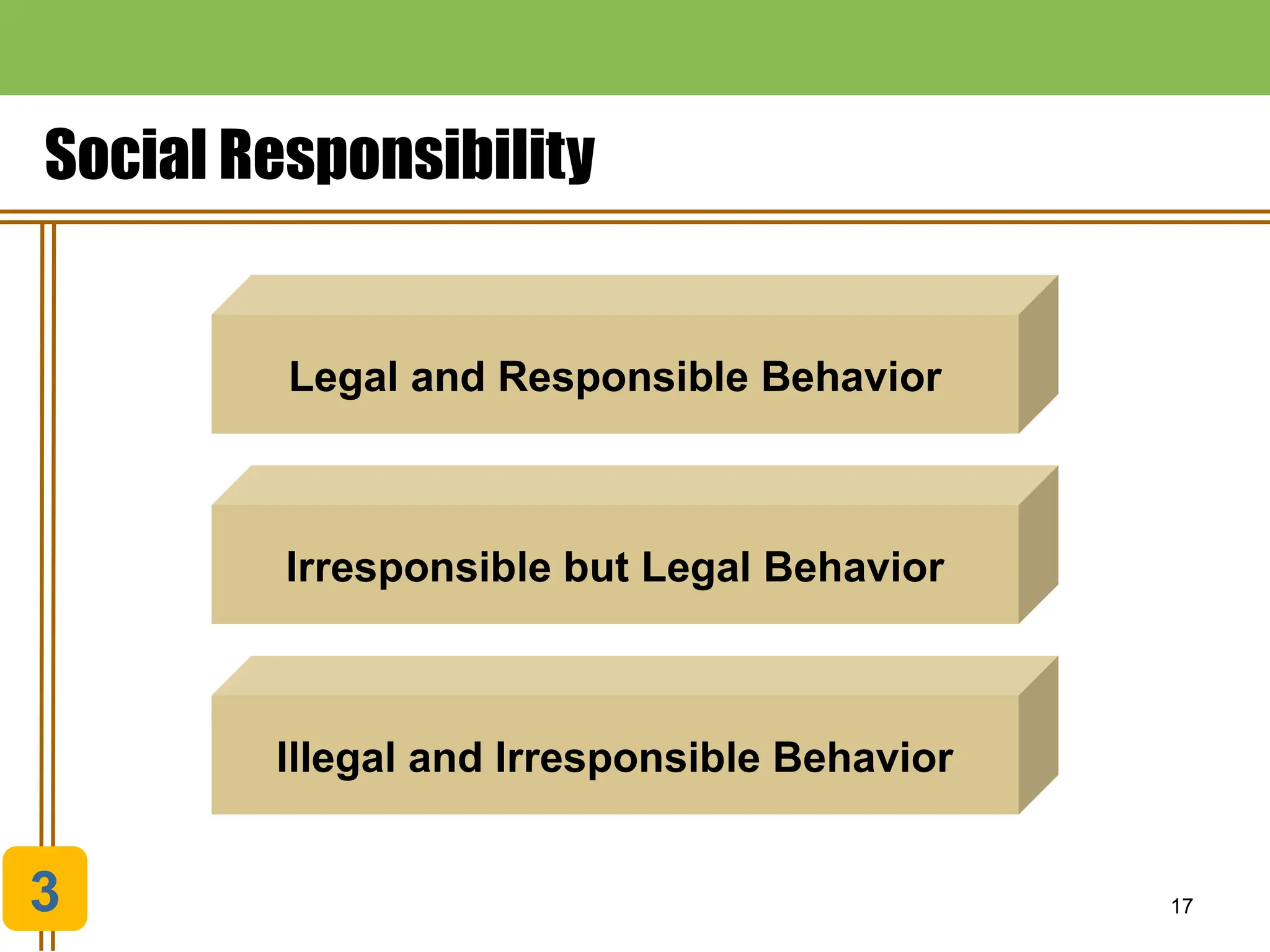
Social Responsibility
Illegal and Irresponsible Behavior
Irresponsible but Legal Behavior
Legal and Responsible Behavior
3
18
CONCEPT check
What are the four components of
social responsibility?
Give an example of legal but
irresponsible behavior.
3
19
Responsibilities to Stakeholders
4
How do businesses met their social
responsibilities to various stakeholders?
4
20
Stakeholders
stakeholders
Individuals or groups to whom a
business has a responsibility.
Investors
General Public
Customers
Employees
4
21
America’s Top Ten Best Places to Work
1. Google
2. Quicken Loans
3. Wegmans Food Markets
4. Edward Jones
5. Genentech
6. Cisco Systems
7. Starbucks
8. Qualcomm
9. Goldman Sachs
10. Methodist Hospital System Exhibit 2.4
Source: Robert Levering and Milton Moskowitz,
“The 100 Best Companies to Work For,”
Fortune (February 4, 2008), p.75.
4
22
corporate philanthropy
The practice of charitable giving by corporations;
includes contributing cash, donating equipment
and products, and supporting the volunteer efforts
of company employees.
4
Responsibility to Society
23
social investing
The practice of limiting investments to securities
of companies that behave in accordance with the
investor’s beliefs about ethical and social
responsibility.
4
Responsibilities to Investors
24
CONCEPT check
How do businesses carry out their social
responsibilities to consumers?
What is corporate philanthropy?
Is a company’s only responsibility to its
investors to make a profit? Why or why not?
4
25
Trends in Ethics and Social Responsibility
5
What are the trends in ethics and
social responsibility?
5
26
Trends in Ethics and Social Responsibility
Corporate philanthropy
New social contract between
employers and employees
Growth of global ethics
and social responsibility
5
© Digital Vision / Getty Images
27
strategic giving
The practice of tying philanthropy closely to the
corporate mission or goals and targeting
donations to regions where a company operates.
Changes in Corporate Philanthropy
5
28
cause-related marketing
The cooperative efforts of a “for-profit” firm and a
“nonprofit organization” for mutual benefit. Used
as any marketing effort for social or other
charitable causes.
Changes in Corporate Philanthropy
5
29
Responsibilities of a Multinational Corporation
 Respect local practices and customs
 Ensure harmony between staff and host population
 Provide management leadership
 Develop local managers who will be a
credit to the community
 Commit to a long-term relationship by involving
stakeholders
 Implement ethical guidelines within the organization
in the host country
 Balance conflicting interests, such as human rights
Global Ethics and Social Responsibility
5
30
CONCEPT check
Describe strategic giving.
What role do employees have in improving
their job security?
How do multinational corporations
demonstrate social responsibility in a
foreign country?
5
31
Appendix:
Understanding the Legal and Tax Environment
6
How does the legal system govern
business transactions and settle
business disputes?
6
32
The Legal System
laws
The rules governing a society’s conduct that are
created and enforced by a controlling authority,
usually the government.
6
33
Business Law
business law
The body of law that governs commercial dealings.
6
34
Business Law
Uniform Commercial Code (UCC)
A model set of rules that apply to commercial
transactions between businesses and between
businesses and individuals.
It covers the sale of goods, bank deposits and
collections, letters of credit, documents of title,
and investment securities.
6
35
6
Nonjudicial methods
Arbitration Mediation
Federal and State Courts
Trial courts Appellate courts Supreme Court
The Court System
36
Nonjudicial Methods
arbitration
A method of settling disputes in which the parties
agree to present their case to an impartial third party
and are required to accept the arbitrator’s decision.
mediation
A method of settling disputes in which the parties
submit their case to an impartial third party but are not
required to accept the mediator’s decision.
6
37
7
What are the required elements of a valid
contract; and what are the key types of
business law?
7
Appendix:
Contracts and Business Law
38
express contract
Specifies the terms of the agreement in either
written or spoken words
implied contract
Depends on the acts and conduct of the parties to
show agreement
Contracts
7
39
The Elements of a Contract
7
Legal form
Legal purpose
Consideration
Capacity
Mutual assent
40
7
Payment of Damages
Specific Performance
Restitution
Remedies for Breach of Contract
41
express warranties
Specific statements of fact or promises about a
product by the seller.
implied warranties
Guarantees that are imposed on sales
transactions by statute or court decision.
Neither written nor oral.
Warranties
7
42
patent
A form of protection established for inventors; gives an
inventor the exclusive right to manufacture, use, and
sell an invention for 17 years.
copyright
A form of protection for creators of works of art, music,
literature, or intellectual property; gives the creator the
exclusive right to use, produce, and sell the creation
during the creator’s lifetime and for 50 years thereafter.
Patents, Copyrights, and Trademarks
7
43
trademark
A design, name, or other distinctive mark that a
manufacturer uses to identify its goods in the
marketplace.
servicemark
A symbol, name, or design that identifies a service
rather than a tangible object.
Patents, Copyrights, and Trademarks
7
44
tort law
Settles disputes involving civil acts that harm
people or their property.
Torts include physical injury, mental anguish, and
defamation.
Tort Law
7
45
Other Laws
 Product liability law
 Bankruptcy law
 Fair competition laws
 Consumer protection laws
 Deregulation of industries
 Regulation of the Internet
7
46
8
What are the most common taxes
paid by businesses?
8
Appendix:
Taxation of Business
47
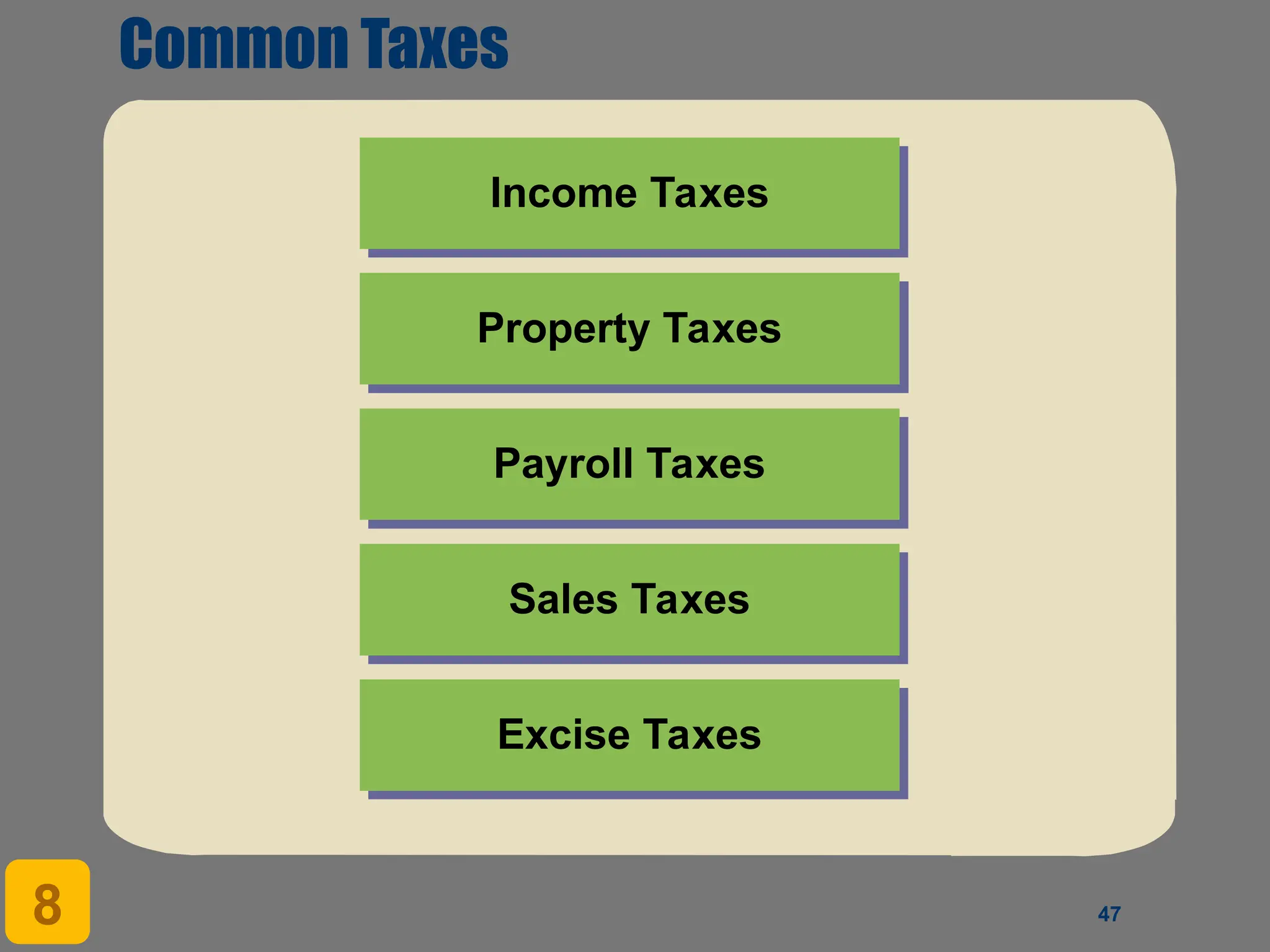
Common Taxes
8
Excise Taxes
Sales Taxes
Payroll Taxes
Property Taxes
Income Taxes

Making ethical decisions and managing .ppt

  • 1.
    The Future ofBusiness The Essentials 4th Edition Gitman & McDaniel Making Ethical Decisions and Managing a Socially Responsible Business CHAPTER 2 Chapter 2 Copyright ©2009 by South-Western, a division of Cengage Learning. All rights reserved Prepared by Deborah Baker © Workbook Stock / Jupiterimages
  • 2.
    2 Learning Goals CHAPTER 2 1 Whatphilosophies and concepts shape personal ethical standards? 2 How can organizations encourage ethical business behavior? 3 What is social responsibility? 4 How do businesses met their social responsibilities to various stakeholders? 5 What are the trends in ethics and social responsibility?
  • 3.
    3 Learning Goals Appendix CHAPTER 2 6How does the legal system govern business transactions and settle business disputes? 7 What are the required elements of a valid contract; and what are the key types of business law? 8 What are the most common taxes paid by businesses?
  • 4.
    4 Understanding Business Ethics 1 Whatphilosophies and concepts shape personal ethical standards? 1
  • 5.
    5 ethics A set ofmoral standards for judging whether something is right or wrong. 1 Understanding Business Ethics
  • 6.
  • 7.
    7 deontology The philosophy thatsays people should meet their obligations and duties when analyzing an ethical dilemma. 1 Factors Influencing Business Ethics
  • 8.
    8 CONCEPT check How areindividuals’ business ethics formed? What is utilitarianism? How can you recognize unethical activities? 1
  • 9.
    9 How Organizations InfluenceEthical Conduct 2 How can organizations encourage ethical business behavior? 2
  • 10.
    10  Lead byexample  Offer ethics training programs  Establish a formal code of ethics  Conduct informal and formal programs 2 How Organizations Influence Ethical Conduct
  • 11.
    11 code of ethics Aset of guidelines prepared by a firm to provide its employees with the knowledge of what the firm expects in terms of their responsibilities and behavior toward fellow employees, customers, and suppliers. Establishing a Formal Code of Ethics 2
  • 12.
    12 Top Best CorporateCitizens Business Ethics Magazine 2007 1. Green Mountain Coffee Roasters, Inc. 2. Advanced Micro Devices, Inc. 3. NIKE, Inc. 4. Motorola, Inc. 5. Intel Corporation 6. International Business Machines Corporation 7. Agilent Technologies, Inc, 8. Timberland Company (The) 9. Starbucks Corporation 10. General Mills Incorporated 2
  • 13.
    13 CONCEPT check What isthe role of top management in organizational ethics? What is a code of ethics? 2
  • 14.
    14 Managing a SociallyResponsible Business 3 What is social responsibility? 3
  • 15.
    15 social responsibility The concernof businesses for the welfare of society as a whole. It consists of obligations beyond those required by law or contracts. Managing a Socially Responsible Business 3 1. Social responsibility is voluntary 2. Obligations of social responsibility are broad
  • 16.
  • 17.
    17 Social Responsibility Illegal andIrresponsible Behavior Irresponsible but Legal Behavior Legal and Responsible Behavior 3
  • 18.
    18 CONCEPT check What arethe four components of social responsibility? Give an example of legal but irresponsible behavior. 3
  • 19.
    19 Responsibilities to Stakeholders 4 Howdo businesses met their social responsibilities to various stakeholders? 4
  • 20.
    20 Stakeholders stakeholders Individuals or groupsto whom a business has a responsibility. Investors General Public Customers Employees 4
  • 21.
    21 America’s Top TenBest Places to Work 1. Google 2. Quicken Loans 3. Wegmans Food Markets 4. Edward Jones 5. Genentech 6. Cisco Systems 7. Starbucks 8. Qualcomm 9. Goldman Sachs 10. Methodist Hospital System Exhibit 2.4 Source: Robert Levering and Milton Moskowitz, “The 100 Best Companies to Work For,” Fortune (February 4, 2008), p.75. 4
  • 22.
    22 corporate philanthropy The practiceof charitable giving by corporations; includes contributing cash, donating equipment and products, and supporting the volunteer efforts of company employees. 4 Responsibility to Society
  • 23.
    23 social investing The practiceof limiting investments to securities of companies that behave in accordance with the investor’s beliefs about ethical and social responsibility. 4 Responsibilities to Investors
  • 24.
    24 CONCEPT check How dobusinesses carry out their social responsibilities to consumers? What is corporate philanthropy? Is a company’s only responsibility to its investors to make a profit? Why or why not? 4
  • 25.
    25 Trends in Ethicsand Social Responsibility 5 What are the trends in ethics and social responsibility? 5
  • 26.
    26 Trends in Ethicsand Social Responsibility Corporate philanthropy New social contract between employers and employees Growth of global ethics and social responsibility 5 © Digital Vision / Getty Images
  • 27.
    27 strategic giving The practiceof tying philanthropy closely to the corporate mission or goals and targeting donations to regions where a company operates. Changes in Corporate Philanthropy 5
  • 28.
    28 cause-related marketing The cooperativeefforts of a “for-profit” firm and a “nonprofit organization” for mutual benefit. Used as any marketing effort for social or other charitable causes. Changes in Corporate Philanthropy 5
  • 29.
    29 Responsibilities of aMultinational Corporation  Respect local practices and customs  Ensure harmony between staff and host population  Provide management leadership  Develop local managers who will be a credit to the community  Commit to a long-term relationship by involving stakeholders  Implement ethical guidelines within the organization in the host country  Balance conflicting interests, such as human rights Global Ethics and Social Responsibility 5
  • 30.
    30 CONCEPT check Describe strategicgiving. What role do employees have in improving their job security? How do multinational corporations demonstrate social responsibility in a foreign country? 5
  • 31.
    31 Appendix: Understanding the Legaland Tax Environment 6 How does the legal system govern business transactions and settle business disputes? 6
  • 32.
    32 The Legal System laws Therules governing a society’s conduct that are created and enforced by a controlling authority, usually the government. 6
  • 33.
    33 Business Law business law Thebody of law that governs commercial dealings. 6
  • 34.
    34 Business Law Uniform CommercialCode (UCC) A model set of rules that apply to commercial transactions between businesses and between businesses and individuals. It covers the sale of goods, bank deposits and collections, letters of credit, documents of title, and investment securities. 6
  • 35.
    35 6 Nonjudicial methods Arbitration Mediation Federaland State Courts Trial courts Appellate courts Supreme Court The Court System
  • 36.
    36 Nonjudicial Methods arbitration A methodof settling disputes in which the parties agree to present their case to an impartial third party and are required to accept the arbitrator’s decision. mediation A method of settling disputes in which the parties submit their case to an impartial third party but are not required to accept the mediator’s decision. 6
  • 37.
    37 7 What are therequired elements of a valid contract; and what are the key types of business law? 7 Appendix: Contracts and Business Law
  • 38.
    38 express contract Specifies theterms of the agreement in either written or spoken words implied contract Depends on the acts and conduct of the parties to show agreement Contracts 7
  • 39.
    39 The Elements ofa Contract 7 Legal form Legal purpose Consideration Capacity Mutual assent
  • 40.
    40 7 Payment of Damages SpecificPerformance Restitution Remedies for Breach of Contract
  • 41.
    41 express warranties Specific statementsof fact or promises about a product by the seller. implied warranties Guarantees that are imposed on sales transactions by statute or court decision. Neither written nor oral. Warranties 7
  • 42.
    42 patent A form ofprotection established for inventors; gives an inventor the exclusive right to manufacture, use, and sell an invention for 17 years. copyright A form of protection for creators of works of art, music, literature, or intellectual property; gives the creator the exclusive right to use, produce, and sell the creation during the creator’s lifetime and for 50 years thereafter. Patents, Copyrights, and Trademarks 7
  • 43.
    43 trademark A design, name,or other distinctive mark that a manufacturer uses to identify its goods in the marketplace. servicemark A symbol, name, or design that identifies a service rather than a tangible object. Patents, Copyrights, and Trademarks 7
  • 44.
    44 tort law Settles disputesinvolving civil acts that harm people or their property. Torts include physical injury, mental anguish, and defamation. Tort Law 7
  • 45.
    45 Other Laws  Productliability law  Bankruptcy law  Fair competition laws  Consumer protection laws  Deregulation of industries  Regulation of the Internet 7
  • 46.
    46 8 What are themost common taxes paid by businesses? 8 Appendix: Taxation of Business
  • 47.
    47 Common Taxes 8 Excise Taxes SalesTaxes Payroll Taxes Property Taxes Income Taxes

Editor's Notes

  • #1 Chapter 2 focuses on ethical and socially responsible decision making in businesses, and the responsibilities businesses have to their stakeholders.
  • #5 Every day, managers and business owners make business decisions based on what they believe to be right and wrong. Through their actions, they demonstrate to their employees what is and is not acceptable behavior and shape the moral standard of the organization. Ethics is a set of moral standards for judging whether something is right or wrong.
  • #6 Individual business ethics are shaped by personal choices and the environments in which we live and work. In addition, the laws of our society are guideposts for choosing between right and wrong. Justice influences individual business ethics. Justice is what is considered fair according to the prevailing standards of society. One of the philosophies that may influence choices between right and wrong is utilitarianism, which focuses on the consequences of an action taken by a person or organization. The notion that “people should act so as to generate the greatest good for the greatest number” is derived from utilitarianism. However, when an action affects the majority adversely, it is morally wrong. Problems of utilitarianism: It is impossible to predict how a decision will affect a large number It always involves winners and losers Some “costs” are so negative that some segments of society find them unacceptable The philosophy that says people should meet their obligations and duties when analyzing an ethical dilemma is called deontology. This means that a person will follow his/her obligations because upholding one’s duty is what is considered ethically correct. Individuals and groups have certain rights that exist under certain conditions regardless of any external circumstances. These rights serve as guides when making individual ethical decisions. Legal rights include: freedom of religion, speech and assembly Protection from improper arrest, searches and seizures Proper access to counsel, confrontation of witnesses Cross-examination in criminal prosecutions Right to privacy in many matters Rights applied without regard to race, color, creed, gender, or ability
  • #10 Poor business ethics can create a negative image for a company, can be expensive, and can result in bankruptcy and jail time for offenders. Organizations can reduce the potential for these types of liability claims by educating their employees about ethical standards, by leading through example, and through various informal and formal programs.
  • #11 A code of ethics is a set of guidelines that provides employees with the knowledge of what the firm expects in terms of their responsibilities and behavior toward fellow employees, customers, and suppliers. Many people believe that codes of ethics make employees behave in a more ethical manner. Others feel that they are public relations gimmicks.
  • #12 The top corporate citizens in 2007, according to Business Ethics magazine, are listed on this slide. Cummins is one of 19 companies named every year since the list was created in 2000.
  • #15 Social responsibility is the concern of businesses for the welfare of society as a whole. It consists of obligations beyond those required by law or union contract. This definition makes two important points: First social responsibility is voluntary. Second, the obligations of social responsibility are broad.
  • #16 Economic performance is the foundation for the other three social responsibilities. At the same time that a business pursues profits (economic responsibility), it is expected to obey the law (legal responsibility), to do what is right, just and fair (ethical responsibility), and to be a good corporate citizen (philanthropic responsibility). If the company does not make a profit, then the other three responsibilities are moot.
  • #17 Using these two dimensions, three behaviors are described: Legal and responsible behavior: Most business activities fall into this category. Consumers are likely to buy brands that have excellent track records and community involvement. Irresponsible but legal behavior: Companies may act responsibly, but act legally. For example, a company that finances cars to customers with credit problems may fit this category. Illegal and irresponsible behavior: Even though it is difficult to conceive of a company that acts in illegal and irresponsible ways, the actions of companies such as Enron, WorldCom, and Tyco fall into this category. Federal, state, and local laws determine the legality of activities.
  • #20 Stakeholders are the individuals or groups to whom a business has a responsibility. The stakeholders of a business are its employees, its customers, the general public, and its investors. An organization’s first responsibility is to provide a job to employees. Enron is an example of a company that violated this responsibility. A company must also satisfy its customers, deliver what it promises, and be honest and forthright. A business is responsible to society by providing jobs, goods, and services, and by paying taxes that support schools, hospitals, and better roads. Other societal responsibilities include protecting and improving the world’s environment, as well as corporate philanthropy. Although a company's economic responsibility to make a profit might seem its main obligation to its shareholders, many investors are putting more emphasis on other aspects of social responsibility. Investors are limiting their investments to securities that fit within their beliefs about ethical and social responsibility. This is called social investing.
  • #21 Results from an annual survey by Fortune is shown in Exhibit 2.4. Unusual benefits, such as camping and recreation areas, are offered by some companies.
  • #26 Today, the focus of corporate philanthropy is shifting to strategic giving, which ties philanthropy more closely to the corporate mission or goals and targets donations to regions where a company operates. One of the biggest events in corporate philanthropy is Warren Buffett’s gift of more than $30 billion to the Bill and Melinda Gates Foundation. Bill Gates' focus is “creative capitalism.” Companies will be encouraged to design products and establish businesses that help the poor while generating business profits. Another trend in social responsibility is the effort by organizations to redefine their relationship with their employees. Now, companies are telling employees that they also have a responsibility when it comes to job security. The new social contract goes like this: “There will never be job security. You will be employed by us as long as you add value to the organization, and you are continuously responsible for finding ways to add value. In return, you have the right to demand interesting and important work, the freedom and resources to perform it well, pay that reflects your contribution, and the experience and training needed to be employable here or elsewhere.” When American businesses expand into global markets, they must take their corporate code of ethics and social responsibility with them.
  • #28 Cause-related marketing is a subset of social responsibility. It is the cooperative efforts of “for profit” firms and “nonprofit organizations” for mutual benefit. It is not based on a straight donation. Some of the benefits include creating good public relations and brand sales for the firm.
  • #29 The world is increasingly becoming a global community. Multinational corporations have several responsibilities, as listed on this slide.
  • #31 The legal system affects everyone who lives and does business in the United States. The purpose of the law is to keep the system stable while allowing orderly change. In addition to banning, regulating, or allowing certain practices, it also helps settle disputes.
  • #34 The UCC is adopted by all states except Louisiana, which uses only part of it. It simplifies the process of doing business across state lines.
  • #35 The judiciary is the branch of government that is responsible for settling disputes by applying and interpreting points of law. It consists of the court system. The U.S. court system includes both state and federal courts, each organized into three levels. Most court cases start in trial courts. Appellate courts are the courts of appeals for decisions made by the trial courts. No cases start in appellate courts, which review decisions of the lower courts. The Supreme Court is the highest court in the nation, and is the only court established by the U.S. Constitution. Its main function is to review decisions by the U.S. circuit courts of appeals. Settling disputes in court is expensive and time consuming. Many organizations now use nonjudicial methods as alternatives to litigation. Nonjudicial methods of settling disputes include arbitration and mediation. With arbitration, parties agree to present their case to an impartial third party and are required to accept the arbitrator’s decision. Mediation is similar, but the parties are not bound by the mediator’s decision.
  • #38 A contract is an agreement that sets forth the relationship between parties regarding the performance of a specified action. It creates a legal obligation and is enforceable in a court of law. A contract can be an express contract or an implied contract.
  • #39 Contracts are an important and frequent part of business dealings. The requirements of a value contract include: Mutual assent: voluntary agreement by both parties to the terms of the contract Capacity: legal ability of a party to enter into contracts Consideration: exchange of some legal value or benefit between the parties Legal purpose: absence of illegality Legal form: oral or written form, as required
  • #40 A breach of contract occurs when one party to a contract fails to fulfill the terms of the agreement. The other party has a right to seek a remedy in the courts. The remedies for breach of contract are: payment of damages. Money awarded to the party who was harmed by the breach of contract specific performance of the contract. A court order requiring the breaching party to perform the duties under the terms of the contract restitution. Canceling the contract and returning to the situation that existed before the contract
  • #42 The U.S. Constitution protects authors, inventors, and creators of intellectual property by giving them the rights to their creative works. Patents, copyrights, and trademark registration are legal protection for key business assets.
  • #44 A tort is a civil or private act that harms other people or their property. Torts are part of common law and are not the result of a breach of contract. Examples include medical malpractice, slander, libel, product liability, and fraud. Although torts are generally not a crime, some acts can be both torts and crimes.
  • #45 Product liability refers to manufacturers’ and sellers’ responsibility for defects in products they make and sell. It combines aspects of contracts, warranties, torts, and statutory law. Bankruptcy is the legal procedure that relieves debts if individuals and businesses cannot meet their financial obligations. Two types are Chapter 7 (liquidation) and Chapter 11 (reorganization). Fair competition laws include antitrust regulation. The first act was the Sherman Antitrust Act, which prevented large companies from dominating an industry. The Clayton Act added specific provisions, as shown on the following slide. Consumer protection laws, which describe sellers and buyers rights and powers, are described beginning on Slide 53. Deregulation removes rules and regulations governing business competition. Widely used during the 1980s and 1990s, it has drastically changed transportation, telecommunications, and financial services industries. Piracy of music and illegal distribution of copyright-protected products through the Internet are concerns of government.
  • #47 The federal government is the largest collector of taxes. The average American family pays about 37 percent of its income for taxes.