Consumer Internet
  & Mobile BBL
  What you need to know to get started in Silicon Valley
 Maisy Samuelson / @msamuelson / msamuelson@gmail
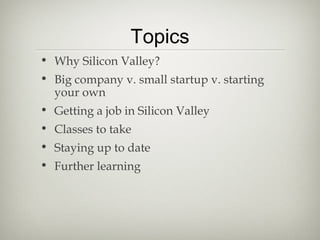
Topics
• Why Silicon Valley?
• Big company v. small startup v. starting
  your own
• Getting a job in Silicon Valley
• Classes to take
• Staying up to date
• Further learning
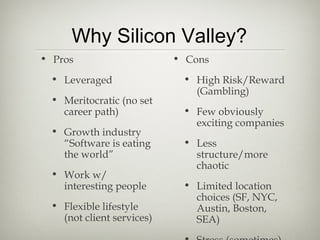
Why Silicon Valley?
• Pros                     • Cons
 • Leveraged                • High Risk/Reward
                              (Gambling)
 • Meritocratic (no set
   career path)             • Few obviously
                              exciting companies
 • Growth industry
   “Software is eating      • Less
   the world”                 structure/more
                              chaotic
 • Work w/
   interesting people       • Limited location
                              choices (SF, NYC,
 • Flexible lifestyle         Austin, Boston,
   (not client services)      SEA)
Established Co v. Startup
Bigger companies: good way to start, learn best
practices, established brand, meet people, little risk

Smaller startup: More growth opt/upside (if startup
does well), fun work environment

Don’t work at a startup for the sake of doing a startup!
What matters: 1) smart people, 2) good product 3) good
brand

Don’t assume that smaller company means greater
impact

Don’t get to caught up w/sector
Getting A Job
•   Approach companies with specific ways that you can help solve a problem
    they have (i.e. wireframes for how you would improve a specific part of the
    site). SV companies value doers more than talkers.
•   “Check your MBA at the door.” An MBA is not necessarily a positive in SV.
•   Participate in Quora/Twitter
•   Leverage LinkedIn (find interesting companies. Reach out to
    people/companies that interest you)
•   Follow companies you’re interested in on Twitter
•   Look at VC/angel websites for list of portfolio companies
•   Make a portfolio/website/blog
•   If the company not too big (e.g. <100 people) take any job and transfer
    internally. Don’t worry too much about seniority of original role--there’s
    room to grow and move!
•   Network early, but realize that startup opportunities come very late in
    recruiting season (often May/June)
Getting A Product Job
•   PMs are risky hires for companies because they control very expensive
    engineering resources and make decisions that can make or break a
    business/product. To mitigate risk, companies look for people who already
    have PM experience and a technical background. If you don’t have both, you
    need to be strategic:
•   Write a sample spec for the company and make wireframes using Balsamiq
    Here’s a spec template.
•   Exhibit these traits ... Intelligence (“you can’t fix stupid”), product sense,
    ability to lead engineers without direct authority. Check out Ken Norton’s
    famous blog post on how to hire PMs
•   Get hired for an easier role and do an internal transfer (only realistic if
    company <100 people)
•   Take the CS classes on the later slide and build something
•   Get a summer job at Amazon/Microsoft. It’s useful to have the words
    “Product Manager” at <Company people have heard of> on your resume
Classes To Take
• If you work at an internet/mobile company, it’s invaluable to
  understand how to build websites/mobile apps. These four classes get
  you 95% of the way there. They’re a lot more work than GSB classes, but
  grades don’t matter and they’re totally worth it.

   •   CS106a: Programming methodology in Java (take this in the spring
       of year 1, so you can take CS142 in the fall).

   •   CS142: Webs Applications (Only offered in the Fall and need to
       take CS106a first. This is the best class at Stanford).

   •   CS193P: Developing Aps for iOS

   •   CS106B: Programming abstractions in C++

   •   Learn SQL, html and CSS on your own (lots of good web tutorials)

• Check out iTunes U, Coursera
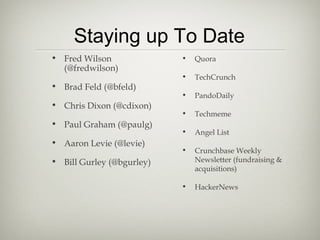
Staying up To Date
• Fred Wilson              •   Quora
  (@fredwilson)
                           •   TechCrunch
• Brad Feld (@bfeld)
                           •   PandoDaily
• Chris Dixon (@cdixon)
                           •   Techmeme
• Paul Graham (@paulg)
                           •   Angel List
• Aaron Levie (@levie)
                           •   Crunchbase Weekly
• Bill Gurley (@bgurley)       Newsletter (fundraising &
                               acquisitions)

                           •   HackerNews
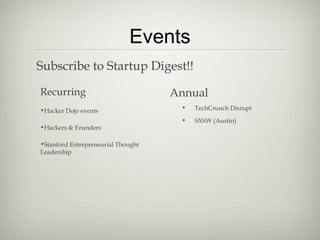
Events
Subscribe to Startup Digest!!

Recurring                           Annual
•Hacker Dojo events                  •   TechCrunch Disrupt
                                     •   SXSW (Austin)
•Hackers & Founders

•Stanford Entrepreneurial Thought
Leadership
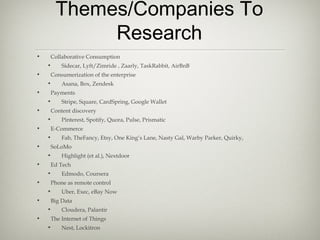
Themes/Companies To
             Research
•   Collaborative Consumption
    •   Sidecar, Lyft/Zimride , Zaarly, TaskRabbit, AirBnB
•   Consumerization of the enterprise
    •   Asana, Box, Zendesk
•   Payments
    •   Stripe, Square, CardSpring, Google Wallet
•   Content discovery
    •   Pinterest, Spotify, Quora, Pulse, Prismatic
•   E-Commerce
    •   Fab, TheFancy, Etsy, One King’s Lane, Nasty Gal, Warby Parker, Quirky,
•   SoLoMo
    •   Highlight (et al.), Nextdoor
•   Ed Tech
    •   Edmodo, Coursera
•   Phone as remote control
    •   Uber, Exec, eBay Now
•   Big Data
    •   Cloudera, Palantir
•   The Internet of Things
    •   Nest, Lockitron
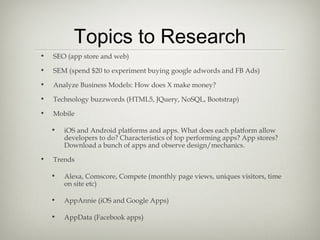
Topics to Research
•   SEO (app store and web)

•   SEM (spend $20 to experiment buying google adwords and FB Ads)

•   Analyze Business Models: How does X make money?

•   Technology buzzwords (HTML5, JQuery, NoSQL, Bootstrap)

•   Mobile

    •   iOS and Android platforms and apps. What does each platform allow
        developers to do? Characteristics of top performing apps? App stores?
        Download a bunch of apps and observe design/mechanics.

•   Trends

    •   Alexa, Comscore, Compete (monthly page views, uniques visitors, time
        on site etc)

    •   AppAnnie (iOS and Google Apps)

    •   AppData (Facebook apps)
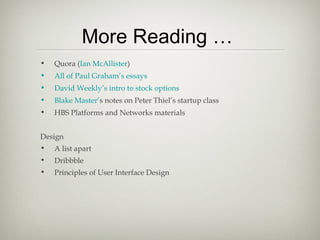
More Reading …
•   Quora (Ian McAllister)
•   All of Paul Graham’s essays
•   David Weekly’s intro to stock options
•   Blake Master’s notes on Peter Thiel’s startup class
•   HBS Platforms and Networks materials


Design
•   A list apart
•   Dribbble
•   Principles of User Interface Design

Consumer internet bbl_nov2012_gf

  • 1.
    Consumer Internet & Mobile BBL What you need to know to get started in Silicon Valley Maisy Samuelson / @msamuelson / msamuelson@gmail
  • 2.
    Topics • Why SiliconValley? • Big company v. small startup v. starting your own • Getting a job in Silicon Valley • Classes to take • Staying up to date • Further learning
  • 3.
    Why Silicon Valley? •Pros • Cons • Leveraged • High Risk/Reward (Gambling) • Meritocratic (no set career path) • Few obviously exciting companies • Growth industry “Software is eating • Less the world” structure/more chaotic • Work w/ interesting people • Limited location choices (SF, NYC, • Flexible lifestyle Austin, Boston, (not client services) SEA)
  • 4.
    Established Co v.Startup Bigger companies: good way to start, learn best practices, established brand, meet people, little risk Smaller startup: More growth opt/upside (if startup does well), fun work environment Don’t work at a startup for the sake of doing a startup! What matters: 1) smart people, 2) good product 3) good brand Don’t assume that smaller company means greater impact Don’t get to caught up w/sector
  • 5.
    Getting A Job • Approach companies with specific ways that you can help solve a problem they have (i.e. wireframes for how you would improve a specific part of the site). SV companies value doers more than talkers. • “Check your MBA at the door.” An MBA is not necessarily a positive in SV. • Participate in Quora/Twitter • Leverage LinkedIn (find interesting companies. Reach out to people/companies that interest you) • Follow companies you’re interested in on Twitter • Look at VC/angel websites for list of portfolio companies • Make a portfolio/website/blog • If the company not too big (e.g. <100 people) take any job and transfer internally. Don’t worry too much about seniority of original role--there’s room to grow and move! • Network early, but realize that startup opportunities come very late in recruiting season (often May/June)
  • 6.
    Getting A ProductJob • PMs are risky hires for companies because they control very expensive engineering resources and make decisions that can make or break a business/product. To mitigate risk, companies look for people who already have PM experience and a technical background. If you don’t have both, you need to be strategic: • Write a sample spec for the company and make wireframes using Balsamiq Here’s a spec template. • Exhibit these traits ... Intelligence (“you can’t fix stupid”), product sense, ability to lead engineers without direct authority. Check out Ken Norton’s famous blog post on how to hire PMs • Get hired for an easier role and do an internal transfer (only realistic if company <100 people) • Take the CS classes on the later slide and build something • Get a summer job at Amazon/Microsoft. It’s useful to have the words “Product Manager” at <Company people have heard of> on your resume
  • 7.
    Classes To Take •If you work at an internet/mobile company, it’s invaluable to understand how to build websites/mobile apps. These four classes get you 95% of the way there. They’re a lot more work than GSB classes, but grades don’t matter and they’re totally worth it. • CS106a: Programming methodology in Java (take this in the spring of year 1, so you can take CS142 in the fall). • CS142: Webs Applications (Only offered in the Fall and need to take CS106a first. This is the best class at Stanford). • CS193P: Developing Aps for iOS • CS106B: Programming abstractions in C++ • Learn SQL, html and CSS on your own (lots of good web tutorials) • Check out iTunes U, Coursera
  • 8.
    Staying up ToDate • Fred Wilson • Quora (@fredwilson) • TechCrunch • Brad Feld (@bfeld) • PandoDaily • Chris Dixon (@cdixon) • Techmeme • Paul Graham (@paulg) • Angel List • Aaron Levie (@levie) • Crunchbase Weekly • Bill Gurley (@bgurley) Newsletter (fundraising & acquisitions) • HackerNews
  • 9.
    Events Subscribe to StartupDigest!! Recurring Annual •Hacker Dojo events • TechCrunch Disrupt • SXSW (Austin) •Hackers & Founders •Stanford Entrepreneurial Thought Leadership
  • 10.
    Themes/Companies To Research • Collaborative Consumption • Sidecar, Lyft/Zimride , Zaarly, TaskRabbit, AirBnB • Consumerization of the enterprise • Asana, Box, Zendesk • Payments • Stripe, Square, CardSpring, Google Wallet • Content discovery • Pinterest, Spotify, Quora, Pulse, Prismatic • E-Commerce • Fab, TheFancy, Etsy, One King’s Lane, Nasty Gal, Warby Parker, Quirky, • SoLoMo • Highlight (et al.), Nextdoor • Ed Tech • Edmodo, Coursera • Phone as remote control • Uber, Exec, eBay Now • Big Data • Cloudera, Palantir • The Internet of Things • Nest, Lockitron
  • 11.
    Topics to Research • SEO (app store and web) • SEM (spend $20 to experiment buying google adwords and FB Ads) • Analyze Business Models: How does X make money? • Technology buzzwords (HTML5, JQuery, NoSQL, Bootstrap) • Mobile • iOS and Android platforms and apps. What does each platform allow developers to do? Characteristics of top performing apps? App stores? Download a bunch of apps and observe design/mechanics. • Trends • Alexa, Comscore, Compete (monthly page views, uniques visitors, time on site etc) • AppAnnie (iOS and Google Apps) • AppData (Facebook apps)
  • 12.
    More Reading … • Quora (Ian McAllister) • All of Paul Graham’s essays • David Weekly’s intro to stock options • Blake Master’s notes on Peter Thiel’s startup class • HBS Platforms and Networks materials Design • A list apart • Dribbble • Principles of User Interface Design