CE-302
Details of Construction
SUBMITTED TO
MD. EKHLAS UDDIN
LECTURER,
CIVIL ENGINEERING DEPARTMENT,
FARIDPUR ENGINEERING COLLEGE,
FARIDPUR
SUBMITTED BY
1. AL FATTAH MD RAUFUN-1830
2. MD ANOWER HOSSAN-2903
3. MD RIPON HOSSAIN-2904
4. MD. LIMON ISLAM-2906
5. SADIK HOSSAIN-2907
PRESENTATION ON BRICKS
Introduction
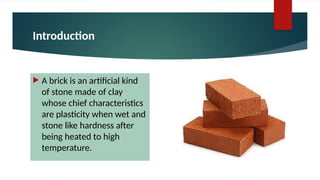
 A brick is an artificial kind
of stone made of clay
whose chief characteristics
are plasticity when wet and
stone like hardness after
being heated to high
temperature.
Standard Size of Brick
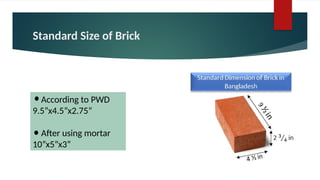
According to PWD
9.5”x4.5”x2.75”
After using mortar
10”x5”x3”
Constituents of Brick
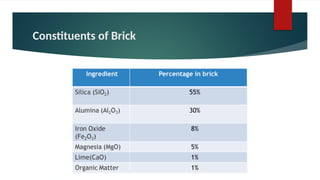
Silica
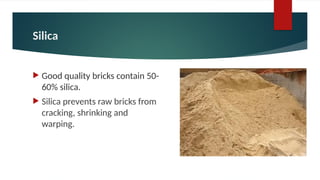
 Good quality bricks contain 50-
60% silica.
 Silica prevents raw bricks from
cracking, shrinking and
warping.
Alumina
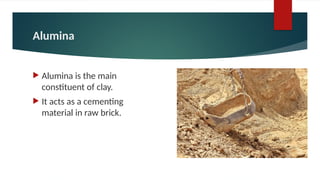
 Alumina is the main
constituent of clay.
 It acts as a cementing
material in raw brick.
Lime
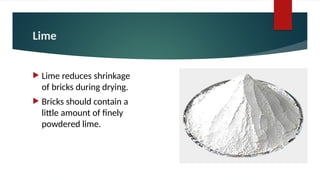
 Lime reduces shrinkage
of bricks during drying.
 Bricks should contain a
little amount of finely
powdered lime.
Iron Oxide
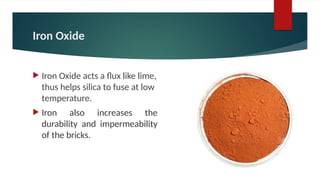
 Iron Oxide acts a flux like lime,
thus helps silica to fuse at low
temperature.
 Iron also increases the
durability and impermeability
of the bricks.
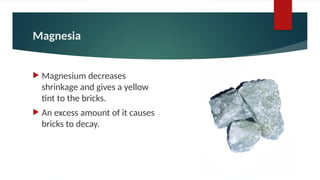
Magnesia
 Magnesium decreases
shrinkage and gives a yellow
tint to the bricks.
 An excess amount of it causes
bricks to decay.
Harmful constituents of Brick clay
1) LIME
2) IRON PYRITES
3) ALKALIS
4) PEBBLES
5) VEGETATION AND ORGANIC
MATTER
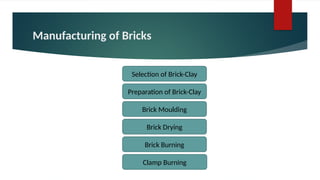
Manufacturing of Bricks
Selection of Brick-Clay
Preparation of Brick-Clay
Brick Drying
Clamp Burning
Brick Moulding
Brick Burning
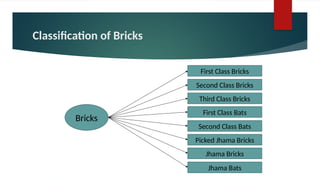
Classification of Bricks
Bricks
First Class Bats
Second Class Bricks
Third Class Bricks
Second Class Bats
Picked Jhama Bricks
Jhama Bricks
Jhama Bats
First Class Bricks
Characteristics of Good Bricks
A. Bricks should be uniform in color, size and shape.
B. They should be sound and compact.
C. They should be free from cracks and other flaws such as
air bubbles, stone nodules etc.
Characteristics of Good Bricks(continue…)
D. Bricks should not absorb more than 1⁄5 of their own
weight of water when immersed in water for 24 hours.
E. The compressive strength of bricks should be in range of
2000 to 5000 psi.
F. Bricks should neither overburnt nor under-brunt.
Field Test of Bricks
 Take a brick and try to make mark on the surface by nail.
If we can make it, then it is not a good brick.
 Take a Brick and strike it with a hammer. If it gives
metallic sound, then it is a good brick; if not ,it is bad
one.
Field Test of Bricks(continue…)
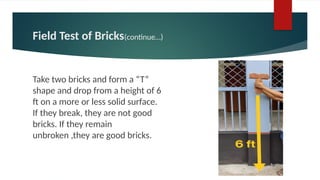
Take two bricks and form a “T”
shape and drop from a height of 6
ft on a more or less solid surface.
If they break, they are not good
bricks. If they remain
unbroken ,they are good bricks.
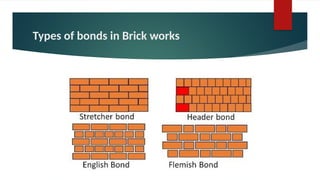
Types of bonds in Brick works
Uses of Bricks
 Construction of walls of any size.
 Construction of floors.
 Construction of arches and cornices.
 Construction of brick retaining wall.
Uses of Bricks(continue…)
 Making Khoa (Broken bricks of required size) to use as an
aggregate in concrete
 Manufacture of shurki (powdered bricks) to be used in
lime plaster and lime concrete
Any Query?
THANK YOU!

Construction_Brick_Civil_Engineering_Limon.pptx

  • 1.
    CE-302 Details of Construction SUBMITTEDTO MD. EKHLAS UDDIN LECTURER, CIVIL ENGINEERING DEPARTMENT, FARIDPUR ENGINEERING COLLEGE, FARIDPUR SUBMITTED BY 1. AL FATTAH MD RAUFUN-1830 2. MD ANOWER HOSSAN-2903 3. MD RIPON HOSSAIN-2904 4. MD. LIMON ISLAM-2906 5. SADIK HOSSAIN-2907 PRESENTATION ON BRICKS
  • 2.
    Introduction  A brickis an artificial kind of stone made of clay whose chief characteristics are plasticity when wet and stone like hardness after being heated to high temperature.
  • 3.
    Standard Size ofBrick According to PWD 9.5”x4.5”x2.75” After using mortar 10”x5”x3”
  • 4.
  • 5.
    Silica  Good qualitybricks contain 50- 60% silica.  Silica prevents raw bricks from cracking, shrinking and warping.
  • 6.
    Alumina  Alumina isthe main constituent of clay.  It acts as a cementing material in raw brick.
  • 7.
    Lime  Lime reducesshrinkage of bricks during drying.  Bricks should contain a little amount of finely powdered lime.
  • 8.
    Iron Oxide  IronOxide acts a flux like lime, thus helps silica to fuse at low temperature.  Iron also increases the durability and impermeability of the bricks.
  • 9.
    Magnesia  Magnesium decreases shrinkageand gives a yellow tint to the bricks.  An excess amount of it causes bricks to decay.
  • 10.
    Harmful constituents ofBrick clay 1) LIME 2) IRON PYRITES 3) ALKALIS 4) PEBBLES 5) VEGETATION AND ORGANIC MATTER
  • 11.
    Manufacturing of Bricks Selectionof Brick-Clay Preparation of Brick-Clay Brick Drying Clamp Burning Brick Moulding Brick Burning
  • 12.
    Classification of Bricks Bricks FirstClass Bats Second Class Bricks Third Class Bricks Second Class Bats Picked Jhama Bricks Jhama Bricks Jhama Bats First Class Bricks
  • 13.
    Characteristics of GoodBricks A. Bricks should be uniform in color, size and shape. B. They should be sound and compact. C. They should be free from cracks and other flaws such as air bubbles, stone nodules etc.
  • 14.
    Characteristics of GoodBricks(continue…) D. Bricks should not absorb more than 1⁄5 of their own weight of water when immersed in water for 24 hours. E. The compressive strength of bricks should be in range of 2000 to 5000 psi. F. Bricks should neither overburnt nor under-brunt.
  • 15.
    Field Test ofBricks  Take a brick and try to make mark on the surface by nail. If we can make it, then it is not a good brick.  Take a Brick and strike it with a hammer. If it gives metallic sound, then it is a good brick; if not ,it is bad one.
  • 16.
    Field Test ofBricks(continue…) Take two bricks and form a “T” shape and drop from a height of 6 ft on a more or less solid surface. If they break, they are not good bricks. If they remain unbroken ,they are good bricks.
  • 17.
    Types of bondsin Brick works
  • 18.
    Uses of Bricks Construction of walls of any size.  Construction of floors.  Construction of arches and cornices.  Construction of brick retaining wall.
  • 19.
    Uses of Bricks(continue…) Making Khoa (Broken bricks of required size) to use as an aggregate in concrete  Manufacture of shurki (powdered bricks) to be used in lime plaster and lime concrete
  • 20.